絵でわかる日本語
Usage 1
Read this source entry ↗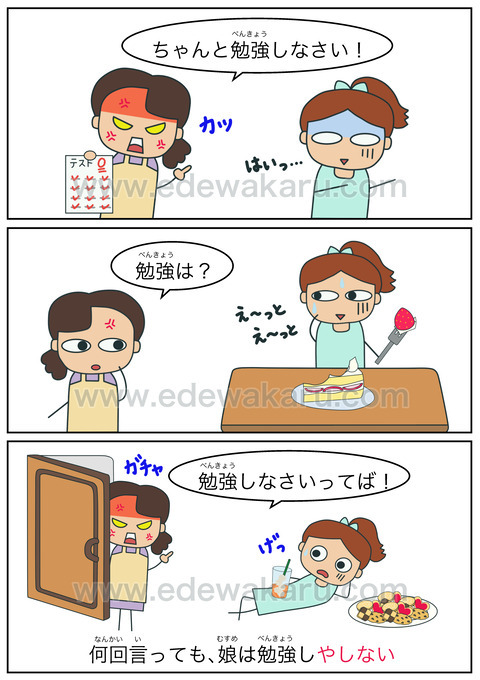
Meaning
(Although one should ~) one does not ~.
How to use it
Verb [ます-form] + やしない
Explanation
“〜やしない” is a sentence pattern meaning “(although one should ~) one does not ~.” It is used to express dissatisfaction or reproach, as in “one should ~, but one doesn’t.”
“〜やしない” does not appear often in textbooks, and I think there are few opportunities to study it. You may hear it in anime or dramas, so it’s good to know it 😊
[Related grammar patterns]
In context 5 examples
何回言っても、娘は勉強しやしない
→何回言っても、娘は全然勉強しないNo matter how many times I tell her, my daughter won’t study at all. →No matter how many times I tell her, my daughter doesn’t study at all.
もう30分も待っているのに、彼女は来やしない!
→30分前に来ているべきなのに、彼女は来ないI’ve been waiting for a whole 30 minutes, but she still hasn’t come! →She should have arrived 30 minutes ago, but she isn’t coming.
どんなに怒っても、息子はゲームをやめやしない
→息子は全然ゲームをやめないNo matter how angry I get, my son won’t stop playing video games. →My son doesn’t stop playing video games at all.
マンガを1週間前(しゅうかんまえ)に注文したのに、届きやしない
→もう届いているべきなのに、まだ届いていないI ordered the manga a week ago, but it still hasn’t arrived. →It should have arrived already, but it still hasn’t.
何度注意しても、彼はあいさつをしやしない
→あいさつするべきなのに、彼はあいさつをしないNo matter how many times I remind him, he won’t greet people. →He should greet people, but he doesn’t.
Read the original source text
Meaning
(〜するべきなのに)〜しない
How to use it
動詞[ます形]+やしない
Explanation
「〜やしない」は「(〜するべきなのに)〜しない」という意味の文型です。これは不満や非難の気持ちを込めて「〜するべきなのに〜しない」と言いたい時に使われます。
「〜やしない」は参考書に載っていることが少なく、勉強する機会があまりないと思います。アニメやドラマなどで聞くことがあるかもしれませんので、知っているといいと思います😊
【関連文型】
Usage 2
Read this source entry ↗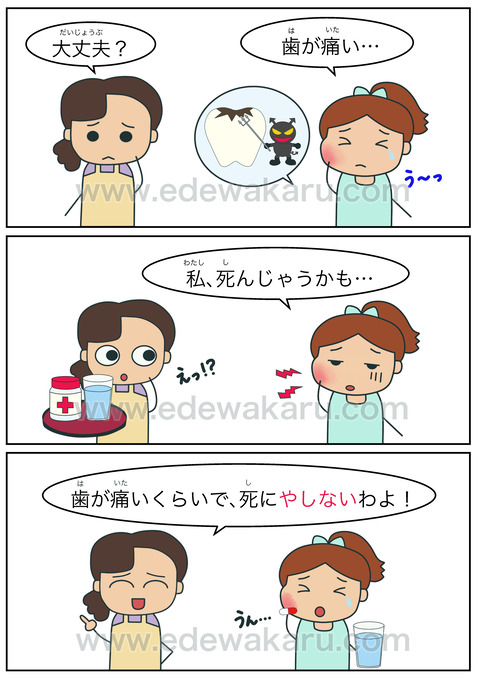
Meaning
absolutely not ~
How to use it
Verb [ます-form] + やしない
Explanation
“〜やしない” is a sentence pattern meaning “absolutely not ~.” It is used when you want to emphasize the feeling “absolutely not ~.” It is often used to reassure someone who is worried, as in “It absolutely won’t happen, so don’t worry.” It is similar to “〜ことはない,” which expresses [complete negation], so learn them together.
“〜やしない” also has a usage that expresses [dissatisfaction], so learn that together 😊
In context 5 examples
娘:歯が痛い…私、死んじゃうかも…母:大丈夫!歯が痛いくらいで、死にやしないわよ
→歯が痛いくらいで、絶対に死なないわよDaughter: My tooth hurts… I might die… Mother: It’s okay! You’re not going to die just because your tooth hurts. →You’re absolutely not going to die just because your tooth hurts.
彼女はうそをつきやしないよ
→彼女は絶対にうそをつかないよShe would never tell a lie. →She absolutely does not tell lies.
このあたりでは、5月に雪は降りやしないよ
→5月に雪は絶対降らないよIt absolutely won’t snow around here in May. →It absolutely won’t snow in May.
A:遅刻してばかりいると首になっちゃうよB:遅刻くらいで首になりやしないさ
→遅刻くらいで、絶対に首にならないさA: If you keep being late, you’ll get fired. B: You’re not going to get fired just for being late. →You absolutely won’t get fired just for being late.
田中さんは、失敗などしやしないよ
→田中さんは、絶対に失敗などしないよTanaka-san would never make a mistake. →Tanaka-san absolutely would not make a mistake.
Read the original source text
Meaning
絶対に〜ない
How to use it
動詞[ます形]+やしない
Explanation
「〜やしない」は「絶対に〜ない」という意味の文型です。「絶対に〜ない」という気持ちを強調したい時に使われます。相手が心配している時などに「絶対に〜ないから、大丈夫だよ」と励ましたりするのによく使われます。【全面否定(ぜんめんひてい)】を表す「〜ことはない」に似ていますので、一緒に覚えておきましょう。
「〜やしない」には【不満】を表す用法もありますので、一緒に覚えておきましょう😊
AIUEO JLPT Grammar
Meaning
This sentence pattern is used to strongly deny something. It emphasizes the speaker’s refusal to perform an action or reject another’s behavior, often with a connotation of contempt or negativity.
How to use it
Verb masu-form や + しない; verb masu-form は + しない; noun や + しない; noun は + しない
In context 5 examples
そんなこと、誰も信じやしないよ。
No one is going to believe that.
何度頼んでも、彼は手伝いはしない。
No matter how many times I ask, he won’t help.
いくら言っても、彼は聞きやしない。
No matter how much I say, he doesn’t listen.
そんなことをしても、誰も感謝しはしないさ。
Even if you do that, no one will appreciate it.
彼は自分の間違いを認めやしない。
He will never admit his mistakes.
Read the original source text
Meaning
This sentence pattern is used to strongly deny something. It emphasizes the speaker’s refusal to perform an action or reject another’s behavior, often with a connotation of contempt or negativity.
How to use it
動詞ます形や+しない動詞ます形は+しない名詞や+しない名詞は+しない
Explanation · 日本語
この文型は、何かを強く否定する表現です。特に、何かをしない、またはその行動を取らないことを強調するために使われます。話し手がその行動を絶対にしないことを示す場合や、相手に対して反論や拒絶を強調したいときに使われます。この表現は、しばしば軽蔑的または否定的なニュアンスを含んでいます。