Bunpro Grammar Reference
Meaning
Just by, Just with
How to use it
Verb + だけで
Noun + だけで
Nuance
An expression used to highlight something that occurs only with (A).
Explanation
だけで is a combination of the adverbial particle だけ, and the case marking particleで. This expression is regularly thought of as meaning 'just by (A), (B)'. However, the literal translation is a bit closer to 'with only (A), (B)'. This reflects the で particle's standard usage of showing a 'tool' that is being used to achieve a certain result.
To use だけで, simply attach it to the end of any (non ます) form of verb, or noun.
彼女と話すだけで楽しい。
Just talking with my girlfriend is fun. (We don't need to do anything else, because talking is fun enough)
これは電子レンジだけでオーブンの機能はついていない。
This is just a microwave, an oven function is not included.
Fun Fact
だけ differs from しか in one very important way. だけ highlights that there is/was more than one option, but that only one thing was chosen/used. However, しか implies that there is only one possible option to begin with.
In context 14 examples
- パーティーに行くだけで楽しい。
Just (by) going to a party is fun.
- 彼女と話すだけで楽しい。
Just talking with my girlfriend is fun. (We don't need to do anything else, because talking is fun enough)
- これは電子レンジだけでオーブンの機能はついていない。
This is just a microwave, an oven function is not included.
- 顔を見ただけで、彼はいい人だと分かった。
I could tell he was a good person just by his face.
- 一緒に時間を過ごすだけで、仲良くなりました。
We became good friends just by spending time together.
- 彼を見ただけで性格が悪いと分かった。
Just by looking at him I determined that he had a bad personality.
- 家族と一緒に居るだけで、幸せ。
Just by being with my family I am happy.
- 空港と聞くだけで、飛行機に乗るのが怖くなる。
Just by hearing the word 'airport' I get scared of flying.
- 彼と話をするだけで、疲れますよ。
Just by talking to him I get tired.
- そういうことを言ってくれるだけで、君は優しいと分かる。
Just by you saying that, I know that you are nice.
- 外国人だけど、着物を着るだけで、日本人みたいになった。
I am a foreigner, but just by wearing a kimono I look Japanese.
- 階段を上るだけで、しんどくなります。
Just by going up some stairs I become exhausted.
- 行ってもいいって彼が言ってくれたが、言い方だけでダメだと分かった。
He said that it was okay to go, but just by the tone of his voice I knew it wasn't okay.
- 辛いものを食べるだけで、お腹が痛くなる。
Just by eating something spicy my stomach starts to hurt.
Read the original source text
Meaning
Just by, Just with
How to use it
Verb + だけで
Noun + だけで
Nuance
An expression used to highlight something that occurs only with (A).
Explanation
だけで is a combination of the adverbial particle だけ, and the case marking particleで. This expression is regularly thought of as meaning 'just by (A), (B)'. However, the literal translation is a bit closer to 'with only (A), (B)'. This reflects the で particle's standard usage of showing a 'tool' that is being used to achieve a certain result.
To use だけで, simply attach it to the end of any (non ます) form of verb, or noun.
彼女と話すだけで楽しい。
Just talking with my girlfriend is fun. (We don't need to do anything else, because talking is fun enough)
これは電子レンジだけでオーブンの機能はついていない。
This is just a microwave, an oven function is not included.
Fun Fact
だけ differs from しか in one very important way. だけ highlights that there is/was more than one option, but that only one thing was chosen/used. However, しか implies that there is only one possible option to begin with.
Nuance · 日本語
(A)がないと起こらないということを強調する表現。
DoJG 日本語文法辞典(全集)
Meaning
Just V-ing is enough; can just ~; just by V-ing
How to use it
V informal | だけで | |
| {読む/読んだ} だけで | Just by reading |
Explanation
A phrase which expresses the idea that just doing something is enough for something.
In context 10 examples
君はここに座っているだけでよい。
You can just sit (literally: be sitting) here.
私は筆跡を見ただけで誰が書いたか分かった。
I knew who wrote it just by looking at the handwriting.
この植木は二週間に一度水をやるだけでよい。
Watering just once every other week is enough for this plant.
この用紙にサインしていただくだけで結構です。
It will be enough if you just sign this form.
本当に来るだけでいいんですか。
Are you sure that I don't have to do anything except attend?
その会議では私はただ座っているだけでよかった。
At that meeting all I had to do was sit there.
村上君は一週間勉強しただけであの試験に通ったそうだ。
I heard that Murakami passed that exam just by studying for one week.
お金を入れてボタンを押すだけで暖かいラーメンが出てくる自動販売機がある。
There is a vending machine which serves hot ramen (literally: from which hot ramen comes out) just by inserting coins and pushing a button.
頭金一万円を払うだけで品物をお届けします。
If you just pay 10,000 yen as deposit, we'll deliver the product.
聞くだけで胸が悪くなるような話だ。
Just hearing that story makes me sick. (literally: It is a story that makes me sick just by hearing it.)
絵でわかる日本語
Meaning
if you do 〜, then 〜 (even if you don’t actually do it)
How to use it
Verb [dictionary form] + だけで
Verb [た-form] + だけで
Explanation
「〜だけで」 is used in the form 「AだけでB」 and means “if you do A, then B,” even without actually experiencing it. Verbs expressing [perception] or [thought] are used for 「A」. It is used to say, “Even without actually experiencing it, doing A makes you feel B” 😊
[Examples]
① Just thinking about going on a trip makes me happy.
→I’m not actually going on the trip, but thinking about it makes me happy.
② Just imagining seeing a ghost is scary.
→I haven’t seen a ghost, but imagining seeing one feels scary.
③ Just thinking about losing my smartphone, for example, makes me feel awful.
→I haven’t lost my smartphone, but thinking that I had would feel awful.
④ Just hearing about it fills me up…
→I haven’t actually eaten, but hearing A’s story makes me feel full.
⑤ Just looking at a lemon makes my mouth water.
→I haven’t eaten the lemon, but looking at one makes my mouth water.
⑥ Just looking at a cake makes me drool.
→Looking at a cake makes me drool.
⑦ Just remembering my first date makes me embarrassed.
→Remembering my first date makes me embarrassed.
Also, the meaning is the same whether it is used with the [dictionary form] or the [た-form] 😮
[Example]
Just thinking about the trip makes me happy.
= Just having thought about the trip makes me happy.
「〜だけで」 is often used with words such as [think], [imagine], [hear], and [see], so it would be good to memorize them 😉
In context 7 examples
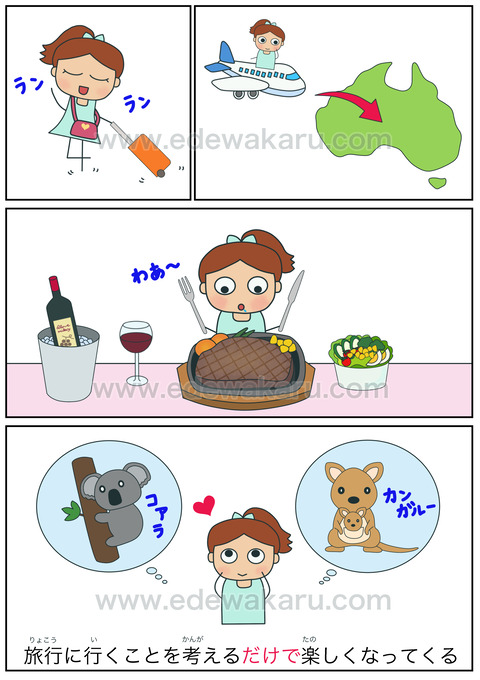
旅行に行くことを考えるだけで楽しくなってくる(復習:〜てくる(発生・開始))
Just thinking about going on a trip makes me happy. (Review: 〜てくる (arising/beginning))
おばけを見たなんて、想像するだけでこわい
Just imagining seeing a ghost is scary.
スマホをなくしてしまうなど、考えるだけで嫌だ
Just thinking about losing my smartphone, for example, makes me feel awful.
A:昨日はドーナツを20個も食べたの!B:聞くだけでお腹がいっぱいになるよ…(復習:〜も(数量詞+も))
A: I ate as many as 20 donuts yesterday! B: Just hearing that makes me feel full… (Review: 〜も (quantity word + も))
レモンを見ただけでつばが出る
Just looking at a lemon makes my mouth water.
ケーキを見ただけでよだれが出ちゃう(復習:〜ちゃう・〜じゃう)
Just looking at a cake makes me drool. (Review: 〜ちゃう・〜じゃう)
初デートのことを思い出すだけで恥ずかしくなる(復習:「思い出す」と「思いつく」)
Just remembering my first date makes me embarrassed. (Review: “思い出す” and “思いつく”)
Read the original source text
Meaning
(実際に〜しなくても)〜すれば〜
How to use it
動詞[辞書形]+だけで
動詞[た形]+だけで
Explanation
「〜だけで」は「AだけでB」の形で使われ、「実際に体験しなくても、AすればB」という意味を表す文型です。「A」には
【知覚】【思考】
を表す動詞が使われ、
「実際に体験しなくても、AすればBと感じられる」
と言いたい時に使用します😊
[例]
①旅行に行くことを考える
だけで
楽しくなってくる
→旅行には行っていないが、旅行のことを考えれば楽しくなってくる
②おばけを見たなんて、想像する
だけで
こわい
→おばけを見ていないが、見たことを想像するとこわいと感じる
③スマホをなくしてしまうなど、考える
だけで
嫌だ
→スマホをなくしていないが、なくしたと考えると嫌だと感じる
④聞く
だけで
お腹がいっぱいになるよ…
→実際には食べていないが、Aの話を聞くとお腹いっぱいになる
⑤レモンを見た
だけで
つばが出る
→レモンを食べていないが、レモンを見ればつばが出てくる
⑥ケーキを見た
だけで
よだれが出ちゃう
→ケーキを見るとよだれが出ちゃう
⑦初デートのことを思い出す
だけで
恥ずかしくなる
→初デートのことを思い出すと、恥ずかしくなる
また「辞書形」に使っても「た形」に使っても意味は同じになります😮
[例]
旅行のことを
考える
だけで
楽しくなってくる
=旅行のことを
考えただけで
楽しくなってくる
「〜だけで」は
【考える】【想像する】【聞く】【見る】
などとよく使われますので、暗記しておくといいと思います😉