絵でわかる日本語
Meaning
From 〜’s point of view, 〜 would be the case
Thinking from 〜’s position, 〜 would be the case
How to use it
Noun [dictionary form] + にしたら
Noun [dictionary form] + にすれば
Explanation
“Aにしたら・Aにすれば” is a sentence pattern meaning “from A’s point of view, 〜 would be the case” or “thinking from A’s position, 〜 would be the case.”
“A” is a noun referring to a person, and this pattern is used to make an inference about how things look from that person’s point of view. Since it is used to infer someone else’s thoughts by taking their perspective, in most cases “A” cannot refer to the speaker themself.
[Examples]
❌ From my point of view, 10,000 yen is a lot of money.
⭕️ From their point of view, 10,000 yen is a lot of money.
Be sure to review patterns similar to “〜にしたら・〜にすれば” 😊
[Similar patterns]
In context 5 examples
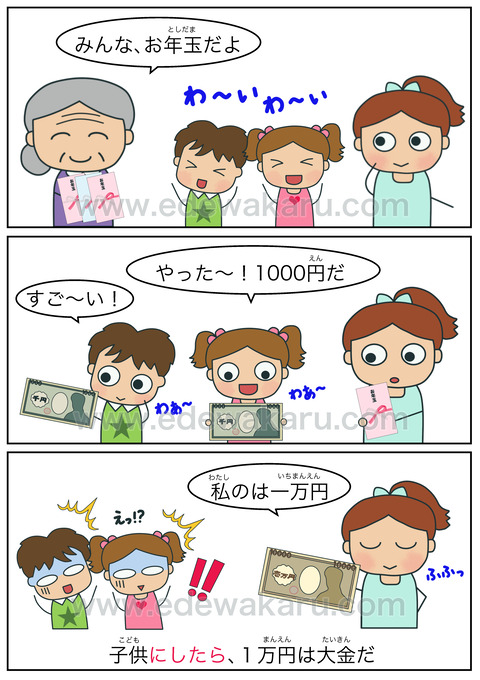
子供にしたら、1万円は大金だ
→子供の立場で考えると、1万円は大金だろうFrom a child’s point of view, 10,000 yen is a lot of money. → From a child’s point of view, 10,000 yen would be a lot of money.
小学生(しょうがくせい)にしたら、夏休みは長いほうがいいに決まっている
→小学生の立場に立って考えると、夏休みは長いほうがいいに決まっているFrom an elementary school student’s point of view, summer vacation is definitely better when it’s longer. → Thinking from an elementary school student’s perspective, summer vacation is definitely better when it’s longer.
日本語学習者(がくしゅうしゃ)にしたら、「あげる・もらう・くれる」を使い分けるのは難しいだろう
→日本語学習者の立場で考えると、「あげる・もらう・くれる」の使い分けは難しいだろうFor Japanese learners, distinguishing between “あげる・もらう・くれる” is probably difficult. → From a Japanese learner’s point of view, distinguishing between “あげる・もらう・くれる” is probably difficult.
妹:お父さんもお母さんも私が留学するのに反対なんだって…姉:そっか…。親にしたら、娘が海外に住むのは心配なんだと思うよ
→親の立場に立って考えると、娘が海外に住むのは心配なんだと思うよYounger sister: Dad and Mom are both against my studying abroad… Older sister: I see… From a parent’s point of view, I think it’s worrying for their daughter to live overseas. → Thinking from a parent’s point of view, I think it’s worrying for their daughter to live overseas.
太りやすい人にしたら、いくら食べても太らないなんて、うらやましい限りだと思う
→太りやすい人の立場に立って考えると、いくら食べても太らないなんて、うらやましい限りだと思うFor people who gain weight easily, not gaining weight no matter how much you eat must be the height of envy. → From the point of view of people who gain weight easily, not gaining weight no matter how much you eat must be the height of envy.
Read the original source text
Meaning
〜の立場に立てば〜だろう
〜の立場で考えると〜だろう
How to use it
名詞[辞書形]+にしたら
名詞[辞書形]+にすれば
Explanation
「Aにしたら・Aにすれば」は「Aの立場に立てば〜だろう」「Aの立場に立って考えると〜だろう」という意味の文型です。
「A」には、人を表す名詞が入り、その人の立場から見た考えを推測して言う場合に使われます。他人の立場に立って、その人の考えを推測するという文型ですので、ほとんどの場合は「A」に自分自身を表すものには使いません。
[例]
❌私
にしたら、1万円は大金だ
⭕️彼ら
にしたら、1万円は大金だ
「〜にしたら・〜にすれば」 に似ている文型を復習しておきましょう😊
【類似文型】
NINJAL 日本語文型データベース
Meaning
Used when speaking from a person’s point of view and making an inference about how that person feels.
How to use it
Nにすれば
Notes
“~” is usually a word referring to a third party. The phrase following “~にすれば” often expresses conjecture, such as “~だろう.”
In context 4 examples
政治家にすれば、一庶民の貧困など関心の対象ではないのかもしれない。しかし、それこそが政治家の最大課題なのではないだろうか。
From a politician’s perspective, the poverty of ordinary citizens may not be a matter of concern. But isn’t that precisely the greatest issue politicians should be addressing?
入社当時は大変だった。課長にすれば、ミスばかり繰り返す私は、やっかいな存在だっただろう。
Things were difficult when I first joined the company. From the section chief’s perspective, I, constantly making mistakes, must have been a troublesome presence.
私は年頃の娘のことが心配であれこれうるさく言ってしまう。しかし、娘にすれば、母親はただの管理者なのかもしれない。
I worry about my teenage daughter and end up nagging her about this and that. But from my daughter’s perspective, her mother may seem like nothing more than a supervisor.
今日、担任の先生に、あることで反抗的な態度をとってしまった。先生にすれば不快だったかもしれないのに、先生は冷静に私の言い分を聞いてくれた。
Today, I acted defiantly toward my homeroom teacher about something. It may have been unpleasant for the teacher, but they calmly listened to what I had to say.
Read the original source text
Meaning
〜の人の立場に立って、その人の気持ちを推測して言うときに使います。
How to use it
Nにすれば
Notes
「~」にはふつう第三者を表す言葉がきます。「〜にすれば」の後には、「〜だろう」などの推量を表す文がくることが多いです。