AIUEO JLPT Grammar
Meaning
「〜ぽっち」 emphasizes smallness or insignificance. It is often used to express surprise or dissatisfaction with small amounts or quantities.
How to use it
Quantity + ぽっち; これ or それ or あれ + っぽっち
In context 5 examples
10円ぽっちで何が買えるの?
What can you buy with only 10 yen?
それっぽっちの人数ではイベントは開催できないよ。
We can’t hold an event with such a small number of people.
これっぽっちの努力じゃ、成功は難しいよ。
With just this little effort, it’ll be hard to succeed.
5分ぽっちでそんなにたくさんの仕事はできない。
You can’t do that much work in just 5 minutes.
あれっぽっちの資料じゃ、話を進めるのは難しい。
With just that little amount of material, it’s hard to proceed with the discussion.
Read the original source text
Meaning
「〜ぽっち」 emphasizes smallness or insignificance. It is often used to express surprise or dissatisfaction with small amounts or quantities.
How to use it
数量+ぽっちこれorそれorあれ+っぽっち
Explanation · 日本語
「〜ぽっち」は、少ないことや価値がないことを強調する表現で、主に話し手がある物事を軽視したり、少ないことに対して驚きや不満を表す時に使われます。また、少量や少額を強調するために使われることが多いです。
絵でわかる日本語
Meaning
There is only ~.
How to use it
Numeral + ぽっち
Quantity + っぽっち
これ・それ・あれ + ぽっち
これ・それ・あれ + っぽっち
Explanation
“〜ぽっち” is a sentence pattern meaning “there is only ~.” It is used when you want to say that an amount is “very small” or “not enough” 😊 (Review: 〜など・〜なんか・〜なんて.) Since it means “small and insufficient,” it is used as a negative expression 😮 (Review: 〜として.)
A small “っ” can be added to “〜ぽっち,” making “〜っぽっち.”
In most cases, “〜っぽっち” is used 😮
[Examples]
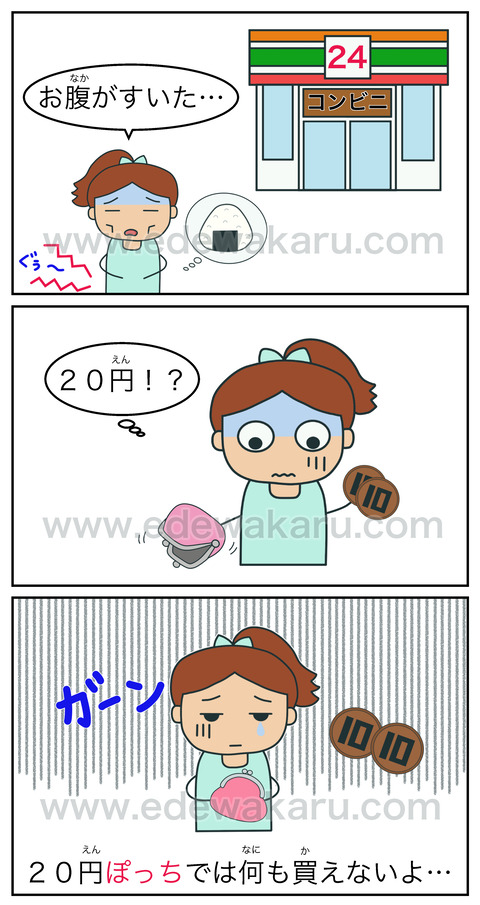
20円ぽっちでは何も買えないよ…
=20円っぽっちでは何も買えないよ…
You can’t buy anything with a mere 20 yen…
これぽっちのお金では何も買えないよ…
=これっぽっちのお金では何も買えないよ…
You can’t buy anything with this tiny amount of money…
There aren’t many opportunities to study “〜ぽっち,” but it is often used in conversation, so I think it’s good to learn it 😉
In context 4 examples
20円ぽっちでは何も買えないよ…
→20円だけしかないから何も買えないよ…You can’t buy anything with only 20 yen… →You can’t buy anything because you only have 20 yen…
これぽっちのお金では何も買えないよ…
→これだけしかお金がないから何も買えないよ…You can’t buy anything with this little money… →You can’t buy anything because this is all the money you have…
そのパーティーには10人ぽっちしか来なかった
→そのパーティーには10人だけしか来なかったOnly ten people came to that party. →Only ten people came to that party.
A:昨日、お母さんにプリンを食べられてすごく腹が立ったよ!B:それぽっちのことで怒らなくていいでしょ…
→それだけのことで怒らなくていいでしょ…(復習:腹が立つ)(復習:口語形「〜でしょ・〜だろ」)A: I was so angry yesterday when my mother ate my pudding! B: You don’t have to get angry over something that small… →You don’t have to get angry over just that… (Review: 腹が立つ [to get angry]) (Review: colloquial forms “〜でしょ・〜だろ.”)
Read the original source text
Meaning
〜だけしかない
How to use it
数詞+ぽっち
数量+っぽっち
これ・それ・あれ+ぽっち
これ・それ・あれ+っぽっち
Explanation
「〜ぽっち」は「〜だけしかない」という意味を表す文型です。数量が「とても少ない」「足りない」などと言いたい時に使います😊(復習:〜など・〜なんか・〜なんて)「少なく、不足している」という意味ですので、
マイナス表現
として使われます😮(復習:〜として)
「〜ぽっち」は小さい「っ」を入れて「〜っぽっち」ということもできます。
ほとんどの場合は「〜っぽっち」が使われます😮
[例]
20円
ぽっち
では何も買えないよ…
=20円
っぽっち
では何も買えないよ…
これ
ぽっち
のお金では何も買えないよ…
=これ
っぽっち
のお金では何も買えないよ…
「〜ぽっち」は勉強する機会がなかなかありませんが、会話でよく使いますので覚えておくといいと思います😉