日本語文型辞典 英語版
Meaning
Attached to nouns which denote bearings and directions such as “north,” “east,” “south,” “west,” “forwards,” “backwards,” “left,” “right,” “up,” and “down,” this means facing that direction. The 前向きに of example
(4)
is a idiomatic expression meaning “if possible, to endeavor to realize....”
Means “perfect for N/suited to N.” Rather than saying Nむきでない we can say Nに不向きだ. The 向き不向きがある of
(5)
is a customary expression meaning “to have or not have aptitude.” For the difference between this and むけ, please refer to the entry for むけ.
Means “there are such people.” Example
(1)
means “there are people who do not take... kindly” and example
(2)
means “there are people who think the implementation will be difficult.” It is a formal, written expression.
Expresses the meaning “to become serious and angry or to insist emphatically, even though it’s not a big deal.” Example
(2)
means “You had better settle down a little.”
How to use it
1. Nむき〈direction〉(facing N; toward N)
2. Nむき〈suitability〉(suited to N)
3. there are also Vむき cases
4. get worked up
In context 15 examples
南向きの部屋は明るくて暖かい。
Rooms facing south are bright and warm.
右向きに置いてください。
Please leave it facing the right.
横向きに寝てください。
Please lie down on your side.
前向きに検討したいと考えております。
I intend to consider this positively.
女性向きのスポーツにはどんなものがありますか。
Which sports are considered suitable for women?
この映画は子供向きだ。
This film is suitable for children.
この家は部屋数も多く台所も広い。どちらかというと大家族向きだ。
This house has many rooms and a large kitchen. If I had to choose, I’d say it’s suitable for a large family.
この機械はたいへん性能がよいが、値段も高く大型で一般家庭向きではない。
This appliance is very efficient but, as the cost is high and it is large-sized, it is not for the average household.
セールスの仕事には向き不向きがある。
Some can and some can’t work in sales.
この機械は大きすぎて家庭で使うのには不向きだ。
As this appliance is too large, it is unsuitable for use in the home.
君の活躍を快く思わないむきもあるようだから、はでな言動は慎んだ方がいい。
As there are some who are not exactly delighted with all your endeavors, you’d better use discretion in your language and behavior.
今回の計画については実現を危ぶむむきもある。
Some have misgivings about the current plan’s implementation.
むきになって言い張った。
She got uptight and insisted on it.
そんなにむきにならなくてもいいじゃないか。
You don’t need to get so upset.
彼はいい男だが、仕事の話となるとすぐむきになるので困る。
He’s a good man but the problem is that, when the conversation turns to work, he quickly gets all upset.
Read the original source text
Meaning
Attached to nouns which denote bearings and directions such as “north,” “east,” “south,” “west,” “forwards,” “backwards,” “left,” “right,” “up,” and “down,” this means facing that direction. The 前向きに of example
(4)
is a idiomatic expression meaning “if possible, to endeavor to realize....”
Means “perfect for N/suited to N.” Rather than saying Nむきでない we can say Nに不向きだ. The 向き不向きがある of
(5)
is a customary expression meaning “to have or not have aptitude.” For the difference between this and むけ, please refer to the entry for むけ.
Means “there are such people.” Example
(1)
means “there are people who do not take... kindly” and example
(2)
means “there are people who think the implementation will be difficult.” It is a formal, written expression.
Expresses the meaning “to become serious and angry or to insist emphatically, even though it’s not a big deal.” Example
(2)
means “You had better settle down a little.”
How to use it
1. Nむき〈direction〉
2. Nむき〈suitability〉
3. Vむきもある
4. むきになる
絵でわかる日本語
Meaning
just right for ...
suitable for ...
How to use it
Noun [dictionary form] + 向き
Noun phrase + 向き
Explanation
“〜向き” is a grammar pattern meaning “just right for ...” or “suitable for ...” It is used when the speaker thinks something is “just right for ...” or “a perfect fit for ...” Its form changes depending on what follows.
[Forms of 〜向き]
〜向きの + noun
〜向きに + verb
The negative form 〜向きではない can also be changed to 〜に不向きだ, meaning “unsuitable for ...”
[Example]
This anime is not suitable for children.
= This anime is unsuitable for children.
The similar pattern 〜向け is also worth reviewing 😊
[Related patterns]
In context 5 examples
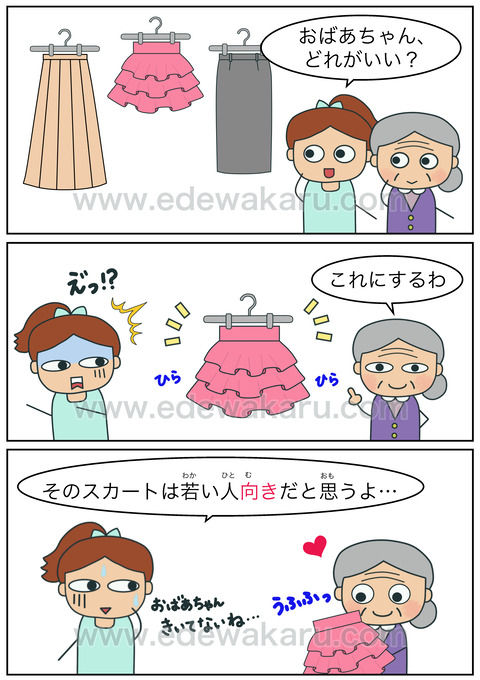
おばあちゃん、そのスカートは若い人向きだと思うよ…
→そのスカートは若い人に適していると思うよ…Grandma, I think that skirt is for young people… →I think that skirt is suitable for young people…
A:このカレーは辛くないねB:うん。子供向きだね
→子供にちょうどいいねA: This curry isn’t spicy. B: Yeah. It’s just right for kids. →It’s just right for kids.
A:ここのランチは量が多くて安いね〜B:私たちみたいな、お金のない学生向きだよね!
→お金のない学生にちょうどいいよね!A: Lunch here is a big portion and cheap~ B: It’s perfect for students like us who don’t have much money! →It’s just right for students who don’t have much money!
A:このアニメ、なんだかこわいね…B:うん。大人向きのアニメだね
→大人に適したアニメだねA: This anime is kind of scary… B: Yeah. It’s an anime for adults. →It’s an anime suited to adults.
彼女はキレやすいし、幼稚園の先生向きではないね
→幼稚園の先生には適していないねShe has a short temper, so she isn’t suited to being a kindergarten teacher. →She isn’t suited to being a kindergarten teacher.
Read the original source text
Meaning
〜にちょうどいい
〜に適している
How to use it
名詞[辞書形]+向き
名詞句+向き
Explanation
「〜向き」は「〜にちょうどいい」「〜に適している」という意味の文型です。「〜向き」は、話し手が「〜にちょうどいいね」「〜にぴったりだね」と思った時に使われます。後ろに何がくるかによって、形が変わります。
[「〜向き」の形]
〜向きの+名詞
〜向きに+動詞
また、否定形は「〜向きではない」で「〜に不向きだ」にチェンジすることができます。
[例]
このアニメは子供
向きではない
=このアニメは子供に
不向きだ
似ている文型に「〜向け」がありますので、復習をしておきましょう😊
【関連文型】
日本語文型辞典
Meaning
When attached to nouns expressing directions, such as the cardinal directions, front/back, left/right, or up/down, it means facing that direction. ④ is the set expression 前向きに, meaning “to make an effort to realize something as much as possible.”
Means “suitable for N” or “appropriate for N.” Instead of Nむきでない, one can say Nに不向きだ. ⑤ 向き不向きがある is an idiom meaning “people differ in whether they are suited to something.” See むけ for the difference from むけ.
Means “there are also people who think so.” ① means “there are also people who do not think well of it,” and ② means “there are also people who think it is difficult to achieve.” This is a formal written expression.
Means “to get seriously angry or make an intense argument over something trivial.” ② means “you should calm down a little and become more composed.”
How to use it
Nむき【Direction】
Nむき【Suitability】
Vむきもある
むきになる
In context 15 examples
南向きの部屋は明るくて暖かい。
A south-facing room is bright and warm.
右向きに置いてください。
Please place it facing right.
横向きに寝てください。
Please lie on your side.
前向きに検討したいと考えております。
We would like to give it favorable consideration.
女性向きのスポーツにはどんなものがありますか。
What kinds of sports are suitable for women?
この映画は子供向きだ。
This movie is for children.
この家は部屋数も多く台所も広い。どちらかというと大家族向きだ。
This house has many rooms and a spacious kitchen. If anything, it’s suited to a large family.
この機械はたいへん性能がよいが、値段も高く大型で一般家庭向きではない。
This machine performs very well, but it is expensive and large, so it is not suitable for ordinary households.
セールスの仕事には向き不向きがある。
People differ in whether they are suited to sales work.
この機械は大きすぎて家庭で使うのには不向きだ。
This machine is too large and is unsuitable for home use.
君の活躍を快く思わないむきもあるようだから、はでな言動は慎んだ方がいい。
There seem to be people who don’t think well of your success, so you’d better refrain from flashy words and actions.
今回の計画については実現を危ぶむむきもある。
There are also people who doubt that this plan can be realized.
むきになって言い張った。
He insisted on it angrily.
そんなにむきにならなくてもいいじゃないか。
You don’t have to get so worked up.
彼はいい男だが、仕事の話となるとすぐむきになるので困る。
He’s a good guy, but it’s a problem that he gets worked up as soon as the subject turns to work.
Read the original source text
Meaning
東西南北などの方角や前後左右、上下など方向を表す名詞に付いて、その方向に正面を向けていることを表す。④は慣用的な表現の「前向きに」で、「なるべく実現させるように努力する」という意味。
「Nのためにちょうどよい/Nに適している」という意味。「Nむきでない」の替わりに、「Nに不向きだ」と言うことができる。⑤の「向き不向きがある」は、慣用的表現で、「その人によって、適性があったりなかったりする」という意味。「むけ」との違いについては「むけ」を参照。
「そういう人達もいる」という意味。①は、「快く思わない人もいる」、②は「実現は類しいと考えている人もいる」という意味。書きことば的なかたい表現。
「たいしたことでもないのに、本気になって怒ったり、激しく主張したりする」意味を表す。②は「少し落ちついて、平静になったほうがいい」という意味。
How to use it
Nむき【方向】
Nむき【通性】
Vむきもある
むきになる