AIUEO JLPT Grammar
Meaning
This sentence pattern highlights the indispensability of a certain condition or factor. It stresses that without it, subsequent events are impossible or extremely difficult.
How to use it
Noun + なしに; noun + なしには; noun + なしでは
In context 5 examples
許可なしには、この部屋に入ることはできません。
You cannot enter this room without permission.
インターネットなしでは、生きていけない。
I can’t live without the internet.
準備なしに、試験に挑むのは無謀だ。
It’s reckless to take on an exam without preparation.
友達の助けなしには、この問題を解決できなかっただろう。
Without my friend’s help, I probably wouldn’t have been able to solve this problem.
資金なしには、このビジネスは成り立たない。
This business cannot operate without funding.
Read the original source text
Meaning
This sentence pattern highlights the indispensability of a certain condition or factor. It stresses that without it, subsequent events are impossible or extremely difficult.
How to use it
名詞+なしに名詞+なしには名詞+なしでは
Explanation · 日本語
この文型は、ある条件や要素が欠けている場合、その結果や行動が成立しないことを強調する表現です。これにより、何かが不可欠であり、それがないと後の事象が不可能または非常に困難であることを示します。
文法
Meaning
“without ... / not doing ...”
In “AなしにB,” although the usual process would be to do A and then B, B is done without doing A.
How to use it
V (dictionary form) + ことなしに
N + なしに
※ N is a suru verb.
In context 11 examples
この建物は許可なしに入ることができない。
You cannot enter this building without permission.
授業は休憩なしに3時間続けられた。
The class continued for three hours without a break.
この映画は涙なしに見られない。
This movie cannot be watched without tears.
住民の理解なしに、新しいマンションを建てることは許されない。
Building a new apartment complex without the residents' understanding is not permitted.
鈴木さんなしでは、このプロジェクトの成功はなかっただろう。
Without Mr. Suzuki, this project probably would not have succeeded.
部長なしで、会議を始めるわけにはいきませんよ。
We can't very well start the meeting without the department head.
あなたなしでは生きていけないわ。
I can't live without you.
辞書なしでは、日本語で書かれた新聞を読むことはできない。
Without a dictionary, I can't read newspapers written in Japanese.
字幕なしでは、日本の映画を見ることができません。
I can't watch Japanese movies without subtitles.
練習することなしに、勝利することはありえないだろう。
Victory would be impossible without practicing.
この件に関しては相手側と争うことなしに、解決したい。
Regarding this matter, I'd like to resolve it without getting into a dispute with the other party.
Read the original source text
Meaning
"〜ないで / 〜なく"
「AなしにB」で本来ならAをして、Bをするという段階があるのに、AをしないでBが行われることを表す。
How to use it
V(辞書形)+ ことなしに
N + なしに
※Nはする動詞
DoJG 日本語文法辞典(全集)
Meaning
Without
How to use it
(i) {N/VN(すること)} | Vます/Vinformal nonpastこと/なしに | |
| 権力なしに | Without (political) power |
| 挨拶(すること) なしに | Without greeting |
| 断りなしに | Without letting someone know something in advance |
| (許可)を得ることなしに | Without obtaining (permission) |
(ii) 何の{N/VN}も | なしに | |
| 何の財産もなしに | Without any estate/fortune |
| 何の挨拶もなしに | Without any greeting |
| 何の断りもなしに | Without someone knowing anything in advance |
(iii) 何のNounも | Vinformal nonpastことなしに | |
| 何の許可も得ることなしに | Without obtaining permission at all |
(iv) {N/VN(すること)/Vinformal nonpastこと} | なしにはVpotential negativeない | |
| コーヒーなしには生活できない | Someone can’t live without coffee |
| 準備運動(すること) なしには入れない | Someone cannot enter without a warm-up |
| 辞書の助けなしには読めない | Someone cannot read something without the help of a dictionary |
| 深く考えることなしには書けない | Someone can’t write without thinking (about it) deeply |
Explanation
An adverbial phrase meaning "without (doing) something".
In context 14 examples
料金は予告(すること)なしに変更する場合がございます。
The fee may (literally: will sometimes) change without prior notice.
友達が何の連絡もなしにいきなり訪ねてきた。
My friend suddenly dropped by without contacting me first.
日本語の授業は手続き(すること)なしには聴講できません。
You cannot audit a Japanese class without going through the formal (registration) process.
ソフトウエアの不正コピーには、許諾なしに複製されたソフトウエアや、偽造されたソフトウエアが含まれている。
Illegal copies of software include software copied without permission and forged software.
お客様の同意なしに、第三者に個人情報を転送することはありません。
We will never transfer private information to a third party without the customer's consent.
男たちは何の許可もなしに事務所のコンピュータを勝手に使っていた。
The men were using the office computers without permission.
キリスト教を理解することなしにヨーロッパの文化や社会を理解することは難しいと言われています。
They say it is difficult to understand European culture and society without understanding Christianity.
この実験の最初の10年は何の成果も得ることなしに過ぎてしまった。
The first 10 years of this experiment passed, and we had not obtained a result.
コンピュータと通信技術が飛躍的に発展するにつれ、社会生活が大きく変化し、いまやコンピュータなしには我々の生活が成立しなくなりつつある。
With the rapid development of computers and communications technology, society has seen great changes, to the point that it is becoming harder to conduct our daily lives without computers.
天気予報もテレビ中継も国際電話も、人工衛星の助けなしにはやっていけない時代になっている。
We are now in an age in which weather forecasting, live TV broadcasting and international telephone calls are impossible without the help of satellites.
この掲示板では、営業目的の書き込みや著しく長い書き込みについては、断りなしに削除させていただくことがあります。
Comments that are for sales purposes or are extremely long may be deleted from this bulletin board without prior notice.
大事なことを何の話し合いもなしに決められて、私としては納得ができない。
They have made an important decision on an issue without any discussion. I am dissatisfied.
一切の政治権力なしに人々自由を実現することは、はたして可能なのだろうか。
I wonder if people's freedom can be realised without any political power.
人一倍照れ屋だった父は、酒なしには人と話もできなかった。
My father, who was twice as shy as other people, couldn't even talk with people without drinking sake first.
どんなときどう使う 日本語表現文型辞典
Meaning
without, don't
How to use it
V-dictionary form+こと/N・suru verbのN+なしに
Explanation
~ないで/~なく
動作を表す言葉について「普通は~するが、この場合は~しないで、…する」または「普通は~するが、この場合は~をしないで、そのままいる」という意味を表す。
Used for words describing action: "normal-ly do something a certain way, but in this instance continues previous state" or "does as intended originally."
In context 5 examples
わたしたちは3時間、休息なしに歩き続けた。
We kept walking for three hours without a break.
断りなしに、ほかの人の部屋に入るな。
Don’t enter someone else’s room without permission.
彼女の話は涙なしには、聞けない。
You can’t listen to her story without crying.
兄の病気のことが気になって朝まで一睡もすることなしに、起きていた。
I was awake until morning, worried about my older brother’s illness, without getting a wink of sleep.
なんとか父に気づかれることなしに、家を出ることができた。
Somehow, I managed to leave the house without my father noticing.
Read the original source text
Meaning
without, don't
How to use it
Vる+こと/N・する動詞のN+なしに
Explanation
~ないで/~なく
動作を表す言葉について「普通は~するが、この場合は~しないで、…する」または「普通は~するが、この場合は~をしないで、そのままいる」という意味を表す。
Used for words describing action: "normal-ly do something a certain way, but in this instance continues previous state" or "does as intended originally."
絵でわかる日本語
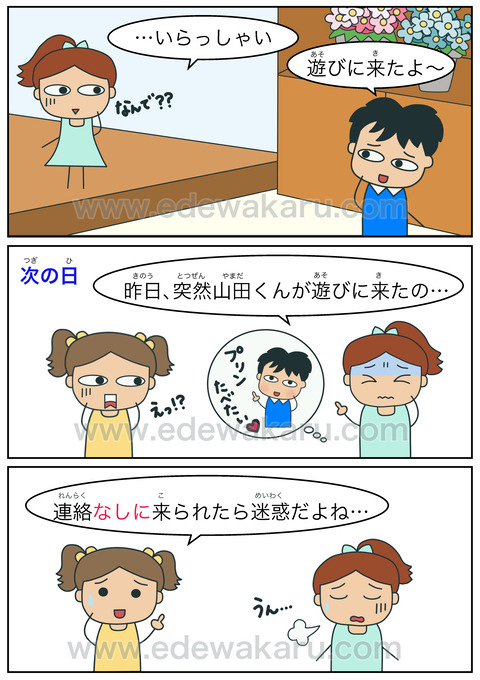
Meaning
Without doing...; without...
How to use it
Noun [dictionary form] + なしに
Explanation
“Aなしに” means “without doing A” and is used when you want to say “do ... without doing [A], which should have been done beforehand.” [A] is often “permission,” “notification,” or “asking first.”
[Examples]
① It would be a nuisance if someone came over to hang out without letting us know...
[What should be done beforehand] Letting us know
→ It would be a nuisance if someone came over without letting us know...
② Please do not enter this room without permission.
[What should be done beforehand] Get permission
→ Please do not enter this room if you have not obtained permission.
③ Holding an event in the park without filing a notification is prohibited.
[What should be done beforehand] File a notification
→ Use of the park is prohibited if no notification has been filed.
④ He took as many as 10 days off work without asking, so he got fired.
[What should be done beforehand] Ask first
→ He got fired because he took time off without asking.
*“Ask first” means “get approval.”
⑤ You cannot build a golf course without the residents’ approval.
[What should be done beforehand] Obtain approval
→ You cannot build a golf course if the residents have not given their approval.
Learn this together with the N1 patterns “〜なしでは〜ない・〜なしには〜ない.” 😊
[Related grammar]
In context 5 examples
A:昨日、突然山田くんが遊びにきて困っちゃった…B:連絡なしに来られたら迷惑だよね…
A: Yamada suddenly came over yesterday, and it was a problem... B: It’s a nuisance when someone comes without letting you know...
許可なしに、この部屋に入らないでください
Please do not enter this room without permission.
届け出なしに公園でイベントを行うことは禁止されています
Holding an event in the park without filing a notification is prohibited.
彼は断りなしに仕事を10日も休んだので、首になってしまった
He took as many as 10 days off work without asking, so he got fired.
住民の了解なしに、ゴルフ場をつくることはできません
You cannot build a golf course without the residents’ approval.
Read the original source text
Meaning
〜しないで
How to use it
名詞[辞書形]+なしに
Explanation
「Aなしに」は「Aしないで」という意味で、「事前にするべき【A】をしないで〜する」と言いたい時に使います。【A】には「許可」「届け出」「断り」などがよく使用されます。
[例]
①連絡
なしに
遊びに来られたら迷惑だよね…
【事前にするべきこと】連絡
→連絡をしないで遊びに来られたら迷惑だよね…
②許可
なしに、この部屋に入らないでください
【事前にするべきこと】許可をとる
→許可をとっていない時は、この部屋に入らないでください
③届け出
なしに
公園でイベントを行うことは禁止されています
【事前にするべきこと】届け出を出す
→届け出を出していない状態では公園の使用は禁止されています
④彼は断り
なしに
仕事を10日も休んだので、首になってしまった
【事前にするべきこと】断りを入れる
→断りを入れないで休んだので、首になってしまった
*「断りを入れる」とは「了解してもらう」という意味です
⑤住民の了解
なしに、ゴルフ場をつくることはできません
【事前にするべきこと】了解をとる
→住民に了解してもらっていない状態では、ゴルフ場をつくることはできません
N1の文型「〜なしでは〜ない・〜なしには〜ない」と一緒に覚えておきましょう😊
【関連文法】
日本語文型辞典
Meaning
Basic information
Nなしに
Attached to an action noun such as 「届け出」「断り」, this means to do something without performing that action. It is often used in contexts where someone does something without first doing something that should naturally have been taken care of. When 「何の」 is attached to the noun, 「も」 is inserted, giving the form 「何のNもなしに」.
Examples
① In winter, climbing this mountain without filing a notice is prohibited.
② Because I stayed out overnight without permission, the dormitory rules required me to clean the lobby for a week.
③ Mr. Maeda is a busy person, so he probably doesn’t meet people without an appointment.
④ At the study group, please aim to make presentations easy for everyone to understand, and don’t plunge straight into the main topic without any introduction.
⑤ The high school student who recently started working part-time at the office is a nice kid, but always leaves without saying goodbye, so we can’t tell when he’s gone, which is a problem.
Example
(Example) He suddenly showed up without any notice and asked to borrow money.
A written expression; 「しないで」 is used in spoken language.
Read the original source text
Meaning
基本情報Nなしに説明「届け出」「断り」など動作を表す名詞に付いて、その動作をしないで何かするという意味を表す。「当然前もってしておかなくてはいけないことをしないで、何かをする」という文脈で使われることが多い。次のように名詞に「何の」が付くと「も」が入って「何のNもなしに」という形になる。例文① この山は、冬は届け出なしに登山してはいけないことになっている。② 断りなしに外泊したために、寮の規則で一週間ロビーの掃除をさせられた。③ 前田さんは忙しい人だから、約束なしに人と会ったりしないでしょう。④ 研究会では、前置きなしにいきなり本題に入らないように、皆にわかりやすい発表をこころがけてください。⑤ 今度事務所に来たアルバイトの高校生は、いい子なのだが、いつもあいさつなしに帰るので、いつ帰ったかわからなくて困る。例文(例) 彼は何の連絡もなしに突然たずねてきて、金の無心をした。説明書きことば的表現で、話しことばでは「しないで」を使う。
日本語文型辞典 英語版
Meaning
【なしに】[Nなしに]
When used with action nouns such as 届け出 (notification) or 断り (permission), なしに means doing something without having done the action expressed by the noun. It is often used in the sense of “do X without doing Y, which should of course have been done in advance.”
When the noun is preceded by 何の, as in the example below, the particle も is inserted after the noun and Nなしに changes to 何のNもなしに.
(例)彼は何の連絡もなしに突然たずねてきて、金の無心をした。
He showed up all of a sudden without contacting me in advance and asked for money.
なしに is mainly a written expression. In spoken Japanese, しないで is used.
In context 5 examples
この山は冬は届け出なしに登山してはいけないことになっている。
This mountain is not to be climbed in winter without prior notification.
断りなしに外泊したために、寮の規則で一週間ロビーの掃除をさせられた。
Because I stayed out overnight without permission, I had to clean the main foyer for a week, in accordance with dormitory regulations.
前田さんは忙しい人だから約束なしに人と会ったりしないでしょう。
Since Maeda-san is a busy man, he probably doesn’t see people without an appointment.
研究会では、前置きなしにいきなり本題に入らないように、皆にわかりやすい発表をこころがけてください。
At the research conference, don’t jump straight into the main topic without introduction; keep in mind that your presentation should be easy for everyone to follow.
今度事務所に来たアルバイトの高校生はいい子なのだが、いつもあいさつなしに帰るので、いつ帰ったかわからなくて困る。
The new high school part-timer in our office is a good kid, but she always goes home without saying goodbye, so it’s a bit of a problem because we never know when she has left.
くらべてわかる日本語表現文型辞典
Meaning
Meaning 1: The usual sequence would be A followed by B, but B happens without A.
Meaning 2: In the form “AなしにはBない”: Without A, B cannot be done. (A is a necessary condition for B to be achieved.)
How to use it
AなしにB (AなしにはBない / AもなしにB)
Connection 1:
[Noun—∅] なしに
Connection 2:
[Noun—∅] なしには [Verb—ない form] ない
Explanation
【Contrast 1】
“AなしでB” (Meaning 1, p. 198)
“AなしでB” means doing B without doing A, even though normally A is done before B. In most cases it can be replaced with “AなしにB.” However, “AなしにB” more strongly conveys the speaker’s dissatisfaction, doubt, or similar feelings.
“AぬきでB” (Meaning 1, p. 266)
“AぬきでB” means doing B with A deliberately omitted from the whole, whereas “AなしにB” means that B happens without A, even though things are supposed to happen in the order A → B.
○仕事の話ぬきで会おう。 — Let’s meet without talking about work.
×仕事の話なしに会おう。 — Let’s meet without talking about work.
×目的ぬきで旅にでる。 — Travel without a purpose.
○目的なしに旅にでる。 — Travel without a purpose.
“AことなしにB” (Meaning 1, p. 90)
Interchangeable. “AなしにB” means that the usual sequence from A to B is absent, whereas “AことなしにB” expresses that ordinarily one would do A when doing B, but A is missing.
“AなくしてB” (Meanings 1 and 2, p. 197)
【Contrast 2】
“AなしでB” (Meaning 2, p. 198)
Interchangeable.
“AなくしてB” (Meaning 1, p. 197)
Notes
【Note 1】
・Often expresses the speaker’s doubt, surprise, or dissatisfaction that A is absent.
In context 8 examples
彼は上司の断りなしに、仕事を休んだ。
He took time off work without getting his supervisor’s permission.
何の相談もなしに決めるなんて、ひどいじゃないか。
Isn’t it awful to decide without even consulting anyone?
周辺住民の同意なしに強引に建設を進めたため、反対運動が起きた。
Because construction was pushed ahead forcefully without the consent of nearby residents, a protest movement arose.
脳の指令なしに筋肉が急速に収縮することにより、痙攣が起こる。
Convulsions occur when muscles contract rapidly without commands from the brain.
体が不自由なため、まわりの支援なしには、生活できない。
Because I have a physical disability, I cannot manage without support from those around me.
彼の協力なしには、この事件のなぞは解明されなかったであろう。
Without his cooperation, the mystery of this case probably would not have been solved.
サービス業に就くには、コミュニケーション能力なしには無理だ。
A job in the service industry is impossible without communication skills.
この事業はA銀行の資金援助なしには成功しなかった。
This project would not have succeeded without financial assistance from A Bank.
Read the original source text
Meaning
意味1:本来ならAからBという段取りであるのに、AがないままB。
意味2:「AなしにはBない」の形で。もしAがなければ、Bできない。(AはB成立の必要条件)
How to use it
AなしにB(AなしにはBない/AもなしにB)
接続1:
[名詞-∅]なしに
接続2:
[名詞-∅]なしには[動詞-ない形]ない
Explanation
【対比1】
「AなしでB」(意味1 P.198)
「AなしでB」はAの次にBをするのが普通なのに、AをしないでBという意味。ほとんど「AなしにB」と置き換え可能。ただし、「AなしにB」のほうが話し手の不満や疑問などが強く現れる。
「AぬきでB」(意味1 P.266)
「AぬきでB」は意識的に全体からAの部分を除いた状態でBだが「AなしにB」は本来はA→Bの順で事が起こるはずなのにAがないのにBという意味である。
○仕事の話ぬきで会おう。
×仕事の話なしに会おう。
×目的ぬきで旅にでる。
○目的なしに旅にでる。
「AことなしにB」(意味1 P.90)
置き換え可能。「AなしにB」はAからBという段取りがないという意味だが、「AことなしにB」は本来BをするときはAもするはずだが、それがないという表現。
「AなくしてB」(意味1,2 P.197)
【対比2】
「AなしでB」(意味2 P.198)
置き換え可能。
「AなくしてB」(意味1 P.197)
Notes
【注意1】
・Aがないことに対する話し手の疑問、驚き、不満を表すことが多い。
日本語NET JLPT文法解説まとめ
Meaning
“without ... / not doing ...”
In “AなしにB,” although the usual process would be to do A and then B, B is done without doing A.
How to use it
V (dictionary form) + ことなしに
N + なしに
※ N is a suru verb.
Explanation
without
In context 11 examples
この建物は許可なしに入ることができない。
You cannot enter this building without permission.
授業は休憩なしに3時間続けられた。
The class continued for three hours without a break.
この映画は涙なしに見られない。
This movie cannot be watched without tears.
住民の理解なしに、新しいマンションを建てることは許されない。
Building a new apartment complex without the residents' understanding is not permitted.
鈴木さんなしでは、このプロジェクトの成功はなかっただろう。
Without Mr. Suzuki, this project probably would not have succeeded.
部長なしで、会議を始めるわけにはいきませんよ。
We can't very well start the meeting without the department head.
あなたなしでは生きていけないわ。
I can't live without you.
辞書なしでは、日本語で書かれた新聞を読むことはできない。
Without a dictionary, I can't read newspapers written in Japanese.
字幕なしでは、日本の映画を見ることができません。
I can't watch Japanese movies without subtitles.
練習することなしに、勝利することはありえないだろう。
Victory would be impossible without practicing.
この件に関しては相手側と争うことなしに、解決したい。
Regarding this matter, I'd like to resolve it without getting into a dispute with the other party.
Read the original source text
Meaning
"〜ないで / 〜なく"
「AなしにB」で本来ならAをして、Bをするという段階があるのに、AをしないでBが行われることを表す。
How to use it
V(辞書形)+ ことなしに
N + なしに
※Nはする動詞
Explanation
without
毎日のんびり日本語教師
How to use it
Noun + (も)なしに
Explanation
This sentence pattern expresses that the action in the second clause is performed without the action in the first clause having taken place.
Notes
Similar grammar: 「【N2 Grammar】~なしでは~ない/~なしには~ない」
In context 8 examples
また同じようなことが行われるのであれば、今後は警告なしに対抗手段を講じます。
If something similar happens again, we will take countermeasures from now on without warning.
雪山には装備なしで登ってはいけない。
You must not climb a snowy mountain without equipment.
あの人は挨拶もなしに帰って行った。
That person went home without even saying hello.
断りもなしに勝手に人のものを使うのは良くない。
It’s not right to use someone else’s things without asking.
本人の合意なしに契約が結ばれた。
The contract was concluded without the person’s consent.
相手の承諾なしには、相手に指一本たりとも触れてはいけない。
Without the other person’s consent, you must not touch them even with a single finger.
夫は私への相談もなしで新車を買っていた。
My husband bought a new car without even discussing it with me.
何の考えもなしに言いたいことを言っていると、他人から反感を買うぞ。
If you say whatever you want without thinking, you’ll make other people resent you.
Read the original source text
How to use it
名詞+(も)なしに
Explanation
前件の動作が行われないまま後件の動作が行われることを表す文型です。
Notes
似ている文法「【N2文法】~なしでは~ない/~なしには~ない」