どんなときどう使う 日本語表現文型辞典
Meaning
omitting; leaving out
How to use it
N + ぬきで
Explanation
~を入れないで
「普通は含まれるもの、本来当然あるべきものを加えずに」と言いたいときに使う。「名詞+ぬき」で名詞のように使う。
Something that is normally or should be included is not. Used like noun in form N+ ぬき.
In context 5 examples
あいさつぬきでいきなり食事となった
We went straight to the meal without any greetings.
食事ぬきで1時間も会議をしている。
They have been in a meeting for an hour without eating.
あのレストランの昼食は税金・サービス料ぬきで、2,000円です。
Lunch at that restaurant costs 2,000 yen, excluding tax and service charge.
A:今晩の会はアルコールぬきのパーティーですよ。B:えっ、お酒なし? アルコールぬきじゃつまらないね。
A: Tonight’s party is alcohol-free. B: What, no drinks? A party without alcohol is no fun.
田中君の就職について本人ぬきにいくら話し合っても意味がない。
There’s no point discussing Tanaka’s job prospects without him present.
Read the original source text
Meaning
omitting; leaving out
How to use it
N+ぬきで
Explanation
~を入れないで
「普通は含まれるもの、本来当然あるべきものを加えずに」と言いたいときに使う。「名詞+ぬき」で名詞のように使う。
Something that is normally or should be included is not. Used like noun in form N+ ぬき.
くらべてわかる日本語表現文型辞典
Meaning
Meaning 1: B is in a state where A, which would normally be present or included, has been removed.
Meaning 2: In the form “A nuki de wa B nai.” If A is removed from the state that would normally be expected, B does not hold.
How to use it
A nuki de B (A nuki no B / A nuki dewa B nai / A nuki ni shite B)
[Noun - ∅] nuki de
Explanation
【Contrast 1】
“A nashi de B” (Meaning 3, p. 198)
“A nuki de B” indicates that A has been removed from among things that should normally be present, whereas “A nashi de B” indicates that A is not used.
○僕は松葉杖なしで歩けるほどに回復した。(松葉杖を使わない状態で歩ける) — I recovered enough to walk without crutches. (I can walk in a state of not using crutches.)
×僕は松葉杖ぬきで歩けるほどに回復した。 — I recovered enough to walk with crutches removed.
Since crutches are not normally part of “me,” “nuki de” cannot be used. Similarly,
×眼鏡ぬきで、あの看板の字が読める。 — I can read the writing on that sign without my glasses.
“A nashi ni B” (Meaning 1, p. 199)
In context 8 examples
今日は感情論ぬきで、冷静に話し合おう。
Let’s discuss this calmly today, without emotional arguments.
忘年会なんだから、商売の話ぬきにして、楽しくやりましょう。
Since it’s a year-end party, let’s have fun without talking business.
ワサビぬきの寿司なんて、まずくて食べられないよ。
Sushi without wasabi is too awful to eat.
父の料理はお世辞ぬきでうまい。
My father’s cooking is delicious, and I’m not just saying that to be polite.
今の経済は環境問題ぬきでは語れない。
The economy today cannot be discussed without environmental issues.
根拠となるデータぬきにしては、説明にならない。
Without supporting data, it is not an explanation.
主役の肉ぬきでは、すき焼きとは呼べない。
Without the main ingredient, meat, it cannot be called sukiyaki.
こんな大切なこと、部長ぬきでは決められない。
We can’t decide something this important without the department manager.
Read the original source text
Meaning
意味1:本来あるべき、含まれがちなAを除いた状態でB。
意味2:「AぬきではBない」の形で。本来あるべき状態からAを除いた場合、Bは成り立たない。
How to use it
AぬきでB(AぬきのB/AぬきではBない/AぬきにしてB)
[名詞-∅]ぬきで
Explanation
【対比1】
「AなしでB」(意味3 P.198)
「AぬきでB」は本来あるべき物の中からAを除いたことを表すが、「AなしでB」はAを使わないことを表す。
○僕は松葉杖なしで歩けるほどに回復した。(松葉杖を使わない状態で歩ける)
×僕は松葉杖ぬきで歩けるほどに回復した。
本来の「僕」に松葉杖が含まれないので「ぬきで」は使えない。同様に、
×眼鏡ぬきで、あの看板の字が読める。
「AなしにB」(意味1 P.199)
文法
Meaning
Without taking ~ into consideration / excluding ~
How to use it
N + は抜きにして
In context 13 examples
冗談は抜きにして、そろそろ本題に入りましょう。
Joking aside, let's get down to business soon.
彼のギャグは冗談抜きで、笑えない。
His jokes are seriously not funny.
2組の田中君、冗談抜きでかっこいいよね。
Tanaka from Class 2 is seriously good-looking, isn't he?
毎回、遅刻してくるし、今度のパーティーはキムさん抜きでやろうか。
He is late every time, so shall we have the next party without Kim?
お世辞抜きで、ジョンさんの日本語はネイティブ並みにすごいよ。
Without flattery, John's Japanese is amazing, on a native-speaker level.
すみません、ワサビ抜きでお願いできますか。
Excuse me, could I get that without wasabi?
チーズバーガー1つ。ピクルス抜きでお願いします。
One cheeseburger, please. No pickles.
彼抜きでは、このプロジェクトは成功しなかっただろう。
This project probably wouldn't have succeeded without him.
堅い話は抜きにして、今日は楽しく飲みましょう。
Let's leave serious talk aside and enjoy some drinks today.
いい加減にしなさい!今日はもう晩ご飯抜きよ!
That's enough! No dinner for you tonight!
本人抜きで、話を勝手に進めるのはちょっと・・・。
It's a bit... to move things along without the person concerned.
今度は偉い人抜きで、若手だけで飲みに行きましょう。
Next time, let's go out for drinks with just the younger employees, without the senior people.
私の人生は彼女抜きでは語れない。
My life cannot be told without her.
Read the original source text
Meaning
〜を考慮に入れず / 〜を除いて
How to use it
N + は抜きにして
絵でわかる日本語
Meaning
Do ~ without ~
Do ~ leaving ~ out
How to use it
Noun [dictionary form] + 抜きで
Noun [dictionary form] + 抜きの + noun
Explanation
“〜抜きで” is a sentence pattern meaning “do ~ without ~.” It is used to say “do ~ without something that is normally present” or “do ~ without someone who is usually there.”
[Examples]
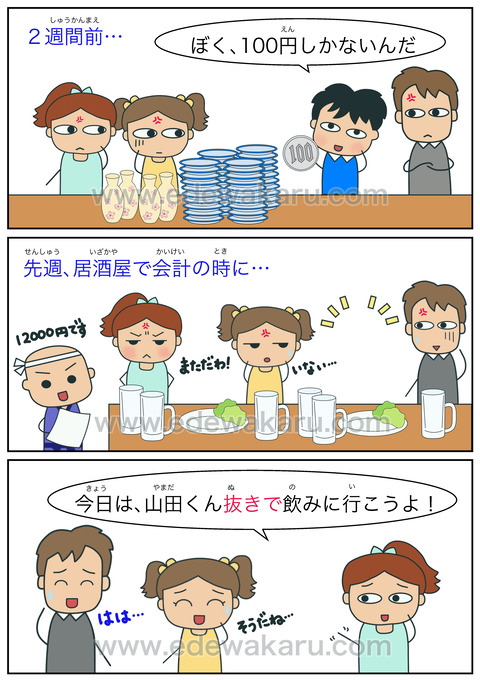
①Let’s go drinking today without Yamada-kun
→We usually go with Yamada-kun too, but today we’ll go without him
②A: What is decaf?
B: It’s coffee without caffeine
→Coffee normally contains caffeine, but decaf does not
③The children always eat sushi without wasabi
→Sushi normally has wasabi, but they eat it without any
④I overslept after going back to sleep, so today I came to work without breakfast
→I usually eat breakfast, but today I came to work without it
Remember that when a noun follows, the form is “〜抜きの + noun.”
[Related grammar]
In context 4 examples
A:今日は、山田くん抜きで飲みに行こうよB:そうね。彼、いつも会計の時にいなくなるもんね
A: Let’s go drinking today without Yamada-kun. B: Sure. He always disappears when it’s time to pay, after all.
A:デカフェって何?B:カフェイン抜きのコーヒーのことよ
A: What is decaf? B: It’s coffee without caffeine.
子供たちは、いつもわさび抜きでお寿司を食べます
The children always eat sushi without wasabi.
二度寝してしまい、今日は朝ごはん抜きで会社に来た
I went back to sleep and overslept, so I came to work without breakfast today.
Read the original source text
Meaning
〜なしで〜する
〜はなしにして〜する
How to use it
名詞[辞書形] +抜きで
名詞[辞書形]+抜きの+名詞
Explanation
「〜抜きで」は「〜なしで〜する」という意味を表す文型です。「普通あるものはなしで〜する」「いつもいる人はなしで〜する」と言いたい時に使われます。
[例]
①今日は山田くん
抜きで
飲みに行こうよ
→いつも山田くんも一緒に行くが、今日は山田くんなしで行く
②A:デカフェって何?
B:カフェイン
抜きの
コーヒーのことよ
→コーヒーには普通カフェインが入っているが、デカフェには入っていない
③子供たちは、いつもわさび
抜きで
お寿司を食べます
→お寿司には普通わさびが入っているが、入っていないものを食べる
④二度寝してしまい、今日は朝ごはん
抜きで
会社に来た
→いつもは朝ごはんを食べるが、今日は朝ごはんなしで会社に来た
後ろに名詞がくる場合は「〜抜きの+名詞」になると覚えておきましょう。
【関連文法】
日本語NET JLPT文法解説まとめ
Meaning
Without taking ~ into consideration / excluding ~
How to use it
N + は抜きにして
Explanation
without
In context 13 examples
冗談は抜きにして、そろそろ本題に入りましょう。
Joking aside, let's get down to business soon.
彼のギャグは冗談抜きで、笑えない。
His jokes are seriously not funny.
2組の田中君、冗談抜きでかっこいいよね。
Tanaka from Class 2 is seriously good-looking, isn't he?
毎回、遅刻してくるし、今度のパーティーはキムさん抜きでやろうか。
He is late every time, so shall we have the next party without Kim?
お世辞抜きで、ジョンさんの日本語はネイティブ並みにすごいよ。
Without flattery, John's Japanese is amazing, on a native-speaker level.
すみません、ワサビ抜きでお願いできますか。
Excuse me, could I get that without wasabi?
チーズバーガー1つ。ピクルス抜きでお願いします。
One cheeseburger, please. No pickles.
彼抜きでは、このプロジェクトは成功しなかっただろう。
This project probably wouldn't have succeeded without him.
堅い話は抜きにして、今日は楽しく飲みましょう。
Let's leave serious talk aside and enjoy some drinks today.
いい加減にしなさい!今日はもう晩ご飯抜きよ!
That's enough! No dinner for you tonight!
本人抜きで、話を勝手に進めるのはちょっと・・・。
It's a bit... to move things along without the person concerned.
今度は偉い人抜きで、若手だけで飲みに行きましょう。
Next time, let's go out for drinks with just the younger employees, without the senior people.
私の人生は彼女抜きでは語れない。
My life cannot be told without her.
Read the original source text
Meaning
〜を考慮に入れず / 〜を除いて
How to use it
N + は抜きにして
Explanation
without
毎日のんびり日本語教師
Usage 1
Read this source entry ↗How to use it
Noun + 抜きで
Noun + 抜きの
Noun + は抜きで
Noun + は抜きにして
Noun + を抜きにして
Explanation
Indicates omitting or removing the thing in question. The latter part describes doing something in that state.
Notes
Nothing in particular.
In context 9 examples
体臭がひどいのは冗談抜きでNG。
Severe body odor is unacceptable, no joke.
あいつはお世辞抜きで本当にすごいと思う。
I think that guy is truly amazing, no flattery.
小難しいことは抜きにしてただ楽しめばいい。(不拘小难只要享受就好。)
Just enjoy yourself without worrying about complicated things. (Just enjoy yourself without getting caught up in difficult details.)
堅苦しい挨拶は抜きにして、早速本題に入ろう。
Let’s skip the formal greetings and get straight to the main topic.
解説抜きで見るスポーツの試合はあまり面白くない。
Watching a sports game without commentary isn’t very interesting.
炭水化物抜きのダイエットは健康に良くない。
A carbohydrate-free diet is not good for your health.
勝ち負けの話は抜きにして、お互いよくやったと思う。
Putting aside talk of winning and losing, I think we both did well.
そういう暗い話は抜きにしませんか。
Could we leave out that kind of gloomy talk?
先入観を抜きにして考えるべきだ。
We should think about it without preconceptions.
Read the original source text
How to use it
名詞+抜きで
名詞+抜きの
名詞+は抜きで
名詞+は抜きにして
名詞+を抜きにして
Explanation
そのものを省略したり、取り除くことを表します。後項にはその状態で何かを行うことが述べられます。
Notes
特になし
Usage 2
Read this source entry ↗How to use it
Noun + (を)抜きに~ない
Noun + (を)抜きで~ない
Noun + (を)抜きにしては~ない
Explanation
Expresses that something is impossible without a certain thing.
The following clause pairs with a negative form such as 「~ない」, 「~できない」, 「~れない」, a negative potential form, or otherwise negative content.
Notes
Nothing in particular.
In context 8 examples
A社の歴史を語るなら、創業者の伝説抜きでは語れない。
You can't tell the history of Company A without the founder's legend.
朝ご飯抜きでは頭が働かない。
I can't think straight without breakfast.
私にとってはタバコ抜きでは生きていけない。
For me, I can't live without cigarettes.
国家の展望はエネルギー政策抜きには語れない。
The future outlook of a nation cannot be discussed without its energy policy.
その人を知るには、コミュニケーション抜きでは進まない。
You can't get to know someone without communication.
進歩は行動抜きにはありえない。
Progress is impossible without action.
近年の異常気象は地球温暖化の影響を抜きには考えにくい。
It's difficult to consider the abnormal weather in recent years without taking the effects of global warming into account.
この件は彼の協力抜きでは進められない。
This matter cannot be moved forward without his cooperation.
Read the original source text
How to use it
名詞+(を)抜きに~ない
名詞+(を)抜きで~ない
名詞+(を)抜きにしては~ない
Explanation
あるものが無ければ不可能であることを表します。
後項は「~ない」「~できない」「~れない」などの否定形、可能否定形、または否定的な内容が呼応します。
Notes
特になし
NINJAL 日本語文型データベース
Meaning
Use this when you want to say that you do something without including something that would normally be expected to be there.
How to use it
N抜きに
Notes
“~” is often something that would normally be expected to be there. The clause after “~抜きに” often describes an action.
When words such as “冗談” or “お世辞” come in “~,” words such as “言って” may be omitted, and the content one wants to express may follow directly after “~抜きに.”
In context 4 examples
子どもたち自身のことを子どもたち抜きに決めてはいけないだろう。
We shouldn’t decide things concerning the children without the children themselves.
せっかくの再会なんだから、今日は硬い話抜きに大いに飲もうじゃないか。
Since it’s a long-awaited reunion, let’s have a good drink today without talking about serious things.
「お世辞抜きに言うよ。君の歌はプロ級だよ」「うれしい! ありがとう」
“I’ll say this without flattery. Your singing is at a professional level.” “I’m so happy! Thank you.”
そのアイディアは面白い。冗談ぬきに、これは商品化するべきだと思う。
That idea is interesting. Seriously, I think we should turn it into a product.
Read the original source text
Meaning
あると予想される~を含めないで何かをすると言いたいときに使います。
How to use it
N抜きに
Notes
「~」には普通あると予想されるものがくることが多いです。「~抜きに」の後には、行為を表す文がくることが多いです。
「〜」に「冗談・お世辞」などの言葉がくる場合、「言って」などの言葉が省略されて「〜抜きに」の後に言いたい内容が直接くることもあります。