DoJG 日本語文法辞典(全集)
Meaning
Upon ~; after ~
How to use it
(i) Vinformal past | 上で | |
| 読んだ上で | Upon reading |
| 研究した上で | Upon conducting research |
(ii) Noun | の上で | |
| 調査の上で | After investigating |
| 討議の上で | After discussion |
Explanation
(の)上で A compound particle that is used to express a preparatory action for a relatively important action.
In context 10 examples
よく考えた上で御返事いたします。
I will reply upon careful consideration.
話し合いの上で結論を出したいと思います。
I would like to draw a conclusion after discussion.
よく問題を話し合った上で決めたらどうでしょうか。
Why don't we decide after discussing the matter?
実験をした上で、理論の正しさを証明しなければならない。
We have to prove the correctness of the theory after conducting an experiment.
日本文学のスミス先生と相談した上で、修士論文の題目を決めました。
I decided the topic of my M.A. thesis after consulting with Japanese literature Professor Smith.
彼女とはお見合いをして、一年間交際した上で、結婚に踏み切りました。
I decided to get married after meeting her through an arranged match and dating her for one year.
日本の生活は高くつくと知った上で、日本へ留学した。
I went to Japan to study, knowing that life is expensive there.
十冊ぐらい本を読んだ上で、学期末のレポートを書き上げた。
I finished writing my term paper after having read about 10 books.
面談の上で、採否を決めます。
After an interview we will decide whether or not to approve the adoption.
二人は協議の上で離婚した。
The two got divorced after reaching an agreement.
絵でわかる日本語
Usage 1
Read this source entry ↗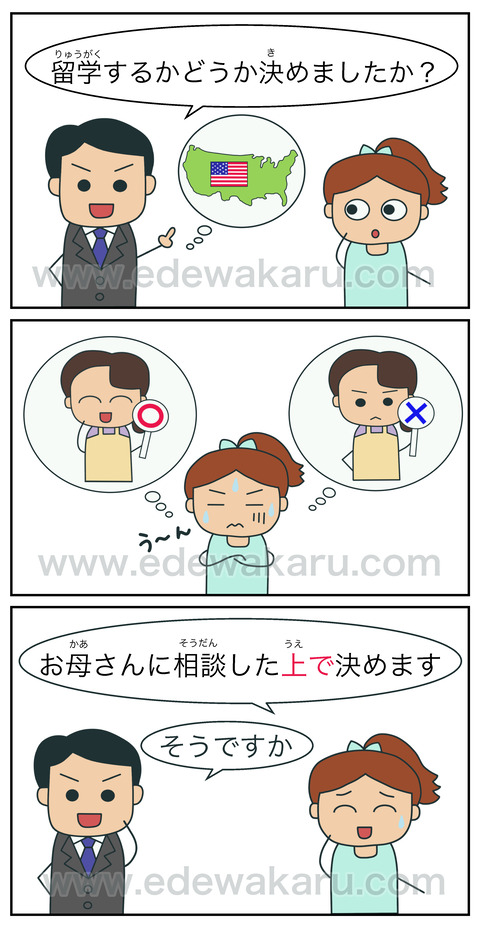
Meaning
First do 〜, then do 〜
Do 〜 first, and then do 〜
How to use it
Verb [た-form] + 上で
Explanation
“〜た上で” is a sentence pattern meaning “do 〜 first, then do 〜.” In the form “Aた上でBする,” it carries the sense that “in order to do B, you first have to do A.” 😮
[Examples]
① I’ll decide after consulting my mother.
[A] consult my mother
[B] decide whether or not to study abroad
→ In order to decide, I first have to consult my mother.
② I’ll contact you after thinking carefully about whether or not to buy this house.
[A] think carefully about whether or not to buy the house
[B] contact you about whether or not to buy the house
[For those with room to explore further]
“〜上で” can also connect to nouns, in the form “Nの上で.” In this case, you have to work out whether “〜上で” means “when doing 〜” or “do 〜 first, then do 〜.” 😨
[Examples]
I’ll decide after the interview.
= I’ll decide after conducting the interview.
Is there anything I should be careful about during the interview?
= Is there anything I should be careful about when being interviewed?
There are several sentence patterns containing “〜上,” so learn to distinguish between them. 😀
(Review: 〜上に)
(Review: 〜上で (Vる + 上で))
In context 4 examples
お母さんに相談した上で決めます
→まずお母さんに相談して、その後決めます(復習:「相談する」「相談にのる」)I’ll decide after consulting my mother. → I’ll consult my mother first, and then decide. (Review: “相談する” and “相談にのる”)
この家を買うかどうか、よく考えた上で連絡します
→この家を買うかどうか、まずよく考えてから連絡しますI’ll contact you after thinking carefully about whether or not to buy this house. → I’ll think carefully first about whether or not to buy this house, and then contact you.
よく考えた上で返事をください
→まずよく考えてから返事をくださいPlease think it over carefully before replying. → Please think it over carefully first, and then reply.
面接をした上で、誰を採用するか決定します
→まず面接をしてから、誰を採用するか決定しますWe’ll decide who to hire after conducting the interviews. → First we’ll conduct the interviews, and then decide who to hire.
Read the original source text
Meaning
まず〜をして、その後で〜する
まず〜をしてから〜する
How to use it
動詞[た形]+上で
Explanation
「〜た上で」は「まず〜してから、〜する」という意味を表す文型です。この文型は
「Aた上でBする」の形で「Bをするためには、まずAをしなければならない」というような意味が含まれます
😮
[例]
①お母さんに相談した
上で
決めます
【A】お母さんに相談する
【B】留学するかどうか決める
→決めるためには、まずお母さんに相談しなければならない
②この家を買うかどうか、よく考えた
上で
連絡します
【A】家を買うかどうか、よく考える
【B】家を買うかどうかを連絡する
【余裕のある人へ】
「〜上で」には名詞接続(めいしせつぞく)もあり、「Nの上で」の形で使われます。この場合、「〜上で」が「〜する場合」か「まず〜てから〜する」のどちらの意味かを考えなければなりません😨
[例]
面接
の上で
決定します
=面接し
た上で
決定します
面接
の上で
注意しなければいけないことはありますか?
=面接を受け
る上で
注意しなければいけないことはありますか?
「〜上」とつく文型はいくつかありますので区別して覚えましょう😀
(復習:〜上に)
(復習:〜上で(Vる+上で))
Usage 2
Read this source entry ↗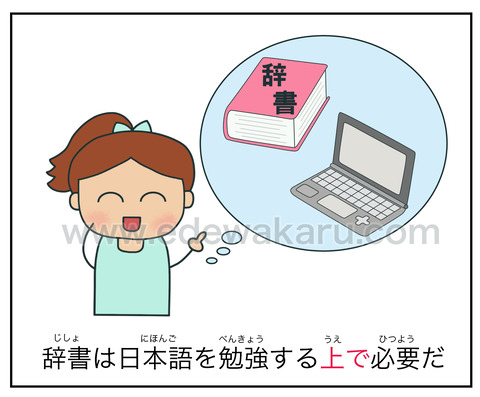
Meaning
when doing 〜
in the process of doing 〜
How to use it
Verb [dictionary form] + 上で
Noun [dictionary form] + の上で
Explanation
“〜上で” is a sentence pattern meaning “when doing 〜.” It is often used when you want to say what to pay attention to or be careful about in that 【situation】 or 【process】. 😊
There are several sentence patterns containing “〜上.” Some are read “うえ,” and others “じょう.” 😨 Also, their meanings differ depending on the particle that follows, so learn to distinguish them from other patterns to avoid confusion. 😉
(Review: 〜によって (distinction))
(Review: 〜上に)
In context 4 examples
辞書は日本語を勉強する上で必要だ
→辞書は日本語を勉強する場合に必要だA dictionary is necessary when studying Japanese. → A dictionary is necessary when studying Japanese.
海外旅行(かいがいりょこう)に行く上で注意しなくちゃいけないことって何?
→海外旅行に行く場合に注意しなくちゃいけないことって何?(復習:口語形「〜なくちゃ」)(復習:口語形「〜って」)What should I be careful about when traveling overseas? → What should I be careful about when traveling overseas? (Review: colloquial form “〜なくちゃ”) (Review: colloquial form “〜って”)
面接を受ける上で準備しなければいけないものはありますか?
→面接を受ける場合に準備しなければいけないものはありますか?(復習:「テストをする」「テストを受ける」)Is there anything I need to prepare when attending an interview? → Is there anything I need to prepare when attending an interview? (Review: “テストをする” and “テストを受ける”)
留学する上で気をつけなければいけないことはたくさんある
→留学する場合に気をつけなければいけないことはたくさんあるThere are many things you have to be careful about when studying abroad. → There are many things you have to be careful about when studying abroad.
Read the original source text
Meaning
〜する場合
〜する過程で
How to use it
動詞[辞書形]+上で
名詞[辞書形]+の上で
Explanation
「〜上で」は「〜する場合〜」という意味を表す文型です。その【場合】や【過程】で、注意することや気をつけることなどを言いたい時にとてもよく使います😊
「〜上」という文型はいくつかあります。読み方も
「うえ」
と読むものと
「じょう」
と読むものがあります😨また、
後ろにくる助詞によって意味が違います
ので、他の文型と混乱しないように区別して覚えておきましょう😉
(復習:〜によって(区別))
(復習:〜上に)
どんなときどう使う 日本語表現文型辞典
Usage 1
Meaning
for, in order to
How to use it
Vる/noun of a する verb の+上で
Explanation
うえで〈目的〉
~のに
「~上で」の形で、「~」に積極的な目的を示し、後にその目的や目標に必要なこと、大切なことなどを述べる文が来る。行為を表す文は来ない。
◆ × 日本での生活の上でいろいろなものを買った。
After indicating a goal to actively work toward, second phrase explains what is necessary or important to achieve that goal or objective. Does not take verbs of action.
In context 5 examples
今度の企画を成功させる上で、ぜひみんなの協力が必要なのだ。
Everyone's cooperation is essential to making this project a success.
数学を学習する上で大切なことは、基礎的な事項をしっかり身につけることだ。
The important thing when studying mathematics is to firmly master the fundamentals.
有意義な留学生活を送る上での注意点は下記のとおりです。
The points to keep in mind for a meaningful study-abroad experience are as follows.
テレビは外国語の勉強の上でかなり役に立ちます。
Television is quite useful for studying a foreign language.
食料品の保存の上で、次のことに注意してください。
Please keep the following points in mind when storing food.
Read the original source text
Meaning
for, in order to
How to use it
Vる/する動詞のNの+上で
Explanation
うえで〈目的〉
~のに
「~上で」の形で、「~」に積極的な目的を示し、後にその目的や目標に必要なこと、大切なことなどを述べる文が来る。行為を表す文は来ない。
◆ × 日本での生活の上でいろいろなものを買った。
After indicating a goal to actively work toward, second phrase explains what is necessary or important to achieve that goal or objective. Does not take verbs of action.
Usage 2
Meaning
after having
How to use it
Vた/noun of a する verb の+上で
Explanation
まず~してから
1)「~上で…」の形で、まず「~」をした後で、それに基づいて「…」という次の行動をとる、という意味。
2)「うえで」の前後の動詞は、意志動詞が来る。
2)Verbs of volition precede or follow うえで.
1)After first doing one thing, another action based on the first will occur.
In context 4 examples
詳しいことはお目にかかった上で、説明いたします。
I will explain the details after we meet in person.
申込書の書き方をよく読んだ上で、記入してください。
Please fill it out after reading the instructions on how to complete the application form carefully.
どの大学を受験するか、両親との相談の上で、決めます。
I will decide which university to apply to after consulting with my parents.
これは一晩考えた上での決心だから、気持ちが変わることはない。
This is a decision I made after thinking it over all night, so I won't change my mind.
Read the original source text
Meaning
after having
How to use it
Vた/する動詞のNの+上で
Explanation
まず~してから
1)「~上で…」の形で、まず「~」をした後で、それに基づいて「…」という次の行動をとる、という意味。
2)「うえで」の前後の動詞は、意志動詞が来る。
2)Verbs of volition precede or follow うえで.
1)After first doing one thing, another action based on the first will occur.
日本語NET JLPT文法解説まとめ
Usage 1
Read this source entry ↗Meaning
“First do ~, and then…”
It indicates that the preceding action is not merely followed by the subsequent action; rather, the preceding action is a prerequisite for the subsequent action to occur.
How to use it
V (た-form) + 上で
N + の上で
Explanation
"first, do ~ "
It expresses that the preceding event is not just followed by the subsequent event, but is a prerequisite for the subsequent event to occur.
Only volitional verbs connect to this construction.
In context 10 examples
進学先は親と話し合った上で、決めます。
I’ll decide where to go to school after discussing it with my parents.
こちらの商品は、きちんと取扱説明書を読んだ上で、使用してください。
Please read the instruction manual carefully before using this product.
実際に見た上で購入するかどうか考えます。
I’ll consider whether to buy it after seeing it in person.
両親ともしっかり話し合った上で、留学することに決めました。
After discussing it thoroughly with my parents, I decided to study abroad.
次の打ち合わせの日程ですが、スケジュールを確認した上でご連絡いたします。
Regarding the date of our next meeting, I’ll check my schedule and then contact you.
今回の企画は部内で何度も話し合いの上で、決めた内容でございます。
This plan was decided after many discussions within our department.
参加費を事前にお支払いの上で、ご参加ください。
Please pay the participation fee in advance before joining.
契約内容をしっかりご確認の上で、サインをお願いします。
Please carefully check the terms of the contract before signing.
この製品を我が社で採用するかどうかは、部内で検討の上で、決定します。
Whether our company adopts this product will be decided after deliberation within the department.
危険を承知の上で、彼は戦場へと足を運んだ。
Knowing the danger, he set foot on the battlefield.
Read the original source text
Meaning
"まず〜してから"
単に「前件が起こる→後件が起こる」ではなく、前件は後件が起こるための前提条件であることを表す。
How to use it
V(タ形) + 上で
N + の上で
Explanation
"first, do ~ "
It expresses that the preceding event is not just followed by the subsequent event, but is a prerequisite for the subsequent event to occur.
接続する動詞は意志動詞のみ
Usage 2
Read this source entry ↗Meaning
For ~ / in order to ~.
How to use it
V (dictionary form) + 上で
N + の上で
Explanation
in order to / for
Read the original source text
Meaning
〜ために / 〜のに
How to use it
V(辞書形) + 上で
Nの + 上で
Explanation
in order to / for
毎日のんびり日本語教師
How to use it
Verb dictionary form + 上で
Explanation
This pattern describes problems that arise when doing something.
The following part describes some kind of problem that arises, or how to deal with that problem.
Notes
The 「上」 series
In context 14 examples
中古車を買う上で注意しなければならないことは何ですか。
What should I be careful about when buying a used car?
企画を実施する上で、これは重要だ。
In carrying out the project, this is important.
西洋文化を理解する上で、キリスト教文化は欠かせない。
Christian culture is indispensable for understanding Western culture.
あの人は計画を遂行する上でどうしても必要な存在だ。
That person is absolutely essential to carrying out the plan.
成功する上で最も大切なのは己と成功者との距離だ。(成功最重要的是自己与成功者的距离。)
The most important thing for success is the distance between oneself and successful people. (The most important thing for success is the distance between oneself and successful people.)
目的を達成する上で足枷となるものを排除しなければならない。
We must eliminate anything that stands in the way of achieving our goal.
失敗は人間が成長する上で必ず通る道だ。
Failure is a road everyone must travel on the way to growing as a person.
お酒の場は本音が出やすく、仕事をする上で重要なことが得られるところだ。
Drinking occasions are places where people are more likely to speak their minds and where you can learn important things for work.
趣味を継続する上で他人に迷惑かけるなんていうのは以ての外。
It is absolutely out of the question to inconvenience others in order to keep up a hobby.
音楽はやっぱり生きていく上で不可欠だと思う。
I think music really is indispensable for living.
成長する上で素直さがあれば、知らないことに謙虚な姿勢で向き合い教えてもらうことができる。
If you are open-minded as you grow, you can approach what you don't know with humility and learn from others.
筋肉を付ける上で最も重要なのはたんぱく質だ。
Protein is the most important thing for building muscle.
経済を学ぶ上で、まず自国の経済を知っておくことは基本です。
When studying economics, it is basic to first learn about your own country's economy.
ホウレンソウは仕事の上での鉄則。(“菠菜”法制—报告联络商量是工作的准则。)
The “report, communicate, and consult” rule is fundamental at work.
Read the original source text
How to use it
動辞形+上で
Explanation
ある物事をする時に生じる問題について述べる文型です。
後件では何らかの問題が生じること、あるいはその問題に対する対応などが述べられます。
Notes
「上」シリーズ
AIUEO JLPT Grammar
Meaning
This sentence pattern indicates that a certain action or judgment is based on a specific condition or foundation. It demonstrates a premise for performing an action or making a decision.
How to use it
Noun + の + 上で or 上では; verb in た-form + 上で or 上では
In context 5 examples
契約書を確認した上で、サインをお願いします。
Please sign the contract after reviewing it.
計画を立てた上で、実行に移してください。
Please proceed after making a plan.
健康の上では、毎日の運動が重要です。
Daily exercise is important for health.
新しい提案は慎重に検討した上での決定です。
The new proposal is a decision made after careful consideration.
データ上では何の問題も無かった。
There was nothing wrong with the data.
Read the original source text
Meaning
This sentence pattern indicates that a certain action or judgment is based on a specific condition or foundation. It demonstrates a premise for performing an action or making a decision.
How to use it
名詞の+上でor上では動詞た形+上でor上では
Explanation · 日本語
この文型は、ある条件や基礎をもとにして、その上で行われる動作や判断を表す表現です。この表現は、特定の行為や状況が成立するための前提条件や基盤を示します。
Bunpro Grammar Reference
Meaning
After, Upon
How to use it
Verb[た]+ 上で
Noun + の + 上で
Nuance
A slightly formal expression that highlights something that logically occurs after or upon (A).
Explanation
上で is an expression in Japanese that is used after the past form of verbs, or nouns followed by の. It shows that something will happen 'after (A)', or 'upon (A)'. This grammar point is used in a similar way to its literal meaning, which is 'with the above/previous (A), (B)'. 上 as 'above', and で as 'with', in で's use as a case marking particle.
この企画は社長と相談した上で、キャンセルすることに決めました。
Upon consulting the CEO of the company, we have decided to cancel this project.
色んな車を運転した上で、どの車を買うか決めたいと思います。
Upon driving various cars, I would like to choose which car to purchase.
以下の内容を確認の上で、サインをしてください。
Upon confirming the details below, please sign your name.
以下のリンクからログインの上で、内容変更をしてください。
Upon logging in from the link below, please change your information.
上で is a structure that is primarily used in formal settings. Due to this, it will not be used in casual conversations very often. It also strongly hints at (A) being a requirement for (B), or (A) being something that would logically be expected before (B).
こちらの商品は医者に相談した上で、使用してください。
Please use this product upon consulting with a doctor.
Caution
Due to 上で being used to show logical progressions from (A) to (B), (A) cannot be a verb that is passive. Passivity in Japanese often implies that someone/thing has a lack of control in relation to the actions that happen to them/it. As a result of this, (A) not being able to be controlled would result in (B) sounding like it could not be planned for.
医者に教えられた上で、使用してください。
Please use this upon being told to by a doctor. (Unnatural)
This is different to the way that passivity works in English (simply showing that something received an action upon it).
In context 18 examples
- 家の中を見た上で、買おうと思っている。
I am thinking that I will buy the house after I have seen the inside. (upon)
- 色んな車を運転した上で、どの車を買うか決めたいと思います。
Upon driving various cars, I would like to choose which car to purchase.
- こちらの商品は医者に相談した上で、使用してください。
Please use this product upon consulting with a doctor.
- この企画は社長と相談した上で、キャンセルすることに決めました。
Upon consulting the CEO of the company, we have decided to cancel this project.
- 以下の内容を確認の上で、サインをしてください。
Upon confirming the details below, please sign your name.
- 以下のリンクからログインの上で、内容変更をしてください。
Upon logging in from the link below, please change your information.
- 説明書を読んだ上で、ご使用ください。
Please use it after reading the instructions. (upon)
- 変更した上で、間違いがあるかどうか確認するべきだ。
After making changes, you should check whether or not there are any mistakes. (upon)
- 妻と相談した上で、手術を受けることを決めたいと思う。
I would like to make the decision about undergoing surgery, after I discuss it with my wife. (upon)
- 慎重な調査の上で、被告は有罪と決定しました。
Upon careful investigation, the defendant has been found guilty. (after)
- 十分付き合った上で、彼女と結婚したいかどうか決めます。
After going steady for a sufficient amount of time, I will decide whether or not I want to marry her. (upon)
- アンケート用紙に記入した上で、来店していただけると助かります。
It would help us a lot if you would fill out the questionnaire before (upon) coming into our shop/restaurant. (after)
- 3年間、日本語を勉強した上で、日本に仕事を見つけに行くことを決めた。
After learning Japanese for three years, I decided to go to Japan to look for a job. (upon)
- ちゃんと調査した上で、報告書を提出してください。
I want you to submit your report after you have done the proper amount of research. (upon)
- メンバー全員に確認した上で、結果を教えてほしい。
I want you to let me know the results after confirming with all members. (upon)
- 住民と協議の上で、橋を開通するかどうか結論を出したいと思います。
We would like to come to a conclusion on whether or not to open the bridge to traffic upon consulting with the inhabitants. (after)
- わが社は研究結果を詳細に分析した上で、その化学物質を製造することに決めた。
After detailed analysis of study results, our company decided to produce that chemical substance. (upon)
- 医者に教えられた上で、使用してください。
Please use this upon being told to by a doctor. (Unnatural)
Read the original source text
Meaning
After, Upon
How to use it
Verb[た]+ 上で
Noun + の + 上で
Nuance
A slightly formal expression that highlights something that logically occurs after or upon (A).
Explanation
上で is an expression in Japanese that is used after the past form of verbs, or nouns followed by の. It shows that something will happen 'after (A)', or 'upon (A)'. This grammar point is used in a similar way to its literal meaning, which is 'with the above/previous (A), (B)'. 上 as 'above', and で as 'with', in で's use as a case marking particle.
この企画は社長と相談した上で、キャンセルすることに決めました。
Upon consulting the CEO of the company, we have decided to cancel this project.
色んな車を運転した上で、どの車を買うか決めたいと思います。
Upon driving various cars, I would like to choose which car to purchase.
以下の内容を確認の上で、サインをしてください。
Upon confirming the details below, please sign your name.
以下のリンクからログインの上で、内容変更をしてください。
Upon logging in from the link below, please change your information.
上で is a structure that is primarily used in formal settings. Due to this, it will not be used in casual conversations very often. It also strongly hints at (A) being a requirement for (B), or (A) being something that would logically be expected before (B).
こちらの商品は医者に相談した上で、使用してください。
Please use this product upon consulting with a doctor.
Caution
Due to 上で being used to show logical progressions from (A) to (B), (A) cannot be a verb that is passive. Passivity in Japanese often implies that someone/thing has a lack of control in relation to the actions that happen to them/it. As a result of this, (A) not being able to be controlled would result in (B) sounding like it could not be planned for.
医者に教えられた上で、使用してください。
Please use this upon being told to by a doctor. (Unnatural)
This is different to the way that passivity works in English (simply showing that something received an action upon it).
Nuance · 日本語
(A)の直後、又は(A)が原因で何かが起こるということを少し丁寧に強調する表現。
Explanation · 日本語
「上で」は、「(A) をしてから」や「(A) をした後で」を意味する表現です。動詞の過去形や「の」が付いた名詞のあとで使われます。この文法は、名詞の「上」と格助詞の「で」からできていて、「まず (A) をして、そのあとに (B) をする」という流れを表すときに使われます。
この企画は社長と相談した上で、キャンセルすることに決めました。
Upon consulting the CEO of the company, we have decided to cancel this project.
色んな車を運転した上で、どの車を買うか決めたいと思います。
Upon driving various cars, I would like to choose which car to purchase.
以下の内容を確認の上で、サインをしてください。
Upon confirming the details below, please sign your name.
以下のリンクからログインの上で、内容変更をしてください。
Upon logging in from the link below, please change your information.
「上で」は、かたい表現なので、日常のくだけた会話ではあまり使われません。(A) が (B) のための条件であるときや、(A) のあとに (B) をするのが自然であるときによく使われます。
こちらの商品は医者に相談した上で、使用してください。
Please use this product upon consulting with a doctor.
注意点
「上で」の文の (A) と (B) には、自分の意思で行う行動が入ります。また、「上で」を使うときは、(A) に受け身の動詞を使うことはできません。日本語の受け身は、その動作を自分の意思では変えられないことを表すことが多いためです。
医者に教えられた上で、使用してください。
Please use this upon being told to by a doctor. (Unnatural)
文法
Usage 1
Meaning
First do 〜, and then…
This does not simply mean “the first clause happens → the second clause happens”; it indicates that the first clause is a prerequisite for the second clause to happen.
How to use it
V (た-form) + 上で
N + の上で
Notes
Only volitional verbs connect to this construction.
In context 10 examples
進学先は親と話し合った上で、決めます。
I’ll decide where to go to school after discussing it with my parents.
こちらの商品は、きちんと取扱説明書を読んだ上で、使用してください。
Please read the instruction manual carefully before using this product.
実際に見た上で購入するかどうか考えます。
I’ll consider whether to buy it after seeing it in person.
両親ともしっかり話し合った上で、留学することに決めました。
After discussing it thoroughly with my parents, I decided to study abroad.
次の打ち合わせの日程ですが、スケジュールを確認した上でご連絡いたします。
Regarding the date of our next meeting, I’ll check my schedule and then contact you.
今回の企画は部内で何度も話し合いの上で、決めた内容でございます。
This plan was decided after many discussions within our department.
参加費を事前にお支払いの上で、ご参加ください。
Please pay the participation fee in advance before joining.
契約内容をしっかりご確認の上で、サインをお願いします。
Please carefully check the terms of the contract before signing.
この製品を我が社で採用するかどうかは、部内で検討の上で、決定します。
Whether our company adopts this product will be decided after deliberation within the department.
危険を承知の上で、彼は戦場へと足を運んだ。
Knowing the danger, he set foot on the battlefield.
Read the original source text
Meaning
まず〜してから。
単に「前件が起こる→後件が起こる」ではなく、前件は後件が起こるための前提条件であることを表す。
How to use it
V(タ形) + 上で
N + の上で
Notes
接続する動詞は意志動詞のみ
Usage 2
Meaning
For ~ / in order to ~.
How to use it
V (dictionary form) + 上で
N + の上で
In context 6 examples
外国人を採用する上で、私たちが見ているのは日本語能力だけではありません。
When hiring foreign nationals, what we look at is not only their Japanese-language ability.
今度の文化祭を成功させる上で必要なのはクラスの団結力だ。
What is needed to make the upcoming cultural festival a success is the class’s unity.
言語を学習する上で大切なのは、インプットとアウトプットのバランスだ。
When learning a language, what matters is the balance between input and output.
海外旅行を楽しむ上で一番重要なことは、安全管理だろう。
The most important thing for enjoying overseas travel is probably safety management.
辞書は外国語を学ぶ上で欠かせない。
A dictionary is indispensable for learning a foreign language.
ノートパソコンは仕事の上で欠かせない道具だ。
A laptop is an essential tool for work.
Read the original source text
Meaning
〜ために / 〜のに
How to use it
V(辞書形) + 上で
Nの + 上で
NINJAL 日本語文型データベース
Usage 1
Meaning
Used when you want to say that you do the next action after “〜.” “〜” is often preparation for the next action, expressing that you proceed to the next action on the condition of “〜.”
It is also used in the form “〜上でのN.”
How to use it
Notes
The subject of the sentence before “〜” and the sentence after “〜上で” is the same. Both “〜” and the sentence after “上で” take expressions for intentional actions.
In context 14 examples
受験する大学は、両親とよく相談した上で決めたいです。
I want to decide which university to apply to after discussing it thoroughly with my parents.
試験のときは、問題の指示をよく読んだ上で解答してください。
During the exam, read the instructions for each question carefully before answering.
十分予習した上で授業に出席したほうがよく理解できるはずだ。
You should be able to understand better if you attend class after preparing thoroughly.
選挙では、候補者が訴える政策や主張をよく理解した上で投票するべきだ。
In an election, you should vote after carefully understanding the policies and positions advocated by the candidates.
周辺住民の方々の了解を得た上で、マンション建設工事に着工したいと考えております。
We are considering beginning construction of the apartment building after obtaining the understanding of the surrounding residents.
テニス初心者の方にも丁寧に指導いたします。実際にレッスンを体験なさった上で入会をご検討ください。
We provide careful instruction even for tennis beginners. Please try an actual lesson before considering enrollment.
間違い電話が増えておりますので、電話番号をよくお確かめの上でおかけください。
There have been more wrong-number calls, so please check the phone number carefully before calling.
入学の手続きにつきましては、下記の口座に入学金をお振り込みの上で、窓口に書類をお持ちください。
For enrollment procedures, please transfer the admission fee to the account below, then bring your documents to the counter.
取締役員会議で検討の上で、新規事業の立ち上げが決定された。
After consideration at the board of directors’ meeting, the launch of the new business was decided.
十分な在庫を確保の上で販売を行っておりますが、万一売り切れの際はご容赦ください。
We sell only after securing sufficient stock, but please understand that items may sell out.
本講座はオンラインで開催されますので、インターネットに接続可能なパソコンまたはスマートフォン・タブレット端末をご準備の上で、お申し込みください。
This course will be held online, so please prepare a computer, smartphone, or tablet that can connect to the internet before applying.
中古品であることは双方合意の上での取り引きだったのだから、それが後で問題になることはないはずだ。
Since both parties agreed that the item was secondhand before making the transaction, it should not become an issue later.
議長「最後に、これまでの意見を整理し、その上で採決をしたいと思います」
Chair: “Finally, I would like to organize the opinions expressed so far and then hold a vote.”
ウェブサイト制作のご注文にあたっては、まずプランをご選択ください。その上でご要望に合ったデザインを提案させていただきます。
When ordering website production, please first select a plan. After that, we will propose a design suited to your needs.
Read the original source text
Meaning
~の後で、次の行為をすると言いたいときに使います。「〜」が次の行為の準備であることが多く、「〜」を条件として次の行為に進むということを表します。
「〜上でのN」の形でも使います。
How to use it
Notes
「〜」と「〜上で」の後の文の主語は同じです。「〜」にも「上で」の後の文にも意志的な行為を表す言葉がきます。
Usage 2
Meaning
Used when you want to talk about things that must be considered for an important purpose such as “〜.”
It is also used in the form “〜上でのN.”
How to use it
Vる上で
Nの上で (N is a noun of a suru verb)
Notes
“〜” takes a verb expressing an intentional action. After “〜上で,” a sentence follows that describes what is necessary or important for it, or what presents a problem.
In context 11 examples
留学する上で、事前に何を準備しておけばいいか調べることは重要だ。
When studying abroad, it is important to find out in advance what you should prepare.
健康的な生活を送る上で、栄養バランスの取れた食事は欠かせない。
A nutritionally balanced diet is essential for living a healthy life.
この商談を成功させる上で、どうしてもあなたの協力が必要なんです。
Your cooperation is absolutely necessary to make this business negotiation a success.
過剰なプライドは、生きていく上で邪魔になることが多い。
Excessive pride often gets in the way of living.
これからのまちづくりを考える上では、公共交通機関のあり方を見直す必要がありそうだ。
When thinking about future community development, it seems necessary to reconsider the role of public transportation.
こちらの説明書には、この製品を安全にお使いいただく上での注意点が書かれていますので、ご一読ください。
This instruction manual lists points to keep in mind in order to use this product safely, so please read it.
今回発見された遺跡は、他国文明との比較の上で非常に注目される。
The ruins discovered this time are attracting considerable attention in comparison with the civilizations of other countries.
犯人逮捕の上で重要になってくるのは、証拠品の有無だ。
What becomes important in apprehending the criminal is whether there is physical evidence.
インタビュアー「海外進出の上で一番苦労されたのはどういった点でしょうか」社長「現地のスタッフとのコミュニケーションですね」
Interviewer: “What was the most difficult aspect of expanding overseas?” President: “Communicating with the local staff.”
学校生活の上では、勉強だけでなく友人との関係作りも大切だ。
In school life, building relationships with friends is important as well as studying.
減塩しながらおいしく食べるには、調理の上での工夫も必要だ。
To eat deliciously while reducing salt, ingenuity in cooking is also needed.
Read the original source text
Meaning
大切な〜という目的のためにどうしても考えるべきことなどを言いたいときに使います。
「〜上でのN」の形でも使います。
How to use it
Vる上で
Nの上で(Nは、する動詞のN)
Notes
「〜」には、意志的な行為を表す動詞がきます。「〜上で」の後には、そのために必要なこと・重要なこと・問題となることを表す文がきます。
Usage 3
Meaning
Used when you want to say what the judgment is when viewed from the perspective of “〜,” when making a judgment based on “〜,” or when considering something within the scope of “〜.”
It is also used in the form “〜上でのN.”
How to use it
Nの上で
In context 5 examples
どうしても勝ちたいという相手チームの気迫はすごかった。私たちのチームは、気持ちの上ですでに負けていた。
The opposing team’s determination to win at all costs was incredible. In terms of morale, our team had already lost.
健康診断でいろいろな検査をした。最近疲れやすいので気になっていたが、数値の上で問題はないらしい。
I had various tests during my health checkup. I was concerned because I have been getting tired easily lately, but apparently there is no problem with the numbers.
暦の上ではもう春ですが、肌寒い日が続いています。お元気ですか。
According to the calendar, it is already spring, but chilly days continue. How are you?
日本では、結婚後、戸籍の上では夫の姓だが、仕事では元の姓を名乗っている女性も多くなっている。
In Japan, after marriage, many women are increasing who use their husband’s surname on the family register but their original surname at work.
林田さんとは仕事の上でのつきあいだけで、プライベートで会ったことはない。
My relationship with Ms. Hayashida is strictly work-related; I have never met her privately.
Read the original source text
Meaning
~を見て判断すると・~を根拠として判断すると・~の範囲に限定して考えるとどうかを言いたいときに使います。
「〜上でのN」の形でも使います。
How to use it
Nの上で