文法
Meaning
when; on the occasion of
How to use it
V (dictionary form / ta-form) + 折りに
Nの + 折りに
Notes
① A more polite expression than “〜ときに.”
② It is not often used for negative matters.
③ There are set phrases such as “折りに触れて” and “折りを見て.”
In context 9 examples
次にお会いした折に、また詳しくお話いたします。
I will tell you more in detail when we meet next time.
中国へ旅行に行った折に、偶然昔の生徒に会った。
When I traveled to China, I happened to meet a former student.
先生、私の国へいらっしゃる折には、ご連絡ください。
Teacher, please contact me when you come to my country.
今後の方針については、次回の会議の折に詳しくご説明いたします。
I will explain our future policy in detail at the next meeting.
東京出張の折に、大学時代の友人に会った。
When I was on a business trip to Tokyo, I met a friend from university.
先生の家にお伺いする折に、本をお返しします。
I will return the book when I visit your house, Teacher.
お忙しい折にお邪魔して、申し訳ございませんでした。
I’m sorry for intruding when you were busy.
次回、お目にかかった折に、旅行の話を聞かせてくださいね。
When I see you next time, please tell me about your trip.
お寺へ行った折に、おみくじを引きました。
When I went to the temple, I drew a fortune slip.
Read the original source text
Meaning
〜ときに / 〜の機会に
How to use it
V(辞書形 / タ形)+ 折りに
Nの + 折りに
Notes
①「〜ときに」よりも丁寧な表現。
②マイナスのことにはあまり使われない。
③「折りに触れて」や「折りを見て」といった定型文句がある。
DoJG 日本語文法辞典(全集)
Meaning
On the occasion; at the time; when; if; opportunity; chance
How to use it
(i) Nounの | 折(に) | |
| 休暇の折(に) | On vacation |
(ii) Vinformal | 折(に) | |
| 京都へ{行く/行った}折(に) | When I go/went to Kyoto |
(iii) Adjectiveいinformal nonpast | 折(に) | |
| 寒さの厳しい折(に) | At a time when it is severely cold |
(iv) Adjectiveなstemな | 折(に) | |
| 暇な折(に) | When you have leisure time |
(v) Demonstrative adjective | 折(に) | |
| その折(に) | On that occasion; at that time |
Explanation
折(に) A noun indicating special/uncommon and primarily desirable occasions which someone takes advantage of, or where someone is expected to do something or where something desirable takes place.
In context 9 examples
上京の折(に)はぜひお立ち寄り下さい。
When you come up to Tokyo, please be sure to stop by.
この前日本に帰った折(に)高校時代の友達に会った。
When I returned to Japan last time, I met with my high school friends.
援助が必要な折(に)は早めに連絡して下さい。
If you need any help, please contact me sooner rather than later.
近くにお越しの折には、ぜひ当店をご利用下さい。
When you are in the area, please use our shop.
ロスへ出張した折に息子の様子を見るために大学の寮に寄ってみた。
When I was on business in L.A., I stopped by my son's university dormitory to see how he was doing.
都心に出た折に、古本屋街に足を延ばした。
When I went into downtown Tokyo, I also went (literally: extended my trip) to the used book store district.
こういうスーツを持っていれば冠婚葬祭の折に着るものを心配しなくてもいい。
If you have a suit like this, you don't have to worry what to wear for (literally: on the occasions of) weddings and funeral services.
卒業の折に親に買ってもらった時計をなくしてしまった。
I lost the watch my parents bought for me for my graduation.
私は大きな借金をかかえて途方にくれていました。そんな折に彼から電話があったのです。
I was saddled with debt and didn't know what to do. On that occasion, there was a call from him.
どんなときどう使う 日本語表現文型辞典
Meaning
whenever there is an occasion
How to use it
Vる・Vた/Nの+折(に)
Explanation
おり(に)
~機会に
「あるいい機会に」という意味であるから、後の文にはマイナスの事柄は来にくい。 ❹ のように手紙文の定型文句としての例もある。
Favorable occasion; negative phrasing usually does not follow. Also used as set phrase in letters, such as in sentence ❹ .おり
In context 4 examples
このことは今度お目にかかった折に詳しくお話しいたします。
I will explain this in detail when we meet next time.
先月北海道に行った折、偶然昔の友達に会った。
When I went to Hokkaido last month, I happened to meet an old friend.
何かの折にわたしのことを思い出したら手紙をくださいね。
If you think of me on some occasion, please write to me.
(手紙)寒さ厳しい折から、くれぐれもお体を大切にしてください。
(Letter) Now that the cold weather has set in, please take especially good care of yourself.
Read the original source text
Meaning
whenever there is an occasion
How to use it
Vる・Vた/Nの+折(に)
Explanation
おり(に)
~機会に
「あるいい機会に」という意味であるから、後の文にはマイナスの事柄は来にくい。 ❹ のように手紙文の定型文句としての例もある。
Favorable occasion; negative phrasing usually does not follow. Also used as set phrase in letters, such as in sentence ❹ .おり
絵でわかる日本語
Meaning
When 〜
How to use it
Verb [dictionary form or past form] + 折に
Noun [dictionary form] + の折に
Verb [dictionary form or past form] + 折には
Noun [dictionary form] + の折には
Explanation
“〜折に” is a pattern meaning “when 〜.” It is a formal and polite expression, so it is often used in situations where honorific language is used.
[For advanced learners]
“折り” means “opportunity.” Let’s learn some idiomatic expressions that use “折り” 😉
・
折があれば
→if there is an opportunity
・
折を見て
→when convenient
・
折に触れて
→whenever there is an opportunity
・
折も折
→right at that moment
There is a similar pattern, “〜際,” so let’s review it 😊
In context 5 examples
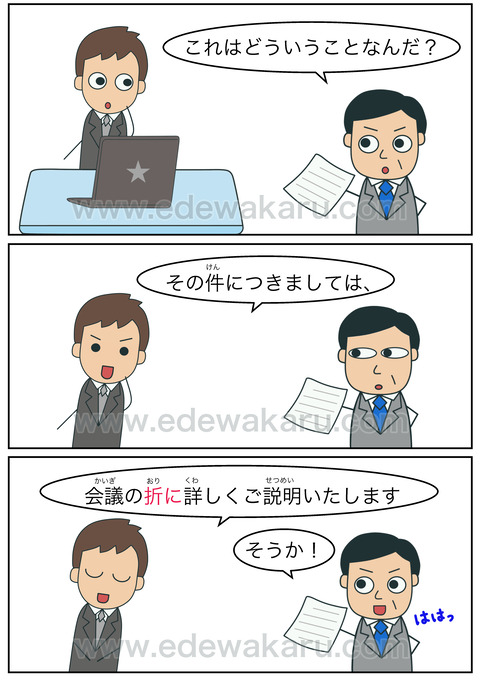
上司:これはどういうことなんだ?部下:その件につきましては、会議の折に詳しくご説明いたします上司:そうか
→会議の時に詳しくご説明いたしますBoss: What is the meaning of this? Subordinate: I will explain the matter in detail at the meeting. Boss: I see. →I will explain it in detail at the meeting.
東京にいらっしゃる折には、ぜひ遊びにきてくださいね
→東京にいらっしゃる時には、ぜひ遊びにきてくださいねWhen you come to Tokyo, please do come visit.
出張で東京に行った折に、お世話になった先生に会いに行った
→出張で東京に行った時に、お世話になった先生に会いに行ったWhen I went to Tokyo on a business trip, I went to see the teacher who had helped me.
お近くにいらっしゃる折には、お食事にでも行きましょう
→お近くにいらっしゃる時には、お食事にでも行きましょうWhen you’re in the neighborhood, let’s go out for a meal.
説明会の折に、偶然山田くんに会いました
→説明会の時に、偶然山田くんに会いましたI happened to run into Yamada at the information session.
Read the original source text
Meaning
〜時に
How to use it
動詞[辞書形・た形]+折に
名詞[辞書形]+の折に
動詞[辞書形・た形]+折には
名詞[辞書形]+の折には
Explanation
「〜折に」は「〜時に」という意味の文型です。かたくて丁寧な言い方ですので、敬語を使うような場面でよく使われます。
【上級レベルの人へ】
「折り」には「機会」という意味があります。「折り」を使った慣用表現(かんようひょうげん)を覚えておきましょう😉
・
折があれば
→機会があれば
・
折を見て
→都合がいい時
・
折に触れて
→機会がある時はいつも
・
折も折
→ちょうどその時
似ている文型に「〜際」がありますので、復習しておきましょう😊
日本語NET JLPT文法解説まとめ
Meaning
when; on the occasion of
How to use it
V (dictionary form / ta-form) + 折りに
Nの + 折りに
Explanation
when
① A more polite expression than “〜ときに.”
② It is not commonly used for negative situations.
③ There are set phrases such as “折りに触れて” and “折りを見て.”
① A more polite expression than "〜ときに"
② Not commonly used for negative situations.
③ There are set phrases like "折りに触れて" or "折りを見て."
In context 9 examples
次にお会いした折に、また詳しくお話いたします。
I will tell you more in detail when we meet next time.
中国へ旅行に行った折に、偶然昔の生徒に会った。
When I traveled to China, I happened to meet a former student.
先生、私の国へいらっしゃる折には、ご連絡ください。
Teacher, please contact me when you come to my country.
今後の方針については、次回の会議の折に詳しくご説明いたします。
I will explain our future policy in detail at the next meeting.
東京出張の折に、大学時代の友人に会った。
When I was on a business trip to Tokyo, I met a friend from university.
先生の家にお伺いする折に、本をお返しします。
I will return the book when I visit your house, Teacher.
お忙しい折にお邪魔して、申し訳ございませんでした。
I’m sorry for intruding when you were busy.
次回、お目にかかった折に、旅行の話を聞かせてくださいね。
When I see you next time, please tell me about your trip.
お寺へ行った折に、おみくじを引きました。
When I went to the temple, I drew a fortune slip.
Read the original source text
Meaning
〜ときに / 〜の機会に
How to use it
V(辞書形 / タ形)+ 折りに
Nの + 折りに
Explanation
when
①「〜ときに」よりも丁寧な表現。
② マイナスのことにはあまり使われない。
③「折りに触れて」や「折りを見て」といった定型文句がある。
① A more polite expression than "〜ときに"
② Not commonly used for negative situations.
③ There are set phrases like "折りに触れて" or "折りを見て."
NINJAL 日本語文型データベース
Meaning
It is used to mean “on the occasion of 〜” or “when 〜.” It is often used when you want to specify more clearly than with 「〜折」 exactly when something happens.
It is often used in formal, ceremonial situations.
「何かの折に」 is an idiomatic expression.
How to use it
Vる折に/Vた折に
i-Aい折に
na-Aな折に
Nの折に
Other forms
Notes
“〜” is a word denoting an opportunity or special event. Words with a negative connotation are not usually used.
If 「〜」 is a verb, it takes the dictionary form when it occurs at the same time as, or before, the action or event described in the sentence following 「〜折に」. It takes the past form if the event in the sentence following 「〜折に」 occurs after 「〜」 is completed.
In context 16 examples
次回御社を訪問させていただく折に、新製品のサンプルをお持ちできると思います。
When I next have the pleasure of visiting your company, I believe I’ll be able to bring samples of our new products.
また京都にいらっしゃる折には、ぜひご連絡ください。
Please be sure to contact me when you next come to Kyoto.
同窓会に参加した折に、久しぶりに木村先生にお目にかかれました。
When I attended the class reunion, I had the pleasure of seeing Professor Kimura for the first time in a long while.
上京した折には大変お世話になりまして、誠にありがとうございました。
Thank you very much for taking such good care of me when I visited Tokyo.
懇親会に参加できず、申し訳ございません。次回開催されます折には、ぜひ出席させていただければと存じます。
I apologize for being unable to attend the social gathering. I hope I will be able to attend the next time it is held.
急ぎではございませんので、ご都合のよい折にご返信いただければと思います。
There is no rush, so I would appreciate it if you could reply when it is convenient for you.
鯛は、正月などのおめでたい折によく食べられる魚です。
Sea bream is often eaten on festive occasions such as New Year’s.
駅前ギャラリーにて新作写真展「光」を開催しております。お暇な折に、お立ち寄りください。
We are holding a new photography exhibition, “Light,” at the station-front gallery. Please stop by when you have some free time.
天候の穏やかな折に、一度お訪ねしたいと思っております。
I would like to visit you sometime when the weather is mild.
山本先生には、研修の折に大変お世話になりました。
Professor Yamamoto was very helpful to me during the training.
新婚旅行の折にこちらのホテルを利用させていただきましたが、サービスもよく、快適に過ごせました。
I stayed at this hotel on my honeymoon, and the service was good, so I had a comfortable stay.
このバッグは、衣類を半分に圧縮して収納できます。旅行や出張などの折に、ご活用いただけます。
This bag compresses clothes to half their size for storage. It can be useful when traveling or going on business trips.
引っ越しました。お近くへお越しの折にはぜひお立ち寄りください。
I’ve moved. Please do stop by when you’re in the neighborhood.
先日は大変有意義なお話をお聞かせいただき、ありがとうございました。また何かの折にお目にかかれれば幸いでございます。
Thank you for sharing such a valuable discussion with me the other day. I hope to have the pleasure of seeing you again sometime.
来週御社に伺いますので、この件に関しましても、その折にご説明させていただきたいと思います。
I will be visiting your company next week, so I would like to explain this matter then as well.
入社して3年、仕事のやり方もわかってきて、そろそろ新しい挑戦をと考えていましたが、そんな折に上司から海外転勤のお話をいただき、迷わず承諾しました。
I’d been with the company for three years, had learned how to do my job, and was thinking it was about time for a new challenge. Just then, my supervisor offered me an overseas transfer, and I accepted without hesitation.
Read the original source text
Meaning
〜の機会に・〜のときに、と言いたいときに使います。「〜折」よりも、どの時点でのことかをはっきり言いたい場合によく使います。
改まった儀礼的な場面でよく使います。
「何かの折に」は慣用的な言い方です。
How to use it
Vる折に/Vた折に
i-Aい折に
na-Aな折に
Nの折に
その他
Notes
「〜」には、機会や特別な出来事を表す言葉がきます。ふつう、マイナスイメージの言葉は使いません。
「~」が動詞の場合、「~」が「〜折に」の後の文が表す動作・出来事の時点と同じか、それより前に起こるなら「~」は辞書形になります。「~」の完了後に、「〜折に」の後の文のことが起こるなら「~」はタ形になります。
IMABI
Occasion
Read this IMABI lesson ↗Explanation
Occasion: ~うえで, ~際に, ~折に, ~際して, ~に当たって, ~に先立って, ~を前に(して), ~を控えて, ~に臨んで, & ~に面して
There are several phrases in Japanese that relate to “on the occasion of”, but never are so many phrases in Japanese completely interchangeable. They do look similar. Writing style and nuances aid in distinguishing them. Don’t worry, though. Even if you get a lot of red after reading this lesson, at least your paper will be decorated.
~(の)うえで
~(の)うえで attaches to the 連体形 of verbs or to nouns to give a meaning of “on the occasion of”. Following it, a discussion concerning a point of concern is expected. Giving an explanation of a circumstance, it shows opinion/thought on an issue. When giving a meaning of ~ときに, ~際に and ~に際して become possible as well.
1. 研究を続けるうえで、中国に留学したほうがいいと判断した。
I have concluded that it is best for me to study abroad in China on the basis of continuing my studies.
2. 時間を守るということは、仕事{をする}うえで最低限さいていげんのマナーである。
Being punctual in the process of work is the minimum of manner.
From 中級日本語文法と教え方のポイント by 市川保子いちかわやすこ.
3. 住宅ローンを利用したいと思っているのですが、借りる{うえで・際(に)は・に際しては}どのようなことに注意し たらよいでしょうか。
I want to utilize a home loan, but on the occasion of borrowing, what sort of things would be good to pay attention to?
From 中級日本語文法と教え方のポイント by 市川保子いちかわやすこ.
~(の)際に
~(の)際(に) is like above in that it means “on the occasion of”. 際 grammatically behaves like any other noun. It is a rather hard and ceremonious phrase, and it has the nuance of coping well when encountering a particular incident.
4. 就任の際には、是非式に参加してください。
By all means, please participate in the ceremony on inauguration.
5. イースト菌はパンを膨ふくらませる際の作用剤さようざいだ。
Yeast is an agent that makes bread rise.
6. 地震の際はガスの元栓もとせんを閉めること。(Stern; 年齢的にも立場的にも上の人の言い方)
In case of an earthquake, turn off the gas at the main outlet.
~際に VS ~折に
~際に Shows a limit to one extraordinary time than other situations.
~折に Shows an opportunity that happens by a stroke of luck.
Remember that ~際に is used a lot as a formal version of ~とき, being used a lot in polite commands ~折に is very respectful and used a lot in letters and in set phrases such as 折りに触れて (on opportunity). If used in the spoken language, the speaker is most certainly old. Neither are appropriate in regular-place situations like ~とき is in the spoken language. Consider the following examples.
7. 出発の際に点呼てんこをとるから、全員、遅れないように、集合すること。
Since I will take roll call on our departure, everyone fall in so as to not be late!
8. お暇いとまな折にでも、お読みいただけましたら、幸甚こうじんに存じます。(手紙文)
I would be so obliged if you were to read this even during your spare time.
9. ひとしお残暑ざんしょの厳しき折、くれくれもご自愛くださいますように。(手紙文)
All the more in this heat of late summer, be sure to take good care of yourself.
Citation Note: These last three examples are from 日本語類義表現 使い分け辞典 by 泉原省二.
10. 一昨日、古本屋に寄った{際・折りに}、注文しておきましたわよ。
I ordered it [when/on the opportunity of] [I stopped/stopping] by at the old book store two days ago.
11. 見ない{〇とき・X 際・X 折}も、テレビを消してね。
Turn off the TV even when you’re not watching it.
~に際して
~に際して has the nuance of “in facing a certain circumstance, on the occasion of that…”. It is rather formal and is often used in the preface of a salutation message. Having said this, though, there are instances where it can be interchanged with ~際に. In such a case, you are merely switching out something that is more so just a very formal fashion of saying ~とき.
Formality Note: Of course, there are the variants ~に際し ~に際しまして
12. 出発に際して、一言ご挨拶申し上げます。
I will give a word of salutations when we depart.
13. 入学{に際して・の際に}寄附金きふきんが要ると聞いているんですが、本当ですか。
We have been hearing that a donation is needed on admission, but is that true?
14. この度の震災に際しまして
On the occasion of this earthquake disaster
Grammar Note: ~うえで is more “static” in showing abstract static processes than even ~に際して. You will see later in this lesson how static versus dynamic makes in comparing these phrases with ~に当たって. In this sense, ~うえで is perfect in situations where one is giving an explanation to the listener.
15a. 協議書きょうぎしょを交かわすに際して、互恵平等ごけいびょうどうの原則を確認しておきたい。
15b. 協議書を交わすうえで、互恵平等の原則を確認しておきたい。
On exchanging agreements, I want to confirm the principles of mutual impartiality.
From 日本語類義表現 使い分け辞典 by 泉原省二.
16.
ドアを開けると、吉田は部下を従えて、妙に媚びるような表情で立っていた。
「昨日の被疑者マルヒなんですが、森井さんじゃないと、話したくないと言い張っとるんです」
挨拶もそこそこに、吉田は昨日の青年について語り始めた。彼は、事情聴取に際して、是非とも勲に会いたいと言っているのだという。
「冗談じゃない、俺はもう警察とは無関係の人間だ」
「ところが、被害者マルガイにも来てもらってるんですけど、そっちの方も、そうなんです。『あのおじさんになら話す』ってね」
When he opened the door, Yoshida with his men was standing with a look like he was trying to oddly curry favor.
“About yesterday’s suspect, he insisted that if it’s not Mr. Morii, he wouldn’t want to talk.”
With some salutations, Yoshida began to talk about the youth from yesterday. He, on the occasion of the police interview, [the suspect] said that he by all means wanted to meet with Isao.
“No joke, I’m no longer a person involved with the police anymore”
“On the contrary, we’ve had the victim come too, and that person’s the same, “If it’s the old man, I’ll talk”.
警察隠語 Police Lingo
This passage from 冷たい誘惑 by 乃南アサ introduces some rather interesting police jargon. 被疑者 and 被害者 are typically read as ひぎしゃ and ひがいしゃ respectively, but the author decided to use the police terminology instead, given that one speaker is a current officer and the other is an ex-officer. Aside from these words, there are several other words used by policemen that are of benefit of you to know, especially if you like watching Japanese cop films.
警察用語 一般語 警察用語 一般語 警察用語 一般語
ヤサ 家 害者 被害者 PM 警察官
PC パトカー タタキ 強盗 レツ 共犯者
アカイヌ 放火 H ヘロイン シャブ 覚醒剤
飛ぶ 逃げる デカ 刑事 ハコ 交番
For more words, see http://sumim.no-ip.com/wiki/1167.
~に当たって
There is also interchangeability with ~に際して and ~に当たって in situations when A is positively received. For instance, just like the first example with ~に際して, you can also see something like the following.
17. 開会に{あたって・あたりまして・際し・際しまして}、一言ご挨拶申し上げます。
On the occasion of opening session, I will give a word of salutations.
18. 年頭に{あたって・際して}の今年の抱負は、何よりも禁煙、ただ禁煙あるのみ。
My ambition for this year marking the beginning of it is above all is not smoking, simply no smoking.
Usage Warning: A sentence like the last one would not be used in the spoken language. Due to the formality and direct tone of the speech modals, such phrases would be limited to journals or soliloquies where such statements are expected.
However, their exact meanings cause them to not be 100% interchangeable.
Aにあたって(の) The time right before A starts/Before the realization of a basis time B
Aに際して(の) The same time as A starts/The same time as the basis time B
For this comparison, more grammar-study terms are used to show the full implications of these two speech modals. The first simply states that there is a time that coincides with A. This time precedes A, and B is some defined time to happen and is not realized. However, with ~に際して these time are in unison.
Consider the examples we’ve seen with them. So, even when they’re interchangeable, this clear distinction holds. So, consider the example when giving salutations at departure.
19. 出発に際して一言ご挨拶申し上げます。
Allow me to say a few words as I/we depart.
You can vision the people leaving still giving their farewells as they, say, drive off or board a plane. Now, what would you end up saying if you rephrased it with に当たって?
20. 出発に当たって一言ご挨拶申し上げます。
Allow me to say a few words in lieu of my/our departure.
After all, there are very similar situations using words like 開会 where they are interchangeable. So, one would think that 出発 would be OK as well. It would, but you then describe a situation more like giving farewells right before departure. However, there are instances where one or the other is only right because of this minor detail.
21. 受刑者じゅけいしゃは、処刑しょけいに際し、牧師ぼくしに懺悔ざんげすることが許されている。→ にあたり X
Convicts are allowed to repent to a pastor on their execution.
From 日本語類義表現 使い分け辞典 by 泉原省二.
漢字 Note: 懺 is not a 常用漢字.
22. 明日の試合出場にあたって、チーム全員はすでに一丸いちがんとなっている。
All of the team members are in a body for the occasion of the game appearance tomorrow.
From 日本語類義表現 使い分け辞典 by 泉原省二.
Formality Note: As to be expected, ~に当たり (literary) and ~に当たりまして (very respectful) exist.
Another thing to note is that ~にあたって is dynamic whereas ~に際して is static. ~にあたって comes from 当たる, so a meaning of “coping/grasping with” is hidden. 際, which is also read as きわ in other instances, refers to when you have no choice but to put up with an extraordinary time of some sort.
23. 実験にあたっては、事故を起こさないように注意してください。
Please be careful to not cause an accident on the experiment.
From 日本語類義表現 使い分け辞典 by 泉原省二.
24. 実験に際しては、事故の起こらないように注意してください。
Please be careful to make sure that an accident is not caused during the experiment.
From 日本語類義表現 使い分け辞典 by 泉原省二.
Notice how the implications of these sentences change. The first sounds like the speaker is giving a verbal warning before a potentially risky experiment, but the second sounds like it is a more indirect yet important advice written down for during the experiment.
More Examples
25. 話の終わりに当たって、皆様方のご協力に感謝いたします。
Lastly, I want to thank all of you for your cooperation.
26. 発電所の建設に当たって多くの障害しょうがいに出くわす。
To meet many difficulties in building a power plant.
27. この施設しせつを利用するに当たって注意すべきこと!
You must be careful when utilizing this facility!
28. 別れに際して泣いた。
I cried at our parting.
29. 妻の死に際して
On the death of my wife
Phrase Note: ~に当たらない, on the other hand, is similar to “no” as in not hitting a certain degree.
30. 拒絶きょぜつは驚くに当たらなかった。
The refusal was not a surprise.
31. 驚くには当たらないと言わぬばかりに。
As if to say there is no use getting alarmed.
~に当たって VS ~うえで
~うえで is extremely indicative of the written language, which is not a characteristic of ~にあたって. For reiteration, ~うえで is used when stating a situation where “an important A, in the course from before you start it and till it ends, B may occur” and there is a “point of interest/necessary condition” that follows (the B).
Take the first example sentence of this lesson into second consideration.
32. 研究を続けるうえで、中国に留学したほうがいいと判断した。
I have concluded that it is best for me to study abroad in China on the basis of continuing my studies.
The event A is “continuing one’s studies”. The B can’t be just a statement of explanation. Rather, it must be a point of concern: 注意点、問題点, 重要ポイント, 必要条件, etc.
Style Note: As far as the distinction between 話し言葉 and 書き言葉 in regards to this usage of ~うえで, it’s not that it is a complete 0%/100% divide. In circumstances such as speaking to a professor, more literary expressions are common as there is an academic atmosphere. This, though, blurs the divide.
33.
A: 先生、論文を書くうえで、どのようなことに注意したらいいでしょうか。
B: まず、今までにどこまで研究されているかをしっかり摑つかむことだね。
From 中級日本語文法と教え方のポイント.
Here, Student A asks what to pay attention to in [writing his/her dissertation] (A). The 問題点 of writing the dissertation is the B (necessary condition/important contingency). The professor responds by stating that first he/she needs to fully grasp what he/she has studied up to that point. Other important things to notice in the dialogue are underlined.
34. 実験する{〇 にあたって・X/△ うえで}、危険物きけんぶつの扱あつかいには、十分に注意してください。(話し言葉)
On the experiment, be careful enough in the treatment of hazards.
From 日本語類義表現 使い分け辞典 by 泉原省二.
35. 実験するうえで、下記かきの薬品やくひんの取り扱いには、特に注意してください。(書き言葉)
On the experiment, pay special attention to the handling of the following chemicals.
From 日本語類義表現 使い分け辞典 by 泉原省二.
Although the first sentence meets the grammatical needs of using ~うえで, it is very unnatural at best because of style conflict. When rephrased to fix this, the unnaturalness goes away. Another major grammatical difference is that ~うえで is not limited to special circumstances like ~に際してand ~に当たって are. In such case, ~うえで becomes the only option, and as a consequence, is even common in the spoken language in this regard.
36. 数のうえでは圧倒的あっとうてきな状態だ。
It’s an overwhelming situation concerning the numbers.
37. 十分に事件を勘案かんあんしたうえで返事します。
I will reply after sufficiently considering the matter.
38. 年齢を重ねていくうえで、忘れてならないのは、友への感謝であろう。
As you age, what one must not forget is admiration towards friends.
From 日本語類義表現 使い分け辞典 by 泉原省二.
~に先立って
Just as with ~にあたって, you can see ~に先立って in situations such as the following.
39. 開会に先立ちまして、一言ご挨拶申し上げます。
In advance of the opening of session, I will give a word of salutations.
From 日本語類義表現 使い分け辞典 by 泉原省二.
Aに先立ってB gives a meaning of “carrying out B in the stage before the start of A, which is important and different than the norm”. Thus, it is seen a lot in speeches and articles. It is only used in situations where there is a “temporal ranking” of some sort. There is some sort of ritual order being expressed between A and B. Thus, the time before A and B is comparatively much larger than when using ~に当たって.
Given the meaning of 先立つ, to precede, it can be used to refer to the passing of someone when used in the passive.
40. 最愛の妻に先立たれた。
I was died on by my beloved wife.
Nuance Note: The translation has a more morbid tone that the original.
~を前に(して) & ~を控えて
These phrases are quite similar to each other, and they are even interchangeable when expressing a situation right before an event. However, they differ in two crucial aspects.
B~を前に(して)A Marks the realistic moment before the beginning of an event.
B~を控えてA Marks a psychological moment before with relative disregard to time.
Both are indicative of the written language and both describe a third person. If the speaker becomes the subject, then the speaker becomes the object of description.
Base Note: The 連体形 of these phrases are ~を前にした and ~を控えた respectively.
41. 筆記試験を終え、面接試験を{まえにした・控えた}応募者おうぼしゃは緊張きんちょうした面持ちだ。
Finishing the written examination, the applicants have a nervous face before the interview examination.
From 日本語類義表現 使い分け辞典 by 泉原省二.
42. 期末試験を控えて学生は忙しそうだ。
The students seemed busy with the final exam at hand.
The next sentence demonstrates that 控える doesn’t have to be used like above. It also has the meaning of “to hesitate/hold off”. Interchanging it, then, with ~を前に is then solely dependent on the logicality of the events and time.
43. 入試を一年後に{〇 控えて・X 前に(して)}ようやく世間並せけんなみの受験生じゅけんせいらしくなった。
After of holding off the entrance exam, I have finally become like a normal examinee.
From 日本語類義表現 使い分け辞典 by 泉原省二.
There are also instances when they are used with place, in which they are never interchangeable and therefore may even appear in the same sentence.
44. 彼の新居は、海岸をまえに、後ろに山脈さんみゃくを控えた高台に位置していた。
His new home was placed on top of an overlook with mountain chains close in the back and the shore before it.
~に臨んで & ~に面して
To finish off this lesson, consider the following speech modals: ~に臨んで, ~に面して.
Aに臨んで On the occasion of participation in a positive/negative A…
Aに面して On the occasion of an extreme, negative situation A faced…
They are basically interchangeable in emergency situations. Aに臨んで, however, shows that one is participating in an event A, whether it being present in that scene, going to such place, or forwarding oneself on.
Oppositely, ~に面して shows that one is suddenly or passively faced with a situation. So, with crisis situations concerning things like war, failure, etc., it is often the case that the former would demonstrate a strong person in spite of the crisis and the latter would give images of a weak person in the upset.
Base Note: The 連体形 of these phrases are ~に臨んだ and ~に面した respectively.
45. 母親の急死に{臨んで・面して}、それまで仲のよかった兄たちは、諍いさかいを始めた。
In facing our mother’s sudden death, my older brothers who had been cordial up till then began a quarrel.
46. 経済的危機に{〇面しても、X臨んでも}、冷静に適切な行動のとれる人を尊敬しています。
I respect those that take the appropriate actions calmly even while facing economic crisis.
47. 第一試合に{〇臨んで・X面して}、緊張を隠しきれなかった。
I couldn’t completely hide my nervousness in facing the first match.
48. 緊急事態に{臨めば臨む・面すれば面する}ほど、非凡ひぼんな力を発揮はっきする者がいる。
There are people that exercise extraordinary abilities the more they face state of emergencies.
49. 難に臨んで遽にわかに兵へいを鋳いる
Literally: To cast soldiers hastily in facing a crisis.
Phrase Note: This is a set phrase coming from the concept of making weapons quickly after a war has started. In a practical sense, it refers to situations where one doesn’t make it in time even if you hurriedly prepare after an incident has started.
In the location sense, the difference is from the speaker’s position. With the former, you are looking down at a vast space from above. With the latter, you are seeing before one’s eyes a space expanding on the front sides. So, no matter if you interchange them, the speaker’s visual position and the vertical direction of the scenery is different. Note, though, that when deviating from pinpointing direction, のぞむ is spelled as 望む to signify actually looking down.
50. そのホテルは、瀬戸内海海に臨んで、高台に立っている。
The hotel faces the Seto Inland Sea and stands on the height.
51. その高層ビルは、海に面して、遊歩道に立っている。
The high rise building faces the ocean and stands on the boardwalk.
52. 街を望む。
To look down at the street/town.
In context 50 examples
研究を続けるうえで、中国に留学したほうがいいと判断した。
I have concluded that it is best for me to study abroad in China on the basis of continuing my studies.
時間を守るということは、仕事{をする}うえで最低限さいていげんのマナーである。
Being punctual in the process of work is the minimum of manner.
住宅ローンを利用したいと思っているのですが、借りる{うえで・際(に)は・に際しては}どのようなことに注意し たらよいでしょうか。
I want to utilize a home loan, but on the occasion of borrowing, what sort of things would be good to pay attention to?
就任の際には、是非式に参加してください。
By all means, please participate in the ceremony on inauguration.
イースト菌はパンを膨ふくらませる際の作用剤さようざいだ。
Yeast is an agent that makes bread rise.
地震の際はガスの元栓もとせんを閉めること。(Stern; 年齢的にも立場的にも上の人の言い方)
In case of an earthquake, turn off the gas at the main outlet.
出発の際に点呼てんこをとるから、全員、遅れないように、集合すること。
Since I will take roll call on our departure, everyone fall in so as to not be late!
お暇いとまな折にでも、お読みいただけましたら、幸甚こうじんに存じます。(手紙文)
I would be so obliged if you were to read this even during your spare time.
ひとしお残暑ざんしょの厳しき折、くれくれもご自愛くださいますように。(手紙文)
All the more in this heat of late summer, be sure to take good care of yourself.
一昨日、古本屋に寄った{際・折りに}、注文しておきましたわよ。
I ordered it [when/on the opportunity of] [I stopped/stopping] by at the old book store two days ago.
見ない{〇とき・X 際・X 折}も、テレビを消してね。
Turn off the TV even when you’re not watching it.
出発に際して、一言ご挨拶申し上げます。
I will give a word of salutations when we depart.
入学{に際して・の際に}寄附金きふきんが要ると聞いているんですが、本当ですか。
We have been hearing that a donation is needed on admission, but is that true?
この度の震災に際しまして
On the occasion of this earthquake disaster
協議書きょうぎしょを交かわすに際して、互恵平等ごけいびょうどうの原則を確認しておきたい。
On exchanging agreements, I want to confirm the principles of mutual impartiality.
協議書を交わすうえで、互恵平等の原則を確認しておきたい。
On exchanging agreements, I want to confirm the principles of mutual impartiality.
開会に{あたって・あたりまして・際し・際しまして}、一言ご挨拶申し上げます。
On the occasion of opening session, I will give a word of salutations.
年頭に{あたって・際して}の今年の抱負は、何よりも禁煙、ただ禁煙あるのみ。
My ambition for this year marking the beginning of it is above all is not smoking, simply no smoking.
出発に際して一言ご挨拶申し上げます。
Allow me to say a few words as I/we depart.
出発に当たって一言ご挨拶申し上げます。
Allow me to say a few words in lieu of my/our departure.
受刑者じゅけいしゃは、処刑しょけいに際し、牧師ぼくしに懺悔ざんげすることが許されている。→ にあたり X
Convicts are allowed to repent to a pastor on their execution.
明日の試合出場にあたって、チーム全員はすでに一丸いちがんとなっている。
All of the team members are in a body for the occasion of the game appearance tomorrow.
実験にあたっては、事故を起こさないように注意してください。
Please be careful to not cause an accident on the experiment.
実験に際しては、事故の起こらないように注意してください。
Please be careful to make sure that an accident is not caused during the experiment.
話の終わりに当たって、皆様方のご協力に感謝いたします。
Lastly, I want to thank all of you for your cooperation.
発電所の建設に当たって多くの障害しょうがいに出くわす。
To meet many difficulties in building a power plant.
この施設しせつを利用するに当たって注意すべきこと!
You must be careful when utilizing this facility!
別れに際して泣いた。
I cried at our parting.
妻の死に際して
On the death of my wife
拒絶きょぜつは驚くに当たらなかった。
The refusal was not a surprise.
驚くには当たらないと言わぬばかりに。
As if to say there is no use getting alarmed.
実験する{〇 にあたって・X/△ うえで}、危険物きけんぶつの扱あつかいには、十分に注意してください。(話し言葉)
On the experiment, be careful enough in the treatment of hazards.
実験するうえで、下記かきの薬品やくひんの取り扱いには、特に注意してください。(書き言葉)
On the experiment, pay special attention to the handling of the following chemicals.
数のうえでは圧倒的あっとうてきな状態だ。
It’s an overwhelming situation concerning the numbers.
十分に事件を勘案かんあんしたうえで返事します。
I will reply after sufficiently considering the matter.
年齢を重ねていくうえで、忘れてならないのは、友への感謝であろう。
As you age, what one must not forget is admiration towards friends.
開会に先立ちまして、一言ご挨拶申し上げます。
In advance of the opening of session, I will give a word of salutations.
最愛の妻に先立たれた。
I was died on by my beloved wife.
筆記試験を終え、面接試験を{まえにした・控えた}応募者おうぼしゃは緊張きんちょうした面持ちだ。
Finishing the written examination, the applicants have a nervous face before the interview examination.
期末試験を控えて学生は忙しそうだ。
The students seemed busy with the final exam at hand.
入試を一年後に{〇 控えて・X 前に(して)}ようやく世間並せけんなみの受験生じゅけんせいらしくなった。
After of holding off the entrance exam, I have finally become like a normal examinee.
彼の新居は、海岸をまえに、後ろに山脈さんみゃくを控えた高台に位置していた。
His new home was placed on top of an overlook with mountain chains close in the back and the shore before it.
母親の急死に{臨んで・面して}、それまで仲のよかった兄たちは、諍いさかいを始めた。
In facing our mother’s sudden death, my older brothers who had been cordial up till then began a quarrel.
経済的危機に{〇面しても、X臨んでも}、冷静に適切な行動のとれる人を尊敬しています。
I respect those that take the appropriate actions calmly even while facing economic crisis.
第一試合に{〇臨んで・X面して}、緊張を隠しきれなかった。
I couldn’t completely hide my nervousness in facing the first match.
緊急事態に{臨めば臨む・面すれば面する}ほど、非凡ひぼんな力を発揮はっきする者がいる。
There are people that exercise extraordinary abilities the more they face state of emergencies.
難に臨んで遽にわかに兵へいを鋳いる
Literally: To cast soldiers hastily in facing a crisis.
そのホテルは、瀬戸内海海に臨んで、高台に立っている。
The hotel faces the Seto Inland Sea and stands on the height.
その高層ビルは、海に面して、遊歩道に立っている。
The high rise building faces the ocean and stands on the boardwalk.
街を望む。
To look down at the street/town.