AIUEO JLPT Grammar
Meaning
This sentence pattern expresses disappointment about an undesired outcome resulting from the non-occurrence of an action or situation. It is used to convey regret, dissatisfaction, or disappointment when the expected result did not happen.
How to use it
Verb + ものを; adjective + ものを; な-adjective な + ものを
In context 5 examples
電話をしてくれれば、迎えに行ったものを。
If you had called, I would have come to pick you up.
もっと早く教えてくれれば、間に合ったものを。
If you had told me earlier, we would have made it on time.
一言言ってくれれば、手伝ったものを。
If you had just said something, I would have helped you.
もう少し冷静に話し合っていれば、誤解は解けたものを。
If we had discussed it more calmly, we could have cleared up the misunderstanding.
もっと時間があれば、準備ができたものを。
If I had more time, I could have prepared.
Read the original source text
Meaning
This sentence pattern expresses disappointment about an undesired outcome resulting from the non-occurrence of an action or situation. It is used to convey regret, dissatisfaction, or disappointment when the expected result did not happen.
How to use it
動詞+ものを形容詞+ものを形容動詞な+ものを
Explanation · 日本語
この文型は、ある行動や状況が起きなかったことで、残念な結果になったことを表現する文法です。話し手が期待していた結果とは異なることが起こり、そのことに対して後悔や不満、失望を表現するときに使われます。
文法
Meaning
If only 〜 had been done, then 〜 would not have happened.
How to use it
V (plain form) + ものを
いA (plain form) + ものを
ナA (plain form) + ものを (ナAな + ものを)
Notes
① It conveys the speaker’s feelings of dissatisfaction or regret.
② What follows 「ものを」 may sometimes be omitted.
In context 6 examples
先輩が貴重な時間を使って丁寧に教えてくれているものを、「わかりにくい」だの「教えるのが下手」だの、どうして彼は文句ばかり言っているのだろう。
Even though my senior is taking the time to teach him carefully, why does he do nothing but complain, saying things like “It’s hard to understand” and “You’re bad at teaching”?
結局、二人は別れることになったそうだ。あのとき、彼が素直に謝っていればよかったものを。
Apparently, the two ended up breaking up. He should have just apologized then.
お金が無いなら、言ってくれたらよかったものを。
If you didn’t have any money, you should have told me.
黙っていればバレなかったものを、どうして言っちゃうかなあ。
If you’d kept quiet, you wouldn’t have been found out, so why did you have to say anything?
もっと早く病院へ行けばひどくならなかったものを、「寝ていれば治る」とか言うからこんなことになるのよ。
If you’d gone to the hospital sooner, it wouldn’t have gotten so bad. This is what happens when you say things like, “I’ll get better if I just sleep.”
やめておけばよかったものを、「大丈夫、大丈夫」とか言って食べるからお腹を壊すんだよ。
You should have stopped eating it. You’ll get an upset stomach if you eat it while saying, “It’s fine, it’s fine.”
Read the original source text
Meaning
〜すれば、そうならかなったのに
How to use it
V(普通形)+ ものを
イA(普通形)+ ものを
ナA(普通形)+ ものを (ナAな + ものを)
Notes
①話し手の不満や後悔などの気持ちが含まれる。
②「ものを」の後ろが省略される場合もある。
Bunpro Grammar Reference
Meaning
But, Although, If only, I wish I had
How to use it
Verb[ば](1) + Verb + ものを(2)
Verb[ば](1) + [い]Adjective + ものを(2)
Verb[ば](1) + [な]Adjective + な + ものを(2)
Verb[ば](1) + Noun + の + ものを(2)
(1) Verb[たら]、Verb + と
(2) ものを
Nuance
A strong phrase, meaning if only (A), presenting (A) as an object of desire. The thing which is (A), if only it had occured.
Explanation
ものを is a grammar point that functions in a similar way to のに in that it will express that (A) is something that was desired, despite (B) being the actual result. However, it is primarily used when the speaker is trying to convey their displeasure at the result of (B), due to (A) being something that by all means should have happened.
ものを will be translated as 'if only (A)', or '(A), but (B)'. Despite being a construction of もの and the adverbial particle を, ものを is often considered as a standalone conjunction particle. It can be seen following verbs or い-Adjectives in their standard form, or な-Adjectives followed by な.
もっと早くに歯医者に行けば歯を抜かずに済んだものを...
If you went to the dentist earlier, they wouldn't have had to remove your tooth, but…
目を合わせなかったら止められなかったものを、なんで警察なんかと目を合わせちゃうんだ。
If only you didn't make eye contact with the police, we wouldn't have been stopped, so why did you have to go and make eye contact with them?
アレルギーなどがあったなら、さきに言ってくれればいいものを...
If you had an allergy, you should have let me know beforehand, but…
「手伝って」って言えばいいものを、一人でやるからこう言う目に遭うんだよ。
If you have just asked for help, but because you did it alone, it ended up like this.
みんなでやれば簡単なものを...
It would have been easy if we all worked on it together, but…
道具を使えば楽なものを、わざわざ自分の力でやろうとするから怪我をするんだよ。
It would have been easier if you used tools, but because you went out of your way to try it without any tools, you ended up getting hurt.
As can be seen in the above examples, ものを is almost always preceded by hypothetical structures such as ば at some point leading up to its use.
Caution
ものを will often be seen at the end of sentences, with what would have come after it being left unspoken. In these cases, the important information is still there, as the (A) part of the sentence will always highlight what the ideal result was. Because of this, it can be safely assumed that the speaker is just frustrated that (A) didn't happen.
素直に認めていればいいものを...
I should have just been honest, but… (I should have just been honest, but instead I continued to lie)
Fun Fact
The adverbial particle を is often used this way in Japanese, where no specific action is linked to it. In these situations it usually just indicates an ideal or goal to which the method of achieving it (the verb that would usually be attached to を) is omitted. ものを can be thought of as an extension of this in literally meaning 'to that which was (A)', with 'I wish it had happened' being unsaid.
政治ポスター: 「日本を前へ。」
Political poster: Japan forward. (Verb omitted but obvious from context, the positive improvement of Japan)
In context 20 examples
- 「嫌いなものがあったなら、そう言ってくれればいいものを...」
'If there was something you didn't like, you should have said so, but…'
- みんなでやれば簡単なものを...
It would have been easy if we all worked on it together, but…
- もっと早くに歯医者に行けば歯を抜かずに済んだものを...
If you went to the dentist earlier, they wouldn't have had to remove your tooth, but…
- 目を合わせなかったら止められなかったものを、なんで警察なんかと目を合わせちゃうんだ。
If only you didn't make eye contact with the police, we wouldn't have been stopped, so why did you have to go and make eye contact with them?
- アレルギーなどがあったなら、さきに言ってくれればいいものを...
If you had an allergy, you should have let me know beforehand, but…
- 道具を使えば楽なものを、わざわざ自分の力でやろうとするから怪我をするんだよ。
It would have been easier if you used tools, but because you went out of your way to try it without any tools, you ended up getting hurt.
- 「手伝って」って言えばいいものを、一人でやるからこう言う目に遭うんだよ。
If you have just asked for help, but because you did it alone, it ended up like this.
- 父は息子に言う:「RINEでメッセージをしてくれたら迎えに行ってあげたもんを...」
Father speaking to his son: 'If you had messaged me on Rine, I would have picked you up, but… (you didn't).'
- 犯罪コメディ映画、トニー:「まったく、ボリス、おとなしく死んでおればいいものを...」
Crime comedy movie, Tony: 'Dear God, Boris, it would have been good if you had just shut up and died, but…'
- 「もっと早くタバコをやめれば健康問題なしに済んだものを、手遅れになってしまった。」
'If I had quit smoking much earlier I would have ended up without any health problems, but now it is too late.'
- 「彼が君に謝ったのなら許すべきものを、子供じゃあるまいし、無視するなんてひどすぎるよ。」
'You are not a child! If he is apologizing, you should forgive him, but ignoring him is too cruel!'
- 素直に従っていればいいものを、反抗的な態度をとったために仕事を首になった。
I wish I had just obediently complied, but due to my insubordinate behavior, I got fired.
- 一人で自殺すればいいものを周りの人を巻き込んで自殺するなんて、身勝手が過ぎる。
If only they had just killed themselves, but to involve all of the surrounding people in their suicide, it is far too selfish.
- 日頃から片付けをしていれば直ぐに片付いたものを、サボっていたために業者に頼む羽目になった。
If only I had habitually tidied, then I could have cleaned straight away, but since I have been neglecting it, I am in the bind of having to request a professional.
- 機嫌が悪いなら早く寝ればいいものを、起きていたために家族に八つ当たりしてしまった。
I wish that I had gone to sleep early due to my poor mood, but because I was unfortunately awake, I took it out on my family.
- 早く病院へ行っていれば治療が出来たものを、行かなかったために彼女の体は治療が不可能なほど弱っていました。
If she had gone to the hospital early, it could have been handled with therapy, but because she didn't, her body had become weak to the extent that treatment was not possible.
- かみやま:「その不良学生が僕の鉛筆を食わなかったら入学試験を受けていたはずのもんを...(食ったから、受けられなかった)」
Kamiyama: 'If that delinquent hadn't eaten my pencil, I would have taken the school entrance exam for sure, but… (He has eaten it, so I couldn't)'
- 不満があるのならその都度言ってくれればいいものを、君が溜めておくから喧嘩になってしまったじゃないか...。
If you have complaints, it would have been fine if you told me at those times, but it becomes a fight because you let it get all pent up, doesn't it?
- 素直に認めていればいいものを...
I should have just been honest, but… (I should have just been honest, but instead I continued to lie)
- 政治ポスター: 「日本を前へ。」
Political poster: Japan forward. (Verb omitted but obvious from context, the positive improvement of Japan)
DoJG 日本語文法辞典(全集)
Meaning
Although; but
How to use it
(i) Vconditionalば{Adjectiveい/Vpotential}informal | ものを | |
VconditionalばAdjectiveな stem | {な/だった}ものを | |
| 行けば{いい/よかった}ものを | Someone should go/should have gone there but |
| 注意すれば{安全な/安全だった}ものを | Someone would be/would have been safe if he were/had been attentive |
| 勉強すれば{行ける/行けた}ものを | Someone could go/could have gone there, if he/she studied/had studied |
(ii) Vinformal pastら~ | Vinformalものを | |
| あったら{食べる/食べた}ものを | Someone would/could have eaten something if it were/had been there |
(iii) Vinformal pastら~ | {いい/よかった}ものを | |
| 行ったら{いい/よかった}ものを | It would be/would have been good if someone went/had gone there |
Explanation
A disjunctive coordinate conjunction expressing the meaning of "although" with the speaker’s strong feeling of discontent
In context 8 examples
彼は日本語を続けて勉強すればいいものを、1年間やっただけでやめてしまった。
Although he should have continued studying Japanese, he quit after only one year.
すぐ医者に診てもらったら簡単に治っていたものを、手遅れになってしまった。
Had I gone to the doctor right away, I would have gotten better easily, but I acted too late.
ゴルフかなんかして少しリラックスすればいいものを、父は週末でも会社の仕事を家でやっている。
My father should play golf or something and relax a little bit, but he brings work home from the office even on weekends.
あのくだらない小説はちょっと読んだだけでやめればよかったものを、なんと最後まで読んでしまった。全くの時間の浪費だった。
I should have stopped reading that cheap novel after a few pages, but believe it or not, I read it to the very end. It was an utter waste of time.
居留守を使えばいいものを、彼女は気が弱いのでそうもできず、いやいや人に会うことになってしまうのだ。
She doesn't have to answer the door, but she doesn't have the nerve to resist and ends up talking to people even though she doesn't want to.
私のことが嫌いなら嫌いだともっと早くはっきり言ってくれたらよかったものを。
He should have told me much earlier that he didn't like me (literally: if in fact he didn't like me).
時間があったらいろいろな外国旅行ができたものを、いつも忙しく働いてきたので、外国はどこにも行っていない。
Had I the time, I could have made trips to various foreign countries, but because I've been so busy working I have never been overseas.
父があと1年生きていてくれたら私の結婚式に出てもらえたものを、私がぐずぐずしていたばかりに、父に私の晴れ姿を見てもらえず、とても残念です。
Had my father lived one year longer, he could have attended my wedding ceremony, but just because I was indecisive for so long, I couldn't give him the chance to see me in my wedding dress. I feel so sorry!
どんなときどう使う 日本語表現文型辞典
Meaning
even though…how could
How to use it
[plain form] (ナAな) + ものを (There is no form that follows N.)
Explanation
~のに
1)期待とは違ってしまった現実を悔やんだり、不満に思ったりしたときに使う。
2)不審・不満・恨み・非難・後悔などの気持ちを込めて言うことが多い。
3) ❹ のように、後の文が省略される場合も多い。
1)Vexation or dissatisfaction about reality that differs from expectations.
2) Often describes such emotions as suspicion, dissatisfaction, bitterness, criticism, regret, etc.
3) Clause following pattern is often omitted, as in sentence ❹ .
In context 4 examples
先輩があんなに親切に言ってくれるものを、彼はどうして断るのだろう。
Though my senior spoke to him so kindly, I wonder why he would refuse.
知っていれば教えてあげたものを。わたしも知らなかったんです。
If I'd known, I would have taught you. I didn't know either.
夏の間にもう少し作業を進めていればよかったものを。怠けていたものだから、今になって、締め切りに追われて苦しんでいる。
I should have gotten a little more work done over the summer. Because I was lazy, now I'm struggling under the pressure of the deadline.
あのとき、薬さえあれば彼の命は助かったものを。
If only we had had medicine then, his life could have been saved.
Read the original source text
Meaning
even though…how could
How to use it
〔普通形〕(ナAな)+ものを(Nにつく形はない)
Explanation
~のに
1)期待とは違ってしまった現実を悔やんだり、不満に思ったりしたときに使う。
2)不審・不満・恨み・非難・後悔などの気持ちを込めて言うことが多い。
3) ❹ のように、後の文が省略される場合も多い。
1)Vexation or dissatisfaction about reality that differs from expectations.
2) Often describes such emotions as suspicion, dissatisfaction, bitterness, criticism, regret, etc.
3) Clause following pattern is often omitted, as in sentence ❹ .
絵でわかる日本語
Meaning
even though ~
when ~, but ~
How to use it
Verb・adjective [plain form] +ものを
Explanation
「〜ものを」 is a sentence pattern meaning “even though ~.” It is used to express 【dissatisfaction】【reproach】【regret】【disappointment】 about something that did not actually happen, as in “If you had done ~, then ~.” 😮 Compared with 「〜のに」, it is often used to express 【dissatisfaction】【reproach】【resentment】 toward the other person 😨
[Examples]
① If you had called me, I would have taken it to you.
→If you had called me, I would have taken it to you, but you didn’t call, so I couldn’t.
【The feeling of “That’s too bad”】
② If I had studied properly, I could have passed.
→I could have passed if I had studied properly, but I didn’t, so I couldn’t.
【The feelings of “regret” and “disappointment”】
There are many patterns in the 「もの」 series, so if you are taking the Japanese Language Proficiency Test, be sure to review them carefully 😉
【The 「もの」 series】
〜たいものだ・〜てほしいものだ
〜たものだ
〜たものではない
〜というもの(Nというもの)
〜ないものだろうか
〜ないものは〜ない
〜もの・〜んだもの
〜ものか
〜ものがある
〜ものだ(感慨)
〜ものだ(本来の性質・一般的な考え方)
〜ものだ・〜ものではない
〜もので・〜ものだから
〜ものと思っていた
〜ものなら
〜ものの
〜ものを
〜ようものなら
In context 4 examples
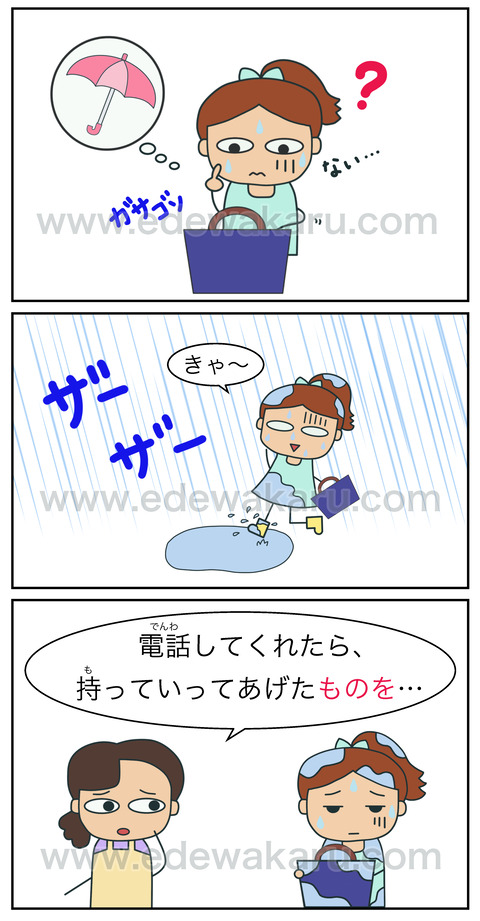
電話をしてくれたら、持っていってあげたものを…
→電話をしてくれたら、持っていってあげたのに…If you had called me, I would have taken it to you… →If you had called me, I would have taken it to you…
ちゃんと勉強していたら合格できたものを…
→ちゃんと勉強していたら合格できたのに…If I had studied properly, I could have passed… →If I had studied properly, I could have passed…
教えてくれたら、手伝いに行ったものを
→教えてくれたら、手伝いに行ったのにIf you had told me, I would have come to help. →If you had told me, I would have come to help.
早く寝たらよかったものを、遅くまで起きていたから遅刻したんだよ
→早く寝たらよかったのに、遅くまで起きていたから遅刻したんだよYou should have gone to bed early; you were late because you stayed up so late. →You should have gone to bed early, but you stayed up so late that you were late.
Read the original source text
Meaning
〜のに
How to use it
動詞・形容詞[普通形]+ものを
Explanation
「〜ものを」は「〜のに」という意味を表す文型です。この文型は
「〜していたら、〜のに」というように、 実際に行われなかったことに対して【不満】【非難】【後悔】【残念だ】という気持ちを表す時に使用されます
😮「〜のに」よりも、相手に対して【不満】【非難】【恨み】の気持ちを表す場合によく使われます😨
[例]
①電話してくれたら、持っていってあげた
ものを
→電話してくれたら持っていってあげたのに、
電話をしなかったから持っていってあげられなかったんだ
【
「残念だ」
という気持ち】
②ちゃんと勉強していたら、合格できた
ものを
→ちゃんと勉強していたら合格できたのに、
しなかったから合格できなかった
【
「後悔」「残念だ」
という気持ち】
「もの」シリーズ
はたくさんありますので、日本語能力試験(にほんごのうりょくしけん)を受ける人は、しっかりと復習をしておきましょう😉
【「もの」シリーズ】
〜たいものだ・〜てほしいものだ
〜たものだ
〜たものではない
〜というもの(Nというもの)
〜ないものだろうか
〜ないものは〜ない
〜もの・〜んだもの
〜ものか
〜ものがある
〜ものだ(感慨)
〜ものだ(本来の性質・一般的な考え方)
〜ものだ・〜ものではない
〜もので・〜ものだから
〜ものと思っていた
〜ものなら
〜ものの
〜ものを
〜ようものなら
日本語文型辞典
Meaning
Roughly the same meaning as 「のに」, but often used to express dissatisfaction that an undesirable result has occurred, as in ①–③.
Means “Things would not have turned out badly if … had been done, but because it wasn't done, a bad result occurred.” Often used with a sense of resentment or reproach.
How to use it
…ものを
…すればいいものを
In context 9 examples
黙っていればわからないものを、彼はつい白状してしまった。
He could have kept quiet and no one would have known, but he ended up confessing.
本来ならば長兄が会社を継ぐはずのものを、その事故のせいで次兄が継ぐことになってしまつた。
The eldest brother was supposed to inherit the company, but because of the accident, it ended up being inherited by the second eldest brother.
知らせてくれたら、すぐ手伝いに行ったものを、何も言わないとはみずくさい人だ。
If you'd let me know, I would have come to help right away. You're so secretive, not saying anything.
場所が場所なら大事故となるものを、この程度のけがですんでよかったと思いなさい。
If this had happened somewhere else, it would have been a major accident, so be grateful that you got away with injuries this minor.
すぐに医者に行けばいいものを、がまんしていたから、ひどくなってしまったのだ。
He would have been fine if he'd gone to the doctor right away, but because he tried to endure it, it got much worse.
そこで引き返せばいいものを、まっすぐ行ったものだから、山に迷い込んでしまった。
We could have turned back there, but because we went straight ahead, we got lost in the mountains.
そのまま逃げだせばいいものを、うろうろしていたので彼は結局警官に捕まってしまった。
He could have simply run away, but he hung around, and in the end the police caught him.
部屋が火につつまれたときすぐ逃げればよかったものを、ペットを助けに行ったばかりに逃げ遅れて死んでしまった。
When the room was engulfed in flames, she could have escaped right away, but because she went to rescue her pet, she was too late and died.
わたしに話してくれればいいものを、どうして、ひとこと言ってくれなかったんですか。
You could have told me. Why didn't you say a word?
Read the original source text
Meaning
「のに」とだいたい同じ意味だが、①~③のように思わしくない結果が生じたことに対して不満の意をこめて用いられることが多い。
「…すれば悪い結果にならなかっただろうが、そうしなかったから、よくない結果になってしまった」という意味を表す。恨みや非難の気持ちをこめて使うことが多い。
How to use it
…ものを
…すればいいものを
日本語文型辞典 英語版
Meaning
Means broadly the same as のに, but is often used to express dissatisfaction in relation to a disappointing result having arisen, as in examples
(1)
-
(3)
.
Means “if (you) had done... probably nothing bad would have resulted from it but, because (you) didn’t, the result was not good.” It is often used to express feelings of regret or of blame.
How to use it
1. ... though; ... and yet
2. one should just ...
In context 9 examples
黙っていればわからないものを、彼はつい白状してしまった。
If he’d kept quiet they wouldn’t have known, but against his better judgment, he confessed.
本来ならば長兄が会社を継ぐはずのものを、その事故のせいで次兄が継ぐことになってしまった。
By all rights, the eldest brother should have taken over the company, but because of that accident, the second eldest did.
知らせてくれたら、すぐ手伝いに行ったものを、何も言わないとはみずくさい人だ。
If I had only been told, I would have gone to help, but her not saying anything shows how standoffish she is.
場所が場所なら大事故となるものを、この程度のけがですんでよかったと思いなさい。
Consider yourself lucky to have escaped with such (minor) injuries since it could have been a serious accident had it taken place elsewhere.
すぐに医者に行けばいいものを、がまんしていたから、ひどくなってしまったのだ。
I should have gone straight to the doctor’s, but I put up with it and it got really bad.
そこで引き返せばいいものを、まっすぐ行ったものだから、山に迷い込んでしまった。
I should have retraced my steps at that point, but I went straight on and ended up lost in the mountains.
そのまま逃げだせばいいものを、うろうろしていたので彼は結局警官に捕まってしまった。
He should have run away, but he wandered around and in the end was caught by the police.
部屋が火につつまれたときすぐ逃げればよかったものを、ペットを助けに行ったばかりに逃げ遅れて死んでしまった。
When the room was engulfed by flames he should have quickly escaped, but he went back in to save his pet, couldn’t get out, and died in the fire.
わたしに話してくれればいいものを、どうして、ひとこと言ってくれなかったんですか。
You should have spoken to me, so why didn’t you say a single word about it?
Read the original source text
Meaning
Means broadly the same as のに, but is often used to express dissatisfaction in relation to a disappointing result having arisen, as in examples
(1)
-
(3)
.
Means “if (you) had done... probably nothing bad would have resulted from it but, because (you) didn’t, the result was not good.” It is often used to express feelings of regret or of blame.
How to use it
1. ...ものを
2. ...すればいいものを
くらべてわかる日本語表現文型辞典
Meaning
This expresses the regret or disappointment that, if A were the case, B would follow, even though in reality that is not so; it can also express blaming the other person.
How to use it
AばBものを
[Verb—ば-form] + [verb] ものを
[Verb—ば-form] + [i-adjective—plain form] ものを
[Verb—ば-form] + [na-adjective—な/である/だった/ではない] ものを
Explanation
【Contrast 1】
“Bのに”
“Bのに” can express a wish, as in “I wish it would rain,” or a concession, as in “Even though you said you’d be back by five.” Like “Bものを,” it can also express regret. However, “Bものを” is a stiff expression and therefore sounds exaggerated, whereas “Bのに” is a softer colloquial expression.
Notes
【Note 1】
・After “ものを,” “Aでない(なかった)のでBにならない(ならなかった)” (“because A is/was not so, B does/did not happen”) is omitted.
In context 4 examples
怪我さえしなければ、あんな奴に負けないものを。
If only I hadn’t gotten hurt, I wouldn’t have lost to a guy like that.
もう少し早く知らせてくれれば、間に合ったものを。
If only you had told me a little earlier, I would have made it in time.
消火器が1本でもあれば、火を消し止められたものを。
If only we’d had even one fire extinguisher, we could have put out the fire.
勉強すれば、もっと成績があがるものを。
If only I studied, my grades would improve more.
Read the original source text
Meaning
もしAならばBなのだが、実際はそうではないということを、悔しく残念に思ったり、相手を責めたりする気持ちを表す。
How to use it
AばBものを
[動詞-ば形]+[動詞]ものを
[動詞-ば形]+[イ形-普]ものを
[動詞-ば形]+[ナ形-な/である/だった/ではない]ものを
Explanation
【対比1】
「Bのに」
「Bのに」には、「雨が降ったらいいのに」のように願望を表したり、「5時までに帰るって言ってたのに」のように逆接を表したりするものがあるが、「Bものを」と同様に残念な気持ちを表す用法もある。しかし、「Bものを」は硬い言葉なので、大げさな表現になるのに対して、「Bのに」はやわらかい口語表現。
Notes
【注意1】
・「ものを」の後には「Aでない(なかった)のでBにならない(ならなかった)」が省略されている。
日本語NET JLPT文法解説まとめ
Meaning
If only one had ~, then ~ would not have happened
How to use it
V (plain form) + ものを
いA (plain form) + ものを
ナA (plain form) + ものを (ナAな + ものを)
Explanation
If (subject) had (done something), (something) wouldn't have happened.
① It includes feelings such as the speaker's dissatisfaction or regret.
② The part following "ものを" may be omitted.
① The speaker's feelings of dissatisfaction or regret are included.
② The part following "ものを" may be omitted.
In context 6 examples
先輩が貴重な時間を使って丁寧に教えてくれているものを、「わかりにくい」だの「教えるのが下手」だの、どうして彼は文句ばかり言っているのだろう。
Even though my senior is taking the time to teach him carefully, why does he do nothing but complain, saying things like “It’s hard to understand” and “You’re bad at teaching”?
結局、二人は別れることになったそうだ。あのとき、彼が素直に謝っていればよかったものを。
Apparently, the two ended up breaking up. He should have just apologized then.
お金が無いなら、言ってくれたらよかったものを。
If you didn’t have any money, you should have told me.
黙っていればバレなかったものを、どうして言っちゃうかなあ。
If you’d kept quiet, you wouldn’t have been found out, so why did you have to say anything?
もっと早く病院へ行けばひどくならなかったものを、「寝ていれば治る」とか言うからこんなことになるのよ。
If you’d gone to the hospital sooner, it wouldn’t have gotten so bad. This is what happens when you say things like, “I’ll get better if I just sleep.”
やめておけばよかったものを、「大丈夫、大丈夫」とか言って食べるからお腹を壊すんだよ。
You should have stopped eating it. You’ll get an upset stomach if you eat it while saying, “It’s fine, it’s fine.”
Read the original source text
Meaning
〜すれば、そうならなかったのに
How to use it
V(普通形)+ ものを
イA(普通形)+ ものを
ナA(普通形)+ ものを (ナAな + ものを)
Explanation
If (subject) had (done something), (something) wouldn't have happened.
①話し手の不満や後悔などの気持ちが含まれる。
②「ものを」の後ろが省略される場合もある。
① The speaker's feelings of dissatisfaction or regret are included.
② The part following "ものを" may be omitted.
毎日のんびり日本語教師
How to use it
Verb plain form + ものを
い-adjective plain form + ものを
な-adjective plain form + ものを
Noun plain form + ものを
な-adjective stem + な + ものを
Noun + な + ものを
Explanation
A pattern used to talk about a hypothesis or possibility concerning something that has already happened, expressing “It would have been better if I had done this then” (a counterfactual conditional).
It conveys dissatisfaction, regret, or disappointment, and is often used when one is dissatisfied with the outcome of something.
「~ばいいものを」 and 「~たらいいものを」 are often used together with conditional expressions.
It can be rephrased as 「のに」, but it is stiffer than 「のに」.
The latter part may be omitted, and the sentence can end with 「~ものを。」.
Notes
Nothing in particular.
In context 8 examples
車で行けばいいものを、歩いて行くからそんなことになるんだ。
You could have gone by car; walking is why this happened.
薬を飲めばすぐ治るものを、意地張って飲まないから悪化したんだ。
It would have cleared up quickly if you’d taken the medicine, but it got worse because you stubbornly refused to take it.
教えてくれたらすぐ助けに行ったものを。
If you’d told me, I would have come to help you right away.
連絡してくれればいいものを、一人でやるなんて大変だったろうに。
You could have contacted me, and I would have helped; it must have been hard doing it all alone.
手を貸してもらえばすぐ片付いたものを。
You could have had me lend you a hand, and it would have been finished right away.
眠くなったら寝ればいいものを、彼女は「寝たら休みが終わっちゃう」と言って無理やり起きている。
She could just go to bed when she gets sleepy, but instead she forces herself to stay up, saying, “If I go to sleep, my break will be over.”
一人で死ねばいいものを、犯人は近くの通行人まで犠牲にして自殺した。
He could have just died alone, but the culprit committed suicide after taking nearby passersby with him as victims.
明日に備えて早く寝たらいいものを。
You could just go to bed early to get ready for tomorrow.
Read the original source text
How to use it
動詞普通形+ものを
イ形普通形+ものを
ナ形普通形+ものを
名詞普通形+ものを
ナ形語幹+な+ものを
名詞+な+ものを
Explanation
既に発生したことに対して「あの時こうしていれば良かったのに」という仮説や可能性について述べる文型です。(反事実条件文)
不満、後悔、残念などのニュアンスを持ち、その事柄の結果に対して不満を感じているときによく用います。
仮定表現と組み合わせた「~ばいいものを」や「~たらいいものを」はよく使われます。
「のに」に言い換えることができますが、「のに」よりも硬い表現です。
後件は省略可で、「~ものを。」で文を終わらせることができます。
Notes
特になし
NINJAL 日本語文型データベース
Meaning
This expresses regret that a result turned out badly because something assumed in 「〜」 did not actually happen, even though there would have been no problem if it had.
How to use it
V普通形+ものを
i-A普通形+ものを
na-A普通形+ものを(ただし、「na-Aだ」→「na-Aな+ものを」)
N普通形+ものを(ただし、「Nだ」→「Nの+ものを・Nな+ものを」は、あまり使わない)
Notes
「〜」 is followed by a sentence supposing an ideal state different from what actually happened. Hypothetical expressions such as 「〜ば・〜ても」 are usually used. After 「〜ものを」 comes a sentence explaining the regrettable result or expressing the speaker's dissatisfaction.
It can also be used at the end of a sentence in the form 「〜ものを。」.
In context 16 examples
イベント会場まで本来なら30分で行けるものを、最短ルートを知らなかったので1時間もかかってしまった。
I could have reached the event venue in 30 minutes, but because I didn't know the shortest route, it ended up taking me a whole hour.
何もしなければ目立たないものを、服にあいた穴を自分で直そうとして、かえって変になった。
It wouldn't have been noticeable if I had done nothing, but I tried to fix the hole in my clothes myself and only made it look worse.
病院の開院時間なんて、インターネットで調べればすぐわかったものを。
I could have found out the hospital's opening hours right away by looking them up online.
反対方向の電車に乗ってしまった。きちんと行き先を確認すれば間違えなかったものを。
I got on a train going in the opposite direction. If I had checked the destination properly, I wouldn't have made that mistake.
熱があるなら休めばいいものを、佐藤さんは仕事がたまるのが嫌だからと無理に出社してきたらしい。
If Mr. Sato had a fever, he should have stayed home, but apparently he forced himself to come to work because he didn't want his work to pile up.
賞味期限内に食べればおいしいものを、いつまでも食べずにおいておくから、味が悪くなってしまうのだ。
It would be delicious if you ate it before its expiration date, but you leave it uneaten for so long that it ends up tasting bad.
上着を着れば寒くないものを、そんな薄着で我慢していたら、風邪を引くだろう。
You wouldn't be cold if you put on a jacket, but if you keep enduring it in such light clothing, you'll catch a cold.
急ぎの買い物でないなら、セールの期間に買えば安かったものを。
If it wasn't something I needed to buy urgently, I could have bought it cheaply during the sale.
休みの初めに宿題を終わらせてしまえば、今ごろつらくなかったものを。ぎりぎりになってやろうとするから大変なんだよ。
If you had finished your homework at the beginning of the break, you wouldn't be having such a hard time now. It's difficult because you wait until the last minute to do it.
「新幹線で行けば楽なものを。あんなに遠くまで車を運転して行くの?」
“It would be easier to take the bullet train. Are you really going to drive all that way?”
この大学なら、努力すれば合格も不可能ではないものを。あの子はあまり努力する気がないのだろう。
If she goes to this university, getting accepted wouldn't be impossible if she worked hard. I guess that girl doesn't feel much like making an effort.
家族4人、何事もなければ十分幸せだったものを、父が株に手を出して大損してしまったので、家を売って引っ越さなければならなくなった。
The four of us in the family would have been perfectly happy if nothing had happened, but my father got involved in stocks and lost a lot of money, so we had to sell our house and move.
このミスがなければ作業はそれほど大変ではなかったものを。修正のために徹夜になってしまった。
If it weren't for this mistake, the work wouldn't have been so difficult. I ended up having to work all night to correct it.
経験者でなければ今回の採用対象ではないものを、知人の娘だからと社長は無理を言って採用したがっている。
Only experienced candidates are eligible for this recruitment, but the president wants to force through the hiring of an acquaintance's daughter.
惜しい。この問題さえ間違えなければ、満点だったものを。
So close. If only I hadn't gotten this one problem wrong, I would have gotten a perfect score.
もう少し早い時間に出発していれば、電車はこれほどひどい混み具合ではなかったものを。
If we had left a little earlier, the train wouldn't have been this unbearably crowded.
Read the original source text
Meaning
〜で仮定したことが実現すれば問題がなかったのに、実際はそうではなかったため残念な結果になったことを表します。
How to use it
V普通形+ものを
i-A普通形+ものを
na-A普通形+ものを(ただし、「na-Aだ」→「na-Aな+ものを」)
N普通形+ものを(ただし、「Nだ」→「Nの+ものを・Nな+ものを」は、あまり使わない)
Notes
「〜」には、実際とは異なる理想の状態を仮定する文がきます。ふつう「〜ば・〜ても」などの仮定表現を使います。「〜ものを」の後には、残念な結果を説明する文や話し手の不満を表す文がきます。
「〜ものを。」の形で、文末にも使います。
IMABI
Combination Particles with もの
Read this IMABI lesson ↗Explanation
第030課: Combination Particles with もの
Just like in Modern Japanese, there are combination particles with もの and they are all conjunctive particles. The particles to be discussed in this lesson are ものを, ものから, ものの, and ものゆゑ(に).
ものを, ものから, ものの, ものゆゑ(に)
Although some have come and gone or changed in nuance, back in Classical Japanese, these four combination particles did the same thing. So, don’t let this be a reason to be confused. All of these particles follow the 連体形. they all may show a concession based on existing conditions. So, they mean “although”. Though ものを and ものの survive today with modified nuances, you have to think in more simplistic terms for this. That should be easy enough to do.
1. 鳴く声も聞こえぬものの悲しきは忍びに燃ゆる蛍なりけり。
Although I couldn’t hear their cries, the sad things were the fireflies hidden and burning.
From the 詞花集.
2. 都出でて君に会はむと来しものを来しかひもなく別れぬるかな。
Although I left the capital, there was no avail in thinking about meeting you, and we ended up parting.
From the 土佐日記.
3. いつはりと思ふ物から今さらにたがまことをか我はたのまむ
Although I think that (that person’s word) is a lie, who’s truth am I to entrust in now?
From the 古今和歌集.
4. 頼まぬものの恋ひつつぞ経る。
Though I rely on you, I pass time longing for you.
From the 伊勢物語.
5. 空蝉うつせみの世の人ごとのしげければわすれぬもののかれぬべらなり。
The rumors of the world are so annoying; though I’ll never forget, I may naturally leave them behind.
From the 古今和歌集.
6. 雖念 知僧裳無跡 知物乎 奈何幾許 吾戀渡 (原文)
思へどもしるしも無しと知るものを何かここだく我が恋ひ渡る
Although I think of you to know avail, why is that I still long for you like this?
From the 万葉集.
7. 春の野に若菜つまむと来しものを散りかふ花に道はまどひぬ。
I came for young greens in the spring field, but scattering flowers blew and obscured my path.
From the 古今和歌集.
8. 将来云毛 不来時有乎 不来云乎 将来常者不待 不来云物乎 (原文)
来むと言ふも 来ぬ時あるを 来じと言ふを 来むとは待たじ 来じと言ふものを
You say you’ll come and don’t, but I wait not for you to say you won’t since you may as you won’t.
From the 万葉集.9. 和我由恵尓 於毛比奈夜勢曽 秋風能 布可武曽能都奇 安波牟母能由恵 (原文)
我が故に思ひな痩せそ秋風の吹かむその月逢はむものゆゑ
Please don’t grow thin thinking of me as I shall moon which the autumn wind does blow.
From the 万葉集.
10. 毎年尓 来喧毛能由恵 霍公鳥 聞婆之努波久 不相日乎於保美 毎年謂之等之乃波 (原文)
年のはに 来鳴くものゆゑ 霍公鳥ほととぎす 聞けばしのはく 逢はぬ日を多み
Every year when I hear the cries of the cuckoo as they come singing, I get this unexplainable feeling. There are too many days I can’t meet them.
From the 万葉集.
11. 月は在明にて光をさまれるものから、不二の峰幽かに見えて。
The moon was that of dawn, and since the light was in check, Mount Fuji’s peak appeared faint.
From the 奥の細道.
12. ふるさとにあらぬ物からわがために人の心のあれてみゆらむ。
You may say a man’s heart is not in his hometown, but why is it that his heart goes to ruin for me?
From the 古今和歌集.
Historical Note:
1. ものを is a combination of the noun もの and the interjectory–not the case particle–を. This explains why even in Modern Japanese it can be seen as a final particle showing a concessive exclamatory statement. Though not normally the case anymore, it did at one point become a causal connector similar to the conjunctive が during the 江戸時代. Nowadays, it shows concession with a sense of the speaker’s discomfort and or dissatisfaction.
13. よど河のよどむとひとは見るらめど流れてふかき心あるものを。
(You probably think that I haven’t been coming and going a while),
although just like that Yodo River’s current is deep I too in my heart think much of you with no end.
From the 古今和歌集.
14. 雀の子を、犬君いぬきが逃しつる、伏籠ふせごの中に、こめたりつるものを。
Inuki let the baby sparrow escape even though I had kept it in the cage!
From the 源氏物語.
15. かたみこそ今はあだなれこれなくばわするる時もあらましものを。
This memento is a resentment that has hurt me even up till now. If I just didn’t have it, I would have time to forget that person.
From the 古今和歌集.
2. ものから came into existence during the 奈良時代 was one of the first phrases where から became a true conjunctive particle. As から became used even more heavily in the spoken language, it eventually made people confused to the point that it turned into a particle with similar meaning to ので. Today you would just use から or ので.
16. 心をぞわりなき物と思ひぬる見るものからや恋しかるべき。
I thought that emotion was irrational. Since I’ve met you, I feel such longing; is this supposed to be?
From the 古今和歌集.
3. ものの got to survive unscathed into Modern Japanese. It’s not used frequently, but you see it often in literature.
4. ものゆゑ(に) has such a good ring to it, yet the only place it has is in 古典. It too could be used to show reason like から. In fact, it can be seen doing this way back in the 万葉集.
In context 19 examples
鳴く声も聞こえぬものの悲しきは忍びに燃ゆる蛍なりけり。
Although I couldn’t hear their cries, the sad things were the fireflies hidden and burning.
都出でて君に会はむと来しものを来しかひもなく別れぬるかな。
Although I left the capital, there was no avail in thinking about meeting you, and we ended up parting.
いつはりと思ふ物から今さらにたがまことをか我はたのまむ
Although I think that (that person’s word) is a lie, who’s truth am I to entrust in now?
頼まぬものの恋ひつつぞ経る。
Though I rely on you, I pass time longing for you.
空蝉うつせみの世の人ごとのしげければわすれぬもののかれぬべらなり。
The rumors of the world are so annoying; though I’ll never forget, I may naturally leave them behind.
雖念 知僧裳無跡 知物乎 奈何幾許 吾戀渡 (原文)
雖念 知僧裳無跡 知物乎 奈何幾許 吾戀渡 (Original text)
春の野に若菜つまむと来しものを散りかふ花に道はまどひぬ。
I came for young greens in the spring field, but scattering flowers blew and obscured my path.
将来云毛 不来時有乎 不来云乎 将来常者不待 不来云物乎 (原文)
将来云毛 不来時有乎 不来云乎 将来常者不待 不来云物乎 (Original text)
毎年尓 来喧毛能由恵 霍公鳥 聞婆之努波久 不相日乎於保美 毎年謂之等之乃波 (原文)
毎年尓 来喧毛能由恵 霍公鳥 聞婆之努波久 不相日乎於保美 毎年謂之等之乃波 (Original text)
月は在明にて光をさまれるものから、不二の峰幽かに見えて。
The moon was that of dawn, and since the light was in check, Mount Fuji’s peak appeared faint.
ふるさとにあらぬ物からわがために人の心のあれてみゆらむ。
You may say a man’s heart is not in his hometown, but why is it that his heart goes to ruin for me?
ものを is a combination of the noun もの and the interjectory–not the case particle–を. This explains why even in Modern Japanese it can be seen as a final particle showing a concessive exclamatory statement. Though not normally the case anymore, it did at one point become a causal connector similar to the conjunctive が during the 江戸時代. Nowadays, it shows concession with a sense of the speaker’s discomfort and or dissatisfaction.
(You probably think that I haven’t been coming and going a while),
よど河のよどむとひとは見るらめど流れてふかき心あるものを。
(You probably think that I haven’t been coming and going a while),
雀の子を、犬君いぬきが逃しつる、伏籠ふせごの中に、こめたりつるものを。
Inuki let the baby sparrow escape even though I had kept it in the cage!
かたみこそ今はあだなれこれなくばわするる時もあらましものを。
This memento is a resentment that has hurt me even up till now. If I just didn’t have it, I would have time to forget that person.
ものから came into existence during the 奈良時代 was one of the first phrases where から became a true conjunctive particle. As から became used even more heavily in the spoken language, it eventually made people confused to the point that it turned into a particle with similar meaning to ので. Today you would just use から or ので.
I thought that emotion was irrational. Since I’ve met you, I feel such longing; is this supposed to be?
心をぞわりなき物と思ひぬる見るものからや恋しかるべき。
I thought that emotion was irrational. Since I’ve met you, I feel such longing; is this supposed to be?
ものの got to survive unscathed into Modern Japanese. It’s not used frequently, but you see it often in literature.
ものの managed to survive unscathed into Modern Japanese. It’s not used frequently, but you see it often in literature.
ものゆゑ(に) has such a good ring to it, yet the only place it has is in 古典. It too could be used to show reason like から. In fact, it can be seen doing this way back in the 万葉集.
ものゆゑ(に) has such a good ring to it, yet it is found only in Classical Japanese. It too could be used to show reason like から. In fact, it can be seen doing this way back in the Manyōshū.
Read the original source text
Explanation
第030課: Combination Particles with もの
Just like in Modern Japanese, there are combination particles with もの and they are all conjunctive particles. The particles to be discussed in this lesson are ものを, ものから, ものの, and ものゆゑ(に).
ものを, ものから, ものの, ものゆゑ(に)
Although some have come and gone or changed in nuance, back in Classical Japanese, these four combination particles did the same thing. So, don’t let this be a reason to be confused. All of these particles follow the 連体形. they all may show a concession based on existing conditions. So, they mean “although”. Though ものを and ものの survive today with modified nuances, you have to think in more simplistic terms for this. That should be easy enough to do.
1. 鳴く声も聞こえぬものの悲しきは忍びに燃ゆる蛍なりけり。
Although I couldn’t hear their cries, the sad things were the fireflies hidden and burning.
From the 詞花集.
2. 都出でて君に会はむと来しものを来しかひもなく別れぬるかな。
Although I left the capital, there was no avail in thinking about meeting you, and we ended up parting.
From the 土佐日記.
3. いつはりと思ふ物から今さらにたがまことをか我はたのまむ
Although I think that (that person’s word) is a lie, who’s truth am I to entrust in now?
From the 古今和歌集.
4. 頼まぬものの恋ひつつぞ経る。
Though I rely on you, I pass time longing for you.
From the 伊勢物語.
5. 空蝉うつせみの世の人ごとのしげければわすれぬもののかれぬべらなり。
The rumors of the world are so annoying; though I’ll never forget, I may naturally leave them behind.
From the 古今和歌集.
6. 雖念 知僧裳無跡 知物乎 奈何幾許 吾戀渡 (原文)
思へどもしるしも無しと知るものを何かここだく我が恋ひ渡る
Although I think of you to know avail, why is that I still long for you like this?
From the 万葉集.
7. 春の野に若菜つまむと来しものを散りかふ花に道はまどひぬ。
I came for young greens in the spring field, but scattering flowers blew and obscured my path.
From the 古今和歌集.
8. 将来云毛 不来時有乎 不来云乎 将来常者不待 不来云物乎 (原文)
来むと言ふも 来ぬ時あるを 来じと言ふを 来むとは待たじ 来じと言ふものを
You say you’ll come and don’t, but I wait not for you to say you won’t since you may as you won’t.
From the 万葉集.9. 和我由恵尓 於毛比奈夜勢曽 秋風能 布可武曽能都奇 安波牟母能由恵 (原文)
我が故に思ひな痩せそ秋風の吹かむその月逢はむものゆゑ
Please don’t grow thin thinking of me as I shall moon which the autumn wind does blow.
From the 万葉集.
10. 毎年尓 来喧毛能由恵 霍公鳥 聞婆之努波久 不相日乎於保美 毎年謂之等之乃波 (原文)
年のはに 来鳴くものゆゑ 霍公鳥ほととぎす 聞けばしのはく 逢はぬ日を多み
Every year when I hear the cries of the cuckoo as they come singing, I get this unexplainable feeling. There are too many days I can’t meet them.
From the 万葉集.
11. 月は在明にて光をさまれるものから、不二の峰幽かに見えて。
The moon was that of dawn, and since the light was in check, Mount Fuji’s peak appeared faint.
From the 奥の細道.
12. ふるさとにあらぬ物からわがために人の心のあれてみゆらむ。
You may say a man’s heart is not in his hometown, but why is it that his heart goes to ruin for me?
From the 古今和歌集.
Historical Note:
1. ものを is a combination of the noun もの and the interjectory–not the case particle–を. This explains why even in Modern Japanese it can be seen as a final particle showing a concessive exclamatory statement. Though not normally the case anymore, it did at one point become a causal connector similar to the conjunctive が during the 江戸時代. Nowadays, it shows concession with a sense of the speaker’s discomfort and or dissatisfaction.
13. よど河のよどむとひとは見るらめど流れてふかき心あるものを。
(You probably think that I haven’t been coming and going a while),
although just like that Yodo River’s current is deep I too in my heart think much of you with no end.
From the 古今和歌集.
14. 雀の子を、犬君いぬきが逃しつる、伏籠ふせごの中に、こめたりつるものを。
Inuki let the baby sparrow escape even though I had kept it in the cage!
From the 源氏物語.
15. かたみこそ今はあだなれこれなくばわするる時もあらましものを。
This memento is a resentment that has hurt me even up till now. If I just didn’t have it, I would have time to forget that person.
From the 古今和歌集.
2. ものから came into existence during the 奈良時代 was one of the first phrases where から became a true conjunctive particle. As から became used even more heavily in the spoken language, it eventually made people confused to the point that it turned into a particle with similar meaning to ので. Today you would just use から or ので.
16. 心をぞわりなき物と思ひぬる見るものからや恋しかるべき。
I thought that emotion was irrational. Since I’ve met you, I feel such longing; is this supposed to be?
From the 古今和歌集.
3. ものの got to survive unscathed into Modern Japanese. It’s not used frequently, but you see it often in literature.
4. ものゆゑ(に) has such a good ring to it, yet the only place it has is in 古典. It too could be used to show reason like から. In fact, it can be seen doing this way back in the 万葉集.