AIUEO JLPT Grammar
Meaning
This sentence pattern is used when encouraging someone to try something. It has the same meaning as “〜てみて” but is more polite and softer in tone, often used with children or subordinates.
How to use it
Verb te-form + ごらん
In context 5 examples
分からなかったら、もう一度やってごらんよ。
If you don’t understand, try doing it again.
この本を読んでごらん、きっと面白いよ。
Try reading this book, it’s definitely interesting.
一度やってごらん、簡単だから。
Give it a try; it’s easy.
困ったときは、誰かに助けを求めてごらん。
When you’re in trouble, try asking someone for help.
失敗してもいいから、挑戦してごらんなさい。
It’s okay to fail, so go ahead and give it a try.
Read the original source text
Meaning
This sentence pattern is used when encouraging someone to try something. It has the same meaning as “〜てみて” but is more polite and softer in tone, often used with children or subordinates.
How to use it
動詞て形+ごらん
Explanation · 日本語
この文型は、相手に何かを試してみるように促す表現で、「〜てみて」と同じ意味を持ちますが、より丁寧で柔らかい響きを持ち、特に子供や後輩など、目下の人に対して使われることが多いです。
Bunpro Grammar Reference
Meaning
(Please) try to, (Please) look
How to use it
Verb[て]+ ごらん
Verb[て]+ ごらんなさい
Nuance
An honorific expression used to ask someone to attempt to do (A), or to peruse at their leisure.
Explanation
てご覧 is an honorific language expression in Japanese that is used in a similar way to なさい. It is usually translated as 'please try to (A)', where (A) is the verb that ご覧 is connected to, through the use of the conjunction particle て.
この本を読んでごらん。この本を読んだら日本について色々と学べるよ。
Try reading this book. If you read it, you will learn various things about Japan.
外を見てごらん。虹が出ているよ。
Look outside. There is a rainbow.
However, despite being translated as 'please try to (A)', the literal meaning of 覧 is 'to look', or 'to peruse' (to look at one's own leisure, without needing to rush). Due to this, てごらん can be thought of as being quite similar to てみる 'to try', but with the added emphasis of 'try as you like, when it suits you'.
Caution
As ご覧 is honorific language, it cannot be used to refer to your own actions, or things that you will 'try'. It will only ever be used to make suggestions to other people about what they should try.
これ食べてごらん。あなただったら絶対に好きだと思うよ。
Try eating this. If it's you, I think you'll definitely like it.
Caution
Sometimes ごらん and なさい will be paired together. This slightly increases the strength of the suggestion, and may be perceived as a very light command. Because of this, ごらんなさい is primarily used by superiors/elders, when requesting that a subordinate/younger person try something.
見てごらんなさい。こんな酷いことをネットに書かれたんだよ、酷くない?
Look at this. Someone wrote something this cruel on the internet. Don't you think this is awful?
In context 16 examples
- その景色を見てごらん。
(Try to) take a look at that scenery.
- 外を見てごらん。虹が出ているよ。
Look outside. There is a rainbow.
- この本を読んでごらん。この本を読んだら日本について色々と学べるよ。
Try reading this book. If you read it, you will learn various things about Japan.
- ニュースを見てごらん。あなたが映っているよ。
(Try to) take a look at the news. You are on TV.
- あの蝶々を捕まえてごらんなさい。
Try to catch that butterfly.
- 手を貸してごらん。手袋をはめてあげるから。
(Try to) give me your hands. I will put your gloves on.
- もう一度やってごらん。きっとうまくできるよ。
Try it once more. I know you can do it.
- 怒らないから…正直に言ってごらんなさい。
I won't get angry... Try telling the truth.
- まだ学んでいない文法を勉強してごらん。
Try studying grammar you haven't learned yet.
- 耳を澄ましてごらん。小鳥の歌声が聞こえるよ。
Try listening carefully. You'll hear the birds singing.
- もっと練習してごらん。絶対できるようになるから。
Try practicing more. You will definitely be able to do it.
- 触ってごらん。こんな手触り初めてだよ。
Try touching it. This is the first time I have ever felt something like this.
- まずは辞書で調べてごらん。それでも分からなかったら質問してね。
First, try looking it up in the dictionary. If you still don't understand, ask me.
- もう一つの方法を試してごらん。うまくいくかもしれないよ。
Try to do it another way. It just might work.
- これ食べてごらん。あなただったら絶対に好きだと思うよ。
Try eating this. If it's you, I think you'll definitely like it.
- 見てごらんなさい。こんな酷いことをネットに書かれたんだよ、酷くない?
Look at this. Someone wrote something this cruel on the internet. Don't you think this is awful?
Read the original source text
Meaning
(Please) try to, (Please) look
How to use it
Verb[て]+ ごらん
Verb[て]+ ごらんなさい
Nuance
An honorific expression used to ask someone to attempt to do (A), or to peruse at their leisure.
Explanation
てご覧 is an honorific language expression in Japanese that is used in a similar way to なさい. It is usually translated as 'please try to (A)', where (A) is the verb that ご覧 is connected to, through the use of the conjunction particle て.
この本を読んでごらん。この本を読んだら日本について色々と学べるよ。
Try reading this book. If you read it, you will learn various things about Japan.
外を見てごらん。虹が出ているよ。
Look outside. There is a rainbow.
However, despite being translated as 'please try to (A)', the literal meaning of 覧 is 'to look', or 'to peruse' (to look at one's own leisure, without needing to rush). Due to this, てごらん can be thought of as being quite similar to てみる 'to try', but with the added emphasis of 'try as you like, when it suits you'.
Caution
As ご覧 is honorific language, it cannot be used to refer to your own actions, or things that you will 'try'. It will only ever be used to make suggestions to other people about what they should try.
これ食べてごらん。あなただったら絶対に好きだと思うよ。
Try eating this. If it's you, I think you'll definitely like it.
Caution
Sometimes ごらん and なさい will be paired together. This slightly increases the strength of the suggestion, and may be perceived as a very light command. Because of this, ごらんなさい is primarily used by superiors/elders, when requesting that a subordinate/younger person try something.
見てごらんなさい。こんな酷いことをネットに書かれたんだよ、酷くない?
Look at this. Someone wrote something this cruel on the internet. Don't you think this is awful?
Nuance · 日本語
誰かに(A)をやるように頼む時や、時間に余裕があれば何かをやってほしいということを伝えるために使われる、尊敬語を使った表現。
Explanation · 日本語
「てご覧」は、「なさい」と同じように使われる、丁寧な表現です。主に「どうぞ (A) をやってみて」のような意味で使われます。(A) は動詞のテ形で、そのあとに「ご覧」を付けます。
この本を読んでごらん。この本を読んだら日本について色々と学べるよ。
Try reading this book. If you read it, you will learn various things about Japan.
外を見てごらん。虹が出ているよ。
Look outside. There is a rainbow.
「てご覧」の「覧」は、もともと「よく見ること」や「広く眺めること」を意味する漢字です。「てごらん」は「てみる」と使われる場面が似ていますが、「てごらん」の方がより優しく丁寧な言い方です。
注意点
名詞の「ご覧」は尊敬語なので、話し手自身の行動には使えません。ほかの人に「やってみて」と勧めるときにだけ使えます。
これ食べてごらん。あなただったら絶対に好きだと思うよ。
Try eating this. If it's you, I think you'll definitely like it.
注意点
「ごらん」と「なさい」が合わさって、「ごらんなさい」の形で使われるときもあります。この場合、表現の強さが少し増し、命令のように聞こえるので、目上・年上の人が、目下・年下の人に「やってみなさい」と言うときによく使われます。
見てごらんなさい。こんな酷いことをネットに書かれたんだよ、酷くない?
Look at this. Someone wrote something this cruel on the internet. Don't you think this is awful?
絵でわかる日本語
Meaning
Try doing …
How to use it
Verb [て-form] + ごらん
Explanation
「〜てごらん」is a sentence pattern used to mean “try doing …” 😊 It is the polite form of the imperative 「〜てみなさい」, the imperative form of「〜てみる」studied at N4.
It is written with kanji as「〜てご覧・〜て御覧」, but it is colloquial and used only in conversation.
Because it is an imperative, it cannot be used with someone of higher status and is used mostly, for example, from a parent to a child 😀 Also, as in example ③, it may be used with 「なさい」attached, as 「〜てごらんなさい」.
The honorific form of 「見る」is「ご覧になる」. This pattern 「〜てごらん」comes from that 😉 It doesn’t appear in many reference books, so remember it.
In context 3 examples
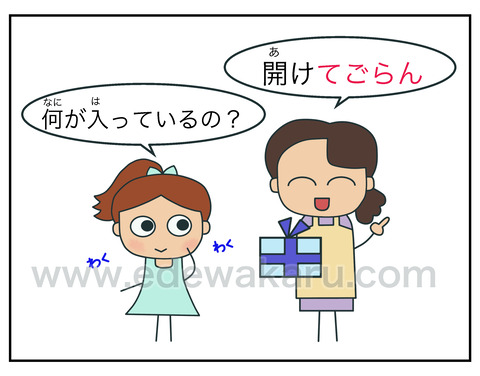
娘:何が入っているの?母:開けてごらん
→開けてみなさいDaughter: What’s inside? Mother: Open it and see. →Try opening it.
見てごらん、きれいな虹がでているよ
→見てみなさい、きれいな虹がでているよLook, there’s a beautiful rainbow! →Look, there’s a beautiful rainbow!
なんで宿題をしなかったのか言ってごらんなさい(復習:口語形【なんで?】)
→なんで宿題をしなかったのか言ってみなさいTell me why you didn’t do your homework (review: colloquial form【なんで?】). →Try telling me why you didn’t do your homework.
Read the original source text
Meaning
〜てみなさい
How to use it
動詞[て形]+ごらん
Explanation
「〜てごらん」は「〜てみなさい」という意味で使われる文型です。N4で勉強した
「〜てみる」の命令形「〜てみなさい」の丁寧形です
😊漢字では「〜てご覧・〜て御覧」と書きますが、口語形ですので会話でしか使用されません。
命令形ですので目上の人には使えず、ほとんどの場合は「親→子供」などに使われます
😀また、例文③のように「〜てごらんなさい」と「なさい」をつけて使用する場合もあります。
「見る」の尊敬語が「ご覧になる」でしたね。この「〜てごらん」はそこからできた文型です😉あまり参考書にのっていませんので覚えておきましょう。
毎日のんびり日本語教師
Meaning
Try doing ~.
Do ~.
How to use it
Verb, te-form + ごらん
Verb, te-form + ごらんなさい
Explanation
「ご覧(ごらん)」 is the honorific form of 「見る」. Like 「~てみる」, it means “to try.”
「ごらん」 is a more polite way of saying it and, depending on the situation, can sound like a mild command.
「ごらんなさい」 expresses a strong command.
Notes
Nothing in particular.
In context 5 examples
君が思うようにやってごらん。(照你的想法做做看。)
Try doing it the way you think is best.
もう一度やってごらん。
Try it one more time.
ちょっとだけで良いから見てごらん。
Just take a little look.
胸に手を当て、よく考えてごらんなさい。
Put your hand on your chest and think carefully.
食べてごらん。好き嫌いはダメだよ。
Try eating it. You shouldn’t be picky.
Read the original source text
Meaning
~してみて。
~しなさい。
How to use it
動て形+ごらん
動て形+ごらんなさい
Explanation
「ご覧(ごらん)」は「見る」の尊敬語です。「~てみる」と同じく「試す」という意味を表します。
「ごらん」はもっと丁寧な言い方で、場合によっては軽い命令調になります。
「ごらんなさい」は強い命令を表します。
Notes
特になし