DoJG 日本語文法辞典(全集)
Meaning
Be bound to; definitely; unmistakably; unquestionably; undoubtedly; without fail; without doubt
How to use it
Vnegative | ずにはおかない | Exception: する→せずにはおかない |
| 働かさずにはおかない | Someone definitely moves something |
Explanation
A phrase that expresses the idea that someone/something necessarily or naturally causes something to happen.
In context 7 examples
技術の発達は社会環境の変化をもたらさずにはおかない。
Technological advancements are bound to bring about changes to social environments.
コンピュータの普及とインターネット利用の拡大は大きな教育の変革を促さずにはおかない。
The spread of computers and the expansion of Internet use are bound to promote big changes in education.
この映画は観る者に感動を与えずにはおかない。
This movie is bound to move viewers. (literally: This movie does not leave viewers without moving them.)
この小説は我々に人間とは何かを考えさせずにはおかない。
Without fail, this novel makes us think about what it is to be human.
この事故は日本とアメリカの関係に影響を及ぼさずにはおかないだろう。
This accident will undoubtedly affect the relationship between Japan and America.
彼女は聴く者を魅了せずにはおかない音楽性とそれを表現する卓越した技術を持っている。
She has a musicality that unfailingly captivates her audiences and the superb technique to express it.
環境や用途に合わせて動物たちがつくりあげる構造物は、彼らの知恵と工夫がいたるところに見られ、我々の好奇心を惹起せずにはおかない。
Structures that animals construct according to their environment and needs exhibit in every aspect their wisdom and ideas, and are bound to arouse our curiosity.
日本語文型辞典
Meaning
Basic information: V-ずにはおかない. Means that a state or action is brought about regardless of the person’s will. It often refers to spontaneous effects, such as a change in emotions or the outbreak of a conflict. Examples: ① This book is bound to move its readers. ② His words and actions are bound to make everyone angry. ③ In the current political climate, it will surely cause the public to distrust the government. ④ The conflict between the two great powers is bound to engulf the whole world.
Read the original source text
Meaning
基本情報V-ずにはおかない説明本人の意志にはかかわらず、そのような状態や行動が引き起こされるという意味を表す。感情の変化や争いごとの発生などの自発的作用について言うことが多い。例文① この本は読む人を感動させずにはおかない。② 彼の言動は皆を怒らせずにはおかない。③ 今のような政治情勢では国民に不信感を与えずにはおかないだろう。④ 両大国の争いは世界中を巻込まずにはおかない。
絵でわかる日本語
Usage 1
Read this source entry ↗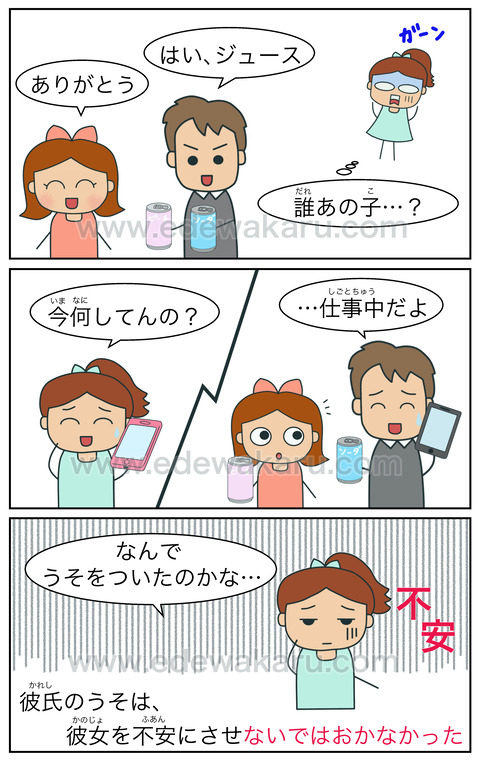
Meaning
Naturally cause someone to 〜
Naturally put something into a 〜 state
How to use it
Verb [ない-form] + ないではおかない
Verb [ない-form] + ずにはおかない
Explanation
「〜ないではおかない」 is a sentence pattern meaning “naturally cause someone to 〜” or “naturally put someone in a 〜 state.” It is used with [verbs expressing feelings or emotions] when you want to say “A makes B feel 〜 (regardless of B’s will).” 😊 It can be confused with other patterns, but remember it as “AはBを〜ないではおかない = A naturally makes B feel 〜.” 😀 In most cases, when it is used with a verb expressing emotion, the form is “emotion verb + causative.” 😮
(Review: 〜がちだ)
[Examples]
① Her boyfriend’s lie made her feel anxious.
[Emotion verb] make anxious → make someone anxious (causative form)
② That movie moved everyone.
[Emotion verb] be moved → move someone (causative form)
③ Yamada-kun’s words and actions will surely make the president angry.
[Emotion verb] get angry → make someone angry (causative form)
④ That politician’s remarks left the citizens confused.
[Emotion verb] be confused → confuse someone (causative form)
Also, 「〜ないではおかない」 can be changed to 「〜ずにはおかない」. 😉
[Examples]
Her boyfriend’s lie made her feel anxious.
= Her boyfriend’s lie made her feel anxious.
Her actions inevitably made her boyfriend distrust her.
= Her actions inevitably made her boyfriend distrust her.
There are several similar patterns using 「〜ないではおかない・〜ずにはおかない」, so be careful not to confuse them. 😊
In context 5 examples
彼氏のうそは、彼女を不安にさせないではおかなかった
→彼氏のうそは、彼女を不安にさせてしまったHer boyfriend’s lie made her feel anxious. → Her boyfriend’s lie made her feel anxious.
あの映画は、みんなを感動させないではおかなかった
→あの映画は、みんなを感動させたThat movie moved everyone. → That movie moved everyone.
山田くんの言動は、社長を怒らせないではおかないだろう
→山田くんの言動は、社長を怒らせてしまうだろうYamada-kun’s words and actions will surely make the president angry. → Yamada-kun’s words and actions will probably make the president angry.
あの政治家の発言は、国民を困惑させないではおかなかった
→あの政治家の発言は、国民を困惑させたThat politician’s remarks left the citizens confused. → That politician’s remarks left the citizens confused.
彼女の行動は、彼氏に不信感を与えないではおかなかった
→彼女の行動は、彼氏に不信感を与えてしまったHer actions inevitably made her boyfriend distrust her. → Her actions ended up making her boyfriend distrust her.
Read the original source text
Meaning
自然に〜させてしまう
自然に〜の状態にする
How to use it
動詞[ない形]+ないではおかない
動詞[ない形]+ずにはおかない
Explanation
「〜ないではおかない」は「自然に〜させてしまう」「自然に〜の状態にする」という意味を表す文型です。
これは【気持ちや感情を表す動詞】と一緒に使い、
「(Bの意志に関係なく)AはBを〜という気持ちにさせる」
と言いたい時に使います😊他の文型と混乱しがちですが、「AはBを〜ないではおかない=AはBを(自然に)〜という気持ちにさせる」と覚えておきましょう😀ほとんどの場合、感情を表す動詞と使う時は「感情を表す動詞+使役形」の形で使われます😮
(復習:〜がちだ)
[例]
①彼氏のうそは、彼女を
不安にさせないではおかなかった
【感情を表す動詞】不安にする→不安にさせる(使役形)
②あの映画は、みんなを
感動させないではおかなかった
【感情を表す動詞】感動する→感動させる(使役形)
③山田くんの言動は、社長を
怒らせないではおかないだろう
【感情を表す動詞】怒る→怒らせる(使役形)
④あの政治家の発言は、国民を
困惑させないではおかなかった
【感情を表す動詞】困惑する→困惑させる(使役形)
また
「〜ないではおかない」は「〜ずにはおかない」にチェンジすることができます
😉
[例]
彼氏のうそは、彼女を不安にさせ
ないではおかなかった
=彼氏のうそは、彼女を不安にさせ
ずにはおかなかった
彼女の行動は、彼氏に不信感を与え
ないではおかなかった
=彼女の行動は、彼氏に不信感を与え
ずにはおかなかった
「〜ないではおかない・〜ずにはおかない」は、似ている文型がいくつかありますので混乱しないようにしましょう😊
Usage 2
Read this source entry ↗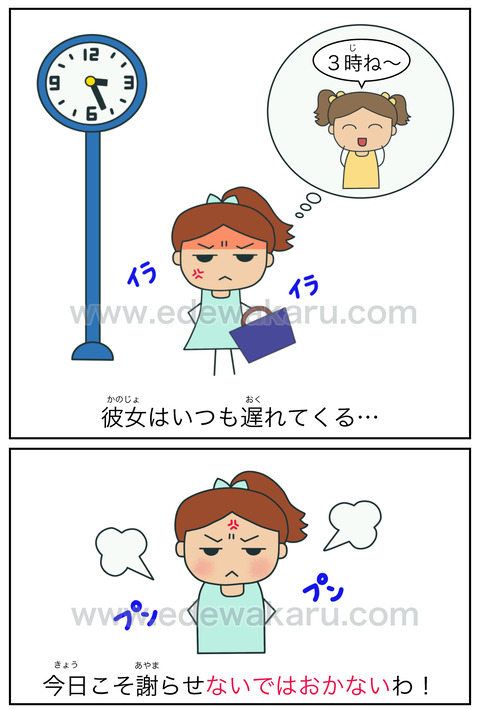
Meaning
I’ll definitely make you 〜
I can’t forgive it if 〜 doesn’t happen
How to use it
Verb [ない-form] + ないではおかない
Verb [ない-form] + ずにはおかない
Explanation
「〜ないではおかない」 is a sentence pattern expressing strong determination, as in “I’ll definitely make sure to 〜.” It is used when you want to say to someone, “I can’t forgive you unless you 〜; I’ll definitely make you 〜.” 😊 It takes the form 「A ないではおかない」, where A is an action verb. Also, 「〜ないではおかない」 can be changed to 「〜ずにはおかない」, and 「〜しないではおかない」 becomes 「〜せずにはおかない」. 😮
[Examples]
She’s always late… This time, I’ll make her apologize no matter what!
= This time, I’ll make her apologize no matter what!
He did something truly awful to me. I won’t let him get away with it; I’ll get revenge.
= ⭕️ I won’t let him get away with it; I’ll get revenge.
= ❌ I won’t let him get away with it; I’ll get revenge.
「〜ないではおかない・〜ずにはおかない」 is one of the very complicated patterns. I think it’s good to learn it together with 「〜ないではおかない・〜ずにはおかない」 meaning [naturally make someone 〜]. 😉
(Review: 〜ないではおかない・〜ずにはおかない① (naturally cause someone to do 〜))
(Review: 〜ておく)
In context 4 examples
彼女はいつも遅れてくる…今日こそ謝らせないではおかないわ!
→彼女はいつも遅れてくる…今日こそ絶対に謝らせてやるわ!(復習:〜こそ)She’s always late… This time, I’ll definitely make her apologize! (Review: 〜こそ)
彼には本当にひどいことをされた。仕返しをしないではおかない
→彼には本当にひどいことをされた。絶対に仕返しをしてやるHe did something truly awful to me. I’ll definitely get revenge.
練習試合(れんしゅうじあい)はAチームにやられっぱなしだった…今回は攻撃しないではおかないぞ
→今回は絶対に攻撃してやるぞ(復習:〜っぱなし)We were completely outplayed by Team A in the practice match… This time, I’ll definitely attack! (Review: 〜っぱなし)
あいつには顔から火が出る思いをさせられた。次に会った時は殴らないではおかない
→次に会った時は絶対に殴ってやる(復習:顔から火が出る)He made me feel so embarrassed my face burned. The next time I see him, I’ll definitely punch him. (Review: 顔から火が出る)
Read the original source text
Meaning
絶対に〜してやる
〜しない状態だと許せない
How to use it
動詞[ない形]+ないではおかない
動詞[ない形]+ずにはおかない
Explanation
「〜ないではおかない」は「絶対に〜してやる」というように、強い決意を表す文型です。これは、
相手に対して「〜しないと許せない、絶対に〜してやる」と言いたい時に使います
😊「A ないではおかない」の形で「A」には動作性の動詞が入ります。また
「〜ないではおかない」は「〜ずにはおかない」にチェンジすることができ、「〜しないではおかない」は「〜せずにはおかない」となります
😮
[例]
彼女はいつも遅れてくる…今日こそ謝らせ
ないではおかない
わ!
=今日こそ謝らせ
ずにはおかないわ!
彼には本当にひどいことをされた。仕返しをし
ないではおかない
=⭕️仕返しをせ
ずにはおかない
=❌仕返しをしずにはおかない
「〜ないではおかない・〜ずにはおかない」はとても複雑な文型の1つです。【自然に〜にさせる】という意味を表す「〜ないではおかない・〜ずにはおかない」と一緒に覚えておくといいと思います😉
(復習:〜ないではおかない・〜ずにはおかない①(自然に〜させる))
(復習:〜ておく)
どんなときどう使う 日本語表現文型辞典
Usage 1
Meaning
will most certainly
How to use it
Vない+ずにはおかない. Exception: しない→せずにはおかない
Explanation
ずにはおかない〈必ずする〉
必ず~する
Vない+では+おかない「~しないでおく、ということは許さない。必ず~する」という強い気持ち、意欲、方針があるときの言い方。
Expresses with strong emotion, desire, or policy the idea that something will not be allowed to go undone.
In context 3 examples
このチームに弱いところがあれば、相手チームはそこを攻めずにはおかないだろう。
If this team has any weak points, the opposing team is sure to attack them.
あの刑事はこの殺人事件の犯人を逮捕しないではおかないと言っている。
That detective says he will definitely arrest the culprit in this murder case.
マナーが悪い人を罰しないではおかないというのが、この国の方針です。
It is this country’s policy to make sure people with bad manners are punished.
Read the original source text
Meaning
will most certainly
How to use it
Vない+ずにはおかない 例外 しない→せずにはおかない
Explanation
ずにはおかない〈必ずする〉
必ず~する
Vない+では+おかない「~しないでおく、ということは許さない。必ず~する」という強い気持ち、意欲、方針があるときの言い方。
Expresses with strong emotion, desire, or policy the idea that something will not be allowed to go undone.
Usage 2
Meaning
can't help but
How to use it
Vない+ずにはおかない. Exception: しない→せずにはおかない
Explanation
ずにはおかない〈自発的作用〉
そのようなことが引き起こされる
Vない+では+おかない
W1)「そのような事態や行動が引き起こされる」という意味。 ❶ は気持ちを表す言葉とともに使って、自然にそのような気持ちになるという言い方。
2) ❷ の「ないではおかない」も意味・用法は同じ。
2)In sentence ❷ , ないではおかない has the same meaning and usage.
1)A situation or action is made to occur. By using with words expressing emotion, sentence ❶ suggests person naturally came to have that feeling.
In context 3 examples
あの犬を描いた映画は、見る人を感動させずにはおかない。
That movie about the dog is bound to move its viewers.
現在の会長と社長の争いは、会社全体を巻き込まないではおかないだろう。
The conflict between the current chairperson and the president is bound to involve the entire company.
彼のやり方は他の人に不信感を抱かせずにはおかない。
His way of doing things is bound to make other people distrustful.
Read the original source text
Meaning
can't help but
How to use it
Vない+ずにはおかない 例外 しない→せずにはおかない
Explanation
ずにはおかない〈自発的作用〉
そのようなことが引き起こされる
Vない+では+おかない
W1)「そのような事態や行動が引き起こされる」という意味。 ❶ は気持ちを表す言葉とともに使って、自然にそのような気持ちになるという言い方。
2) ❷ の「ないではおかない」も意味・用法は同じ。
2)In sentence ❷ , ないではおかない has the same meaning and usage.
1)A situation or action is made to occur. By using with words expressing emotion, sentence ❶ suggests person naturally came to have that feeling.
日本語NET JLPT文法解説まとめ
Meaning
① Be sure to ~ (expressing a strong determination)
② End up doing ~ naturally
How to use it
V(ない form)ない + ずにはおかない ※「する」 becomes 「せずにはおかない」.
V(ない form)+ ではおかない
Explanation
① "definitely
In context 6 examples
最近、公開されたあの映画は演技の上手な女優が主演なので、観客を感動させずにはおかないだろう。
That recently released movie stars a talented actress, so it is sure to move audiences.
彼女の美貌は多くの男性を虜にさせずにはおかない。
Her beauty is sure to captivate many men.
指名手配犯を目撃したのだから、警察に通報せずにはおかない。
Since I witnessed a wanted criminal, I have no choice but to report it to the police.
景気は一向に回復しないので、このままだと国民に不信感を与えずにはおかないだろう。
The economy shows no sign of recovering, so if things continue this way, it is sure to make the public distrustful.
消費税の増税や年金問題は日本国民を不安にさせずにはおかない。
The consumption tax hike and pension issues are bound to make the Japanese people anxious.
彼は新人なのに偉そうなので、みんなを怒らせずにはおかないだろう。
He acts so arrogant despite being a newcomer that he is bound to make everyone angry.
Read the original source text
Meaning
①必ず〜する (強い決意を表す)
②自然に〜してしまう
How to use it
V(ナイ形)ない + ずにはおかない ※「する」は「せずにはおかない」となる。
V(ナイ形)+ ではおかない
Explanation
① "definitely
毎日のんびり日本語教師
How to use it
Verb ない-form + ずにはおかない
Verb ない-form + ないではおかない
Explanation
Indicates that a feeling or action is naturally brought about, regardless of the person’s will.
When attached to verbs expressing feelings or psychology, it is often used in the causative form.
“する” becomes “せずにはおかない” or “しないではおかない.”
Notes
Similar and easily confused grammar patterns
In context 8 examples
私たちの劇団には人を引き付けずにはおかない魅力的な演技ができる俳優がたくさんいます。
Our theater company has many actors capable of captivating performances that are sure to draw people in.
実話に基づいた親子の愛を描くこの物語は人を感動させずにはおかないだろう。
This story, which depicts the love between a parent and child based on a true story, is sure to move people.
近年の異常気象は、環境問題の深刻さについて考えさせずにはおかない。
The extreme weather of recent years cannot help but make us think about the seriousness of environmental problems.
その見た目から漂う高級感と精巧に作られたフォルム。腕時計好きを魅了せずにはおかない。
The luxurious look it gives off and its meticulously crafted form are sure to captivate watch lovers.
スポーツは見る者に驚嘆や感銘を与えずにはおかない。
Sports never fail to inspire awe and admiration in those who watch.
戦ったもの同士が健闘を讃え抱き合う姿は人の涙を誘わずにはおかないものだ。
The sight of people who fought against each other praising one another’s efforts and embracing is bound to bring tears to people’s eyes.
そのピアニズムは聴く者を感動させずにはおかない。
That pianist’s artistry cannot help but move those who listen.
癌とは、誰もに死を意識させずにはおかない病だ。用法② 話者の強い意志
Cancer is an illness that inevitably makes everyone conscious of death. Usage ②: the speaker’s strong will
Read the original source text
How to use it
動ない形+ずにはおかない
動ない形+ないではおかない
Explanation
本人の意志と関係なく、自然にその感情や行動が引き起こされることを表します。
感情・心理を表す動詞につく時は、使役形になる場合が多めです。
「する」は「せずにはおかない」「しないではおかない」になります。
Notes
似ていて紛らわしい文法
日本語文型辞典 英語版
Meaning
【ずにはおかない】[V-ずにはおかない]
Means that a certain kind of situation or action is bound to occur, regardless of the will of the person him/herself. Often used to refer to spontaneous actions or effects, such as a change in emotion or the outbreak of conflict.
In context 4 examples
この本は読む人を感動させずにはおかない。
This book will not fail to move anyone who reads it.
彼の言動は皆を怒らせずにはおかない。
His words and actions will surely anger everyone.
今のような政治情勢では国民に不信感を与えずにはおかないだろう。
Given the current political climate, this will be sure to arouse mistrust in the people of Japan.
両大国の争いは世界中を巻込まずにはおかない。
A conflict between the two great powers will surely entangle the whole world.
文法
Meaning
① Be sure to ~ (expressing a strong determination)
② End up doing ~ naturally
How to use it
V (ない-form) ない + ずにはおかない ※「する」becomes 「せずにはおかない」.
V (ない-form) + ではおかない
In context 5 examples
最近、公開されてあの映画は演技は女優が主演なので、観客を感動させずにはおかないだろう。
That recently released movie, starring an actress known for her acting, will surely move the audience.
彼女の美貌は多くの男性を虜にさせずにはおかない。
Her beauty is sure to captivate many men.
景気は一向に回復しないので、このままだと国民に不信感を与えずにはおかないだろう。
The economy shows no sign of recovering, so if things continue this way, it is sure to make the public distrustful.
消費税の増税や年金問題は日本国民を不安にさせずにはおかない。
The consumption tax hike and pension issues are bound to make the Japanese people anxious.
彼は新人なのに偉そうなので、みんなを怒らせずにはおかないだろう。
He acts so arrogant despite being a newcomer that he is bound to make everyone angry.
Read the original source text
Meaning
①必ず〜する (強い決意を表す)
②自然に〜してしまう
How to use it
V(ナイ形)ない + ずにはおかない ※「する」は「せずにはおかない」となる。
V(ナイ形)+ ではおかない
Bunpro Grammar Reference
Meaning
Will definitely, Will certainly, Bound to, Not fail to
How to use it
Verb [ない-stem] + ずには + おかない
Verb [ない] + では + おかない
Exception:
する→せずにはおかない
Verb [Negative] + では + おかない
Nuance
A strong construction, implying that someone will definitely do (A). I will not set it aside with (A) not being done.
Explanation
ずにはおかない is a combination of the classical auxiliary verb ず, the case-marking particle に, the adverbial particle は, and the standard negated form of the う-Verb 措く, 措かない, ‘to set aside’, or ‘to leave as is’. It is interpreted as ‘(A) will definitely happen’, or ‘I will not fail to (A)’.
This is a formal expression that literally means ‘I cannot leave it as it is with (A) undone’, and therefore indicates strong will to complete the action that is reflected in the standard translations.
As this structure begins with ず, it will only be used with verbs.
あんなひどいことをした人だから、警察も捕まえずにはおかないだろう。
I am sure the police will not fail to arrest that person, since they did something so horrible.
メディアにも取り上げられたから、警察も調査をせずにはおかない。
Since it was covered by the media, the police will certainly investigate.
Alternatively, ないでは may replace ず. This will be seen as ないではおかない. However, the meaning will not change at all.
こんなことをされたのだから、お客さんも訴えないではおかないだろう。
Since they did such a thing to the customers, they would certainly sue them.
この犬は30キロになるから、躾に力を入れないではおかない。
Since this dog will become 30kg, I will not fail to train him.
Caution
Due to this grammar expression showing strong will to not give up until (A) is done, it will often be used with causative verbs in (A). This indicates that the speaker is determined not to quit until they can make another person do something.
あの人のスピーチは聞く人を感動させずにはおかない。
That person’s speech will not fail to move the audience.
In context 10 examples
- 小説、勇者:「どんな手段を用いても、かならず魔王を倒さずにはおかない。」
Novel: 'No matter what it takes, I will not fail to defeat the Demon Lord!'
- この犬は30キロになるから、躾に力を入れないではおかない。
Since this dog will become 30kg, I will not fail to train him.
- メディアにも取り上げられたから、警察も調査をせずにはおかない。
Since it was covered by the media, the police will certainly investigate.
- あんなひどいことをした人だから、警察も捕まえずにはおかないだろう。
I am sure the police will not fail to arrest that person, since they did something so horrible.
- こんなことをされたのだから、お客さんも訴えないではおかないだろう。
Since they did such a thing to the customers, they would certainly sue them.
- 「私はきっと彼に同じ手で仕返しをしないではおかない。」
'I won't fail to pay him back in his own coin.'
- 「警察はすべての悪者に必ず罰を与えずにはおかない。」
'The police will not fail to punish all the wicked people.'
- 「彼はまた私との約束をすっぽかした。絶対に彼に『ごめんなさい』と言わせずにはおかない。」
'He skipped our appointment again. I won't fail to get him to say "I'm sorry".'
- 小説:「探偵は『この残虐行為の責任者を訴追せずにはおかない』と意を決する。」
Novel: 'The detective resolved himself, "I won't fail to bring the person responsible for this atrocity to justice".'
- あの人のスピーチは聞く人を感動させずにはおかない。
That person’s speech will not fail to move the audience.
IMABI
Can’t Help III
Read this IMABI lesson ↗Explanation
Can’t Help III: ~ないではすまない, ~ないではおかない, ~を余儀なく[される・させる], & ~を禁じ得ない
These are even more difficult phrases dealing with not being able to help one’s emotions, etc. Not only do you need to try to separate these in your mind from the phrases found in the two previous lessons about this topic, but you’re going to have to pay even more attention to the differences among these patterns.
~{ないで・ずに}はすまない
Also seen as ~ずにはすまない, which is more formal but can still be found used in the spoken language, is used to show that if one thinks from a societal point of view with a given circumstance, doing something is simply and certainly unavoidable. It is difficult to use, however, when you think that you have to do something from personal emotion. Given that the phrase is stiff, this should be understandable.
1. 人の心を傷つけてしまったなら、謝らずにはすまない。
If you are to hurt someone’s heart, you can’t avoid apologizing.
2. 借金をせずにはすむまい。(古風で、硬い言い方)
You can’t get by without borrowing money.
3. 親に知られたら叱られないではすまないよ。
If your parents found out, you won’t be able to avoid getting scolded.
The non-double negative form above result in ~ないで済すむ, which means “to get by without…”. Just as in English, this implies a good thing because you got away without doing something. 済む itself may show that something is done.
4. 済んだことだ。
It’s finished.
5. 済んだのですか。
Is it over?
6. 金を払わないで済みました。
I got by without paying for it.
7. 気づかれずに済む。
To escape attention.
8. 彼が怪我けがをせずに済んでよかった。
I’m glad that he got by without injury.
9. 冗談じょうだんですまない。
To go beyond a joke. (Shows guilt)
10. 済んだことは元もとに戻もどらない。
What’s done cannot be undone.
11. 蜂を見つけたら、ゆっくり離れたほうがいい。体に止まっても振り払わずにじっとしていれば刺されずに済むよ。
If you are to find a bee, it’s best to separate oneself from it slowly. Even if it lands on you, you can leave without being stung if you stay still.
12. もう一つは、犯行後、同じように夜を待ち、普通の道を河内長野方面に向かって歩いたかもしれないことだ。これは車道以外に近道の旧道もあるので、ここを歩けば夜間は誰にも見られずに済む。
Another possibility is that (the criminal) waited just like that for night after the crime and walked down a regular road toward Kawachi-Nagano. This could go without being seen by anyone at night walking through here because there are also old shortcuts aside from the roadway.
From 二重葉脈 by 松本清張.
~{ないで・ずに}はおかない
Also seen as ~ずにはおかない, this pattern is used to show that one will certainly happen naturally or that you won’t allow something to stay not being done. It shows strong resolution. The situation where one won’t allow for something deals with first person. However, the first situation deals with subjects outside of first person, which includes inanimate things.
13. あの話はやはり嘘だったと、絶対に白状はくじょうさせないではおかないぞ。
If that was indeed a lie, I will absolutely not stand without making (that person) confess.
14. 彼女が歌ったのは聞く人の心を揺ゆさぶらずにはおかない。
What she had sung will surely move the hearts of those who hear.
~を余儀なく[される・させる]
余儀 よぎ means “another way/problem” and 余儀ない expresses “out of one’s control”. So, ~を余儀なくされる, shows that one had to do something that was not of one’s will and there was no other choice to get around it. You are essentially driven into a corner in a certain situation. This can also be seen in the causative as ~を余儀なくさせる. Usually the subject of sentences with ~を余儀なくされる is usually human, but the subject of sentences with ~を余儀なくさせる is usually not human but a something.
15. 悪天候のため試合の中止を余儀なくされました。
Bad weather made us postpone the match.
16. アメリカの圧力が貿易ぼうえき自由化を余儀なくさせた。
American pressure made free trade unavoidable.
17. 暴風雨で遠足は延期を余儀なくされた。
We had to put off the field trip due to fierce rain.
18. {余儀ない・やむを得ない}事情で欠席しました。
I was absent due to an uncontrollable situation.
19. 辞任を余儀なくされる。
To become out of one’s control to resign.
~を禁じ得ない
Although most dictionaries will just tell you this is the same as ~ないではいられない, this is not enough information to help you get a question right about it on the JLPT. Like all the other phrases in this series, this phrase describes not being able to withhold emotions, but this portrays an image of not being able to restrain emotions that have sprung up due to the circumstances. This phrase attaches to nouns that imply emotion. Sentences with it are usually first person.
20. 涙を禁じえなかった。
I couldn’t hold back the tears.
21. 犯人の供述を聞き、犯行動機はんこうどうきの身勝手みがってさに怒いかりを禁じ得なかった。
I couldn’t withhold my anger at the selfishness of the motive from listening to the criminal’s affidavit.
22. 同情の念を禁じえない。
I can’t hold back sympathy
23. 残された子犬を見て、涙を禁じ得なかった。
I couldn’t hold back the tears from looking at the puppy that was left.
In context 23 examples
人の心を傷つけてしまったなら、謝らずにはすまない。
If you are to hurt someone’s heart, you can’t avoid apologizing.
借金をせずにはすむまい。(古風で、硬い言い方)
You can’t get by without borrowing money.
親に知られたら叱られないではすまないよ。
If your parents found out, you won’t be able to avoid getting scolded.
済んだことだ。
It’s finished.
済んだのですか。
Is it over?
金を払わないで済みました。
I got by without paying for it.
気づかれずに済む。
To escape attention.
彼が怪我けがをせずに済んでよかった。
I’m glad that he got by without injury.
冗談じょうだんですまない。
To go beyond a joke. (Shows guilt)
済んだことは元もとに戻もどらない。
What’s done cannot be undone.
蜂を見つけたら、ゆっくり離れたほうがいい。体に止まっても振り払わずにじっとしていれば刺されずに済むよ。
If you are to find a bee, it’s best to separate oneself from it slowly. Even if it lands on you, you can leave without being stung if you stay still.
もう一つは、犯行後、同じように夜を待ち、普通の道を河内長野方面に向かって歩いたかもしれないことだ。これは車道以外に近道の旧道もあるので、ここを歩けば夜間は誰にも見られずに済む。
Another possibility is that (the criminal) waited just like that for night after the crime and walked down a regular road toward Kawachi-Nagano. This could go without being seen by anyone at night walking through here because there are also old shortcuts aside from the roadway.
あの話はやはり嘘だったと、絶対に白状はくじょうさせないではおかないぞ。
If that was indeed a lie, I will absolutely not stand without making (that person) confess.
彼女が歌ったのは聞く人の心を揺ゆさぶらずにはおかない。
What she had sung will surely move the hearts of those who hear.
悪天候のため試合の中止を余儀なくされました。
Bad weather made us postpone the match.
アメリカの圧力が貿易ぼうえき自由化を余儀なくさせた。
American pressure made free trade unavoidable.
暴風雨で遠足は延期を余儀なくされた。
We had to put off the field trip due to fierce rain.
{余儀ない・やむを得ない}事情で欠席しました。
I was absent due to an uncontrollable situation.
辞任を余儀なくされる。
To become out of one’s control to resign.
涙を禁じえなかった。
I couldn’t hold back the tears.
犯人の供述を聞き、犯行動機はんこうどうきの身勝手みがってさに怒いかりを禁じ得なかった。
I couldn’t withhold my anger at the selfishness of the motive from listening to the criminal’s affidavit.
同情の念を禁じえない。
I can’t hold back sympathy
残された子犬を見て、涙を禁じ得なかった。
I couldn’t hold back the tears from looking at the puppy that was left.