AIUEO JLPT Grammar
Meaning
This sentence pattern expresses a hypothetical condition, emphasizing that if something were to happen, the result would be meaningless or ineffective.
How to use it
Verb + としたって; verb + にしたって; verb + としたところで; verb + にしたところで; noun + としたって; noun + にしたって; noun + としたところで; noun + にしたところで
In context 5 examples
頑張ったとしたって、結果が出なければ意味がない。
Even if you try hard, it won’t mean much if there are no results.
プロとしたところで、失敗することもある。
Even professionals make mistakes sometimes.
急いだとしたところで、間に合わないだろう。
Even if we hurry, we probably won’t make it in time.
フォローをするにしたって、もう遅い。
It's too late to follow up now.
今日を休みにしたところで、状況は変わらない。
Taking today off won't change the situation.
Read the original source text
Meaning
This sentence pattern expresses a hypothetical condition, emphasizing that if something were to happen, the result would be meaningless or ineffective.
How to use it
動詞と+したって動詞に+したって動詞と+した+ところで動詞に+した+ところで名詞と+したって名詞に+したって名詞と+した+ところで名詞に+した+ところで
Explanation · 日本語
この文型は、仮定や前提を示す表現で、何かを仮定してその結果や状況がどうなるかを述べるときに使われます。この表現は、ある行動や状況を前提として、それがあっても結果として意味がない、または効果がないことを強調する場合に使用されます。
絵でわかる日本語
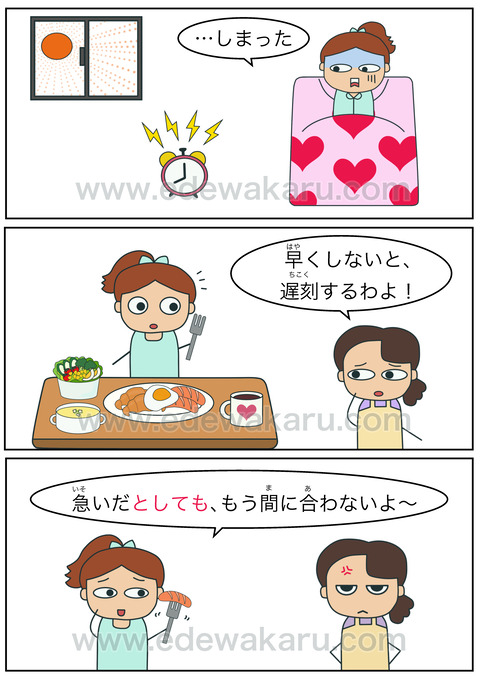
Meaning
Even if, hypothetically, 〜
Even if 〜 were to happen
Even if 〜 were true
How to use it
Verb/adjective/noun [plain form] + としても
Verb/adjective/noun [plain form] + としたって
*For the present affirmative form of な-adjectives and nouns, use “〜だとしても.”
Explanation
“AとしてもB” is a sentence pattern meaning “Even if hypothetically A, B,” “Even if A were to happen, B,” or “Even if A were true, B.” It is used when you want to say that even if a certain situation comes about, B will remain unchanged.
[Examples]
① Mother: Hurry up or you’ll be late!
Daughter: Even if I hurry, I won’t make it in time anyway~
→ Even if I hurry, the fact that I won’t make it in time won’t change~
② Even if a typhoon comes, I can’t take time off work…
→ Even if a typhoon comes, the fact that I can’t take time off work won’t change.
③ Even if you complain, nothing can be done.
→ Even if you complain, nothing can be done; that won’t change.
④ Even if that story is true, I just can’t believe it.
→ Even if that story is true, the fact that I can’t believe it won’t change.
⑤ Even if it’s a joke, you shouldn’t say something like that.
→ Even if it’s a joke, you shouldn’t say something like that.
⑥ Even if I failed, all the effort I’ve put in so far probably won’t go to waste.
→ Even if I failed, it would still be true that all the effort I’ve put in so far won’t go to waste.
The colloquial form of “〜としても” is “〜としたって,” so be sure to learn them together 😊
In context 6 examples
母:早くしないと、遅刻するわよ!娘:急いだとしても、もう間に合わないよ〜
Mother: Hurry up or you’ll be late! Daughter: Even if I hurry, I won’t make it in time anyway~
台風がきたとしても、仕事を休むことはできない…
Even if a typhoon comes, I can’t take time off work…
文句を言ったとしても、どうにもならないよ
Even if you complain, nothing can be done.
その話が本当だとしても、どうしても信じることができない
Even if that story is true, I just can’t believe it.
冗談だとしても、そんなことを言うものではないよ
Even if it’s a joke, you shouldn’t say something like that.
不合格だったとしても、今までの努力は無駄にならないだろう
Even if I fail, all the effort I’ve put in so far probably won’t go to waste.
Read the original source text
Meaning
仮に〜ても
もし〜になった場合でも
もし〜が事実でも
How to use it
動詞・形容詞・名詞[普通形]+としても
動詞・形容詞・名詞[普通形]+としたって
*な形容詞・名詞の現在肯定形は「〜だとしても」になる
Explanation
「AとしてもB」は「仮にAてもB」「もしAになった場合でもB」「Aが事実でもB」という意味の文型です。「Aという状態になっても、Bなのは変わらない」と言いたい時に使われます。
[例]
①母:早くしないと、遅刻するわよ!
娘:急いだ
としても、もう間に合わない〜
→仮に急いでも、もう間に合わないことは変わらないよ〜
②台風がきた
としても、仕事を休むことはできない…
→もし台風がきても、仕事を休むことはできないのは変わらない
③文句を言った
としても、どうにもならないよ
→文句を言っても、どうにもならないのは変わらない
④その話が本当だ
としても、どうしても信じることができない
→その話が本当でも、信じることができないのは変わらない
⑤冗談だ
としても、そんなことを言うものではないよ
→仮に冗談でも、そんなことを言うものではないよ
⑥不合格だった
としても、今までの努力は無駄にならないだろう
→仮に不合格でも、今までの努力は無駄にならないことは変わらない
「〜としても」の口語形は「〜としたって」ですので、一緒に覚えておきましょう😊
NINJAL 日本語文型データベース
Meaning
[1] Used to express the speaker’s judgment that even if something is assumed to be the case, it will not have the kind of effect one might expect as a result.
[2] Used to express the speaker’s judgment that even if something is a fact, it will not have the kind of effect one might expect as a result.
How to use it
V plain form + としたって
i-A plain form + としたって
na-A plain form + としたって (「na-Aだ」 can also take the form 「na-A+としたって」)
N plain form + としたって (「Nだ」 can also take the form 「N+としたって」)
na-A plain form + としたって
N plain form + としたって (the form 「N+としたって」 is also used)
Notes
[1] The “〜” takes a sentence expressing an assumption. What follows “〜としたって” is usually a sentence expressing the speaker’s judgment, evaluation, or intention.
When “〜” contains an interrogative word such as 「何・どこ・だれ」, it indicates that the same result applies under any conditions.
[2] What follows “〜としたって” is usually a sentence expressing the speaker’s judgment, evaluation, or intention.
In context 35 examples
フランスではひと月ぐらいバカンスが取れるらしいが、日本では取れるとしたってせいぜい2週間ぐらいだろうか。
It seems you can take about a month of vacation in France, but in Japan, even if you can take time off, I wonder if it would be two weeks at most.
今住んでいるこの家は、仮にこの先長くは住まないとしたって、もう嫌だ。狭いし暗いし……。
Even if I’m not going to live in this house much longer, I hate it now. It’s cramped and dark…
こんなくじ、つまらない。もし当たったとしたって、もらえる物は安っぽいおもちゃだけだ。
These lottery tickets are boring. Even if I win, all I’ll get is some cheap toy.
「合格発表は明後日? 受かっているといいね。でも、万一合格できなかったとしたって、落胆することはないよ。チャンスはまだあるよ」
“The results come out the day after tomorrow? I hope you pass. But even if you happen not to pass, don’t be disappointed. You’ll have another chance.”
彼女から連絡が来ない。仮に忙しいとしたって、簡単なメッセージぐらいは書けると思うけどなあ。
I haven’t heard from her. Even if she’s busy, I think she could at least send a quick message.
今日の美香さん、ちょっと変だった。たとえ飲み会が楽しくないとしたって、あんなに不機嫌な顔をしなくてもいいのに。
Mika was a little strange today. Even if she wasn’t enjoying the party, she didn’t have to look that unhappy.
親「どんなにおもちゃが欲しかったとしたって、幼稚園のものを勝手に持ってきちゃだめだよ」
Parent: “No matter how badly you wanted the toy, you mustn’t take things from kindergarten without permission.”
「どんな理由か知らないけど、たとえ行きたくなかったとしたって、何も言わないで食事会を欠席するのはよくないよ」
“I don’t know what the reason was, but even if you didn’t want to go, it wasn’t right to skip the dinner without saying anything.”
このチーム、けっこう強いよ。優勝は無理だとしたって、準決勝には残れるんじゃないかなあ。
This team is pretty strong. Even if winning the championship is out of reach, I think they could make it to the semifinals.
たとえ食材が十分でないとしたって、一流の料理人ならおいしい一品が作れるはずだ。
Even if there aren’t enough ingredients, a first-rate chef ought to be able to make a delicious dish.
仮に相手の説明がいい加減だったとしたって、そんなに腹を立てなくてもいいと思います。よく話し合えば、お互いの誤解は解けたはずです。
Even if the other person’s explanation was careless, I don’t think you needed to get so angry. If you had talked it through, you should have been able to clear up the misunderstanding on both sides.
たとえ学校の勉強があまり好きじゃなかったとしたって、本当にやりたいことが見つかれば、その方面で一生懸命勉強するようになると思う。
Even if you didn’t really like schoolwork, I think that once you find something you truly want to do, you’ll work hard at studying in that field.
「親しき仲にも礼儀あり」ということわざがある。たとえ親友だとしたって礼儀はわきまえるべきだと思う。
There’s a saying, “Even among close friends, manners matter.” I think that even if someone is your best friend, you should still be considerate.
そういえば山田君からゴルフの返事、まだもらっていないなあ。たとえスケジュールの調整中だとしたってずいぶん待たせるなあ。
Come to think of it, I still haven’t heard back from Yamada about golf. Even if he’s still trying to work out his schedule, he’s keeping me waiting a long time.
休憩所に荷物を置かせてもらうのに300円もお金が要るのか。仮に100円としたって有料はひどい。
It costs as much as 300 yen to leave your luggage at the rest area? Even if it were 100 yen, charging a fee is outrageous.
私なら、彼からの誕生日プレゼントがそんなに高い物じゃないとしたって気にしないけど、気にする人もいるんだなあ。
I wouldn’t mind if the birthday present from him wasn’t very expensive, but I guess there are people who do mind.
この俳優、当時いくつだったんだろう。仮に30代だったとしたって、今の感覚だと、それよりずいぶん年上に見えるなあ。
I wonder how old this actor was back then. Even if he was in his thirties, by today’s standards he looks much older.
彼が結婚するって話が万一本当じゃなかったとしたって、もう私には何の関係もない。
Even if the story about him getting married turns out not to be true, it has nothing to do with me anymore.
あれ、雨か。まあ、降っているとしたって、このぐらいなら散歩はできそうだ。
Oh, it’s raining. Well, even if it is, it looks like I could still go for a walk in weather like this.
「卒業パーティーには参加しないの? 参加しないとしたって、記念品代だけは払って」
“Aren’t you going to the graduation party? Even if you don’t go, pay for the commemorative gift at least.”
さっき出した荷物、郵便番号を書き間違えてしまった。間違えたとしたって、住所が正しければ、ちゃんと着くと思うけど。
I made a mistake writing the postal code on the package I sent earlier. Even if it’s wrong, I think it’ll still arrive as long as the address is correct.
「今回は結局お金をとられなかったとしたって、詐欺は危ないよ。これからはもっと気をつけたほうがいいよ」
“Even if they didn’t end up taking your money this time, scams are dangerous. You should be more careful from now on.”
私たちは確かに仲がいいけど、どんなに仲がいいとしたって、個人的な事情をあれこれ突っ込んで聞かれたくはないなあ。
We’re certainly close, but no matter how close we are, I don’t want people prying into my personal affairs.
もう若くないとしたって、私は体力とやる気はまだあると実感しているから、いろいろなことに挑戦していくつもりだ。
Even if I’m no longer young, I feel that I still have stamina and motivation, so I intend to take on all kinds of challenges.
「いくら安かったとしたって食べきれないほどりんごを買ってくるなんてばかだよ」
“No matter how cheap they were, it was foolish to buy so many apples that you can’t eat them all.”
この間のテスト、あまり難しくなかったとしたって、僕がこんないい点が取れたなんて驚きだ。
Even if the test the other day wasn’t very difficult, I’m surprised I got such a good score.
今度の週末は暇だけど、どんなに暇だとしたってうちでごろごろしているのは好きじゃない。
I’m free this weekend, but no matter how much free time I have, I don’t like lounging around at home.
いくら子どもが好きじゃないとしたって、自分の甥や姪にはもっと優しくしたほうがいいと思うよ。
No matter how much you dislike children, I think you should be kinder to your own nieces and nephews.
母は昔、芸能人だったそうだ。いくらテレビに出ていて有名だったとしたって、芸能界を引退した今ではふつうのおばさんだ。
I hear my mother used to be an entertainer. No matter how famous she was from appearing on TV, now that she’s retired from show business, she’s just an ordinary middle-aged woman.
父と大げんかした。僕が素直じゃなかったとしたって、僕だけが悪いんじゃない。父だって僕の言い分を全く聴こうとしないんだから。
I had a huge fight with my father. Even if I wasn’t being honest, I wasn’t the only one at fault. My father wouldn’t even listen to my side of things.
本はどこで買っても同じ値段だとしたって、あんな嫌な店員のいる本屋では買いたくない。
Even if books cost the same wherever you buy them, I don’t want to buy them at a bookstore with such an unpleasant clerk.
「なんだ、あの小林さんの態度。いくら大口の株主としたって、あんな偉そうな態度、許せないよなあ」
“What’s with that attitude from Kobayashi? No matter how large a shareholder he is, I can’t stand him acting so high and mighty.”
確かに私は正社員じゃないですけど、正社員じゃないとしたって、この会社のために頑張っているんです。
It’s true that I’m not a regular employee, but even so, I’m working hard for this company.
父がかつて大酒飲みだったとしたって、今では反省してもうあまり飲んでいないのだから、母も昔のことはそろそろ忘れてあげるべきだ。
Even if my father used to drink heavily, he has since reflected on it and doesn’t drink much anymore, so my mother should start letting go of the past.
「期待していた仕事じゃなかったとしたって、3日で辞めることはないでしょう? せめて3か月ぐらいは頑張ってみればよかったのに」
“Even if it wasn’t the job you expected, you didn’t have to quit after three days, did you? You should have at least tried sticking it out for about three months.”
Read the original source text
Meaning
[1] 〜と仮定した場合も、そのことから予想されるような影響は受けないという話し手の判断を述べるときに使います。
[2] ~は事実だがその場合も、そのことから予想されるような影響は受けないという話し手の判断を述べるときに使います。
How to use it
V普通形+としたって
i-A普通形+としたって
na-A普通形+としたって(「na-Aだ」→「na-A+としたって」の形になることもある)
N普通形+としたって(「Nだ」→「N+としたって」の形になることもある)
na-A普通形+としたって
N普通形+としたって(「N+としたって」の形もある)
Notes
[1] 「〜」には、仮定したことを表す文がきます。「~としたって」の後には、ふつう話し手の判断・評価・意志を表す文がきます。
「~」が疑問詞(「何・どこ・だれ」など)を含むときは、どのような条件の場合にも同じ結果になることを表します。
[2] 「~としたって」の後には、ふつう話し手の判断・評価・意志を表す文がきます。