くらべてわかる日本語表現文型辞典
Meaning
Meaning 1: A expresses the reason for B.
Meaning 2: B is allocated per unit A.
Meaning 3: A indicates the target of the action B.
How to use it
AにつきB
[Noun – ∅] につき
Explanation
【Contrast 2】
“Aに対してB” (Meaning 3, p. 245)
“AにつきB” specifically indicates the base unit used when allocating something, whereas “Aに対してB” expresses the ratio between two things in general terms.
○売り上げ200万円につき5万円がもらえる。(売り上げ200万円が基準単位となる。つまり400万円なら10万、600万円なら15万円ということを想定している。) — You receive 50,000 yen for every 2 million yen in sales. (Sales of 2 million yen are the base unit. In other words, the assumption is that for 4 million you receive 100,000 yen, and for 6 million, 150,000 yen.)
○もらえるのは売り上げ200万円に対して5万円である。(売り上げともらえる分の関係を単純に決定している。) — The amount you receive is 50,000 yen for 2 million yen in sales. (This simply establishes the relationship between sales and the amount received.)
○ワイン1本につきグラス1個進呈。 — One glass is given with each bottle of wine.
×ワイン1本に対してグラス1個進呈。 — One glass is given for one bottle of wine.
“AあたりB” (Meaning 1, p. 28)
【Contrast 3】
“AについてB” (Meaning 1, p. 247)
“AつきB” is a formal expression used in discussions, reports, and the like, and has a narrower range of use than “AについてB.”
○あの人の職歴について、知っていることがあったら教えてください。 — If you know anything about that person’s work history, please tell me.
×あの人の職歴につき、知っていることがあったら教えてください。 — If you know anything about that person’s work history, please tell me.
○会議の結果、以下の点に(ついて/つき)我々の意見が認められた。 — As a result of the meeting, our opinions were accepted on the following points.
Notes
【Note 1】
・It is often used on signs and in announcements.
○道路工事中につき、この先通行止め。(掲示) — Due to road construction, the road ahead is closed. (Sign)
×道路工事中につき、車が込んでいて遅れてしまった。 — Due to road construction, traffic was heavy and I ended up being late.
【Note 2】
・When the allocation is not emphasized, it can also be used in the form “AにB.”
○あの人の家には一部屋に(つき)1台テレビがあるらしい。 — Apparently, there is one TV in each room of that person’s house.
In context 12 examples
雨天につき、運動会は中止します。
The sports day will be canceled due to rain.
会議中につき、立入禁止。
No entry while a meeting is in progress.
本日、多忙につき、欠席いたします。
I will be absent today because I am busy.
好評につき、販売期間を延長いたしました。
Due to popular demand, we have extended the sales period.
一人につき5枚ずつ紙を配る。
We will hand out five sheets of paper to each person.
ボート代は1時間につき、800円いただきます。
Boat rental costs 800 yen per hour.
1年につき10日、有給休暇がとれます。
You can take ten days of paid leave per year.
お買い上げ2000円につき、1回くじ引きができます。
For every 2,000 yen spent, you can enter one drawing.
今の発言につき、反論申し上げる。
I would like to offer a rebuttal to the remarks just made.
そのことにつき、質問があります。
I have a question about that matter.
この点につき、意見を述べた。
I expressed my opinion on this point.
まずはじめに、今後の予定につきご説明いたします。
First, I will explain the plans going forward.
Read the original source text
Meaning
意味1:AはBの理由を表す。
意味2:単位AにBが割り当てられる。
意味3:AはBの行為の対象を表す。
How to use it
AにつきB
[名詞-∅]につき
Explanation
【対比2】
「Aに対してB」(意味3 P.245)
「AにつきB」は何かを割り当てるときの基準単位を具体的に示し、「Aに対してB」は二つの事柄の割合を一般的に示す。
○売り上げ200万円につき5万円がもらえる。(売り上げ200万円が基準単位となる。つまり400万円なら10万、600万円なら15万円ということを想定している。)
○もらえるのは売り上げ200万円に対して5万円である。(売り上げともらえる分の関係を単純に決定している。)
○ワイン1本につきグラス1個進呈。
×ワイン1本に対してグラス1個進呈。
「AあたりB」(意味1 P.28)
【対比3】
「AについてB」(意味1 P.247)
「AつきB」は硬い表現で、議論や報告などに用いられ、「AついてB」より使用範囲が狭い。
○あの人の職歴について、知っていることがあったら教えてください。
×あの人の職歴につき、知っていることがあったら教えてください。
○会議の結果、以下の点に(ついて/つき)我々の意見が認められた。
Notes
【注意1】
・掲示やアナウンスなどで使用することが多い。
○道路工事中につき、この先通行止め。(掲示)
×道路工事中につき、車が込んでいて遅れてしまった。
【注意2】
・割り当てることを強調しない場合、「AにB」の形でも使う。
○あの人の家には一部屋に(つき)1台テレビがあるらしい。
DoJG 日本語文法辞典(全集)
Meaning
A; per; for; on; to
How to use it
Number+Counter | につき | |
| 一時間につき | Per hour |
Explanation
A compound particle which expresses a rate or ratio.
In context 6 examples
この仕事は一時間につき六ドル貰える。
This job will pay you six dollars an hour. (literally: You can get six dollars an hour doing this job.)
一冊につき百五十円の送料が要ります。
A hundred and fifty yen is necessary per copy for postage. (literally: Postage of one hundred and fifty yen is necessary per copy.)
五千円につき四十円の手数料をいただきます。
We place a forty-yen service charge on five thousand yen
米一カップにつき、しょう油大さじ二杯の割合にします。
The ratio should be two tablespoons of soy sauce to a cup of rice.
切符は一人につき三枚までにして下さい。
Please limit it to three tickets per person.
間違い一つにつき一点減点します。
I'll take one point off for each mistake.
日本語文型辞典
Meaning
A formal expression for 「Nについて」.
See also: について 1
Following a noun, it means “for that reason.” It is used in formal letters and similar contexts.
A formal expression for 「N+数量詞+について」.
See also: について 2
How to use it
Nにつき【concerning】
Nにつき【reason】
N+数量詞+につき
In context 7 examples
本部の移転問題につき審議が行われた。
A review was held concerning the issue of relocating the headquarters.
領土の分割案につき関係各国の代表から厳しい批判が浴びせられた。
Representatives of the countries concerned leveled harsh criticism at the proposal to divide the territory.
改装中につきしばらくお休みさせていただきます。
We are temporarily closed due to renovations.
父は高齢につき参加をとりやめさせていただきます。
As my father is elderly, we regret that he will be unable to attend.
参加者200人につき、5人の随行員がついた。
There was one accompanying staff member for every 200 participants.
テニスコートの使用料は1時間につき千円ちょうだいします。
The tennis court costs 1,000 yen per hour to use.
食費は1人1目につき2千円かかる。
Food expenses are 2,000 yen per person per day.
Read the original source text
Meaning
「Nについて」のあらたまった言い方。
⇾について1
名詞を受けて「その理由で」の意を表す。改まった手紙などに用いられる。
「N+数量詞+について」のあらたまった言い方。
⇾について2
How to use it
Nにつき【関して】
Nにつき【理由】
N+数量詞+につき
絵でわかる日本語
Usage 1
Read this source entry ↗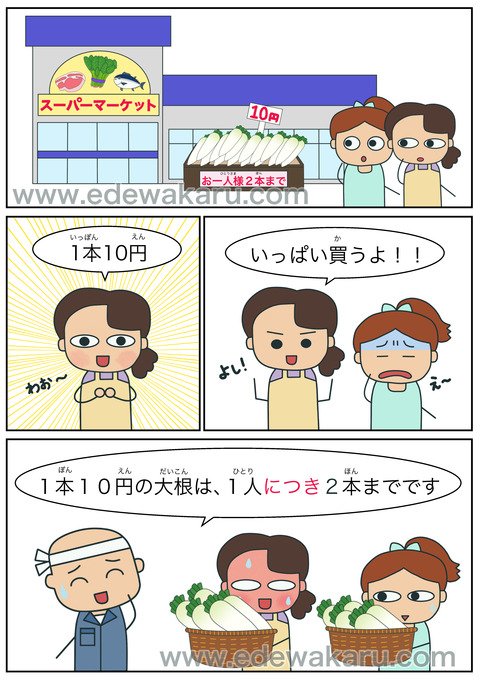
Meaning
~ per (quantity)
~ for each (quantity)
How to use it
Quantity word+につき
Explanation
「〜につき」 is a sentence pattern meaning “~ per quantity.” It is used to express “how much money or time is required for a given quantity” or “how much you receive for a given quantity” 😊
[Examples]
Radishes that cost 10 yen each are limited to two per person.
→ Each person can buy only two.
For every 10 stamps, you get one gift.
→ You get one gift for every 10 stamps.
I’ll give you one point for every 100 yen.
→ You get one point for every 100 yen.
You can attend the drinking party for 1,000 yen per person.
→ It costs 1,000 yen per person.
Lunch costs at least 500 yen per day.
→ It costs at least 500 yen for each day.
The karaoke room usage fee is 800 yen per hour.
→ It costs 800 yen per hour.
「〜につき」 also has a meaning that expresses [reason], so learn that meaning too 😊
(Review: 〜につき (reason))
In context 6 examples
1本10円の大根は、1人につき2本までです
Radishes that cost 10 yen each are limited to two per person.
スタンプ10個につき、プレゼントが1つもらえる
For every 10 stamps, you get one gift.
100円につき1ポイント差し上げます
I’ll give you one point for every 100 yen.
パーティーには1人につき1000円で参加できるよ
You can attend the party for 1,000 yen per person.
ランチには1日につき500円以上かかる(復習:〜かかる)
Lunch costs at least 500 yen per day. (Review: 〜かかる)
カラオケルームの使用料は1時間につき800円です
The karaoke room usage fee is 800 yen per hour.
Read the original source text
Meaning
〜(の数量)に対して〜
How to use it
数量詞+につき
Explanation
「〜につき」は「〜の数量に対して〜」という意味を表す文型です。「
〜の数量に対して、どのくらいお金や時間がかかるか」「〜の数量に対してどれだけのものがもらえるか」
という意味で使われます😊
[例]
1本10円の大根は、1人につき2本までです
→1人に対して、2本だけ買うことができる
スタンプ10個
につき、プレゼントが1つもらえる
→スタンプ10個に対して、プレゼントが1つもらえる
100円
につき
1ポイント差し上げます
→100円に対して1ポイントもらえる
飲み会には1人
につき
1000円で参加できるよ
→1人に対して1000円かかる
ランチには1日
につき
500円以上かかる
→1日に対して500円以上かかる
カラオケルームの使用料は1時間
につき
800円です
→1時間に対して800円かかる
「〜につき」には【理由】を表す意味もあります
ので、一緒に覚えておきましょう😊
(復習:〜につき(理由))
Usage 2
Read this source entry ↗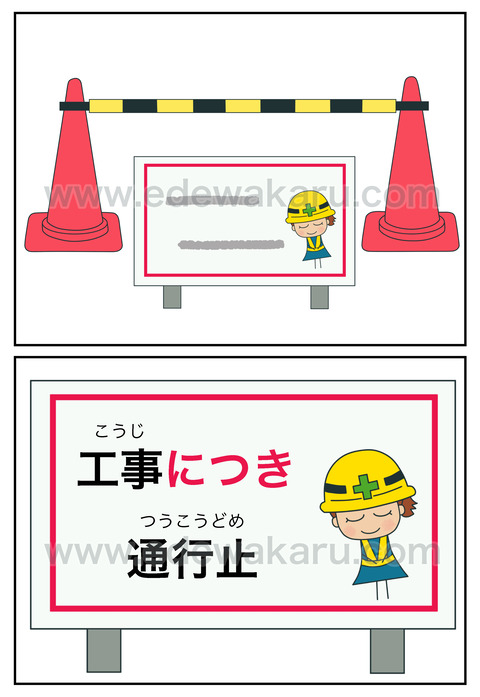
Meaning
for the reason that 〜
How to use it
Noun [dictionary form] + につき
Explanation
“〜につき” is a sentence pattern used to mean “for the reason that 〜.” It is a formal-sounding expression, so it is not often used in everyday conversation. 😅
In most cases, it is used on signs, bulletin boards, letters, and so on. 😊 “〜につき” has several meanings, so if you’re taking N3 or above, learn to distinguish them. 😉
[Meanings of “〜につき”]
① “reason”
② “topic”
【〜につき・〜について】
[Example]
Talk about Japanese culture.
Talk about Japanese culture.
③ “per; for each”
【〜につき・〜について】
The hourly wage is 1,000 yen per hour.
The hourly wage is 1,000 yen per hour.
I’ll explain “〜につき” for “topic” and “per” next time. 😀
In context 4 examples
工事につき通行止
→工事という理由で通行止Road closed due to construction. → Road closed because of construction.
冷房中(れいぼうちゅう)につき、ドアを閉めてください
→冷房中ですので、ドアを閉めてくださいPlease keep the door closed because the air conditioning is on. → The air conditioning is on, so please keep the door closed.
お盆につき、1週間休業します
→お盆という理由で、1週間休業します(復習:お盆)We’ll be closed for one week due to Obon. → We’ll be closed for one week because of Obon. (Review: Obon)
山田は会議中につき、席を外しております
→山田は会議中ですので、席を外しております*「席を外す」とは「不在」「その場所を離れている」という慣用表現(かんようひょうげん)です。日本の会社で働いている人は、とてもよく使う表現ですので覚えておくといいですよ😊Yamada is currently in a meeting, so he is away from his desk. → Yamada is in a meeting, so he is away from his desk. *“席を外す” is an idiomatic expression meaning “to be absent” or “to have left that place.” It is used very often by people who work at Japanese companies, so it’s useful to learn. 😊
Read the original source text
Meaning
〜という理由で
How to use it
名詞[辞書形]+につき
Explanation
「〜につき」は「〜という理由で」という意味で使用される文型です。かたい言い方ですので、日常会話(にちじょうかいわ)ではあまり使われません😅
ほとんどの場合は、看板や掲示板、手紙などで使われます
😊「〜につき」はいくつかの意味がありますので、N3以上を受ける人は区別して覚えておきましょう😉
[「〜につき」の意味]
①「理由」
②「内容」
【〜につき・〜について】
[例]
日本文化(日本文化)
につき
話をする
日本文化
について
話をする
③「比率」
【〜につき・〜について】
時給は1時間
につき
1000円です
時給は1時間
について
1000円です
「内容」「比率」の「〜につき」はまた次回説明します😀
どんなときどう使う 日本語表現文型辞典
Meaning
because of; on account of
How to use it
N + につきW
Explanation
~のため
理由を言うときに使う。お知らせ・掲示・張り紙などの通知や改まった手紙文の決まった言い方。
Gives reasons. For idioms used in notices, bulletins, posters, and other notifications, or formal letter-writing.
In context 3 examples
(店の張り紙)店内改装中につき、しばらく休業いたします。
(Sign in a shop) Closed temporarily for interior renovations.
(事務所の張り紙)本日は祭日につき、休業。
(Sign in an office) Closed today for a public holiday.
(郵便局からの通知)この手紙は料金不足につき、返送されました。
(Notice from a post office) This letter was returned because of insufficient postage.
Read the original source text
Meaning
because of; on account of
How to use it
N+につきW
Explanation
~のため
理由を言うときに使う。お知らせ・掲示・張り紙などの通知や改まった手紙文の決まった言い方。
Gives reasons. For idioms used in notices, bulletins, posters, and other notifications, or formal letter-writing.
日本語NET JLPT文法解説まとめ
Usage 1
Read this source entry ↗Meaning
「Nにつき」 indicates how much cost or time is required, or what services are available, per N.
When speaking, 「につき」 is often omitted.
How to use it
N + につき
Explanation
per
In context 10 examples
スタンプ10個につき500円値引きいたします。
We’ll give you a 500-yen discount for every 10 stamps.
ここの時給は1時間につき900円です。
The hourly wage here is 900 yen per hour.
この駐車場は1日につき1,500円かかります。
This parking lot costs 1,500 yen per day.
こちらのセール品は1人につき2つまでとさせていただいております。
Each person may purchase up to two of these sale items.
本日の資料は1人につき2部までお持ち帰りいただけます。
You may take home up to two copies of today’s materials per person.
くじを引けるのは1人につき1回までとなっております。
Each person may draw a lottery ticket once at most.
電気代は1ヶ月につき、だいたい1万円ぐらいです。
The electricity bill is about 10,000 yen per month.
パーティーへの参加費用は1人につき、2,000円です。
The party costs 2,000 yen per person.
当コワーキングスペースは1時間につき、5,00円かかります。
This coworking space costs 5,00 yen per hour.
セール品のトマトは1人につき、5個まで買うことができる。
You can buy up to five of the sale tomatoes per person.
Read the original source text
Meaning
「Nにつき」でNに対してどのぐらい費用や時間がかかるのか、サービスがあるのかなどを表す。
話すときは「につき」を省略して言うことが多い。
How to use it
N + につき
Explanation
per
Usage 2
Read this source entry ↗Meaning
Because of ~ / due to ~
An expression often used in notices such as signs and posted announcements. It is formal, so it is hardly ever used in everyday conversation.
How to use it
N + につき
Explanation
because of / on account of
Expressions commonly used in notices, signs, and other informational texts. Since this grammar pattern is formal expressions, this is rarely used in everyday conversation.
In context 11 examples
閉店につき、店内全品半額セール。
Closing-down sale: everything in the store is half price.
店内改装中につき、しばらく休業いたします。
We will be closed for a while due to renovations inside the store.
出入り口につき、駐車禁止
No parking, as this is an entrance and exit.
私有地につき、立入禁止
Private property. No trespassing.
この先、工事中につき立入禁止です。
Construction ahead; no entry.
夏休みにつき、15日まで休業いたします。
We will be closed until the 15th for summer vacation.
準備中につき、今しばらくお待ちください。
We are preparing. Please wait a little longer.
申し訳ございません。田中は会議中につき、席を外しております。
We apologize. Tanaka is away from their desk because they are in a meeting.
大好評につき、品切れとなりました。
Sold out due to overwhelming popularity.
不評につき、製造停止となりました。
Production has been discontinued due to poor reviews.
本日のコンサートは大雨につき、中止とさせていただきます。
Today’s concert is canceled due to heavy rain.
Read the original source text
Meaning
〜のため、〜という理由で
看板や掲示物など通知文でよく使われる表現。硬い表現なので日常会話で使うことはほとんどない。
How to use it
N + につき
Explanation
because of / on account of
Expressions commonly used in notices, signs, and other informational texts. Since this grammar pattern is formal expressions, this is rarely used in everyday conversation.
毎日のんびり日本語教師
How to use it
Noun + につき
Explanation
It has the same meaning as 「~について」 (“about ~”).
It is a more formal expression than 「~について」.
Notes
Nothing in particular.
In context 8 examples
移転問題につき、野党からの激しい追及を受けている。
Regarding the relocation issue, we are facing fierce questioning from the opposition parties.
この問題につき、熱い議論が交わされた。
A heated discussion was held on this issue.
当店物件につき、お気軽にお問い合わせ下さい。
Please feel free to inquire about our properties.
参考資料につき、一部誤記がございましたので修正しました。
We corrected some misprints in the reference materials.
新しい事業計画につき、これからごいたします。
Regarding the new business plan, we will provide an update from here on.
会場につき参加申込可能人数を超えてお申込みがあった場合は、参加をお断りすることがありますのでご了承ください。
Please note that if applications exceed the venue’s participation capacity, we may have to refuse your participation.
館内のご利用に際し、下記内容につきご留意ください。
Please take note of the following regarding your use of the facility.
小学校に必要なタブレット端末の選定につき検討の結果、性能も良くより安価なA社製品のものを導入することにした。用法② 理由や原因
After considering the selection of tablet devices needed for elementary schools, we decided to adopt products from Company A, which offer good performance at a lower price. Usage ② Reason or cause
Read the original source text
How to use it
名詞+につき
Explanation
「~について」と同じ意味を持ちます。
「~について」よりも改まった表現です。
Notes
特になし
日本語文型辞典 英語版
Meaning
A formal expression of Nについて.
→
1
With a noun, expresses the meaning of “for reasons of N (something).” について is used in a formal letter.
A formal expression of N + numeral + について.
→
【について】2
How to use it
1. Nにつき〈about, regarding〉
2. Nにつき〈reason〉
3. N+数量詞+につき
In context 7 examples
本部の移転問題につき審議が行われた。
There was a debate over the issue of relocating the head office.
領土の分割案につき関係各国の代表から厳しい批判が浴びせられた。
The proposal of territorial division was harshly condemned by representatives of all countries concerned.
改装中につきしばらくお休みさせていただきます。
The restaurant is closed temporarily for renovation.
父は高齢につき参加をとりやめさせていただきます。
I’m afraid that my father will have to forego attending on account of his advanced age.
参加者 200 人につき、5人の随行員がついた。
Five attendants are allocated to 200 participants.
テニスコートの使用料は1時間につき千円ちょうだいします。
The fee for one hour of court time (for tennis) is 1,000 yen.
食費は1人1日につき2千円かかる。
It costs each person 2,000 yen for meals per day.
AIUEO JLPT Grammar
Meaning
「〜につき」is an expression used to explain reasons or situations. It is often used in official notices or announcements. It can also be used with units of quantity or time to mean “per”.
How to use it
Noun に + つき
In context 5 examples
本日は定休日につき、休業させていただきます。
We are closed today due to our regular holiday.
台風の影響につき、イベントは中止となります。
The event is canceled due to the typhoon.
一人につき1枚のチケットが必要です。
One ticket is required per person.
このサービスは1時間につき500円です。
This service costs 500 yen per hour.
この場所は関係者以外立ち入り禁止につき、ご注意ください。
This area is off-limits to unauthorized personnel, so please be cautious.
Read the original source text
Meaning
「〜につき」is an expression used to explain reasons or situations. It is often used in official notices or announcements. It can also be used with units of quantity or time to mean “per”.
How to use it
名詞に+つき
Explanation · 日本語
「〜につき」は、理由や状況を説明するときに使われる表現です。特に、公式な案内や告知などでよく使用されます。また、「〜ごとに」という意味で数量や時間の単位と共に使われることもあります。
文法
Usage 1
Meaning
「Nにつき」 indicates how much cost or time is required, or what services are available, per N.
When speaking, 「につき」 is often omitted.
How to use it
N + につき
In context 10 examples
スタンプ10個につき500円値引きいたします。
We’ll give you a 500-yen discount for every 10 stamps.
ここの時給は1時間につき900円です。
The hourly wage here is 900 yen per hour.
この駐車場は1日につき1,500円かかります。
This parking lot costs 1,500 yen per day.
こちらのセール品は1人につき2つまでとさせていただいております。
Each person may purchase up to two of these sale items.
本日の資料は1人につき2部までお持ち帰りいただけます。
You may take home up to two copies of today’s materials per person.
くじを引けるのは1人につき1回までとなっております。
Each person may draw a lottery ticket once at most.
電気代は1ヶ月につき、だいたい1万円ぐらいです。
The electricity bill is about 10,000 yen per month.
パーティーへの参加費用は1人につき、2,000円です。
The party costs 2,000 yen per person.
当コワーキングスペースは1時間につき、5,000円かかります。
This coworking space costs 5,000 yen per hour.
セール品のトマトは1人につき、5個まで買うことができる。
You can buy up to five of the sale tomatoes per person.
Read the original source text
Meaning
「Nにつき」でNに対してどのぐらい費用や時間がかかるのか、サービスがあるのかなどを表す。
話すときは「につき」を省略して言うことが多い。
How to use it
N + につき
Usage 2
Meaning
Because of ~ / due to ~
An expression often used in notices such as signs and posted announcements. It is formal, so it is hardly ever used in everyday conversation.
How to use it
N + につき
In context 11 examples
閉店につき、店内全品半額セール。
Closing-down sale: everything in the store is half price.
店内改装中につき、しばらく休業いたします。
We will be closed for a while due to renovations inside the store.
出入り口につき、駐車禁止
No parking, as this is an entrance and exit.
私有地につき、立入禁止
Private property. No trespassing.
この先、工事中につき立入禁止です。
Construction ahead; no entry.
夏休みにつき、15日まで休業いたします。
We will be closed until the 15th for summer vacation.
準備中につき、今しばらくお待ちください。
We are preparing. Please wait a little longer.
申し訳ございません。田中は会議中につき、席を外しております。
We apologize. Tanaka is away from their desk because they are in a meeting.
大好評につき、品切れとなりました。
Sold out due to overwhelming popularity.
不評につき、製造停止となりました。
Production has been discontinued due to poor reviews.
本日のコンサートは大雨につき、中止とさせていただきます。
Today’s concert is canceled due to heavy rain.
Read the original source text
Meaning
〜のため、〜という理由で
看板や掲示物など通知文でよく使われる表現。硬い表現なので日常会話で使うことはほとんどない。
How to use it
N + につき
Bunpro Grammar Reference
Meaning
Due to, On account of, Each or every
How to use it
Noun + につき
Nuance
A structure showing that something is due to (A), or for each (A). May be interpreted as taking up the position of (A), (B).
Explanation
Although rarely seen in its kanji form, につき is a grammar pattern that comes from a combination of に and the conjunctive form of the う- Verb 就く 'to take up (A)', or 'to assume (A)'. This meaning is usually in regard to assuming a new position, such as a new job.
However, the particular meaning conveyed here will be closer to 'due to (A), (B)', 'on account of (A), (B)', or 'for each (A), (B)'. につき will follow nouns directly, before the (B) part of the sentence describes what is happening 'due to' or 'on account of (A)'.
閉店につき、特別セール開催中!
Due to our store closing, there is a special sale going on!
工事中につき、この先立ち入り禁止。
Due to construction, entry beyond this point is prohibited.
この商品は大人気のため、一人につき二つまでとさせていただいております。
Since this product is very popular, we are limiting it to two per person.
This grammar point is quite formal, so it is often seen in formal documents, announcements, and notifications.
Regardless of the several common English translations, the base meaning of 'to affix to (A)' is kept in all of the uses of につき, as it simply implies that (B) is in answer to, exists in a way that is directly linked to, suitable for, or caused by (A).
In context 15 examples
- 工事中に就き、迂回してください。
Due to construction, please take a detour.
- 閉店につき、特別セール開催中!
Due to our store closing, there is a special sale going on!
- この商品は大人気のため、一人につき二つまでとさせていただいております。
Since this product is very popular, we are limiting it to two per person.
- 工事中につき、この先立ち入り禁止。
Due to construction, entry beyond this point is prohibited.
- 開店に就き、事務員を募集する。
On account of opening a new shop, we are hiring clerks.
- 今なら100円に就き5ポイントもらえる。
Right now, you get five points for each 100 yen you spend.
- 明日は祭日に就き、会社は休みです。
On account of tomorrow's festival, the company will be closed.
- ここは私有地に就き、通り抜け禁止です。
Due to this being private land, it is prohibited to cut through here.
- 本日は雨天に就き、試合は中止となりました。
On account of today's rain, the match has been canceled.
- 本日特売のたまごは、一人に就き2パックまでです。
Today's special sale on eggs is limited to two cartons per person (each person).
- 料理長の出張に就き、本日はメニューを変更させていただきました。
On account of the head chef being on a business trip, today's menu has been changed.
- この駐車場は30分に就き300円も取られる。
This parking area takes as much as 300 yen for (every) 30 minutes.
- 好評に就き、期間限定でしたが定番メニューになりました。
On account of its popularity, the limited time item was made a standard menu item.
- 熱中症アラートの発令に就き、ケイティ・シェリーのコンサートがキャンセルされました。ご迷惑をおかけして申し訳ありません。
Due to the heat stroke alert's announcement, Katy Sherry's concert has been canceled. We are sorry for the inconvenience.
- 改築工事中に就き、2階のお手洗をご使用ください。ご迷惑をおかけして申し訳ありません。
Due to ongoing renovation works, please use the restroom on the second floor. We are sorry for the inconvenience.
Read the original source text
Meaning
Due to, On account of, Each or every
How to use it
Noun + につき
Nuance
A structure showing that something is due to (A), or for each (A). May be interpreted as taking up the position of (A), (B).
Explanation
Although rarely seen in its kanji form, につき is a grammar pattern that comes from a combination of に and the conjunctive form of the う- Verb 就く 'to take up (A)', or 'to assume (A)'. This meaning is usually in regard to assuming a new position, such as a new job.
However, the particular meaning conveyed here will be closer to 'due to (A), (B)', 'on account of (A), (B)', or 'for each (A), (B)'. につき will follow nouns directly, before the (B) part of the sentence describes what is happening 'due to' or 'on account of (A)'.
閉店につき、特別セール開催中!
Due to our store closing, there is a special sale going on!
工事中につき、この先立ち入り禁止。
Due to construction, entry beyond this point is prohibited.
この商品は大人気のため、一人につき二つまでとさせていただいております。
Since this product is very popular, we are limiting it to two per person.
This grammar point is quite formal, so it is often seen in formal documents, announcements, and notifications.
Regardless of the several common English translations, the base meaning of 'to affix to (A)' is kept in all of the uses of につき, as it simply implies that (B) is in answer to, exists in a way that is directly linked to, suitable for, or caused by (A).
Nuance · 日本語
何かが(A)のせいである、又は何かが各(A)であるということを表す表現。(A)の立場を取って(B)になるという解釈もできる。
Explanation · 日本語
「につき」は「に」と五段動詞「就く」でできている文型で、たいていの場合はひらがなで書かれます。動詞の「就く」は「引き受ける」や「身を置く」という意味を持ち、よく新しい仕事、地位や立場などと関連して使われます。
しかし、この文型はふつう「(A) の理由で (B)」「(A) が原因で (B)」「(A) ごとに (B)」などの意味で使われます。「につき」は名詞の後ろに直接置かれ、その後ろの (B) の部分で (A) が理由や原因となって起こっている内容の説明が続きます。
閉店につき、特別セール開催中!
Due to our store closing, there is a special sale going on!
工事中につき、この先立ち入り禁止。
Due to construction, entry beyond this point is prohibited.
この商品は大人気のため、一人につき二つまでとさせていただいております。
Since this product is very popular, we are limiting it to two per person.
「につき」はとても硬い文型なので、正式な書類や公の場での告知、または通知などで使われることが多いです。
この文法の根底にある「(A) に付く」という意味は、「につき」の全ての用法に共通していると言えます。というのも、(B) の内容は、(A) に対応するもの、(A) に適したもの、(A) と直接繋がるもの、または (A) によって引き起こされるものになり、どれも (A) と (B) が密接に関連しているというニュアンスを持つためです。
NINJAL 日本語文型データベース
Usage 1
Meaning
Used to announce that a certain situation will occur for the reason of “~.” It is used on notices and in official documents.
How to use it
Nにつき
In context 5 examples
本日強風につき、ケーブルカーの運行は終日運休させていただきます。
Due to strong winds today, the cable car service will be suspended for the entire day.
店内改装につき、15日から18日まで休業いたします。
We will be closed from the 15th to the 18th due to renovations inside the store.
交通事故多発につき注意!
Caution: frequent traffic accidents!
クリスマス限定ギフトセットはご好評につき、完売いたしました。ありがとうございました。
Our Christmas limited-edition gift sets have sold out due to popular demand. Thank you.
ただいまキャンペーン中につき、全品10%オフと大変お得です。
We are currently running a campaign, so everything is 10% off—a great bargain.
Read the original source text
Meaning
〜という理由で、ある状況になると知らせるときに使います。張り紙や公的文書などに使います。
How to use it
Nにつき
Usage 2
Meaning
Expresses the content of an exchange of information, thoughts, and so on.
How to use it
Nにつき
Notes
“~” is followed by a topic involving gathering or exchanging information, thinking, and so on. “~について” is often followed by a clause with a verb that expresses gathering or exchanging information or thinking, such as “調べる・話す・聞く・書く・考える.”
In context 3 examples
現在、区議会では育児支援につき活発な議論が行われている。
The ward assembly is currently engaged in active discussions regarding childcare support.
日本での消費税導入の経緯につき、以下に詳しく述べる。
The history of the introduction of consumption tax in Japan is described in detail below.
地域医療の問題点につき、会合では次々と意見があがった。
At the meeting, opinions were raised one after another about the problems facing regional healthcare.
Read the original source text
Meaning
情報のやりとり、思考などの内容を表します。
How to use it
Nにつき
Notes
「~」には情報の収集、やりとり、思考などの話題がきます。「〜について」の後には、「調べる・話す・聞く・書く・考える」などの情報の収集、やりとり、思考などを表す動詞の文がくることが多いです。