日本語文型辞典
Meaning
Basic information: V-るがはやいか. Explanation. In the form “XがはやいかY,” it means that Y happens almost at the same time as X. A written expression, like “…やいなや” and “…とたんに.” Examples: ① No sooner had he heard those words than he lunged at the man. ② The man grabbed the mug and drained it in one go. ③ As soon as the child got home from school and put his bag in the entrance, he dashed back out again. ④ No sooner had the crow seized the rabbit in its sharp claws than it shot up into the sky.
Read the original source text
Meaning
基本情報V-るがはやいか説明「XがはやいかY」の形で、Xが起こるのとほとんど同時にYが起こる、という意味。「…やいなや」「…とたんに」書きことば。例文① そのことばを聞くがはやいか、彼はその男になぐりかかった。② その男はジョッキをつかむがはやいか一気に飲みほした。③ こどもは、学校から帰って来ると、玄関にかばんをおくが早いか、また飛び出していった。④ その烏は、ウサギをするどいツメでとらえるが早いか、あっと言う間に空にまい上がった。
日本語文型辞典 英語版
Meaning
【がはやいか】[V-るがはやいか]
Means Y happens almost simultaneously with X. Similar to やいなや and とたんに. Used in written language.
In context 4 examples
そのことばを聞くがはやいか、彼はその男になぐりかかった。
As soon as he heard the word, he started hitting the man.
その男はジョッキをつかむがはやいか一気に飲みほした。
The instant the man picked up the beer mug, he drank it empty in one gulp.
こどもは、学校から帰って来ると、玄関にカバンをおくが早いか、また飛び出していった。
After getting home from school, the child no sooner placed his bag in the entrance than he rushed out again.
その鳥は、ウサギをするどいツメでとらえるが早いか、あっと言う間に空にまい上がった。
As soon as the bird had caught the rabbit with its sharp claws, it immediately flew up into the sky.
IMABI
Tendency
Read this IMABI lesson ↗Explanation
Tendency: 嫌いがある, が早いか, が最後, & そばから
In this lesson we will learn about speech modals concerning tendency.
嫌いがある
嫌い means “to hate”–it is treated as a 形容動詞 instead of as a verb in Japanese–and is followed by がある to show what someone or something has a tendency of doing. As the word suggests, this is not a good tendency. This tendency has to be somewhat bad, so it doesn’t work with phrases like ぎりぎり間に合う.
1. 依存症の嫌いがあること
To have a tendency of dependence.
2. その生徒は遅刻する嫌いがありました。
That student had a tendency to be late.
3. 彼は酒を飲みすぎる嫌いがある。
He has a tendency of drinking too much sake.
4. 人には自分の聞きたくないことは耳に入れないというきらいがあるのではないか。
Isn’t there are tendency that what one doesn’t want to hear doesn’t get heard?
5. 彼女は優しいですが、無意識に人を傷付けることを言うきらいがある。
She’s nice but, she has a tendency to say things that hurt people without knowing it.
6. 人間は年を取ると、他の人の話を聞かなくなる嫌いがある。
When humans get older, they have a tendency of not wanting to listen to other people.
が早いか
が早いか is best translated as “the instant”. Basically the same as the noun 瞬間(instant). The situation in question must not be of one’s control. It has also become limited to actions done by people. The actions also have to be logically related to each other. が早いか can be used with the non-past or the past tense. However, the former is the most common and some speakers may not like it with the past tense.
7. 彼女は先生を見るが早いか、逃げ出しました。
She started running away the instant she saw the teacher.
8. 「飲んでみよう」と言ったが早いか、彼は全て飲んでしまった。
The instant I said, “Let’s try drinking it”, he completely drank it all.
9. 言うが早いかやってしまった。
No sooner said than done.
10. 弟は、口に押し込んだが早いか、玄関を出ていった。 (△)
My brother left the house just as soon as he shoved it down in his mouth.
11. 初級者向けのIMABIの教科書は店頭に並べられたが早いか、すぐに売れていきました。
The IMABI textbooks for beginners flew off the shelves the instant they were put up in front of the store.
12. ベルを聞くが早いか、生徒達は教室から飛び出していった。
The instant they heard the bell, the students dashed out of the classroom.
The verb must be one that describes something of an instant. It’s not a verb that entails a longer period of time. When you see, ask, arrive, etc. that is 瞬間的. The part of the sentence that comes after is unexpected. Again, this pattern must not be used to show the speaker’s wants or intentions.
~が最後
~が最後 shows that once some starts doing something, there is no end to their action in sight. Due to this, it is very similar to 一旦(いったん) meaning “once”. However, 一旦 doesn’t always have the implications of nonstop.
13. 飲みだしたが最後、止められなかった。
Once I started to drink it, I couldn’t stop.
14. 入ったが最後二度と出てこられなくなる場所に行ったことがありますか。
Have you ever gone to a place where once you entered, you became unable to leave (because it was so awesome)?
15. いったん始めたら、止めてはならない。
Once you start, you must not quit.
16. いったん封を切ると、返品できません。
Once you break the seal, you can’t return it.
そばから
そばから describes an event that repeatedly happens right over again, plain and simple. So, no matter what you do, right when you do it, something messes it up, and this cycle keeps repeating itself. So, it’s usually a bad thing. It’s usually used with the non-past form of a verb, but the past tense is also acceptable.
17. 返事を書いているそばからランスさんが次々とメールを送ってくる。まあ、日本語の勉強に非常に熱心ですね。
Every moment I write a response, but each instant Lance sends a new e-mail one after another. Well, he’s very earnest in his Japanese studies.
18. 妹が掃除するそばから散らかすから、もう諦めたくなりました。
My little sister messes the room up (repeatedly) as soon as I clean it up, so I’ve become tired of doing it.
19. IMABIは漢字が多くて大変ですね。調べたそばから新しい漢字がいつも出てきます。もっとシンプルな漢字でだけ書かれていたらいいのに。
It’s hard that IMABI has a lot of kanji, isn’t it? The moment I look one up, new kanji always show up. If only it were written with just simple kanji.
20. 習うそばから忘れてしまうので、ぜんぜん新しい単語が覚えられない。
Since as soon as I learn it I forget it, I can’t learn any new words.
In context 20 examples
依存症の嫌いがあること
To have a tendency of dependence.
その生徒は遅刻する嫌いがありました。
That student had a tendency to be late.
彼は酒を飲みすぎる嫌いがある。
He has a tendency of drinking too much sake.
人には自分の聞きたくないことは耳に入れないというきらいがあるのではないか。
Isn’t there are tendency that what one doesn’t want to hear doesn’t get heard?
彼女は優しいですが、無意識に人を傷付けることを言うきらいがある。
She’s nice but, she has a tendency to say things that hurt people without knowing it.
人間は年を取ると、他の人の話を聞かなくなる嫌いがある。
When humans get older, they have a tendency of not wanting to listen to other people.
彼女は先生を見るが早いか、逃げ出しました。
She started running away the instant she saw the teacher.
「飲んでみよう」と言ったが早いか、彼は全て飲んでしまった。
The instant I said, “Let’s try drinking it”, he completely drank it all.
言うが早いかやってしまった。
No sooner said than done.
弟は、口に押し込んだが早いか、玄関を出ていった。 (△)
My brother left the house just as soon as he shoved it down in his mouth.
初級者向けのIMABIの教科書は店頭に並べられたが早いか、すぐに売れていきました。
The IMABI textbooks for beginners flew off the shelves the instant they were put up in front of the store.
ベルを聞くが早いか、生徒達は教室から飛び出していった。
The instant they heard the bell, the students dashed out of the classroom.
飲みだしたが最後、止められなかった。
Once I started to drink it, I couldn’t stop.
入ったが最後二度と出てこられなくなる場所に行ったことがありますか。
Have you ever gone to a place where once you entered, you became unable to leave (because it was so awesome)?
いったん始めたら、止めてはならない。
Once you start, you must not quit.
いったん封を切ると、返品できません。
Once you break the seal, you can’t return it.
返事を書いているそばからランスさんが次々とメールを送ってくる。まあ、日本語の勉強に非常に熱心ですね。
Every moment I write a response, but each instant Lance sends a new e-mail one after another. Well, he’s very earnest in his Japanese studies.
妹が掃除するそばから散らかすから、もう諦めたくなりました。
My little sister messes the room up (repeatedly) as soon as I clean it up, so I’ve become tired of doing it.
IMABIは漢字が多くて大変ですね。調べたそばから新しい漢字がいつも出てきます。もっとシンプルな漢字でだけ書かれていたらいいのに。
It’s hard that IMABI has a lot of kanji, isn’t it? The moment I look one up, new kanji always show up. If only it were written with just simple kanji.
習うそばから忘れてしまうので、ぜんぜん新しい単語が覚えられない。
Since as soon as I learn it I forget it, I can’t learn any new words.
DoJG 日本語文法辞典(全集)
Meaning
As soon as; the moment; no sooner ~ than
How to use it
Vinformal nonpast | が早いか | |
| 食べるが早いか | As soon as someone ate |
Explanation
A conjunction indicating that as soon as something happens, something else happens.
In context 8 examples
彼は朝起きるが早いか、シャワーを浴びた。
As soon as he woke up he took a shower.
彼女は日本に着くが早いか友人に電話をかけた。
The moment she arrived in Japan she called her friend.
彼は私がいるのを見るが早いか、部屋を出て行ってしまった。
As soon as he saw me, he left the room.
猫は鼠を捕まえるが早いか、食べ始めた。
The moment the cat caught the mouse, it started to eat it.
電車はジョンが乗るが早いか、動き始めた。
As soon as John got on the train, it started to move.
ディーンは奇麗な女の子を見かけるが早いか、近寄って行って話しかけた。
No sooner did Dean see the pretty girl than he approached her and started talking to her.
子供たちはパンが焼けるが早いか、全部食べてしまった。
As soon as the bread was baked, the children ate it all.
ひったくりは金を奪うが早いか、自転車で逃げた。
As soon as the thief (literally: snatcher) snatched my money, he fled by bike.
どんなときどう使う 日本語表現文型辞典
Meaning
no sooner than
How to use it
Vる+が早いか
Explanation
~すると、同時に
1)「~が早いか…」の形で、「~」が起こると直後に「…」の動作をする、と言いたいときに使う。
2)「がはやいか」は現実のできごとを描写するのであるから、意志的な行為を表す文や「よう・つもり」などの意志の文、命令文、否定文などが後に来ることはない。
◆ × チャイムが鳴るが早いか授業をやめてください。
3)同様の意味・用法を持つ表現には次のものがある。
2)Phrase ~が早いか describes actual event. Clauses expressing volitional action or words of volition, such as よう or つもり, commands, or negatives cannot follow.
◆ × チャイムが鳴るが早いか授業をやめてください。
1)Some action occurs shortly after another.
3)Patterns with similar meanings or usage are:
In context 3 examples
小田先生はチャイムが鳴るが早いか、教室に入ってきます。
As soon as the bell rings, Professor Oda comes into the classroom.
ひろ子は自転車に乗るが早いか、どんどん行ってしまった。
As soon as Hiroko got on her bicycle, she sped off.
その警察官は遠くに犯人らしい姿を見つけるが早いか追いかけて行った。
As soon as the police officer spotted a figure in the distance that looked like the criminal, he went after them.
Read the original source text
Meaning
no sooner than
How to use it
Vる+が早いか
Explanation
~すると、同時に
1)「~が早いか…」の形で、「~」が起こると直後に「…」の動作をする、と言いたいときに使う。
2)「がはやいか」は現実のできごとを描写するのであるから、意志的な行為を表す文や「よう・つもり」などの意志の文、命令文、否定文などが後に来ることはない。
◆ × チャイムが鳴るが早いか授業をやめてください。
3)同様の意味・用法を持つ表現には次のものがある。
2)Phrase ~が早いか describes actual event. Clauses expressing volitional action or words of volition, such as よう or つもり, commands, or negatives cannot follow.
◆ × チャイムが鳴るが早いか授業をやめてください。
1)Some action occurs shortly after another.
3)Patterns with similar meanings or usage are:
絵でわかる日本語
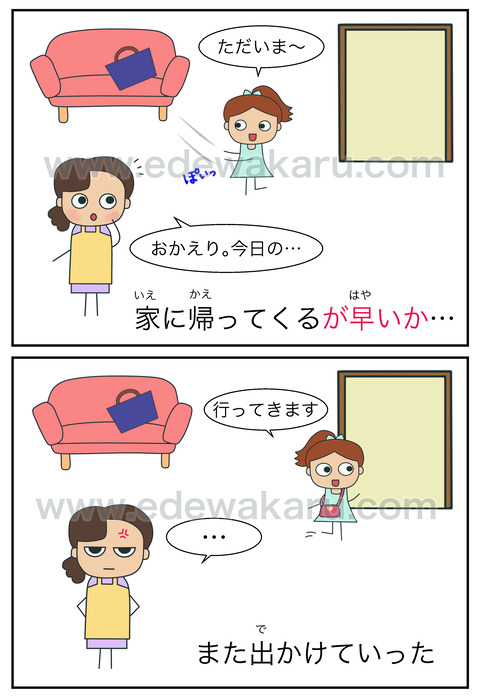
Meaning
〜and then immediately…
〜and at the same time…
How to use it
Verb [dictionary form] + が早いか
Explanation
“〜が早いか” is a grammar pattern meaning “as soon as 〜, …” This construction expresses “〜 and at the same time, …,” emphasizing that the actions occurred almost simultaneously 😮 It is a written expression and is hardly ever used in conversation 😀
[Additional explanation]
“〜が早いか” expresses that two actions occurred almost simultaneously, as in “〜 and then immediately …,” so an intentional verb follows. Therefore, using it for the occurrence of a natural phenomenon or a state is considered likely to sound unnatural (other dictionaries also accept such examples) 😨
[Examples]
❌ No sooner did I go outside than it started raining.
(“It rains” is a natural phenomenon.)
❌ No sooner did I hear my mother’s voice than tears came to my eyes.
(Tears coming out is the occurrence of a state.)
Also, this pattern is used for actions that have already occurred, so expressions such as “〜たい・〜だろう・〜つもりだ” cannot follow 😥 Remember that the た-form follows 😀
[Examples]
❌ As soon as school ends, I plan to go to the department store.
❌ No sooner will I graduate than I want to study in Japan.
There are many similar patterns to “〜が早いか,” so it may be helpful to remember the cases where it cannot be used 😉
[Related grammar patterns]
In context 3 examples
家に帰ってくるが早いか、また出かけていった
→家に帰ってくるとすぐ、また出かけていったAs soon as he got home, he went out again. →As soon as he got home, he went out again.
彼は授業が終わるが早いか、教室を飛び出していった
→彼は授業が終わると同時に、教室を飛び出していったAs soon as class ended, he dashed out of the classroom. →He dashed out of the classroom the moment class ended.
黄さんは大学を卒業するが早いか、日本に留学した
→黄さんは大学を卒業するとすぐに、日本に留学したAs soon as Mr. Huang graduated from university, he studied abroad in Japan. →Mr. Huang studied abroad in Japan immediately after graduating from university.
Read the original source text
Meaning
〜すると、すぐ…した
〜すると同時に…した
How to use it
動詞[辞書形]+が早いか
Explanation
「〜が早いか」は「〜すると、すぐ…」という意味を表す文型です。この文型は「〜すると同時に…した」という表現で、
動作がほぼ同時に起こったという意味を強調します
😮書き言葉ですので会話で使用されることはほとんどありません😀
【補足説明】
「〜が早いか」は「〜すると、すぐに…した」というように、2つの動作がほとんど同時に起こったことを表す文型ですので、後ろには「意志動詞」がきます。ですから、
自然現象や状態の発生などに使うと不自然になりやすいとされます(他の辞書はそうした例も認めます)
😨
[例]
❌外に出るが早いか、
雨が降りだした
(
「雨が降る」は自然現象)
❌母の声を聞くが早いか、
涙が出てきた
(
「涙が出る」のは状態の発生)
また、この文型はすでに起こった動作に使用しますので、
後ろには「〜たい・〜だろう・〜つもりだ」などの表現は使えません
😥後ろには「た形」がくると覚えておきましょう😀
[例]
❌学校が終わるが早いか、デパートに行く
つもりだ
❌卒業するが早いか、日本に留学し
たい
「〜が早いか」は似ている文型がたくさんありますので、使用できない場合を覚えておくといいと思います😉
【関連文型】
くらべてわかる日本語表現文型辞典
Meaning
B happens almost at the same time as A. The speaker wants to say that B happens immediately.
How to use it
A が早いか B
[Verb—dictionary form] が早いか
Explanation
【Comparison 1】
“Aや否やB” (Meaning 1, p. 313)
When the clause following “Aや否やB” expresses intention, it can be substituted without changing the meaning of the sentence. However, the sense of simultaneity is stronger with “Aが早いかB,” and there is a difference in the sense of speed. Also, “Aが早いかB” is not used when time actually passes between A and B.
×彼は新しい部署に配属されるが早いか、ベテラン並みの働きをした。
“AかAないかのうちにB” (Meaning 1, p. 49)
The time relationship between A and B is different.
○部屋に入るが早いか、カバンを投げ出した。(入るとほぼ同時に投げ出す) — 部屋に入るが早いか、カバンを投げ出した。(He threw down his bag almost as soon as he entered.)
○部屋に入るか入らないかのうちに、カバンを投げ出した。(入る前に投げ出している) — 部屋に入るか入らないかのうちに、カバンを投げ出した。(He threw down his bag before he had even entered.)
“AたとたんにB” (Meaning 2, p. 122)
With “AたとたんにB,” some unexpected change occurs in B. With “Aが早いかB,” the point is to describe A and B as simultaneous, so B cannot be an involuntary verb.
○立ちあがったとたんに、目まいがした。
×立ちあがるが早いか、目まいがした。
Notes
【Note 1】
・B cannot be a sentence expressing intention or a command.
×私は家に帰るが早いか、テレビを付けよう。
In context 4 examples
男は私のハンドバッグを奪うが早いか、逃げだした。
The man snatched my handbag and immediately ran off.
電車の扉が開くが早いか、乗客が我先に乗り込んできた。
As soon as the train doors opened, the passengers rushed in, each trying to get on first.
彼はパスポートを置き忘れたと気づくが早いか、さっきまでいた店に向かって駆け出していた。
As soon as he realized he had left his passport behind, he dashed toward the shop he had just been in.
「嘘つき」と言うが早いか、平手打ちが飛んできた。
No sooner had I called him a liar than a slap came flying at me.
Read the original source text
Meaning
Aするのとほとんど同時にB。すぐにBということが言いたい。
How to use it
Aが早いかB
[動詞-る形]が早いか
Explanation
【対比1】
「Aや否やB」(意味1 P.313)
「Aや否やB」の後文が意志表現のものは、置き換えても文意は変わらないが、同時という感じが「Aが早いかB」のほうが強く、スピード感に差がある。また、実際にはAとBの間に時間の経過を伴う場合は、「Aが早いかB」は使わない。
×彼は新しい部署に配属されるが早いか、ベテラン並みの働きをした。
「AかAないかのうちにB」(意味1 P.49)
AとBとの時間の関係が異なる。
○部屋に入るが早いか、カバンを投げ出した。(入るとほぼ同時に投げ出す)
○部屋に入るか入らないかのうちに、カバンを投げ出した。(入る前に投げ出している)
「AたとたんにB」(意味2 P.122)
「AたとたんにB」はBに何らかの意外な変化がくるが、「Aが早いかB」はAとBの同時性が述べたいのであり、Bに無意志動詞はこない。
○立ちあがったとたんに、目まいがした。
×立ちあがるが早いか、目まいがした。
Notes
【注意1】
・Bに意向文・命令文はこない。
×私は家に帰るが早いか、テレビを付けよう。
毎日のんびり日本語教師
Meaning
As soon as ~; the moment ~
How to use it
Verb dictionary form + が早いか
Verb past form + が早いか
Explanation
Means “as soon as ~.”
Emphasizes that the actions in the preceding and following clauses occur almost simultaneously. The time interval between them is extremely short.
This grammar is used mainly for past events. (Other dictionaries also give non-past examples.)
The subject does not need to be the same.
Notes
Nothing in particular.
In context 8 examples
チャイムが鳴るが早いか、生徒たちは教室を飛び出していった。
No sooner had the bell rung than the students rushed out of the classroom.
電話が来るが早いか、緊張で手が震え出した。
The moment the call came, my hands began to tremble with nerves.
お金を手にするが早いか、どこかへ遊びに行った。(钱一到手就出去玩了。)
As soon as he got his hands on the money, he went out somewhere to have fun. (As soon as the money was in hand, he went out to have fun.)
あの鷹は獲物を捕まえるが早いか、すぐ飛び立っていった。
No sooner had that hawk caught its prey than it flew off.
その言葉を聞くが早いか、嬉しさのあまり泣き出してしまった。
The moment I heard those words, I started crying with joy.
極度の疲れからか、ベッドに入るが早いか、すぐ寝付いてしまった。
Perhaps because I was extremely tired, I fell asleep as soon as I got into bed.
帰宅してカバンを玄関に置くが早いか、また飛び出して行った。
As soon as I got home and put my bag by the entrance, I rushed out again.
出会うが早いか、すぐお互いを抱き締め合った。
The moment they met, they immediately embraced each other.
Read the original source text
Meaning
~するとすぐに~
How to use it
動辞形+が早いか
動た形+が早いか
Explanation
「~するとすぐに~」という意味です。
前後の動作がほぼ同時発生していることを強調します。前件と後件の時間的感覚は非常に短いです。
この文法は主に過去のことに使われます。(他の辞書は非過去の例も挙げています)
同一主語である必要はありません。
Notes
特になし
NINJAL 日本語文型データベース
Meaning
Used to say that one action was immediately followed by another action or an event. It is often used to describe past actions or events.
How to use it
Vるが早いか・Vたが早いか
Notes
It is generally not used to describe the speaker’s own actions.
“〜” is preceded by a verb expressing an instantaneous action or event. Use the ta-form when you want to make clear that the action or event in “〜” has been completed. After “〜が早いか,” a sentence describing a somewhat unexpected action or event follows. A sentence expressing the speaker’s hope or intention, or one urging the listener to do something, does not follow.
In context 5 examples
その学生はよほど疲れていたのか、席に着くが早いか居眠りを始めた。
Perhaps the student was very tired: no sooner had they sat down than they began to doze off.
母は私の部屋のドアを開けるが早いか、テレビのワイドショーで知ったニュースについて話し始めた。
No sooner had my mother opened the door to my room than she began talking about some news she had heard on a TV talk show.
田中は日記帳を開くが早いか、猛烈な勢いで今日の体験を書き始めた。
No sooner had Tanaka opened his diary than he began writing about what he had experienced that day at a furious pace.
レジの人がお金を受け取るが早いか、息子はおもちゃの袋を開けて中身を取り出した。
No sooner had the cashier taken the money than my son opened the toy bag and took out what was inside.
弟は「いただきます」と言ったが早いか、あっという間に大盛りの焼きそばを全部平らげてしまった。
No sooner had my younger brother said, “Let’s eat,” than he polished off the large serving of yakisoba in no time.
Read the original source text
Meaning
〜するとすぐ続いて次の動作をした・出来事が起こったと言いたいときに使います。過去の動作や出来事を説明するときに使うことが多いです。
How to use it
Vるが早いか・Vたが早いか
Notes
話し手自身の行為の描写にはふつう使いません。
「〜」には瞬間的な動作や出来事を表す動詞がきます。「〜」の動作や出来事の完了をはっきり表したいとき、タ形を使います。「〜が早いか」の後には、少し意外性のある動作や出来事を表す文がきます。話し手の希望・意向を表す文や相手への働きかけの文はきません。