絵でわかる日本語
Meaning
~ happened because one did ~
~ happened as a result of doing ~
How to use it
Verb [た-form] + 弾みに・弾みで
Noun [dictionary form] + の弾みに・の弾みで
Explanation
「A弾みにB」 is a sentence pattern meaning “B happened because A happened” or “B occurred as a result of A.” B is something that happened by chance. It is used to say, “The moment A happened, B happened,” or “The moment A happened, B occurred.” The form 「〜弾みに〜てしまった」 is often used.
Learn 「〜弾みに」 together with the similar pattern 「〜拍子に」 😉
In context 5 examples
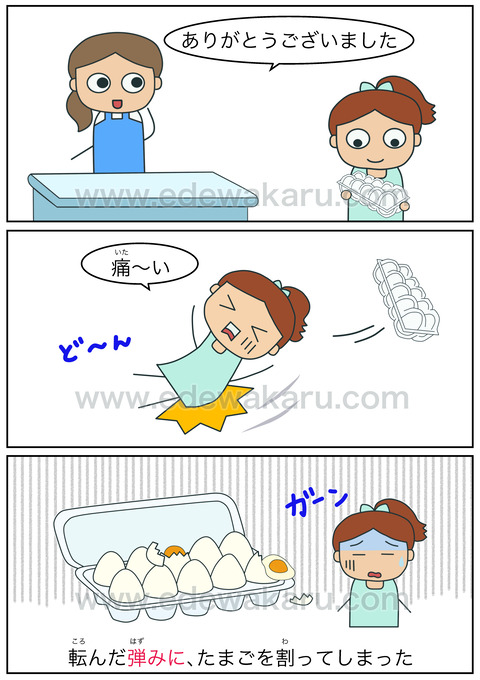
転んだ弾みに、たまごを割ってしまった
→転んだことで、たまごを割ってしまったWhen I fell, I broke the eggs. → I broke the eggs because I fell.
滑った弾みで転んでしまい、足の骨が折れてしまった
→滑った瞬間に転んでしまい、足の骨が折れてしまったI slipped and fell, and ended up breaking a bone in my foot. → The moment I slipped, I fell and broke a bone in my foot.
重いものを持ち上げた弾みに、腰を痛めてしまった
→重いものを持ち上げた瞬間に、腰を痛めてしまったWhen I lifted something heavy, I hurt my back. → The moment I lifted something heavy, I hurt my back.
急いで電車に乗ろうとした弾みで、靴が脱げてしまった
→急いで電車に乗ろうとした瞬間に、靴が脱げてしまったAs I hurried to get on the train, one of my shoes came off. → The moment I hurried to get on the train, one of my shoes came off.
友達にぶつかった弾みで、コーヒーをこぼしてしまった
→友達にぶつかったことで、コーヒーをこぼしてしまったI bumped into my friend and spilled my coffee. → I spilled my coffee because I bumped into my friend.
Read the original source text
Meaning
〜したことで〜した
〜したことで〜が起こった
How to use it
動詞[た形]+弾みに・弾みで
名詞[辞書形]+の弾みに・の弾みで
Explanation
「A弾みにB」は「AしたことでBした」「AしたことでBが起こった」という意味の文型です。「B」には偶然起こってしまったことが入り、「Aした瞬間に、Bしてしまった」「Aした瞬間に、Bが起こってしまった」と言いたい時に使われます。 「〜弾みに〜てしまった」の形がよく使われます。
「〜弾みに」に似ている文型の「〜拍子に」と一緒に覚えておきましょう😉
毎日のんびり日本語教師
How to use it
Verb ta-form + 弾みに
Verb ta-form + 拍子に
Explanation
This expresses that the preceding event triggers the following event, which occurs by chance. Here, 「弾み」 and 「拍子」 mean a momentary force or a trigger.
It is usually used to describe something that happened because someone was careless or acted absentmindedly.
Phrases such as 「その弾みに」「その拍子に」 and 「何かの拍子に」 are also used.
Notes
Nothing in particular.
In context 5 examples
寝起きによろけた拍子に、足首をひねって痛めた。
I stumbled as I was getting up, twisted my ankle, and hurt it.
倒れた弾みに持っていたものをぶちまけてしまった。
When I fell, I accidentally scattered everything I was carrying.
昔のことを、ふとした拍子に思い出す。
I remember things from the past on the spur of the moment.
転んだ弾みで、頭をぶつけた。
I hit my head when I fell.
こんな人通りの多いところで駆け回っていると、何かの拍子で大惨事になりかねない。
If you run around in such a crowded place, something could trigger a major disaster.
Read the original source text
How to use it
動た形+弾みに
動た形+拍子に
Explanation
前項が引き金となって(きっかけとなって)、後項の事態が偶発的に発生することを表します。この文型における「弾み」と「拍子」は、瞬間的な勢いやきっかけを意味します。
通常は人が不注意で、あるいはうっかりして起きた現象を述べるときに用います。
「その弾みに」「その拍子に」「何かの拍子に」などの言い方もあります。
Notes
特になし