日本語文型辞典
Usage 1
Meaning
Attached to a noun, it indicates, as in ①②③④, that the noun is the subject of the predicate's action or state, or, as in ⑤⑥⑦, that it is the object of the predicate's state. In proverbs and idioms, as in “負けるが勝ち,” it may also attach to words other than nouns.
The same noun is repeated, followed by a word giving a reason, such as “だから,” “ので・し・だもの・もので.” In many cases, it conveys a negative evaluation of what the noun denotes and is used to describe the natural consequence. ① means “a parent who is too indulgent toward their child”; ② means “it is late to go out for a meal”; ③ means “a price so high one simply can't afford it”; and ④ means “an age too advanced to find another job.”
The same noun is repeated to mean “given the nature of that thing, this is only to be expected.” What follows describes something that naturally follows from that nature. The nature itself may not be clear until the content of the latter part is known. For example, in ①, the description “the flavor is exceptional too” shows that the ingredients are good. But in “素材が素材だけに、大した料理はできやしない” (“given the ingredients, there's no way to make a very good dish”), the ingredients are poor. ② refers to a convenient place where people can easily gather; ③, conversely, means an inconvenient place that is hard to get to. “ことがことだけに” in ⑤ is an idiomatic expression. In this example, it means “because it is a serious matter.”
The same noun is repeated to express the supposition “if the circumstances were appropriate for that.” Expressions such as “…だろうが/だろうに/かもしれないが” follow, and then the actual circumstances, which are in fact different, are described. ① means “if it were an era when many people seriously thought about how to live”; ②, “if it were a world that would give that guy a fair appraisal”; and ③, “if only it were a better university.” It supposes a more favorable state than reality and says that, if things were so, a good result would follow. Because that is impossible in reality, it conveys disappointment, frustration, or resignation that the wish cannot come true.
The nouns in “NがNなら” and “NもNだ” are different but related. This expresses the negative evaluation that “both N's are equally bad.” ① means “both the parent and child are equally problematic”; ② means “both the uncle and aunt are stubborn, which is no good.” Used to criticize both.
⇾がさいご
⇾はやいか
How to use it
Nが
NがNだから
NがNだけに
NがNなら…(が)
NがNならNもNだ
V-たがさいご
V-るがはやいか
In context 21 examples
あの人が山本さんです。
That person is Mr. Yamamoto.
隣のうちには猫が3匹いる。
There are three cats at the house next door.
あ、財布が落ちている。
Oh, there's a wallet lying on the ground.
この本は表紙がきれいですね。
This book has a beautiful cover, doesn't it?
私はジャズが好きです。
I like jazz.
外交官になるには語学力が必要だ。
You need language skills to become a diplomat.
彼は10ヶ国語ができるらしい。
Apparently, he knows ten languages.
親が親だから、子供があんなふうに生意気になるのだ。
The child has become so cheeky because the parents are what they are.
もう時間が時間だし、今から行ってもあのレストランは閉まってるかもしれないよ。
It's late, and if we go now, that restaurant may be closed.
デパートをぶらぶら歩いていて、かわいいネックレスを見つけた。とても気に入ったのだが、なにしろ値段が値段だったので買うのはあきらめた。
I was browsing around the department store and found a cute necklace. I really liked it, but the price was what it was, so I gave up on buying it.
A:再就職しようと思ったけど、なかなかむずかしいわ。
B:そりゃ、年が年だもの。37の女なんか今ビきどこも雇ってくれないわよ。A: I thought I'd get another job, but it's really difficult. B: Well, at your age, that's to be expected. No one hires a 37-year-old woman these days.
ここの料理は、素材が素材だけに味も格別だ。
The food here tastes exceptional, given the quality of the ingredients.
この店は味は大したことはないが、場所が場所だけにたいていいつも満員だ。
The food at this restaurant isn't anything special, but given its location, it's almost always full.
この店はとても気に入っているのだが、場所が場所だけにそうしょっちゅうは来られないのが残念だ。
I really like this restaurant, but it's a shame that, given its location, I can't come here very often.
その映画は戦時中の日本軍の侵略を扱ったもので、多くの評論家が絶賛している優れた作品だが、内容が内容だけに、一般的な娯楽映画と比べると興行成績は格段に悪かった。
That movie is an excellent work about the Japanese military's wartime aggression, and many critics have praised it highly. But given its subject matter, its box-office performance was far worse than that of ordinary entertainment films.
学長が収賄容疑で逮捕された。今までも小さな不祥事はあったが、マスコミには騒がれないよう注意してきた。しかし、今回はことがことだけに、マスコミの取材からは逃れられないだろう。
The university president was arrested on suspicion of bribery. There had been minor scandals before, but care had been taken to keep the media from making a fuss. This time, however, given the seriousness of the matter, he will probably be unable to avoid media scrutiny.
時代が時代なら、この本も売れたかもしれないが、今の時代では人間の生き方を問うような本は若い人には読まれない。
If it were a different era, this book might have sold, but these days young people don't read books that question how people live.
世が世ならあいつも出世できただろうに。
If the world were different, that guy might have been able to get ahead.
俺も大学が大学ならもう少しましな仕事にもつけたのだろうが、この大学ではせいぜいこの会社ぐらいがいいところだ。
If only I'd gone to a better university, I might have landed a somewhat better job, but with this university, this company is about the best I can hope for.
この生徒はいつも教師に口答えばかりして困る。親もすぐ学校にどなりこんでくるし、まったく、親が親なら子も子だ。
This student is always talking back to the teacher, which is a problem. His parents also come storming into the school at the slightest thing; really, with parents like those, it's no wonder the child is the way he is.
まったく、おじさんがおじさんなら、おばさんもおばさんだよ。おじさんが頑固なのはわかっているんだから、嘘でも「ごめんなさい」って言えば喧嘩なんかすぐにおさまるのに。
Honestly, the uncle's just as bad as the aunt. We know the uncle is stubborn, so if you'd just say “I'm sorry,” even if you didn't mean it, the fight would be over in no time.
Read the original source text
Meaning
名詞に付いて、①②③④のようにその名詞が述語の動作や状態の主体であることを表したり、⑤⑥⑦のように述語の状態の対象であることを表したりする。「負けるが勝ち」のように、ことわざや慣用句などでは、名詞以外の語に付く場合もある。
同じ名詞を繰り返し用いて、後には「だから」や「ので・し・だもの・もので」などの理由を表す言葉がくる。多くの場合、名詞の表すものに対するマイナス評価を意味し、そこから当然出てくる結果を述べるのに用いられる。①だと「子供に甘すぎる親だ」、②は「食事に行くには遅い時間だ」、③は「とても買えないような値段だ」、④は「再就職するには高すぎる年齢だ」の意味。
同じ名詞を繰り返し用いて「それが持っている性質から考えると当然」という意味を表す。後ろにはそこから当然のこととして導き出されることがらが述べられる。それがどういう性質を持つかということは、後半部分の記述内容が明らかにならないと分からない。例えば①は「味も格別だ」という記述から素材がよいものであることが分かる。しかし、「素材が素材だけに、大した料理はできやしない」となると、素材が悪いということになる。②は便利で人が集まりやすい場所、③は反対に、不便で来にくい場所という意味になる。⑤の「ことがことだけに」は慣用的な表現。この例の場合は「重大なことがらなので」という意味を表す。
同じ名詞を繰り返し用いて、「もしもそれにふさわしい状況であったら」と仮定する気持ちを表す。後ろには「…だろうが/だろうに/かもしれないが」などの表現が続き、そのあとに、実はそうではない現実のありさまが述べられる。①は「生き方を真剣に考える人が多くいるような時代なら」、②は「あいつを正しく評価してくれるような世なら」、③は「もっといい大学なら」というような意味。現実より都合のいい状態を仮定して「もしそうならこのような良い結果になるはずだ」ということを述べる。現実にはありえないことなので、願望がかなわない残念な気持ちや悔しさ、あきらめなどの気持ちが含まれる。
「NがNなら」の名詞と「NもNだ」の名詞は異なるが、関連性のあるもの。「どちらのNも同じくらいよくない」というマイナス評価を表す。①は「親も子もどちらも同じくらい問題だ」、②は「おじさんもおばさんも意地を張ってばかりでよくない」の意味。両方を非難する場合に使う。
⇾がさいご
⇾はやいか
How to use it
Nが
NがNだから
NがNだけに
NがNなら…(が)
NがNならNもNだ
V-たがさいご
V-るがはやいか
Usage 2
Meaning
Basic information: N/Nₐ だが A/V が
Used to connect two contrasting things. The contents of the first and second parts conflict, or the second part describes something contrary to what would be expected from the first.
Used to give a preamble before doing something directed at another person, such as asking a question, making a request, or giving an order.
Attached at the end of a sentence to soften the wording when saying something difficult or making a difficult request.
How to use it
が【contrast】
が【preamble】
が【softening an expression】
In context 12 examples
彼は学生だが、私は社会人だ。
He is a student, but I'm a working adult.
昨日は暑かったが、今日は急に涼しくなって風邪をひきそうだ。
It was hot yesterday, but it's suddenly turned cool today, and I feel like I'm going to catch a cold.
今日の試合は、がんばったが負けてしまった。
We did our best in today's game, but we lost.
種をまいたが、芽が一つも出なかった。
I sowed seeds, but not a single sprout came up.
山田と申しますが、厚子さんいらっしゃいますか。
My name is Yamada. Is Atsuko there?
今日広田さんに会うんですが、何か伝えておくことはありますか。
I'm seeing Mr. Hirota today. Is there anything you'd like me to tell him?
先日お願いいたしました件ですが、引き受けていただくことはできませんでしょうか。
About the matter I asked you about the other day, might you be able to take it on?
先月パソコンを買ったのですが、使い方がよくわからないので教えてほしいんですが。
I bought a computer last month, but I don't really understand how to use it, so I'd like you to show me.
≪コピーしている人に≫あのう、ちょっと1枚だけコピーしたいんですが。
〈To someone using the copier〉Um, I'd like to make just one copy.
すみませんが、ちょっとお先に失礼させていただきたいんですが。
I'm sorry, but I'd like to excuse myself and leave a little early.
あのう、実は明日の会議に出られないんですが。
Um, actually, I can't attend tomorrow's meeting.
この辞書に書いてること、間違っていると思うんですが。
I think what's written in this dictionary is wrong.
Read the original source text
Meaning
基本情報N/Na だがA/V が
対立的な二つのことがらを結びつけるのに用いる。前半と後半の内容が対立したり、前半のことから予想される結果と反対のことが後半に述べられたりする。
質問、依頼、命令など、相手に働きかける行為をする前に、前置きとなることを述べるのに用いる。
言いにくいことや頼みにくいことなどを言う場合、文末に付けて表現を和らげる。
How to use it
が【逆境】
が【前置き】
が【言いよとみ】
絵でわかる日本語
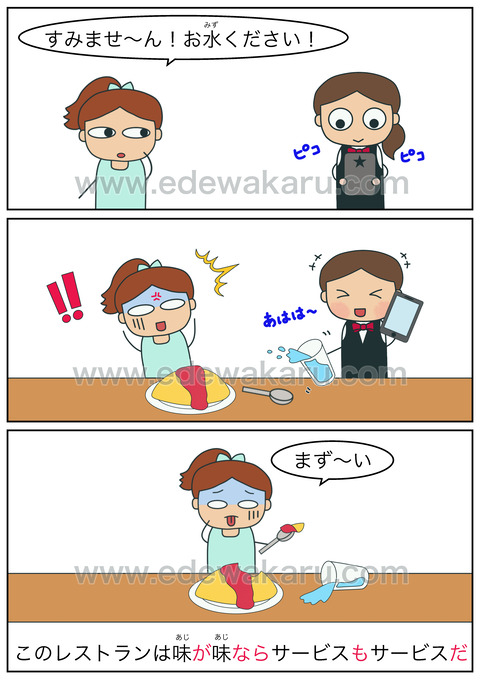
Meaning
Both ~ and ~ are bad
How to use it
Noun [dictionary form] + が + Noun [dictionary form] + なら + Noun [dictionary form] + も + Noun [dictionary form] + だ
Explanation
「AがAならBもBだ」 is a sentence pattern meaning “Both A and B are bad.”
A and B refer to people or things with a close relationship, such as a parent and child or a husband and wife. It is often used to criticize both A and B. 「AがAならBもBだ」 can also be changed to 「AもAならBもBだ」.
[Example]
If the food is bad,
then the service is bad, too.
→
The food is bad,
and the service is bad, too.
「〜が〜なら〜も〜だ」 is a commonly used pattern, so advanced learners should learn it 😉
In context 4 examples
このレストランは味が味ならサービスもサービスだ
→味もサービスも、どちらも最悪だAt this restaurant, the food is bad, and the service is bad, too. → Both the food and the service are terrible.
A:毎日遅刻して、先生に怒られないの?B:怒られないよ〜。先生も毎日遅れてくるしA:…。学生が学生なら、先生も先生ね…
→学生も先生も、どちらもよくないね…A: You’re late every day. Doesn’t the teacher get mad at you? B: No. The teacher is late every day, too. A: ... If the students are like that, and the teacher is like that, too... → Both the students and the teacher are bad...
A:お隣の奥さんは、何かにつけ文句を言ってくるの…B:聞いたところによると、旦那さんもそうらしいわよA:…。妻が妻なら、夫も夫だね
→妻も夫もどちらもよくないねA: The woman next door complains about everything... B: From what I hear, her husband is like that, too. A: ... If the wife is like that, and the husband is like that, too. → Both the wife and the husband are bad.
A:あの家の子は、すごく乱暴よね…B:うん。でも注意すると、母親がキレるんだってA:そうなんだ…親が親なら、子も子だね
→親も子供も、どちらもよくないんだねA: That family’s child is so rough... B: Yeah. But apparently, when someone tells them off, the mother loses her temper. A: I see... Like parent, like child. → Both the parent and the child are bad.
Read the original source text
Meaning
〜も〜も、どちらもよくない
How to use it
名詞[辞書形]+が+名詞[辞書形]なら+名詞[辞書形]+も+名詞[辞書形]だ
Explanation
「AがAならBもBだ」は「AもBもどちらもよくない」という意味の文型です。
「A」と「B」には、[親・子][夫・妻]など、関係が深い人やものが入ります。「A」と「B」の両方を批判する場合によく使われます。「AがAならBもBだ」は「AもAならBもBだ」にチェンジすることもできます。
[例]
味
が
味
なら
サービス
も
サービス
だ
→味
も
味
なら
サービス
も
サービス
だ
「〜が〜なら〜も〜だ」はよく使われる文型ですので、上級レベルの人は覚えておきましょう😉
どんなときどう使う 日本語表現文型辞典
Usage 1
Meaning
but
How to use it
〔polite form〕・〔plain form〕+が
Explanation
が〈逆接〉
逆の意味や対立する意味の文をつなぐ。
Links phrases of opposite meaning or contrasts.
In context 3 examples
10月になりましたが、毎日暑い日が続いています。
It's October, but hot days continue every day.
この部屋は新しくてきれいですが、狭いです。
This room is new and clean, but it's small.
読み方を辞書で調べたが、わからなかった。
I looked up the reading in the dictionary, but I couldn't figure it out.
Read the original source text
Meaning
but
How to use it
〔丁寧形〕・〔普通形〕+が
Explanation
が〈逆接〉
逆の意味や対立する意味の文をつなぐ。
Links phrases of opposite meaning or contrasts.
Usage 2
Meaning
on account of
How to use it
NがN+だけに
Explanation
が~だけに
特別の~だから
「NがNだけに、…」の形で、同じ名詞を繰り返して、Nが特別だから「…」で述べることに十分の理由がある、と言いたいときの表現。
By repeating the noun, expresses notion that because the noun is special, there is ample reason for whatever follows the だけに.
In context 3 examples
母は今年93歳になった。今は元気だが、歳が歳だけに、病気をすると心配だ。
My mother turned 93 this year. She's well now, but given her age, I'd be worried if she got sick.
ほしい時計があるのだが24万円だそうだ。値段が値段だけに買おうかどうしようかと迷っている。
There's a watch I want, but I hear it costs 240,000 yen. Given the price, I'm torn about whether to buy it.
彼女は死にたいと言っている。事が事だけに、黙って聞いていることはできない。
She says she wants to die. Given how serious the situation is, I can't just sit quietly and listen.
Read the original source text
Meaning
on account of
How to use it
NがN+だけに
Explanation
が~だけに
特別の~だから
「NがNだけに、…」の形で、同じ名詞を繰り返して、Nが特別だから「…」で述べることに十分の理由がある、と言いたいときの表現。
By repeating the noun, expresses notion that because the noun is special, there is ample reason for whatever follows the だけに.
Usage 3
Meaning
excuse me; I'm sorry, but
How to use it
〔polite form〕・〔plain form〕+が
Explanation
が〈前置き・和らげ〉
1)二つの文をつなぐだけの「が」の使い方である。 ❶ ~ ❸ のように「話の前置き」としてよく使われる。
2) ❹ の使い方は言い方を和らげて余韻を残す言い方である。
1)Here が simply connects two clauses. Often used to preface discourse, as in sentences ❶ , ❷ , and ❸ .
2)In sentence ❹ , gives subdued, softened impression.
In context 4 examples
先生、この言葉の意味がわからないんですが、教えてくださいませんか。
Teacher, I don't understand the meaning of this word; could you please explain it to me?
(電話で)もしもし、田中ですが、鈴木さん、いらっしゃいますか。
(On the phone) Hello, this is Tanaka. Is Mr. Suzuki there?
ちょっとお聞きしたいんですが……。駅へはどう行くんでしょうか。
There's something I'd like to ask you... How do I get to the station?
A:一人でお酒を飲むのはつまらないですよね。B:さあ、わたしはそうは思いませんが……。
A: Drinking alone is no fun, isn't it? B: Well, I don't think so, but...
Read the original source text
Meaning
excuse me; I'm sorry, but
How to use it
〔丁寧形〕・〔普通形〕+が
Explanation
が〈前置き・和らげ〉
1)二つの文をつなぐだけの「が」の使い方である。 ❶ ~ ❸ のように「話の前置き」としてよく使われる。
2) ❹ の使い方は言い方を和らげて余韻を残す言い方である。
1)Here が simply connects two clauses. Often used to preface discourse, as in sentences ❶ , ❷ , and ❸ .
2)In sentence ❹ , gives subdued, softened impression.
毎日のんびり日本語教師
How to use it
Noun + が + the same noun + だけに
Noun + が + the same noun + なだけに
Noun + が + the same noun + であるだけに
Explanation
This pattern uses the same noun twice in succession and describes a natural result that can be inferred from its nature or state.
It has a meaning close to 「~のおかげで」and 「~のせいで」.
The following clause may describe something good or bad.
The content of the following clause may be omitted when the context makes it possible to predict what it would be.
Notes
The 「だけ」series
In context 8 examples
性格が性格なだけに、本音をはっきり言えない。
Given the kind of personality I have, I can't clearly say what I really think.
人が人なだけに、言っていることに真実味がある。
Given the kind of person he is, what he says has a ring of truth.
この映画は実際の事件を基に作られている。話が話だけに胸が苦しくなる。
This movie is based on a real incident. Given the kind of story it is, it makes my heart ache.
ここは場所が場所だけに大きな声は出せない。
Given the kind of place this is, we can't speak loudly.
内容が内容なだけに、彼と一緒に見ていると恥ずかしい。
Given the kind of content it is, I feel embarrassed watching it with him.
この時期熱が出ると、時期が時期なだけにコロナウイルスじゃないかって周囲から疑われてしまう。
If you get a fever at this time of year, given the timing, people around you will suspect it might be coronavirus.
値段が値段なだけに、性能はあんまり高くない。
Given the price, the performance isn't very high.
こんな単純な作業でも、量が量なだけに終わるまでにめちゃくちゃ時間がかかった。
Even though the task was simple, given the sheer amount of it, it took an incredibly long time to finish.
Read the original source text
How to use it
名詞+が+名詞+だけに
名詞+が+名詞+なだけに
名詞+が+名詞+であるだけに
Explanation
同じ名詞を2度用いて接続し、その性質や状態から考えられる必然的な結果を述べる文型です。
「~のおかげで」「~のせいで」に近い意味を持っています。
後件は良い内容も悪い内容もきます。
後件の内容は、その内容が予測できるような特別な文脈下であれば省略可能です。
Notes
「だけ」シリーズ
日本語文型辞典 英語版
Meaning
Attaches to a noun and indicates that the noun is the subject of an action or state, as in
(1)
,
(2)
,
(3)
, and
(4)
, or that the noun is the object of a state, as in
(5)
,
(6)
, and
(7)
. When used in proverbs or idioms, it sometimes attaches to words other than nouns, as in 負けるが勝ち (Sometimes you have to lose to win).
B:そりゃ、年が年だもの。70すぎた人間なんか今どきどこも雇ってくれないわよ。
Well, it’s your age. These days no one wants to hire someone in his seventies.
The same noun is repeated and then followed by a word expressing a reason, such as だから, ので, し, だもの, or もので. In many cases, this pattern expresses a negative evaluation of the noun and is used to describe an inevitable result that arises from it. For example,
(1)
means the parents are too indulgent of their children,
(2)
means it is too late to go to the restaurant,
(3)
means the price is far too expensive, and
(4)
means that, in B’s opinion, A is too old to get another job.
Repetition of the same noun indicates that a certain outcome is natural or inevitable, considering the characteristics of that noun. NがNだけに is followed by a description of the natural or inevitable outcome. The listener/reader does not know the exact nature of the noun’s characteristics until s/he reaches the description in the latter part of the sentence. For example, in
(1)
, the description 味も格別だ (exceptionally tasty) tells us the ingredients are good. However, in the sentence 素材が素材だけに大した料理はできやしない (Because the ingredients are what they are, the food can’t be very good), the interpretation is that the ingredients are bad.
(2)
means a place that is conveniently located and easy to get to. On the other hand,
(3)
means a place that is inconveniently located and hard to get to. ことがことだけに in
(5)
is an idiomatic expression. In this example, it means “because this situation is serious.”
Repetition of the same noun indicates that the speaker is making the supposition “if the conditions were suitable....” NがNなら is accompanied by expressions such asだろうが, だろうに or かもしれないが, and a statement or description of the actual state of affairs then follows.
(1)
means “if it were a time when many people thought seriously about how to live,”
(2)
means “if people in society evaluated him correctly,” and
(3)
means “if I had graduated from a better university.” This pattern is used to hypothesize a situation that is better than reality; it means “if the situation were X, a good result like Y would follow.” Because the situation hypothesized is one that is actually impossible, a sense of pity, regret, or resignation is implied.
The first noun (repeated in NがNなら) is different from the second noun (repeated in NもNだ), but the two nouns are related. The expression as a whole conveys a negative evaluation: both N’s are equally bad.
(1)
means that the parents and child are equally problematic, and
(2)
means that both the uncle and aunt are bad, because they are equally stubborn. Used to criticize both parties or elements.
【が2】[N/Na だが][A/V が]
Connects two situations or events in a relation of contrast. Used when the content of the first half of the sentence contrasts with that of the second half, or when what is said in the second half is the opposite of what is expected from the first half.
Used to make a remark that prefaces a question, a request, an order, or some other speech act that exerts an influence on the addressee.
Can be added to the end of a sentence to soften something that is hard to say or a request that is difficult to make.
How to use it
1. Nが
2. NがNだから
3. NがNだけに
4. NがNなら...(が)
5. NがNならNもNだ
6. V-たがさいご→
7. V-るがはやいか→
1. が〈adversative connective〉
2. が〈introductory remark〉
3. が〈hesitation〉
In context 33 examples
あの人が山本さんです。
That person is Yamamoto-san.
隣のうちには猫が3匹いる。
There are three cats in the house next door.
あ、財布が落ちている。
Look, there’s a wallet on the floor.
この本は表紙がきれいですね。
This book has a beautiful cover, doesn’t it.
私はジャズが好きです。
I like jazz.
外交官になるには語学力が必要だ。
You need to be good at languages to be a diplomat.
彼は 10 ヶ国語ができるらしい。
I heard that he can speak ten different languages.
親が親だから、子供があんなふうに生意気になるのだ。
With such parents, it’s no wonder the child is so bratty.
もう時間が時間だし、今から行ってもあのレストランは閉まってるかもしれないよ。
Considering what time it is now, the restaurant might be closed by the time we get there.
デパートをぶらぶら歩いていて、かわいいネックレスを見つけた。とても気に入ったのだが、なにしろ値段が値段だったので買うのはあきらめた。
I was wandering around the department store and found a pretty necklace. I really liked it, but with the price being what it was, I decided not to buy it.
A:再就職しようと思ったけど、なかなかむずかしいわ。
I thought I’d try to go back to work, but it’s really quite difficult to find a job.
ここの料理は、素材が素材だけに味も格別だ。
The food here is exceptionally tasty because of the ingredients.
この店は味は大したことはないが、場所が場所だけにたいていいつも満員だ。
The food at this restaurant isn’t particularly good, but its location means it’s almost always full.
この店はとても気に入っているのだが、場所が場所だけにそうしょっちゅうは来られないのが残念だ。
I really like this shop, but because it’s located where it is, unfortunately I can’t come very often.
その映画は戦時中の日本軍の侵略を扱ったもので、多くの評論家が絶賛している優れた作品だが、内容が内容だけに、一般的な娯楽映画と比べると興行成績は格段に悪かった。
The movie deals with the aggression of the Japanese army during the war. It is an excellent work that many critics have praised highly, but because of the subject matter, box office returns were markedly worse than those of ordinary movies made for entertainment.
学長が収賄容疑で逮捕された。今までも小さな不祥事はあったが、マスコミには騒がれないよう注意してきた。しかし、今回はことがことだけに、マスコミの取材からは逃れられないだろう。
The president of the university was arrested on suspicion of bribery. There have been minor scandals before, but care was always taken to keep the media from making anything of them. However, this time, with the situation being what it is, there will be no stopping the mass media from covering the story.
時代が時代なら、この本も売れたかもしれないが、今の時代では人間の生き方を問うような本は若い人には読まれない。
If times were different, this book might have sold well, but in this day and age, young people don’t read books that raise questions about how to live.
世が世ならあいつも出世できただろうに。
In another time and place, she probably would have been successful.
俺も大学が大学ならもう少しましな仕事にもつけたのだろうが、この大学ではせいぜいこの会社ぐらいがいいところだ。
I suppose if I had graduated from a better university, I could have found a better job, but this is the best company anyone from a university like mine could hope to work for.
この生徒はいつも教師に口答えばかりして困る。親もすぐ学校にどなりこんでくるし、まったく、親が親なら子も子だ。
This student always causes trouble to his teachers by answering back. His parents often come storming into the school with complaints, too. With such parents, it’s no wonder the children behave the way they do.
まったく、おじさんがおじさんなら、おばさんもおばさんだよ。おじさんが頑固なのはわかっているんだから、嘘でも「ごめんなさい」って言えば喧嘩なんかすぐにおさまるのに。
(to an aunt and uncle) Honestly, you two are both just as bad as each other. (to the aunt) You know he’s obstinate, so if you say “I’m sorry,” even if you don’t mean it, the quarrel will quickly be resolved.
彼は学生だが、私は社会人だ。
He is a student, but I work.
昨日は暑かったが、今日は急に涼しくなって風邪をひきそうだ。
Yesterday it was hot, but today it’s turned cold all of a sudden, and I feel like I’m going to catch a cold.
今日の試合は、がんばったが負けてしまった。
We did our best in the game today, but we lost.
種をまいたが、芽が一つも出なかった。
I planted some seeds, but not a single one sprouted.
山田と申しますが、陽子さんいらっしゃいますか。
My name is Yamada. May I speak to Yoko-san, please?
今日広田さんに会うんですが、何か伝えておくことはありますか。
I’ll see Hirota-san today. Is there anything I should tell her?
先日お願いいたしました件ですが、引き受けていただくことはできませんでしょうか。
Regarding the request I made the other day, do you think it would it be possible for you to take it on?
先月パソコンを買ったのですが、使い方がよくわからないので教えてほしいんですが。
I bought a computer last month, but I don’t really know how to use it, so could you teach me...?
《コピーしている人に》あのう、ちょっと1枚だけコピーしたいんですが。
《to someone making copies》Umm, do you think I could make just one copy?
すみませんが、ちょっとお先に失礼させていただきたいんですが。
I’m sorry, but I would like to be excused a little bit early.
あのう、実は明日の会議に出られないんですが。
Well, actually, I can’t attend the meeting tomorrow.
この辞書に書いてること、間違っていると思うんですが。
I think what it says in this dictionary is actually incorrect.
AIUEO JLPT Grammar
Usage 1
Meaning
「〜が」is a conjunction that expresses contrast. It is used when the content of the first and second clauses is in opposition, or when presenting an exception or opposite fact following the first clause. Similar to "but” or "however” in English.
How to use it
Plain sentence + が
In context 5 examples
彼は努力しましたが、成功しませんでした。
He made an effort, but he did not succeed.
あのレストランは美味しいですが、サービスが悪いです。
That restaurant’s food is delicious, but the service is bad.
この本は面白いですが、難しいです。
This book is interesting, but it is difficult.
彼は若いですが、とても賢いです。
He is young, but very smart.
全体的に良いのですが、ここだけ直してください。
Overall it's pretty good, but this part needs some revision.
Read the original source text
Meaning
「〜が」is a conjunction that expresses contrast. It is used when the content of the first and second clauses is in opposition, or when presenting an exception or opposite fact following the first clause. Similar to "but” or "however” in English.
How to use it
普通文+が
Explanation · 日本語
「〜が」は、逆接の意味を表す接続助詞です。前の文と後の文の内容が対立している場合や、前の文の内容に続けて例外や逆の事実を述べる場合に使われます。
Usage 2
Meaning
This sentence pattern uses noun 1 as the subject and describes noun 2 as the attribute or state of noun 1. It is used when explaining the nature, feelings, or state of a specific subject.
How to use it
Noun 1 は + Noun 2 が
In context 5 examples
昨日は雨が降りました。
It rained yesterday.
この本は面白い話がたくさんあります。
This book has many interesting stories.
日本は温泉が多いです。
Japan has many hot springs.
彼は頭がいいです。
He is smart.
この映画は音楽が素晴らしいです。
The music in this movie is wonderful.
Read the original source text
Meaning
This sentence pattern uses noun 1 as the subject and describes noun 2 as the attribute or state of noun 1. It is used when explaining the nature, feelings, or state of a specific subject.
How to use it
名詞1は+名詞2が
Explanation · 日本語
この文型は、名詞1を主題として取り上げ、名詞2がその属性や状態を表すことを示す。特定の主題に対して、性質や感情、状態などを説明するときに使用されます。
Bunpro Grammar Reference
Usage 1
Meaning
Subject marking particle, Identification particle
How to use it
Subject + が
Nuance
A grammar point that presents single pieces of information that stand out within a sentence.
Explanation
が is considered to be the subject marker in Japanese. This means that it marks someone or something that is performing an action, or it identifies someone or something as having a specific feature (this is usually a feature that the listener is not aware of).
父が働く。
My father works. (My father is the one who does work)
父は背が高い。
My father is tall. (My father's stature is the thing that is tall)
In both of these sentences, が puts focus on the thing performing an action/existing in some way (as opposed to any other thing). Because of this, が is usually said to highlight what comes before it, while は highlights what comes after it.
コーヒーが好きです。
I like coffee. (Coffee is the thing that I like)
テストは嫌いです。
I dislike tests. (In general, I don't like tests)
が always shows the 'target' of a statement, when other targets also exist. This is why が is used to describe situations that are happening either 'in the moment', or 'individually of other things'.
近所の子供たちが走る。
The neighborhood kids will run. (As opposed to some other group of people)
Because the group in this sentence is only one group out of many possible 'groups of people' that could be described, が will be used.
Caution
が is not usually used to describe something about yourself, unless you are intentionally describing yourself compared to other people. If you want to talk about yourself 'in general terms', は will sound more natural (there are exceptions).
In context 17 examples
- お茶が冷たいです。
The tea is cold.
- コーヒーが好きです。
I like coffee. (Coffee is the thing that I like)
- 父が働く。
My father works. (My father is the one who does work)
- 近所の子供たちが走る。
The neighborhood kids will run. (As opposed to some other group of people)
- テストは嫌いです。
I dislike tests. (In general, I don't like tests)
- 父は背が高い。
My father is tall. (My father's stature is the thing that is tall)
- 何がいい?
What is good? (What would you like?)
- それがいいです。
That is good. (That is what I would like)
- カレーが辛い。
The curry is spicy. (The curry is the thing that is spicy)
- 木が高い。
The tree is tall. (The tree is the thing that is tall)
- 体が大きい。
The body is big. (The body is the thing that is big)
- 川が細い。
The river is narrow. (The river is the thing that is narrow)
- 私は赤色の車が欲しいです。
The red car is what I want. (As for me, I want the red car)
- バナナが欲しいですか。
Are bananas what you want? (Do you want bananas?)
- これがいいですか。
Is this good?
- 赤がいいです。
Red is good. (I prefer red)
- フルーツがいいです。
Fruit is good (for me). (I prefer fruits)
Read the original source text
Meaning
Subject marking particle, Identification particle
How to use it
Subject + が
Nuance
A grammar point that presents single pieces of information that stand out within a sentence.
Explanation
が is considered to be the subject marker in Japanese. This means that it marks someone or something that is performing an action, or it identifies someone or something as having a specific feature (this is usually a feature that the listener is not aware of).
父が働く。
My father works. (My father is the one who does work)
父は背が高い。
My father is tall. (My father's stature is the thing that is tall)
In both of these sentences, が puts focus on the thing performing an action/existing in some way (as opposed to any other thing). Because of this, が is usually said to highlight what comes before it, while は highlights what comes after it.
コーヒーが好きです。
I like coffee. (Coffee is the thing that I like)
テストは嫌いです。
I dislike tests. (In general, I don't like tests)
が always shows the 'target' of a statement, when other targets also exist. This is why が is used to describe situations that are happening either 'in the moment', or 'individually of other things'.
近所の子供たちが走る。
The neighborhood kids will run. (As opposed to some other group of people)
Because the group in this sentence is only one group out of many possible 'groups of people' that could be described, が will be used.
Caution
が is not usually used to describe something about yourself, unless you are intentionally describing yourself compared to other people. If you want to talk about yourself 'in general terms', は will sound more natural (there are exceptions).
Nuance · 日本語
文章の中で一番重要な情報を表すときに使われる文法。
Usage 2
Meaning
But, However
How to use it
Verb + が
[い]Adjective + が
[な]Adjective + だ + が
Noun + だ + が
Verb (Polite) + が
[い]Adjective + です + が
[な]Adjective + です + が
Noun + です + が
Nuance
A formal, short way of expressing an alternative view.
Explanation
As a particle, が has several different uses in Japanese. However, each of these different uses share a common theme. That theme expresses 'highlighting (A) as important, (B)'. In this use, が comes across as 'but', or 'however' in English.
This nuance of が is used directly after any form of verb or い-Adjective, but requires one of the conjugations of だ or です before it when used with a noun or な-Adjective.
毎日走るが、運動はきらい。
I run everyday, but I don't like exercise.
このカレーは辛いが、美味しい。
This curry is spicy, but delicious.
車は便利だが、危ない。
Cars are convenient, but dangerous.
お金は大切だが、時間も大切だ。
Money is important, but time is also important.
From these examples, we can see that が is simply highlighting that 'while (A) is important, there is extra information'. が with the meaning of 'but' is considered to be very formal, this is due to it sounding quite direct in asserting that there is extra information.
Caution
Sometimes a statement will end with が. In these cases it just means that more information exists, but it is obvious, so it does not need to be said.
まあ、綺麗ですが。
Well, it is pretty, but… (I still don't like it)
In context 17 examples
- 早いですが、起きます。
It is early, but I will wake up.
- お金は大切だが、時間も大切だ。
Money is important, but time is also important.
- このカレーは辛いが、美味しい。
This curry is spicy, but delicious.
- 車は便利だが、危ない。
Cars are convenient, but dangerous.
- 毎日走るが、運動はきらい。
I run everyday, but I don't like exercise.
- 難しいですが、頑張ります。
It is difficult, but I will do my best.
- 寒いですが、外へ行きます。
It's cold, but I will go outside.
- ロイさんの携帯は古いですが、速いです。
Roy's cellphone is old, but it is fast.
- 綺麗ですが、危ないです。
It is beautiful but dangerous.
- 難しいが、楽しい。
It is difficult but fun.
- 大変ですが、面白い。
It is hard, but interesting.
- 月曜日ですが、休みだ。
It's Monday, but I have the day off.
- 明日は日曜日ですが、仕事があります。
Tomorrow is Sunday, but I have work.
- 日本語は面白いが、難しいです。
Japanese is fun, but it is difficult.
- 今日は暇ですが、明日は授業があります。
Today I am free, but tomorrow I have class.
- すみませんが、この漢字の意味は何ですか。
I'm sorry, but what is the meaning of this kanji?
- まあ、綺麗ですが。
Well, it is pretty, but… (I still don't like it)
Yokubi — The Common Grammar Guide (https://yoku.bi)
Explanation
Unrelated to the **subject marker** が, the **conjunction** が states that, even though the former statement is true, the latter statement is also true. With が, both statements are independent clauses. Often, but not always, the second statement is in contrast with the first statement. This is commonly translated as "but" or "although", but there are cases where it's simply just an "and" and there is no contrast at all.
が attaches after a complete sentence, meaning after nouns and な adjectives it **requires** だ (or です). ですが is common in speech and everyday polite language, but だが sounds too stiff and it's almost exclusively left to written or very formal language.
Same as が, there is also the conjunction けど. Their usage and meaning can be considered pretty much the same. Just like with が, both ですけど and だけど exist and are very common in conversational tone in real life too. けど comes across as less formal than が.
けど and が both cover a formality/politeness space that can feel very nuanced, so here's a few rules of thumb. These aren't actual rules, just general advice:
- If the entire sentence is in plain form, use (だ)けど
- If it's conversational language, don't use (だ)が
- If the entire sentence is in polite form, use ですが
- Ending a statement with polite form but using けど in the middle is common, but can come across as unnatural if the politeness level isn't appropriate
A very common usage of が/けど is to introduce something as a topic in an indirect manner. In this usage it does not have a nuance of adversative ("but"). It is simply introducing something before talking about it. It is common to see this usage with the explanatory の particle like なんだけど or なんですが:
This usage is very common when easing the listener into a request or question you have for them:
This type of phrase is so common that in many situations the speaker doesn't even need to provide an explanation after the んですが/んだけど, to the point where the second half of the sentence can be completely dropped.
けど can also show up as けれど and けれども. They are *mostly* the same, but the longer it is, the more formal it sounds.
しかし is an interjection. It sounds formal. English speakers tend to overuse this because it resembles how we use "but" at the beginning of sentences in our language but in Japanese it is not that common.
ても is a combination of the て form and も. It works as a conjunction stating that the statement after it is true *despite* the statement before it. This is like an adversative, but it's not always one.
There is also でも that can be used to add an adversative "but" meaning at the beginning of a new sentence.
In context 3 examples
少し早いですが、おめでとうございます。
It is a bit early but, congratulations
一つお願いがあるんですが、よろしいでしょうか?
I have one request... would that be okay?
すいません、本を探しているんですが
(In a store) I'm sorry, I'm looking for a book... (could you help me?)
NINJAL 日本語文型データベース
Meaning
[1] Used when you want to say that the situation differs from what one would expect from 〜.
[2] Used when you want to say that 〜 contrasts with something else.
[3] Used to introduce a topic or show the speaker’s attitude toward the main point before getting to the main point, such as a question, request, or explanation. It is also used to add parenthetical information in the middle of a sentence.
In conversation, to soften a question, request, or assertion, speakers may avoid stating it outright and use it at the end of a sentence, as in “〜が。”
How to use it
V plain form + が・V polite form + が
i-A plain form + が・i-A polite form + が
na-A plain form + が・na-A polite form + が
N plain form + が・N polite form + が
Other forms
V plain form + が・V polite form + が
N plain form + が・N polite form + が
aV plain form + が・V polite form + が
i-A plain form + が・i-A polite form + が
na-A plain form + が・na-A polite form + が
Notes
[2] は is often used in the clauses before and after “〜が” to make the contrast clear. In the form “〜は〜が、〜は,” the two contrasted matters are of the same kind.
In context 79 examples
うちにはピアノがあるが、誰もひかない。
We have a piano at home, but no one plays it.
私はお金があまりないが、心配していない。
I don’t have much money, but I’m not worried.
階段から落ちたが、けがはしなかった。
I fell down the stairs, but I wasn’t injured.
スピーチの練習はあまりしなかったが、本番ではよくできたと思う。
I didn’t practice my speech much, but I think I did well when it mattered.
外は雪が降っていますが、そんなに寒くないです。
It’s snowing outside, but it isn’t that cold.
熱は下がりましたが、もう少し休みます。
My fever has gone down, but I’ll rest a little longer.
このレストランは味はいいが、なぜか人気があまりない。
The food at this restaurant is good, but for some reason it isn’t very popular.
入社記念にS社の時計を思い切って買った。少々高かったが。
I splurged and bought an S Company watch to mark my joining the company. It was a little expensive, though.
注射は痛くなかったが、後で腕が痛くなってきた。
The injection didn’t hurt, but my arm started hurting afterward.
「カナダに留学されるんですか」「いえ、留学はしたいですが、時間もお金もないので無理だと思います」
“Are you going to study abroad in Canada?” “No, I’d like to, but I don’t have the time or money, so I don’t think it’s possible.”
スピーチするのは恥ずかしかったですが、頑張ってやってみました。
I was embarrassed to give a speech, but I tried my best and did it.
祖父は元気だが、最近、出かけるのを嫌がる。
My grandfather is in good health, but lately he doesn’t like going out.
山田君は真面目じゃないが、クラスの人気者で友達も多い。
Yamada isn’t serious, but he’s popular in class and has lots of friends.
昨日の試験は簡単ではなかったが、よくできたと思う。
Yesterday’s exam wasn’t easy, but I think I did well.
転職しました。仕事は大変ですが、充実した毎日を過ごしています。
I changed jobs. The work is demanding, but I’m having fulfilling days.
このアパートは古いのであまりきれいではありませんが、部屋が広いので快適です。
This apartment is old, so it isn’t very clean, but the rooms are spacious, so it’s comfortable.
遊園地に行きたがっていた子どもがかわいそうでしたが、私は仕事が忙しくて、連れて行ってやることができませんでした。
I felt sorry for the child, who had been wanting to go to the amusement park, but I was busy with work and couldn’t take them.
当時の彼女はまだ女優として有名ではありませんでしたが、すでに多くの人が彼女の才能を認めていました。
At the time, she wasn’t yet famous as an actress, but many people already recognised her talent.
破られないと思っていた記録だが、とうとう更新されてしまった。
It was a record I thought could never be broken, but at last it was surpassed.
藤井さんはまだ社会人ではないが、しっかりしていて落ち着いている。
Mr. Fujii isn’t yet a working adult, but he is dependable and composed.
昨日は休日だったが、朝早くから用事で出かけなければならなかった。
Yesterday was a day off, but I had to go out on an errand early in the morning.
田中さんは金持ちですが、質素な生活をしています。
Mr. Tanaka is rich, but he lives modestly.
この毛布はウール100%ではありませんが、とても暖かいです。
This blanket isn’t 100% wool, but it’s very warm.
隆さんは親戚じゃありませんが、昔から家族のように親しくしています。
Takashi isn’t a relative, but we’ve been close like family for a long time.
昨日はあまりいい天気ではありませんでしたが、思い切って山に行ってきました。
The weather wasn’t very good yesterday, but I went ahead and went to the mountains.
あの子はよく頑張って練習しているのだが、なかなか記録が伸びない。
That child practices hard, but their record just won’t improve.
このワインはフランス産なのだが、味は日本酒に似ている。
This wine is from France, but it tastes similar to sake.
マラソン大会の当日は転んじゃって入賞できませんでした。体のコンディションは完璧だったんですが。
I fell on the day of the marathon and didn’t place. My physical condition was perfect, though.
多くの人は自分は詐欺にはあわないと思っているかもしれないが、詐欺のやり方は巧妙で、誰でもだまされる可能性がある。
Many people may think they won’t fall victim to a scam, but scammers’ methods are clever, and anyone can be deceived.
こんな古い書類はもう見ないだろうが、念のためにとっておこう。
I probably won’t look at such old documents again, but I’ll keep them just in case.
私はよくビールを飲むが、ウィスキーは飲まない。
I often drink beer, but I don’t drink whisky.
晴れた日には職場まで自転車で行くが、雨の日には電車で行く。
On sunny days I cycle to work, but on rainy days I take the train.
祖母は高齢になってからあまり掃除をしなくなったが、料理はよくしている。
Since my grandmother got older, she has stopped cleaning much, but she still cooks often.
昔から小説はあまり読まなかったが、漫画はよく読んでいた。
I didn’t read many novels from way back, but I used to read manga a lot.
電車はあまり遅れませんが、バスは渋滞などで大幅に遅れることがあります。
Trains aren’t often late, but buses can be significantly delayed by traffic jams and the like.
最寄り駅までは車で20分で行けますが、泉町までは1時間以上かかります。
It takes 20 minutes by car to get to the nearest station, but it takes more than an hour to get to Izumicho.
このレポートは内容はいいが、書き方がよくない。
This report’s content is good, but the way it is written isn’t.
部屋の中はエアコンが効いていて寒くないが、外はすごく寒い。
The air conditioner is on inside the room, so it isn’t cold, but it’s very cold outside.
前の会社は、給料はよかったが、仕事はあまり面白くなかった。
At my previous company, the pay was good, but the work wasn’t very interesting.
その大学は最寄りの駅からは遠くなかったが、大学の門から校舎までは歩いて7分もかかった。
The university wasn’t far from the nearest station, but it took as long as seven minutes to walk from the university gate to the buildings.
この家は部屋数は少ないですが、庭が広いので、気に入っています。
This house has few rooms, but I like it because the garden is spacious.
この映画は映像はきれいだが、ストーリーが平凡だ。
The visuals in this film are beautiful, but the story is ordinary.
着物は着るときは大変だが、脱ぐときは簡単だ。
A kimono is difficult to put on, but easy to take off.
高校生の頃、数学は得意じゃなかったが、英語は得意だった。
When I was in high school, I wasn’t good at maths, but I was good at English.
料理を作るのは嫌じゃありませんが、後片付けが苦手なんです。
I don’t mind cooking, but I’m not good at cleaning up.
母は料理は上手でしたが、掃除は下手でした。
My mother was good at cooking, but bad at cleaning.
昔、奈良や京都が日本の首都だったが、現在は東京が首都である。
In the past, Nara and Kyoto were Japan’s capitals, but today Tokyo is the capital.
私は職場で「先生」と呼ばれる立場だが、家では末娘で親に甘えている。
At work, I’m in a position where I’m called “teacher,” but at home I’m the youngest daughter and rely on my parents.
「そちらの薬は1回2錠ですが、この薬は1回1錠でいいです」
“You take two tablets per dose of that medicine, but one tablet per dose of this medicine is enough.”
「傘とハンカチのお忘れ物、田中さんのですか」「傘は私のではありませんが、ハンカチは私のです」
“Are this umbrella and handkerchief that were left behind Mr. Tanaka’s?” “The umbrella isn’t mine, but the handkerchief is.”
昨日は台風でひどい天候でしたが、今日はよく晴れて気持ちがいいです。
The weather was awful yesterday because of the typhoon, but today it’s sunny and pleasant.
学生がする仕事のことをアルバイトと言うが、これはドイツ語からきた言葉だ。
Work done by students is called arubaito (part-time work), but this is a word that came from German.
なぜかわからないが、始業時間なのに教室に誰もいない。
I don’t know why, but even though it’s time for classes to start, no one is in the classroom.
昨日初めて歌舞伎を見たが、とても面白かった。
I saw kabuki for the first time yesterday, and it was very interesting.
「少々お尋ねしますが、田中先生は今、どちらにいらっしゃるでしょうか」
“Excuse me, but where might Professor Tanaka be at the moment?”
「もしもし、田中と申しますが、鈴木先生、いらっしゃいますか」「田中様ですね。少々お待ちください」
“Hello, this is Tanaka. Is Professor Suzuki there?” “Mr. Tanaka, is it? Please wait a moment.”
このアプリ、今まで知りませんでしたが、とても良さそうですね。
I didn’t know about this app until now, but it looks very good.
「花屋ですか。この辺にはないと思いますが……」
“A flower shop? I don’t think there is one around here, though…”
のどが痛いが、風邪だろうか。
My throat hurts; could it be a cold?
この頃寒いですが、いかがお過ごしですか。
It’s been cold lately. How have you been?
「これ、少ないですが、うちでとれたみかんです。よかったら召し上がってください」
“It’s not much, but these are mandarins we grew at home. Please have some if you’d like.”
「このお部屋、すごく広いですが、50平米ぐらいありますか」「まさか、そんなに広くないですよ」
“This room is very spacious. Is it around 50 square metres?” “No way, it isn’t that big.”
あの店の料理はおいしかったが、まだあの店はあるのだろうか。
The food at that restaurant was delicious, but I wonder if it’s still there.
子ども部屋が静かだが、寝ているのだろうか。
It’s quiet in the children’s room; I wonder if they’re asleep.
「失礼ですが、会員でない方は、こちらにお名前とお電話番号をお願いいたします」
“Excuse me, but if you are not a member, please write your name and phone number here.”
「簡単ですが、こちらが説明書です。どうぞ、ご覧ください」
“It’s simple, but this is the instruction manual. Please take a look.”
今話題になっているこのドラマだが、今週の展開はどうなるのだろうか。
As for this drama that’s being talked about right now, I wonder what will happen in this week’s episode.
自慢ではないが、私はカラオケ大会で優勝したことがある。
I don’t mean to brag, but I’ve won a karaoke contest.
このイベントには初参加だったが、来年も開催されるならぜひまた参加したい。
It was my first time participating in this event, but if it’s held again next year, I’d definitely like to take part again.
「先ほどご連絡いただいた忘れ物の件ですが、こちらには届いておりませんので、もし届きましたら、すぐにお電話させていただきます」
“Regarding the item you called about earlier, it hasn’t been turned in here. If it does arrive, we’ll call you right away.”
先生「最近のお子さんの様子ですが、2年生になってから、勉強にもスポーツにも積極的に頑張っていますよ」生徒の母「そうですか。ありがとうございます。安心しました」
Teacher: “Regarding how your child has been doing lately, since entering second grade, they’ve been working hard and enthusiastically at both their studies and sports.” Student’s mother: “I see. Thank you. That’s a relief.”
確認ですが、明日のミーティングは1時からでよろしいですか。
Just to confirm, is tomorrow’s meeting at one o’clock?
「あの、田中課長にお目にかかれませんか。急用ではありませんが」
“Um, could I see Section Manager Tanaka? It isn’t urgent, though.”
「すみませんが、そこの時計を見せてください」「こちらですね。ただ今、お出しします」
“Excuse me, but could you show me that clock over there?” “This one? I’ll get it for you right away.”
「田舎に帰ってきたんですが、これ、お土産です」
“I’ve been back to my hometown, and this is a souvenir.”
「気分が悪いので、ちょっと先に失礼させていただきたいんですが……」
“I’m feeling unwell, so I’d like to leave a little early…”
「あの、ちょっとお聞きしたいんですが、市民会館にはどう行けばいいでしょうか」
“Um, I’d like to ask you something. How should I get to the civic hall?”
上司「週末に悪いんだが、会議の資料を月曜日までに用意できないだろうか」部下「承知しました。なんとか間に合わせます」
Boss: “Sorry to bother you over the weekend, but could you prepare the meeting materials by Monday?” Subordinate: “Understood. I’ll somehow get them ready in time.”
ご存じかもしれませんが、この本の改訂版が出たんです。
You may already know this, but a revised edition of this book has come out.
Read the original source text
Meaning
[1] 〜から予想されることと事態が異なっていると言いたいときに使います。
[2] 〜が他の事柄と対比的であると言いたいときに使います。
[3] 質問や依頼、説明などの本題に入る前に、話題を示したり、本題についての話し手の態度を示したりするときに使います。また、文の途中で注釈的な情報を加えるときにも使います。
会話では、質問・依頼・主張などを柔らかく言うために、言い切ることを避けて、「〜が。」のように文末に使うこともあります。
How to use it
V普通形+が・V丁寧形+が
i-A普通形+が・i-A丁寧形+が
na-A普通形+が・na-A丁寧形+が
N普通形+が・N丁寧形+が
その他
V普通形+が・V丁寧形+が
N普通形+が・N丁寧形+が
V普通形+が・V丁寧形+が
i-A普通形+が・i-A丁寧形+が
na-A普通形+が・na-A丁寧形+が
Notes
[2] 「~が」の前後の文に「は」を使って対比をはっきりさせることが多いです。「~は~が、~は」の形の場合、対比する二つの事柄は同じ種類のものです。
IMABI
The Subject Marker が
Read this IMABI lesson ↗Explanation
The Subject Marker が
主格しゅかくを表あらわす格助詞かくじょし「が」
Particles are small affixes that attach to words to indicate their grammatical function. Among these, “case particles” (格助詞かくじょし) are particularly important. While they are somewhat analogous to English prepositions, they do not align perfectly with them, nor does English have a preposition for every Japanese case particle.
What is Case?
Case refers to the grammatical function a noun plays in a sentence. For this lesson, we will focus on one of the most important grammatical functions: the subject, which is marked by the case particle が.
が≠は
So far, we have not encountered the case particle が, even in the Japanese iteration of the basic sentence pattern “X is Y,” but ironically, が is more fundamental to the grammar of basic sentence structures in Japanese than the particle は which has been seen.
Whereas が’s role is defined by the grammatical function it marks, は’s role is tied to the commentary that is lived out in the surrounding context. The importance of this relationship will become clearer as you become familiarized with them.
Terminology Recap
Before diving into the main discussion, let’s review the essential grammar terms you will need to understand as we move forward.
Subject: The person/thing that performs an action (with verb predicates) or is what exhibits a certain state (with adjectival/adjectival-noun predicates).
Predicate: The part of a sentence that makes a statement about the subject.
Copula: A word used to link the subject and predicate of a sentence.
Noun: In its most basic definition, a word that refers to a person, place, thing, event, substance, or quality.
Adjective: A word that describes a state and may constitute the predicate at the end of a sentence or be a part of a noun-predicate if it is the modifier.
Verb: A word that describes an action, state, or occurrence. It may constitute the predicate at the end of a sentence or be part of a noun-predicate when used as a participle/modifier.
Auxiliary: An ending that helps construct conjugations in adjectives, verbs, and other auxiliaries.
Independent Clause: A phrase that stands alone as a complete sentence.
Plain Speech: 常体語じょうたいご refers to the entire plain speech register in Japanese grammar.
Plain Style: 常体じょうたい is the plain speech rendition of any given phrase.
Plain Form: 基本形きほんけい is the basic form of any given phrase: a.k.a, its plain form.
Polite Speech: 丁寧語ていねいご refers to the entire polite speech register in Japanese grammar.
Polite Style: 丁寧体ていねいたい is the rendition of polite speech with any particular phrasing.
Polite Form: 丁寧形ていねいけい refers to polite speech conjugations.
Case Particle: A particle that attaches to a noun to mark a particular grammatical function/case.
Intransitive Verb: A verb that only takes a subject and does not take an object.
Important Note on Context
The example sentences provided in this lesson are presented in isolation—meaning the context is limited to the sentence itself. At this stage, it is not constructive to consider how が might be interpreted or could be replaced by は in various contexts. The focus here is solely on understanding its fundamental role within the confines of natural, isolated sentences.
The Case Particle が
格助詞かくじょし「が」の使つかい方かた
The particle が marks the subject1 (主語しゅご) of a sentence. This refers to the person or thing that:
Performs an action (in sentences with verb predicates).
Exhibits a state (in sentences with noun-predicates, adjectival predicates, or adjectival-noun predicates).
This definition updates the one introduced in Lessons 10–11, adding more depth to our understanding of が so that we can better understand how things like adjectives, adjectival nouns, and verbs function even before learning how to conjugate them.
Why Mark the Subject with が?
Marking the subject with が serves to highlight information that is newly registered by the speaker. This information is then distilled to the listener as new information.
This distinction helps が serve as an objective means for:
Making neutral statements.
Providing answers to questions.
Asking direct questions such as “What is…?” or “Who is…?”
In addition to these purposes, が is commonly seen in sentences involving:
Statements of existence
The five senses
Simple intransitive verbs (verbs that do not take objects)
Spontaneous remarks
To tackle all of these contexts in the simplest yet logically sound fashion possible, we will investigate these environments based on how they relate to each other.
New Information
Whereas the main purpose of は is to topicalize something to bring attention to the comment that follows, the particle が is used mostly to present new information. In doing so, the statements can be neutral or biased. First, we will investigate the neutral-leaning contexts in which が appears.
Existential Sentences
Neutral statements describe states and or actions. They form the objective truth of the recent past, the present, or the future. In doing so, existential sentences are the simplest to understand and form.
Existential sentences are statements that indicate the existence of something. These sentences often include additional information, such as location.
In English, the subject of an existential sentence is the dummy pronoun “there,” while the thing that exists is treated as the object:
i. There is a dog in the yard.
ii. There are oranges on the table.
iii. There is not a dragon here.
iv. There are not any pens in the room.
In Japanese, however, the thing that exists is treated as the subject, and existence is expressed using specific verbs:
ある: Used for non-living (inanimate) objects.
いる: Used for living (animate) beings.
In Lesson 11, we learned how the copula is used in XはY{だ・です} when English uses “there is…” to state that something exists in a particular situation, but to simply state that something exists, Xが{ある・いる} is used instead.
1. 飴あめがある。
There is candy.
2. 鉛筆えんぴつがある。
There is/are pencil(s).
3. 鳥とりがいる。
There is/are (a) bird(s).
4. 牛うしがいる。
There is/are (a) cow(s).
Animacy of the subject
Animacy is a grammatical notion that pertains to how alive or sentient an object is perceived, and it is this feature that is used to differentiate between ある and いる.
With living, animate things, いる is used. Sentient status is broadly applied to all animals in Japanese.
5. 猿さるがいる。
There is/are (a) monkey(s).
While still alive, things like “trees” are not deemed to be animate. Their stationary existence makes them likened to any other inanimate object. As such, they are not deemed to be sentient in Japanese grammar and are thus paired with ある.
6. 木きがある。
There is/are (a) tree(s).
Living things die. Once they die, they lose their animacy. Thus, Ex. 7 specifically refers to a dead fish, and while the fish’s dead status is understood by the use of ある, the practical reason for why a speaker would utter this phrase would instead be to imply that the “fish” is being treated as a foodstuff.
7. 魚さかながある。
There is/are (a) fish.
Adding Location to an Existential Sentence
In existential sentences, the location of the subject is marked by the case particle に, which corresponds to the English prepositions “in” and “on.” In Japanese, location typically takes precedence over the subject, resulting in the location marked by に typically appearing before the subject of existence marked by が. Ultimately, exact placement is determined by whatever order of information best reflects the ranking of importance those said elements have to the speaker.
8. あそこに学校がっこうがある。
There is a school over there.
9. 部屋へやに猫ねこがいる。
There is/are (a) cat(s) in the room.
10. 机つくえの上うえに本ほんがある。
There is/are a book(s) on top of the desk.
11. テーブルの下したにネズミがいる。
There is/are (a) mouse/mice underneath the table.
12. 橋はしの隣となりに滝たきがある。
There is a waterfall next to the bridge.
13. 図書館としょかんが中なかにある。
A library is inside.
Neutral states w/ adjectival/Adjectival-Noun Predicates
While neutral states often pertain to existence, the next most common scenario involves making a comment about how something is. Such sentences involve predicates which utilize adjectives or adjectival nouns.
14. 品質ひんしつがいい。
The quality is good.
15. (彼かれは)礼儀れいぎが悪わるい。
His manners are bad.
Literally: As for him, (his) manners are bad.
16. (あなたは)頭あたまがいい。
You’re smart.
Literally: As for you, your mind is good.
Neutral Phenomena: Intransitive Verb Predicates
Now that we have looked at how neutral statements may pertain to states, now it is time to look at how they may pertain to actions. The actions that we will be looking at constitute intransitive verbs.
Intransitive verbs are verbs that describe actions (phenomena) that occur. For the purpose of this discussion, we will only be looking at intransitive verbs which lack a willful agent (doer). This allows for all these actions to have one thing in common: what happens is out of anyone’s control.
To better showcase how neutral phenomena are described with が, other verbal conjugations beyond the plain non-past form will be used. However, you do not have to worry about learning them just yet.
17. 雪ゆきが積つもる。
(The) snow (will) accumulate(s).
18. 強つよい風かぜが吹ふきました。(Polite Speech)
Strong wind blew.
19. 雨あめが降ふります。(Polite Speech)
It is going to rain.
20. ドアが閉しまります!(Polite Speech)
The door(s) will close!
21. 台風たいふうが上陸じょうりくしました。(Polite Speech)
A/the typhoon landed.
22. 猿さるが木きから落おちた。
A monkey fell from a/the tree.
23. 日食にっしょくが起おきます。(Polite Speech)
There will be a solar eclipse.
The Five senses
The natural occurrence of the five senses—sight, sound, smell, taste, and touch—also falls under the umbrella of neutral statements pertaining to phenomena which lack an active agent. Although there is a person or thing which experiences these senses, there is no control over said sensory information.
24. 寒気さむけがする。
I’m chilly.
25. 臭くさい匂においがする。
There is an awful smell.
26. 変へんな音おとがする。
There is a strange noise.
27. 塩辛しおからい味あじがする。
It tastes salty.
28. 山やまが見みえる。
The mountain(s) [is/are] visible.
While intransitive verbs constitute most examples of neutral statements pertaining to the five senses, adjectives may also take this role.
29. 肌触はだざわりがいい。
It feels good to the touch.
Exhaustive Listing
The term “exhaustive listing” is crucial to properly understanding が’s appearance in questions—both the questions themselves and their answers—along with an array of other contexts. These are the “biased” contexts alluded to earlier.
It is “X” that is Y
When a statement with が is “biased” rather than “neutral,” it indicates that only the subject in question is exclusively indicative of whatever the predicate states. By exclusively being the subject which makes the statement true, all other options in the speaker’s mind have been “exhaustively listed” and canceled out. Also, for the speaker to go out of their way to say that “X IS (WHAT IS) Y,” the statement must be intrinsically true.
Isolated sentences using this nuance can, at times, be difficult to identify. To alleviate this problem, we will briefly also cover the most common rephrasing of the XがY pattern: YはXだ.
This transformation involves two key grammatical phenomena:
Nominalization2: The predicate Y in “XがY” is turned into a noun-like phrase.
Topicalization: The nominalized Y is then marked with は for emphasis as to what pertains to the matter at hand (as opposed to other statements).
Both these grammatical phenomena will be discussed in greater detail later, for now, Ex. 30a-b gives the simplest comparison of these patterns possible.
30a. 彼かれが学生がくせいです。
30b. 学生がくせいなのは彼かれです。(Less Emphatic Rephrasing of 30a)
30a. (Of all the people that could be being talked about) he is the student (and no one else is a student).
30b. He is the one who is the student.
This exhaustive-listing function of が introduces a level of exclusivity, making it a powerful tool for nuanced expression. As your understanding of Japanese grammar grows, recognizing this distinction will become more intuitive.
31. この教科書きょうかしょが便利べんりです。
This textbook is useful.
Imagine arriving at the best beach with the “sickest waves.” You might be used to the gentle waves of your local harbor, but tackling these powerful waves might require some pro-level skills. Upon seeing those waves roaring towards them, the first thing you might exclaim could be:
32. 波なみが高たかっ!
These waves are high!
Using ~のほう w/ the Exhaustive-Listing Function of が
The structure ~のほう (literally meaning “side (of a comparison)”) attaches to the subject marked by the exhaustive-listing が when the statement itself must be made with the canceled-out options in the speaker’s mind invoked indirectly to make the statement both absolute and clear to the listener.
33. 新幹線しんかんせんのほうが早はやい。
The bullet train is the (means which is the) fast one.
Incidentally, the Y in the pattern XがY can be replaced by [Y’がZ]. This results in the sentence having two nouns marked by が. However, these two nouns must never hold the exact same function. This Xが[Y’がZ] pattern can be broken down as…
Xが[Y’が Z], where:
X = The main subject of the sentence.
Y’ = The auxiliary subject that relates to Z.
Z = The predicate describing an attribute of Y.
In this arrangement, Y’ is ancillary to X by nature, meaning it serves as a supporting detail within the broader statement about X, but is directly related to Z. Meanwhile [Y’がZ] as a whole constitutes Y, the predicate of X.
34. この魚さかなのほうが歯応はごたえが弱よわい。
Literally: This fish is whose texture is weaker.
This fish has the weaker texture.
The Exhaustive-Listing が in Questions
The exhaustive-listing function of が also comes into play when a direct and substantive answer is required. This usage mirrors its English equivalents, where the phrasing emphasizes exclusivity or specificity. To construct such direct questions in Japanese, が is attached to an interrogative (question word).
Here are the fundamental interrogatives used to form such questions:
who?誰だれwhat?何なに
when?いつwhat time?何時なんじ
where?どこwhy?何故なぜ
In English, question words typically appear at the front of the sentence. This is known as “wh-movement.” Japanese does not exhibit this feature. Meaning, the question word can appear in the subject position or as part of the predicate itself.
35a. 病院びょういんはどこですか。(どこ=part of noun-predicate)
Where is the hospital?
35b. どこが病院びょういんですか。(どこ = subject)
Where is the hospital?
This all relates back to the difference between XがY and its paraphrasing YはX, which is altered as YがX? in this interrogative environment with the exhaustive functionality of が. As such, Ex. 35b is not a simple question about where the hospital is. Imagine a person looking at a line of buildings and wondering which is the hospital. There could even be a hint of frustration or urgency in the question.
As another example of these two patterns side by side, let’s compare Ex. 36a and Ex. 36b.
36a. 誰だれが社長しゃちょうですか?
36b. 社長しゃちょうは誰だれですか?
36a. Who’s the company president?
36b. Who is the company president?
Ex. 36a: This phrasing is appropriate when there is a group of people present, and you want to identify who among them is the company president. The focus is on selecting the president from the group.
Ex. 36b: This phrasing is used when the company president is already the focus of the conversation. In this case, you are simply asking the listener to identify who the company president is. This conversation does not require the company president to be physically present.
The key takeaway here is, of course, how context dictates particle usage:
Ex. 36a emphasizes identifying a subject from a group (new information).
Ex. 36b assumes prior knowledge or context, shifting the focus to confirming details about the subject.
37. 何故なぜここに幽霊ゆうれいが存在そんざいするんですか。
Why is it that ghosts exist here?
38. 何なにがおかしい!?
What (is it that) is so funny!?
So far, we know about the patterns XはY, XがY, YはX, and YがX?, but it goes without saying that these values are best understood when the subject and the topic are the same entity. This does not have to be the case, however, as is shown here in Ex. 39. This is how は and が most often appear in tandem. Not only that, we see that が may appear twice.
39. 明日あしたは{いつ・何時なんじ}(が)都合つごうがいいですか。
As for tomorrow, [when/what time] is convenient (for you)?
The dropping of が after {いつ・何時なんじ} is not detrimental, but its presence would imply that the answer inevitably cancels out all other time slots.
Answers to questions w/ Exhaustive-Listing が
Questions brought about with the exhaustive-listing が are typically answered back with the information sought. が, thus, provides an exclusive answer to the question at hand.
40. 「誰だれが行いく?」「僕ぼくが行いきます。」
“Who’s the one going?” “I’m the one going.”
41. 「何なにがいい?」「ラーメンがいいでしょう。」
“What would be good?” “Ramen would be good.”
Spontaneous Remarks
Offshoots of either が’s role in neutral statements or its exhaustive-listing function, spontaneous remarks possess an exclamatory tone, of which there are three common effects that could be indicated:
A lightbulb moment.
A sense of urgency.
A sense of discovery
Lightbulb Moment or Sense of Urgency
Whenever someone spontaneously utters something, the statement is often in reference to some immediate concern.
42. あ、この薬くすりが効きくかもしれない!
Oh, this medicine might work.
Suppose you find out a friend has a cold and you have some cold medicine on you. The moment you hear about your friend’s condition, you take out the medicine and say this will help them.
43. お客きゃくさんが来きたぞ!
Customer(s) are here!
You are the owner of a restaurant. It is nearing lunch hour and at last you hear the first guest(s) entering.
Sense of Discovery
Spontaneous remarks may also be made to express surprise regarding some discovery. This application translates as “X is what Y is…”
44. あ、これが雪ゆきだ!
Ah, this is what snow is!
45. あ、あの人ひとが噂うわさの山田師匠やまだししょうだ!
Ah, that person is the rumored Master Yamada!
が as an Object Marker?
Having already learned quite a lot about how が functions as a subject marker, we will study its function as an object marker in stative-transitive predicates (See Lesson 22).
Previous Lesson
Next Lesson
The case for “subject marking” is known as the “nominative case” (主格). ↩︎
The Y in Ex. 30b is [学生なの]. The な here is actually the attributive form (連体形) of the copula だ. Its purpose in this sentence is to maintain 学生 as a predicate noun within a dependent clause (従属節)—”student” is the subject of this clause but not the subject of the main clause; the subject of the main clause is [学生なの] as a whole—much in the same way “who [is a student]’ functions. [is a student] cannot stand alone in the same way 学生なの cannot, and the particle の here acts like the “who” in the English sentence, allowing for [is a student] to function as a noun. Although not as natural, the English could also be rendered “it is he [being a student],” which is more parallel to how the Japanese sentence works grammatically. ↩︎
In context 48 examples
飴あめがある。
There is candy.
鉛筆えんぴつがある。
There is/are pencil(s).
鳥とりがいる。
There is/are (a) bird(s).
牛うしがいる。
There is/are (a) cow(s).
猿さるがいる。
There is/are (a) monkey(s).
木きがある。
There is/are (a) tree(s).
魚さかながある。
There is/are (a) fish.
あそこに学校がっこうがある。
There is a school over there.
部屋へやに猫ねこがいる。
There is/are (a) cat(s) in the room.
机つくえの上うえに本ほんがある。
There is/are a book(s) on top of the desk.
テーブルの下したにネズミがいる。
There is/are (a) mouse/mice underneath the table.
橋はしの隣となりに滝たきがある。
There is a waterfall next to the bridge.
図書館としょかんが中なかにある。
A library is inside.
品質ひんしつがいい。
The quality is good.
(彼かれは)礼儀れいぎが悪わるい。
His manners are bad.
(あなたは)頭あたまがいい。
You’re smart.
雪ゆきが積つもる。
(The) snow (will) accumulate(s).
強つよい風かぜが吹ふきました。(Polite Speech)
Strong wind blew.
雨あめが降ふります。(Polite Speech)
It is going to rain.
ドアが閉しまります!(Polite Speech)
The door(s) will close!
台風たいふうが上陸じょうりくしました。(Polite Speech)
A/the typhoon landed.
猿さるが木きから落おちた。
A monkey fell from a/the tree.
日食にっしょくが起おきます。(Polite Speech)
There will be a solar eclipse.
寒気さむけがする。
I’m chilly.
臭くさい匂においがする。
There is an awful smell.
変へんな音おとがする。
There is a strange noise.
塩辛しおからい味あじがする。
It tastes salty.
山やまが見みえる。
The mountain(s) [is/are] visible.
肌触はだざわりがいい。
It feels good to the touch.
彼かれが学生がくせいです。
30a. (Of all the people that could be being talked about) he is the student (and no one else is a student).
学生がくせいなのは彼かれです。(Less Emphatic Rephrasing of 30a)
30a. (Of all the people that could be being talked about) he is the student (and no one else is a student).
この教科書きょうかしょが便利べんりです。
This textbook is useful.
波なみが高たかっ!
These waves are high!
新幹線しんかんせんのほうが早はやい。
The bullet train is the (means which is the) fast one.
この魚さかなのほうが歯応はごたえが弱よわい。
Literally: This fish is whose texture is weaker.
病院びょういんはどこですか。(どこ=part of noun-predicate)
Where is the hospital?
どこが病院びょういんですか。(どこ = subject)
Where is the hospital?
誰だれが社長しゃちょうですか?
36a. Who’s the company president?
社長しゃちょうは誰だれですか?
36a. Who’s the company president?
何故なぜここに幽霊ゆうれいが存在そんざいするんですか。
Why is it that ghosts exist here?
何なにがおかしい!?
What (is it that) is so funny!?
明日あしたは{いつ・何時なんじ}(が)都合つごうがいいですか。
As for tomorrow, [when/what time] is convenient (for you)?
「誰だれが行いく?」「僕ぼくが行いきます。」
“Who’s the one going?” “I’m the one going.”
「何なにがいい?」「ラーメンがいいでしょう。」
“What would be good?” “Ramen would be good.”
あ、この薬くすりが効きくかもしれない!
Oh, this medicine might work.
お客きゃくさんが来きたぞ!
Customer(s) are here!
あ、これが雪ゆきだ!
Ah, this is what snow is!
あ、あの人ひとが噂うわさの山田師匠やまだししょうだ!
Ah, that person is the rumored Master Yamada!
The Object Marker が
Read this IMABI lesson ↗Explanation
The Object Marker が
対象を表す「が」
In Lesson 16, we learned how the particle を marks the direct object of a sentence1. Direct objects are acted upon by an active agent (doer). Meaning, there is someone or something that is willfully exerting intent on another entity.
i. Sam chopped the lettuce.
ii. Sarah threw the ball.
iii. Dusty petted the cat.
Some verbs, however, do not involve an activity with an active agent. Some simply express a stative condition. For such verbs, the agent is not necessarily exerting his/her control over the object. The relation between agent and object, then, can be viewed as a mere statement of reality.
iv. I understand the situation.
v. I have three dogs.
vi. I need money.
These verbs (in italics) are all treated as transitive verbs because, in English, they have objects (in bold). However, their meanings are stative in nature. A stative verb is one that expresses a state/condition rather than an activity. In English, stative verbs can either be intransitive or transitive depending on whether there is an object.
vii. There are horses here. (intransitive)
viii. The flag stands still. (intransitive)
ix. The fire burns brightly. (intransitive)
x. Everyone wants money. (transitive)
xi. I like dogs. (transitive)
xii. I hate cats. (transitive)
In English, while objects are typically linked to verbs of activity, this is not the case for stative-transitive verbs. In fact, these verbs share much in common with adjectives. After all, adjectives are primarily used in expressing the state/condition of something.
xiii. I’m good at math.
xiv. I’m bad at physics.
xv. Spiders are scary.
xvi. I’m scared of spiders.
Whether it be a stative-transitive verb or an adjective with an object, they both constitute what are called stative-transitive predicates. In Japanese, the objects of these so-called “stative-transitive predicates” are marked by が as opposed to を.
These predicates involve perception, necessity, possession, inherent desire, etc. An important commonality is that, in Japanese, these attributes are all viewed as being outside the realm of the agent’s control. Even when someone “wants something,” the want is treated as an emotion the speaker (agent of the wanting) cannot control. This lack of control prompts the Japanese mind to use が over を.
Stative-transitive predicates carry over into Japanese as either intransitive verbs, the subtype of which will be called stative-ergative predicates for the purpose of this discussion, or as adjectives/adjectival nouns. Why some correspond to intransitive verbs and others to adjectives/adjectival nouns may seem arbitrary because, either way, they are still predicates with objects marked by が, but it will be important to view them as unique grammatical environments to study individually.
In Japanese, “intransitive verb” 自動詞 refers not only to verbs that have no objects, but also to verbs whose objects are marked by が2, and “transitive verb” 他動詞 is reserved only to verbs with an active agent whose objects are marked by を.
Now that we have learned what stative-transitive predicates are in English, it is time to see how they manifest in Japanese. These predicates will be divided into two broad categories with further semantic divisions, as shown below.
Objective Stative Predicates
・Possession
・Necessity
・Non-intentional Perception
・Non-intentional Understanding
・Ability
Subjective Stative Predicates
・Internal Feeling
・Like/Dislike
・Want/Desire
・Competence
Some of these categories exhibit interchangeability between が and を. In this lesson, we will focus first on the instances が seems to mark the object, and in later lessons, we will investigate these circumstances on a more individual basis.
Objective Stative Predicates
客観的状態動詞述語の対象を表す「が」
Before we delve into what these verbs look like in Japanese, let’s revisit past discussions that will be pertinent to the discussions in this lesson.
1. The subject/agent of a stative-ergative predicate must be a person or a personified entity. Otherwise, the particle が would simply be marking the subject of a typical intransitive verb.
2. The subject and topic are often the same entity. When said entity is marked as the topic by は, the subject is still the X element of the basic sentence structure X [が・は] (Yを) Z3.
3. When the subject is marked by が and there is also another が to mark the object of a stative-ergative predicate, the subject が is exhaustive in nature4. Meaning, out of any other entity, that subject/agent is singled out being exclusively representative of the truth statement of the predicate. Thinking a sentence is wrong because it has two が is flawed, as they will inevitably serve different functions. As to how they differ, that has to be examined by predicate type.
Possession: ある & いる
On top of meaning “to be,” the verbs ある and いる can also mean “to have.” ある is used to show possession of inanimate objects that may or may not be alive. いる is primarily used to show possession of human relations.
Whenever the subject=owner=possessor is stated, が is typically interpreted with its exhaustive meaning. The use of は to mark the possessor as the topic implicitly contrasts the agent with other entities to some degree, but when に5は is used, it is like saying “…for one” in English.
These two verbs primarily show existence, and this is reflected in their secondary meaning of “to have,” so much so that the use of には can be literally interpreted as showing the place where possession occurs – which is how the notion of agency and possession are linked to residing. This connection between the possessor and possessed entity becomes heavily emphasized as an effect, which is what brings out the translation “…for one.”
1. 私(に)は腕時計があります。
I (for one) have a wristwatch.
2. 私たち(に)は十分なお金があります。
We (for one) have enough money.
3. (私【には・は】)兄がいます。
[I, for one,/As for me, I] have an older brother.
4. 私(に)は友達が【います・いません】。
I (for one) [have/have no] friends.
5. 女に6孫がいるって?若い女と想像していた。
You’re saying the woman has a grandchild? I was imagining a younger woman.
Having Pets
Having pets/livestock is usually expressed with 飼っている. Students are often tempted to use いる to express having pets. Although this is not technically wrong, には would need to mark the subject.
6. 私は【犬・猫・ウサギ・亀・アライグマ・狐・鹿】を飼っています。
I have a [dog/cat/rabbit/turtle/raccoon/fox/deer].
7. 私には猫がいます。
I, for one, have a cat.
8. 【我が家・家】には猫がいます。
I have a cat at [my/our house/home].
A more practical way to say one has a cat or any other kind of pet is to say that you have it at one’s home. This means いる is used in the literal sense of the pet existing at a certain location, and the implication of ownership of said animal is made by association with the location of the pet’s existence—your home.
Necessity: 要る
The 五段 verb 要る means “to need” regarding a certain need for time, resources, money, etc. While the object of these inherent needs are marked with が, when willful intent is hard to ignore, we see that zero-particle renditions (Exs. 11-12) are commonplace.
9. 入場料は要らないですが、乗り物はお金が要ります。
Admission fee isn’t needed, but you need money for the rides.
10. 最初は少しコツが要ります。
Some skill is needed from the start.
11.このお菓子、要る?
Do you really want this candy?
12. 【晩ご飯・夜ご飯】、要る?要らない?
Do you need dinner, or do you not?
要るVS 必要だ
The intransitive=stative absolutive (See Footnote 2) 要る is similar to the adjectival-noun predicate 必要だ meaning “to be necessary.” 必要だ is far more broad in usage, as anything may be presented as a necessity with it; whereas 要る is typically limited to nouns that can be conceptualized as some sort of resource. To “need” is rather subjective in nature, as is also the case with 要る, but 必要だ can be used in very objective contexts.
13. 注意が必要です。
Caution is necessary.
14. お金が必要だ。
Money is needed/necessary.
Non-intentional Perception: 見える & 聞こえる
The verbs 見える and 聞こえる express that something is visible and audible respectively. Neither verb implies volition. Rather, they merely express the natural phenomena of sight and hearing. They are typically translated as “can see” and “can hear,” respectively, but it may be best to perceive them as meaning “visible” and “audible” so that you do not attribute volition to them.
15. 山の景色が見えます。
The mountain scenery is visible.
I/one can see the mountain scenery.
16. 何が見えますか。
What’s visible?
What can you see?7
17. 聞こえましたか?
Did you hear it?
18. 大きな爆発が聞こえました。
I heard a large explosion.
Non-Intentional = Inherent Understanding:
分かる
There are two different meanings of 分かる. It can be used to mean “to understand” or “to become known8.” For the first meaning, 分かる behaves like the stative-ergative subtype of Japanese intransitive verbs at the heart of this discussion. The agent of knowing does not know what is known by them intentionally, per se. Yet, the agent certainly does know, and in an intrinsic way.
The object of knowing is marked by が, as is representative of this predicate type in which the absence of a willful agent triggers such objects to be marked with が like a subject. This, then, connects to the second definition “to become known,” in which case が behaves no differently than it normally does as the subject marker.
19. 日本語が分かりますか。
Do you understand Japanese?
20. 私は韓国語がわかりません。
I don’t understand Korean.
21. 関東人は関西弁がわかりますか。
Do people from Kanto understand the Kansai dialect?
22. その原因が分かりました。
The cause has become known.
23. 僕の気持をわかってくれ。
Understand my emotions!
Incidentally, the particle を is occasionally used instead of が with 分かる whenever it is used in heavily emotionally driven contexts, but this usage is quite different as it does imply volition. This usage is treated as a neologism among younger speakers and is still deemed ungrammatical to many.
Ability: できる
The verb できる can mean “to be able to,” and as you will learn, the default object marker for potential verb predicates9 happens to be が, as ability has traditionally been akin to a state of being as opposed to willful behavior on standby.
24. 日本語ができますか。
Can you speak Japanese?
25. 彼はテニスができます。
He can play tennis.
26. 私は少し手話ができます。
I can speak a little sign language.
27. どんなスポーツができますか。
What kind of sports can you play?
Subjective Stative Predicates
感情的・主観的状態述語の対象を表す「が」
All stative-transitive predicates in English involving emotion correspond to adjectives/adjectival nouns in Japanese. Just from the fact that they are not verbs disqualifies them from being used with the particle を, but these predicates still have objects which are, of course, marked by が.
Internal Feeling
“To be scary” and “to be scared of” are two sides of the same coin, but one thing that might be confusing is that this ‘coin’ is just a flat surface in Japanese. Meaning, the word 怖い covers both.
28. 妖怪が怖い!
Ghosts are scary!
I’m scared of ghosts.
Saying something is scary is a comment on one’s feelings, and that is how the complement marked by が is viewed as the subject marker. However, the translation “I’m scared of ghosts” best reflects the grammatical reality we have been discussing so far. “Ghost” would be the object of a Japanese stative-ergative predicate, and the agent (the one who is acting all afraid toward ghosts) would be the “I” of the sentence, which would be simply omitted, as is generally common in Japanese in the first place.
29. 私が怖い?
I’m scary?
Are you scared of me?
30. 「俺、クモが怖くないよ」「本当?僕は怖いけど。」
“Me, I’m not afraid of spiders.” “Really? Well, I am.”
31. 私は怖い母親です。
I’m a “scary” mother.
In isolation, Xは怖い is consequently grammatically ambiguous. It could be that there is a zero-pronoun, which would indicate that “X” is the agent and not the object of fear.
In Ex. 31, however, this ambiguity does not occur. With 怖い modifying a noun, 私 cannot be the subject/agent of the dependent clause [怖い] modifying 母親. Meanwhile, 私 still behaves as the object of fear of the mother’s child(ren), but that relationship is contextually understood. In short, in isolation, 私は怖い can indeed mean either “I’m scary” or “I’m scared.” Any context would make it clear as to what the syntactic role of what the complement followed by は possesses.
32. 僕は柿が待ち遠しい。
I look forward to persimmons.
Like/Dislike
The adjectival noun expressions 好きだ and 嫌いだ respectively show personal like and dislike. Interestingly, both these words did derive from regular transitive verbs.
33. どんな料理が好きですか。
What kind of food do you like?
34. 私は彼が好きです。
I like him.
35. 猫はみんな僕が好きみたいですねえ。
All cats seem to like me, don’t they?
The word “personal” is used because there is a general principle in Japanese that one can never definitively state the mindset of another person (third person). In such a situation, a qualifier must be added to make clear that one is not asserting absolute knowledge pertaining to someone else’s feelings (Ex. 35).
36. 人が【異性・同性】{が・を}好きになる理由は何ですか。
What are the reasons for why people like the [opposite sex/same sex]?
The particle を is occasionally seen instead of が with 好きだ in casual speech, but this is still viewed as ungrammatical by most speakers. However, it is representative of how lack of agency is the critical feature that enables が to mark the objects of stative-ergative predicates as subjects (subject ≠ agent).
37. 上司が嫌いです。
I hate my boss.
38. 【娘・息子】の彼氏が嫌いです。
I hate my [daughter’s/son’s] boyfriend.
39. 食べ物は何が嫌いですか。
What foods do you hate?
40. 私がすぐ人{が・を}嫌いになる理由は何だろう。
I wonder what the reasons are for why I end up hating people immediately?
Although not as common as with 好きだ, some speakers will occasionally utilize ~を嫌いだ; however, this is still ungrammatical to most speakers but nonetheless reflective of the dynamics touched upon in this lesson.
Want/Desire
The adjective 欲しい is used to show personal want/desire for something, but it is not extended to show personal want to do something. It is also not extended to indicate third-person desire. As should be expected by this point, objects of personal desire are marked by が, reflective of the notion that they are inherent desires that the agent cannot help.
41. 子供が欲しいです。
I want a child/children.
42. 話し相手が欲しいです。
I want someone to talk to.
43. 明確な返事がほしいです。
I want a clear response.
44. どちらがほしいですか。
Which one do you want?
In Lesson 110, we will learn how ~をほしい is now appearing in colloquial speech, and for the same reason ~を好きだ・~を嫌いだ are appearing.
Competence
There are several phrases in Japanese for “to be good at” and “to be bad at.” How they mainly differ is to what degree they qualify someone and who the subject can be.
Good At
・上手だ – Used to express how well someone is at something, it is meant to be a generally nice compliment, but in some situations, it may be taken sarcastically or poorly if the comment is not warranted. For instance, saying someone’s Japanese is 上手 could be insulting to someone who has been in the country for decades. One’s demeanor plays a major role in how this phrase is interpreted.
・うまい – This is generally felt as a more lighthearted version of above and is more appropriate in casual situations, especially among men.
・得意だ – This is used to express personal forte, thus also able to refer to one’s own.
Bad At
・苦手だ – Neutral way of expressing “bad at.”
・不得意だ – Neutral way of expressing that something is not one’s forte.
・まずい – Subjective way of expressing “bad at” and is certainly rude but honest when not about oneself.
・下手だ – A curt way to express how someone is bad at something. Although it can refer rather coarsely to one’s inability, it is usually directed at others in a not-so-nice way.
・下手くそだ – A more vulgar/emphatic version of 下手だ.
One word of caution that must be had when using any of these phrases is how you go about saying it. Your demeanor can turn a compliment into a backhanded insult, and not truly appreciating someone’s skill or evaluating their lack of skill could be received poorly if you do not choose your words carefully.
45. 日本語が(お)10上手ですね。
Your Japanese is good.
46. 私は料理が得意です。
I’m good at cooking.
47. 運転がうまいですね。
Wow, your driving is good.
48. 英語が苦手ですが、頑張ります。
I’m bad at English, but I’ll try.
49. 僕は早起きが苦手です。
I’m bad at waking up early.
50. 彼女はメイクが下手だ。
She’s bad at makeup.
51. あいつはどうも苦手だ。
He’s terribly hard to deal with.
苦手だ may also express that one has difficulties dealing with someone.
52. お前は字が下手くそだな。
Your handwriting is crappy, you know.
Word Note: お前 is a masculine, rough word for “you” that should only be used if you truly understand all of its connotations. In Ex. 51, the speaker is being overtly rude to the listener.
Previous Lesson
Next Lesson
Specifically, verbs denoted as transitive verbs 他動詞 in Japanese grammar. Japanese transitive verbs require that the doer (agent), which in their case is equivalent to the subject, willfully (=purposefully) acts upon the direct object. ↩︎
When an “object” corresponds to the subject of an intransitive predicate, that intransitive predicate may also be specifically denoted as an ergative-like predicate. This indicates that 自動詞, as a kind of verb, can be further broken down into at least three different subtypes:
1. Stative-Ergative Intransitive (ex. わかる (to understand)): Intransitive verbs whose agents are not willful doers, and by their semantic objects being marked with が, it seems as though there is no agent at all.
2. Unergative Intransitive (ex. 笑う (to laugh)): Intransitive verbs in which the subject is an agent (willful doer) actively initiating said action.
3. Unaccusative Intransitive (ex. 死ぬ (to die)): Intransitive verbs with no agent at all. The person who dies is the subject of the dying, and that subject cannot be viewed as an agent.
Distinguishing between the first two types is generally overlooked in Japanese grammar discussions. One reason for this is that verbs noted to be “ergative” in Japanese, as well as English for that matter, are those which can be used intransitively or transitively without change in word form, of which 笑う is actually an example of this:
i. 人を笑う = “to laugh at someone” → transitive
vs
ii. 誰かが笑っている = “someone is laughing” → intransitive
In this scenario, the object argument is marked by を when the verb is transitive/accusative, but when the verb is intransitive/unaccusative, that same argument as before is now the subject argument and is, thus, marked by が. What, then, makes the intransitive iteration unergative? The first issue is that “ergative” verb is not quite the right word. Instead, viewing these verbs themselves as ambitransitive (両義動詞), is more appropriate, in the same way labeling stative-transitive realizations in Japanese as being ergative as opposed to ergative-like is similarly misleading.
So, what prevents intransitive verbs like わかる from being blanketly labeled as “ergative” predicates?
One, these verbs do not typically have instances, at least without additional morphology, in which they can be used as typical transitive verbs. This rules out using the word “ergative” synonymously with the concept of “ambitransitivity” in morphology. These stative-transitive-equivalent predicates in Japanese all, however, may be likened to transitive-functioning paraphrases. For instance, the semantic similarity between わかる and 理解する is uncanny. This reestablishes the “ergative”-likeness of these predicates.
Secondly, although the objects of these predicates are treated as subjects in an intransitive structure, the subject of a transitive predicate is not specially marked by a separate case marker in Japanese, which is what one would expect to be a key feature of a language which possesses “ergativity” as a widespread grammatical phenomenon. This prevents these predicates from being ergative in the overall case marking structure of Japanese. Typically, languages are one of two types: ergative vs. accusative. In an ergative language, intransitive subjects and transitive objects take the same case markers (or are grammatically treated as being the same) and transitive subjects (=agent) are handled differently. In Japanese, there are not separate subject markers depending on whether a verb is intransitive or transitive; therefore, it is not an ergative language. Instead, Japanese is an accusative language. In these languages, intransitive subjects and transitive subjects (=agents) take the same case markers (or are grammatically treated as being the same), and it is the object of transitive verbs that take a different case marker.
Another confusing factor is that even if we grant that predicates like わかる are ergative-like, we cannot label が as being the “ergative case (能格),” as that is meant to refer to transitive subjects in those languages, not the equal treatment of all (or some) intransitive subjects and transitive objects. The latter is known as the absolutive case (絶対格), which is what would be at play as in how this all pertains to が as an object marker.
In conclusion, ergativity as a phenomenon is triggered in Japanese ONLY when the agency (willfulness) of the agent is near zero or non-existent. At this point, the agent’s object becomes marked by が as opposed to を, as the complement in question is being perceived as a subject with the perceived absence of an agent. These predicates are all stative-transitive in English, which further exemplifies the innate interchangeability between the notion of “subject” and “object” in the context of ergative predicates, with this restrictive environment crucial to the phenomenon’s minor appearance in Japanese, as it is crucially not endemic in the language. As how this all pertains to what が is, though, in terms of case, as opposed to marking the nominative/accusative case 主格, it would be marking the absolutive case 絶対格 for these predicates. In this light, the subject が and the object が can be delineated in terminology as NOT being one and the same, albeit with the concession that further research can one day resolve the apparent lack of proper terminology for が・を interchangeability in lieu of actual ergative languages.
↩︎
As for the deep sentence structure of sentences with ellipsed instances of が, there are two synonymous approaches:
X [subject marker] [topic marker]
X [subject marker] X [topic marker]
These different approaches can be reconciled with an algebraic approach by notating them together as: X(subject + topic). For the second approach, the dropped subject would need to be held in place by invoking a zero pronoun, which would aid in reconciling various abnormal predicate types such as ウナギ文 and こんにゃく文 (See Lesson 13). ↩︎
The exhaustive function of が may also be viewed as a focus marker function, a phenomenon that is separate from the concept of case marking. ↩︎
This is the agent marker に. Seeing it paired with an いる predicate makes the agent clearly possessive of its object marked by が.
↩︎
The complement [agent + に] does not need to be topicalized in all contexts, as seen in Ex. 5. Topicalization occurs for emphasis here, which is usually the case to highlight who is doing the possessing, but such highlighting would not even make sense in this context, as the source of surprise by the speaker is what the agent possesses. ↩︎
This is not intended to refer to what you can actively look to see but what is naturally in view. This nuancing further relates back to the notion of stative-absolutive predicates in Japanese. In the future, we will learn even more about how が shows up in potential verb predicates after the object of sentences whose agents are not (quite) active in a typical sense. ↩︎
Within the etymological breakdown of many intransitive verbs in Japanese, one will find the affix /-r/ embedded inside them, which also gave rise to the passive affixes. This enables many intransitive verbs to be translated back into English in either the active or passive voice without a significant difference in meaning. ↩︎
Incidentally, potential verb forms for all other verbs derive from passive grammar structures, which adds another layer of complexity for this specific predicate type, resulting in considerable fluctuation in case marking for both the agent (doer) and the object depending on both the nature of how the predicate can come about and how the agent handles their potential. ↩︎
The prefix お- is a politeness marker. ↩︎
In context 58 examples
The subject/agent of a stative-ergative predicate must be a person or a personified entity. Otherwise, the particle が would simply be marking the subject of a typical intransitive verb.
The subject/agent of a stative-ergative predicate must be a person or a personified entity. Otherwise, が would simply be marking the subject of a typical intransitive verb.
The subject and topic are often the same entity. When said entity is marked as the topic by は, the subject is still the X element of the basic sentence structure X [が・は] (Yを) Z3.
The subject and topic are often the same entity. When that entity is marked as the topic by は, the subject is still the X element of the basic sentence structure X [が・は] (Yを) Z3.
When the subject is marked by が and there is also another が to mark the object of a stative-ergative predicate, the subject が is exhaustive in nature4. Meaning, out of any other entity, that subject/agent is singled out being exclusively representative of the truth statement of the predicate. Thinking a sentence is wrong because it has two が is flawed, as they will inevitably serve different functions. As to how they differ, that has to be examined by predicate type.
When the subject is marked by が and there is also another が marking the object of a stative-ergative predicate, the subject が is exhaustive in nature4. This means that, among all other entities, that subject/agent is singled out as the exclusive representative of the predicate’s truth statement. Thinking a sentence is wrong because it has two が is flawed, since they inevitably serve different functions. How they differ must be examined by predicate type.
私(に)は腕時計があります。
I (for one) have a wristwatch.
私たち(に)は十分なお金があります。
We (for one) have enough money.
(私【には・は】)兄がいます。
[I, for one,/As for me, I] have an older brother.
私(に)は友達が【います・いません】。
I (for one) [have/have no] friends.
女に6孫がいるって?若い女と想像していた。
You’re saying the woman has a grandchild? I was imagining a younger woman.
私は【犬・猫・ウサギ・亀・アライグマ・狐・鹿】を飼っています。
I have a [dog/cat/rabbit/turtle/raccoon/fox/deer].
私には猫がいます。
I, for one, have a cat.
【我が家・家】には猫がいます。
I have a cat at [my/our house/home].
入場料は要らないですが、乗り物はお金が要ります。
Admission fee isn’t needed, but you need money for the rides.
最初は少しコツが要ります。
Some skill is needed from the start.
このお菓子、要る?
Do you really want this candy?
【晩ご飯・夜ご飯】、要る?要らない?
Do you need dinner, or do you not?
注意が必要です。
Caution is necessary.
お金が必要だ。
Money is needed/necessary.
山の景色が見えます。
The mountain scenery is visible.
何が見えますか。
What’s visible?
聞こえましたか?
Did you hear it?
大きな爆発が聞こえました。
I heard a large explosion.
日本語が分かりますか。
Do you understand Japanese?
私は韓国語がわかりません。
I don’t understand Korean.
関東人は関西弁がわかりますか。
Do people from Kanto understand the Kansai dialect?
その原因が分かりました。
The cause has become known.
僕の気持をわかってくれ。
Understand my emotions!
日本語ができますか。
Can you speak Japanese?
彼はテニスができます。
He can play tennis.
私は少し手話ができます。
I can speak a little sign language.
どんなスポーツができますか。
What kind of sports can you play?
妖怪が怖い!
Ghosts are scary!
私が怖い?
I’m scary?
「俺、クモが怖くないよ」「本当?僕は怖いけど。」
“Me, I’m not afraid of spiders.” “Really? Well, I am.”
私は怖い母親です。
I’m a “scary” mother.
僕は柿が待ち遠しい。
I look forward to persimmons.
どんな料理が好きですか。
What kind of food do you like?
私は彼が好きです。
I like him.
猫はみんな僕が好きみたいですねえ。
All cats seem to like me, don’t they?
人が【異性・同性】{が・を}好きになる理由は何ですか。
What are the reasons for why people like the [opposite sex/same sex]?
上司が嫌いです。
I hate my boss.
【娘・息子】の彼氏が嫌いです。
I hate my [daughter’s/son’s] boyfriend.
食べ物は何が嫌いですか。
What foods do you hate?
私がすぐ人{が・を}嫌いになる理由は何だろう。
I wonder what the reasons are for why I end up hating people immediately?
子供が欲しいです。
I want a child/children.
話し相手が欲しいです。
I want someone to talk to.
明確な返事がほしいです。
I want a clear response.
どちらがほしいですか。
Which one do you want?
日本語が(お)10上手ですね。
Your Japanese is good.
私は料理が得意です。
I’m good at cooking.
運転がうまいですね。
Wow, your driving is good.
英語が苦手ですが、頑張ります。
I’m bad at English, but I’ll try.
僕は早起きが苦手です。
I’m bad at waking up early.
彼女はメイクが下手だ。
She’s bad at makeup.
あいつはどうも苦手だ。
He’s terribly hard to deal with.
お前は字が下手くそだな。
Your handwriting is crappy, you know.
Stative-Ergative Intransitive (ex. わかる (to understand)): Intransitive verbs whose agents are not willful doers, and by their semantic objects being marked with が, it seems as though there is no agent at all.
Stative-ergative intransitive (e.g. わかる (to understand)): intransitive verbs whose agents are not willful doers; because their semantic objects are marked with が, it seems as though there is no agent at all.
Unergative Intransitive (ex. 笑う (to laugh)): Intransitive verbs in which the subject is an agent (willful doer) actively initiating said action.
Unergative intransitive (e.g. 笑う (to laugh)): intransitive verbs in which the subject is an agent (a willful doer) actively initiating the action.
Unaccusative Intransitive (ex. 死ぬ (to die)): Intransitive verbs with no agent at all. The person who dies is the subject of the dying, and that subject cannot be viewed as an agent.
Unaccusative intransitive (e.g. 死ぬ (to die)): intransitive verbs with no agent at all. The person who dies is the subject of the dying, and that subject cannot be viewed as an agent.
Read the original source text
Explanation
The Object Marker が
対象を表す「が」
In Lesson 16, we learned how the particle を marks the direct object of a sentence1. Direct objects are acted upon by an active agent (doer). Meaning, there is someone or something that is willfully exerting intent on another entity.
i. Sam chopped the lettuce.
ii. Sarah threw the ball.
iii. Dusty petted the cat.
Some verbs, however, do not involve an activity with an active agent. Some simply express a stative condition. For such verbs, the agent is not necessarily exerting his/her control over the object. The relation between agent and object, then, can be viewed as a mere statement of reality.
iv. I understand the situation.
v. I have three dogs.
vi. I need money.
These verbs (in italics) are all treated as transitive verbs because, in English, they have objects (in bold). However, their meanings are stative in nature. A stative verb is one that expresses a state/condition rather than an activity. In English, stative verbs can either be intransitive or transitive depending on whether there is an object.
vii. There are horses here. (intransitive)
viii. The flag stands still. (intransitive)
ix. The fire burns brightly. (intransitive)
x. Everyone wants money. (transitive)
xi. I like dogs. (transitive)
xii. I hate cats. (transitive)
In English, while objects are typically linked to verbs of activity, this is not the case for stative-transitive verbs. In fact, these verbs share much in common with adjectives. After all, adjectives are primarily used in expressing the state/condition of something.
xiii. I’m good at math.
xiv. I’m bad at physics.
xv. Spiders are scary.
xvi. I’m scared of spiders.
Whether it be a stative-transitive verb or an adjective with an object, they both constitute what are called stative-transitive predicates. In Japanese, the objects of these so-called “stative-transitive predicates” are marked by が as opposed to を.
These predicates involve perception, necessity, possession, inherent desire, etc. An important commonality is that, in Japanese, these attributes are all viewed as being outside the realm of the agent’s control. Even when someone “wants something,” the want is treated as an emotion the speaker (agent of the wanting) cannot control. This lack of control prompts the Japanese mind to use が over を.
Stative-transitive predicates carry over into Japanese as either intransitive verbs, the subtype of which will be called stative-ergative predicates for the purpose of this discussion, or as adjectives/adjectival nouns. Why some correspond to intransitive verbs and others to adjectives/adjectival nouns may seem arbitrary because, either way, they are still predicates with objects marked by が, but it will be important to view them as unique grammatical environments to study individually.
In Japanese, “intransitive verb” 自動詞 refers not only to verbs that have no objects, but also to verbs whose objects are marked by が2, and “transitive verb” 他動詞 is reserved only to verbs with an active agent whose objects are marked by を.
Now that we have learned what stative-transitive predicates are in English, it is time to see how they manifest in Japanese. These predicates will be divided into two broad categories with further semantic divisions, as shown below.
Objective Stative Predicates
・Possession
・Necessity
・Non-intentional Perception
・Non-intentional Understanding
・Ability
Subjective Stative Predicates
・Internal Feeling
・Like/Dislike
・Want/Desire
・Competence
Some of these categories exhibit interchangeability between が and を. In this lesson, we will focus first on the instances が seems to mark the object, and in later lessons, we will investigate these circumstances on a more individual basis.
Objective Stative Predicates
客観的状態動詞述語の対象を表す「が」
Before we delve into what these verbs look like in Japanese, let’s revisit past discussions that will be pertinent to the discussions in this lesson.
1. The subject/agent of a stative-ergative predicate must be a person or a personified entity. Otherwise, the particle が would simply be marking the subject of a typical intransitive verb.
2. The subject and topic are often the same entity. When said entity is marked as the topic by は, the subject is still the X element of the basic sentence structure X [が・は] (Yを) Z3.
3. When the subject is marked by が and there is also another が to mark the object of a stative-ergative predicate, the subject が is exhaustive in nature4. Meaning, out of any other entity, that subject/agent is singled out being exclusively representative of the truth statement of the predicate. Thinking a sentence is wrong because it has two が is flawed, as they will inevitably serve different functions. As to how they differ, that has to be examined by predicate type.
Possession: ある & いる
On top of meaning “to be,” the verbs ある and いる can also mean “to have.” ある is used to show possession of inanimate objects that may or may not be alive. いる is primarily used to show possession of human relations.
Whenever the subject=owner=possessor is stated, が is typically interpreted with its exhaustive meaning. The use of は to mark the possessor as the topic implicitly contrasts the agent with other entities to some degree, but when に5は is used, it is like saying “…for one” in English.
These two verbs primarily show existence, and this is reflected in their secondary meaning of “to have,” so much so that the use of には can be literally interpreted as showing the place where possession occurs – which is how the notion of agency and possession are linked to residing. This connection between the possessor and possessed entity becomes heavily emphasized as an effect, which is what brings out the translation “…for one.”
1. 私(に)は腕時計があります。
I (for one) have a wristwatch.
2. 私たち(に)は十分なお金があります。
We (for one) have enough money.
3. (私【には・は】)兄がいます。
[I, for one,/As for me, I] have an older brother.
4. 私(に)は友達が【います・いません】。
I (for one) [have/have no] friends.
5. 女に6孫がいるって?若い女と想像していた。
You’re saying the woman has a grandchild? I was imagining a younger woman.
Having Pets
Having pets/livestock is usually expressed with 飼っている. Students are often tempted to use いる to express having pets. Although this is not technically wrong, には would need to mark the subject.
6. 私は【犬・猫・ウサギ・亀・アライグマ・狐・鹿】を飼っています。
I have a [dog/cat/rabbit/turtle/raccoon/fox/deer].
7. 私には猫がいます。
I, for one, have a cat.
8. 【我が家・家】には猫がいます。
I have a cat at [my/our house/home].
A more practical way to say one has a cat or any other kind of pet is to say that you have it at one’s home. This means いる is used in the literal sense of the pet existing at a certain location, and the implication of ownership of said animal is made by association with the location of the pet’s existence—your home.
Necessity: 要る
The 五段 verb 要る means “to need” regarding a certain need for time, resources, money, etc. While the object of these inherent needs are marked with が, when willful intent is hard to ignore, we see that zero-particle renditions (Exs. 11-12) are commonplace.
9. 入場料は要らないですが、乗り物はお金が要ります。
Admission fee isn’t needed, but you need money for the rides.
10. 最初は少しコツが要ります。
Some skill is needed from the start.
11.このお菓子、要る?
Do you really want this candy?
12. 【晩ご飯・夜ご飯】、要る?要らない?
Do you need dinner, or do you not?
要るVS 必要だ
The intransitive=stative absolutive (See Footnote 2) 要る is similar to the adjectival-noun predicate 必要だ meaning “to be necessary.” 必要だ is far more broad in usage, as anything may be presented as a necessity with it; whereas 要る is typically limited to nouns that can be conceptualized as some sort of resource. To “need” is rather subjective in nature, as is also the case with 要る, but 必要だ can be used in very objective contexts.
13. 注意が必要です。
Caution is necessary.
14. お金が必要だ。
Money is needed/necessary.
Non-intentional Perception: 見える & 聞こえる
The verbs 見える and 聞こえる express that something is visible and audible respectively. Neither verb implies volition. Rather, they merely express the natural phenomena of sight and hearing. They are typically translated as “can see” and “can hear,” respectively, but it may be best to perceive them as meaning “visible” and “audible” so that you do not attribute volition to them.
15. 山の景色が見えます。
The mountain scenery is visible.
I/one can see the mountain scenery.
16. 何が見えますか。
What’s visible?
What can you see?7
17. 聞こえましたか?
Did you hear it?
18. 大きな爆発が聞こえました。
I heard a large explosion.
Non-Intentional = Inherent Understanding:
分かる
There are two different meanings of 分かる. It can be used to mean “to understand” or “to become known8.” For the first meaning, 分かる behaves like the stative-ergative subtype of Japanese intransitive verbs at the heart of this discussion. The agent of knowing does not know what is known by them intentionally, per se. Yet, the agent certainly does know, and in an intrinsic way.
The object of knowing is marked by が, as is representative of this predicate type in which the absence of a willful agent triggers such objects to be marked with が like a subject. This, then, connects to the second definition “to become known,” in which case が behaves no differently than it normally does as the subject marker.
19. 日本語が分かりますか。
Do you understand Japanese?
20. 私は韓国語がわかりません。
I don’t understand Korean.
21. 関東人は関西弁がわかりますか。
Do people from Kanto understand the Kansai dialect?
22. その原因が分かりました。
The cause has become known.
23. 僕の気持をわかってくれ。
Understand my emotions!
Incidentally, the particle を is occasionally used instead of が with 分かる whenever it is used in heavily emotionally driven contexts, but this usage is quite different as it does imply volition. This usage is treated as a neologism among younger speakers and is still deemed ungrammatical to many.
Ability: できる
The verb できる can mean “to be able to,” and as you will learn, the default object marker for potential verb predicates9 happens to be が, as ability has traditionally been akin to a state of being as opposed to willful behavior on standby.
24. 日本語ができますか。
Can you speak Japanese?
25. 彼はテニスができます。
He can play tennis.
26. 私は少し手話ができます。
I can speak a little sign language.
27. どんなスポーツができますか。
What kind of sports can you play?
Subjective Stative Predicates
感情的・主観的状態述語の対象を表す「が」
All stative-transitive predicates in English involving emotion correspond to adjectives/adjectival nouns in Japanese. Just from the fact that they are not verbs disqualifies them from being used with the particle を, but these predicates still have objects which are, of course, marked by が.
Internal Feeling
“To be scary” and “to be scared of” are two sides of the same coin, but one thing that might be confusing is that this ‘coin’ is just a flat surface in Japanese. Meaning, the word 怖い covers both.
28. 妖怪が怖い!
Ghosts are scary!
I’m scared of ghosts.
Saying something is scary is a comment on one’s feelings, and that is how the complement marked by が is viewed as the subject marker. However, the translation “I’m scared of ghosts” best reflects the grammatical reality we have been discussing so far. “Ghost” would be the object of a Japanese stative-ergative predicate, and the agent (the one who is acting all afraid toward ghosts) would be the “I” of the sentence, which would be simply omitted, as is generally common in Japanese in the first place.
29. 私が怖い?
I’m scary?
Are you scared of me?
30. 「俺、クモが怖くないよ」「本当?僕は怖いけど。」
“Me, I’m not afraid of spiders.” “Really? Well, I am.”
31. 私は怖い母親です。
I’m a “scary” mother.
In isolation, Xは怖い is consequently grammatically ambiguous. It could be that there is a zero-pronoun, which would indicate that “X” is the agent and not the object of fear.
In Ex. 31, however, this ambiguity does not occur. With 怖い modifying a noun, 私 cannot be the subject/agent of the dependent clause [怖い] modifying 母親. Meanwhile, 私 still behaves as the object of fear of the mother’s child(ren), but that relationship is contextually understood. In short, in isolation, 私は怖い can indeed mean either “I’m scary” or “I’m scared.” Any context would make it clear as to what the syntactic role of what the complement followed by は possesses.
32. 僕は柿が待ち遠しい。
I look forward to persimmons.
Like/Dislike
The adjectival noun expressions 好きだ and 嫌いだ respectively show personal like and dislike. Interestingly, both these words did derive from regular transitive verbs.
33. どんな料理が好きですか。
What kind of food do you like?
34. 私は彼が好きです。
I like him.
35. 猫はみんな僕が好きみたいですねえ。
All cats seem to like me, don’t they?
The word “personal” is used because there is a general principle in Japanese that one can never definitively state the mindset of another person (third person). In such a situation, a qualifier must be added to make clear that one is not asserting absolute knowledge pertaining to someone else’s feelings (Ex. 35).
36. 人が【異性・同性】{が・を}好きになる理由は何ですか。
What are the reasons for why people like the [opposite sex/same sex]?
The particle を is occasionally seen instead of が with 好きだ in casual speech, but this is still viewed as ungrammatical by most speakers. However, it is representative of how lack of agency is the critical feature that enables が to mark the objects of stative-ergative predicates as subjects (subject ≠ agent).
37. 上司が嫌いです。
I hate my boss.
38. 【娘・息子】の彼氏が嫌いです。
I hate my [daughter’s/son’s] boyfriend.
39. 食べ物は何が嫌いですか。
What foods do you hate?
40. 私がすぐ人{が・を}嫌いになる理由は何だろう。
I wonder what the reasons are for why I end up hating people immediately?
Although not as common as with 好きだ, some speakers will occasionally utilize ~を嫌いだ; however, this is still ungrammatical to most speakers but nonetheless reflective of the dynamics touched upon in this lesson.
Want/Desire
The adjective 欲しい is used to show personal want/desire for something, but it is not extended to show personal want to do something. It is also not extended to indicate third-person desire. As should be expected by this point, objects of personal desire are marked by が, reflective of the notion that they are inherent desires that the agent cannot help.
41. 子供が欲しいです。
I want a child/children.
42. 話し相手が欲しいです。
I want someone to talk to.
43. 明確な返事がほしいです。
I want a clear response.
44. どちらがほしいですか。
Which one do you want?
In Lesson 110, we will learn how ~をほしい is now appearing in colloquial speech, and for the same reason ~を好きだ・~を嫌いだ are appearing.
Competence
There are several phrases in Japanese for “to be good at” and “to be bad at.” How they mainly differ is to what degree they qualify someone and who the subject can be.
Good At
・上手だ – Used to express how well someone is at something, it is meant to be a generally nice compliment, but in some situations, it may be taken sarcastically or poorly if the comment is not warranted. For instance, saying someone’s Japanese is 上手 could be insulting to someone who has been in the country for decades. One’s demeanor plays a major role in how this phrase is interpreted.
・うまい – This is generally felt as a more lighthearted version of above and is more appropriate in casual situations, especially among men.
・得意だ – This is used to express personal forte, thus also able to refer to one’s own.
Bad At
・苦手だ – Neutral way of expressing “bad at.”
・不得意だ – Neutral way of expressing that something is not one’s forte.
・まずい – Subjective way of expressing “bad at” and is certainly rude but honest when not about oneself.
・下手だ – A curt way to express how someone is bad at something. Although it can refer rather coarsely to one’s inability, it is usually directed at others in a not-so-nice way.
・下手くそだ – A more vulgar/emphatic version of 下手だ.
One word of caution that must be had when using any of these phrases is how you go about saying it. Your demeanor can turn a compliment into a backhanded insult, and not truly appreciating someone’s skill or evaluating their lack of skill could be received poorly if you do not choose your words carefully.
45. 日本語が(お)10上手ですね。
Your Japanese is good.
46. 私は料理が得意です。
I’m good at cooking.
47. 運転がうまいですね。
Wow, your driving is good.
48. 英語が苦手ですが、頑張ります。
I’m bad at English, but I’ll try.
49. 僕は早起きが苦手です。
I’m bad at waking up early.
50. 彼女はメイクが下手だ。
She’s bad at makeup.
51. あいつはどうも苦手だ。
He’s terribly hard to deal with.
苦手だ may also express that one has difficulties dealing with someone.
52. お前は字が下手くそだな。
Your handwriting is crappy, you know.
Word Note: お前 is a masculine, rough word for “you” that should only be used if you truly understand all of its connotations. In Ex. 51, the speaker is being overtly rude to the listener.
Previous Lesson
Next Lesson
Specifically, verbs denoted as transitive verbs 他動詞 in Japanese grammar. Japanese transitive verbs require that the doer (agent), which in their case is equivalent to the subject, willfully (=purposefully) acts upon the direct object. ↩︎
When an “object” corresponds to the subject of an intransitive predicate, that intransitive predicate may also be specifically denoted as an ergative-like predicate. This indicates that 自動詞, as a kind of verb, can be further broken down into at least three different subtypes:
1. Stative-Ergative Intransitive (ex. わかる (to understand)): Intransitive verbs whose agents are not willful doers, and by their semantic objects being marked with が, it seems as though there is no agent at all.
2. Unergative Intransitive (ex. 笑う (to laugh)): Intransitive verbs in which the subject is an agent (willful doer) actively initiating said action.
3. Unaccusative Intransitive (ex. 死ぬ (to die)): Intransitive verbs with no agent at all. The person who dies is the subject of the dying, and that subject cannot be viewed as an agent.
Distinguishing between the first two types is generally overlooked in Japanese grammar discussions. One reason for this is that verbs noted to be “ergative” in Japanese, as well as English for that matter, are those which can be used intransitively or transitively without change in word form, of which 笑う is actually an example of this:
i. 人を笑う = “to laugh at someone” → transitive
vs
ii. 誰かが笑っている = “someone is laughing” → intransitive
In this scenario, the object argument is marked by を when the verb is transitive/accusative, but when the verb is intransitive/unaccusative, that same argument as before is now the subject argument and is, thus, marked by が. What, then, makes the intransitive iteration unergative? The first issue is that “ergative” verb is not quite the right word. Instead, viewing these verbs themselves as ambitransitive (両義動詞), is more appropriate, in the same way labeling stative-transitive realizations in Japanese as being ergative as opposed to ergative-like is similarly misleading.
So, what prevents intransitive verbs like わかる from being blanketly labeled as “ergative” predicates?
One, these verbs do not typically have instances, at least without additional morphology, in which they can be used as typical transitive verbs. This rules out using the word “ergative” synonymously with the concept of “ambitransitivity” in morphology. These stative-transitive-equivalent predicates in Japanese all, however, may be likened to transitive-functioning paraphrases. For instance, the semantic similarity between わかる and 理解する is uncanny. This reestablishes the “ergative”-likeness of these predicates.
Secondly, although the objects of these predicates are treated as subjects in an intransitive structure, the subject of a transitive predicate is not specially marked by a separate case marker in Japanese, which is what one would expect to be a key feature of a language which possesses “ergativity” as a widespread grammatical phenomenon. This prevents these predicates from being ergative in the overall case marking structure of Japanese. Typically, languages are one of two types: ergative vs. accusative. In an ergative language, intransitive subjects and transitive objects take the same case markers (or are grammatically treated as being the same) and transitive subjects (=agent) are handled differently. In Japanese, there are not separate subject markers depending on whether a verb is intransitive or transitive; therefore, it is not an ergative language. Instead, Japanese is an accusative language. In these languages, intransitive subjects and transitive subjects (=agents) take the same case markers (or are grammatically treated as being the same), and it is the object of transitive verbs that take a different case marker.
Another confusing factor is that even if we grant that predicates like わかる are ergative-like, we cannot label が as being the “ergative case (能格),” as that is meant to refer to transitive subjects in those languages, not the equal treatment of all (or some) intransitive subjects and transitive objects. The latter is known as the absolutive case (絶対格), which is what would be at play as in how this all pertains to が as an object marker.
In conclusion, ergativity as a phenomenon is triggered in Japanese ONLY when the agency (willfulness) of the agent is near zero or non-existent. At this point, the agent’s object becomes marked by が as opposed to を, as the complement in question is being perceived as a subject with the perceived absence of an agent. These predicates are all stative-transitive in English, which further exemplifies the innate interchangeability between the notion of “subject” and “object” in the context of ergative predicates, with this restrictive environment crucial to the phenomenon’s minor appearance in Japanese, as it is crucially not endemic in the language. As how this all pertains to what が is, though, in terms of case, as opposed to marking the nominative/accusative case 主格, it would be marking the absolutive case 絶対格 for these predicates. In this light, the subject が and the object が can be delineated in terminology as NOT being one and the same, albeit with the concession that further research can one day resolve the apparent lack of proper terminology for が・を interchangeability in lieu of actual ergative languages.
↩︎
As for the deep sentence structure of sentences with ellipsed instances of が, there are two synonymous approaches:
X [subject marker] [topic marker]
X [subject marker] X [topic marker]
These different approaches can be reconciled with an algebraic approach by notating them together as: X(subject + topic). For the second approach, the dropped subject would need to be held in place by invoking a zero pronoun, which would aid in reconciling various abnormal predicate types such as ウナギ文 and こんにゃく文 (See Lesson 13). ↩︎
The exhaustive function of が may also be viewed as a focus marker function, a phenomenon that is separate from the concept of case marking. ↩︎
This is the agent marker に. Seeing it paired with an いる predicate makes the agent clearly possessive of its object marked by が.
↩︎
The complement [agent + に] does not need to be topicalized in all contexts, as seen in Ex. 5. Topicalization occurs for emphasis here, which is usually the case to highlight who is doing the possessing, but such highlighting would not even make sense in this context, as the source of surprise by the speaker is what the agent possesses. ↩︎
This is not intended to refer to what you can actively look to see but what is naturally in view. This nuancing further relates back to the notion of stative-absolutive predicates in Japanese. In the future, we will learn even more about how が shows up in potential verb predicates after the object of sentences whose agents are not (quite) active in a typical sense. ↩︎
Within the etymological breakdown of many intransitive verbs in Japanese, one will find the affix /-r/ embedded inside them, which also gave rise to the passive affixes. This enables many intransitive verbs to be translated back into English in either the active or passive voice without a significant difference in meaning. ↩︎
Incidentally, potential verb forms for all other verbs derive from passive grammar structures, which adds another layer of complexity for this specific predicate type, resulting in considerable fluctuation in case marking for both the agent (doer) and the object depending on both the nature of how the predicate can come about and how the agent handles their potential. ↩︎
The prefix お- is a politeness marker. ↩︎
The Conjunctive Particles が & けれど
Read this IMABI lesson ↗Explanation
The Conjunctive Particles が & けれど
These are perhaps the most used conjunctions in Japanese.
The Conjunctive Particle が
The conjunctive particle が may give the premise of a conversation or indicate a contradiction. The two clauses of the sentence should be the same in politeness.
1. 目が赤いが、どうしたの。(Casual)
Your eyes are red…what’s the matter?
2. テレビで聞いたが。
I heard it on TV, but…
3. 高いが、質しつは悪い。
It’s expensive, but the quality is bad.
4. ちょっとすみませんが、案内所あんないじょはどこですか。
Excuse me one moment, but where is the information center?
5. すみませんが、塩しおを取っていただけませんか。
Excuse me, but could you pass me the salt?
6. 安やすいことは安いが、質が悪い。
A cheap thing is cheap, but the quality is bad.
7. 寒いんですが、掛かけ布団ぶとんをもう一枚いちまいかしてくださいませんか。
Since it is cold, could you lend me another quilt?
8. すみませんが、私の質問しつもんに答こたえてくださいませんか。
I’m sorry, but could you please answer to my questions?
9. 質はいいが、値段ねだんも高い。
The quality is good, but the price is high.
10. 映画えいがを見たが、面白おもしろかった。
I watched a movie, and it was interesting.
11. 「日本語のコースでは、漢字をいくつか習いますか」「いくつ習うか分かりませんが、もう漢字が読めますから、 私は気にしません」
“How many Kanji do you learn in the Japanese course?” “I don’t know how many you learn, but since I can already read Kanji, I don’t care”.
12. 本を読んだが、つまらなかった。
I read it, and it was dull.
13. 札幌へは行きますが、函館へは行きません。
I’ll go to Sapporo, but I won’t go to Hakodate.
14. 負まけるに負けたが、悲しくない。
{I/we} indeed lost, but I’m not sad.
15. 聞くには聞いたが、まだよく聞こえない。
I’ve listened to it and listened, but I still can’t hear it well.
16. 高田くんは頭がいいが、冷たい人だ。
Takata is smart, but he’s a cold person.
Sentence Note: As is, this sentence is rather harsh. To critique someone less harshly in Japanese, you should mention the bad quality first and then say something positive.
17. 鼻はなが高いが、においができない。
His nose is long, but he can’t smell.
Word Choice Note: 高い is “long” for human noses; long for other noses like elephants’ is 長い.
漢字 Note: The 漢字 spelling for におい in this situation is 匂い, which is very common.
18. ちょっとお願ねがいがあるんですが。
I have a little request.
Usage Note: This sentence shows how んですが can be used to introduce a topic politely, and it’s followed by something that needs permission, whether it be a request or invitation. As this sentence shows, what follows が doesn’t always have to be mentioned. Something that could have followed it here would be いいでしょうか. け(れ)ど could have been used instead of が.
The Conjunctive Particle けれど
けれど, more polite as けれども and casual as けど, means “although/but”, similarly to が. It may also be used to mean “but” at the end of a sentence, but it may also just soften a statement to be more polite and indirect. Even as a conjunctive particle, it may just simply connect phrases without a sense of contrast.
18. 彼は若いけれど、考えのしっかりした人です。
Although he’s young, he’s a sound thinking person.
19. 漢字は書けないけれど、読むことはできます。
Although I can’t write Kanji, I can read them.
20. ちょっとテレビがうるさくて勉強できないんだけど、音を小さくしてくれない?
The TV is a little loud and I can’t study, so could you turn it down?
21. 益田ですけれども。
This is Masuda.
22. もうすこし日本語がよく分かるといいのだけれども。
But it would be nice if I understood Japanese a little bit better.
23. 登山とざんに行きたいんですけど、どこかいいところありませんか。
I want to go mountain climbing. Could you tell me of any good places?
24. この地方ちほうは寒くないと聞いたけれども、本当に毎日冷え込こみますよ。
Although I heard that it wasn’t cold in this region, it actually gets chilly every day.
25. それは立派りっぱだけれど、そうなっていない。
That’s great, but it’s not turning out as such.
26. 返事へんじするにはするけど、もうちょっと待ってね。
I’ll give you the answer, certainly, but could you wait a minute?
27. そうすっけど、本当にだいじょうぶ?
I’ll do so, but is it really OK?
Contraction Note: すっけど = するけど. る → っ is common in really causal speech in situations like this where it is before a consonant like k. Thus, するから may be seen as すっから.
Variant Note: けども is a dialectal variant.
Phrase Note: こう言ってはなんだ{が・けど} is a vague way of saying that one might be saying too much.
In context 28 examples
目が赤いが、どうしたの。(Casual)
Your eyes are red…what’s the matter?
テレビで聞いたが。
I heard it on TV, but…
高いが、質しつは悪い。
It’s expensive, but the quality is bad.
ちょっとすみませんが、案内所あんないじょはどこですか。
Excuse me one moment, but where is the information center?
すみませんが、塩しおを取っていただけませんか。
Excuse me, but could you pass me the salt?
安やすいことは安いが、質が悪い。
A cheap thing is cheap, but the quality is bad.
寒いんですが、掛かけ布団ぶとんをもう一枚いちまいかしてくださいませんか。
Since it is cold, could you lend me another quilt?
すみませんが、私の質問しつもんに答こたえてくださいませんか。
I’m sorry, but could you please answer to my questions?
質はいいが、値段ねだんも高い。
The quality is good, but the price is high.
映画えいがを見たが、面白おもしろかった。
I watched a movie, and it was interesting.
「日本語のコースでは、漢字をいくつか習いますか」「いくつ習うか分かりませんが、もう漢字が読めますから、 私は気にしません」
“How many Kanji do you learn in the Japanese course?” “I don’t know how many you learn, but since I can already read Kanji, I don’t care”.
本を読んだが、つまらなかった。
I read it, and it was dull.
札幌へは行きますが、函館へは行きません。
I’ll go to Sapporo, but I won’t go to Hakodate.
負まけるに負けたが、悲しくない。
{I/we} indeed lost, but I’m not sad.
聞くには聞いたが、まだよく聞こえない。
I’ve listened to it and listened, but I still can’t hear it well.
高田くんは頭がいいが、冷たい人だ。
Takata is smart, but he’s a cold person.
鼻はなが高いが、においができない。
His nose is long, but he can’t smell.
ちょっとお願ねがいがあるんですが。
I have a little request.
彼は若いけれど、考えのしっかりした人です。
Although he’s young, he’s a sound thinking person.
漢字は書けないけれど、読むことはできます。
Although I can’t write Kanji, I can read them.
ちょっとテレビがうるさくて勉強できないんだけど、音を小さくしてくれない?
The TV is a little loud and I can’t study, so could you turn it down?
益田ですけれども。
This is Masuda.
もうすこし日本語がよく分かるといいのだけれども。
But it would be nice if I understood Japanese a little bit better.
登山とざんに行きたいんですけど、どこかいいところありませんか。
I want to go mountain climbing. Could you tell me of any good places?
この地方ちほうは寒くないと聞いたけれども、本当に毎日冷え込こみますよ。
Although I heard that it wasn’t cold in this region, it actually gets chilly every day.
それは立派りっぱだけれど、そうなっていない。
That’s great, but it’s not turning out as such.
返事へんじするにはするけど、もうちょっと待ってね。
I’ll give you the answer, certainly, but could you wait a minute?
そうすっけど、本当にだいじょうぶ?
I’ll do so, but is it really OK?
Object Marking: が VS を
Read this IMABI lesson ↗Explanation
Object Marking: が VS を
In previous lessons, we learned that the particle が marks the subject, that the particle を marks the direct object, but that が may also mark the object of stative-transitive predicates which manifest in Japanese as no longer being transitive, therefore が marks what still semantically fills the role of the object. Then, when we learned about the auxiliary ~たい, we learned that this logic stems from a phenomenon known as ergativity, in which objects are treated as the subjects of intransitive verbs, with this only occurring with certain predicate types in Japanese, all of which exhibit this issue between が vs を that must be sorted out.
The purpose of this lesson will be to reexamine the differences between が・を from other angles, and in doing so, we will better understand how these particles function.
Established Interchangeability
Before we dive into this lesson’s analysis, let’s recap the instances we have learned が・を are absolutely NOT interchangeable and when they are interchangeable.
■NOT Interchangeable: In Typical Intransitive/Transitive Predicates
Typical intransitive predicates do not possess objects, and so the particle が cannot be interpreted as an object marker in said clauses. In turn, with a standard transitive predicate, が marks the subject and を marks the object.
1. 災害が起きた。(w/ Intransitive Predicate)
A natural disaster occurred.
2. 神々が災害を起こした。
The gods caused a natural disaster.
■Limited to Full-Fledged Interchangeability
In ergative-like stative-transitive predicates, we come across the notion that が is the most linguistically pure choice for the object marker wherever its use appears, and that it is a growing consequence of said predicates exhibiting heightened control on the part of their agents that allows for を to appear in those contexts, despite not having appeared in those contexts traditionally.
Incidentally, in modern speech, this has resulted in a spectrum of naturalness between が and を, with agency playing a major role. So far, we have delved into the following scenarios:
①With the Potential
In many potential statements, が・を may be interchanged with no apparent change in nuance in the simplest of statements in the spoken language.
3a. 韓国語が話せます。
3b. 韓国語を話せます。
I can speak Korean.
If one were to ponder how 3a and 3b would differ in nuance, the particle を would be akin to the simple exercise of freewill, whereas the particle が would highlight the object of capability as being a natural association with the ability manifesting.
The more typical an action is when the potential form is used, the more likely を is seen. Likewise, when the object’s importance in the situation cannot be ignored and places a quintessential role in the state at hand, が is used, to the point that を becomes unnatural.
4. 美恵子は自然に美しい歌詞{が 〇・を △}書けた。
Mieko was naturally able to write beautiful lyrics.
5. ホームラン{が 〇・を △}打てた。
I was able to hit a home run.
6. この漢字{が ◎・を 〇}書ける人はあまりいないでしょうね。
There probably isn’t a lot of people who can write this Kanji.
②With the Auxiliary ~たい
The same dynamic is found with the auxiliary ~たい, and in modern speech, there is a 50% likelihood of either が・を appearing as the object marker. Aside from が being preferred to highlight the object and を appearing with typical statements of desired action, が is preferred in simpler predicates, whereas を is found most frequently when other things are interjected between the object and the predicate.
7. SFが読みたい!
I want to read science fiction!
8. 自分のやることすべてを完璧にやりたいから。
Because I want to do everything I do perfectly.
9. 私はポケットモンスター新作{が・を}買いたいです。
I want to buy the latest Pokémon game.
③With 好きだ & 嫌いだ
These adjectival nouns derive from transitive verbs, similarly to how ~たい also ultimately derive from transitive verb forms—好く and 嫌う respectively. This provides a basis for how their predicates became ergative-like predicates which correspond to stative-transitive predicates in English.
Currently, the use of を is not quite accepted as other instances of it being interchangeable with が, only appearing ironically in simpler predicates void of other complex sentence structures.
10. 私は自分のこと{が ◎・を △}好きになった。
I’ve gotten to like myself.
④With 分かる
~を分かる has traditionally been incorrect, being the poster child for stative-transitive predicates manifesting as intransitive verbs in Japanese grammar, but the use of を marking the object with it has been observed since the late 1800s, and it is here to stay. The trigger for why を is being acceptable is a change in perceptible control implied by 分かる over an emotional circumstance.
11. 誰もあたしの気持ちを分かるはずなんてない!
There’s no way anyone understands my feelings!
⑤With 欲しい
In a rather limited capacity, we have also seen how ~をほしい is becoming possible, at least in very colloquial speech. The reasoning for the appearance of を here can be explained by what has already been occurring to ~たい.
12. ちゅーる{をほしくて △・がほしくて 〇・をほしがって ◎}待ち構えてるのに無反応な猫も超可愛い!
Cats with no reaction even though they’re waiting so much for that churu (kind of cat food treat) are so cute!
Sentence Note: Ex. 12 exhibits other relatively newer grammatical phenomena as well, most notably the use of な instead of の after 無反応.
⑥With ~やすい & ~にくい
Although both these endings are adjectival, when attached to transitive verbs, we find that を appears regardless of whether the agent is willfully acting or not as the subject-transitive predicate still has an object.
13. お腹を壊しやすい普段食べているものと腸内細菌の関係を知りたいです。
I want to know the relationship between the foods that I normally eat which often upset my stomach and my gut bacteria.
14. 体が柔らかいと怪我をしにくい。
You’re less likely to get injured if your body is flexible.
Particle Distribution w/ The Potential
Japanese phraseology generally frowns upon the same particle showing up more than once in a single clause, and this tendency becomes outright ungrammatical if the particle is being used to serve the same function.
In the context of a potential sentence, in which the object is marked by が by default, the subject, in theory, ought to be capable of being marked by が out of grammatical necessity. In practice, this is not what ends up happening. This then begs question: what can naturally follow the subject here? Also, how do those options pair up with the option between が and を for the object marker?
To get down to the bottom of things, let’s posit that there are four types of outcomes regarding particle choice with potential verb predicates. These types manifest as follows:
15a. 百合さんが英語が話せます。X (Type 1a)
15b. 百合さんは英語が話せます (Type 1b)
15c. 百合さんは英語を話せます。(Type 2a)
15d. 百合さんが英語を話せます。(Type 2b)
15e. 百合さんに英語が話せます。△ (Type 3)
15f. 百合さんに英語を話せます。X (Type 4)
The archetypal structure seen in 15a (XがYがZ) in which Z is a potential verb predicate1 is ungrammatical when spoken; however, it is nonetheless the underlining (deep sentence) structure for Type 1b. As we know, the particle は, when following a subject, prevents the subject marker が from manifesting.
Aside from が, of course, the particles that do overtly follow the grammatical subject varies between が, は, に, には, and にも in potential sentences, but to provide full coverage of its distribution, we must also keep in mind what is marking the object: が or を.
The chart illustrates the percentage each combination of case markings found for potential verb predicates as can be found in natural speech. Combinations that are marked as being 0-1% are indicative of ungrammatical statements to native speakers.
Particle w/ SubjectObject Marker がObject Marker を
が≧0%50%
は25%49%
に8%0%
には51%≧1%
にも16%≧0%
Chart Note: These statistics reflect neither the subject nor the object being dropped from a potential verb predicate as well as the sentence pattern [X (subject) が Y (object) が Z] in relative isolation. As such, when the object is dropped, the likelihood of が marking the subject is just as likely as when an overt object is marked with を.
From these statistics, we also see that on seldom occasion, [subject + に] occurs, albeit usually with は or も following. However, because this use of に derives from its role of marking the agent (doer) in passive as well as spontaneity grammar, and because the potential form derives from said passive grammar, the object marker does not manifest as を here when に takes on this role.
16a. 俺は涙を流せない。◎
16b. 俺には涙を流せない。△・X
I can’t shed a tear.
17. [人間には涙が流せる]し、[自分は涙を流せない]が、[涙を流す理由は理解できた]。
Man can cry, and so though I myself cannot shed tears, I have now understood the reason for crying.
In the final clause [涙を流す理由は理解できた], we see that the particle after the grammatical direct object is は, but は’s inherently adverbial nature trumps the use of が and を2.
Stative Predicates 状態的述語
The concept of the stative-(transitive) predicate cannot be overlooked. So far, we have seen how が is intrinsically tied to these predicates with various grammar points – the potential and the auxiliary ~たい being exemplary of this.
The biggest take away from the interchangeability seen between が・を is undoubtedly the shift in emphasis. This can be visualized as follows:
18a. 友里さんは英語が話せます。
18b.友里さんは英語を話せます。
Yuri can speak English.
19a. 僕はパンを食べたい。
19b. 僕はパンが食べたい。
I want to eat bread.
20a. その文型が説明できません。
20b. その文型を説明できません。
I can’t explain that grammar structure.
21. 北朝鮮はいつでもミサイルを発射できる状態だ。
North Korea is in the state of being able to fire a missile whenever.
We will see again this concept of whether the ending is modifying the verb only or the entire phrase itself. Also, you may be wondering why を is used in Ex. 21 even though the subject is clearly in the state of being able to do the action. That is because of the next factor: control.
Ultimate Control 最大限のコントロール
We have touched briefly on how を is associated with typical willpower, but what if control over what the speaker/agent does is truly within the hands of the speaker/agent? In Ex. 18a-b, we find that を is the natural choice.
22a. あいつは他人{を ◎・が △/X}偽れる男だ。
22b. あいつは自分{を ◎・が △/X}偽れる男だ。
22a. That guy is a man who can deceive others.
22b. That guy is a man who can deceive himself.
With を, the focus is on the action, and just from hearing the verb 偽る, how the agent goes about deceiving people is immediately on the mind. Deception is also inflammatory, meaning if the particle が were to be used before it, it would be hard to not view it as the subject marker. If, though, that ambiguity were to be alleviated in context, that would at least elevate the naturalness of が to a degree.
23. 俺に自分が偽れるだろうか?
Do I have it in me to be able to deceive myself?
~ようになる・~ようにする
~ようになる is inherently intransitive. When the subordinate clause that modifies ~よう is also intransitive, を marking the object with potential verbs that may happen to compose said subordinate clause becomes far less likely.
24. 毎日やっているうちに[自然に漢字{が ◎・を ?}書けるように]なりました。
I became able to naturally write Kanji while I was studying every day.
25. 乃理子は独学で[ハングル{が 〇・を ?}書けるように]なった。
Noriko became able to write Hangul through self-study.
That does not mean を is not possible. So long as the object does not bear the majority of the emphasis, を will at best sound colloquial.
26. 文法だけをひたすら勉強してても、フランス語を話せるようになるわけじゃないですよ。
Even if you’re wholeheartedly studying grammar alone, that doesn’t mean you’ll become able to speak French.
In contrast, ~ようにする is transitive, and we find that because する is the main verb of the overall sentence, [potential verb + よう]に truly behaves as an adverbial clause modifying する. Meaning, する’s direct object must be found elsewhere, and that direct object, must be marked by を. That direct object may happen to be placed right before the [potential verb + よう] clause, or it could appear earlier in the sentence. That much is irrelevant as to why the direct object must take を.
27. 4年生が終わるまでに常用漢字{が X・を 〇}[書けるように]します。
I will have (the students) able to write the Joyo Kanji by the time the fourth year students end.
28. 乃理子はハングル{が X・を 〇}独学で[読めるように]した。
Noriko had herself able to read Hangul through self-study.
The necessity for the transitive verb する to have its direct object marked by を is not obscured whenever する happens to be used in another complex structure. In Exs. 29-30, the presence of a potential verb in the clause containing ~ように is irrelevant as to why を is present.
29. 運転中は、絶対にスマホ{が X・を 〇}使えないようにしなくてはいけない。
You must make it that you can’t use your smartphone ever while you drive.
30. 引っ越しの前に、不要なもの{が X・を 〇}捨てられるようにしておけ。
Before moving, have it that you are able to throw away unneeded things.
Agency 動作主性
Control is directly tied to a sense of agency. An agent is the grammatical entity which carries out an action. In non-passive constructs, the agent is synonymous with the subject. When the agent has no control over an outcome at all, we find that を becomes unnatural. Conversely, when freewill is exercised and the object of desire/potential is not dwelled upon, を becomes the most natural choice – although が cannot be ruled out due to aforementioned etymological reasons.
31. 中国に長く住んでいて、英語を話す機会がほとんどなくなったので、英語{が 〇・を ??}話せなくなった。
I lived in China for a long time, and because I basically lost my chances to speak English, I became unable to speak English.
32. いつでも野良猫{を 〇・が ?}殺せるわけではない。
You aren’t able to just kill the stray cats whenever.
33. 思ったより早くエッセイを書けてよかった。
I’m so glad I was able to write the essay earlier than I thought.
34. 冬の間はあの洞窟にある氷柱を溶かせない。
You can’t melt the icicles in that cave during the winter.
35. 量が多すぎて、ビール{を 〇・が ?}{飲み干せなかった・飲み切れなかった}。
I was unable to {douse down/completely drink} all of the beer because there was just too much.
In Ex. 36a, [potential verb + よう] is a part of a larger subordinate clause preventing the subject of that clause, 山口さん, from being topicalized with は. This alleviates the unnaturalness of [subject + が object + が] somewhat.
36a. [山口さんがフランス語{を 〇・が △}話せる]ように、私はフランス人も招待しました。
So that Yamaguchi-san could speak French, I also invited French people.
Another possible route to alleviate this issue is by adding adverbial phrases to the clause containing the subject and object of the potential verb. Here, we see that this in tandem with both being in a subordinate clause makes [subject + が object + が] valid, but this ought not be extrapolated to independent clauses.
36b. 山口さんが、フランス語{が 〇・を ◎}好きなだけに話せる場を作るために、私はフランス人も招待しました。
When a supplementary verb that has a high level of volition behind it is used in combination with the main verb but the auxiliary ~たい still concludes the predicate, we find that the supplementary verb has just enough autonomy to cause the ergative-like nature of ~たい to not prevail in the sentence, allowing for を to appear in the previous clause ending in ~て.
37. [神経科学試験の前に韓国語の宿題{を 〇・が X}して]しまいたい。
I want to get my Korean homework over before my neurology exam.
38. [子供たちが来る前に、テーブル{を 〇・が X}片づけて]おきたい。
I want to have the table cleared off before the children come.
Confusing Intransitive & Potential Forms Together
There are instances in which the potential form of a transitive form looks just like the intransitive form in a transitive-intransitive pair. This renders Ex. 35 ambiguous.
39a. パンが焼ける。
For bread to bake.
I can bake bread.
This ambiguity is often left unnoticed depending on whether an agent is implied. Here, the difference would be negligible because for bread to bake, there must be an agent baking it and the ability to make it happen. Potential verbs also tend to be spontaneous in nature just like intransitive verbs. In their case, the agent can so happen to perform the action, whereas with intransitive verbs, spontaneity implies that the predicate just happens to occur. In either case, が is the best fit.
Of course, 39b is also possible but without this happenstance ambiguity. However, the use of を greatly diminishes the focus on bread and shifts it to being able to get the act of “baking” done.
39b. パンを焼ける。
I can bake bread.
Spontaneity 自発性
There is a subset of verbs in Japanese known as spontaneous verbs (自発動詞) in which the event/action described naturally happens on its own. All such verbs have transitive forms, with the spontaneous form being the most derived. These verbs, unsurprisingly are all viewed as intransitive with the focus of attention being marked with が.
This sense of spontaneity (自発性) bleeds into how が may be chosen over を whenever there is a total lack of control over the action. Of course, in actual practice, so long as no other critical grammatical restraint is present, the particle を may be seen used nonetheless, with spontaneity being beside the point.
40. セス先生は日本語の天才だから、次から次にとめどなく新しいレッスン{が・を ?/△}作れたんだ。
Because Seth Sensei is a genius at Japanese, he was able create new lessons nonstop one after the other.
41. 俺はお前{が 〇・を 〇 ?/△}好きで好きでたまらねーんだよ。
I like you so, so much I can’t stand it.
42. 僕はきのうから豚骨スープ{が・を ?/△}食べたくて、食べたくて仕方なかったので、あの屋台に行ってみた。
I wanted to eat tonkotsu soup so bad since yesterday, and so I tried that stand over there out.
Lines drawn in grey zones such as these truly rests in the individual speaker: how does each person internalizes spontaneity versus control and how both factors interrelate with potential (可能)and desire(願望).
Control ≈ Will
Though this connection has already been touched on to a degree, it goes without saying that when one has control over something, one usually willfully exercises said control.
Because of this sense of control, を is never possible with true spontaneous verbs. Meaning, ~を聞こえる or ~を見える are not grammatical; not only do these verbs express completely spontaneous actions, they fundamentally lack willpower (有意志性) in both a literal and a grammatical sense.
43. 山が見える。
I can see the mountain(s).
44. 音(が)聞こえてない?
Can’t you hear a sound?
Grey zones such as those seen in Exs. 40-42, although touching on the idea of spontaneity, show where separate semantic domains overlap. When no overlap exists and we are looking at the extreme case of a phenomenon being true, we cannot expect interchangeability that is only found in said overlap to hold true for that extremity.
The Ungrammaticality of ~をできる
This point of spontaneity is being brought up so heavily because of the tendency of mainstream textbooks to introduce 聞こえる and 見える as potential verbs, when in fact, they are not.
What, then, about 出来る? 出来る is often described as the potential form of する. This relationship, however, is a relatively recent development. Its primary means are still, in fact, describing something that used to not exist coming into existence. The idea of potential was borne from the idea of one’s ability to do something innately coming into being.
Meaning, 出来る has a naturally higher degree of spontaneity than other potential verbs, resulting in ~を出来る still being ungrammatical – although instances are starting to appear in highly colloquial speech.
45. 知也君は英語{が 〇・を X}出来る。
Tomoya can speak English.
46. 知也君は英語{が 〇・を X}出来るようになった。
Tomoya became able to speak English.
We saw earlier how ~ようになる and ~ようにする influence the interchangeability between が and を by how phrase boundaries function.
47. 知也君は英語{が 〇・を X}出来るようになりたいと思っている。
Tomoya wants to become able to speak English.
48. 知也君は英語{が ◎・を 〇}出来るようにしたいと思っている。
Tomoya wants to have himself able to speak English.
Yet, in Ex. 48, we find that が is far more common than を, which can be explained by 出来る’s high level of spontaneity. Using ~ようにする with it is not problematic, as the speaker is expressing the want to make themselves get to that level of capacity.
Next, let’s see examples of ~ておく used in conjunction with 出来る.
49. これまでに出来なかった問題{が・を}できるようにしておくことを願います。
We ask that you prepare yourself to be able to answer the problems that you haven’t been able to up to now.
50. 休み時間になったら、噂話{が・を}できるようにしておいた。
We had that we cold gossip once we were in free time.
51. 学校で使っている問題集の問題が出来るようにしておくこと。
Have it that you can do the problems in the problem set used at school.
52. お金の管理{が・を}できるようにしておくことが、自分の生活を守る上でも大切になってくる。
Being able to manage one’s money before will become even more important than protecting one’s way of life.
53. みだりに青年が埋立地に立ち入るのを防止すること{が 〇・を X}できるようにしておくこと。
Have it that you can prevent youths from trespassing recklessly into the land reclamation site.
Under normal circumstances, we see that が and を appear interchangeable, but the internalized clause boundaries will still differ. Whereas ~ができるよう functions as a subordinate clause, [~を][できるように~] constitutes as two separate clauses. Even so, ~が出来る will still usually prevail.
As for Ex. 53, we see that under no condition does ~することができる, an extended means of creating the potential form for する verbs, get altered to allow for を to appear inside it.
Speaking of する verbs, when 出来る creates their potential form, が・を interchangeability may be observed with transitive verbs so long as they are before the noun composing the する verb. This is allowed because できる is rendered as a supplementary verb, which means it loses its literal interpretation to simply serve the grammatical role of marking potential.
54. 汚染{が・を}防止できる。
(We) can prevent pollution.
When a する verb is in isolation, particles may be interjected in between the noun and する, but when turned into the potential, only が can mark the object. This is because 出来る regains its autonomy.
55. これで再発防止{が 〇・を X}できるのか?
Can (we) prevent it from happening again with this?
Returning to 見える・聞こえる briefly, the phenomenon seen with ~ておく and 出来る holds true for them. Either が or を may be used, but the clause boundaries will still differ.
56. 通学路の近くでは、どこからでも交通標識{が・を}見えるようにしておきなさい。
Please make sure that the traffic signs are visible from any direction near the school zone.
W/ 分かる
Traditionally, 分かる is viewed as an intransitive verb with all the hallmarks of being a stative predicate. Because its object is marked with が, it can also be viewed as being an ergative-like predicate.
The use of ~を分かる, though, has been on the rise, but for it to be made grammatical, a bending of its definition had to take place. When we see examples of this, the intended meaning is instead “emotionally understanding someone out of one’s own volition,” not intrinsically understanding something.
Through this redefining, we find 分かる used with a range of endings which pertain to one’s volition that it traditionally had no access to. Because of this redefining, though, 分かる is no longer being used as an intransitive verb, making が ironically ungrammatical.
57. 相手が自分のことを分かってくれないと気にするよりも、自分が相手のことを分かろうとしないことを気にしなさい。
Rather than worry about the other person not understanding you, worry about you yourself not trying to understand the other person.
58. 俺の気持ち{を 〇・が X}分かってくれ!
Understand my feelings!
参照
「~が~できる」と「~を~できる」について by 田村泰男.
While [X (subject) が Y (object) が Z] is possible for various predicate types, even for others featured in this lesson such as stative-transitive predicates, the pattern does not manifest with potential verb predicates due to the ergative-like nature of the potential affix(es) themselves. Ergo, the intransitive-like nature of the grammar structure is incompatibility with the exclusivity nuance of the exhaustive focus marking function of X which is inherent to the aforementioned sentence structure, which would direct focus onto the agent; yet, for potential grammar in the traditional sense, innate ability is spontaneous in nature and not reflective of a willful agent exercising said ability. If that were to be the case, を would be invoked as the object marker, at which point が could resume its focus marker function. ↩︎
Either particle would still have to be in the underlining, deep structure of the potential verb clauses. ↩︎
In context 71 examples
災害が起きた。(w/ Intransitive Predicate)
A natural disaster occurred.
神々が災害を起こした。
The gods caused a natural disaster.
韓国語が話せます。
I can speak Korean.
韓国語を話せます。
I can speak Korean.
美恵子は自然に美しい歌詞{が 〇・を △}書けた。
Mieko was naturally able to write beautiful lyrics.
ホームラン{が 〇・を △}打てた。
I was able to hit a home run.
この漢字{が ◎・を 〇}書ける人はあまりいないでしょうね。
There probably isn’t a lot of people who can write this Kanji.
SFが読みたい!
I want to read science fiction!
自分のやることすべてを完璧にやりたいから。
Because I want to do everything I do perfectly.
私はポケットモンスター新作{が・を}買いたいです。
I want to buy the latest Pokémon game.
私は自分のこと{が ◎・を △}好きになった。
I’ve gotten to like myself.
誰もあたしの気持ちを分かるはずなんてない!
There’s no way anyone understands my feelings!
ちゅーる{をほしくて △・がほしくて 〇・をほしがって ◎}待ち構えてるのに無反応な猫も超可愛い!
Cats with no reaction even though they’re waiting so much for that churu (kind of cat food treat) are so cute!
お腹を壊しやすい普段食べているものと腸内細菌の関係を知りたいです。
I want to know the relationship between the foods that I normally eat which often upset my stomach and my gut bacteria.
体が柔らかいと怪我をしにくい。
You’re less likely to get injured if your body is flexible.
百合さんが英語が話せます。X (Type 1a)
Ms. Yuriko can speak English. X (Type 1a)
百合さんは英語が話せます (Type 1b)
Ms. Yuriko can speak English. (Type 1b)
百合さんは英語を話せます。(Type 2a)
Ms. Yuriko can speak English. (Type 2a)
百合さんが英語を話せます。(Type 2b)
Ms. Yuriko can speak English. (Type 2b)
百合さんに英語が話せます。△ (Type 3)
Ms. Yuriko can speak English. △ (Type 3)
百合さんに英語を話せます。X (Type 4)
Ms. Yuriko can speak English. X (Type 4)
俺は涙を流せない。◎
I can’t shed a tear.
俺には涙を流せない。△・X
I can’t shed a tear.
[人間には涙が流せる]し、[自分は涙を流せない]が、[涙を流す理由は理解できた]。
Man can cry, and so though I myself cannot shed tears, I have now understood the reason for crying.
友里さんは英語が話せます。
Yuri can speak English.
友里さんは英語を話せます。
Yuri can speak English.
僕はパンを食べたい。
I want to eat bread.
僕はパンが食べたい。
I want to eat bread.
その文型が説明できません。
I can’t explain that grammar structure.
その文型を説明できません。
I can’t explain that grammar structure.
北朝鮮はいつでもミサイルを発射できる状態だ。
North Korea is in the state of being able to fire a missile whenever.
あいつは他人{を ◎・が △/X}偽れる男だ。
22a. That guy is a man who can deceive others.
あいつは自分{を ◎・が △/X}偽れる男だ。
22a. That guy is a man who can deceive others.
俺に自分が偽れるだろうか?
Do I have it in me to be able to deceive myself?
毎日やっているうちに[自然に漢字{が ◎・を ?}書けるように]なりました。
I became able to naturally write Kanji while I was studying every day.
乃理子は独学で[ハングル{が 〇・を ?}書けるように]なった。
Noriko became able to write Hangul through self-study.
文法だけをひたすら勉強してても、フランス語を話せるようになるわけじゃないですよ。
Even if you’re wholeheartedly studying grammar alone, that doesn’t mean you’ll become able to speak French.
4年生が終わるまでに常用漢字{が X・を 〇}[書けるように]します。
I will have (the students) able to write the Joyo Kanji by the time the fourth year students end.
乃理子はハングル{が X・を 〇}独学で[読めるように]した。
Noriko had herself able to read Hangul through self-study.
運転中は、絶対にスマホ{が X・を 〇}使えないようにしなくてはいけない。
You must make it that you can’t use your smartphone ever while you drive.
引っ越しの前に、不要なもの{が X・を 〇}捨てられるようにしておけ。
Before moving, have it that you are able to throw away unneeded things.
中国に長く住んでいて、英語を話す機会がほとんどなくなったので、英語{が 〇・を ??}話せなくなった。
I lived in China for a long time, and because I basically lost my chances to speak English, I became unable to speak English.
いつでも野良猫{を 〇・が ?}殺せるわけではない。
You aren’t able to just kill the stray cats whenever.
思ったより早くエッセイを書けてよかった。
I’m so glad I was able to write the essay earlier than I thought.
冬の間はあの洞窟にある氷柱を溶かせない。
You can’t melt the icicles in that cave during the winter.
量が多すぎて、ビール{を 〇・が ?}{飲み干せなかった・飲み切れなかった}。
I was unable to {douse down/completely drink} all of the beer because there was just too much.
[山口さんがフランス語{を 〇・が △}話せる]ように、私はフランス人も招待しました。
So that Yamaguchi-san could speak French, I also invited French people.
山口さんが、フランス語{が 〇・を ◎}好きなだけに話せる場を作るために、私はフランス人も招待しました。
Since Yamaguchi-san can speak French so well, I also invited French people so that we could create an opportunity for conversation.
[神経科学試験の前に韓国語の宿題{を 〇・が X}して]しまいたい。
I want to get my Korean homework over before my neurology exam.
[子供たちが来る前に、テーブル{を 〇・が X}片づけて]おきたい。
I want to have the table cleared off before the children come.
パンが焼ける。
For bread to bake.
パンを焼ける。
I can bake bread.
セス先生は日本語の天才だから、次から次にとめどなく新しいレッスン{が・を ?/△}作れたんだ。
Because Seth Sensei is a genius at Japanese, he was able create new lessons nonstop one after the other.
俺はお前{が 〇・を 〇 ?/△}好きで好きでたまらねーんだよ。
I like you so, so much I can’t stand it.
僕はきのうから豚骨スープ{が・を ?/△}食べたくて、食べたくて仕方なかったので、あの屋台に行ってみた。
I wanted to eat tonkotsu soup so bad since yesterday, and so I tried that stand over there out.
山が見える。
I can see the mountain(s).
音(が)聞こえてない?
Can’t you hear a sound?
知也君は英語{が 〇・を X}出来る。
Tomoya can speak English.
知也君は英語{が 〇・を X}出来るようになった。
Tomoya became able to speak English.
知也君は英語{が 〇・を X}出来るようになりたいと思っている。
Tomoya wants to become able to speak English.
知也君は英語{が ◎・を 〇}出来るようにしたいと思っている。
Tomoya wants to have himself able to speak English.
これまでに出来なかった問題{が・を}できるようにしておくことを願います。
We ask that you prepare yourself to be able to answer the problems that you haven’t been able to up to now.
休み時間になったら、噂話{が・を}できるようにしておいた。
We had that we cold gossip once we were in free time.
学校で使っている問題集の問題が出来るようにしておくこと。
Have it that you can do the problems in the problem set used at school.
お金の管理{が・を}できるようにしておくことが、自分の生活を守る上でも大切になってくる。
Being able to manage one’s money before will become even more important than protecting one’s way of life.
みだりに青年が埋立地に立ち入るのを防止すること{が 〇・を X}できるようにしておくこと。
Have it that you can prevent youths from trespassing recklessly into the land reclamation site.
汚染{が・を}防止できる。
(We) can prevent pollution.
これで再発防止{が 〇・を X}できるのか?
Can (we) prevent it from happening again with this?
通学路の近くでは、どこからでも交通標識{が・を}見えるようにしておきなさい。
Please make sure that the traffic signs are visible from any direction near the school zone.
相手が自分のことを分かってくれないと気にするよりも、自分が相手のことを分かろうとしないことを気にしなさい。
Rather than worry about the other person not understanding you, worry about you yourself not trying to understand the other person.
俺の気持ち{を 〇・が X}分かってくれ!
Understand my feelings!
Read the original source text
Explanation
Object Marking: が VS を
In previous lessons, we learned that the particle が marks the subject, that the particle を marks the direct object, but that が may also mark the object of stative-transitive predicates which manifest in Japanese as no longer being transitive, therefore が marks what still semantically fills the role of the object. Then, when we learned about the auxiliary ~たい, we learned that this logic stems from a phenomenon known as ergativity, in which objects are treated as the subjects of intransitive verbs, with this only occurring with certain predicate types in Japanese, all of which exhibit this issue between が vs を that must be sorted out.
The purpose of this lesson will be to reexamine the differences between が・を from other angles, and in doing so, we will better understand how these particles function.
Established Interchangeability
Before we dive into this lesson’s analysis, let’s recap the instances we have learned が・を are absolutely NOT interchangeable and when they are interchangeable.
■NOT Interchangeable: In Typical Intransitive/Transitive Predicates
Typical intransitive predicates do not possess objects, and so the particle が cannot be interpreted as an object marker in said clauses. In turn, with a standard transitive predicate, が marks the subject and を marks the object.
1. 災害が起きた。(w/ Intransitive Predicate)
A natural disaster occurred.
2. 神々が災害を起こした。
The gods caused a natural disaster.
■Limited to Full-Fledged Interchangeability
In ergative-like stative-transitive predicates, we come across the notion that が is the most linguistically pure choice for the object marker wherever its use appears, and that it is a growing consequence of said predicates exhibiting heightened control on the part of their agents that allows for を to appear in those contexts, despite not having appeared in those contexts traditionally.
Incidentally, in modern speech, this has resulted in a spectrum of naturalness between が and を, with agency playing a major role. So far, we have delved into the following scenarios:
①With the Potential
In many potential statements, が・を may be interchanged with no apparent change in nuance in the simplest of statements in the spoken language.
3a. 韓国語が話せます。
3b. 韓国語を話せます。
I can speak Korean.
If one were to ponder how 3a and 3b would differ in nuance, the particle を would be akin to the simple exercise of freewill, whereas the particle が would highlight the object of capability as being a natural association with the ability manifesting.
The more typical an action is when the potential form is used, the more likely を is seen. Likewise, when the object’s importance in the situation cannot be ignored and places a quintessential role in the state at hand, が is used, to the point that を becomes unnatural.
4. 美恵子は自然に美しい歌詞{が 〇・を △}書けた。
Mieko was naturally able to write beautiful lyrics.
5. ホームラン{が 〇・を △}打てた。
I was able to hit a home run.
6. この漢字{が ◎・を 〇}書ける人はあまりいないでしょうね。
There probably isn’t a lot of people who can write this Kanji.
②With the Auxiliary ~たい
The same dynamic is found with the auxiliary ~たい, and in modern speech, there is a 50% likelihood of either が・を appearing as the object marker. Aside from が being preferred to highlight the object and を appearing with typical statements of desired action, が is preferred in simpler predicates, whereas を is found most frequently when other things are interjected between the object and the predicate.
7. SFが読みたい!
I want to read science fiction!
8. 自分のやることすべてを完璧にやりたいから。
Because I want to do everything I do perfectly.
9. 私はポケットモンスター新作{が・を}買いたいです。
I want to buy the latest Pokémon game.
③With 好きだ & 嫌いだ
These adjectival nouns derive from transitive verbs, similarly to how ~たい also ultimately derive from transitive verb forms—好く and 嫌う respectively. This provides a basis for how their predicates became ergative-like predicates which correspond to stative-transitive predicates in English.
Currently, the use of を is not quite accepted as other instances of it being interchangeable with が, only appearing ironically in simpler predicates void of other complex sentence structures.
10. 私は自分のこと{が ◎・を △}好きになった。
I’ve gotten to like myself.
④With 分かる
~を分かる has traditionally been incorrect, being the poster child for stative-transitive predicates manifesting as intransitive verbs in Japanese grammar, but the use of を marking the object with it has been observed since the late 1800s, and it is here to stay. The trigger for why を is being acceptable is a change in perceptible control implied by 分かる over an emotional circumstance.
11. 誰もあたしの気持ちを分かるはずなんてない!
There’s no way anyone understands my feelings!
⑤With 欲しい
In a rather limited capacity, we have also seen how ~をほしい is becoming possible, at least in very colloquial speech. The reasoning for the appearance of を here can be explained by what has already been occurring to ~たい.
12. ちゅーる{をほしくて △・がほしくて 〇・をほしがって ◎}待ち構えてるのに無反応な猫も超可愛い!
Cats with no reaction even though they’re waiting so much for that churu (kind of cat food treat) are so cute!
Sentence Note: Ex. 12 exhibits other relatively newer grammatical phenomena as well, most notably the use of な instead of の after 無反応.
⑥With ~やすい & ~にくい
Although both these endings are adjectival, when attached to transitive verbs, we find that を appears regardless of whether the agent is willfully acting or not as the subject-transitive predicate still has an object.
13. お腹を壊しやすい普段食べているものと腸内細菌の関係を知りたいです。
I want to know the relationship between the foods that I normally eat which often upset my stomach and my gut bacteria.
14. 体が柔らかいと怪我をしにくい。
You’re less likely to get injured if your body is flexible.
Particle Distribution w/ The Potential
Japanese phraseology generally frowns upon the same particle showing up more than once in a single clause, and this tendency becomes outright ungrammatical if the particle is being used to serve the same function.
In the context of a potential sentence, in which the object is marked by が by default, the subject, in theory, ought to be capable of being marked by が out of grammatical necessity. In practice, this is not what ends up happening. This then begs question: what can naturally follow the subject here? Also, how do those options pair up with the option between が and を for the object marker?
To get down to the bottom of things, let’s posit that there are four types of outcomes regarding particle choice with potential verb predicates. These types manifest as follows:
15a. 百合さんが英語が話せます。X (Type 1a)
15b. 百合さんは英語が話せます (Type 1b)
15c. 百合さんは英語を話せます。(Type 2a)
15d. 百合さんが英語を話せます。(Type 2b)
15e. 百合さんに英語が話せます。△ (Type 3)
15f. 百合さんに英語を話せます。X (Type 4)
The archetypal structure seen in 15a (XがYがZ) in which Z is a potential verb predicate1 is ungrammatical when spoken; however, it is nonetheless the underlining (deep sentence) structure for Type 1b. As we know, the particle は, when following a subject, prevents the subject marker が from manifesting.
Aside from が, of course, the particles that do overtly follow the grammatical subject varies between が, は, に, には, and にも in potential sentences, but to provide full coverage of its distribution, we must also keep in mind what is marking the object: が or を.
The chart illustrates the percentage each combination of case markings found for potential verb predicates as can be found in natural speech. Combinations that are marked as being 0-1% are indicative of ungrammatical statements to native speakers.
Particle w/ SubjectObject Marker がObject Marker を
が≧0%50%
は25%49%
に8%0%
には51%≧1%
にも16%≧0%
Chart Note: These statistics reflect neither the subject nor the object being dropped from a potential verb predicate as well as the sentence pattern [X (subject) が Y (object) が Z] in relative isolation. As such, when the object is dropped, the likelihood of が marking the subject is just as likely as when an overt object is marked with を.
From these statistics, we also see that on seldom occasion, [subject + に] occurs, albeit usually with は or も following. However, because this use of に derives from its role of marking the agent (doer) in passive as well as spontaneity grammar, and because the potential form derives from said passive grammar, the object marker does not manifest as を here when に takes on this role.
16a. 俺は涙を流せない。◎
16b. 俺には涙を流せない。△・X
I can’t shed a tear.
17. [人間には涙が流せる]し、[自分は涙を流せない]が、[涙を流す理由は理解できた]。
Man can cry, and so though I myself cannot shed tears, I have now understood the reason for crying.
In the final clause [涙を流す理由は理解できた], we see that the particle after the grammatical direct object is は, but は’s inherently adverbial nature trumps the use of が and を2.
Stative Predicates 状態的述語
The concept of the stative-(transitive) predicate cannot be overlooked. So far, we have seen how が is intrinsically tied to these predicates with various grammar points – the potential and the auxiliary ~たい being exemplary of this.
The biggest take away from the interchangeability seen between が・を is undoubtedly the shift in emphasis. This can be visualized as follows:
18a. 友里さんは英語が話せます。
18b.友里さんは英語を話せます。
Yuri can speak English.
19a. 僕はパンを食べたい。
19b. 僕はパンが食べたい。
I want to eat bread.
20a. その文型が説明できません。
20b. その文型を説明できません。
I can’t explain that grammar structure.
21. 北朝鮮はいつでもミサイルを発射できる状態だ。
North Korea is in the state of being able to fire a missile whenever.
We will see again this concept of whether the ending is modifying the verb only or the entire phrase itself. Also, you may be wondering why を is used in Ex. 21 even though the subject is clearly in the state of being able to do the action. That is because of the next factor: control.
Ultimate Control 最大限のコントロール
We have touched briefly on how を is associated with typical willpower, but what if control over what the speaker/agent does is truly within the hands of the speaker/agent? In Ex. 18a-b, we find that を is the natural choice.
22a. あいつは他人{を ◎・が △/X}偽れる男だ。
22b. あいつは自分{を ◎・が △/X}偽れる男だ。
22a. That guy is a man who can deceive others.
22b. That guy is a man who can deceive himself.
With を, the focus is on the action, and just from hearing the verb 偽る, how the agent goes about deceiving people is immediately on the mind. Deception is also inflammatory, meaning if the particle が were to be used before it, it would be hard to not view it as the subject marker. If, though, that ambiguity were to be alleviated in context, that would at least elevate the naturalness of が to a degree.
23. 俺に自分が偽れるだろうか?
Do I have it in me to be able to deceive myself?
~ようになる・~ようにする
~ようになる is inherently intransitive. When the subordinate clause that modifies ~よう is also intransitive, を marking the object with potential verbs that may happen to compose said subordinate clause becomes far less likely.
24. 毎日やっているうちに[自然に漢字{が ◎・を ?}書けるように]なりました。
I became able to naturally write Kanji while I was studying every day.
25. 乃理子は独学で[ハングル{が 〇・を ?}書けるように]なった。
Noriko became able to write Hangul through self-study.
That does not mean を is not possible. So long as the object does not bear the majority of the emphasis, を will at best sound colloquial.
26. 文法だけをひたすら勉強してても、フランス語を話せるようになるわけじゃないですよ。
Even if you’re wholeheartedly studying grammar alone, that doesn’t mean you’ll become able to speak French.
In contrast, ~ようにする is transitive, and we find that because する is the main verb of the overall sentence, [potential verb + よう]に truly behaves as an adverbial clause modifying する. Meaning, する’s direct object must be found elsewhere, and that direct object, must be marked by を. That direct object may happen to be placed right before the [potential verb + よう] clause, or it could appear earlier in the sentence. That much is irrelevant as to why the direct object must take を.
27. 4年生が終わるまでに常用漢字{が X・を 〇}[書けるように]します。
I will have (the students) able to write the Joyo Kanji by the time the fourth year students end.
28. 乃理子はハングル{が X・を 〇}独学で[読めるように]した。
Noriko had herself able to read Hangul through self-study.
The necessity for the transitive verb する to have its direct object marked by を is not obscured whenever する happens to be used in another complex structure. In Exs. 29-30, the presence of a potential verb in the clause containing ~ように is irrelevant as to why を is present.
29. 運転中は、絶対にスマホ{が X・を 〇}使えないようにしなくてはいけない。
You must make it that you can’t use your smartphone ever while you drive.
30. 引っ越しの前に、不要なもの{が X・を 〇}捨てられるようにしておけ。
Before moving, have it that you are able to throw away unneeded things.
Agency 動作主性
Control is directly tied to a sense of agency. An agent is the grammatical entity which carries out an action. In non-passive constructs, the agent is synonymous with the subject. When the agent has no control over an outcome at all, we find that を becomes unnatural. Conversely, when freewill is exercised and the object of desire/potential is not dwelled upon, を becomes the most natural choice – although が cannot be ruled out due to aforementioned etymological reasons.
31. 中国に長く住んでいて、英語を話す機会がほとんどなくなったので、英語{が 〇・を ??}話せなくなった。
I lived in China for a long time, and because I basically lost my chances to speak English, I became unable to speak English.
32. いつでも野良猫{を 〇・が ?}殺せるわけではない。
You aren’t able to just kill the stray cats whenever.
33. 思ったより早くエッセイを書けてよかった。
I’m so glad I was able to write the essay earlier than I thought.
34. 冬の間はあの洞窟にある氷柱を溶かせない。
You can’t melt the icicles in that cave during the winter.
35. 量が多すぎて、ビール{を 〇・が ?}{飲み干せなかった・飲み切れなかった}。
I was unable to {douse down/completely drink} all of the beer because there was just too much.
In Ex. 36a, [potential verb + よう] is a part of a larger subordinate clause preventing the subject of that clause, 山口さん, from being topicalized with は. This alleviates the unnaturalness of [subject + が object + が] somewhat.
36a. [山口さんがフランス語{を 〇・が △}話せる]ように、私はフランス人も招待しました。
So that Yamaguchi-san could speak French, I also invited French people.
Another possible route to alleviate this issue is by adding adverbial phrases to the clause containing the subject and object of the potential verb. Here, we see that this in tandem with both being in a subordinate clause makes [subject + が object + が] valid, but this ought not be extrapolated to independent clauses.
36b. 山口さんが、フランス語{が 〇・を ◎}好きなだけに話せる場を作るために、私はフランス人も招待しました。
When a supplementary verb that has a high level of volition behind it is used in combination with the main verb but the auxiliary ~たい still concludes the predicate, we find that the supplementary verb has just enough autonomy to cause the ergative-like nature of ~たい to not prevail in the sentence, allowing for を to appear in the previous clause ending in ~て.
37. [神経科学試験の前に韓国語の宿題{を 〇・が X}して]しまいたい。
I want to get my Korean homework over before my neurology exam.
38. [子供たちが来る前に、テーブル{を 〇・が X}片づけて]おきたい。
I want to have the table cleared off before the children come.
Confusing Intransitive & Potential Forms Together
There are instances in which the potential form of a transitive form looks just like the intransitive form in a transitive-intransitive pair. This renders Ex. 35 ambiguous.
39a. パンが焼ける。
For bread to bake.
I can bake bread.
This ambiguity is often left unnoticed depending on whether an agent is implied. Here, the difference would be negligible because for bread to bake, there must be an agent baking it and the ability to make it happen. Potential verbs also tend to be spontaneous in nature just like intransitive verbs. In their case, the agent can so happen to perform the action, whereas with intransitive verbs, spontaneity implies that the predicate just happens to occur. In either case, が is the best fit.
Of course, 39b is also possible but without this happenstance ambiguity. However, the use of を greatly diminishes the focus on bread and shifts it to being able to get the act of “baking” done.
39b. パンを焼ける。
I can bake bread.
Spontaneity 自発性
There is a subset of verbs in Japanese known as spontaneous verbs (自発動詞) in which the event/action described naturally happens on its own. All such verbs have transitive forms, with the spontaneous form being the most derived. These verbs, unsurprisingly are all viewed as intransitive with the focus of attention being marked with が.
This sense of spontaneity (自発性) bleeds into how が may be chosen over を whenever there is a total lack of control over the action. Of course, in actual practice, so long as no other critical grammatical restraint is present, the particle を may be seen used nonetheless, with spontaneity being beside the point.
40. セス先生は日本語の天才だから、次から次にとめどなく新しいレッスン{が・を ?/△}作れたんだ。
Because Seth Sensei is a genius at Japanese, he was able create new lessons nonstop one after the other.
41. 俺はお前{が 〇・を 〇 ?/△}好きで好きでたまらねーんだよ。
I like you so, so much I can’t stand it.
42. 僕はきのうから豚骨スープ{が・を ?/△}食べたくて、食べたくて仕方なかったので、あの屋台に行ってみた。
I wanted to eat tonkotsu soup so bad since yesterday, and so I tried that stand over there out.
Lines drawn in grey zones such as these truly rests in the individual speaker: how does each person internalizes spontaneity versus control and how both factors interrelate with potential (可能)and desire(願望).
Control ≈ Will
Though this connection has already been touched on to a degree, it goes without saying that when one has control over something, one usually willfully exercises said control.
Because of this sense of control, を is never possible with true spontaneous verbs. Meaning, ~を聞こえる or ~を見える are not grammatical; not only do these verbs express completely spontaneous actions, they fundamentally lack willpower (有意志性) in both a literal and a grammatical sense.
43. 山が見える。
I can see the mountain(s).
44. 音(が)聞こえてない?
Can’t you hear a sound?
Grey zones such as those seen in Exs. 40-42, although touching on the idea of spontaneity, show where separate semantic domains overlap. When no overlap exists and we are looking at the extreme case of a phenomenon being true, we cannot expect interchangeability that is only found in said overlap to hold true for that extremity.
The Ungrammaticality of ~をできる
This point of spontaneity is being brought up so heavily because of the tendency of mainstream textbooks to introduce 聞こえる and 見える as potential verbs, when in fact, they are not.
What, then, about 出来る? 出来る is often described as the potential form of する. This relationship, however, is a relatively recent development. Its primary means are still, in fact, describing something that used to not exist coming into existence. The idea of potential was borne from the idea of one’s ability to do something innately coming into being.
Meaning, 出来る has a naturally higher degree of spontaneity than other potential verbs, resulting in ~を出来る still being ungrammatical – although instances are starting to appear in highly colloquial speech.
45. 知也君は英語{が 〇・を X}出来る。
Tomoya can speak English.
46. 知也君は英語{が 〇・を X}出来るようになった。
Tomoya became able to speak English.
We saw earlier how ~ようになる and ~ようにする influence the interchangeability between が and を by how phrase boundaries function.
47. 知也君は英語{が 〇・を X}出来るようになりたいと思っている。
Tomoya wants to become able to speak English.
48. 知也君は英語{が ◎・を 〇}出来るようにしたいと思っている。
Tomoya wants to have himself able to speak English.
Yet, in Ex. 48, we find that が is far more common than を, which can be explained by 出来る’s high level of spontaneity. Using ~ようにする with it is not problematic, as the speaker is expressing the want to make themselves get to that level of capacity.
Next, let’s see examples of ~ておく used in conjunction with 出来る.
49. これまでに出来なかった問題{が・を}できるようにしておくことを願います。
We ask that you prepare yourself to be able to answer the problems that you haven’t been able to up to now.
50. 休み時間になったら、噂話{が・を}できるようにしておいた。
We had that we cold gossip once we were in free time.
51. 学校で使っている問題集の問題が出来るようにしておくこと。
Have it that you can do the problems in the problem set used at school.
52. お金の管理{が・を}できるようにしておくことが、自分の生活を守る上でも大切になってくる。
Being able to manage one’s money before will become even more important than protecting one’s way of life.
53. みだりに青年が埋立地に立ち入るのを防止すること{が 〇・を X}できるようにしておくこと。
Have it that you can prevent youths from trespassing recklessly into the land reclamation site.
Under normal circumstances, we see that が and を appear interchangeable, but the internalized clause boundaries will still differ. Whereas ~ができるよう functions as a subordinate clause, [~を][できるように~] constitutes as two separate clauses. Even so, ~が出来る will still usually prevail.
As for Ex. 53, we see that under no condition does ~することができる, an extended means of creating the potential form for する verbs, get altered to allow for を to appear inside it.
Speaking of する verbs, when 出来る creates their potential form, が・を interchangeability may be observed with transitive verbs so long as they are before the noun composing the する verb. This is allowed because できる is rendered as a supplementary verb, which means it loses its literal interpretation to simply serve the grammatical role of marking potential.
54. 汚染{が・を}防止できる。
(We) can prevent pollution.
When a する verb is in isolation, particles may be interjected in between the noun and する, but when turned into the potential, only が can mark the object. This is because 出来る regains its autonomy.
55. これで再発防止{が 〇・を X}できるのか?
Can (we) prevent it from happening again with this?
Returning to 見える・聞こえる briefly, the phenomenon seen with ~ておく and 出来る holds true for them. Either が or を may be used, but the clause boundaries will still differ.
56. 通学路の近くでは、どこからでも交通標識{が・を}見えるようにしておきなさい。
Please make sure that the traffic signs are visible from any direction near the school zone.
W/ 分かる
Traditionally, 分かる is viewed as an intransitive verb with all the hallmarks of being a stative predicate. Because its object is marked with が, it can also be viewed as being an ergative-like predicate.
The use of ~を分かる, though, has been on the rise, but for it to be made grammatical, a bending of its definition had to take place. When we see examples of this, the intended meaning is instead “emotionally understanding someone out of one’s own volition,” not intrinsically understanding something.
Through this redefining, we find 分かる used with a range of endings which pertain to one’s volition that it traditionally had no access to. Because of this redefining, though, 分かる is no longer being used as an intransitive verb, making が ironically ungrammatical.
57. 相手が自分のことを分かってくれないと気にするよりも、自分が相手のことを分かろうとしないことを気にしなさい。
Rather than worry about the other person not understanding you, worry about you yourself not trying to understand the other person.
58. 俺の気持ち{を 〇・が X}分かってくれ!
Understand my feelings!
参照
「~が~できる」と「~を~できる」について by 田村泰男.
While [X (subject) が Y (object) が Z] is possible for various predicate types, even for others featured in this lesson such as stative-transitive predicates, the pattern does not manifest with potential verb predicates due to the ergative-like nature of the potential affix(es) themselves. Ergo, the intransitive-like nature of the grammar structure is incompatibility with the exclusivity nuance of the exhaustive focus marking function of X which is inherent to the aforementioned sentence structure, which would direct focus onto the agent; yet, for potential grammar in the traditional sense, innate ability is spontaneous in nature and not reflective of a willful agent exercising said ability. If that were to be the case, を would be invoked as the object marker, at which point が could resume its focus marker function. ↩︎
Either particle would still have to be in the underlining, deep structure of the potential verb clauses. ↩︎
語尾 III
Read this IMABI lesson ↗Explanation
語尾 III: かな, かしら, じゃん, い, け, が, こと, & たら
As the curriculum remastering progresses, the goal is to have all final particles given proper discussions, with most receiving their own lessons.
The Final Particle かな & かしら
かな = “I wonder” and is a colloquial variant of ~でしょう. ~ないかな shows wishful thinking by stressing desire for something to happen already. かしら is a feminine version.
1. 終わるかな。
I wonder if it’s going to end.
2. 悲しいかな。
How sad!
3. 窓まどを開けてくれないかな。
Could you open up the window?
Nuance Note: As demonstrated, かな may also elicit a request to people familiar/close to you.
4. 喋しゃべりすぎたのかな。
I wonder if I chatted too much?
5. どのくらい雪が積つもったかしらね。
I wonder how much snow accumulated.
6. どうかしら?
How does it look?
7. これをいただけるかしら?
May I take this?
9. 大丈夫だいじょうぶかしら。
I wonder if he’s OK.
10. あの男、誰だれかしら。
I wonder who that man is.
11a. 売らんかなの宣伝せんでん (慣用句)
11b. 売ってなんぼの姿勢が見え隠れする宣伝 (普通の言い方)
Exploitation/sales talk
Phrase Note: 売らんかな is a set phrase made up of the verb 売る (to sell), the auxiliary verb ~ん, which is a contraction of ~む (a Classical ending that shows guess here), and かな.
13. 「トルコで最もっとも危険な道路」と言われるのもむべなるかなである。
It’s also plausible that it’s called “the most dangerous road in Turkey”.
From 雨天炎天 by 村上春樹.
Phrase Note: むべなるかな is a set phrase made up an old 形容動詞 in its 連体形, むべなる, which is equivalent to もっともな (plausible; quite right), followed by かな.
果 はたせるかな means “just as expected”. It is interchangeable with 果たして, but it may be confusing to some simply because it has かな in it.
14. {果たせるかな・案の定じょう・思った通り}試こころみはことごとく失敗しっぱいしたんだ。
As expected, the experiment failed altogether.
The Final Particle じゃん
じゃん started out as a contraction of じゃないか. Once it reached Tokyo, it reached national stardom. Unlike what it came from, it is quite casual and is by no means blunt.
15. 足元あしもとが危なっかしいじゃん?
Isn’t your footing unsteady?
Word Note: 危なっかしい is not a typo of 危ない (dangerous). The word is very similar and refers to a situation that is either unsteady or dangerous. It is very similar to the word “precarious”.
16. いいじゃん。
Isn’t that good?
The Final Particle い
い is quite explosive and normally rude. It is almost always used by guys but is most importantly used by people of high temperament. It is often seen after だ, や, or じゃ and is also seen often after the 命令形.
17. 当たり前だぜぃ。
That is obvious!
18. おい、こりゃ何だい?
Hey, what is this!?
19. 何か飲むかい?
Will you drink anything?
20. こりゃ何じゃい?
What’s that?
Etymology Note: This particle comes from the particle よ. よ → え → い.
The Final Particle け
(っ)け is casually used in attempt to recall something by jogging one’s memory and perhaps also the listener(s). っけ can only follow either the plain non-past or the plain or polite past forms. So, ですっけ isn’t used. It is most often used with the plain forms, probably due to the fact that it is a contraction. However, with adjectives and verbs in the non-past, んだ is almost always inserted. So, you will see 新しいんだっけ but not 新しいっけ. This, though, may be acceptable in certain dialects.
This restriction stems from the fact that its usage with the past tense has a much longer history. -た can show confirmation in sentences like “what was his name?”. Obviously the person’s name hasn’t changed, but we still use the past tense form of the verb.
Similarly, with interrogatives it solicits a response from the listener, whether it’s something that the listener(s) have actually said before or not. Some situations, then, require the past tense. For instance, if you’re recalling an event that’s already happened, だっけ is wrong.
Examples
21. よく喧嘩けんかしたっけねえ。
We often bickered, didn’t we?
22. このパンはもう賞味期限しょうみきげんが切れてるんだっけ?
Isn’t this bread already passed the expiration date?
23. いつ象ぞうを捕つかまえたっけ?
When did you catch the elephant?
24. アメリカでは、税金ぜいきんが去年ぐーんと引き上げられたっけ。
Weren’t taxes raised straight up in America last year?
25. いつだ(った)っけ。
When is it?
Historical Note: ~たっけ comes from ~たりけり. It does not come from ~たかえ. ~かえ is now old-fashioned, but it is a feature of Eastern Japanese dialects similar to かい without the vulgarity.
26. 出来たかえ。
Could you do it?
From 我輩わがはいは猫である by 漱石.
Dialect Note: In some dialects け can be a ruder or typical version of か.
27. これ要るけ。(京都弁)
Do you need this?
Also, in some dialects け → かいな. In Standard Japanese, though, this is an old ending that stresses a thought with a sense of doubt or is a contraction of そうかな.
28. やったかいな (京都弁) = やったっけ
The Final Particle が
1. The final particle が shows malice by speaking ill of someone. This usage is very rude and may cause sharp backlashes.
29. ガキめが!
You brat!
2. The final particle が may hint at one’s own thoughts rather than what’s at hand.
30. 今日はもう閉店なんですが。
But we’re already closed for today. (Polite)
31. 引っ越こせばよかったんだが。
It would be good if we had moved, but…
32. 僕も注意したんだが。
I also warned them, but…
33. もしもし、鈴木ですが。
Hello, this is Suzuki. (Polite)
34. 社長がお呼びですが。 (Respectful)
The company president has called for you.
The Final Particle たら
This たら brings up something to someone’s attention with a sense of surprise, criticism, or impatience. This has nothing to do with the conditionals, but don’t be surprised when you hear it. It’s not a good thing if such a statement is directed to you.
35. やめてったら!
Stop that!
36. だまってたら!
Shut it!
Multiple 語尾
You will often see more than one 語尾 at once. There are several important combinations that you should be aware that you can make. Exact combinations may not be common in some parts of Japan. Plus, there are plenty of interjectory particles that are very regional.
かね
かな is the combination of か and な. かね is also possible. It works the same way as かな, but it is definitely more common in certain age groups and or dialects in Japanese. It can also be used to soften a criticism like in “どうしてそんなことをしているのかね?” It is softer than かな.
がな
This comes from the archaic particle もがな, which shows wishful thinking. This is equivalent to といいなあ. がな is still occasionally used. It may also be dialectal to emphasize (a reminder).
37. もう済すんだがな!
It should already be done!
かい
かい is a more harsh version of か. Its use is declining and can be associated with foreigner speech as learners tend to overuse it.
38. もういいのかい。
Are you done already?
わい
わい is typical of (older) male speech, and it is more common in dialectical speech, especially in West Japanese Dialects. This ending shows exclamation.
39. こんな老人を目の前にして「お墓」の一語をさらりと口に出すというのはなかなか良い根性をしておるわいと平岡は思い一転して愉快な気分になってきた。
Having such an old man in front of his eyes without hesitation express the word “grave” shows good tenacity, Hiraoka thought, and in turn, he came to feel delightful.
From 不可能 by 松浦寿輝.
40. 困ったことだわい。
I’m troubled.
41. そんなことないわい。
That’s not it at all.
In context 42 examples
終わるかな。
I wonder if it’s going to end.
悲しいかな。
How sad!
窓まどを開けてくれないかな。
Could you open up the window?
喋しゃべりすぎたのかな。
I wonder if I chatted too much?
どのくらい雪が積つもったかしらね。
I wonder how much snow accumulated.
どうかしら?
How does it look?
これをいただけるかしら?
May I take this?
大丈夫だいじょうぶかしら。
I wonder if he’s OK.
あの男、誰だれかしら。
I wonder who that man is.
売らんかなの宣伝せんでん (慣用句)
Exploitation/sales talk
売ってなんぼの姿勢が見え隠れする宣伝 (普通の言い方)
Exploitation/sales talk
「トルコで最もっとも危険な道路」と言われるのもむべなるかなである。
It’s also plausible that it’s called “the most dangerous road in Turkey”.
{果たせるかな・案の定じょう・思った通り}試こころみはことごとく失敗しっぱいしたんだ。
As expected, the experiment failed altogether.
足元あしもとが危なっかしいじゃん?
Isn’t your footing unsteady?
いいじゃん。
Isn’t that good?
当たり前だぜぃ。
That is obvious!
おい、こりゃ何だい?
Hey, what is this!?
何か飲むかい?
Will you drink anything?
こりゃ何じゃい?
What’s that?
よく喧嘩けんかしたっけねえ。
We often bickered, didn’t we?
このパンはもう賞味期限しょうみきげんが切れてるんだっけ?
Isn’t this bread already passed the expiration date?
いつ象ぞうを捕つかまえたっけ?
When did you catch the elephant?
アメリカでは、税金ぜいきんが去年ぐーんと引き上げられたっけ。
Weren’t taxes raised straight up in America last year?
いつだ(った)っけ。
When is it?
出来たかえ。
Could you do it?
これ要るけ。(京都弁)
Do you need this?
やったかいな (京都弁) = やったっけ
やったかいな (Kyoto dialect) = やったっけ (I wonder if I did it / Did I do it?)
The final particle が shows malice by speaking ill of someone. This usage is very rude and may cause sharp backlashes.
You brat!
ガキめが!
You brat!
The final particle が may hint at one’s own thoughts rather than what’s at hand.
But we’re already closed for today. (Polite)
今日はもう閉店なんですが。
But we’re already closed for today. (Polite)
引っ越こせばよかったんだが。
It would be good if we had moved, but…
僕も注意したんだが。
I also warned them, but…
もしもし、鈴木ですが。
Hello, this is Suzuki. (Polite)
社長がお呼びですが。 (Respectful)
The company president has called for you.
やめてったら!
Stop that!
だまってたら!
Shut it!
もう済すんだがな!
It should already be done!
もういいのかい。
Are you done already?
こんな老人を目の前にして「お墓」の一語をさらりと口に出すというのはなかなか良い根性をしておるわいと平岡は思い一転して愉快な気分になってきた。
Having such an old man in front of his eyes without hesitation express the word “grave” shows good tenacity, Hiraoka thought, and in turn, he came to feel delightful.
困ったことだわい。
I’m troubled.
そんなことないわい。
That’s not it at all.
Read the original source text
Explanation
語尾 III: かな, かしら, じゃん, い, け, が, こと, & たら
As the curriculum remastering progresses, the goal is to have all final particles given proper discussions, with most receiving their own lessons.
The Final Particle かな & かしら
かな = “I wonder” and is a colloquial variant of ~でしょう. ~ないかな shows wishful thinking by stressing desire for something to happen already. かしら is a feminine version.
1. 終わるかな。
I wonder if it’s going to end.
2. 悲しいかな。
How sad!
3. 窓まどを開けてくれないかな。
Could you open up the window?
Nuance Note: As demonstrated, かな may also elicit a request to people familiar/close to you.
4. 喋しゃべりすぎたのかな。
I wonder if I chatted too much?
5. どのくらい雪が積つもったかしらね。
I wonder how much snow accumulated.
6. どうかしら?
How does it look?
7. これをいただけるかしら?
May I take this?
9. 大丈夫だいじょうぶかしら。
I wonder if he’s OK.
10. あの男、誰だれかしら。
I wonder who that man is.
11a. 売らんかなの宣伝せんでん (慣用句)
11b. 売ってなんぼの姿勢が見え隠れする宣伝 (普通の言い方)
Exploitation/sales talk
Phrase Note: 売らんかな is a set phrase made up of the verb 売る (to sell), the auxiliary verb ~ん, which is a contraction of ~む (a Classical ending that shows guess here), and かな.
13. 「トルコで最もっとも危険な道路」と言われるのもむべなるかなである。
It’s also plausible that it’s called “the most dangerous road in Turkey”.
From 雨天炎天 by 村上春樹.
Phrase Note: むべなるかな is a set phrase made up an old 形容動詞 in its 連体形, むべなる, which is equivalent to もっともな (plausible; quite right), followed by かな.
果 はたせるかな means “just as expected”. It is interchangeable with 果たして, but it may be confusing to some simply because it has かな in it.
14. {果たせるかな・案の定じょう・思った通り}試こころみはことごとく失敗しっぱいしたんだ。
As expected, the experiment failed altogether.
The Final Particle じゃん
じゃん started out as a contraction of じゃないか. Once it reached Tokyo, it reached national stardom. Unlike what it came from, it is quite casual and is by no means blunt.
15. 足元あしもとが危なっかしいじゃん?
Isn’t your footing unsteady?
Word Note: 危なっかしい is not a typo of 危ない (dangerous). The word is very similar and refers to a situation that is either unsteady or dangerous. It is very similar to the word “precarious”.
16. いいじゃん。
Isn’t that good?
The Final Particle い
い is quite explosive and normally rude. It is almost always used by guys but is most importantly used by people of high temperament. It is often seen after だ, や, or じゃ and is also seen often after the 命令形.
17. 当たり前だぜぃ。
That is obvious!
18. おい、こりゃ何だい?
Hey, what is this!?
19. 何か飲むかい?
Will you drink anything?
20. こりゃ何じゃい?
What’s that?
Etymology Note: This particle comes from the particle よ. よ → え → い.
The Final Particle け
(っ)け is casually used in attempt to recall something by jogging one’s memory and perhaps also the listener(s). っけ can only follow either the plain non-past or the plain or polite past forms. So, ですっけ isn’t used. It is most often used with the plain forms, probably due to the fact that it is a contraction. However, with adjectives and verbs in the non-past, んだ is almost always inserted. So, you will see 新しいんだっけ but not 新しいっけ. This, though, may be acceptable in certain dialects.
This restriction stems from the fact that its usage with the past tense has a much longer history. -た can show confirmation in sentences like “what was his name?”. Obviously the person’s name hasn’t changed, but we still use the past tense form of the verb.
Similarly, with interrogatives it solicits a response from the listener, whether it’s something that the listener(s) have actually said before or not. Some situations, then, require the past tense. For instance, if you’re recalling an event that’s already happened, だっけ is wrong.
Examples
21. よく喧嘩けんかしたっけねえ。
We often bickered, didn’t we?
22. このパンはもう賞味期限しょうみきげんが切れてるんだっけ?
Isn’t this bread already passed the expiration date?
23. いつ象ぞうを捕つかまえたっけ?
When did you catch the elephant?
24. アメリカでは、税金ぜいきんが去年ぐーんと引き上げられたっけ。
Weren’t taxes raised straight up in America last year?
25. いつだ(った)っけ。
When is it?
Historical Note: ~たっけ comes from ~たりけり. It does not come from ~たかえ. ~かえ is now old-fashioned, but it is a feature of Eastern Japanese dialects similar to かい without the vulgarity.
26. 出来たかえ。
Could you do it?
From 我輩わがはいは猫である by 漱石.
Dialect Note: In some dialects け can be a ruder or typical version of か.
27. これ要るけ。(京都弁)
Do you need this?
Also, in some dialects け → かいな. In Standard Japanese, though, this is an old ending that stresses a thought with a sense of doubt or is a contraction of そうかな.
28. やったかいな (京都弁) = やったっけ
The Final Particle が
1. The final particle が shows malice by speaking ill of someone. This usage is very rude and may cause sharp backlashes.
29. ガキめが!
You brat!
2. The final particle が may hint at one’s own thoughts rather than what’s at hand.
30. 今日はもう閉店なんですが。
But we’re already closed for today. (Polite)
31. 引っ越こせばよかったんだが。
It would be good if we had moved, but…
32. 僕も注意したんだが。
I also warned them, but…
33. もしもし、鈴木ですが。
Hello, this is Suzuki. (Polite)
34. 社長がお呼びですが。 (Respectful)
The company president has called for you.
The Final Particle たら
This たら brings up something to someone’s attention with a sense of surprise, criticism, or impatience. This has nothing to do with the conditionals, but don’t be surprised when you hear it. It’s not a good thing if such a statement is directed to you.
35. やめてったら!
Stop that!
36. だまってたら!
Shut it!
Multiple 語尾
You will often see more than one 語尾 at once. There are several important combinations that you should be aware that you can make. Exact combinations may not be common in some parts of Japan. Plus, there are plenty of interjectory particles that are very regional.
かね
かな is the combination of か and な. かね is also possible. It works the same way as かな, but it is definitely more common in certain age groups and or dialects in Japanese. It can also be used to soften a criticism like in “どうしてそんなことをしているのかね?” It is softer than かな.
がな
This comes from the archaic particle もがな, which shows wishful thinking. This is equivalent to といいなあ. がな is still occasionally used. It may also be dialectal to emphasize (a reminder).
37. もう済すんだがな!
It should already be done!
かい
かい is a more harsh version of か. Its use is declining and can be associated with foreigner speech as learners tend to overuse it.
38. もういいのかい。
Are you done already?
わい
わい is typical of (older) male speech, and it is more common in dialectical speech, especially in West Japanese Dialects. This ending shows exclamation.
39. こんな老人を目の前にして「お墓」の一語をさらりと口に出すというのはなかなか良い根性をしておるわいと平岡は思い一転して愉快な気分になってきた。
Having such an old man in front of his eyes without hesitation express the word “grave” shows good tenacity, Hiraoka thought, and in turn, he came to feel delightful.
From 不可能 by 松浦寿輝.
40. 困ったことだわい。
I’m troubled.
41. そんなことないわい。
That’s not it at all.
The Particles Ga & Wo
Read this IMABI lesson ↗Explanation
第022課: The Particles が & を
To begin coverage with particles in Classical Japanese, we’ll start with perhaps the two easiest to relearn in Classical Japanese.
が
An amazing feature of が in Classical Japanese is that it is for most of its history interchangeable almost completely with の as a case particle. Yes, even の was seen for the function of marking the subject. Another odd thing was that the simple sentence did not need が. This is because in the ancient period this usage didn’t exist. The first usage of が was to mark an attribute like の. From there it began being used as a subject marker, and then it started taking on conjunctive usages.
Remember that a case particle shows some sort of relationship between the preceding NOMINAL phrase that it modifies and the rest of the sentence. Have you noticed that they are always nominal phrases? Well, what may cause you confusion with Classical Japanese is how these particles seemingly follow right after a verb. However, the 連体形 was able to be used as a nominalized part of speech. Thus, the only difference here is how this relation is marked. This phenomenon is called 連体形の準体法. It is no longer done today for the most part. However, you can still see things like ~するのがいい. Even then the pattern is considered old-fashioned.
Just as が can mark the subject (主格), it can also mark an attribute just like の (連体修飾格れんたいしゅうしょくかく). There are still cases where が does this today. This usage is very common in place names, and it is seen in older expressions like 我が国. As far as names are concerned, you might not recognize that its が because it is often spelled as ヶ. For example, think of places like 関せきヶが原はら, which was where a crucial battle in 1600 marked the start of the 徳川幕府とくがわばくふ.
Two other usages that differ from Modern Japanese are showing an implied nominal, similar to what の can do today, and show apposition (同格). This usage is rather odd from appearance if you were brand new to Classical Japanese. It should not be confused as “but”. Remember that all of the usages up to now are classified as case particle usages. After all, the conjunctive usages were the last to evolve, as is the case for other particles as well.
Examples
1. 清見きよみが関せきを過すぐ。
We pass the barrier at Kiyomi.
From the 十六夜いざよひ.
2. すずめの子こを、犬いぬきが逃にがしつる。
Inuki let the baby sparrow escape.
From the 源氏物語.
3. 君之行 氣長成奴 山多都祢 迎加将行 待尓可将待 (原文)
君が行き日け長くなり山たづね迎むかへ行かむ待ちにか待たむ
It’s been a while since he left. I wonder if he will cross the mountains to visit, or is he waiting as is?
From the 万葉集.
4. 舎人とねりが寝たる足を狐にくわる。
The feet of the servant who was asleep were eaten by a fox.
From the 徒然草.
5. 観音くわんおん、我ガ身ヲ助けたまへ。
Kannon, please save me!
From the 今昔物語集.
The Conjunctive Particle が
Similar to the conjunctive particles を and に that you will learn about later in this lesson, this が can be used to mean “but/although” like it still does in Modern Japanese, or, like in Modern Japanese, it an be used to show a sequential connection.
6. 清盛公其比きよもりこうそのころいまだ大納言だいなごんにておはしけるが、大きに恐れ騒がれけり。
At the time, Minister Kiyomori was still a senior counselor, and he gained quite a lot of attention.
From the 平家物語.
7. 昔よりおほくの白拍子しらびやうしありしが、かかる舞はいまだ見ず。
There have been many shirabyoushi dancers from the past, but we had never seen this kind of dance.
From the 平家物語.
を
Most of what を does should not be big news. Like today it marks direct objects. This, though, is not deemed as much of a grammatical necessity is today. It is often dropped just as it is in Modern Japanese.
With intransitive verbs it can mean “through” as in through a point of transit as we ll as show point of origin meaning “from” as in 脇道を入る. Of course, these definitions are rather vague. It can be used in situations like showing the surroundings through which something is being done, show an event or place one isn’t at like in 授業を休む, the time through which one spends in a certain condition, like in 時を経る. It can also be used with the causative. All of these examples are in Modern Japanese, but they’re usages that were also used in Classical Japanese. Notice that all but the first were used with intransitive verbs.
There are a few usages of を that are not so in Modern Japanese. There are two patterns such patterns.
Pattern Modern Equivalent
Nominal + を + Adjective stem + み …が…なので
Nominal + を + Verb in 連用形 + に(て) …を…として
…を…み
This pattern shows cause or origin. It is rather old. In fact, most of the occurrences of this pattern were in the 奈良時代. Many sources actually classify this as an interjectory particle. A problem with this theory is how similar み is to a 連用形 of a verb. Although you can’t just make a verb out of any adjective by sending it to the stem and adding む, there are some that appear to be made as such. For example, 惜しい = regrettable and 惜しむ = to regret. It’s not uncommon for a language to have a construction be limited. So, when you treat み as a 連用形, it makes the pattern a lot easier to remember.
Particle Note: Remember that を+は = をば. This combination is extremely common in Classical Japanese. In some dialects this pattern resulted in the object marker becoming ば altogether, having dropped the initial を. This is extremely common in dialects of 九州.
Examples
8. そこに日を暮らしつ。
They ended up passing the day there.
From the 更級日記.
9. 滷乎無美 葦辺乎指天 多頭鳴渡 (原文)
潟を無み葦辺あしなべをさして鶴たず泣き渡る
Since the tideland was gone, the cranes cried and flew, aiming for the reed shore.
From the 万葉集
10. 秋の田のかりほの庵いほの苫とまを荒みわが衣手ころもでは露にぬれつつ。
Since the autumn rice field’s temporary thatch is rough, my robe sleeves are drenched in dew.
From the 百人一首.
11. かたじけなき御心おんこころばへの、たぐひなきを頼みにて、まじらひたまふ。
She entered the court relying on the unprecedented depth of the affections (of the Emperor).
From the 源氏物語.
Particle Note: The particle の shows apposition here just like が here, showing that かたじけなき and たぐひなき are both in reference to 御心ばへ.
12. 遙はるかなる苔こけの細道をふみわけて
Cutting through the long moss covered path
From the 徒然草
13. 奥浪 邊波安美 射去為登 藤江乃浦尓 船曽動流 (原文)
沖つ浪なみ邊波へなみ静しづけみ漁いさりすと藤江の浦に舟そ動ける
The waves in the offing and the surging waves were calm, so when I attempted to fish, my fishing boat got stuck in Fujie Bay.
From the 万葉集.
14. 空をも飛ぶべからず。
They couldn’t fly in the air.
From the 方丈記.
Particle Note: Notice that the combination をも, which is now considered quite old-fashioned, is, as to be expected, very common in Classical Japanese.
15. 偽りても賢けんを学ばんを、賢といふべし。
A person who deceives yet studies the wise should be called wise.
From the 徒然草.
16. かの白く咲けるをなん「夕顔ゆふがほ」と申しはべる。
That (flower) blooming white is called the “evening face”.
From the 源氏物語.
Particle Note: As you can see, there is some sort of noun that is implied before を. This is a common property of 連体形の準体法.
17. 頼朝が首をはねて、わが墓の前に懸かくべし。
Cut off Yoritomo’s head and hang it in front of my grave!
From the 平家物語.
18. 在管裳 君乎者将待 打靡 吾黒髪尓 霜乃置萬代日 (原文)
在りつつも君をば待たむ打ち靡なびく吾わが黒髪に霜の置くまでに
I will wait for you all the time as is up until my waving hair has white mixing with the black.
From the 万葉集
19. 秋田之 穂上尓霧相 朝霞 何時邊乃方二 我戀将息 (原文)
秋の田の穂ほの上へに霧きらふ朝霞何処邊あさかすみいつへの方にあが恋ひ止まむ
The morning mist draped over the ripened ears of corn in the autumn field: when will my love, which is like the mist which will never clear, ever cease?
From the 万葉集.
20. 居明而 君乎者将待 奴婆珠能吾黒髪尓 霜者零騰文 (原文)
居明かして君をば待たむ烏珠ぬばたまの吾が黒髪に霜は降るとも
I will wait as is till dawn, no matter if the dew falls into my black hair.
From the 万葉集.
Orthography Note: Since を was commonly in nouns and could start words and be inside words, do not confuse word boundaries. So, をとこ = 男 and is one word.
The Conjunctive Particle を
Here is a usage unlike anything in Modern Japanese of を. を =のに as a conjunctive particle in Classical Japanese. It follows the 連体形 and can be used to show causation, concession, or sequence. These usages are all interchangeable with the conjunctive particle に. Both conjunctive particles emerged in the 奈良時代 but became in full use in the 平安時代. This usage of を already began to fade away by the 室町時代. and now the concession usage of these particles survives with the particle のに.
21. 名を聞くより、やがて面影は押しはかるる心地ここちするを、見る時は、かねて思ひつるままの顔したる人こそなけれ。
If you hear the name, you’ll be able to guess the person’s features automatically, but when you actually see the person, he is not going to look like the person that you had thought.
From the 徒然草.
22. わが弓の力は強きを、龍たつあらば、ふと射殺して、首の玉は取りてむ。
Since the power of my bow is strong, if there is a dragon, I’ll immediately shoot and kill it, and I’ll definitely get the jewel in its neck.
From the 竹取物語.
23. 或ある者、小野道風の書ける和漢朗詠集わかんらうえいしうとて持ちたりけるを、ある人、「御相伝ごさうでん浮ける事には侍らじなれども、四条大納言選ばれたる物を、道風書かん事、時代や違ひ侍はべらん。…」
It seems that a certain person had Ono Toufuu’s Wakan Rouei Shuu, but as another person said, “although it isn’t that there is no proof in this that it’s Toufuu’s writing, doesn’t Toufuu writing about something compiled by Shijou Dainagon conflict time periods?…”…
From the 徒然草.
24.藁一束わらひとつかねありけるを、夕べにはこれに臥ふし。
He had a bundle of straw, and in the evening he slept on it.
From the 徒然草.
25. 大殿油おほとなぶら消えにけるを、ともしつくる人もなし。
The light burned out, but there was no one to relight it.
From the 源氏物語.
The Interjectory Particle を
This を is just like よ.
26. いか許ばかりかはあやしかりけむを。
How countrified I must have been!
From the 更級日記.
27. 夢と知りせばさめざらましを。
If I had known it was a dream, I wouldn’t have woken up!
From the 古今和歌集.
28. 如此許 戀乍不有者 高山之 磐根四巻手 死奈麻死物呼 (原文)
かくばかり恋ひつつあらずは高山の磐根いはねし枕まきて死なましものを
If I’m going to feel love sick like this, then I’d rather make a pillow of the rock on that tall mountain and die!
From the 万葉集.
In context 28 examples
清見きよみが関せきを過すぐ。
We pass the barrier at Kiyomi.
すずめの子こを、犬いぬきが逃にがしつる。
Inuki let the baby sparrow escape.
君之行 氣長成奴 山多都祢 迎加将行 待尓可将待 (原文)
君之行 氣長成奴 山多都祢 迎加将行 待尓可将待 (Original text)
舎人とねりが寝たる足を狐にくわる。
The feet of the servant who was asleep were eaten by a fox.
観音くわんおん、我ガ身ヲ助けたまへ。
Kannon, please save me!
清盛公其比きよもりこうそのころいまだ大納言だいなごんにておはしけるが、大きに恐れ騒がれけり。
At the time, Minister Kiyomori was still a senior counselor, and he gained quite a lot of attention.
昔よりおほくの白拍子しらびやうしありしが、かかる舞はいまだ見ず。
There have been many shirabyoushi dancers from the past, but we had never seen this kind of dance.
そこに日を暮らしつ。
They ended up passing the day there.
滷乎無美 葦辺乎指天 多頭鳴渡 (原文)
滷乎無美 葦辺乎指天 多頭鳴渡 (Original text)
秋の田のかりほの庵いほの苫とまを荒みわが衣手ころもでは露にぬれつつ。
Since the autumn rice field’s temporary thatch is rough, my robe sleeves are drenched in dew.
かたじけなき御心おんこころばへの、たぐひなきを頼みにて、まじらひたまふ。
She entered the court relying on the unprecedented depth of the affections (of the Emperor).
遙はるかなる苔こけの細道をふみわけて
Cutting through the long moss covered path
奥浪 邊波安美 射去為登 藤江乃浦尓 船曽動流 (原文)
奥浪 邊波安美 射去為登 藤江乃浦尓 船曽動流 (Original text)
空をも飛ぶべからず。
They couldn’t fly in the air.
偽りても賢けんを学ばんを、賢といふべし。
A person who deceives yet studies the wise should be called wise.
かの白く咲けるをなん「夕顔ゆふがほ」と申しはべる。
That (flower) blooming white is called the “evening face”.
頼朝が首をはねて、わが墓の前に懸かくべし。
Cut off Yoritomo’s head and hang it in front of my grave!
在管裳 君乎者将待 打靡 吾黒髪尓 霜乃置萬代日 (原文)
在管裳 君乎者将待 打靡 吾黒髪尓 霜乃置萬代日 (Original text)
秋田之 穂上尓霧相 朝霞 何時邊乃方二 我戀将息 (原文)
秋田之 穂上尓霧相 朝霞 何時邊乃方二 我戀将息 (Original text)
居明而 君乎者将待 奴婆珠能吾黒髪尓 霜者零騰文 (原文)
居明而 君乎者将待 奴婆珠能吾黒髪尓 霜者零騰文 (Original text)
名を聞くより、やがて面影は押しはかるる心地ここちするを、見る時は、かねて思ひつるままの顔したる人こそなけれ。
If you hear the name, you’ll be able to guess the person’s features automatically, but when you actually see the person, he is not going to look like the person that you had thought.
わが弓の力は強きを、龍たつあらば、ふと射殺して、首の玉は取りてむ。
Since the power of my bow is strong, if there is a dragon, I’ll immediately shoot and kill it, and I’ll definitely get the jewel in its neck.
或ある者、小野道風の書ける和漢朗詠集わかんらうえいしうとて持ちたりけるを、ある人、「御相伝ごさうでん浮ける事には侍らじなれども、四条大納言選ばれたる物を、道風書かん事、時代や違ひ侍はべらん。…」
It seems that a certain person had Ono Toufuu’s Wakan Rouei Shuu, but as another person said, “although it isn’t that there is no proof in this that it’s Toufuu’s writing, doesn’t Toufuu writing about something compiled by Shijou Dainagon conflict time periods?…”…
藁一束わらひとつかねありけるを、夕べにはこれに臥ふし。
He had a bundle of straw, and in the evening he slept on it.
大殿油おほとなぶら消えにけるを、ともしつくる人もなし。
The light burned out, but there was no one to relight it.
いか許ばかりかはあやしかりけむを。
How countrified I must have been!
夢と知りせばさめざらましを。
If I had known it was a dream, I wouldn’t have woken up!
如此許 戀乍不有者 高山之 磐根四巻手 死奈麻死物呼 (原文)
如此許 戀乍不有者 高山之 磐根四巻手 死奈麻死物呼 (Original text)
Read the original source text
Explanation
第022課: The Particles が & を
To begin coverage with particles in Classical Japanese, we’ll start with perhaps the two easiest to relearn in Classical Japanese.
が
An amazing feature of が in Classical Japanese is that it is for most of its history interchangeable almost completely with の as a case particle. Yes, even の was seen for the function of marking the subject. Another odd thing was that the simple sentence did not need が. This is because in the ancient period this usage didn’t exist. The first usage of が was to mark an attribute like の. From there it began being used as a subject marker, and then it started taking on conjunctive usages.
Remember that a case particle shows some sort of relationship between the preceding NOMINAL phrase that it modifies and the rest of the sentence. Have you noticed that they are always nominal phrases? Well, what may cause you confusion with Classical Japanese is how these particles seemingly follow right after a verb. However, the 連体形 was able to be used as a nominalized part of speech. Thus, the only difference here is how this relation is marked. This phenomenon is called 連体形の準体法. It is no longer done today for the most part. However, you can still see things like ~するのがいい. Even then the pattern is considered old-fashioned.
Just as が can mark the subject (主格), it can also mark an attribute just like の (連体修飾格れんたいしゅうしょくかく). There are still cases where が does this today. This usage is very common in place names, and it is seen in older expressions like 我が国. As far as names are concerned, you might not recognize that its が because it is often spelled as ヶ. For example, think of places like 関せきヶが原はら, which was where a crucial battle in 1600 marked the start of the 徳川幕府とくがわばくふ.
Two other usages that differ from Modern Japanese are showing an implied nominal, similar to what の can do today, and show apposition (同格). This usage is rather odd from appearance if you were brand new to Classical Japanese. It should not be confused as “but”. Remember that all of the usages up to now are classified as case particle usages. After all, the conjunctive usages were the last to evolve, as is the case for other particles as well.
Examples
1. 清見きよみが関せきを過すぐ。
We pass the barrier at Kiyomi.
From the 十六夜いざよひ.
2. すずめの子こを、犬いぬきが逃にがしつる。
Inuki let the baby sparrow escape.
From the 源氏物語.
3. 君之行 氣長成奴 山多都祢 迎加将行 待尓可将待 (原文)
君が行き日け長くなり山たづね迎むかへ行かむ待ちにか待たむ
It’s been a while since he left. I wonder if he will cross the mountains to visit, or is he waiting as is?
From the 万葉集.
4. 舎人とねりが寝たる足を狐にくわる。
The feet of the servant who was asleep were eaten by a fox.
From the 徒然草.
5. 観音くわんおん、我ガ身ヲ助けたまへ。
Kannon, please save me!
From the 今昔物語集.
The Conjunctive Particle が
Similar to the conjunctive particles を and に that you will learn about later in this lesson, this が can be used to mean “but/although” like it still does in Modern Japanese, or, like in Modern Japanese, it an be used to show a sequential connection.
6. 清盛公其比きよもりこうそのころいまだ大納言だいなごんにておはしけるが、大きに恐れ騒がれけり。
At the time, Minister Kiyomori was still a senior counselor, and he gained quite a lot of attention.
From the 平家物語.
7. 昔よりおほくの白拍子しらびやうしありしが、かかる舞はいまだ見ず。
There have been many shirabyoushi dancers from the past, but we had never seen this kind of dance.
From the 平家物語.
を
Most of what を does should not be big news. Like today it marks direct objects. This, though, is not deemed as much of a grammatical necessity is today. It is often dropped just as it is in Modern Japanese.
With intransitive verbs it can mean “through” as in through a point of transit as we ll as show point of origin meaning “from” as in 脇道を入る. Of course, these definitions are rather vague. It can be used in situations like showing the surroundings through which something is being done, show an event or place one isn’t at like in 授業を休む, the time through which one spends in a certain condition, like in 時を経る. It can also be used with the causative. All of these examples are in Modern Japanese, but they’re usages that were also used in Classical Japanese. Notice that all but the first were used with intransitive verbs.
There are a few usages of を that are not so in Modern Japanese. There are two patterns such patterns.
Pattern Modern Equivalent
Nominal + を + Adjective stem + み …が…なので
Nominal + を + Verb in 連用形 + に(て) …を…として
…を…み
This pattern shows cause or origin. It is rather old. In fact, most of the occurrences of this pattern were in the 奈良時代. Many sources actually classify this as an interjectory particle. A problem with this theory is how similar み is to a 連用形 of a verb. Although you can’t just make a verb out of any adjective by sending it to the stem and adding む, there are some that appear to be made as such. For example, 惜しい = regrettable and 惜しむ = to regret. It’s not uncommon for a language to have a construction be limited. So, when you treat み as a 連用形, it makes the pattern a lot easier to remember.
Particle Note: Remember that を+は = をば. This combination is extremely common in Classical Japanese. In some dialects this pattern resulted in the object marker becoming ば altogether, having dropped the initial を. This is extremely common in dialects of 九州.
Examples
8. そこに日を暮らしつ。
They ended up passing the day there.
From the 更級日記.
9. 滷乎無美 葦辺乎指天 多頭鳴渡 (原文)
潟を無み葦辺あしなべをさして鶴たず泣き渡る
Since the tideland was gone, the cranes cried and flew, aiming for the reed shore.
From the 万葉集
10. 秋の田のかりほの庵いほの苫とまを荒みわが衣手ころもでは露にぬれつつ。
Since the autumn rice field’s temporary thatch is rough, my robe sleeves are drenched in dew.
From the 百人一首.
11. かたじけなき御心おんこころばへの、たぐひなきを頼みにて、まじらひたまふ。
She entered the court relying on the unprecedented depth of the affections (of the Emperor).
From the 源氏物語.
Particle Note: The particle の shows apposition here just like が here, showing that かたじけなき and たぐひなき are both in reference to 御心ばへ.
12. 遙はるかなる苔こけの細道をふみわけて
Cutting through the long moss covered path
From the 徒然草
13. 奥浪 邊波安美 射去為登 藤江乃浦尓 船曽動流 (原文)
沖つ浪なみ邊波へなみ静しづけみ漁いさりすと藤江の浦に舟そ動ける
The waves in the offing and the surging waves were calm, so when I attempted to fish, my fishing boat got stuck in Fujie Bay.
From the 万葉集.
14. 空をも飛ぶべからず。
They couldn’t fly in the air.
From the 方丈記.
Particle Note: Notice that the combination をも, which is now considered quite old-fashioned, is, as to be expected, very common in Classical Japanese.
15. 偽りても賢けんを学ばんを、賢といふべし。
A person who deceives yet studies the wise should be called wise.
From the 徒然草.
16. かの白く咲けるをなん「夕顔ゆふがほ」と申しはべる。
That (flower) blooming white is called the “evening face”.
From the 源氏物語.
Particle Note: As you can see, there is some sort of noun that is implied before を. This is a common property of 連体形の準体法.
17. 頼朝が首をはねて、わが墓の前に懸かくべし。
Cut off Yoritomo’s head and hang it in front of my grave!
From the 平家物語.
18. 在管裳 君乎者将待 打靡 吾黒髪尓 霜乃置萬代日 (原文)
在りつつも君をば待たむ打ち靡なびく吾わが黒髪に霜の置くまでに
I will wait for you all the time as is up until my waving hair has white mixing with the black.
From the 万葉集
19. 秋田之 穂上尓霧相 朝霞 何時邊乃方二 我戀将息 (原文)
秋の田の穂ほの上へに霧きらふ朝霞何処邊あさかすみいつへの方にあが恋ひ止まむ
The morning mist draped over the ripened ears of corn in the autumn field: when will my love, which is like the mist which will never clear, ever cease?
From the 万葉集.
20. 居明而 君乎者将待 奴婆珠能吾黒髪尓 霜者零騰文 (原文)
居明かして君をば待たむ烏珠ぬばたまの吾が黒髪に霜は降るとも
I will wait as is till dawn, no matter if the dew falls into my black hair.
From the 万葉集.
Orthography Note: Since を was commonly in nouns and could start words and be inside words, do not confuse word boundaries. So, をとこ = 男 and is one word.
The Conjunctive Particle を
Here is a usage unlike anything in Modern Japanese of を. を =のに as a conjunctive particle in Classical Japanese. It follows the 連体形 and can be used to show causation, concession, or sequence. These usages are all interchangeable with the conjunctive particle に. Both conjunctive particles emerged in the 奈良時代 but became in full use in the 平安時代. This usage of を already began to fade away by the 室町時代. and now the concession usage of these particles survives with the particle のに.
21. 名を聞くより、やがて面影は押しはかるる心地ここちするを、見る時は、かねて思ひつるままの顔したる人こそなけれ。
If you hear the name, you’ll be able to guess the person’s features automatically, but when you actually see the person, he is not going to look like the person that you had thought.
From the 徒然草.
22. わが弓の力は強きを、龍たつあらば、ふと射殺して、首の玉は取りてむ。
Since the power of my bow is strong, if there is a dragon, I’ll immediately shoot and kill it, and I’ll definitely get the jewel in its neck.
From the 竹取物語.
23. 或ある者、小野道風の書ける和漢朗詠集わかんらうえいしうとて持ちたりけるを、ある人、「御相伝ごさうでん浮ける事には侍らじなれども、四条大納言選ばれたる物を、道風書かん事、時代や違ひ侍はべらん。…」
It seems that a certain person had Ono Toufuu’s Wakan Rouei Shuu, but as another person said, “although it isn’t that there is no proof in this that it’s Toufuu’s writing, doesn’t Toufuu writing about something compiled by Shijou Dainagon conflict time periods?…”…
From the 徒然草.
24.藁一束わらひとつかねありけるを、夕べにはこれに臥ふし。
He had a bundle of straw, and in the evening he slept on it.
From the 徒然草.
25. 大殿油おほとなぶら消えにけるを、ともしつくる人もなし。
The light burned out, but there was no one to relight it.
From the 源氏物語.
The Interjectory Particle を
This を is just like よ.
26. いか許ばかりかはあやしかりけむを。
How countrified I must have been!
From the 更級日記.
27. 夢と知りせばさめざらましを。
If I had known it was a dream, I wouldn’t have woken up!
From the 古今和歌集.
28. 如此許 戀乍不有者 高山之 磐根四巻手 死奈麻死物呼 (原文)
かくばかり恋ひつつあらずは高山の磐根いはねし枕まきて死なましものを
If I’m going to feel love sick like this, then I’d rather make a pillow of the rock on that tall mountain and die!
From the 万葉集.
日本語NET JLPT文法解説まとめ
Meaning
The particle 「は」 is used when contrasting two things or matters.
Explanation
When contrasting two objects or matters, the particle 'は' is used.
In context 7 examples
日本に来たときは寂しかったですが、今は友達もできて楽しくなりました。
When I came to Japan, I was lonely, but now I've made friends and am enjoying myself.
日本語の会話練習は好きですが、漢字の練習は嫌いです。
I like practicing Japanese conversation, but I hate practicing kanji.
トムさんにはバレンタインのチョコをあげたが、ジェームスさんにはあげなかった。
I gave Tom Valentine's chocolate, but I didn't give any to James.
日本に来てから京都へは行きましたが、東京へはまだ行っていません。
Since coming to Japan, I've been to Kyoto, but I haven't been to Tokyo yet.
時給は安いですが、この仕事は楽しいです。
The hourly wage is low, but this job is fun.
英語はわかりますが、中国語はわかりません。
I understand English, but I don't understand Chinese.
犬は好きですが、猫はあまり好きじゃありません。
I like dogs, but I don't like cats very much.
Read the original source text
Meaning
2つの物や事柄を対比して言う時に助詞「は」が使われる。
Explanation
When contrasting two objects or matters, the particle 'は' is used.