AIUEO JLPT Grammar
Meaning
「なかなか」is an adverb used to indicate that progress or realization is more difficult than expected, or conversely, to indicate that things are better than anticipated.
In context 5 examples
このプロジェクトはなかなか進まない。
This project is not progressing easily.
この問題はなかなか解けない。
This problem is quite difficult to solve.
風邪がなかなか治らない。
My cold is not getting better.
彼はなかなか面白い人だ。
He is quite an interesting person.
連絡がなかなか取れない。
It’s quite difficult to get in touch.
Bunpro Grammar Reference
Usage 1
Meaning
Very, Quite, Considerably
How to use it
なかなか + Adjective
なかなか + の + Noun
Nuance
A word that expresses a very high level of (A), by stating that it is at the most center of what would be expected of (A).
Explanation
なかなか (or 中々 in kanji) is an adverb in Japanese that is frequently translated as 'very', or 'considerably'. It is regularly paired directly with other adjectives, or before nouns (with の coming between なかなか and the noun).
ここのラーメンは中々美味しいね。
The ramen here is pretty tasty.
ミムラさんもなかなか可愛いよ。
Mimura-san is very cute.
あのシェフが作るパスタはなかなかの物だ。
The pasta that the chef makes is very good.
元カノはなかなかの美人でしたが、性格が悪かったので別れました。
My ex-girlfriend was considerably beautiful, but her personality was bad, so I broke up with her.
なかなか can also sometimes have the nuance of being something that is 軽視しがたい. This basically translates as 'difficult to dismiss', but is a bit closer to English expressions like 'nothing to scoff at', or 'not to be taken lightly'.
なかなかの事をしてくれたな。こんな事をお客さんにどう説明したらいいんだ。
You have done something that is difficult to dismiss, haven't you? How am I supposed to explain this to our client? (What you did cannot be taken lightly. How am I supposed to explain what has happened to our client?)
Fun Fact
なかなか highlights that something is 'considerably/extremely (A)', or 'far more (A) than expected'. If we imagine a dartboard, where the whole board shows the intensity level of a specific word, and なかなか represents the bullseye, this is basically the nuance. '(A) is the middle (bullseye) example of (B)'.
先月始めたばかりなの?なかなか上手じゃないか。
You just started last month? You are quite a lot better than I expected!
Fun Fact
なかなか, coming from the kanji 中 meaning 'within', can be thought to mean the 'middle' or 'most' (A).
In context 18 examples
- このお菓子は中々おいしい。
This snack is quite good.
- ここのラーメンは中々美味しいね。
The ramen here is pretty tasty.
- 元カノはなかなかの美人でしたが、性格が悪かったので別れました。
My ex-girlfriend was considerably beautiful, but her personality was bad, so I broke up with her.
- あのシェフが作るパスタはなかなかの物だ。
The pasta that the chef makes is very good.
- ミムラさんもなかなか可愛いよ。
Mimura-san is very cute.
- なかなかの事をしてくれたな。こんな事をお客さんにどう説明したらいいんだ。
You have done something that is difficult to dismiss, haven't you? How am I supposed to explain this to our client? (What you did cannot be taken lightly. How am I supposed to explain what has happened to our client?)
- ここからの景色は中々いいですね。
The view from here is quite decent.
- ここの会員になるのは中々難しい。
Becoming a member here is considerably difficult.
- 富士登山は中々大変です。
Reaching the top of Mt. Fuji is quite grueling.
- この子が描く絵は中々のものです。
The paintings that this child paints are quite (extraordinary).
- それは中々厳しい注文ですね。
That is quite a harsh request.
- この作品は中々の出来栄えですよ。
This piece (of art) is quite good.
- 中々かっこいい車だと自分では思っている。
I believe that the car is quite cool.
- 彼は中々頼りになる奴だよ。
He is quite a reliable fellow.
- 今月の目標を達成するのは中々大変です。
It's going to be quite difficult to reach this month's target.
- これは中々難しい問題ですね。
This is quite a tough question.
- 彼女は中々素直でいい子じゃないか。
She's quite honest and good, isn't she?
- 先月始めたばかりなの?なかなか上手じゃないか。
You just started last month? You are quite a lot better than I expected!
Read the original source text
Meaning
Very, Quite, Considerably
How to use it
なかなか + Adjective
なかなか + の + Noun
Nuance
A word that expresses a very high level of (A), by stating that it is at the most center of what would be expected of (A).
Explanation
なかなか (or 中々 in kanji) is an adverb in Japanese that is frequently translated as 'very', or 'considerably'. It is regularly paired directly with other adjectives, or before nouns (with の coming between なかなか and the noun).
ここのラーメンは中々美味しいね。
The ramen here is pretty tasty.
ミムラさんもなかなか可愛いよ。
Mimura-san is very cute.
あのシェフが作るパスタはなかなかの物だ。
The pasta that the chef makes is very good.
元カノはなかなかの美人でしたが、性格が悪かったので別れました。
My ex-girlfriend was considerably beautiful, but her personality was bad, so I broke up with her.
なかなか can also sometimes have the nuance of being something that is 軽視しがたい. This basically translates as 'difficult to dismiss', but is a bit closer to English expressions like 'nothing to scoff at', or 'not to be taken lightly'.
なかなかの事をしてくれたな。こんな事をお客さんにどう説明したらいいんだ。
You have done something that is difficult to dismiss, haven't you? How am I supposed to explain this to our client? (What you did cannot be taken lightly. How am I supposed to explain what has happened to our client?)
Fun Fact
なかなか highlights that something is 'considerably/extremely (A)', or 'far more (A) than expected'. If we imagine a dartboard, where the whole board shows the intensity level of a specific word, and なかなか represents the bullseye, this is basically the nuance. '(A) is the middle (bullseye) example of (B)'.
先月始めたばかりなの?なかなか上手じゃないか。
You just started last month? You are quite a lot better than I expected!
Fun Fact
なかなか, coming from the kanji 中 meaning 'within', can be thought to mean the 'middle' or 'most' (A).
Nuance · 日本語
ある物が(A)に期待されている中心にあり、(A)のレベルが非常に高いことを表す表現。
Explanation · 日本語
「なかなか」(漢字では「中々」)は、何かの程度が思っていたよりも高いときに使われる副詞です。形容詞の前や、名詞と「の」の前に置いて使われます。
ここのラーメンは中々美味しいね。
The ramen here is pretty tasty.
ミムラさんもなかなか可愛いよ。
Mimura-san is very cute.
あのシェフが作るパスタはなかなかの物だ。
The pasta that the chef makes is very good.
元カノはなかなかの美人でしたが、性格が悪かったので別れました。
My ex-girlfriend was considerably beautiful, but her personality was bad, so I broke up with her.
「なかなか」は、その対象を「軽く見ることができない」や「無視できない」のようなニュアンスを持つ場合もあります。
なかなかの事をしてくれたな。こんな事をお客さんにどう説明したらいいんだ。
You have done something that is difficult to dismiss, haven't you? How am I supposed to explain this to our client? (What you did cannot be taken lightly. How am I supposed to explain what has happened to our client?)
豆知識
「なかなか」のニュアンスを、ダーツの的を使って考えてみましょう。まずは、的全体があるものの程度を示しているとイメージしてみてください。「なかなか」が使われるのは、想像を超えて、ダーツがその的の真ん中に近いところに当たったようなときです。このように、「なかなか」は思っていたよりも程度が高いとき、期待以上であるときに使われます。
先月始めたばかりなの?なかなか上手じゃないか。
You just started last month? You are quite a lot better than I expected!
豆知識
「なかなか」は、漢字で書くと「中々」になります。
Usage 2
Meaning
Not really, Hardly, Not easily or readily, By no means, Far from
How to use it
なかなか + Phrase + Verb[ない]
Nuance
A phrase that expresses a very low level of (A), by stating that it is nowhere near the center of what would be expected of (A).
Explanation
When used positively, なかなか means to be 'very', or 'considerably' something. However, when used in a sentence that has a verb in the ない (or ありません) form, it carries the meaning of 'not at all', 'hardly', or 'far from'. Quite often, this expression is used to highlight something that the speaker expects should happen, but for some reason does/is not.
To use なかなか (or 中々 in its kanji form), なかなか will be put at the beginning of a phrase (or directly before the negative verb), before further describing the situation.
先生、風邪がなかなか治らないんですけど、どうした方がいいですか?
Doctor, my cold is hardly getting any better, what should I do?
仕事が忙しくて中々休みが取れないんだよね。
Work is getting so busy that I can hardly take a day off.
Fun Fact
As 中々 just means the 'middle' of something, this expression can be thought of as highlighting that something is not in the 'middle' (optimal place to achieve a certain result). Due to this, it often expresses that the speaker wants something to be in that 'optimal position' but feels frustration due to the fact that it isn't.
あいつなかなか来ないね。連絡もないし、俺たちだけで行こう。
He is not coming at all. Since he hasn't contacted us, let's just go without him.
In context 15 examples
- このシステムは中々改善されない。
This system is far from being improved.
- 仕事が忙しくて中々休みが取れないんだよね。
Work is getting so busy that I can hardly take a day off.
- 先生、風邪がなかなか治らないんですけど、どうした方がいいですか?
Doctor, my cold is hardly getting any better, what should I do?
- 調査が中々進まない。
The survey hardly makes any forward progress.
- 貯金が中々できない。
I can hardly save any money.
- 最近、あたしは中々やる気が出ない。
Recently I am not easily motivated. (hardly)
- 痛みが中々良くならない。
The pain is not really getting better. (hardly)
- 彼は中々本当のことを言ってくれません。
He is far from telling the truth.
- この飲み物は中々飲めない珍しい飲み物です。
This is a rare and not so easily drinkable drink.
- 結果が中々出ないから不安です。
I am anxious because it is taking quite some time for the results to be released. (by no means)
- 山の頂上が中々見えてこない。
The mountain top is not easily seen. (hardly)
- 事件の犯人が中々捕まらない。
The criminal responsible for the incident is far from being caught. (By no means)
- 何度この文法の解説を読んでも、中々理解できないんだ。
No matter how many times I read the explanation for this grammar, I am far from understanding it. (by no means)
- あいつは中々トイレから出てこない! 何をしてるんだ?
He is taking forever to come out of the toilet. What is he doing in there? (by no means)
- あいつなかなか来ないね。連絡もないし、俺たちだけで行こう。
He is not coming at all. Since he hasn't contacted us, let's just go without him.
Read the original source text
Meaning
Not really, Hardly, Not easily or readily, By no means, Far from
How to use it
なかなか + Phrase + Verb[ない]
Nuance
A phrase that expresses a very low level of (A), by stating that it is nowhere near the center of what would be expected of (A).
Explanation
When used positively, なかなか means to be 'very', or 'considerably' something. However, when used in a sentence that has a verb in the ない (or ありません) form, it carries the meaning of 'not at all', 'hardly', or 'far from'. Quite often, this expression is used to highlight something that the speaker expects should happen, but for some reason does/is not.
To use なかなか (or 中々 in its kanji form), なかなか will be put at the beginning of a phrase (or directly before the negative verb), before further describing the situation.
先生、風邪がなかなか治らないんですけど、どうした方がいいですか?
Doctor, my cold is hardly getting any better, what should I do?
仕事が忙しくて中々休みが取れないんだよね。
Work is getting so busy that I can hardly take a day off.
Fun Fact
As 中々 just means the 'middle' of something, this expression can be thought of as highlighting that something is not in the 'middle' (optimal place to achieve a certain result). Due to this, it often expresses that the speaker wants something to be in that 'optimal position' but feels frustration due to the fact that it isn't.
あいつなかなか来ないね。連絡もないし、俺たちだけで行こう。
He is not coming at all. Since he hasn't contacted us, let's just go without him.
Nuance · 日本語
(A)のレベルが低く、(A)に期待されている中心からは離れていることを表す表現。
Explanation · 日本語
「なかなか」が肯定の文で使われると、物事の程度が大きいことを表します。これが動詞のナイ形(または「ありません」)と一緒に否定の文で使われると、「思ったようにいかない」や「簡単には実現しない」のような意味になります。多くの場合、この表現は話し手が「本来はそうなるはずだ」と思っているのに、簡単にはそうならないときに使われます。
「なかなか」(漢字は「中々」)は、文の始まりか、動詞の否定形の前に置いて使います。
先生、風邪がなかなか治らないんですけど、どうした方がいいですか?
Doctor, my cold is hardly getting any better, what should I do?
仕事が忙しくて中々休みが取れないんだよね。
Work is getting so busy that I can hardly take a day off.
豆知識
「中々」には「中」という漢字が含まれるので、「なかなか〜ない」は、物事がちょうどいい位置(理想の状態)に届いていないことを強調しているとイメージすると覚えやすいかもしれません。実際、「なかなか〜ない」は、思うようにいかずに、イライラしているときによく使われます。
あいつなかなか来ないね。連絡もないし、俺たちだけで行こう。
He is not coming at all. Since he hasn't contacted us, let's just go without him.
DoJG 日本語文法辞典(全集)
Meaning
Quite; fairly; considerably; (not) easily; pretty; (not) readily
How to use it
(i) なかなか | Adjective(い/な)affirmative | |
| なかなか面白い | Quite interesting |
| なかなか便利だ | Quiet convenient |
(ii) なかなか | Vaffirmative | |
| なかなかやる | Someone performs something quite well |
(iii) なかなか | Vnegative | |
| なかなか分からない | Cannot understand something easily |
(iv) なかなか | Adverb | |
| なかなか上手に話す | Someone speaks quite well |
(v) なかなか(の) | Noun | |
| なかなか(の)学者 | Quite a scholar |
Explanation
An adverb used to indicate the speaker's feelings that something is impressive or his annoyance at slowness or difficulty in achieving something.
In context 16 examples
ブラウンさんは日本語がなかなか上手ですね。
{Mr. Brown is / Mr. Brown, you are} remarkably good at Japanese.
この生け花はなかなか見事に生けてある。
This flower arrangement is done quite nicely.
今年は桜の花がなかなか咲きません。
It will be a long time before the cherry blossoms are out this year. (literally: This year the cherry blossoms do not bloom easily.)
あの男は仕事がなかなか出来るねえ。
That guy does his job quite well, doesn't he?
山田部長の奥さんはなかなか(の)美人だ。
The wife of our departmental chief Yamada is quite a beauty.
この庭園はなかなか綺麗ですね。
This garden is quite beautiful, isn't it?
この数学の問題はなかなか難しそうだ。
This math problem looks quite difficult, doesn't it?
君はなかなかコンピュータに強いそうじゃないか。
I heard that you are quite good with computers.
この大学の学生はなかなかよく出来る。
The students at this college are pretty good.
あのピアニストはモーツァルトをなかなかうまく弾く。
That pianist plays Mozart quite well.
テニスは毎日練習しているのに、なかなか上手にならないんです。
I am practicing tennis every day, but I cannot become good at it readily.
約束の時間になっても友達がなかなか来なかったので家に帰ってしまった。
The meeting time long passed, but my friend didn't show up for a long time, so I went home.
あの人はどんなに説明しても、僕の言うことがなかなか分からないようだ。
No matter how hard I try to explain, he doesn't seem to understand me easily.
風邪がなかなか治らないので、困っているんです。
I'm having a difficult time, because my cold won't go away easily.
河豚は怖くて、なかなか食べられないんだ。
I am scared of blowfish and cannot eat it easily.
中村先生はなかなか話せる先生だ。
Mr. Nakamura is a teacher who (literally: can talk with us) can understand us.
絵でわかる日本語
文法
Meaning
① Not easy to ~
② It takes time to ~
How to use it
なかなか + V (negative form)
In context 10 examples
もう来るはずなんですが、なかなかバスが来ませんね。
The bus should be here by now, but it sure is taking a while to come.
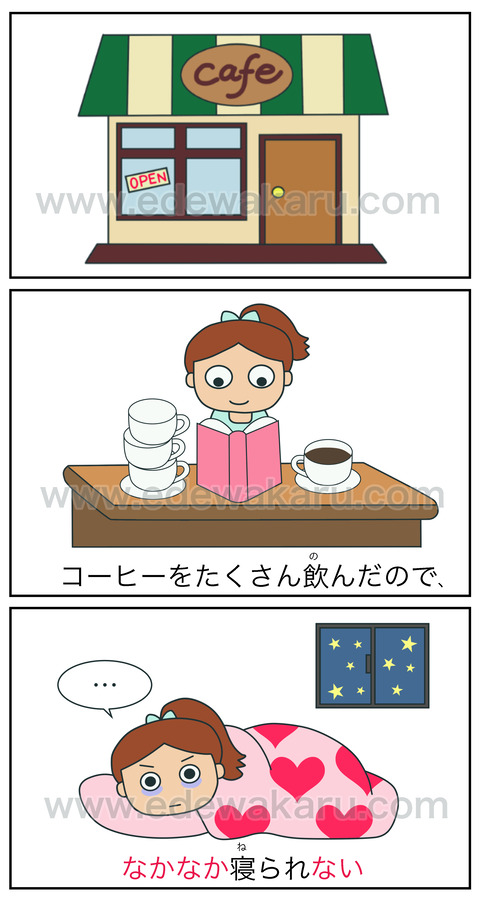
さっきコーヒーを飲んだせいで、なかなか寝られません。
Because I drank coffee earlier, I can't get to sleep easily.
タバコをやめたいと思っているんですが、なかなかやめることができません。
I want to quit smoking, but I just can't manage to.
もう日本に来て1年以上経つのですが、日本語がなかなか上手になりません。
I've been in Japan for over a year now, but my Japanese still isn't getting much better.
毎日ジョンギングをし、食べる量も減らしたのですが、なかなか痩せません。
I've been jogging every day and cut down on how much I eat, but I just can't seem to lose weight.
先日潰したニキビの跡がなかなか消えません。
The mark from the pimple I popped the other day just won't go away.
一度ポテチを食べ始めると、なかなかやめることができません。
Once I start eating potato chips, I just can't stop.
薬を飲んで、たくさん寝ているんですが、なかなか熱が下がりません。
I'm taking medicine and sleeping a lot, but my fever just won't go down.
何度も書いて練習しているんですが、なかなか覚えられません。
I've been practicing by writing it over and over, but I just can't memorize it.
飲み会の店を探しているんですが、どこも満席でなかなか見つけられません。
I'm looking for a place for the drinking party, but everywhere is full, so I just can't find one.
Read the original source text
Meaning
① 簡単には〜できない
② 〜するには時間がかかる
How to use it
なかなか + V(否定形)
日本語NET JLPT文法解説まとめ
Meaning
① Not easy to ~
② It takes time to ~
How to use it
なかなか + V (negative form)
Explanation
① It's not easy to ~.
② It takes time to ~.
In context 10 examples
もう来るはずなんですが、なかなかバスが来ませんね。
The bus should be here by now, but it sure is taking a while to come.
さっきコーヒーを飲んだせいで、なかなか寝られません。
Because I drank coffee earlier, I can't get to sleep easily.
タバコをやめたいと思っているんですが、なかなかやめることができません。
I want to quit smoking, but I just can't manage to.
もう日本に来て1年以上経つのですが、日本語がなかなか上手になりません。
I've been in Japan for over a year now, but my Japanese still isn't getting much better.
毎日ジョギングをし、食べる量も減らしたのですが、なかなか痩せません。
I've been jogging every day and cut down on how much I eat, but I still can't seem to lose weight.
先日潰したニキビの跡がなかなか消えません。
The mark from the pimple I popped the other day just won't go away.
一度ポテチを食べ始めると、なかなかやめることができません。
Once I start eating potato chips, I just can't stop.
薬を飲んで、たくさん寝ているんですが、なかなか熱が下がりません。
I'm taking medicine and sleeping a lot, but my fever just won't go down.
何度も書いて練習しているんですが、なかなか覚えられません。
I've been practicing by writing it over and over, but I just can't memorize it.
飲み会の店を探しているんですが、どこも満席でなかなか見つけられません。
I'm looking for a place for the drinking party, but everywhere is full, so I just can't find one.
Read the original source text
Meaning
① 簡単には〜できない
② 〜するには時間がかかる
How to use it
なかなか + V(否定形)
Explanation
① It's not easy to ~.
② It takes time to ~.