絵でわかる日本語
Meaning
Without actually saying 〜, with a face that seems to say 〜
Without actually saying 〜, in a manner that seems to say 〜
Without actually saying 〜, with an attitude that seems to say 〜
How to use it
Verb/adjective/noun [plain form] + と言わんばかりに
Explanation
「〜と言わんばかり」 is a sentence pattern meaning “Without actually saying 〜, with a face, manner, or attitude that seems to say 〜.” As in Example ①, when a noun follows, the form is 「〜と言わんばかりの + noun」. 😀 Also, 「〜とばかりに」 is an abbreviated form of 「〜と言わんばかりに」, so they can be used interchangeably. 😮
[Examples]
They’re making a face as if to say it tastes bad.
= They’re making a face as if to say it tastes bad.
When I get home, my dog runs up to me as if to say “Welcome home.”
= It runs up to me as if to say “Welcome home.”
「〜と言わんばかり・〜とばかり」 are formal expressions, so they are used mostly in writing. People taking N1 should learn 「〜んばかり」 together with them. 😉
In context 5 examples
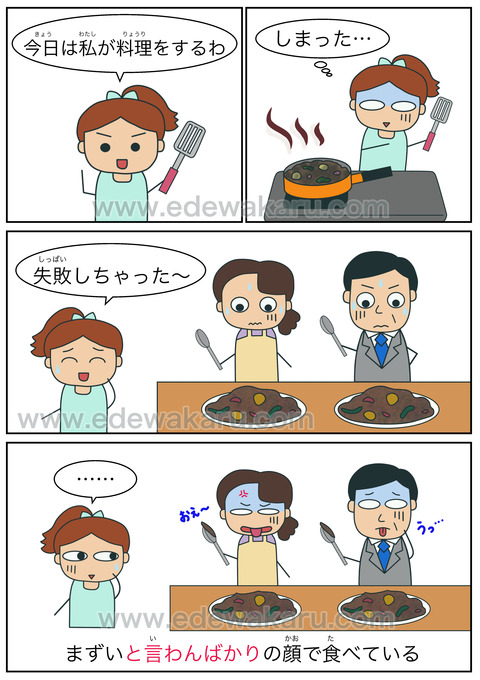
まずいと言わんばかりの顔をして食べている
→実際に「まずい」とは言っていないが、「まずい」と言いそうな顔をして食べているThey’re eating with a face as if to say, “This tastes bad.” → They aren’t actually saying “This tastes bad,” but they’re eating with a face that seems to say it.
うちの犬は、私が帰ると「おかえり」と言わんばかりに走ってくる
→実際に「おかえり」と言っていないが、「おかえり」と言いそうな様子で走ってくるWhen I get home, my dog runs up to me as if to say, “Welcome home.” → It doesn’t actually say “Welcome home,” but runs up to me in a manner that seems to say it.
遅刻をしたら、出て行けと言わんばかりににらまれた
→実際に「出て行け」と言っていないが、「出て行け」と言いそうな態度でにらまれたWhen I was late, I was glared at as if to say, “Get out.” → They didn’t actually say “Get out,” but glared at me with an attitude that seemed to say it.
失敗したのは彼女のせいだと言わんばかりの表情で、みんなが彼女を見ている
→みんなは「彼女のせいだ」と言っていないが、「彼女のせいだ」と言いそうな顔で彼女を見ているEveryone is looking at her with an expression as if to say that the failure was her fault. → They aren’t saying “It was her fault,” but they’re looking at her with a face that seems to say it.
彼は、こんな問題は簡単だと言わんばかりに、どんどん問題を解いていく
→実際に「簡単だ」と言っていないが、「簡単だ」と言いそうな様子でどんどん問題を解いていくHe keeps solving problem after problem as if to say, “A problem like this is easy.” → He isn’t actually saying “It’s easy,” but he keeps solving problem after problem in a manner that seems to say it.
Read the original source text
Meaning
実際には〜と言っていないが、〜と言いそうな顔で〜
実際には〜と言っていないが、〜と言いそうな様子で〜
実際には〜と言っていないが、〜と言いそうな態度で〜
How to use it
動詞・形容詞・名詞[普通形]+と言わんばかりに
Explanation
「〜と言わんばかり」は「実際は〜と言っていないが、〜と言いそうな顔・様子・態度で〜」という意味を表す文型です。例文①のように、後ろに名詞がくる場合は
「〜と言わんばかりの+名詞」
になります😀また「〜とばかりに」は「〜と言わんばかりに」の省略形(しょうりゃくけい)ですので、チェンジすることができます😮
[例]
まずい
と言わんばかり
の顔をしている
=まずい
とばかり
の顔をしている
うちの犬は、私が帰ると「おかえり」
と言わんばかり
に走ってくる
=「おかえり」
とばかり
に走ってくる
「〜と言わんばかり・〜とばかり」はかたい言い方ですので、ほとんど
書き言葉
として使われます。N1を受ける人は「〜んばかり」も一緒に覚えておくといいと思います😉