DoJG 日本語文法辞典(全集)
Meaning
Whether X or not
How to use it
(i) {V/Adjectiveい} informal | か否か | |
| {来る/来た}か否か | Whether or not someone will come/came |
| {面白い/面白かった}か否か | Whether or not something is/was interesting |
(ii) {Noun/Adjectiveな} stem | {∅/である/だった/であった}か否か | |
| 学生{∅/である/だった/であった}か否か | Whether or not someone is/was a student |
| 元気{∅/である/だった/であった}か否か | Whether or not someone is/was healthy |
(iii) Vinformal nonpast | べき(である) か否か | |
{Noun/Adjectiveなstem} | であるべきか否か | |
| 行くべき(である) か否か | Whether or not someone should go there |
| 学生であるべきか否か | Whether or not someone should be a student |
| 質素であるべきか否か | Whether or not someone should be frugal |
Explanation
A conjunctive phrase indicating that the speaker/writer is wondering whether something is the case or not.
In context 9 examples
このソフトが役に立つか否かは保証の限りではありません。
I cannot say (literally: guarantee) whether this software is useful or not.
選挙の時に、有権者は候補者が倫理観のある政治家(である)か否かを見抜かなければならない。
In an election, the voter has to judge (literally: see through) whether or not a candidate is a politician of integrity.
子供に携帯電話を持たせるべきか否かは議論が分かれる。
Opinions differ as to whether we should allow a child to have a cell phone.
アメリカの大学では教授が外国人であるか否かは問題にならないが、日本ではそれがよく問題になるようだ。
In the U.S., whether or not a professor is a foreigner is not a problem, but in Japan, it appears that it is frequently an issue.
家を探す場合、その地域が安全であるか否かが一番大事なポイントになる。
When you search for a house, whether or not the area is safe is the most important point.
クラシック音楽を聞く時、私は旋律が美しいか否かよりその音楽が生命を感じさせるか否かに注意を払う。
When I listen to classical music, I pay attention to whether or not it causes me to feel life rather than whether or not the melody is beautiful.
大学の入試要項をよく読んでから受験するか否かを決めるべきだ。
You should decide whether or not to take the entrance examination after reading the university's guidelines carefully.
愛されたら愛しかえすべきか否かという疑問は愚問です。
The question of whether or not one should return love when one is loved is a silly one.
容疑者に遺体を見せると、真犯人か否かが分かることがある。
There are cases in which you can tell whether or not a suspect is the real culprit when you show him or her the dead body.
絵でわかる日本語
Meaning
whether ~ or not
How to use it
Verb/adjective/noun [plain form] + か否か
In context 3 examples
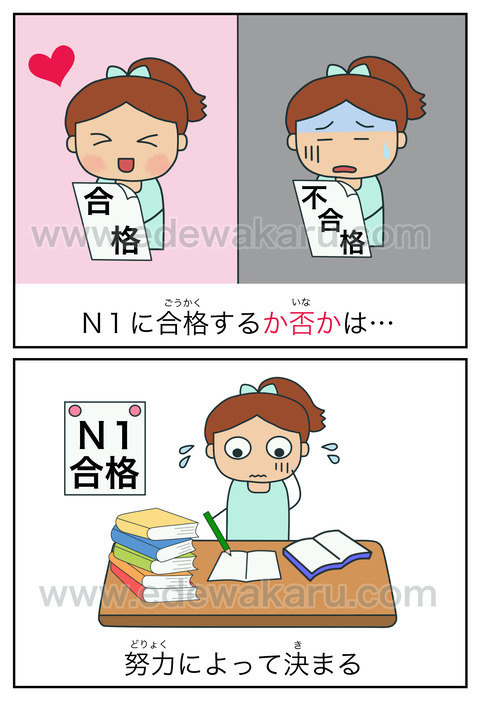
N1に合格するか否かは努力によって決まる
→N1に合格するかしないかは努力によって決まる(復習:〜によって(区別))Whether I pass N1 or not is determined by my effort. → Whether I pass N1 or not is determined by my effort. (Review: 〜によって (distinction))
パーティーに参加するか否かはメールで知らせてください
→パーティーに参加するかしないかはメールで知らせてくださいPlease let me know by email whether you will attend the party or not. → Please let me know by email whether you will attend the party or not.
賛成するべきか否かわからなかった
→賛成するべきかしないべきかわからなかった(復習:〜べきだ)I didn’t know whether I should agree or not. → I didn’t know whether I should agree or not. (Review: 〜べきだ)
Read the original source text
Meaning
〜するか〜しないか
How to use it
動詞・形容詞・名詞[普通形]+か否か
毎日のんびり日本語教師
How to use it
Verb dictionary form / verb past form + か否か
い-adjective + (の) + か否か
な-adjective stem + (である/なの) + か否か
Noun + (である/なの) + か否か
Explanation
Expresses that something is difficult to question or judge. It has the same meaning as 「~かどうか」.
This is a relatively more formal expression than 「~かどうか」and is not used very often in conversation.
Notes
Nothing in particular.
In context 6 examples
人生楽しむか否か。結局は自分次第。(人生是否愉快全靠自己决定。)
Whether to enjoy life or not—in the end, it's up to you. (Whether life is enjoyable is entirely up to you.)
ダイエット中だけどケーキを食べるか否かで迷ってる。
I'm on a diet, but I'm debating whether or not to eat cake.
この服似合ってるか否かは自分ではちょっとわからない。
I can't really tell for myself whether these clothes suit me.
どこでも寝れるのは長所に含まれるか否か。(在哪儿都能睡着是不是也能当作自己的优点。)
Whether being able to sleep anywhere counts as a strength. (Whether being able to fall asleep anywhere can be considered one of my strengths.)
契約を更新するのか否か悩む。
I'm unsure whether to renew the contract.
遠慮なくと言われて遠慮せずに質問し続けるのは失礼であるか否か。
Whether it is rude to keep asking questions without holding back after being told to feel free to ask.
Read the original source text
How to use it
動詞辞書形/動詞た形+か否か
い形容詞+(の)+か否か
な形容詞語幹+(である/なの)+か否か
名詞+(である/なの)+か否か
Explanation
疑問や判断がしにくいことを表します。「~かどうか」と同じ意味です。
こちらは「~かどうか」よりも比較的硬い表現で、口語での使用頻度はあまり高くないです。
Notes
特になし