絵でわかる日本語
Meaning
〜according to; 〜in line with
How to use it
Noun [dictionary form] + に即して・〜に則して
Noun [dictionary form] + に即した・に則した + noun
Explanation
“〜に即して・〜に則して” is a grammar pattern meaning “according to” or “in line with.” When talking about facts or experience, use “〜に即して”; when referring to laws or regulations, use “〜に則して.” When used with a noun, the forms are:
“〜に即した + noun” and “〜に則した + noun.”
[Example]
We should adopt a way of thinking that is
in keeping with the times.
Let’s review some grammar patterns similar to “〜に即して・〜に則して” 😊
[Related articles]
In context 4 examples
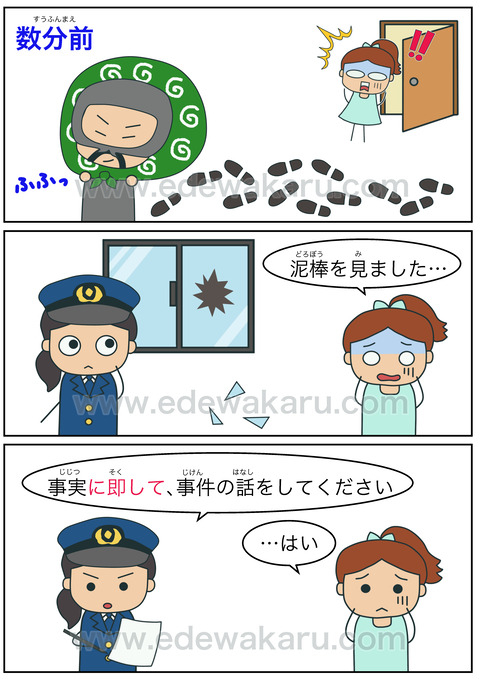
警察:事実に即して、事件の話をしてください
→事実の通りに、事件の話をしてくださいPolice officer: Tell us about the incident in accordance with the facts. →Tell us about the incident as it happened.
時代に即して、習慣や考え方を変えていくべきだと思う
→時代に合わせて、習慣や考え方を変えていくべきだと思うI think we should change our customs and ways of thinking to keep up with the times. →I think we should change our customs and ways of thinking to suit the times.
経験に即して言うと、留学した意味はすごく大きいと思う
→経験した通りに言うと、留学した意味はすごく大きいと思うSpeaking from experience, I think studying abroad was very meaningful. →Speaking as things happened, I think studying abroad was very meaningful.
学校の規則に則して、決められた制服を着なければいけない
→学校の規則通りに、決められた制服を着なければいけないIn accordance with school regulations, we have to wear the designated uniform. →We have to wear the designated uniform according to school regulations.
Read the original source text
Meaning
〜の通りに
〜に合わせて
How to use it
名詞[辞書形]+に即して・〜に則して
名詞[辞書形]+に即した・に則した+名詞
Explanation
「〜に即して・〜に則して」は「〜の通りに」「〜に合わせて」という意味の文型です。事実や経験について言う時は「〜に即して」になり、法律や規則に関することに使う場合は「〜に則して」になります。名詞と使用する場合は
「〜に即した+名詞」「〜に則した+名詞」
になります。
[例]
時代
に即した
考え方をするべきだ
「〜に即して・〜に則して」に似ている文型を復習しておきましょう😊
【関連記事】