文法
Meaning
Even if 〜 were to happen hypothetically
Expresses that even if the condition in the first part is met, it does not affect the condition in the second part.
How to use it
V (plain form) + としても / としたって
い-adjective (plain form) + としても / としたって
な-adjective (plain form) + としても / としたって
N (plain form) + としても / としたって
Notes
・It is often used together with “たとえ.”
In context 12 examples
私はお金もちになったとしても、私は今と変わらない生活をするでしょう。
Even if I became rich, I would live the same way I do now.
仮に会社をクビになったとしても、しばらくは生活できるほどの蓄えがある。
Even if I were fired, I have enough savings to live on for a while.
学校を卒業後、国に帰ったとしても、日本語の勉強は続けるつもりです。
Even if I return to my country after graduating from school, I intend to keep studying Japanese.
気になる子への告白が失敗に終わったとしても、自分の気持ちを伝えられるのなら後悔はない。
Even if my confession to the person I like ends in failure, I won't regret it if I can convey my feelings.
今回の試験で不合格になったとしても、あきらめずに次回も受験するつもりです
Even if I fail this exam, I intend to take it again next time without giving up.
たとえ選手生命が絶たれる危険があるとしても、今回の試合には出場します。
Even if there's a risk that my athletic career will be cut short, I will compete in this match.
たとえ明日地球が滅びるとしても、最後まで君と一緒にいたい。
Even if the world were to end tomorrow, I want to be with you until the very end.
たとえ失敗したとしても、またチャレンジすればいいじゃないか。
Even if you fail, you can just try again, can't you?
彼氏にプロポーズされたとしても、今は素直に「はい」とは言えない。
Even if my boyfriend proposed to me, I can't honestly say “yes” right now.
たとえ冗談だとしても、言っていいことと悪いことがあるでしょ。
Even if it's a joke, there are things you should and shouldn't say, right?
誰に何を言われたとしても、意見を変えるつもりはありません。
No matter what anyone says to me, I have no intention of changing my opinion.
ミスをしたとしても、素直に謝れば許してもらえるものだ。
Even if you make a mistake, people will forgive you if you apologize sincerely.
Read the original source text
Meaning
もし仮に〜が起こったという場合でも
前件の条件が成立しても、後件の条件には影響しないということを表す。
How to use it
V(普通形)+ としても / としたって
イA(普通形) + としても / としたって
ナA(普通形) + としても / としたって
N(普通形) + としても / としたって
Notes
・「たとえ」と一緒に使うことも多い。
Bunpro Grammar Reference
Meaning
Even if (we assume), Assuming, Also as
How to use it
Verb + としても
[い]Adjective + としても
[な]Adjective + (だ)+ としても
Noun + (だ)+ としても
Nuance
A hypothetical phrase that expresses that even assuming or going with (A), (B) is still the case.
Explanation
としても is a structure used in Japanese for expressing thoughts about (A), assuming that it were what is being described. This may be translated as 'even if we assume that it's (A)', or 'assuming that (A)'. However, the literal translation is quite close to 'even going off that it were (A), (B)', as としても simply expresses that despite (A) not being true, the speaker is willing to say that it is for arguments sake, before giving their thoughts about that hypothetical situation.
としても will be seen following verbs and い-Adjectives, or nouns and な-Adjectives that are followed by だ.
たとえ早くついたとしても、一番乗りになることはないだろう。
Even if we get there early, that probably doesn't mean that we will be the first to get on.
あなたが言っている事が正しいとしても、私は賛成できません。
Even if we assume that what you are saying is correct, I do not agree with it.
たとえ仕事が簡単だとしても、仕事は丁寧にやるべきだ。
Even if work is easy, work should be done with care.
冗談だとしても、そういうことは言わない方がいいと思う。
Even if that was a joke, I don't think that you should say something like that.
In some cases, としても just functions as an extension of として 'as', and can be interpreted as 'even as (A)'. This nuance primarily highlights people or organizations in the position of (A), and states that 'even for (A), it will still be (B)'. Unlike the previous nuance, this としても will only be used with nouns.
こんな急に内容を変えられたら、私としても困ります。
It will even inconvenience me if you change the details so suddenly.
環境問題に取り組んでいる会社としてもこういうことをしたくないのですが、仕方がないんです。
As a company that works on environmental issues, we don't want to do this, but we really don't have a choice.
In context 18 examples
- たとえできるとしても、やらないだろう。
I wouldn't do it even if I could.
- たとえ早くついたとしても、一番乗りになることはないだろう。
Even if we get there early, that probably doesn't mean that we will be the first to get on.
- あなたが言っている事が正しいとしても、私は賛成できません。
Even if we assume that what you are saying is correct, I do not agree with it.
- たとえ仕事が簡単だとしても、仕事は丁寧にやるべきだ。
Even if work is easy, work should be done with care.
- 冗談だとしても、そういうことは言わない方がいいと思う。
Even if that was a joke, I don't think that you should say something like that.
- 環境問題に取り組んでいる会社としてもこういうことをしたくないのですが、仕方がないんです。
As a company that works on environmental issues, we don't want to do this, but we really don't have a choice.
- こんな急に内容を変えられたら、私としても困ります。
It will even inconvenience me if you change the details so suddenly.
- 例え話だとしても許されない。
Even if it is a parable, I can't permit it.
- 大人向きの本だとしても売れます。
Even if it's a book meant for adults, it will sell.
- 彼はピアノ奏者だが、オルガン奏者としても有名です。
He is a pianist, but he is also famous as an organ player.
- それが正式な回答だとしても、僕はまだ諦めきれません。
Even if we assume that is the official answer, I still cannot accept it.
- 落し物が見つかったとしても、ネコババされている可能性もある。
Even if we assume that the lost item was found, there is still the possibility that someone pocketed it.
- 各自で決めるべき問題だとしても、アドバイスくらいしてほしい。
Even if we assume that it is a problem that should be decided individually, I would like some advice.
- 例え伯母さんだとしても、あの秘密を打ち明けるわけにはいかない。
Even assuming it is my aunt, it is impossible for me to open up about that secret.
- 快晴だとしても、少し風邪っぽいなら休んだ方がいいと思います。
Even if we assume it is nice weather, I think it is better if you rested if you are feeling a little like you have a cold.
- 無事解放されたとしても、その後の精神的なケアが必要です。
Even if we assume that he was safely released, he still needs mental health care afterward.
- 有名な先生から教わったとしても、こんなに早く上達した人は見たことがない。
Even if we assume that they were taught by a famous teacher, I have never seen someone progress so quickly.
- 何らかの恩恵を受けられるとしても、カジノの受け入れには反対だ。
Even if we assume that we'd get some kind of benefit from it, I am opposed to the casino's acceptance.
どんなときどう使う 日本語表現文型辞典
Meaning
even supposing
How to use it
〔plain form〕+としても
Explanation
~と仮定しても
1)「~としても、…」の形で、「実際は~ではないが、もしそうなっても」と言いたいときに使う。「…」では逆接の事柄を述べる。
2)話者の主張、意見などを述べるときによく使われる。
3)「たとえ~としても・仮に~としても・疑問詞~としても」などとともによく使う。
4)くだけた話し言葉では ❺ のように「としたって」を使う。
3)Often used with たとえ~としても, 仮に~としても, interrogative~としても.
4)In informal speech, としたってis used, as in sentence ❺ .
1)Something isn't actually true; examines what would happen if it were. Adversative conjunctions follow.
2)Often used to give speaker's assertion or opinion.
In context 5 examples
たとえわたしが大金持ちだとしても、毎日遊んで暮らしたいとは思わない。
Even if I were very rich, I wouldn’t want to spend every day just having fun.
仮にわたしが病気で倒れたとしても、これだけの蓄えがあれば大丈夫だろう。
Even if I were to collapse from illness, I’d probably be all right with savings this large.
彼ほどの才能があれば、どんな家に生まれたとしても音楽家になっていただろう。
With talent like his, he would have become a musician no matter what kind of family he was born into.
もし彼がわたしの親しい友人であったとしても、わたしは彼を許さなかっただろう。
Even if he had been a close friend of mine, I probably wouldn’t have forgiven him.
どんな事業を始めるとしたって、お金は必要だ。
No matter what kind of business you start, you need money.
Read the original source text
Meaning
even supposing
How to use it
〔普通形〕+としても
Explanation
~と仮定しても
1)「~としても、…」の形で、「実際は~ではないが、もしそうなっても」と言いたいときに使う。「…」では逆接の事柄を述べる。
2)話者の主張、意見などを述べるときによく使われる。
3)「たとえ~としても・仮に~としても・疑問詞~としても」などとともによく使う。
4)くだけた話し言葉では ❺ のように「としたって」を使う。
3)Often used with たとえ~としても, 仮に~としても, interrogative~としても.
4)In informal speech, としたってis used, as in sentence ❺ .
1)Something isn't actually true; examines what would happen if it were. Adversative conjunctions follow.
2)Often used to give speaker's assertion or opinion.
絵でわかる日本語
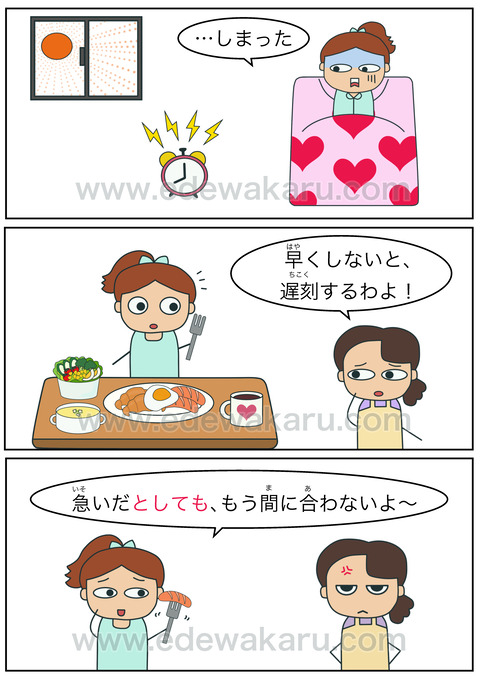
Meaning
Even if, hypothetically, 〜
Even if 〜 were to happen
Even if 〜 were true
How to use it
Verb/adjective/noun [plain form] + としても
Verb/adjective/noun [plain form] + としたって
*For the present affirmative form of な-adjectives and nouns, use “〜だとしても.”
Explanation
“AとしてもB” is a sentence pattern meaning “Even if hypothetically A, B,” “Even if A were to happen, B,” or “Even if A were true, B.” It is used when you want to say that even if a certain situation comes about, B will remain unchanged.
[Examples]
① Mother: Hurry up or you’ll be late!
Daughter: Even if I hurry, I won’t make it in time anyway~
→ Even if I hurry, the fact that I won’t make it in time won’t change~
② Even if a typhoon comes, I can’t take time off work…
→ Even if a typhoon comes, the fact that I can’t take time off work won’t change.
③ Even if you complain, nothing can be done.
→ Even if you complain, nothing can be done; that won’t change.
④ Even if that story is true, I just can’t believe it.
→ Even if that story is true, the fact that I can’t believe it won’t change.
⑤ Even if it’s a joke, you shouldn’t say something like that.
→ Even if it’s a joke, you shouldn’t say something like that.
⑥ Even if I failed, all the effort I’ve put in so far probably won’t go to waste.
→ Even if I failed, it would still be true that all the effort I’ve put in so far won’t go to waste.
The colloquial form of “〜としても” is “〜としたって,” so be sure to learn them together 😊
In context 6 examples
母:早くしないと、遅刻するわよ!娘:急いだとしても、もう間に合わないよ〜
Mother: Hurry up or you’ll be late! Daughter: Even if I hurry, I won’t make it in time anyway~
台風がきたとしても、仕事を休むことはできない…
Even if a typhoon comes, I can’t take time off work…
文句を言ったとしても、どうにもならないよ
Even if you complain, nothing can be done.
その話が本当だとしても、どうしても信じることができない
Even if that story is true, I just can’t believe it.
冗談だとしても、そんなことを言うものではないよ
Even if it’s a joke, you shouldn’t say something like that.
不合格だったとしても、今までの努力は無駄にならないだろう
Even if I fail, all the effort I’ve put in so far probably won’t go to waste.
Read the original source text
Meaning
仮に〜ても
もし〜になった場合でも
もし〜が事実でも
How to use it
動詞・形容詞・名詞[普通形]+としても
動詞・形容詞・名詞[普通形]+としたって
*な形容詞・名詞の現在肯定形は「〜だとしても」になる
Explanation
「AとしてもB」は「仮にAてもB」「もしAになった場合でもB」「Aが事実でもB」という意味の文型です。「Aという状態になっても、Bなのは変わらない」と言いたい時に使われます。
[例]
①母:早くしないと、遅刻するわよ!
娘:急いだ
としても、もう間に合わない〜
→仮に急いでも、もう間に合わないことは変わらないよ〜
②台風がきた
としても、仕事を休むことはできない…
→もし台風がきても、仕事を休むことはできないのは変わらない
③文句を言った
としても、どうにもならないよ
→文句を言っても、どうにもならないのは変わらない
④その話が本当だ
としても、どうしても信じることができない
→その話が本当でも、信じることができないのは変わらない
⑤冗談だ
としても、そんなことを言うものではないよ
→仮に冗談でも、そんなことを言うものではないよ
⑥不合格だった
としても、今までの努力は無駄にならないだろう
→仮に不合格でも、今までの努力は無駄にならないことは変わらない
「〜としても」の口語形は「〜としたって」ですので、一緒に覚えておきましょう😊
日本語文型辞典
Meaning
⇾として3
In the form 「XとしてもY」, means “even if X is true or established, it does not effectively help bring about or prevent Y.” Y expresses something contrary to or outside what would be expected or anticipated from X. When X is a verb, it often takes the past form 「V-たとしても」, as in ④–⑦, though 「V-るとしても」 is also used, as in ③. ③ means “if something like studying abroad in the future were to happen,” and Y describes a time concurrent with the realization of X. In contrast, 「V-たとしても」 means “even if event X had occurred,” with X taking place before Y. For example, ④ means “even if we took a taxi, we probably wouldn't make it in time.” ⑥ and ⑦ describe counterfactual X: they say that result Y would still have happened “even if Mr. Kato had not given his advice,” though he actually did, or “even if I had not met my classmate,” though I actually did.
Follows a noun or clause in the form 「XはいいとしてもY」. Y is followed by a negative evaluation such as 「よくない」, and the expression means “it may be all right to accept X, but the same cannot be said of Y.” It contrasts two things, indicating that X is within acceptable limits, whereas Y is not.
How to use it
Nとしても
2…としても
N/Na(だ)としても
A/V としても
…はいいとしても
In context 11 examples
彼の言っていることが真実だとしても、証拠がなければ信じるわけにはいかない。
Even if what he says is true, I can't believe it without proof.
たとえ賛成してくれる人が一人もいないとしても、自分の意見を最後まで主張するつもりだ。
Even if not a single person agrees with me, I intend to stand by my opinion to the end.
留学するとしても、来年以降です。
Even if I study abroad, it won't be until next year or later.
今からタクシーに乗ったとしても、時間には間に合いそうもない。
Even if I take a taxi now, there's no way I'll make it on time.
渋滞でバスが遅れたとしても、電話ぐらいしてくるはずだ。
Even if the bus is delayed by traffic, they should at least call.
加藤さんの忠告がなかったとしても、やっぱり病院を変えていただろう。
Even if Mr. Kato hadn't advised me, I probably would have changed hospitals anyway.
同級生に駅で出会わなかったとしても、やっぱり授業をさぼって映画に行っただろう。
Even if I hadn't run into my classmate at the station, I probably would have skipped class and gone to a movie anyway.
彼はいいとしても、彼女が許してくれないだろう。
He may be all right with it, but she probably won't forgive me.
計算を間違えたのはいいとしても、すぐに報告しなかったことが問題だ。
It's one thing to have made a mistake in the calculation, but the problem is that you didn't report it right away.
時間通り来たのはいいとしても、宿題を忘れて来たのはよくない。
It's all right that you arrived on time, but it isn't all right that you forgot to bring your homework.
あのホテルは、部屋はいいとしても、従業員の態度がよくない。
That hotel has nice rooms, but the staff's attitude is poor.
Read the original source text
Meaning
⇾として3
「XとしてもY」の形で、「仮にXが事実であっても/成立していてもYの成立や阻止に有効に働かない」という意味を表す。Yは、Xから予想・期待されることに反したり、はずれたことがらを表す。Xが動詞の場合は、④~⑦のように「V-たとしても」のようにタ形を受ける場合が多いが、③のように「V-るとしても」も使われる。③は「未来に留学するようなことが生じる場合」という意味で、YはXが成立する同時的な時間を表している。これに対して「V-たとしても」は、「Xの事態が成立した場合でも」という意味で、XはYに先行して成立していることがらを表す。④の例で言えば「タクシーに乗った場合でも間に合わないという結果に終わるだろう」という意味の表現である。⑥⑦はXが事実に反することがらを表す場合で、「実際は加藤さんの忠告があったが、それがなかった場合でも」「実際は同級生に会ったが、会わなかった場合でも」、Yという結果は成立していただろうということを述べる表現。
名詞や節を受け、「XはいいとしてもY」の形で用いられる。Yには「よくない」などのマイナス評価の表現が続き、「Xについてはいいと考えてもいいが、Yについてはそうは言えない」という意味を表す。二つのことがらを対比させ、Xは許容される範囲にあるが、Yはその範囲にないということを表す言い方。
How to use it
Nとしても
2…としても
N/Na(だ)としても
A/V としても
…はいいとしても
日本語文型辞典 英語版
Meaning
3
Takes the pattern XとしてもY (even if X, then Y). Expresses that “even if X were true/had happened, it would not have caused or hindered the occurrence of Y.” Y expresses something that contradicts or deviates from what is expected from X.
When X is a verb, the pattern V-たとしても (ta-form) is the most common, as shown in
(4)
-
(7)
. However, the pattern V-るとしても (dictionary form) is also used, as shown in
(3)
.
(3)
means “if something like studying abroad happens in the future,” and the time frame indicated by Y is essentially the same as that for the occurrence of X. On the other hand, V-たとしても means “even if/when situation X has arisen,” so this pattern expresses that X occurs before Y. For example,
(4)
means “even if we do take a taxi, the end result will probably still be that we won’t make it in time.”
In
(6)
and
(7)
, X expresses a situation that is contrary to fact, and Y expresses a result that probably would have happened anyway: “In fact, Kato-san did warn me, but even if s/he hadn’t...” and “I did actually run into a classmate, but even if I hadn’t....”
Placed after nouns and clauses. Takes the pattern XはいいとしてもY (even if I accept X, still Y). Y contains an expression of negative evaluation, such as よくない (not good), and the pattern as a whole means “even if I consider X to be all right, I cannot say the same about Y.” This expression is used to contrast two situations, X and Y. It means that while X lies within the range of what is permissible, Y does not.
How to use it
1. Nとしても→
2. ...としても[N/Na (だ)としても][A/V としても]
3. ...はいいとしても
In context 11 examples
彼の言っていることが真実だとしても、証拠がなければ信じるわけにはいかない。
Even if what he says is true, I can’t very well believe it without proof.
たとえ賛成してくれる人が一人もいないとしても、自分の意見を最後まで主張するつもりだ。
I intend to stick with my opinion to the very end, even if there isn't a single person who concurs with it.
留学するとしても、来年以降です。
If I do study overseas, it will have to be next year or later.
今からタクシーに乗ったとしても、時間には間に合いそうもない。
Even if we took a taxi at this point, it’s not very likely we would make it in time.
渋滞でバスが遅れたとしても、電話ぐらいしてくるはずだ。
Even if the bus was delayed in traffic, I would at least expect a phone call.
加藤さんの忠告がなかったとしても、やっぱり病院を変えていただろう。
Even if Kato-san hadn’t warned me, I would probably have changed hospitals anyway.
同級生に駅で出会わなかったとしても、やっぱり授業をさぼって映画に行っただろう。
Even if I hadn’t run into a classmate at the station, I probably still would have cut class to go see a movie.
彼はいいとしても、彼女が許してくれないだろう。
Even if he’s OK with it, she probably won’t allow it.
計算を間違えたのはいいとしても、すぐに報告しなかったことが問題だ。
Even if we overlook the miscalculation, the fact that you didn't report it right away is a problem.
時間通り来たのはいいとしても、宿題を忘れて来たのはよくない。
You may have come on time, but it's not acceptable that you forgot to bring your homework.
あのホテルは、部屋はいいとしても、従業員の態度がよくない。
The rooms at that hotel might be all right, but the employees don’t have a very good attitude.
Read the original source text
Meaning
3
Takes the pattern XとしてもY (even if X, then Y). Expresses that “even if X were true/had happened, it would not have caused or hindered the occurrence of Y.” Y expresses something that contradicts or deviates from what is expected from X.
When X is a verb, the pattern V-たとしても (ta-form) is the most common, as shown in
(4)
-
(7)
. However, the pattern V-るとしても (dictionary form) is also used, as shown in
(3)
.
(3)
means “if something like studying abroad happens in the future,” and the time frame indicated by Y is essentially the same as that for the occurrence of X. On the other hand, V-たとしても means “even if/when situation X has arisen,” so this pattern expresses that X occurs before Y. For example,
(4)
means “even if we do take a taxi, the end result will probably still be that we won’t make it in time.”
In
(6)
and
(7)
, X expresses a situation that is contrary to fact, and Y expresses a result that probably would have happened anyway: “In fact, Kato-san did warn me, but even if s/he hadn’t...” and “I did actually run into a classmate, but even if I hadn’t....”
Placed after nouns and clauses. Takes the pattern XはいいとしてもY (even if I accept X, still Y). Y contains an expression of negative evaluation, such as よくない (not good), and the pattern as a whole means “even if I consider X to be all right, I cannot say the same about Y.” This expression is used to contrast two situations, X and Y. It means that while X lies within the range of what is permissible, Y does not.
How to use it
1. Nとしても→
2. ...としても[N/Na (だ)としても][A/V としても]
3. ...はいいとしても
くらべてわかる日本語表現文型辞典
Meaning
Meaning 1: In reality, A is not the case, but even if one assumes A, B. Therefore, there is no point in doing A.
Meaning 2: Even if A is the case, B.
Meaning 3: A is a particular person or organization, and from that position they do B or are B.
Meaning 4: X is B in the position or role of A as well (just as in other positions or roles).
Meaning 5: In the form “A₁ようとしてもA₂ない.” No matter how hard one tries to do A, it is absolutely impossible.
How to use it
(Xは) AとしてもB (A₁ようとしてもA₂ない)
Connection 1:
[Verb—た form] としても
Connection 2:
[Verb] としても
[i-adjective—plain form] としても
[na-adjective—だ/である/だった/ではない] としても
[Noun—∅/である/ではない/だ/だった] としても
Connection 3:
[Noun—∅] としても
Connection 4:
[Noun—∅] としても
Connection 5:
[Verb—volitional form] としても [Verb—non-potential form]
Explanation
[Comparison 1]
“AにしてもB” (Meaning 2, p. 237)
“AとてB” (Meaning 3, p. 180)
[Comparison 2]
“AにしてもB” (Meaning 3, p. 237)
[Comparison 3]
“AにしてもB” (Meaning 4, p. 238)
“AとしてもB” is used when speaking only of A’s position, whereas “AにしてもB” is often used when the speaker has in mind that there are others who are also B, just like A.
○我が社としても、独自の円高対策を打ち出さねばならない。 — Our company, too, must come up with its own measures to counter the strong yen.
○厳しい円高で苦しんでいるのは、我が社にしても同様だ。 — Our company is likewise suffering from the strong yen.
[Comparison 5]
“A₁ようとしてもA₂ものではない”
“A₁ようとしてもA₂ものではない” has the same meaning, but conveys a stronger sense of “cannot.”
○信じていた人に裏切られたのだから、許そうとしても許せるものではない。 — Since I was betrayed by someone I trusted, it is simply impossible to forgive them, no matter how hard I try.
“A₁ようにもA₂ない” (Meaning 1, p. 322)
“A₁ようにもA₂ない” means that one wants to do A₁ but cannot because of some objective circumstance, whereas “A₁ようとしてもA₂ない” means that one cannot do it even after trying.
○財布を忘れてきては、バスに乗ろうにも乗れないじゃないか。 — Having forgotten my wallet, I can’t take the bus even if I want to.
×財布を忘れてきては、バスに乗ろうとしても乗れないじゃないか。 — Having forgotten my wallet, I can’t take the bus even if I try.
“A₁にA₂ない” (Meaning 1, p. 210)
“A₁にA₂ない” means that one thinks of doing A₁ but is psychologically unable to do it; it does not mean that one cannot do it even after trying.
○国に帰りたくても、成功するまでは帰るに帰れない。 — Even though I want to go back to my country, I can’t bring myself to go until I succeed.
×国に帰りたくても、成功するまでは帰ろうとしても帰れない。 — Even though I want to go back to my country, I can’t go back even if I try until I succeed.
Notes
[Note 3]
・A is a noun denoting a person or organization.
[Note 5]
・The following “Aない” may be omitted.
○授業中、眠くて先生の話を聞こうとしても、(聞けなくて)寝てしまうときがある。 — During class, I sometimes get so sleepy that even though I try to listen to the teacher, I end up falling asleep (because I can’t listen).
In context 20 examples
この問題は先生に聞いたとしてもわからないだろう。
Even if I asked the teacher about this problem, I probably wouldn’t understand.
駐車場の数を増やしたとしても、不法駐車はなくならないと思う。
Even if the number of parking spaces were increased, I don’t think illegal parking would disappear.
これから一生懸命働いたとしても、億ションなんて買えるわけがない。
Even if I worked as hard as I could from now on, there’s no way I could buy a luxury condominium.
交渉に時間をかけていたとしても、おそらく妥結しなかっただろう。
Even if they had spent more time negotiating, they probably would not have reached an agreement.
100点は無理だとしても、90点は取れるだろう。
Even if 100 points is out of reach, I should be able to get 90.
私が手伝えるとしても、二日間だけだ。
Even if I can help, it will only be for two days.
あす雨天だとしても、運動会は決行されます。
Even if it rains tomorrow, the sports day will go ahead.
彼に謝るとしても、何といって謝ったらいいのかわからない。
Even if I apologize to him, I don’t know what to say.
これは先生としても、十分検討してみた結果だけれどね。
This is the result of giving it thorough consideration, even as a teacher.
政府としても、安全性に考慮しつつ住民の賛成を得なければならない。
The government, too, must take safety into consideration while securing the residents’ approval.
彼女としても、仕事か子どもかの選択を迫られるわけだ。
She, too, will be forced to choose between her job and her child.
いまさらそんなことを言われたら、私としても困るんです。
If you tell me something like that at this late stage, I’m at a loss too.
彼は夫としても(父親としても)失格だ。
He is unfit to be a husband (or a father).
犬はペットとしても(番犬としても)役に立つ。
Dogs are useful as pets (and as guard dogs).
彼女は妻としても(母親としても)すばらしい人だ。
She is a wonderful person as a wife (and as a mother).
この鍋はフライパンとしても(蒸し器としても)使えます。
This pot can also be used as a frying pan (or a steamer).
あの事件のことは忘れようとしても忘れられない。
No matter how hard I try to forget that incident, I can’t.
8年前の今日、何があったかなんて思い出そうとしても思い出せない。
No matter how hard I try, I can’t remember what happened on this day eight years ago.
今日こそ本当のことを打ち明けようとしても、どうしても打ち明けられなかった。
Even though I tried to tell the truth today of all days, I just couldn’t bring myself to tell it.
かゆくて、かゆくて、我慢しようとしても我慢できずかいてしまった。
It was so itchy, so itchy that I couldn’t stop myself from scratching, no matter how hard I tried to bear it.
Read the original source text
Meaning
意味1:実際はAではないがAと仮定してもB。だからAをしても仕方がない。
意味2:もしAの場合でもBだ。
意味3:Aはある特定の人物や組織であり、その立場からBをする、Bである。
意味4:Xは(他の立場や役割のときと同様)Aの立場・役割でもBである
意味5:「A₁ようとしてもA₂ない」の形で。どんなにがんばってAをしようと努力しても絶対できない、無理だ。
How to use it
(Xは)AとしてもB(A₁ようとしてもA₂ない)
接続1:
[動詞-た形]としても
接続2:
[動詞]としても
[イ形-普]としても
[ナ形-だ/である/だった/ではない]としても
[名詞-∅/である/ではない/だ/だった]としても
接続3:
[名詞-∅]としても
接続4:
[名詞-∅]としても
接続5:
[動詞-意向形]としても[動詞-可能のない形]
Explanation
【対比1】
「AにしてもB」(意味2 P.237)
「AとてB」(意味3 P.180)
【対比2】
「AにしてもB」(意味3 P.237)
【対比3】
「AにしてもB」(意味4 P.238)
「AとしてもB」はAの立場だけを述べる場合に使うが「AにしてもB」はAと同様にBであるものがほかにもあることを意識した表現でよく使われる。
○我が社としても、独自の円高対策を打ち出さねばならない。
○厳しい円高で苦しんでいるのは、我が社にしても同様だ。
【対比5】
「A₁ようとしてもA₂ものではない」
「A₁ようとしてもA₂ものではない」も同じ意味だが、「できない」という気持ちが強い。
○信じていた人に裏切られたのだから、許そうとしても許せるものではない。
「A₁ようにもA₂ない」(意味1 P.322)
「A₁ようにもA₂ない」はA₁をしたいが、何かの客観的事情があってできないという意味であり、「A₁ようとしてもA₂ない」は努力してもできないという意味である。
○財布を忘れてきては、バスに乗ろうにも乗れないじゃないか。
×財布を忘れてきては、バスに乗ろうとしても乗れないじゃないか。
「A₁にA₂ない」(意味1 P.210)
「A₁にA₂ない」はA₁をしようと思うが、心理的にできないという意味で、努力をしてもできないという意味はない。
○国に帰りたくても、成功するまでは帰るに帰れない。
×国に帰りたくても、成功するまでは帰ろうとしても帰れない。
Notes
【注意3】
・Aは人や組織を表す名詞である。
【注意5】
・後文の「Aない」が省略されることもある。
○授業中、眠くて先生の話を聞こうとしても、(聞けなくて)寝てしまうときがある。
日本語NET JLPT文法解説まとめ
Meaning
“Even if 〜 were to happen”
This expresses that even if the condition in the first clause is met, it does not affect the condition in the second clause.
How to use it
V (plain form) + としても / としたって
い-adjective (plain form) + としても / としたって
な-adjective (plain form) + としても / としたって
N (plain form) + としても / としたって
Explanation
"Even if ~ were to happen"
It indicates that even if the condition in the former clause is met, it does not affect the condition in the latter clause.
・It is often used together with 'たとえ'.
It is often used together with 'たとえ'.
In context 12 examples
私はお金もちになったとしても、私は今と変わらない生活をするでしょう。
Even if I became rich, I would live the same way I do now.
仮に会社をクビになったとしても、しばらくは生活できるほどの蓄えがある。
Even if I were fired, I have enough savings to live on for a while.
学校を卒業後、国に帰ったとしても、日本語の勉強は続けるつもりです。
Even if I return to my country after graduating from school, I intend to keep studying Japanese.
気になる子への告白が失敗に終わったとしても、自分の気持ちを伝えられるのなら後悔はない。
Even if my confession to the person I like ends in failure, I won't regret it if I can convey my feelings.
今回の試験で不合格になったとしても、あきらめずに次回も受験するつもりです。
Even if I fail this exam, I intend to take it again next time without giving up.
たとえ選手生命が絶たれる危険があるとしても、今回の試合には出場します。
Even if there's a risk that my athletic career will be cut short, I will compete in this match.
たとえ明日地球が滅びるとしても、最後まで君と一緒にいたい。
Even if the world were to end tomorrow, I want to be with you until the very end.
たとえ失敗したとしても、またチャレンジすればいいじゃないか。
Even if you fail, you can just try again, can't you?
彼氏にプロポーズされたとしても、今は素直に「はい」とは言えない。
Even if my boyfriend proposed to me, I can't honestly say “yes” right now.
たとえ冗談だとしても、言っていいことと悪いことがあるでしょ。
Even if it's a joke, there are things you should and shouldn't say, right?
誰に何を言われたとしても、意見を変えるつもりはありません。
No matter what anyone says to me, I have no intention of changing my opinion.
ミスをしたとしても、素直に謝れば許してもらえるものだ。
Even if you make a mistake, people will forgive you if you apologize sincerely.
Read the original source text
Meaning
"もし仮に〜が起こったという場合でも"
前件の条件が成立しても、後件の条件には影響しないということを表す。
How to use it
V(普通形)+ としても / としたって
イA(普通形) + としても / としたって
ナA(普通形) + としても / としたって
N(普通形) + としても / としたって
Explanation
"Even if ~ were to happen"
It indicates that even if the condition in the former clause is met, it does not affect the condition in the latter clause.
・「たとえ」と一緒に使うことも多い。
It is often used together with 'たとえ'.
毎日のんびり日本語教師
How to use it
Verb plain form + としても
い-adjective plain form + としても
な-adjective stem + (だ / である)としても
Noun + (だ / である)としても
Explanation
Indicates that the latter clause does not hold under the conditions stated in the preceding clause. The latter clause often describes something undesirable. For this reason, it often combines with a negative form in the latter clause.
“~とて” is the stiffest expression among these.
When attached to a verb, it often takes the ta-form or the form “~ようとした.”
Notes
Similar grammar pattern: “【N1 Grammar】~にしたって/にしたところで”
In context 8 examples
進学しようとしたって学力がないとできない。
Even if you try to go on to further education, you can’t do it without academic ability.
行動しないと何も変わらないが、行動したとしても目標がなければ何も意味を成さない。
Nothing will change if you don’t act, but even if you do act, it means nothing without a goal.
辛いことは忘れようとしたって忘れられない。(即使想忘记痛苦也忘不了。)
No matter how hard I try to forget painful things, I can’t.
母は良いとしても、父は許してくれないはずだ。
Even if my mother is okay with it, my father probably won’t forgive me.
全てが真実だとしても、この目で確かめない限りは信じられない。
Even if everything is true, I can’t believe it unless I confirm it with my own eyes.
誤魔化そうとて無駄だ。
It’s no use trying to cover it up.
整形しようとしたところで中身まで変わるわけではない。
Even if you get plastic surgery, that doesn’t mean what’s inside will change too.
過去は消そうとしたって消せない。
No matter how hard I try to erase the past, I can’t.
Read the original source text
How to use it
動詞普通形+としても
イ形容詞普通形+としても
ナ形語幹+(だ/である)としても
名詞+(だ/である)としても
Explanation
前件の条件下では後件が成り立たないことを表します。後件は良くない内容が述べられることが多いです。そのため後件にはよく否定形が呼応します。
「~とて」はこの中では一番硬めな表現です。
動詞に接続するときは、動た形、あるいは「~ようとした」の形になることが多いです。
Notes
似ている文法「【N1文法】~にしたって/にしたところで」
NINJAL 日本語文型データベース
Meaning
[1] Used to express the speaker’s judgment that even if something is assumed to be the case, it will not have the kind of effect one might expect as a result.
[2] Used to express the speaker’s judgment that even if something is a fact, it will not have the kind of effect one might expect as a result.
How to use it
V plain form + としても
i-A plain form + としても
na-A plain form + としても (「na-Aだ」 can also take the form 「na-Aである+としても」)
N plain form + としても (「Nだ」 can also take the form 「Nである+としても」)
Other forms
V plain form + としても
N plain form + としても (「Nだ」 can also take the form 「Nである+としても」)
Notes
[1] The “〜” takes a sentence expressing an assumption. What follows “〜としても” is usually a sentence expressing the speaker’s judgment, evaluation, or intention.
When “〜” contains an interrogative word such as 「何・どこ・だれ」, it indicates that the same result applies under any conditions.
[2] What follows “〜としても” is usually a sentence expressing the speaker’s judgment, evaluation, or intention.
In context 39 examples
「犬を飼いたいの? もし飼うとしても大型犬はだめだよ」
“You want to have a dog? Even if you do, you can’t get a large dog.”
プロの棋士には勝てないとしても、私の将棋の腕も実は相当なものだと自負しているんですが……。
Even if I can’t beat a professional shogi player, I’m actually quite confident in my own shogi skills…
部長、遅いなあ。万が一乗り遅れて3時の新幹線に乗ったとしても、もう着くころだけどなあ。
The department head is late. Even if he missed the earlier train and took the 3 o’clock Shinkansen, he should be getting here about now.
料理はそんなに簡単に上手になるものではない。たとえ今日は上手に作れなかったとしても、練習を重ねるうちに次第に上達していくはずだ。
You don’t become good at cooking that easily. Even if you didn’t cook well today, you should gradually improve as you keep practicing.
仮に講習料が高いとしても、仕事に必要な技能の講習会には参加しておいたほうがいいだろう。
Even if the course fee is high, it would be better to attend training sessions for skills you need at work.
万一もう付き合いたくないとしても、会ったら会釈ぐらいしてくれてもいいんじゃないかな。
Even if she doesn’t want to see me anymore, couldn’t she at least nod hello when we meet?
もし今日の先生の説明がわかりにくかったとしても、家でテキストを読み直せばきっとわかるはずだ。
Even if the teacher’s explanation today was hard to understand, you should be able to get it if you reread the textbook at home.
検査入院がそれほどつらくなかったとしても、その結果、再入院しなければならないと言ったら母は絶対嫌がるだろう。
Even if the examination stay wasn’t that difficult, if I told my mother that as a result she has to be hospitalized again, she’d absolutely hate it.
「山頂はたぶん真っ暗で、星がきれいに見えるだろうね」「たとえ真っ暗だとしても、曇っていれば星は見えないよ」
“It’ll probably be pitch-dark at the summit, and the stars will look beautiful.” “Even if it is pitch-dark, you won’t see the stars if it’s cloudy.”
たとえ田中氏が政治家として有能であるとしても、乱れた私生活が公になれば、国民の信頼を損ねてしまうだろう。
Even if Mr. Tanaka is an able politician, if his unruly private life becomes public, he’ll probably lose the public’s trust.
未来のことは予測できない。たとえその時点で不景気でないとしても、いつ経済が傾くかわからない。
The future cannot be predicted. Even if there isn’t a recession at that point, you never know when the economy might slump.
音楽家の中には、もしかしたら練習が好きではなかったという人もいるかもしれない。でも、たとえ心の中では練習が嫌だったとしても、ずっと続けてきたからこそ、音楽家になれたのだろう。
Some musicians may say they didn’t like practicing. But even if they hated it deep down, they probably became musicians precisely because they kept at it.
先輩たちも、入社当時の専門知識が十分だったかはわからない。たとえ十分ではなかったとしても、働きながら学んで、今は立派に活躍しているのだ。
We don’t know whether our senior colleagues had enough specialized knowledge when they joined the company. Even if they didn’t, they learned while working and are now doing very well.
もし出張先が治安がよくない国だとしても、出張手当の上乗せはないそうだ。
I hear there won’t be any extra travel allowance even if the business trip is to a country with poor public safety.
小林さんの経済状態についてはよく知らないが、たとえ負債を抱えている身であるとしても、彼に対する信頼は変わらない。
I don’t know much about Mr. Kobayashi’s financial situation, but even if he is burdened with debt, my trust in him won’t change.
この俳優は、先日テレビのインタビューで、「これからもっといろいろな役をやってみたい。たとえ重要な役でないとしても精一杯楽しんで演じるつもりだ」と話していた。
In a recent television interview, this actor said, “I’d like to try many different kinds of roles from now on. Even if it isn’t an important role, I intend to enjoy playing it to the fullest.”
結婚なんかしたくなかったと美知は言った。もしそれが本音だったとしても、今さらそんなことを言ってもどうしようもないではないか。
Michiru said she never wanted to get married. Even if that was how she really felt, there’s no point saying that now, is there?
今日部長に褒められた。部長の本心ではなかったとしても、褒められるのはうれしいものだ。
The department head praised me today. Even if he didn’t really mean it, it feels good to be praised.
いつもは病院食を嫌がる父が今日は出されたものをよく食べた。たとえ今日だけだとしても家族としては安心だ。
My father, who usually refuses hospital food, ate what he was served today. Even if it’s only for today, that’s a relief for the family.
今付き合っている彼と結婚できるとはかぎらない。いつかは別れが来るのだとしても、私に後悔はない。
There’s no guarantee I’ll be able to marry the man I’m dating now. Even if we eventually part, I have no regrets.
家族はいる。しかし、いるとしても私は孤独だ。
I have a family. But even if I do, I’m lonely.
「テレビはお好きじゃないんですね。でも、テレビは見ないとしても、インターネットの動画はご覧になるんでしょう?」
“You don’t like television, do you? But even if you don’t watch TV, you watch videos on the internet, don’t you?”
「夜中に雪が降ったらしいよ」「そう。降ったとしても積もるほどじゃなかったんだね」
“Apparently it snowed last night.” “I see. Even if it did, it wasn’t enough to accumulate.”
今回は富士山の頂上までは行けなかったとしても満足だ。なにしろ9合目までは行ったんだから。
Even if we couldn’t make it all the way to the top of Mount Fuji this time, I’m satisfied. After all, we made it to the ninth station.
日本のタクシー料金は私の国と比べてずっと高い。高いとしても私はほとんどタクシーには乗らないから、あまり関係ないが……。
Taxi fares in Japan are much higher than in my country. Even if they are high, it doesn’t matter much to me since I hardly ever take taxis…
客の苦情への対応は大変だ。しかし、誰も引き受けたくないとしても、誰かがやらなければならないことだ。
Handling customer complaints is hard. But even if nobody wants to take it on, someone has to do it.
医師「手術後の痛みがつらかったとしても、それを乗り越えたんですから大丈夫です。これからはどんどん回復に向かいますよ」
Doctor: “Even if the pain after surgery was difficult to bear, you got through it, so you’ll be fine. From now on, your recovery will continue steadily.”
確かに私の両親は子どもに対して寛大だった。しかし、行動にはうるさくなかったとしても、言葉遣いには厳しかった。
It’s true that my parents were lenient with their children. But even if they weren’t strict about our behavior, they were strict about our language.
子どもだからある程度好き嫌いがあるのはしょうがないとしても、うちの子は食べられないものが多すぎる。
Even if it’s unavoidable for children to be picky to some extent, my child has far too many foods they can’t eat.
一人暮らしでも備えがあるから金銭的には安心だとしても、先のことを考えると心細くなることもある。
Even if I feel financially secure living alone because I have savings, I sometimes feel anxious when I think about the future.
この映画は盛り上がる場面が少ない。しかし、ストーリーは単調であるとしても、どの場面も意味が深い。
This movie has few exciting scenes. But even if the story is monotonous, every scene is rich in meaning.
残業は決して楽ではないとしても、残業代がもらえるから収入を増やすためにやるしかない。
Even if overtime is by no means easy, I have no choice but to do it to increase my income because I get paid for it.
以前の日本では性別役割分業が一般的だったとしても、それはかなり昔の話だ。今では、日本人の価値観も大きく変化している。
Even if gender-based division of labor was common in Japan in the past, that was a long time ago. Japanese people’s values have changed greatly by now.
リーさんのスピーチは流暢ではなかったとしても、訴える内容は真に迫っていたと思う。
Even if Mr. Lee’s speech wasn’t fluent, I think what he was saying was deeply moving.
いくらこの集落は過疎地だとしても、公共交通手段が少なすぎる。そのせいで住民は高齢でも自家用車を手放すことができない。
No matter how depopulated this settlement is, there are far too few public transport options. Because of that, residents can’t give up their cars even when they’re elderly.
今月から私は家で仕事をしているが、在宅勤務であるとしても、疲労度は今までとあまり変わらないような気がする。
I’ve been working from home since this month, but even though I work remotely, I feel about as tired as before.
検査の結果、インフルエンザではないと言われた。でも、インフルエンザじゃないとしても、今日は仕事を休んでゆっくりしよう。
The test results said it isn’t influenza. But even if it isn’t, I’ll take the day off work and rest.
兄は、朝の天気予報で降水確率が10%だったとしても、傘を持って出かけるような慎重な人だ。
My older brother is so cautious that he takes an umbrella with him even if the morning forecast gives only a 10% chance of rain.
小野氏は政治家として目立つ存在ではなかったとしても、没後も長く人々に慕われていた。
Even if Mr. Ono wasn’t a prominent politician, people continued to cherish him long after his death.
Read the original source text
Meaning
[1] 〜と仮定した場合も、そのことから予想されるような影響は受けないという話し手の判断を述べるときに使います。
[2] 〜は事実だがその場合も、そのことから予想されるような影響は受けないという話し手の判断を述べるときに使います。
How to use it
V普通形+としても
i-A普通形+としても
na-A普通形+としても(「na-Aだ」→「na-Aである+としても」の形になることもある)
N普通形+としても(「Nだ」→「Nである+としても」の形になることもある)
その他
V普通形+としても
N普通形+としても(「Nだ」→「Nである+としても」の形になることもある)
Notes
[1] 「〜」には、仮定したことを表す文がきます。「~としても」の後には、ふつう話し手の判断・評価・意志を表す文がきます。
「~」が疑問詞(「何・どこ・だれ」など)を含むときは、どのような条件の場合にも同じ結果になることを表します。
[2] 「~としても」の後には、ふつう話し手の判断・評価・意志を表す文がきます。