くらべてわかる日本語表現文型辞典
Meaning
Expresses that the speaker sincerely feels A. Very A.
How to use it
A かぎりだ (A かぎりの B)
[い-adjective stem without い] かぎりだ
[な-adjective stem] かぎりだ
Notes
[Note 1]
・A is an adjective expressing an emotional state.
In context 4 examples
彼が味方になってくれたら、心強いかぎりだ。
If he became our ally, it would be immensely reassuring.
優秀な君が国に帰ってしまうなんて、残念なかぎりだ。
It’s such a shame that someone as talented as you is going back to your country.
同じ失敗を二度も続けてするなんて、我ながら情けないかぎりだ。
To make the same mistake twice in a row—I feel utterly ashamed of myself.
あんなに頼りなかった弟が、社会人として頑張っている姿を見ると、まったく頼もしいかぎりだ。
When I see my younger brother, who used to be so unreliable, working hard as a member of society, I find it truly reassuring.
Read the original source text
Meaning
話し手が心からAと思っていることを表す。とてもA。
How to use it
Aかぎりだ(AかぎりのB)
[イ形-い]かぎりだ
[ナ形-な]かぎりだ
Notes
【注意1】
・Aは心情を表す形容詞
DoJG 日本語文法辞典(全集)
Meaning
extremely
How to use it
Adjective い informal nonpast | 限りだ | Where adjectiveい=emotive adjective |
| 嬉しい限りだ | I am extremely happy |
Explanation
A phrase that indicates the extreme degree of the speaker’s/writer’s emotion — happiness, sorrow, envy, shame or loneliness, among others
In context 6 examples
いろいろなところに行っておられるんですね。うらやましい限りです。
You are traveling to all sorts of places. I'm extremely envious of you.
電子メールでご連絡いただければ、嬉しい限りです。
I would be extremely happy if you would kindly contact me by e-mail.
私の講演が皆様の知性を刺激できれば喜ばしい限りです。
If my lecture stimulates you intellectually, I will be extremely happy.
あなたの明るい顔が見られなくなって、寂しい限りです。
I cannot see your cheerful face any longer, and I couldn't feel lonelier.
私がかいた絵をお見せするのはお恥ずかしい限りです。
[a humble expression] It really makes me feel embarrassed to show you my painting.
その頃は大阪に単身赴任で行っていたが、家族から離れて夜一人でアパートで食事をするのはわびしい限りだった。
During that time I was working in Osaka, but leaving my family behind and eating dinner alone in my apartment made me feel so miserable.
どんなときどう使う 日本語表現文型辞典
Meaning
absolutely; extremely
How to use it
イAい/ナAな+かぎりだ
Explanation
最高に~だと感じる
1)「現在、自分が非常にそう感じている」という心の状態を表す。
2)話者の気持ちを表す言葉であるから、3人称の文にはほとんど使わない。
1)Speaker now feels something very strongly.
2)Being an expression of speaker's feelings, is rarely used in the third person.
In context 3 examples
明日彼が3年ぶりにアフリカから帰ってくる。うれしいかぎりだ。
Tomorrow, he will return from Africa for the first time in three years. I couldn't be happier.
このごろの若い人ははっきりと自己主張する。うらやましいかぎりである。
Young people these days assert themselves clearly. I couldn't be more envious.
大事な仕事なのに彼が手伝ってくれないなんて、心細いかぎりだ。
It's so unsettling that he won't help me even though this is important work.
Read the original source text
Meaning
absolutely; extremely
How to use it
イAい/ナAな+かぎりだ
Explanation
最高に~だと感じる
1)「現在、自分が非常にそう感じている」という心の状態を表す。
2)話者の気持ちを表す言葉であるから、3人称の文にはほとんど使わない。
1)Speaker now feels something very strongly.
2)Being an expression of speaker's feelings, is rarely used in the third person.
絵でわかる日本語
Meaning
Extremely 〜
How to use it
い-adjective [remove ーい] +限りだ
な-adjective [ーな] +限りだ
Explanation
「〜限りだ」 is a sentence pattern meaning “very ~” or “extremely ~.” It is used with adjectives that express emotions 😊
[Adjectives often used with 「〜限りだ」]
・残念な限りだ (extremely regrettable)
・悔しい限りだ (extremely frustrating)
・寂しい限りだ (extremely lonely)
・苦しい限りだ (extremely painful)
・腹立たしい限りだ (extremely irritating)
・悲しい限りだ (extremely sad), etc.
There are many patterns in the 「限る」 series, so be sure to distinguish them and learn them carefully 😉
【The 「限る」 series】
〜限り(限界)
〜限り
〜限りだ
〜限りで・N限りのN(限定)
〜限りでは(範囲)
限りなく〜に近い
〜とは限らない
〜ない限り
〜に限ったことではない
〜に限らず(〜も)
〜に限る
〜を限りに
In context 4 examples
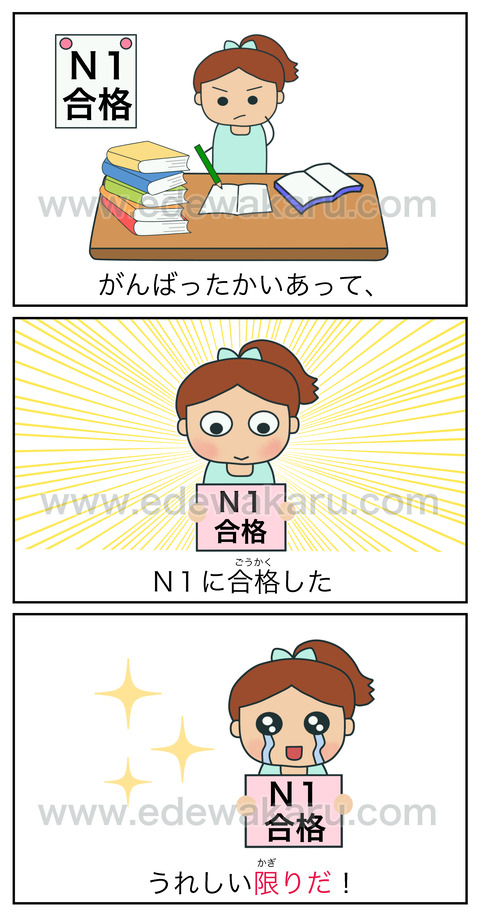
がんばったかいあってN1に合格した!うれしい限りだ!
→がんばったかいあってN1に合格した!とてもうれしい!(復習:〜かいあって)All my hard work paid off, and I passed N1! I couldn’t be happier! →All my hard work paid off, and I passed N1! I’m so happy! (Review: 〜かいあって)
海外旅行(かいがいりょこう)に行けるなんてうらやましい限りだ
→海外旅行に行けるなんてとてもうらやましい(復習:〜なんて(感情))I’m so envious that you get to go on an overseas trip. →I’m so envious that you get to go on an overseas trip (Review: 〜なんて(感情))
おばけが見えるとは、おそろしい限りだ
→おばけが見えるとは、とてもおそろしい(復習:〜とは)How frightening that ghosts are visible! →It’s so frightening that ghosts are visible (Review: 〜とは)
あんな失敗をしてしまい、恥ずかしい限りです
→あんな失敗をしてしまい、とても恥ずかしいですI made such a mistake, and I’m terribly embarrassed. →I made such a mistake, and I’m very embarrassed.
Read the original source text
Meaning
とても〜だ
How to use it
い形容詞[ーい]+限りだ
な形容詞[ーな]+限りだ
Explanation
「〜限りだ」は「とても〜だ」「非常に〜だ」という意味を表す文型です。この文型は感情を表す形容詞に使われます😊
[「〜限りだ」とよく使われる形容詞]
・残念な限りだ
・悔しい限りだ
・寂しい限りだ
・苦しい限りだ
・腹立たしい限りだ
・悲しい限りだ など
「限り」シリーズはたくさんありますので、しっかりと区別をして覚えておきましょう😉
【「限る」シリーズ】
〜限り(限界)
〜限り
〜限りだ
〜限りで・N限りのN(限定)
〜限りでは(範囲)
限りなく〜に近い
〜とは限らない
〜ない限り
〜に限ったことではない
〜に限らず(〜も)
〜に限る
〜を限りに
毎日のんびり日本語教師
How to use it
Emotion-expressing い-adjective + 限りだ
Emotion-expressing な-adjective + な + 限りだ
Emotion-expressing noun + の + 限りだ
Explanation
When it connects to a word expressing an emotion, it emphasizes the degree of that emotion.
Notes
The 「限る」series
In context 8 examples
彼、宝くじが当たるなんて羨ましい限りだ。(看见他中彩票只有羡慕了。)
He won the lottery—I'm so envious. (Seeing him win the lottery makes me nothing but envious.)
信頼していた人に裏切られ、悲しい限りだ。
I feel utterly sad to have been betrayed by someone I trusted.
一人こんなところで待たされ、心細い限りだ。
Being made to wait alone in a place like this, I feel utterly uneasy.
わざわざ来ていただいて嬉しい限りです。
I'm absolutely delighted that you went to the trouble of coming.
この街に再び活気が戻ってきたことは喜ばしい限りだ。
It is an absolute joy that this town has become lively again.
日米首脳会談のため街中が警察に溢れ、鬱陶しい限りだ。
With police filling the city for the Japan-U.S. summit, it is utterly annoying.
誤字があって恥ずかしい限りです。
I'm utterly embarrassed that there is a typo.
多くの人に私の作品を評価していただき、本当にありがたい限りです。用法② 限定的な数量
I am truly grateful that so many people have appreciated my work. Usage ②: limited quantity
Read the original source text
How to use it
感情を表すイ形容詞+限りだ
感情を表すナ形容詞+な+限りだ
感情を表す名詞+の+限りだ
Explanation
感情を表す語に接続する場合は、その程度を強調します。
Notes
「限る」シリーズ