日本語文型辞典 英語版
Meaning
【すえに】[Nのすえに][V-たすえに]
Means “at the end of a period of time.” In
(1)
it simply indicates the end of the time period, but it is often used with the meaning of “in the end, following a progression of events,” as shown in
(2)
and the rest of the examples. Tends to be used in written language.
In context 5 examples
今月のすえに、首相が訪中する。
The prime minister will visit China at the end of this month.
長時間の協議のすえに、やっと結論が出た。
After long hours of discussion, a conclusion was finally reached.
かれは三年の闘病生活の末に亡くなった。
He passed away after three years of struggle with the disease.
よく考えた末に決めたことです。
It is a decision that was made after careful thought.
大型トラックは1キロ暴走した末に、ようやく止まった。
After driving out of control for a kilometer, the big truck finally came to a stop.
IMABI
Result
Read this IMABI lesson ↗Explanation
Result: ~結果, ~うえで, ~挙句, ~すえに, & ~始末だ
Though these patterns show result, they have their own special nuances. So, even when there is interchangeability, that doesn’t mean you are saying 100% the same thing.
~結果
~結果 utilizes the word for “result”. It is seen after nouns or the past tense of verbs. What follows is a result and what precedes is a cause. Whether it is in one sentence or two, this is how the pattern works. It is objective and 書き言葉的. It is preceded by verbs of thought/consideration and followed by verbs of result.
1. やるだけはやったのだから、静かに結果を待とう。
I’ve done just what to do, so I will quietly await the results.
2. 消防車しょうぼうしゃなど13台が消火にあたった結果、火はおよそ1時間半後に消し止められましたが、部屋は全焼しまし た。
As a result of 13 fire trucks fighting the fire, the fire was extinguished after approximately an hour and a half, but the room was completely burned.
From the NHK article 県営けんえい住宅焼け1人死亡1人重体じゅうたい on 2013年7月3日 2時11分.
3. 2日のロンドン外国為替かわせ市場は、ニューヨーク市場や東京市場で株価かぶかが上昇じょうしょうしたことなどを背景はいけいに、世界経済の先行さきゆきに対する懸念けねんがいくぶん和やわらぎ、ドルを買って円を売る動きが次第しだいに強まりました。その結果、円相場そうばは一時、先月上旬じょうじゅん以来およそ1か月ぶりに1ドル=100円台前半ぜんはんまで値下ねさがりしました。
The London Foreign Stock Exchange on the second, against the background of stocks having risen in the New York and Tokyo Exchanges, concerns towards the world economy’s future have somewhat eased, and the trend of buying dollars and selling yes has gradually strengthened.
As a result, the yen exchange rate for a moment dropped down to the low 1$ = 100\ mark after about a month since the first part of last month.
From the NHK article ロンドン市場 1か月ぶり100円台 on 2013年7月2日 21時36分.
4. この問題は、東日本大震災の復興予算ふっこうよさんが、自治体じちたいなどが管理する基金を通じて、被災地ひさいち以外の事業にも使われているという指摘してきが出ていたもので、政府は、財務省や復興庁など関係省庁しょうちょうを通じて実態調査じったいちょうさを進めてきました。その結果、調査の対象となった各自治体などが管理する16の基金には、およそ1兆1500億円の復興予算が配分され、その大半はすでに執行されていましたが、およそ1400億円がまだ使われていないことが分かりました。
As for this problem, with the indication having come out that the East Japan Great Earthquake Disaster Recovery Budget, through funds the municipalities manages are being used even in projects outside the devastated areas, the government has forwarded investigations into the actual circumstances through the ministries and offices concerned such as the Ministry of Office and the Recovery Agency.
As a result, in the 16 funds that each of the municipalities that have become the object of investigation manage, approximately 1 trillion 150 billion yen recovery budget has been allocated, and the great majority of which has already been administered, but it has been found out that approximately 140 billion yen has yet to be used.
From the NHK article未使用の復興予算 返還要請へんかんようせいへ on 2013年7月2日 12時48分.
~うえで
~うえで works grammaticality just like ~結果. It too is seen after nouns or the past tense of a verb. ~うえで shows a willful aspect in taking the next action based on the results of the present/clause or context. This makes it quite different for all of the other patterns in this lesson. It is preceded by verbs of thought/consideration, and then it is followed by verbs of conclusion. Adverbs frequently used in the first clause include よく and 十分(に).
5. 十分に事件を勘案かんあんしたうえで返事します。
I will reply after having sufficiently considered the matter.
6. 上司と詳くわしく相談したうえで、お返事いたします。
I will reply after having consulted in detail with my boss.
7. ASEAN=東南アジア諸国連合しょこくれんごうと、日本やアメリカ、それに北朝鮮も含む、27の国と国際機関の外相がいしょうなどが参加して、2日にブルネイで開かれたARFは、会議の締しめくくりとして議長声明を採択さいたくしました。
議長声明では、ほとんどの参加国の共通認識きょうつうにんしきとして、北朝鮮に核実験かくじっけんの停止ていしなどを求めた過去の国連安保理あんぽり決議と、北朝鮮による既存きそんの核計画の放棄ほうきなどを盛もり込こんだ、6か国協議の共同声明の義務を果はたすよう、北朝鮮に求めています。
そのうえで、「参加国のほとんどは朝鮮半島の非核化に向けた努力を支持する」としています。
ARF, which was opened in Brunei on the second with foreign ministers from 27 international organizations including ASEAN (Association of Southeast Asian Nations), Japan, America, as well as North Korea participating, adopted the chairman’s proclamation as the meeting’s close. With the chairman’s proclamation, as almost all of the participating nations’ common understanding, it is calling for North Korea to carry out its duties of the six nation conference joint statement, including things such as U.N Security Council Resolution of the past which sought the halt of nuclear tests in North Korea and the abandonment of current nuclear plans by North Korea.
Moreover, it is asserting that “almost all of the participating nations support the efforts towards the denuclearization of the Korean Peninsula”.
From the NHK Article ARF議長声明 朝鮮半島の非核化支持ひかくかしじ on 2013年7月3日 0時9分.
8. 新潟県にいがたけん知事「地元軽視けいしだ」
新潟県の泉田知事いずみだちじは「事前に連絡はなく、こんな地元軽視はない」と強い不快感ふかいかんを示しました。
そのうえで、「東京電力は福島第一原発の事故の際のTV会議の状況をすべて公開していないなど、検証けんしょうが不十分で事故の責任せきにんもとっていない。運転再開について議論を行う段階ではない」と東京電力の姿勢を改めて批判しました。
国も理解得る努力を茂木もてぎ経済産業大臣けいざいさんぎょうだいじんは、訪問中ほうもんちゅうのベトナムで「申請しんせいが出された段階で原子力規制委員会きせいいいんかいには厳正げんせいで速すみやかな審査しんさを行っていただきたい。そのうえで安全性が確認されたら東京電力任せではなくて国としても前面 ぜんめんに出て自治体などの理解を得るよう努力どりょくをしていきたい」と述べました。
Niigata Prefecture Governor “It’s local neglect”
Niigata Prefecture Governor Izumida demonstrated strong displeasure saying that “there isn’t local neglect like this without contact beforehand”.
Moreover, he again criticized the position of Tokyo Electric saying, “Tokyo Electric aren’t even taking responsibility for the accident, not completely making public the conditions of the TV meeting at the time of the Fukushima No. 1 Reactor accident and with the inspections being insufficient. This is not the stage to debates about the restart of operations”.
The Nation Too to Strive for Receiving Understanding
Ministry of Economy, Trade and Industry Motegi, stated while in Vietnam “I would like for a strict and speedy hearing in the Nuclear Energy Regulations Committee on the phase of having sent an application. Moreover, once safety is confirmed, not being left up to Tokyo Electric, but as a nation, I want us to come to the front and strive to seek the understanding of the municipalities.
From the NHK article柏崎刈羽原発かしわざきかりわげんぱつ 安全審査の申請決定 on 2013年7月2日 15時12分.
9.菅官房長官すがかんぼうちょうかんは、東京都内で講演こうえんし、参議院選挙さんぎいんせんきょでは自民・公明両党こうめいりょうとうで非改選ひかいせんも含め過半数を確保することが最低限の目標だとしたうえで、経済の再生を最優先さいゆうせんに掲かかげて選挙戦に臨みたいという考えを示しました。
そのうえで、菅官房長官は、参議院選挙で訴うったえる政策せいさくについて、「憲法けんぽう改正は、自民党の党是であり今回の選挙戦でも訴えることになる。しかし、今の状況での優先順位じゅんいは、国民やいろいろな人から話を聞いても、経済だ」と述べ、経済の再生を最優先に掲げて選挙戦に臨みたいという考えを示しました。
Chief Cabinet Secretary Suga held a lecture in Tokyo and suggested that they look forward to the election battle carrying the economy’s recover as their top priority, with both the Liberal Democratic Party and the Justice Party securing the majority including those not up for reelection in the House of Councilors election as a minimal goal.
Moreover, Chief Cabinet Secretary Suga, in regards to the policies they’re calling for in the election stated, “As for Constitution revision, it is the LDP’s party platform, and we are to call for it in this election battle as well. However, our current priority is on the economy no matte what we hear from citizens or others”, suggesting that carrying the economy’s recover is their top priority.
From the NHK article 菅氏「過半数目標 経済前面に」on 2013年7月2日 15時12分.
~挙句
挙句 あげく, normally negative, is used with a noun or the past tense of a verb to show that one spends a lot of effort on something but something else comes out of it with the outcome often being a last resort. 挙句 is close to “after a great deal of” and is often used with the adverb 散々さんざんmeaning “repeatedly”. Verbs that precede it entail thought/consideration, but they are mainly verbs with negative outcomes such as 悩む, 迷う, 議論する, 文句もんくをいう, etc. Passive and causative expressions are also common.
Expressions found in the latter clause involve result just like ~結果. However, again, it is usually negative, and even if the result isn’t totally bad, it definitely gives the sense that it’s not worth much. With that said, you are not likely to see it much in the news as the news is typically written in an objective fashion.
Orthography Note: 挙(げ)句 can also be spelled as 揚(げ)句.
Examples
10. 散々文句を言った挙句、出たばかりだよ。
After a great deal of repeatedly arguing, she just left!
11. 三人が酔よっ払ぱらった挙句の果てに高圧線こうあつせんに襲おそいかけて感電死かんでんししたという。
It’s said that after three men had gotten drunk that they crashed into a high-voltage line and were electrocuted to death.
12. 色々いろいろ勉強の揚句、地元の大学に入学することにしました。
After a great deal of various studies, I decided to enter a local college (although I tried for more).
13. 頑張った挙句の果てに諦あきらめただけさ。(Casual)
After trying my best, I just gave up.
~すえに
すえ is noun that literally refers to the “end/tip”. You see it in temporal phrases such as 7月の末. However, it also shares something in common with the speech modals of this lesson. Used in the same fashion as them, it shows a temporal conclusion in which “after a certain course of events has run its way, in the end it becomes as such”.
14. 夜を徹てっして議論した{△ 結果・〇 挙句・Xうえで・〇すえに}、白紙はくしに戻もどしてやり直すことになった。
After having debated all night, it became decided that we should redo and go back to the drawing board.
From 中級日本語文法と教え方のポイント by 市川保子.
From this sentence it resembles 挙句, but it is actually more objective. It also doesn’t have to seem negative. What they do share, though, is that they demonstrate a long trial of sorts.
15. 「コマキさん、楽器は何か演奏できる」
固い布団に横たわりながら、モウリさんが聞いた。長く逃げてきたすえ、よく知らない西の町の海辺に、部屋を借りているのだった。モウリさんは町のはずれにあるゴムの工場に勤めていた。三日に一回ある夜勤から帰った日だったかもしれない。窓の外が明るみはじめていた。
“Komaki, can you play any instrument?”, Mouri asked as she lay on the hard futon. After having ran away a long ways, we were renting a room on the shore in a town to the west we didn’t quite know. Mouri was working at a rubber factory at the edge of the town. It might have been the day she returned from a certain night shift once every three days. The outside from the window was beginning to brighten up.
From 溺レる by 川上弘美.
16. あの国は長年ながねんの紛争ふんそうを経へた{〇 結果・△ 挙句・Xうえで・〇 すえに}、ようやく反対デモもなく自主選挙じしゅせんきょを行なうことができた。
That nation after having gone through years of conflict was able to finally carry out voluntary elections without even any opposition demonstrations.
Finally: やっと, ようやく, ついに, Etc.
There are many adverbs that are translated as “finally”. If there are so many words, there must be differences between them. The sentence above shows a very typical instance of ようやく, but the sentence would sound unnatural to various degrees if you were to replace it with another synonymous phrase.
やっと: After one’s effort over a long period of time, something finally/narrowly realizes. やっと is a positive and shows considerable satisfaction. Whether it is a place, time, or money, after a narrow situation, there is a final realization/conclusion. If the speaker has gone through much trial/struggle in achieving a result that is positive yet contrary to original expectation, やっと can’t be used.
17. やっと安心して眠れる。
I’m finally able to sleep with ease.
18. やっとこさ全部片づいたよ。
I’ve finally finished it all.
Slang Note: In slang it can be seen as やっとこさ.
ついに・遂に: At the final stage of something, X either realizes or it doesn’t. The situation one has been in has lasted a long time (like やっと), and there is the potential that what you wanted ends up not happening at all (not like やっと). ついに can rather coldly state non-realization. If it is a positive outcome, it may have a light sense of happiness or relief. However, although やっと doesn’t foster an indifferent attitude, it usually implies that the speaker wished the good outcome would have come earlier.
19. 警察はついに犯人を逮捕した。
The police finally arrested the criminal.
ようやく・漸く: やっと and ついに capture the moment of realization, but ようやく places stress on the process. ようやく shows a positive, objective evaluation of planned change, and it expressed an effort that one has waited on. This is in relation to time and not something like money or physical labor. ようやく is inappropriate in showing one’s 本音 due to its objectivity.
20. ようやく分かった気がする。
I think I finally understand.
21. ようやく秋が来た。
Fall has finally come.
22. 寮での集団生活にようやく慣れました。
I have finally gotten used to group living in the dormitory.
23. 私は漸くほっとした心もちになって、巻煙草まきたばこに火をつけながら、始めて懶ものうい睚まぶたをあげて、前の席に腰を下していた小娘の顔を一瞥いちべつした。
I finally became relieved, and while I lit my cigar, I first started to raise my languid eyes and glanced at the little girl’s face, who was sitting in the seat in front of me.
From 蜜柑 by 芥川龍之介.
Form Note: It can be seen as ようよう・漸う in older language. ようやっと, the fusion of やっと and ようやく, also exists and is essentially the same as やっと with the time nuance of ようやく.
とうとう・到頭: This is similar to ようやく in that it places stress on the process rather than instant of realization. It is either used in positive or negative situations to show that after repeated efforts and over the course of a long time, an expected change either does or doesn’t happen. This is subjective rather than objective. If you were to use it or ついに instead of やっと in something like あっ、やっと電車が来た!, your statement would be quite hyperbolic.
24. 彼らはとうとう行っちゃったよ。
They finally left.
25. すると間もなく凄すさまじい音をはためかせて、汽車が隧道トンネルへなだれこむと同時に、小娘の開けようとした硝子戸がらすどは、とうとうばたりと下へ落ちた。
Then, in no time at all, the girl caused a fierce noise to flutter about, and at the same time the train plunged into the tunnel, the glass door that she had tried to open finally fell and plopped down below.
From 蜜柑 by 芥川龍之介.
辛うじて: This is a literary word that shows an extremely close-call situation in one’s favor. So, it is often translated as “barely”, but it is much like やっと. But, it doesn’t have the same requirement that it have the prerequisite of something going as planned. かろうじて can easily be used to refer to future event. If it is an nonfactual probability, it can’t be replaced with やっと or ようやく. It can be if it is a factual probability, but in this case ついに and とうとう aren’t good because they aren’t used with future expressions.
26. 辛うじて生きてろ!
Narrowly live!
27. 辛うじて手に入った。
I narrowly got a hold of it.
いよいよ・愈(々)・ 弥弥: This can be very similar to the above when it shows that after some time, an event reaches an important situation. In this sense it is very similar to ついに. It is not emotionally cold like ついに. However, it is more objective than the other options like やっと. It also has other meanings such as “more and more” in which it implies increase in momentum.
28. あの皸しわだらけの頬は愈いよいよ赤くなって、時々鼻洟はなをすすりこむ音が、小さな息の切れる声と一しょに、せわしなく耳へはいって来る。
Her wrinkle covered cheeks at last became red, and the occasional sound of her sniffling her nose along with the sound of her breath running out restlessly entered my ears.
From 蜜柑 by 芥川龍之介.
~始末だ
There are four simple meanings of 始末. The first is to mean “beginning and end”. It may mean “end result” in a negative fashion. As a noun or a verb with する, it means “clean up/get rid of”. Lastly, it can mean “thrifty” as a noun or as a verb with する.
29. 事の始末を語った。
He gave the story of it (an event) from beginning to end.
30. 彼はしまいに、逃げ出す始末だった。
He, in the end, had to run away (from there).
31. 不法滞在して国外追放になる始末だ。
Illegal overstaying in a country results in deportation.
32. 酔ようと始末に終えない。
Obstreperous.
33. 始末屋
A thrifty person
In context 33 examples
やるだけはやったのだから、静かに結果を待とう。
I’ve done just what to do, so I will quietly await the results.
消防車しょうぼうしゃなど13台が消火にあたった結果、火はおよそ1時間半後に消し止められましたが、部屋は全焼しまし た。
As a result of 13 fire trucks fighting the fire, the fire was extinguished after approximately an hour and a half, but the room was completely burned.
2日のロンドン外国為替かわせ市場は、ニューヨーク市場や東京市場で株価かぶかが上昇じょうしょうしたことなどを背景はいけいに、世界経済の先行さきゆきに対する懸念けねんがいくぶん和やわらぎ、ドルを買って円を売る動きが次第しだいに強まりました。その結果、円相場そうばは一時、先月上旬じょうじゅん以来およそ1か月ぶりに1ドル=100円台前半ぜんはんまで値下ねさがりしました。
The London Foreign Stock Exchange on the second, against the background of stocks having risen in the New York and Tokyo Exchanges, concerns towards the world economy’s future have somewhat eased, and the trend of buying dollars and selling yes has gradually strengthened.
この問題は、東日本大震災の復興予算ふっこうよさんが、自治体じちたいなどが管理する基金を通じて、被災地ひさいち以外の事業にも使われているという指摘してきが出ていたもので、政府は、財務省や復興庁など関係省庁しょうちょうを通じて実態調査じったいちょうさを進めてきました。その結果、調査の対象となった各自治体などが管理する16の基金には、およそ1兆1500億円の復興予算が配分され、その大半はすでに執行されていましたが、およそ1400億円がまだ使われていないことが分かりました。
As for this problem, with the indication having come out that the East Japan Great Earthquake Disaster Recovery Budget, through funds the municipalities manages are being used even in projects outside the devastated areas, the government has forwarded investigations into the actual circumstances through the ministries and offices concerned such as the Ministry of Office and the Recovery Agency.
十分に事件を勘案かんあんしたうえで返事します。
I will reply after having sufficiently considered the matter.
上司と詳くわしく相談したうえで、お返事いたします。
I will reply after having consulted in detail with my boss.
ASEAN=東南アジア諸国連合しょこくれんごうと、日本やアメリカ、それに北朝鮮も含む、27の国と国際機関の外相がいしょうなどが参加して、2日にブルネイで開かれたARFは、会議の締しめくくりとして議長声明を採択さいたくしました。
The ARF, held in Brunei on the 2nd with foreign ministers and other officials from 27 countries and international organizations—including ASEAN (the Association of Southeast Asian Nations), Japan, the United States, and North Korea—adopted a chair’s statement to conclude the meeting.
新潟県にいがたけん知事「地元軽視けいしだ」
Niigata Prefecture governor: “The local area was treated with disregard.”
菅官房長官すがかんぼうちょうかんは、東京都内で講演こうえんし、参議院選挙さんぎいんせんきょでは自民・公明両党こうめいりょうとうで非改選ひかいせんも含め過半数を確保することが最低限の目標だとしたうえで、経済の再生を最優先さいゆうせんに掲かかげて選挙戦に臨みたいという考えを示しました。
Chief Cabinet Secretary Suga gave a speech in Tokyo. He said that the minimum goal for the House of Councillors election was to secure a majority for the Liberal Democratic and Komeito parties, including seats not up for election, and expressed his intention to enter the election campaign with economic recovery as the top priority.
散々文句を言った挙句、出たばかりだよ。
After a great deal of repeatedly arguing, she just left!
三人が酔よっ払ぱらった挙句の果てに高圧線こうあつせんに襲おそいかけて感電死かんでんししたという。
It’s said that after three men had gotten drunk that they crashed into a high-voltage line and were electrocuted to death.
色々いろいろ勉強の揚句、地元の大学に入学することにしました。
After a great deal of various studies, I decided to enter a local college (although I tried for more).
頑張った挙句の果てに諦あきらめただけさ。(Casual)
After trying my best, I just gave up.
夜を徹てっして議論した{△ 結果・〇 挙句・Xうえで・〇すえに}、白紙はくしに戻もどしてやり直すことになった。
After having debated all night, it became decided that we should redo and go back to the drawing board.
「コマキさん、楽器は何か演奏できる」
“Komaki, can you play any musical instruments?”
あの国は長年ながねんの紛争ふんそうを経へた{〇 結果・△ 挙句・Xうえで・〇 すえに}、ようやく反対デモもなく自主選挙じしゅせんきょを行なうことができた。
That nation after having gone through years of conflict was able to finally carry out voluntary elections without even any opposition demonstrations.
やっと安心して眠れる。
I’m finally able to sleep with ease.
やっとこさ全部片づいたよ。
I’ve finally finished it all.
警察はついに犯人を逮捕した。
The police finally arrested the criminal.
ようやく分かった気がする。
I think I finally understand.
ようやく秋が来た。
Fall has finally come.
寮での集団生活にようやく慣れました。
I have finally gotten used to group living in the dormitory.
私は漸くほっとした心もちになって、巻煙草まきたばこに火をつけながら、始めて懶ものうい睚まぶたをあげて、前の席に腰を下していた小娘の顔を一瞥いちべつした。
I finally became relieved, and while I lit my cigar, I first started to raise my languid eyes and glanced at the little girl’s face, who was sitting in the seat in front of me.
彼らはとうとう行っちゃったよ。
They finally left.
すると間もなく凄すさまじい音をはためかせて、汽車が隧道トンネルへなだれこむと同時に、小娘の開けようとした硝子戸がらすどは、とうとうばたりと下へ落ちた。
Then, in no time at all, the girl caused a fierce noise to flutter about, and at the same time the train plunged into the tunnel, the glass door that she had tried to open finally fell and plopped down below.
辛うじて生きてろ!
Narrowly live!
辛うじて手に入った。
I narrowly got a hold of it.
あの皸しわだらけの頬は愈いよいよ赤くなって、時々鼻洟はなをすすりこむ音が、小さな息の切れる声と一しょに、せわしなく耳へはいって来る。
Her wrinkle covered cheeks at last became red, and the occasional sound of her sniffling her nose along with the sound of her breath running out restlessly entered my ears.
事の始末を語った。
He gave the story of it (an event) from beginning to end.
彼はしまいに、逃げ出す始末だった。
He, in the end, had to run away (from there).
不法滞在して国外追放になる始末だ。
Illegal overstaying in a country results in deportation.
酔ようと始末に終えない。
Obstreperous.
始末屋
A thrifty person
Read the original source text
Explanation
Result: ~結果, ~うえで, ~挙句, ~すえに, & ~始末だ
Though these patterns show result, they have their own special nuances. So, even when there is interchangeability, that doesn’t mean you are saying 100% the same thing.
~結果
~結果 utilizes the word for “result”. It is seen after nouns or the past tense of verbs. What follows is a result and what precedes is a cause. Whether it is in one sentence or two, this is how the pattern works. It is objective and 書き言葉的. It is preceded by verbs of thought/consideration and followed by verbs of result.
1. やるだけはやったのだから、静かに結果を待とう。
I’ve done just what to do, so I will quietly await the results.
2. 消防車しょうぼうしゃなど13台が消火にあたった結果、火はおよそ1時間半後に消し止められましたが、部屋は全焼しまし た。
As a result of 13 fire trucks fighting the fire, the fire was extinguished after approximately an hour and a half, but the room was completely burned.
From the NHK article 県営けんえい住宅焼け1人死亡1人重体じゅうたい on 2013年7月3日 2時11分.
3. 2日のロンドン外国為替かわせ市場は、ニューヨーク市場や東京市場で株価かぶかが上昇じょうしょうしたことなどを背景はいけいに、世界経済の先行さきゆきに対する懸念けねんがいくぶん和やわらぎ、ドルを買って円を売る動きが次第しだいに強まりました。その結果、円相場そうばは一時、先月上旬じょうじゅん以来およそ1か月ぶりに1ドル=100円台前半ぜんはんまで値下ねさがりしました。
The London Foreign Stock Exchange on the second, against the background of stocks having risen in the New York and Tokyo Exchanges, concerns towards the world economy’s future have somewhat eased, and the trend of buying dollars and selling yes has gradually strengthened.
As a result, the yen exchange rate for a moment dropped down to the low 1$ = 100\ mark after about a month since the first part of last month.
From the NHK article ロンドン市場 1か月ぶり100円台 on 2013年7月2日 21時36分.
4. この問題は、東日本大震災の復興予算ふっこうよさんが、自治体じちたいなどが管理する基金を通じて、被災地ひさいち以外の事業にも使われているという指摘してきが出ていたもので、政府は、財務省や復興庁など関係省庁しょうちょうを通じて実態調査じったいちょうさを進めてきました。その結果、調査の対象となった各自治体などが管理する16の基金には、およそ1兆1500億円の復興予算が配分され、その大半はすでに執行されていましたが、およそ1400億円がまだ使われていないことが分かりました。
As for this problem, with the indication having come out that the East Japan Great Earthquake Disaster Recovery Budget, through funds the municipalities manages are being used even in projects outside the devastated areas, the government has forwarded investigations into the actual circumstances through the ministries and offices concerned such as the Ministry of Office and the Recovery Agency.
As a result, in the 16 funds that each of the municipalities that have become the object of investigation manage, approximately 1 trillion 150 billion yen recovery budget has been allocated, and the great majority of which has already been administered, but it has been found out that approximately 140 billion yen has yet to be used.
From the NHK article未使用の復興予算 返還要請へんかんようせいへ on 2013年7月2日 12時48分.
~うえで
~うえで works grammaticality just like ~結果. It too is seen after nouns or the past tense of a verb. ~うえで shows a willful aspect in taking the next action based on the results of the present/clause or context. This makes it quite different for all of the other patterns in this lesson. It is preceded by verbs of thought/consideration, and then it is followed by verbs of conclusion. Adverbs frequently used in the first clause include よく and 十分(に).
5. 十分に事件を勘案かんあんしたうえで返事します。
I will reply after having sufficiently considered the matter.
6. 上司と詳くわしく相談したうえで、お返事いたします。
I will reply after having consulted in detail with my boss.
7. ASEAN=東南アジア諸国連合しょこくれんごうと、日本やアメリカ、それに北朝鮮も含む、27の国と国際機関の外相がいしょうなどが参加して、2日にブルネイで開かれたARFは、会議の締しめくくりとして議長声明を採択さいたくしました。
議長声明では、ほとんどの参加国の共通認識きょうつうにんしきとして、北朝鮮に核実験かくじっけんの停止ていしなどを求めた過去の国連安保理あんぽり決議と、北朝鮮による既存きそんの核計画の放棄ほうきなどを盛もり込こんだ、6か国協議の共同声明の義務を果はたすよう、北朝鮮に求めています。
そのうえで、「参加国のほとんどは朝鮮半島の非核化に向けた努力を支持する」としています。
ARF, which was opened in Brunei on the second with foreign ministers from 27 international organizations including ASEAN (Association of Southeast Asian Nations), Japan, America, as well as North Korea participating, adopted the chairman’s proclamation as the meeting’s close. With the chairman’s proclamation, as almost all of the participating nations’ common understanding, it is calling for North Korea to carry out its duties of the six nation conference joint statement, including things such as U.N Security Council Resolution of the past which sought the halt of nuclear tests in North Korea and the abandonment of current nuclear plans by North Korea.
Moreover, it is asserting that “almost all of the participating nations support the efforts towards the denuclearization of the Korean Peninsula”.
From the NHK Article ARF議長声明 朝鮮半島の非核化支持ひかくかしじ on 2013年7月3日 0時9分.
8. 新潟県にいがたけん知事「地元軽視けいしだ」
新潟県の泉田知事いずみだちじは「事前に連絡はなく、こんな地元軽視はない」と強い不快感ふかいかんを示しました。
そのうえで、「東京電力は福島第一原発の事故の際のTV会議の状況をすべて公開していないなど、検証けんしょうが不十分で事故の責任せきにんもとっていない。運転再開について議論を行う段階ではない」と東京電力の姿勢を改めて批判しました。
国も理解得る努力を茂木もてぎ経済産業大臣けいざいさんぎょうだいじんは、訪問中ほうもんちゅうのベトナムで「申請しんせいが出された段階で原子力規制委員会きせいいいんかいには厳正げんせいで速すみやかな審査しんさを行っていただきたい。そのうえで安全性が確認されたら東京電力任せではなくて国としても前面 ぜんめんに出て自治体などの理解を得るよう努力どりょくをしていきたい」と述べました。
Niigata Prefecture Governor “It’s local neglect”
Niigata Prefecture Governor Izumida demonstrated strong displeasure saying that “there isn’t local neglect like this without contact beforehand”.
Moreover, he again criticized the position of Tokyo Electric saying, “Tokyo Electric aren’t even taking responsibility for the accident, not completely making public the conditions of the TV meeting at the time of the Fukushima No. 1 Reactor accident and with the inspections being insufficient. This is not the stage to debates about the restart of operations”.
The Nation Too to Strive for Receiving Understanding
Ministry of Economy, Trade and Industry Motegi, stated while in Vietnam “I would like for a strict and speedy hearing in the Nuclear Energy Regulations Committee on the phase of having sent an application. Moreover, once safety is confirmed, not being left up to Tokyo Electric, but as a nation, I want us to come to the front and strive to seek the understanding of the municipalities.
From the NHK article柏崎刈羽原発かしわざきかりわげんぱつ 安全審査の申請決定 on 2013年7月2日 15時12分.
9.菅官房長官すがかんぼうちょうかんは、東京都内で講演こうえんし、参議院選挙さんぎいんせんきょでは自民・公明両党こうめいりょうとうで非改選ひかいせんも含め過半数を確保することが最低限の目標だとしたうえで、経済の再生を最優先さいゆうせんに掲かかげて選挙戦に臨みたいという考えを示しました。
そのうえで、菅官房長官は、参議院選挙で訴うったえる政策せいさくについて、「憲法けんぽう改正は、自民党の党是であり今回の選挙戦でも訴えることになる。しかし、今の状況での優先順位じゅんいは、国民やいろいろな人から話を聞いても、経済だ」と述べ、経済の再生を最優先に掲げて選挙戦に臨みたいという考えを示しました。
Chief Cabinet Secretary Suga held a lecture in Tokyo and suggested that they look forward to the election battle carrying the economy’s recover as their top priority, with both the Liberal Democratic Party and the Justice Party securing the majority including those not up for reelection in the House of Councilors election as a minimal goal.
Moreover, Chief Cabinet Secretary Suga, in regards to the policies they’re calling for in the election stated, “As for Constitution revision, it is the LDP’s party platform, and we are to call for it in this election battle as well. However, our current priority is on the economy no matte what we hear from citizens or others”, suggesting that carrying the economy’s recover is their top priority.
From the NHK article 菅氏「過半数目標 経済前面に」on 2013年7月2日 15時12分.
~挙句
挙句 あげく, normally negative, is used with a noun or the past tense of a verb to show that one spends a lot of effort on something but something else comes out of it with the outcome often being a last resort. 挙句 is close to “after a great deal of” and is often used with the adverb 散々さんざんmeaning “repeatedly”. Verbs that precede it entail thought/consideration, but they are mainly verbs with negative outcomes such as 悩む, 迷う, 議論する, 文句もんくをいう, etc. Passive and causative expressions are also common.
Expressions found in the latter clause involve result just like ~結果. However, again, it is usually negative, and even if the result isn’t totally bad, it definitely gives the sense that it’s not worth much. With that said, you are not likely to see it much in the news as the news is typically written in an objective fashion.
Orthography Note: 挙(げ)句 can also be spelled as 揚(げ)句.
Examples
10. 散々文句を言った挙句、出たばかりだよ。
After a great deal of repeatedly arguing, she just left!
11. 三人が酔よっ払ぱらった挙句の果てに高圧線こうあつせんに襲おそいかけて感電死かんでんししたという。
It’s said that after three men had gotten drunk that they crashed into a high-voltage line and were electrocuted to death.
12. 色々いろいろ勉強の揚句、地元の大学に入学することにしました。
After a great deal of various studies, I decided to enter a local college (although I tried for more).
13. 頑張った挙句の果てに諦あきらめただけさ。(Casual)
After trying my best, I just gave up.
~すえに
すえ is noun that literally refers to the “end/tip”. You see it in temporal phrases such as 7月の末. However, it also shares something in common with the speech modals of this lesson. Used in the same fashion as them, it shows a temporal conclusion in which “after a certain course of events has run its way, in the end it becomes as such”.
14. 夜を徹てっして議論した{△ 結果・〇 挙句・Xうえで・〇すえに}、白紙はくしに戻もどしてやり直すことになった。
After having debated all night, it became decided that we should redo and go back to the drawing board.
From 中級日本語文法と教え方のポイント by 市川保子.
From this sentence it resembles 挙句, but it is actually more objective. It also doesn’t have to seem negative. What they do share, though, is that they demonstrate a long trial of sorts.
15. 「コマキさん、楽器は何か演奏できる」
固い布団に横たわりながら、モウリさんが聞いた。長く逃げてきたすえ、よく知らない西の町の海辺に、部屋を借りているのだった。モウリさんは町のはずれにあるゴムの工場に勤めていた。三日に一回ある夜勤から帰った日だったかもしれない。窓の外が明るみはじめていた。
“Komaki, can you play any instrument?”, Mouri asked as she lay on the hard futon. After having ran away a long ways, we were renting a room on the shore in a town to the west we didn’t quite know. Mouri was working at a rubber factory at the edge of the town. It might have been the day she returned from a certain night shift once every three days. The outside from the window was beginning to brighten up.
From 溺レる by 川上弘美.
16. あの国は長年ながねんの紛争ふんそうを経へた{〇 結果・△ 挙句・Xうえで・〇 すえに}、ようやく反対デモもなく自主選挙じしゅせんきょを行なうことができた。
That nation after having gone through years of conflict was able to finally carry out voluntary elections without even any opposition demonstrations.
Finally: やっと, ようやく, ついに, Etc.
There are many adverbs that are translated as “finally”. If there are so many words, there must be differences between them. The sentence above shows a very typical instance of ようやく, but the sentence would sound unnatural to various degrees if you were to replace it with another synonymous phrase.
やっと: After one’s effort over a long period of time, something finally/narrowly realizes. やっと is a positive and shows considerable satisfaction. Whether it is a place, time, or money, after a narrow situation, there is a final realization/conclusion. If the speaker has gone through much trial/struggle in achieving a result that is positive yet contrary to original expectation, やっと can’t be used.
17. やっと安心して眠れる。
I’m finally able to sleep with ease.
18. やっとこさ全部片づいたよ。
I’ve finally finished it all.
Slang Note: In slang it can be seen as やっとこさ.
ついに・遂に: At the final stage of something, X either realizes or it doesn’t. The situation one has been in has lasted a long time (like やっと), and there is the potential that what you wanted ends up not happening at all (not like やっと). ついに can rather coldly state non-realization. If it is a positive outcome, it may have a light sense of happiness or relief. However, although やっと doesn’t foster an indifferent attitude, it usually implies that the speaker wished the good outcome would have come earlier.
19. 警察はついに犯人を逮捕した。
The police finally arrested the criminal.
ようやく・漸く: やっと and ついに capture the moment of realization, but ようやく places stress on the process. ようやく shows a positive, objective evaluation of planned change, and it expressed an effort that one has waited on. This is in relation to time and not something like money or physical labor. ようやく is inappropriate in showing one’s 本音 due to its objectivity.
20. ようやく分かった気がする。
I think I finally understand.
21. ようやく秋が来た。
Fall has finally come.
22. 寮での集団生活にようやく慣れました。
I have finally gotten used to group living in the dormitory.
23. 私は漸くほっとした心もちになって、巻煙草まきたばこに火をつけながら、始めて懶ものうい睚まぶたをあげて、前の席に腰を下していた小娘の顔を一瞥いちべつした。
I finally became relieved, and while I lit my cigar, I first started to raise my languid eyes and glanced at the little girl’s face, who was sitting in the seat in front of me.
From 蜜柑 by 芥川龍之介.
Form Note: It can be seen as ようよう・漸う in older language. ようやっと, the fusion of やっと and ようやく, also exists and is essentially the same as やっと with the time nuance of ようやく.
とうとう・到頭: This is similar to ようやく in that it places stress on the process rather than instant of realization. It is either used in positive or negative situations to show that after repeated efforts and over the course of a long time, an expected change either does or doesn’t happen. This is subjective rather than objective. If you were to use it or ついに instead of やっと in something like あっ、やっと電車が来た!, your statement would be quite hyperbolic.
24. 彼らはとうとう行っちゃったよ。
They finally left.
25. すると間もなく凄すさまじい音をはためかせて、汽車が隧道トンネルへなだれこむと同時に、小娘の開けようとした硝子戸がらすどは、とうとうばたりと下へ落ちた。
Then, in no time at all, the girl caused a fierce noise to flutter about, and at the same time the train plunged into the tunnel, the glass door that she had tried to open finally fell and plopped down below.
From 蜜柑 by 芥川龍之介.
辛うじて: This is a literary word that shows an extremely close-call situation in one’s favor. So, it is often translated as “barely”, but it is much like やっと. But, it doesn’t have the same requirement that it have the prerequisite of something going as planned. かろうじて can easily be used to refer to future event. If it is an nonfactual probability, it can’t be replaced with やっと or ようやく. It can be if it is a factual probability, but in this case ついに and とうとう aren’t good because they aren’t used with future expressions.
26. 辛うじて生きてろ!
Narrowly live!
27. 辛うじて手に入った。
I narrowly got a hold of it.
いよいよ・愈(々)・ 弥弥: This can be very similar to the above when it shows that after some time, an event reaches an important situation. In this sense it is very similar to ついに. It is not emotionally cold like ついに. However, it is more objective than the other options like やっと. It also has other meanings such as “more and more” in which it implies increase in momentum.
28. あの皸しわだらけの頬は愈いよいよ赤くなって、時々鼻洟はなをすすりこむ音が、小さな息の切れる声と一しょに、せわしなく耳へはいって来る。
Her wrinkle covered cheeks at last became red, and the occasional sound of her sniffling her nose along with the sound of her breath running out restlessly entered my ears.
From 蜜柑 by 芥川龍之介.
~始末だ
There are four simple meanings of 始末. The first is to mean “beginning and end”. It may mean “end result” in a negative fashion. As a noun or a verb with する, it means “clean up/get rid of”. Lastly, it can mean “thrifty” as a noun or as a verb with する.
29. 事の始末を語った。
He gave the story of it (an event) from beginning to end.
30. 彼はしまいに、逃げ出す始末だった。
He, in the end, had to run away (from there).
31. 不法滞在して国外追放になる始末だ。
Illegal overstaying in a country results in deportation.
32. 酔ようと始末に終えない。
Obstreperous.
33. 始末屋
A thrifty person
DoJG 日本語文法辞典(全集)
Meaning
After; at the end of
How to use it
(i) Nounの | 末(に) | |
| 今月の末(に) | At the end of this month |
| 交渉の末(に) | After negotiation |
(ii) Vinformal past | 末(に) | |
| よく考えた末(に) | After thinking hard |
Explanation
末(に)A noun that indicates the end of a period or the time after long, hard mental or physical work.
In context 10 examples
さんざん迷った末に、友達の結婚祝いはコーヒーカップのセットを贈ることにした。
After much hesitation, I decided to give my friends a set of coffee cups as a wedding present.
試行錯誤の末(に)、やっと車に使える燃料電池ができた。
After much trial and error, we finally made a fuel cell battery that can be used in cars.
一週間悩んだ末(に)、家族をおいて単身赴任することにした。
After considering it for a week, I decided to leave my family behind and transfer to my new job alone.
両者は8時間にわたる交渉の末に、ついに合意に達した。
After eight hours of negotiation, both parties finally came to an agreement.
5時間を超える熱戦の末、タイガースが勝った。
After a close game lasting more than five hours, the Tigers won.
M銀行とU銀行の合併交渉は1年以上も難航した末、やっと成立した。
After more than a year of difficult merger negotiations, M Bank and U Bank finally came to an agreement.
下書きを20枚近く失敗した末に、やっとなんとか気に入った絵ができた。
After almost twenty bad sketches, I finally managed to draw one I liked.
再就職は、苦労した末、過去のコンピュータ経験を評価してくれたIT関係の会社に決まりました。
After much trouble looking for a new job, I found one with an IT-related company that valued my previous computer experience.
男は走って逃げ、最後には暴れ回って抵抗した末に逮捕された。
The man tried to run away and, in the end, he was arrested after resisting violently.
この案は、各国の意見が衝突した末の「妥協の産物」だった。
This plan was a product of compromise, reached after working through a clash of opinions between the countries.
絵でわかる日本語
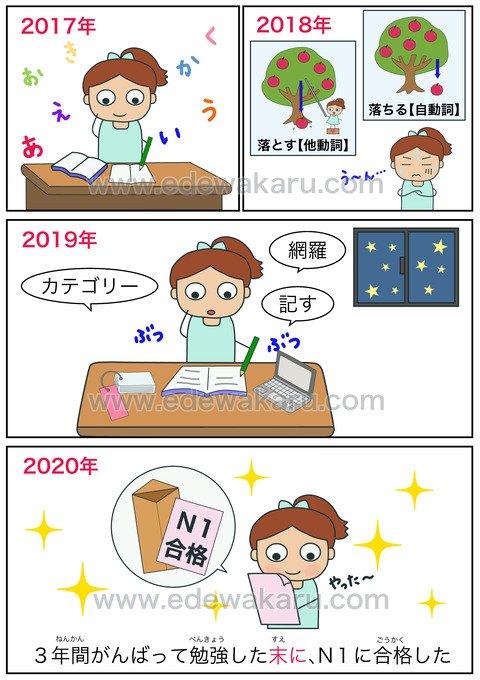
Meaning
After doing various things, ~ happened as a result.
After doing various things, the result was ~.
After doing ~ for a long time, eventually ~.
How to use it
Verb [た-form] + 末
Noun [dictionary form] + 末
Explanation
「A末にB」 is a sentence pattern meaning “B happened as a result of doing A.” It emphasizes that it took time or was difficult to reach the result B, as in “After doing A for a long time, B happened” or “After doing various things, the result was B.” 「に」 in 「〜末に」 can be omitted.
[Examples]
① After studying hard for three years,
末に, I passed N1.
“Three years” emphasizes that I worked hard for a long time.
② After thinking it over in various ways,
末に, I decided to study abroad.
“Thinking it over in various ways” emphasizes that I thought about it for a long time.
③ I heard that my parents got married after a passionate romance.
末に
“Passionate romance” emphasizes that many difficult things happened.
④ After agonizing over it for a long time,
末に, I decided to give up on my dream.
“Agonizing for a long time” emphasizes the long period.
⑤ The culprit kept running away for two years
末に, and was caught by the police.
“Running away for two years” emphasizes that it was a long time and difficult.
When a noun follows, the form is 「〜末の+noun」.
[Example]
Passing N1 is the result of working extremely hard
末の結果
desu.
「〜末に」 is more characteristic of written language and can be used for both good and bad outcomes. The related pattern 「〜あげく」 is also worth reviewing.
[Related patterns]
In context 5 examples
3年間がんばって勉強した末に、N1に合格した
→3年間がんばって勉強した結果、N1に合格したAfter studying hard for three years, I passed N1. →As a result of studying hard for three years, I passed N1.
いろいろ考えた末に、留学することにした
→いろいろ考えた結果、最終的に留学することに決めたAfter thinking it over in various ways, I decided to study abroad. →After thinking it over in various ways, I finally decided to study abroad.
お父さんとお母さんは大恋愛の末に結婚したそうだ
→大恋愛をした結果、結婚したそうだI heard that my parents got married after a passionate romance. →I heard they got married as a result of their passionate romance.
長い間悩んだ末に、夢をあきらめることにした
→長い間悩んで、夢をあきらめることにしたAfter agonizing over it for a long time, I decided to give up on my dream. →After agonizing over it for a long time, I decided to give up on my dream.
犯人は2年間逃げ続けた末に、警察に捕まった
→2年間逃げ続けて、最終的に警察に捕まったThe culprit kept running away for two years before eventually being caught by the police. →After running away for two years, the culprit was eventually caught by the police.
Read the original source text
Meaning
いろいろ〜した結果、〜した
いろいろ〜した後で、〜という結果になった
長い間〜して、最終的(さいしゅうてき)に〜した
How to use it
動詞[た形]+末
名詞[辞書形]+末
Explanation
「A末にB」は「Aした結果、Bした」という意味の文型です。この文型は「長い間AしてBした」「いろいろAした後で、Bという結果になった」というように、「B」の結果になるまで【時間がかかった】【大変だった】という意味を強調します。「〜末に」の「に」は省略することができます。
[例]
①3年間がんばって勉強した
末に、N1に合格した
「3年間」→「長い間がんばった」ことを強調
②いろいろ考えた
末に、留学することにした
「いろいろ考えた」→「長い間考えた」ことを強調
③お父さんとお母さんは大恋愛の
末に
結婚したそうだ
「大恋愛」→「大変なことがたくさんあった」ことを強調
④長い間悩んだ
末に、夢をあきらめることにした
「長い間悩んだ」→「長い間」を強調
⑤犯人は2年間逃げ続けた
末に、警察に捕まった
「2年間逃げる」→「長い間」「大変だった」ことを強調
また、後ろに名詞がくる場合は「〜末の+名詞」になります。
[例]
N1合格は、すごく努力した
末の結果
だ
「〜末に」は書き言葉的(かきことばてき)で、【いい結果】と【悪い結果】の両方に使うことができます。関連文型に「〜あげく」がありますので、復習をしておきましょう。
【関連文型】
日本語文型辞典
Meaning
Basic information
N のすえに; V-たすえに
Means “at the end of a certain period.” In ① it simply refers to the end of a period, but more often, as in ② onward, it means “after going through a certain process, finally.” Characteristic of written language.
Examples: ① The prime minister will visit China at the end of this month. ② After lengthy discussions, we finally reached a conclusion. ③ He died at the end of a three-year battle with illness. ④ This is a decision I made after careful consideration. ⑤ The large truck finally stopped after careering out of control for a kilometer.
Read the original source text
Meaning
基本情報NのすえにV-たすえに説明「ある期間のおわりに」の意味。①の場合は単に期間のおわりを指すが、②以下のように「ある経過をたどったあとで最後に」の意味で使われることが多い。書きことば的。例文① 今月のすえに、首相が訪中する。② 長時間の協議のすえに、やっと結論が出た。③ かれは三年の闘病生活の末に亡くなった。④ よく考えた末に決めたことです。⑤ 大型トラックは1キロ暴走した末に、ようやく止まった。
日本語NET JLPT文法解説まとめ
Meaning
After doing various things, ultimately.
How to use it
V (ta-form) + 末に
Nの + 末に ※N is a noun used with する verbs
Explanation
The に in 末に can be omitted.
In context 9 examples
色々悩んだ末、もうしばらくこの会社で頑張ってみることにしました。
After worrying about it a lot, I decided to keep doing my best at this company for a little while longer.
色々と考えた末、大学を卒業したら国へ帰ることにした。
After thinking it over a lot, I decided to return to my country after graduating from university.
二年浪人した末に、やっと医学部に合格できた。
After spending two years as a ronin, I finally managed to get into medical school.
試合は巨人と阪神の激しい戦いの末、巨人がサヨナラホームランで勝利した。
After a fierce game between the Giants and the Tigers, the Giants won with a walk-off home run.
さんざん検討した末に出した結論ですので、後悔はありません。
Since this is the conclusion I reached after much deliberation, I have no regrets.
妻とはしっかりと話し合った末に、離婚するなった。
After having a thorough discussion with my wife, we ended up getting divorced.
試行錯誤の末に、完成した製品がこちらです。
This is the product we completed after much trial and error.
警察は5時間に及ぶ説得の末、何とか銀行に立て篭もる男性を捕まえることができた。
After five hours of persuasion, the police somehow managed to catch the man holed up in the bank.
私は何度も転職を繰り返した末、今は自分の会社を作って働いています。
After changing jobs many times, I now run my own company.
Read the original source text
Meaning
色々〜したけど、最終的に。
How to use it
V(タ形) + 末に
Nの + 末に ※Nはする動詞のN
Explanation
末にの「に」は省略可能。
NINJAL 日本語文型データベース
Meaning
Use this when you want to say that something reached a certain outcome after various things had been done.
How to use it
Vた末に
Nの末に
Other
Notes
“~” is preceded by words describing how difficult circumstances continued until a result was reached. The clause after “~末に” expresses the final result.
In context 11 examples
結婚式をどこでするかいろいろと考えた末に、ハワイの教会に決めました。
After considering various places for the wedding, we decided on a church in Hawaii.
その男は酒に酔って大騒ぎした末に、ようやく警察官に取り押さえられた。
After getting drunk and causing a huge commotion, the man was finally restrained by a police officer.
今の職場ではやりたい仕事ができないと思い、家族や知人に相談した末に転職を決意した。
Thinking I couldn’t do the work I wanted at my current workplace, I consulted my family and acquaintances and then decided to change jobs.
デートに何を着ていくか悩んだ末に選んだのは、結局いつものワンピースだった。
After agonizing over what to wear on the date, what I chose was, in the end, my usual dress.
これは去年の発表会の前、毎日遅くまで練習したすえに、やっと弾けるようになった曲だ。
This is the piece I finally learned to play after practicing late every day before last year’s recital.
10年にわたる研究の末に、新薬が生み出された。
A new medicine was developed after ten years of research.
試行錯誤の末に開発された商品だったが、あまり売れなかった。
It was a product developed through trial and error, but it didn’t sell very well.
慎重な調査の末に、飛行機事故の原因は整備ミスによるものだと判明した。
After a careful investigation, it was determined that the cause of the plane crash was a maintenance error.
人事会議が開かれ、検討の末に武田部長補佐が新しい営業部長となることが決定した。
A personnel meeting was held, and after deliberation, it was decided that Deputy General Manager Takeda would become the new sales department manager.
親に言われた仕事をいくつかしてみたが、どれも長続きしなかった。苦悩のすえに悟ったのは、やはり自分の好きなことでなければだめだということだった。
I tried a few jobs my parents suggested, but none of them lasted long. What I realized after much anguish was that, after all, I had to do something I liked.
彼女は、何人もの男性と出会い、恋人となっては別れることを繰り返した。その末に、長年の男友達と結婚した。
She met many men, repeatedly becoming their girlfriend and then breaking up with them. In the end, she married a longtime male friend.
Read the original source text
Meaning
いろいろ〜した後で、ある結末になったと言いたいときに使います。
How to use it
Vた末に
Nの末に
その他
Notes
「〜」には、結果にたどりつくまでに大変な状況が続いたことを説明する言葉がきます。「〜末に」の後には、最終的な結果を表す文がきます。