AIUEO JLPT Grammar
Meaning
This sentence pattern emphasizes that no one or nothing but a specific person or object can fulfill a role. It often conveys a positive nuance, such as “nothing is more suitable than this,” highlighting particular choices or individuals.
How to use it
Noun を + おいて
In context 5 examples
この仕事を任せられるのは、彼をおいてほかにいない。
There is no one but him who can be entrusted with this job.
今回の試験に合格できるのは、君をおいて他にはいないだろう。
There is probably no one but you who can pass this exam.
この難局を乗り越えられるのは、彼をおいて他にいない。
There is no one other than him who can overcome this difficult situation.
このチームを率いるのにふさわしい人は、彼をおいていない。
There is no one but him who is suitable to lead this team.
彼女をおいて、この仕事を完璧にこなせる人はいないだろう。
Other than her, there’s probably no one who can do this job perfectly.
Read the original source text
Meaning
This sentence pattern emphasizes that no one or nothing but a specific person or object can fulfill a role. It often conveys a positive nuance, such as “nothing is more suitable than this,” highlighting particular choices or individuals.
How to use it
名詞を+おいて
Explanation · 日本語
この文型は、ある特定の人や物以外にはその役割を果たせるものがないという状況を強調する表現です。「これ以上ふさわしいものはない」といった肯定的な意味を含んで使われることが多く、特定の選択肢や人物を強調するときに使われます。
文法
Meaning
No one/nothing except ~ can ~
How to use it
N を + おいて
Notes
① An expression of high praise.
② The latter clause is often negative.
In context 5 examples
次のプロジェクトのリーダー、君をおいて他に任せられる人がいないんだが、引き受けてくれるかな?
There’s no one else I can entrust with leading the next project except you. Will you take it on?
次の社長にふさわしいのは、木村さんをおいて他にはいない。
There’s no one but Mr. Kimura who is suitable to be the next president.
もう30歳だし、今の仕事が楽しくないし、転職するなら今をおいて他にない。
I’m already 30, and I don’t enjoy my current job, so if I’m going to change jobs, there’s no time like now.
メジャーリーグで3000本安打を達成できたのは、イチローをおいて他にはいない。
There’s no one but Ichiro who could have achieved 3,000 hits in Major League Baseball.
この秘密を知るものは我々をおいて他にはいません。これがどういうことを意味するかわかりますよね。
There is no one but us who knows this secret. You understand what that means, right?
Read the original source text
Meaning
〜以外にできない
How to use it
Nを + おいて
Notes
①高く評価する表現
②後件は否定の形が来ることが多い。
どんなときどう使う 日本語表現文型辞典
Meaning
nothing/no one besides
How to use it
N + をおいて
Explanation
~以外に
「~をおいてない(いない)」の形で、「~以外ほかにない(いない)」と言いたいときに使う。「それと比較できるものはほかにない」と高く評価するときに使うことが多い。
In form …をおいてない (いない), means there is nothing or no one else. Often used to give high assessment by stressing there is nothing comparable.
In context 3 examples
この仕事をやれる人はあなたをおいてほかにいないと思います。
I don’t think there is anyone other than you who can do this job.
こんないやなことを引き受ける人は彼をおいてだれもいない。
There’s no one but him who would take on such an unpleasant task.
海洋学を勉強するなら、入るべき大学はあの大学をおいてほかにない。
If you’re going to study oceanography, there’s no other university you should enter but that one.
Read the original source text
Meaning
nothing/no one besides
How to use it
N+をおいて
Explanation
~以外に
「~をおいてない(いない)」の形で、「~以外ほかにない(いない)」と言いたいときに使う。「それと比較できるものはほかにない」と高く評価するときに使うことが多い。
In form …をおいてない (いない), means there is nothing or no one else. Often used to give high assessment by stressing there is nothing comparable.
絵でわかる日本語
Meaning
There is no one other than... who can...
There is nothing more suitable than...
How to use it
Noun [dictionary form] + をおいて
Explanation
“Aをおいて” is a sentence pattern meaning “there is no one other than A who can...” or “there is nothing more suitable than A.” It is used to praise “A” highly and say, “There is no [person, thing, or matter] more suitable than A” or “There is no [person, thing, or matter] as wonderful as A.” In most cases, a negative form follows. The form “〜をおいて、ほかに〜ない” is often used.
There are many N1 grammar patterns that are somewhat difficult to remember, but make sure to review them for the test. 😊
In context 5 examples
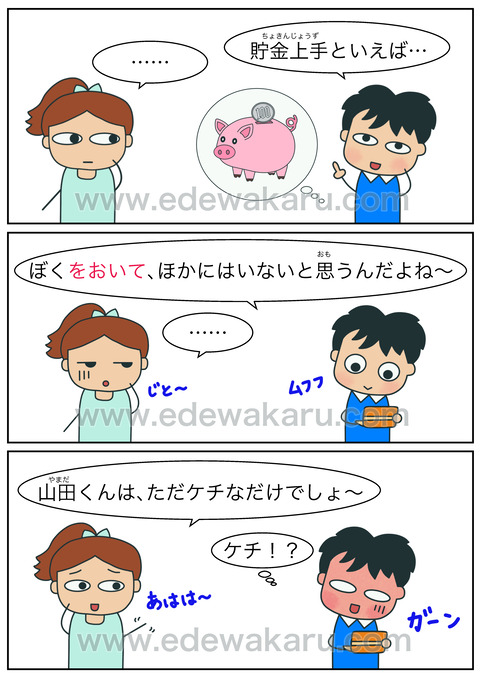
A:貯金上手(ちょきんじょうず)といえば、ぼくをおいてほかにはいないと思うんだ〜B:…ただケチなだけだけでしょ?
→ぼくのほかに、同じくらいすばらしい人はいないと思うんだ〜A: When it comes to being good at saving money, I don’t think there’s anyone but me~ B: ...You’re just stingy, aren’t you? → I don’t think there’s anyone as good as me~
結婚するなら、彼をおいてほかには考えられないわ
→彼以外にふさわしい人はいないわIf I’m going to get married, I can’t think of anyone but him. → There’s no one more suitable than him.
美人でダンスが上手な歌手は、彼女をおいてほかにはいないだろう
→彼女と同じくらい美人でダンスが上手い歌手はいないだろうThere probably isn’t another singer as beautiful and good at dancing as she is. → There probably isn’t another singer as beautiful and good at dancing as she is.
私にとって大切なものは、家族をおいてほかにはいない
→家族よりも大切なものはないTo me, there is nothing more important than my family. → There is nothing more important than my family.
チームのリーダーにふさわしいのは、彼をおいてほかにはいない
→彼以外にふさわしい人はいないHe is the only one suitable to be the team leader. → There is no one more suitable than him.
Read the original source text
Meaning
〜以外に、〜できる人はいない
〜以外に、ふさわしいものはない
How to use it
名詞[辞書形]+をおいて
Explanation
「Aをおいて」は「A以外に、〜できる人はいない」「A以外にふさわしいものはない」という意味の文型です。
「A」を高く評価する文型で、「 A以外に適当な[人・もの・こと]はない」「Aのほかに、同じくらいすばらしい[人・もの・こと]はない」
と言いたい時に使われます。ほとんどの場合、後ろには否定形がきます。「〜をおいて、ほかに〜ない」という形がよく使われます。
N1の文型は少し覚えにくいものがたくさんありますが、テストのためにしっかりと復習しておきましょう😊
日本語文型辞典
Meaning
Basic information: Nをおいて. Means “excluding/setting aside …”. In ③, the idiom 何をおいても means “whatever the circumstances.” Examples: ① If you’re going to consult someone about urban planning, there’s no one but him. ② If you want to study the influence of mass media on society, there’s no university but this one. ③ If my mother should collapse, I must rush to the hospital immediately, no matter what.
Read the original source text
Meaning
基本情報Nをおいて説明「…を別にして/のぞいて」の意味。③の「何をおいても」は「どんな状況でも」という意味の慣用句。例文① 都市計画について相談するなら、彼をおいて他にはいないだろう。② マスメディアの社会への影響について研究したいのなら、この大学をおいて他にはない。③ もし万一母が倒れたら、何をおいてもすぐに病院に駆けつけなければならない。
日本語文型辞典 英語版
Meaning
【をおいて】[Nをおいて]
Means “setting aside...except....” The 何をおいても of
(3)
is an idiomatic expression meaning “whatever happens.”
In context 3 examples
都市計画について相談するなら、彼をおいて他にはいないだろう。
If you’re going to talk about town planning, I don’t think there’s anyone but him (to talk to).
マスメディアの社会への影響について研究したいのなら、この大学をおいて他にはない。
If you want to research the influence of the mass media on society, there’s no other university than this one.
もし万一母が倒れたら、何をおいてもすぐに病院に駆けつけなければならない。
If, by some chance, mother should collapse, whatever happens, I have to rush to the hospital immediately.
日本語NET JLPT文法解説まとめ
Meaning
No one/nothing except ~ can ~
How to use it
N を + おいて
Explanation
① An expression of high praise.
② The latter clause is often negative.
In context 5 examples
次のプロジェクトのリーダー、君をおいて他に任せられる人がいないんだが、引き受けてくれるかな?
There’s no one else I can entrust with leading the next project except you. Will you take it on?
次の社長にふさわしいのは、木村さんをおいて他にはいない。
There’s no one but Mr. Kimura who is suitable to be the next president.
もう30歳だし、今の仕事が楽しくないし、転職するなら今をおいて他にない。
I’m already 30, and I don’t enjoy my current job, so if I’m going to change jobs, there’s no time like now.
メジャーリーグで3000本安打を達成できたのは、イチローをおいて他にはいない。
There’s no one but Ichiro who could have achieved 3,000 hits in Major League Baseball.
この秘密を知るものは我々をおいて他にはいません。これがどういうことを意味するかわかりますよね。
There is no one but us who knows this secret. You understand what that means, right?
Read the original source text
Meaning
〜以外にできない
How to use it
Nを + おいて
Explanation
①高く評価する表現
②後件は否定の形が来ることが多い。
IMABI
Exception
Read this IMABI lesson ↗Explanation
Exception: ~をのぞいて, ~をおいて, & ~ならでは
These phrases limit things as exceptions in their own unique ways.
~のぞいて
After a noun phrase of some sort, ~除いて is used to mean “except…” and is often left in ひらがな. It is a general phrase and will differ with the emotive power of the following grammar point ~をおいて. The verb 除く can mean “to remove/exclude”, and “exclude” can also be expressed with the verb 除外じょがいする, which is of the vein of “to set aside/rule out”.
1. 一隻いっせきを除いて艦船かんせんは全部沈しずんだ。
Except for one vessel, all of the carriers sank.
2. きのう、暑かったことをのぞいて、僕らは楽しいときを過ごした。
Yesterday, except it being hot, we had a good time.
3. 私は除いてください。
Please include me out.
4. 私は報道記者と政治家を除く全ての人々が平等であると信じている。
I believe it in the equality of all people except reporters and politicians.
5. 北部をのぞいて、お天気はよかったですよ。
The weather was good except in the north.
6. わたしを除いて全ての人がそれを知っていたそ。
Except me, it seems that everyone knew about it.
7. 女性は調査対象ちょうさたいしょうから除外することになった。
It was decided that women were to be taken out of the inquiry subjects.
Variant Note: In more formal literary fashion, this can also be seen as ~のぞき.
8. 政府の規制改革会議きせいかいかくかいぎが全面的ぜんめんてきな解禁かいきんを求めている、インターネットを使った市販薬しはんやくの販売について、菅官房長官かんかんぼうちょうかんや田村厚生労働大臣たむらこうせいろうどうだいじんら関係4閣僚かくりょうは、副作用ふくさようのリスクの評価が終わっていない、ごく一部の市販薬を除き、大半たいはんを解禁する方向で調整ちょうせいを進める見通しです。
In regards to the all-round band lift of the sale of over-the-counter drugs using the internet that a government regulation reform meeting is seeking, Chief Cabinet Secretary Kan, Prime Minister Tamura of the Ministry of Health, Labor and Welfare, and four other bureaucrats in connection are forecast to further the coordination in the direction of lifting the ban in large part with exception to a small amount of over-the-counter drugs of which the evaluation of side-effect risks is not over.
From NHK on June 4, 2013.
Warning Note: Do not confuse this with the verb 覗く, which means to “to peep/take a look at” and has the same pronunciation.
~をのぞいて VS ~以外
This is very similar to ~以外. One thing to notice, though, is that ~以外 is a suffix, and as seen below, the phrase is more affirmative and somewhat more formal sounding.
9. 九州以外のどこも地震が発生した。
With exception of Kyushu, earthquakes occurred everywhere.
10. これ以外に方法はありませんよ。
There is no method other than this.
~をおいて
~をおいて means “apart from”. This phrase is used to highly evaluate something or someone. So, it’s a good thing. There is always something like ほかに…(い)ない after it. When you are generally saying “aside from”, use ~を除いて. Like ~除いて, ~をおいて is used after noun phrases.
This phrase originally showed a meaning of “without emphasizing A as something important, one treats A as being useless and throws it out/places it to the side/separates it apart/removes it. In this sense, Aをおいてほかに(い)ない becomes a double negative expression, which then makes it an extremely powerful affirmative statement of A being number one.
In Japanese it is usually the case that very powerful expressions are kept in the written language, and although this is the case for をおいて, in rather formal situations, it can be used to declare one’s top recommendation. It doesn’t necessarily have to be in formal situations; however, as the first example sentence demonstrates clearly.
Examples
11. 君をおいて適任者てきにんしゃはいないぞ!
Apart from you there’s no responsible person!
12. 頼れるのは彼女をおいてほかにない。
There is no one to rely apart from her.
13. これをおいてほかに方法はなかった。
There was no way but this.
14. それはさておき・それはさておいて
Aside from that
15. 九州と四国を除いてそこかしこで東日本大震災は多数の死者を出して大災害が発生する結果となりました。
Apart from Kyushu and Shikoku, no matter where there are many deaths and major catastrophes have occurred in the Tohoku-Kanto Earthquake Catastrophe.
~別 VS ~をおいて
The following paraphrases with 別 is used rather than ~をおいて because the situation is not one of pointing out as the best but something that should be treated separately.
16a. 震度7 は別として、釜石市には津波が押し寄せました。
16b. 震度7度の地震とは別に、津波が釜石市を襲おそった。
Apart from a 7 earthquake, Kamaishi City got flooded by a tsunami.
Word Note: The 震度 system is on a different scale than the Richter scale.
~ならでは
~ならでは is one of those instances where classical grammar holds on strong. The なら in this expression, like the particle なら comes from the 未然形 of the Classical Japanese copular verb なり. It is then followed by a classical usage of で, which is not related to the contraction of にて. In this case, it is the contraction of ~ずて, which is equivalent to ~なくて. は, here, is here for contrastive purposes. If the pattern were translated into something solely Modern Japanese, it would be equivalent to ~でなくては・~でなければ.
This pattern is used to express the brilliance/wonderfulness of something by claiming that only it is as such. In the unabbreviated state of a sentence with it, a complementing verbal/adjectival phrase follows, but this can be omitted out if that phrase is being used as an attribute by replacing it with の, giving ~ならではの, which is the more common form of the pattern.
The entire phrase, which is “AならではBない(C )” is, then, equivalent to expressions such as “AであってはじめてB” and “AだからこそB”. In the case that A is a commonplace noun, ~ならでは is of the sense of the former coming from the position of societal wisdom/common sense. However, when A is particular, it shows that only A can do C.
Examples
17. 君ならではできないことだよ!
Without you, this cannot be done!
18. それ、中国の方ならでは{できない・の}ものの考え方ですよ。
That is only a matter of thought possibly by a person from China.
19. それって、大阪弁ならでは{ありえない・の}人当たりのよさですね。
That is charm only that of Osaka Dialect, isn’t it?
20. 社長しゃちょうならではの発想はっそうですね。
This can only be a conception of the company president, isn’t it?
21. この教科書きょうかしょならではの特徴とくちょうです。
This is a characteristic only in this textbook.
22. 50年続いた老舗ならでは出せないこの味の良さ!
The goodness of this flavor that only an old shop for 50 years can offer!
23. この体験は沖縄ならではですよ。
This experience can only be in Okinawa!
Grammar Note: As you can see, another exceptional thing about ~ならでは is that it can be followed by ~です with the rest of the pattern omitted.
24. さすが一流レストランのシェフならでは{出せない・の}味ですね。
This is as expected flavor that can only be from a first rate restaurant chef.
Phrase Note: さすが, which is an adverb that shows something as something to be expected, is frequently used with ~ならでは.
In context 25 examples
一隻いっせきを除いて艦船かんせんは全部沈しずんだ。
Except for one vessel, all of the carriers sank.
きのう、暑かったことをのぞいて、僕らは楽しいときを過ごした。
Yesterday, except it being hot, we had a good time.
私は除いてください。
Please include me out.
私は報道記者と政治家を除く全ての人々が平等であると信じている。
I believe it in the equality of all people except reporters and politicians.
北部をのぞいて、お天気はよかったですよ。
The weather was good except in the north.
わたしを除いて全ての人がそれを知っていたそ。
Except me, it seems that everyone knew about it.
女性は調査対象ちょうさたいしょうから除外することになった。
It was decided that women were to be taken out of the inquiry subjects.
政府の規制改革会議きせいかいかくかいぎが全面的ぜんめんてきな解禁かいきんを求めている、インターネットを使った市販薬しはんやくの販売について、菅官房長官かんかんぼうちょうかんや田村厚生労働大臣たむらこうせいろうどうだいじんら関係4閣僚かくりょうは、副作用ふくさようのリスクの評価が終わっていない、ごく一部の市販薬を除き、大半たいはんを解禁する方向で調整ちょうせいを進める見通しです。
In regards to the all-round band lift of the sale of over-the-counter drugs using the internet that a government regulation reform meeting is seeking, Chief Cabinet Secretary Kan, Prime Minister Tamura of the Ministry of Health, Labor and Welfare, and four other bureaucrats in connection are forecast to further the coordination in the direction of lifting the ban in large part with exception to a small amount of over-the-counter drugs of which the evaluation of side-effect risks is not over.
九州以外のどこも地震が発生した。
With exception of Kyushu, earthquakes occurred everywhere.
これ以外に方法はありませんよ。
There is no method other than this.
君をおいて適任者てきにんしゃはいないぞ!
Apart from you there’s no responsible person!
頼れるのは彼女をおいてほかにない。
There is no one to rely apart from her.
これをおいてほかに方法はなかった。
There was no way but this.
それはさておき・それはさておいて
Aside from that
九州と四国を除いてそこかしこで東日本大震災は多数の死者を出して大災害が発生する結果となりました。
Apart from Kyushu and Shikoku, no matter where there are many deaths and major catastrophes have occurred in the Tohoku-Kanto Earthquake Catastrophe.
震度7 は別として、釜石市には津波が押し寄せました。
Apart from a 7 earthquake, Kamaishi City got flooded by a tsunami.
震度7度の地震とは別に、津波が釜石市を襲おそった。
Apart from a 7 earthquake, Kamaishi City got flooded by a tsunami.
君ならではできないことだよ!
Without you, this cannot be done!
それ、中国の方ならでは{できない・の}ものの考え方ですよ。
That is only a matter of thought possibly by a person from China.
それって、大阪弁ならでは{ありえない・の}人当たりのよさですね。
That is charm only that of Osaka Dialect, isn’t it?
社長しゃちょうならではの発想はっそうですね。
This can only be a conception of the company president, isn’t it?
この教科書きょうかしょならではの特徴とくちょうです。
This is a characteristic only in this textbook.
50年続いた老舗ならでは出せないこの味の良さ!
The goodness of this flavor that only an old shop for 50 years can offer!
この体験は沖縄ならではですよ。
This experience can only be in Okinawa!
さすが一流レストランのシェフならでは{出せない・の}味ですね。
This is as expected flavor that can only be from a first rate restaurant chef.