絵でわかる日本語
Meaning
(If ~ doesn’t work,) I’ll just do ~
(If ~ doesn’t work,) I can just do ~, so it’s no problem
How to use it
Verb [dictionary form] + までだ
Verb [dictionary form] + までのことだ
Explanation
“〜までだ・〜までのことだ” is a sentence pattern meaning “just do ~.” It means “there’s no other way, so I’ll just do ~,” and is used when you want to say, “If ~ doesn’t work, I can just do ~, so there’s no problem,” or “I’ll just do ~, so it’ll be fine.” “〜までのことだ” emphasizes “〜までだ,” so the two can be used interchangeably 😉
[Example]
If the trains stop running, I’ll just go home by taxi.
=If the trains stop running, I’ll just go home by taxi.
A conditional sentence comes before “〜までだ,” so remember that forms like “〜だったら〜までだ” and “〜なら〜までだ” are often used 😀
[Patterns containing “まで”]
〜たまでだ・〜たまでのことだ
〜たらそれまでだ・〜ばそれまでだ
〜ないまでも
〜に至るまで
〜までして
〜までだ・〜までのことだ(V辞+までだ)
〜までに
〜までになる
〜までもない
In context 5 examples
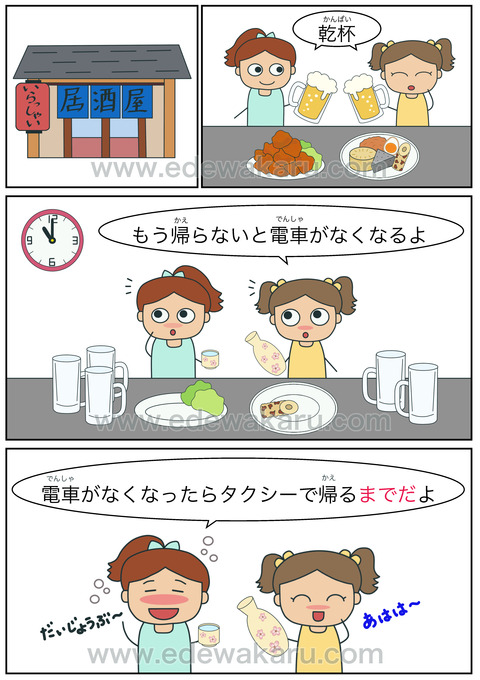
電車がなくなったら、タクシーで帰るまでだ
→電車がなくなったら、タクシーで帰ればいいから大丈夫だIf the trains stop running, I’ll just go home by taxi. →If the trains stop running, I can just go home by taxi, so it’ll be fine.
お金が足りなかったら、お母さんに借りるまでだ
→お金が足りなかったら、お母さんに借りるだけだから問題ない(復習:貸す・借りる)(復習:貸す・借りる(練習))If I don’t have enough money, I’ll just borrow some from my mother. →If I don’t have enough money, I can just borrow some from my mother, so it’s no problem. (Review: lend/borrow) (Review: lend/borrow [practice])
不合格だったら、来年またチャレンジするまでだ
→不合格だったら、来年またチャレンジするだけだIf I fail, I’ll just try again next year. →If I fail, I’ll just try again next year.
手伝ってくれないんだったら、一人でやるまでだ
→手伝ってくれないんだったら、一人でやるだけだから問題ないIf you won’t help me, I’ll just do it alone. →If you won’t help me, I can just do it alone, so it’s no problem.
ホテルが見つからなかったら、カラオケでオールするまでだ
→ホテルが見つからなかったら、カラオケでオールするだけだから大丈夫だ(復習:オール)If I can’t find a hotel, I’ll just stay up all night at karaoke. →If I can’t find a hotel, I’ll just stay up all night at karaoke, so it’ll be fine. (Review: stay up all night)
Read the original source text
Meaning
(〜がだめなら)〜するだけだ
(〜がだめなら)〜すればいいから、問題ない
How to use it
動詞[辞書形]+までだ
動詞[辞書形]+までのことだ
Explanation
「〜までだ・〜までのことだ」は「〜するだけだ」という意味を表す文型です。これは「他の方法がないので〜するだけだ」という意味で、
「〜がだめなら〜すればいいから問題ない」「〜するだけだから大丈夫だ」
と言いたい時に使われます。
「〜までのことだ」は「〜までだ」を強調した言い方です
のでチェンジすることができます😉
[例]
電車がなくなったら、タクシーで帰る
までだ
=電車がなくなったら、タクシーで帰る
までのことだ
「〜までだ・〜までのことだ」は前には条件文(じょうけんぶん)がきますので、
「〜だったら〜までだ」「〜なら〜までだ」
の形がよく使われると覚えておきましょう😀
【「まで」がつく文型】
〜たまでだ・〜たまでのことだ
〜たらそれまでだ・〜ばそれまでだ
〜ないまでも
〜に至るまで
〜までして
〜までだ・〜までのことだ(V辞+までだ)
〜までに
〜までになる
〜までもない
NINJAL 日本語文型データベース
Meaning
[1] Used when you want to state clearly that you are prepared to do 〜 if there is no other way, and that it is not a big problem.
[2] Used when you want to state clearly that you did nothing more than simply 〜, without any particular deeper meaning. It is used when the speaker feels they may have made something seem more meaningful than it was and wants to tell the other person that there was no ulterior motive or special reason. It is also used to modestly say, out of consideration for the other person, that one’s action was nothing significant.
How to use it
Vるまでのことだ
Vたまでのことだ
Notes
[1] Do not use the past or negative form.
「〜」 takes verbs expressing intentional actions. The subject is usually first person, but is often left unstated. In a sentence advising the listener, the listener may be the subject.
It is often used to talk about a hypothetical situation. It commonly occurs with conditional expressions such as 「~たら、〜ば、〜場合」.
[2] Do not use the past or negative form.
「~」 takes verbs expressing intentional actions.
It commonly occurs with expressions of reason such as 「〜から」.
In context 10 examples
もし子どもが障害を持って生まれたら、しっかり覚悟して一生懸命育てるまでのことだ。
If my child is born with a disability, I’ll be prepared and do my best to raise them.
もしこの裁判に負けたら、上告するまでのことだ。これが最後というわけではない。
If I lose this trial, I’ll just appeal. It won’t be the end of the road.
店を持つには多少資金不足かもしれない。まあ、資金が足りなければ銀行から借りるまでのことだ。
I may be a little short on funds to open a shop. Well, if I don’t have enough, I’ll just borrow from the bank.
倒産して財産を失ってしまうかもしれないが、そうなったら一から出直すまでのことだ。今から心配しても仕方がない。
I might go bankrupt and lose everything, but if that happens, I’ll just start over from scratch. There’s no point worrying about it now.
この計画がうまくいかなかった場合は、別の方法を試すまでのことだ。方法はいろいろ考えられる。
If this plan doesn’t work, I’ll just try another method. There are many possibilities to consider.
夫婦関係がどうしてもうまくいかないのなら、別れて一人で生きるまでのことですよ。それも人生です。
If our marriage really isn’t working, we’ll just separate and live on our own. That’s life too.
「特に褒められたいと思ったわけではなく、ただテストでいい点を取りたかったから努力したまでのことだよ」
“It’s not that I particularly wanted to be praised. I just worked hard because I wanted to get a good score on the test.”
君の力になれるかもしれないと思ったから助けたまでのことで、別に君に好意を持っているわけではない。
I helped you just because I thought I might be able to help; it’s not that I have any special feelings for you.
実験を入念にしているわけではありません。はじめの方法でうまくいかなかったから、別の方法でやり直したまでのことなんです。
It’s not that I’m conducting the experiment particularly carefully. The first method didn’t work, so I just tried again with a different method.
「おばさん、自転車、貸してくださってありがとうございました。これ、お礼です。どうぞ召し上がってください」「家にあるものをお貸ししたまでのことなのに……。すみません」
“Auntie, thank you for lending me your bicycle. This is a token of my gratitude. Please enjoy it.” “I only lent you something I had at home… I’m sorry.”
Read the original source text
Meaning
[1] 他に方法がなければ〜する覚悟を持っているし、それは大した問題ではないとはっきり言いたいときに使います。
[2] 特に深い意味はなく、ただ~しただけだとはっきり言いたいときに使います。もっと意味のあることのように思わせてしまったと話し手が考えている状況で他意はない、特別な理由はない、と、相手に伝えたいときに使います。また、相手への配慮から、自分の行為は大したものではないと謙遜して言う場合にも使います。
How to use it
Vるまでのことだ
Vたまでのことだ
Notes
[1] 過去形や否定形にはしません。
「〜」には意志的な行為を表す動詞がきます。主語はふつう一人称ですが、文中に表さないことが多いです。聞き手に忠告する文では聞き手を主語にする場合もあります。
仮定した状況について言うことが多いです。「~たら、〜ば、〜場合」など条件を表す表現をよく一緒に使います。
[2] 過去形や否定形にはしません。
「~」には、意志的な行為を表す動詞がきます。
「〜から」など理由を表す表現をよく一緒に使います。