絵でわかる日本語
日本語文型辞典
Meaning
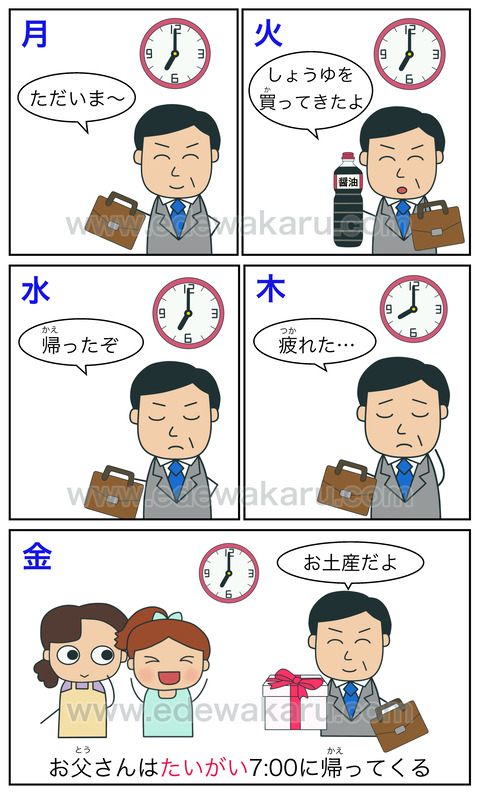
Basic information: Used with habitual actions to indicate a high frequency or probability. Sometimes phrased as 「たいがいは」 or 「たいがいの場合(は)」. Cannot be used to make predictions about the future. Examples: ① That person usually comes around nine. Sometimes they come around eight, though. ② I usually have bread for breakfast. ③ If it’s not too far, I generally use my bicycle. People who did poorly on the exam are generally required to take a make-up exam. Incorrect example: I’ll probably be home by seven tonight. Correct example: I’ll probably be home by seven tonight. Explanation: Also, when used in the form 「たいがいのN」, as in 「たいがいの人」 or 「たいがいの町」, it indicates a high proportion and can be rephrased as 「大部分のN」. Also said as 「たいてい」.
Read the original source text
Meaning
基本情報説明習慣的なことに付いて、頻度・確率が高いことを表す。「たいがいは」「たいがい」の場合(は)」などというときもある。将来についての推測には使えない。例文① あの人は、たいがい9時ごろ来ます。8時ごろの時もありますが。② 私は、朝食は、たいがいパンですね。③ そんなに遠くない所なら、たいがいは自転車を使うことにしています。試験の成績が悪かった人は、たいがいの場合、追試を受けることになっています。例文(誤) 今晩はたいがい7時には帰るでしょう。例文(正) 今晩はおそらく7時には帰るでしょう。説明また、「たいがいの人」「たいがいの町」のように「たいがいのN」の形で使う場合は、割合が高いことを表し、「大部分のN」で言いかえられる。「たいてい」とも言う。
日本語文型辞典 英語版
Meaning
Used with respect to habitual activities, to express that their frequency or likelihood is high. May also be used in the forms たいがいは and たいがいの場合(は). Cannot be used to make a conjecture about the future.
(×)今晩はたいがい7時には帰るでしょう。
He’ll usually be back at seven o’clock tonight.
(○)今晩はおそらく7時には帰るでしょう。
He’ll probably be back at seven o’clock tonight.
When used in the form たいがいのN, as in たいがいの人 (most people) or たいがいの町 (most towns), it means that the proportion of something is high, and it can be replaced by 大部分のN (the majority of N). たいてい (most) can also be used.
In context 4 examples
あの人は、たいがい9時ごろ来ます。8時ごろの時もありますが。
That person usually arrives at around nine o’clock... but sometimes at eight or so.
私は、朝食は、たいがいパンですね。
I usually have bread for breakfast.
そんなに遠くない所なら、たいがいは自転車を使うことにしています。
If I’m going somewhere that’s not so far away, I generally try to use my bicycle.
試験の成績が悪かった人は、たいがいの場合、追試を受けることになっています。
In most cases, students who get a bad score are expected to take a make-up exam.