AIUEO JLPT Grammar
Meaning
This sentence pattern emphasizes the events or actions that occur as a result of certain conditions or situations. It is used when the outcome is expected as a result of the fulfillment of conditions.
How to use it
Verb (dictionary form) と + あっては; Noun と + あっては
In context 5 examples
上司の指示とあっては、従わざるを得ない。
If it’s an instruction from the boss, I have no choice but to follow it.
親友の頼みとあっては、断れない。
If it’s a request from a close friend, I can’t refuse.
これほどの問題とあっては、すぐに対策を立てる必要がある。
If it’s such a serious problem, we need to take immediate action.
健康に関わることとあっては、真剣に考えなければならない。
If it concerns health, we must take it seriously.
緊急事態とあっては、すぐに行動する必要がある。
If it’s an emergency, immediate action is required.
Read the original source text
Meaning
This sentence pattern emphasizes the events or actions that occur as a result of certain conditions or situations. It is used when the outcome is expected as a result of the fulfillment of conditions.
How to use it
動詞辞書形と+あっては名詞と+あっては
Explanation · 日本語
この文型は、特定の状況や条件が原因で、その結果として起こる事象や行動を強調する表現です。この表現は、条件が揃った時にその結果が生じることを示し、強調したい場合に使われます。また、一般的には予期される結果や動作が伴う場面で使用されます。
DoJG 日本語文法辞典(全集)
Meaning
If it is true that; if it is the case that; if; because; since
How to use it
(i) NP | とあっては | |
| 病気とあっては | If it’s true that someone is ill |
(ii) Sinformal | とあっては | だ after Adjectiveなstem and Noun is omitted |
| 由美も行くとあっては | If it’s true that Yumi is going, too |
| タクシーの方が安いとあっては | If it’s true that a taxi is cheaper |
| バスの方が便利とあっては | If it’s true that the bus is more convenient |
| 締め切りが今週末とあっては | If it’s the case that the deadline is the end of this week |
Explanation
A conditional phrase that indirectly presents a factual situation as a reason.
In context 8 examples
社長の頼みとあっては断るわけにはいかない。
If (it's true that) it's a favour for the president, I can't say no.
全商品が3割引きで買えるとあっては、遠方からわざわざ人が買いに来るのもうなずける。
If (it's true that) you can buy everything at 30% off, I understand why people come from far away to shop (here).
この大学が他の大学に統合されるのは残念だが、国の方針とあっては致し方ない。
It is a pity that this university is going to be integrated into another university, but if that's the national policy, it cannot be helped.
ブラジル・ドイツ戦のすぐ後とあっては国内チーム同士の試合が物足りなく感じられたのも仕方がない。
Because it came right after the game between Brazil and Germany, it was inevitable that people did not feel the game between the domestic teams was very exciting.
皆が多忙な身とあっては30人以上の家族が集まれるのはクリスマスの休みしかない。
Since everyone is so busy, Christmas vacation is the only time our family of more than 30 can get together.
スカイダイビングがここサイパンで楽しめるとあっては、挑戦してみない手はない。
If it's true that we can enjoy skydiving here in Saipan, there's no reason not to try it.
どんなに短い作文でも、他の人に読まれ、コメントがつくとあっては、書く時の真剣味が増す。
No matter how short your composition is, if it is read by others and they make comments, it makes you think more seriously when you write.
役人の飲食費に税金が使われたとあっては、誰もが腹立たしく思うのは当たり前だ。しかも、そのことが明るみに出そうになると、今度は圧力をかけて「口封じ」をやったとあっては、もう救いようがない。
If tax money was used to pay for government officials' dining and drinking, of course people would be angry. But there's no hope if the officials pressured those involved to keep their mouths shut when the practice was about to be exposed.
絵でわかる日本語
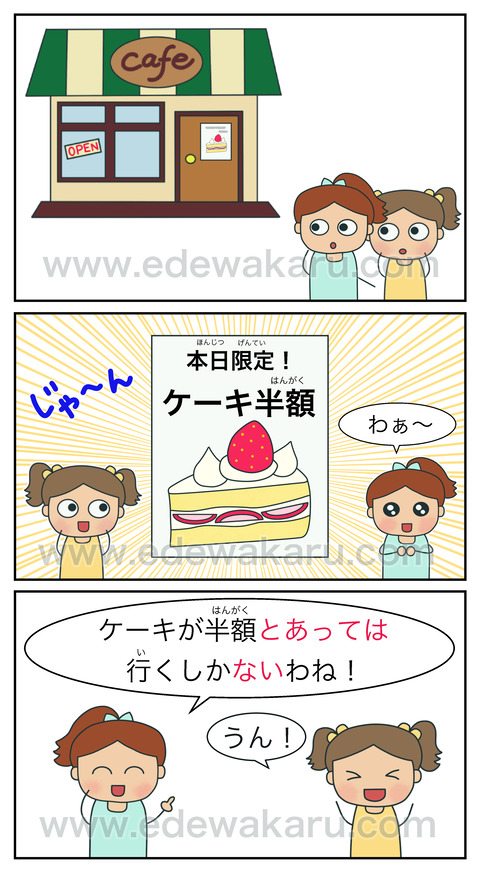
Meaning
If the situation is ~, then not ~.
If it’s a matter of ~, then not ~.
How to use it
Verb, adjective, or noun [plain form] + とあっては〜ない
Explanation
“〜とあっては〜ない” is a sentence pattern meaning “If the situation is ~, then not ~” or “If it’s a matter of ~, then not ~.” It is used to say, “In this special situation, ~.” 😊 There are patterns that are often used with it, so it may be good to learn some of them. 😉
[Patterns often used with “〜とあっては〜ない”]
・
〜とあっては〜しかない
(Review: 〜しかない)
・
〜とあっては〜ないわけにはいかない
(Review: 〜ないわけにはいかない)
・
〜とあっては〜するほかない
・
〜とあっては〜まい
(Review: 〜まい)
・
〜とあっては〜はずがない
“〜とあっては〜ない” is somewhat formal, but it is also used in conversation, so be sure to learn it well. 😀
(Review: 〜ことがある)
In context 4 examples
ケーキ半額とあっては、行くしかないわね!
→ケーキ半額という状況なら、行くしかないわね!(復習:〜しかない)If the cakes are half price, we have no choice but to go! (Review: 〜しかない) →If the situation is that the cakes are half price, we have no choice but to go!
お金がないとあっては、旅行はあきらめなきゃいけないな…
→お金がないという状況なら、旅行はあきらめなきゃいけないな…(復習:〜なきゃ)If we have no money, I’ll have to give up on the trip… →If the situation is that we have no money, I’ll have to give up on the trip… (Review: 〜なきゃ)
社長のパーティーとあっては行かないわけにはいかない
→社長のパーティーということなら行かないわけにはいかない(復習:〜ないわけにはいかない)If it’s the company president’s party, I can’t not go. →If it’s a party for the company president, I can’t not go. (Review: 〜ないわけにはいかない)
彼女の頼みとあっては、断れない
→彼女の頼みということなら、断れないIf it’s her request, I can’t refuse. →If it’s her request, I can’t refuse.
Read the original source text
Meaning
〜という状況なら〜ない
〜ということなら〜ない
How to use it
動詞・形容詞・名詞[普通形]+とあっては〜ない
Explanation
「〜とあっては〜ない」は「〜という状況なら〜ない」「〜ということなら〜ない」という意味を表す文型です。「〜という特別な状況では〜だ」と言いたい時に使います😊一緒によく使う文型がありますので、いくつか覚えておくといいと思います😉
[「〜とあっては〜ない」とよく使う文型]
・
〜とあっては〜しかない
(復習:〜しかない)
・
〜とあっては〜ないわけにはいかない
(復習:〜ないわけにはいかない)
・
〜とあっては〜するほかない
・
〜とあっては〜まい
(復習:〜まい)
・
〜とあっては〜はずがない
「〜とあっては〜ない」は少しかたい言い方ですが、会話で使われることもありますので、しっかりと覚えておきましょう😀
(復習:〜ことがある)
くらべてわかる日本語表現文型辞典
Meaning
Meaning 1: When situation A occurs, B follows. B is something beyond one’s control or something that cannot be helped.
Meaning 2: A gives a sufficient reason to actively support judgment B.
How to use it
AとあってはB (Aと知ってはB / Aと聞いてはB)
[Verb] とあっては
[Noun—∅] とあっては
Explanation
[Contrast 1]
“AとあってB” (Meaning 1, p. 150)
“AとあってB” means that situation B occurs because fact A exists, and B is not a subjective sentence. “AとあってはB” is followed by something that is beyond one’s control, such as “~仕方がない” (can’t be helped), “~ざるをえない” (have no choice but to), or “~止むを得ない” (unavoidable).
○累積損失が500億円とあっては、当事業からの撤退も止むを得ない。 — Given that the cumulative losses amount to 50 billion yen, withdrawing from this business is unavoidable.
○累積損失が500億円とあって、Z社は苦境に立たされている。 — With cumulative losses of 50 billion yen, Company Z is in a difficult position.
[Contrasts 1 and 2]
“AにあってはB” (Meaning 2, p. 213)
Notes
[Notes 1 and 2]
・A is information or an action brought from outside, and it can also indicate the means, as in “知っては” (when one learns) and “聞いては” (when one hears).
In context 8 examples
主力選手が欠場しているとあっては、3連敗もいたしかたない。
Given that the key players are absent, a third consecutive loss can hardly be helped.
社長の命令と知っては、断るわけにはいかない。
Knowing it is the president’s order, I can’t refuse.
待ちに待った旅行だが、台風が来るとあってはあきらめるしかない。
It’s a long-awaited trip, but if a typhoon is coming, we have no choice but to give up.
重要な会議だがインフルエンザとあっては、欠席もやむを得ない。
It’s an important meeting, but with the flu, it can’t be helped if I’m absent.
風邪ならともかく、肺炎とあっては入院が必要だ。
A cold would be one thing, but with pneumonia, hospitalization is necessary.
祭りとあっては、仕事なんてしていられない。
If it’s a festival, I can’t just sit around working.
市価の半額と聞いては、買わずにいられない。
Knowing it’s half the market price, I can’t resist buying it.
弱いものがいじめられているとあっては、黙っちゃいられない。
If the weak are being bullied, I can’t just stay silent.
Read the original source text
Meaning
意味1:Aという事態になってB。Bには自分の力ではコントロールできないこと、仕方のないことが来る。
意味2:AはBの判断を積極的に支持する十分な理由を示す。
How to use it
AとあってはB(Aと知ってはB/Aと聞いてはB)
[動詞]とあっては
[名詞-∅]とあっては
Explanation
【対比1】
「AとあってB」(意味1 P.150)
「AとあってB」はAという事実があるからBという事態が起こるという意味であり、Bには主観的な文はこない。「AとあってはB」はBに自己の力でコントロールできないこと「~仕方がない」「~ざるをえない」「~止むを得ない」などがくる。
○累積損失が500億円とあっては、当事業からの撤退も止むを得ない。
○累積損失が500億円とあって、Z社は苦境に立たされている。
【対比1,2】
「AにあってはB」(意味2 P.213)
Notes
【注意1,2】
・Aは外部からもたらされた情報・行為であり、「知っては」「聞いては」などのようにその手段を表す場合もある。
毎日のんびり日本語教師
How to use it
Verb dictionary form + とあっては
Noun + とあっては
Explanation
Expresses a hypothetical situation.
The preceding clause states that a special situation has arisen, and the following clause describes an action that must be taken in response to that situation, or a state that naturally results from it.
Notes
Similar sentence pattern: 「【N1文法】~とあれば」
In context 7 examples
社長直々の命令とあっては嫌でもやらなければ。
If it's a direct order from the company president, I have to do it whether I like it or not.
Aさんの頼みとあっては断れない。
If it's a request from A, I can't refuse.
自国民が殺されたとあっては、政府としても何もしないわけにはいかない。
If our own citizens have been killed, the government can't just do nothing.
この値段とあってはかなり売れそうだ。
At this price, it looks like it will sell quite well.
生のオーケストラを聴けるとあっては行かなければ。
If I can hear a live orchestra, I have to go.
愛する子が失踪するとあっては、どんな親でも心配しないはずがない。
If a beloved child goes missing, any parent is bound to worry.
大好きなアイドルがやってくるとあっては行かない理由がない。
If my favorite idol is coming, there's no reason not to go.
Read the original source text
How to use it
動辞形+とあっては
名詞+とあっては
Explanation
仮定を表します。
前件には特別な状況が発生したこと、後件にはその特別な状況に対して行わなければならない行動、または自然に引き起こされる状態が述べられます。
Notes
似ている文型「【N1文法】~とあれば」