AIUEO JLPT Grammar
Meaning
This sentence pattern expresses that when something undesirable happens, the expected good result does not occur. It often carries a critical nuance or a warning.
How to use it
Verb dictionary form + ようでは; verb nai-form + ようでは
In context 5 examples
この問題が解決できないようでは、困る。
If we can’t solve this problem, it will be a problem.
そんな簡単なことが分からないようでは、先が思いやられる。
If you can’t understand something so simple, I worry about the future.
こんなことで疲れているようでは、最後まで持たないだろう。
If you’re already tired from this, you probably won’t last until the end.
試験の準備がまだできていないようでは、合格するのは難しいかもしれない。
If you still haven’t prepared for the exam, passing might be difficult.
小さな問題を解決できないようでは、大きな課題に取り組むのは無理だ。
If you can’t solve small problems, handling bigger challenges will be impossible.
Read the original source text
Meaning
This sentence pattern expresses that when something undesirable happens, the expected good result does not occur. It often carries a critical nuance or a warning.
How to use it
動詞辞書形+ようでは動詞ない形+ようでは
Explanation · 日本語
この文型は、ある状況や行動が望ましくない場合に、その結果として期待される良い結果が得られないことを示す表現です。批判的なニュアンスや警告の意味を含むことが多いです。
Bunpro Grammar Reference
Meaning
If, If it is true that
How to use it
Verb + ようでは(2) + (Negative Result)
(2) ようじゃ
Nuance
An expression stating that if something is determined to be the manner of (A), then (B) will also be the case.
Explanation
ようでは is a combination of the auxiliary verb 様 'manner', or 'seeming', and では, a conjunction that is frequently used as an abbreviation of それなら in expressing 'if'. Due to this, ようでは itself often has the meaning of 'if', with extra focus on the fact that (A) is something unconfirmed, or only being guessed at. This may be translated as 'if it is the case that (A)', or 'if that which seems to be (A) is true'.
In most cases, ようでは will be used to make an evaluation that if (A) is true, then some particular negative result will arise from it.
ようでは will primarily appear after verbs in any of their standard forms.
こんな毎日同じミスをするようでは、いつまで経っても店長にはなれませんよ。
If you keep making the same mistake everyday, you will never be able to become a manager.
これらの文法が分からないようでは、N2(ツー)に合格することはできません。
If you do not understand these grammar points, you will not be able to pass N2.
これぐらいの高さで怖がっているようでは消防士にはなれませんよ。
You can't become a firefighter if you're afraid of heights like this.
ようでは puts extra focus on the appearance or condition of (A), based on what is observable by the speaker. In this way, it is often the speaker's subjective (negative) opinion about what they perceive to be true.
In context 15 examples
- そこまで甘やかすようでは、ろくな大人にならないですよ。
If you are spoiled to that extent, you can't become a decent adult. (...it appears that...)
- こんな毎日同じミスをするようでは、いつまで経っても店長にはなれませんよ。
If you keep making the same mistake everyday, you will never be able to become a manager.
- これらの文法が分からないようでは、N2(ツー)に合格することはできません。
If you do not understand these grammar points, you will not be able to pass N2.
- これぐらいの高さで怖がっているようでは消防士にはなれませんよ。
You can't become a firefighter if you're afraid of heights like this.
- こんなに日時を間違えるようでは、仕事なんてできないよ。
If you can make these kinds of mistakes about the time and date, you can't do your job. (...it appears that...)
- こんな問題も解けないようでは、次のテストが思いやられる。
If you can't solve a problem like this, I am worried about your next test. (...it appears that...)
- 人の成功を羨んでいるようでは、自分の成功にはつながらない。
If you envy other people's achievements, it won't lead to your own achievements. (...it appears that...)
- 勉強の日課を守れないようでは、試験に受からないと思います。
If you can't keep up with your daily study routine, I don't think you can pass the test. (...it appears that...)
- この程度で吐き気がするようでは、もっと強い薬は使えない。
If you are having this degree of nausea, you cannot use a stronger medicine. (...it appears that...)
- 緊張して実力を発揮できないようでは、この世界では通用しない。
If you get nervous and can't demonstrate your true ability, you will not make it in this world. (...it appears that...)
- 仕事と休息のバランスが取れないようでは、体を壊してしまいます。
If you cannot balance work and rest, your body will end up breaking down. (...it appears that...)
- 反省する気がないようでは、今後の成長は見込めない。
If you do not feel like reflecting on your actions, you cannot anticipate growing any further. (...it appears that...)
- 日当たりが悪いようでは、部屋の借り手はなかなか見つからないと思います。
If this place doesn't get enough sun, I don't think you will find a renter for the room. (...it appears that...)
- 赤ん坊のおむつを替えられないようでは、とてもイクメン(子育てする男性)とは呼べない。
If he can't change a baby's diapers, he can't be called a man who can raise a child. (...it appears that...)
- この程度の距離で音を上げているようでは、本格的な登山に挑戦することなどできない。
If you are going to give up at this distance, you won't be able to take on the challenge of real mountain climbing. (...it appears that...)
DoJG 日本語文法辞典(全集)
Meaning
If; if it is true that; if it is the case that
How to use it
(i) {V/Adjectiveい}informal nonpast | ようでは | |
| 行くようでは | If it’s true/the case that someone goes/is going |
| 弱いようでは | If it’s true/the case that something/someone is weak |
(ii) Adjectiveなstemな | ようでは | |
| 下手なようでは | If it’s true/the case that someone is bad at something |
(iii) Nounの | ようでは | |
| 二年のようでは | If something is like two years ago |
Explanation
A conjunction that presents an undesirable situation, which is assumed to be factual.
In context 11 examples
知らない単語が出てくるたびに辞書を引いているようではいつまでたっても速く読めない。
If (it is true that) you look up unfamiliar words in the dictionary every time you encounter a new one, you will never learn to read fast.
アパートがそんなに高いようでは私たちは東京には住めない。
If (it is true that) apartments in Tokyo are that expensive, we cannot live there.
成績が今までのようでは困ります。
If you continue to show the level of performance you have to date, we will have a problem. (literally: If your performance is like what you have exhibited up to now, it's a problem.)
今からそんなに文句を言っているようでは、この仕事をやり遂げるのは難しいだろう。
If you complain like that now, it will be difficult to complete this job.
困った時に助けてくれないようでは友達とは言えない。
If (it is true that) he doesn't help you when you are in trouble, you cannot call him a friend.
朝が弱いようではこの仕事は無理でしょう。
If it is true that) you have trouble getting up early in the morning (literally: are weak in the morning), you probably won't be able to do this job.
千円程度の旅費払い戻しに4枚も5枚も書類が必要なようでは問題だ。
It is a problem if (it is true that) it takes four or five forms to request a travel reimbursement for an amount as small as one thousand yen.
今頃そんなことをしているようでは、とても締め切りに間に合わない。
If you're doing things like that now, there's no way you'll meet the deadline.
部下の面倒が見られないようでは上司失格だ。
If (it is true that) you cannot take care of the people under you, you are not qualified to be their boss.
大学の施設が現状のようでは、せっかく研究資金を増やしても有効に活用できない。
Even if we make an effort to increase research funding, with the university facilities the way they are (literally: if the university facilities are in their present condition), we won't be able to utilize the funds effectively.
次の試合も今日の試合のようでは、とても決勝には進めない。
If we play the next game like (we did in) today's game, there's no way we can advance to the finals.
絵でわかる日本語
Meaning
In a situation like that, 〜
In a state like that, 〜
How to use it
Verb [dictionary form] + ようでは
Verb [ない-form] + ようでは
Verb [ている-form] + ようでは
Explanation
「〜ようでは」 is a sentence pattern meaning “in a situation like 〜” or “in a state like 〜.” It is used when you want to say “You can’t be in a state like that” or “That won’t do.” 😊
Negative things such as “no good,” “impossible,” and “troublesome” often follow.
😮
「〜ようでは」 is used to tell someone something like “You mustn’t be 〜 like that”
In context 5 examples
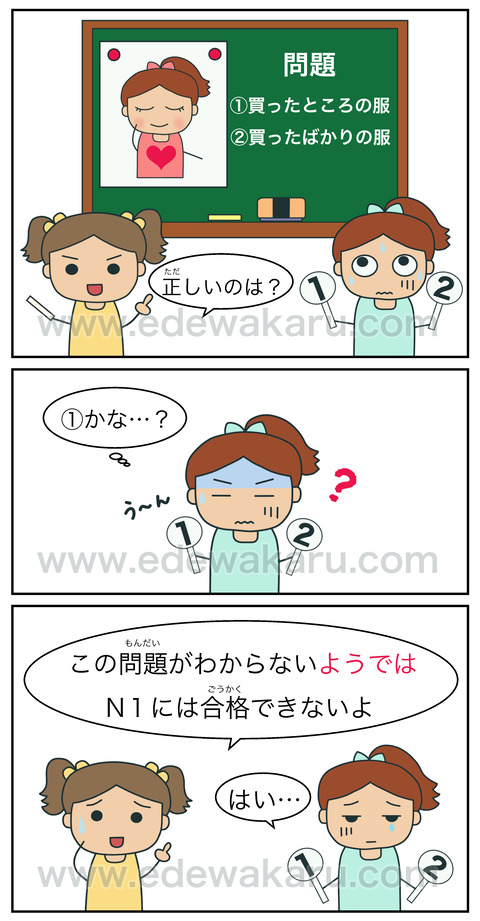
この問題がわからないようではN1には合格できないよ
→この問題がわからない状態ではN1には合格できないよIf you don’t understand this problem, you won’t be able to pass N1. → You won’t be able to pass N1 in a state where you don’t understand this problem.
小学校(しょうがっこう)レベルの漢字が読めないようではダメだね
→小学校レベルの漢字が読めない状態ではダメだねIt’s no good if you can’t read kanji at an elementary school level. → It’s no good to be in a state where you can’t read kanji at an elementary school level.
英語のテストで0点を取っているようでは留学は無理だな
→英語のテストで0点を取っている状態では留学は無理だなIf you keep getting zero points on English tests, studying abroad is impossible. → Studying abroad is impossible in a state where you keep getting zero points on English tests.
上司:君、遅刻してばかりいるようでは困る部下:すみません…
→君、遅刻してばかりいる状態では困るよ(復習:〜てばかりいる・〜てばかりだ)Boss: You’re always late; this is a problem. Subordinate: I’m sorry… → It’s a problem if you keep being late. (Review: 〜てばかりいる・〜てばかりだ)
一度不合格だったくらいであきらめるようではいけないと思うよ
→一度不合格だったくらいであきらめるという様子ではいけないと思うよI don’t think you should give up just because you failed once. → I don’t think it’s okay to be in a state where you give up just because you failed once.
Read the original source text
Meaning
そのような様子では〜
そのような状態では〜
How to use it
動詞[辞書形]+ようでは
動詞[ない形]+ようでは
動詞[ている]+ようでは
Explanation
「〜ようでは」は「〜のような様子では」「〜のような状態では」という意味を表す文型です。この文型は
「〜のような状態ではいけない」「それではいけない」
と言いたい時に使います😊
「ダメだ」「無理だ」「困る」など、マイナスなことがよくきます
😮
「〜ようでは」は、相手に「〜ではいけないよ」というように
毎日のんびり日本語教師
How to use it
Verb dictionary form + ようでは
Verb ない-form + ないようでは
Explanation
Expresses that if what is stated in the first clause were to happen, the expected result would not follow.
The latter clause often contains negative content such as「だめ」,「困る」, or「~ない」.
Notes
The “よう” series
In context 10 examples
どんなに苦しくても、人にそれを気づかれるようではいけない。
No matter how hard it is, you mustn’t let other people notice.
デートでお金をケチるようではモテない。
If you’re stingy with money on a date, you won’t be popular.
困難に対して立ち向かわないようでは駄目だ。
It’s no good if you don’t face difficulties head-on.
勝負において、相手のミスを願うようではプロにはなれない。
In a competition, if you’re hoping for your opponent to make a mistake, you can’t become a professional.
まだ時間があるからといって遊んでいるようでは競争には勝てない。
If you keep playing just because there’s still time, you won’t win the competition.
自分の管理もできないようでは、人の上に立つこともできない。
If you can’t even manage yourself, you can’t lead others.
何度しても分からないようでは、やっぱり君はこの仕事に向いていないんだろう。
If you still don’t understand after trying so many times, I guess you’re not suited to this job after all.
リスクばかりを恐れているようでは何もできない。
If all you do is fear risks, you won’t be able to do anything.
こんなところで手こずっているようではまだまだだ。
If you’re struggling with something like this, you still have a long way to go.
周囲の目をそんなに気にしているようでは、自分らしく生きられない。
If you care that much about what people around you think, you can’t live true to yourself.
Read the original source text
How to use it
動辞形+ようでは
動ない形+ないようでは
Explanation
前項で述べたことが仮に実現すれば、期待される結果とはならないことを表します。
後項にはよく「だめ」「困る」「~ない」などの良くない内容がきます。
Notes
「よう」シリーズ