Bunpro Grammar Reference
Meaning
When, When doing something, On the occasion, At the time
How to use it
Verb[る]+ にあたり(1)
Noun + にあたり(1)
(1) にあたって
Nuance
A formal expression meaning at the time of (A), (B). When hitting upon doing (A), (B). Often in regard to preparations.
Explanation
に当たり or に当たって is a formal grammar pattern in Japanese used to convey the meaning of 'at the time of (A)', 'when doing (A)', or 'on the occasion of (A)'. Like に際して 'on the occasion of (A)', it will often be used in regard to preparation for future events. This structure is a combination of に, and the う-Verb 当たる 'to hit', or 'to come into contact' in either its formal-conjunctive form or て-form.
に当たり will appear following verbs in their dictionary form, or nouns. There are two primary nuances that this structure will be used for, so let's look at a few examples of each.
The first is when (A) is some sort of special occasion or condition from which (B) will be done.
就活を始めるに当たり、新しいスーツを買った。
On the occasion of starting my job search, I bought a new suit.
卒業にあたって、みんなで卒業旅行として韓国に行った。
On the occasion of my graduation, we all went to Korea as a graduation trip.
The second is when (A) is some sort of goal or target for which (B) will be the means or measures in response to that goal.
転職をするに当たり、インターネットで自分に合った会社を探すことにした。
At the time of changing jobs, I looked for a company that would suit me well on the internet.
新しいお店の開店にあたって、オープニングスタッフを募集しました。
We recruited opening staff at the time of opening a new restaurant.
Caution
Unlike に際して, which can be used for either positive or negative situations, に当たり will primarily only be used for positive or neutral situations.
母の葬式に際して必要な書類を準備した。
I gathered all the necessary documents at the time of my mother's funeral. (Natural Japanese)
母の葬式に当たって必要な書類を準備した。
I gathered all the necessary documents at the time of my mother's funeral. (Unnatural Japanese)
In context 18 examples
- レーザーの試験に当たり、必ず保護メガネを着用してください。
Be sure to wear safety glasses when testing the laser. (on the occasion of)
- 就活を始めるに当たり、新しいスーツを買った。
On the occasion of starting my job search, I bought a new suit.
- 卒業にあたって、みんなで卒業旅行として韓国に行った。
On the occasion of my graduation, we all went to Korea as a graduation trip.
- 転職をするに当たり、インターネットで自分に合った会社を探すことにした。
At the time of changing jobs, I looked for a company that would suit me well on the internet.
- 新しいお店の開店にあたって、オープニングスタッフを募集しました。
We recruited opening staff at the time of opening a new restaurant.
- 綱渡りをするに当たり、命綱をつけてもらった。
When I did a tightrope walk, I had a safety wire connected. (at the time of)
- 彫刻を彫るに当たり、彫刻刀を買い換えた。
On the occasion of carving a sculpture, I bought a new chisel.
- 課長の退職に当たって、お別れの一言を述べさせていただきます。
Let me say a few words of farewell on the occasion of the section manager's retirement.
- パスポートの申請に当たり、顔写真を必ず持ってきてください。
Be sure to bring headshots at the time of passport application.
- 彼と付き合うに当たり、幾つかの条件を提示した。
At the time of dating him, I suggested several conditions.
- 定価を下げるに当たり、社員とかなりの話し合いがなされた。
On the occasion of lowering the set price, they would hold considerable discussions with the staff.
- 予約を取り消すに当たり、幾つか手続きをしていただきたい。
When cancelling a reservation, there are several steps that you must go through. (on the occasion of)
- 今回の特売に当たっての準備は大変でした。
When doing the preparation for the the special sale, it was a lot of work this time. (on the occasion of)
- 手帳を買うに当たって、何軒も店を回って探しました。
At the time of buying a memo pad, I looked around at several shops.
- 作品を作るに当たって、必要なものを買ってきてください。
When making a product, please buy and bring the necessary things. (on the occasion of)
- 通訳をするに当たって、万全に準備を整えた。
When I would interpret, I would prepare to perfection. (on the occasion of)
- 母の葬式に際して必要な書類を準備した。
I gathered all the necessary documents at the time of my mother's funeral. (Natural Japanese)
- 母の葬式に当たって必要な書類を準備した。
I gathered all the necessary documents at the time of my mother's funeral. (Unnatural Japanese)
Read the original source text
Meaning
When, When doing something, On the occasion, At the time
How to use it
Verb[る]+ にあたり(1)
Noun + にあたり(1)
(1) にあたって
Nuance
A formal expression meaning at the time of (A), (B). When hitting upon doing (A), (B). Often in regard to preparations.
Explanation
に当たり or に当たって is a formal grammar pattern in Japanese used to convey the meaning of 'at the time of (A)', 'when doing (A)', or 'on the occasion of (A)'. Like に際して 'on the occasion of (A)', it will often be used in regard to preparation for future events. This structure is a combination of に, and the う-Verb 当たる 'to hit', or 'to come into contact' in either its formal-conjunctive form or て-form.
に当たり will appear following verbs in their dictionary form, or nouns. There are two primary nuances that this structure will be used for, so let's look at a few examples of each.
The first is when (A) is some sort of special occasion or condition from which (B) will be done.
就活を始めるに当たり、新しいスーツを買った。
On the occasion of starting my job search, I bought a new suit.
卒業にあたって、みんなで卒業旅行として韓国に行った。
On the occasion of my graduation, we all went to Korea as a graduation trip.
The second is when (A) is some sort of goal or target for which (B) will be the means or measures in response to that goal.
転職をするに当たり、インターネットで自分に合った会社を探すことにした。
At the time of changing jobs, I looked for a company that would suit me well on the internet.
新しいお店の開店にあたって、オープニングスタッフを募集しました。
We recruited opening staff at the time of opening a new restaurant.
Caution
Unlike に際して, which can be used for either positive or negative situations, に当たり will primarily only be used for positive or neutral situations.
母の葬式に際して必要な書類を準備した。
I gathered all the necessary documents at the time of my mother's funeral. (Natural Japanese)
母の葬式に当たって必要な書類を準備した。
I gathered all the necessary documents at the time of my mother's funeral. (Unnatural Japanese)
Nuance · 日本語
(A)に際して(B)であるという意味をする表現。(A)を行ったら(B)。準備に関して使われることが多い。
Explanation · 日本語
「に当たり」または「に当たって」は日本語の硬い文型で「(A) のときに」という意味を表します。「に際して」と同様に、未来の出来事への準備に関連して使われます。この文型は「に」と五段動詞「当たる」のテ形または連用形(丁寧な形)の組み合わせでできています。
「に当たり」は動詞の辞書形または名詞の後に付きます。この文型には主に二つのニュアンスがあります。例をいくつか見てみましょう!
一つ目は (A) が特別な行事や機会であり、それに向けて事前に (B) が行われる場合です。
就活を始めるに当たり、新しいスーツを買った。
On the occasion of starting my job search, I bought a new suit.
卒業にあたって、みんなで卒業旅行として韓国に行った。
On the occasion of my graduation, we all went to Korea as a graduation trip.
二つ目は (A) が目標であり、それを実現するための手段や対応が (B) である場合です。
転職をするに当たり、インターネットで自分に合った会社を探すことにした。
At the time of changing jobs, I looked for a company that would suit me well on the internet.
新しいお店の開店にあたって、オープニングスタッフを募集しました。
We recruited opening staff at the time of opening a new restaurant.
注意点
「に際して」は肯定的な場面にも否定的な場面にも使えますが、「に当たり」は肯定的または中立的な場面で使われるのがふつうです。
母の葬式に際して必要な書類を準備した。
I gathered all the necessary documents at the time of my mother's funeral. (Natural Japanese)
母の葬式に当たって必要な書類を準備した。
I gathered all the necessary documents at the time of my mother's funeral. (Unnatural Japanese)
絵でわかる日本語
Meaning
Do 〜 before doing 〜
Do 〜 when doing 〜
On a special occasion such as 〜
How to use it
Verb [dictionary form] + にあたって
Noun [dictionary form] + にあたって
Explanation
“AにあたってB” is a sentence pattern meaning “do B when doing A” or “do B before doing A.” “A” refers to a [special occasion] or [important time]. It is a formal expression and is also used when giving speeches or greetings. When followed by a noun, it becomes “〜にあたっての+noun.” “〜にあたり” is even more formal than “〜にあたって.”
[Example]
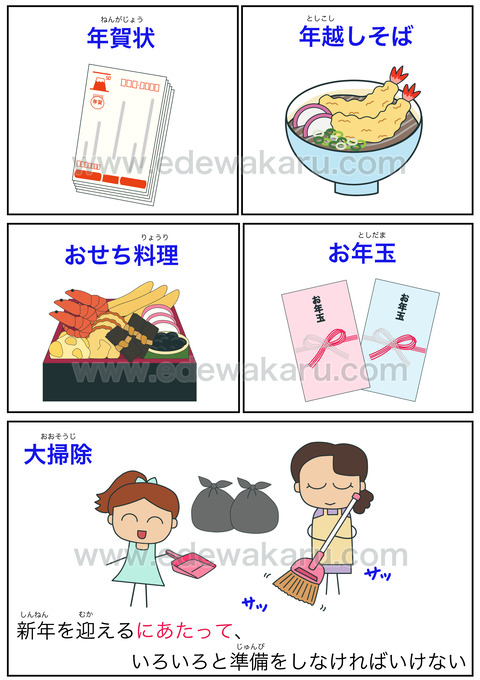
Make preparations for welcoming the New Year.
“〜にあたって” is a formal expression and is not used very much in everyday conversation, but if you’re taking N2 or above, learn it for the test 😊
[Similar patterns]
In context 5 examples
新年を迎えるにあたって、いろいろと準備をしなければいけない
→新年を迎える前に、いろいろと準備をしなければいけないWe have to make various preparations before welcoming the New Year. → We have to make various preparations before welcoming the New Year.
留学するにあたって、必要なものを揃えました
→留学する前に、必要なものを揃えましたI gathered the things I needed before studying abroad. → I gathered the things I needed before studying abroad.
海外旅行(かいがいりょこう)するにあたって、注意すべきことを調べた
→海外旅行する時に、注意すべきことを調べたBefore traveling overseas, I looked up things I should be careful about. → When traveling overseas, I looked up things I should be careful about.
その機械を使うにあたって、説明書をよく読んでください
→その機械を使う前に、説明書をよく読んでくださいPlease read the instruction manual carefully before using that machine. → Please read the instruction manual carefully before using that machine.
イベントを行うにあたって、一言あいさつをさせていただきます
→イベントを行う前に、一言あいさつをさせていただきますBefore holding the event, I’d like to say a few words. → Before holding the event, I’d like to say a few words.
Read the original source text
Meaning
〜する前に〜する
〜する時に〜する
〜という特別な時に
How to use it
動詞[辞書形]+にあたって
名詞[辞書形]+にあたって
Explanation
「AにあたってB」は「Aする時にB」「Aする前にBする」という意味の文型です。「A」には[特別な時]や[重要な時]が入ります。かたい言い方で、スピーチやあいさつをする場合にも使われます。後ろに名詞がくる場合は「〜にあたっての+名詞」になります。「〜にあたり」は「〜にあたって」よりも、さらにかたい言い方です。
[例]
新年を迎える
にあたっての
準備をする
「〜にあたって」はかたい言い方ですので日常会話(にちじょうかいわ)ではあまり使われることがありませんが、N2以上を受ける人はテストのために覚えておきましょう😊
【類似文型】
日本語文型辞典 英語版
Meaning
【にあたり】[Nにあたり][V-るにあたり]
にあたり is a more formal way of saying にあたって.
→
In context 2 examples
代表団の選出にあたり、被選挙人名簿を作成した。
On the occasion of selecting members of the delegation, I compiled a list of eligible people.
今回の企画を実現するにあたりまして、皆様から多大のご支援を賜りましたことを感謝致します。
Upon the completion of this plan, I would like to thank you all for your tremendous support.
くらべてわかる日本語表現文型辞典
Meaning
Meaning 1: When a special situation A arises, (from then on) B.
Meaning 2: Set a goal A and take measure B to achieve it.
How to use it
AにあたりB (AにあたってB/AにあたってのB)
[Verb—る form] にあたり
[Noun—∅] にあたり
Explanation
【Contrast 1】
“Aに際してB” (Meaning 1, p. 229)
Since A in “AにあたりB” is a situation that one actively intends to accept, negative matters are not easily associated with it. “Aに際してB,” however, places no such restriction on A.
○父は死に際して、母に初めてねぎらいの言葉をかけた。 — As my father was dying, he spoke words of appreciation to my mother for the first time.
×父は死にあたって、母に初めてねぎらいの言葉をかけた。 — As my father was dying, he spoke words of appreciation to my mother for the first time.
However, it can be used when conveying the nuance of deliberately resolving to accept A.
○内閣は国家的危機にあたり、機敏な対応がとれなかった。 — Faced with a national crisis, the Cabinet was unable to respond swiftly.
“Aに臨んでB” (Meaning 1, p. 253)
“AうえでB” (Meaning 2, p. 37)
“AにおいてB” (Meaning 4, p. 216)
Notes
【Notes 1, 2】
・“あたり” and “あたって” have the same meaning. This is a stiff expression that is hard to use in everyday conversation.
In context 8 examples
防災強化月間を迎えるにあたり、今年度のスローガンを募集します。
As we enter Disaster Prevention Strengthening Month, we are inviting submissions for this fiscal year’s slogan.
文化祭の開幕にあたり、村長にお言葉をいただきたいと思います。
To mark the opening of the cultural festival, I would like to ask the village mayor to say a few words.
手術を受けるにあたっての十分な説明を受けていない。
I have not received a sufficient explanation about undergoing the surgery.
家を売るにあたり、信頼できる不動産鑑定士に調査を依頼した。
When selling my house, I asked a trustworthy real estate appraiser to assess it.
祭りを成功させるにあたって、みんなの団結が必要だ。
Everyone’s unity is necessary to make the festival a success.
社業繁栄にあたり、さらなる事業計画の見直しに努める。
As our company’s business prospers, we will strive to further review our business plans.
明治政府は条約改正にあたり、まず民主的な憲法の制定を急いだ。
In revising the treaties, the Meiji government first hurried to establish a democratic constitution.
店を拡張するにあたって、銀行から融資を受けることにした。
When expanding the shop, we decided to obtain a loan from a bank.
Read the original source text
Meaning
意味1:特別なAという事態になって、(これから)B。
意味2:Aという目的を設定し、それに対してBという手段を講じる。
How to use it
AにあたりB(AにあたってB/AにあたってのB)
[動詞-る形]にあたり
[名詞-∅]にあたり
Explanation
【対比1】
「Aに際してB」(意味1 P.229)
「AにあたりB」のAは、積極的に受け入れようとする事態であるため、マイナスのことはつきにくいが、「Aに際してB」はAに制約はない。
○父は死に際して、母に初めてねぎらいの言葉をかけた。
×父は死にあたって、母に初めてねぎらいの言葉をかけた。
ただし、あえて覚悟を決めてAを受け入れるというニュアンスでは使うことができる。
○内閣は国家的危機にあたり、機敏な対応がとれなかった。
「Aに臨んでB」(意味1 P.253)
「AうえでB」(意味2 P.37)
「AにおいてB」(意味4 P.216)
Notes
【注意1,2】
・「あたり」と「あたって」は、同じ意味である。日常会話では使いにくい、硬い表現である。
NINJAL 日本語文型データベース
Meaning
Used when you want to say that you do something when undertaking a special event or on the occasion of doing 「〜」.
How to use it
Vるにあたり
Nにあたり
Notes
「〜」 is filled by a word expressing a proactive action. The clause after 「〜にあたり」 often expresses a volitional action.
In context 7 examples
家を購入するにあたり、資金面での計画をファイナンシャルプランナーに相談した。
When purchasing a home, I consulted a financial planner about how to plan my finances.
このマンションを建て替えるにあたり、オーナー会社は来週居住者向けの説明会の開催を予定している。
In connection with rebuilding this apartment building, the owner company plans to hold an information session for residents next week.
市民意識調査を行うにあたり、18歳以上の市内在住者から無作為に1000人を抽出した。
In conducting a public opinion survey, 1,000 residents aged 18 or older were randomly selected.
会員は本サービスを利用するに当たり、次の行為を行ってはならないものとします。
When using this service, members must not engage in the following actions.
この本の執筆にあたり、多くの方にご協力をいただきました。
Many people helped me in writing this book.
治療薬の開発にあたり、動物実験による有効性や安全性の評価が行われてきました。
In developing therapeutic drugs, their efficacy and safety have been evaluated through animal testing.
オリンピックの開催に当たり、「ホストタウン」として参加国・地域との人的・文化的・経済的な交流を図る地方公共団体が募集された。
In connection with hosting the Olympics, local governments were invited to participate as “Host Towns” to promote interpersonal, cultural, and economic exchanges with participating countries and regions.
Read the original source text
Meaning
〜という特別なことをするとき、または〜する機会に、何かをすると言いたいときに使います。
How to use it
Vるにあたり
Nにあたり
Notes
「〜」には、積極的な行為を表す言葉がきます。「〜にあたり」の後には、意志的な行為を表す文がくることが多いです。
DoJG 日本語文法辞典(全集)
Meaning
On the occasion of; at; in; before; prior to
How to use it
(i) Noun | に{当たって/当たり} | |
| 結婚に{当たって/当たり} | On the occasion of the marriage |
(ii) Vinformal nonpast | に{当たって/当たり} | |
| 話すに{当たって/当たり} | On the occasion of talking |
Explanation
に当たって/当たり A compound particle that indicates occasion of doing something or of having done something in formal Japanese.
In context 6 examples
新入社員の入社に{当たって/当たり}社長はホテルでパーティーを開いた。
On the occasion of new employees' entering the company, the president threw a party at a hotel.
和也は大学を卒業するに{当たって/当たり}、指導教官に今後の進路について相談した。
On the occasion of graduating from college, Kazuya consulted with his academic adviser on his future direction.
私の留学に当たり、父は自分の経験を話してくれた。
On the occasion of my study abroad, my father told me about his own experience.
日本の経済を研究するに当たって、国会図書館で資料集めをした。
Before I did research on the Japanese economy, I collected materials at the National Diet Library.
総理はサミット出席に当たり、閣僚と会議をした。
The Premier had a conference with cabinet members before attending the summit.
小説家は時代小説を書くに当たり、その時代の歴史を詳しく調べた。
Before writing a historical novel, the novelist did an in-depth survey of the history of the period he dealt with.