AIUEO JLPT Grammar
Usage 1
Meaning
「とても」is an adverb indicating a very high degree and is used in formal settings and written language. In spoken language, a similar adverb, 「すごく」, is more commonly used. “めっちゃ” is also used, especially among young people, as a casual expression. Similar to "very” in English.
In context 5 examples
こちらの商品は、とても人気があります。
This product is very popular.
お元気そうで、とても嬉しいです。
I’m very glad to see you are well.
この問題はとても難しいですが、頑張ってください。
This problem is very difficult, but do your best.
この提案は、とても重要です。
This proposal is very important.
この条件は、とても有利です。
These terms are very advantageous.
Usage 2
Meaning
This sentence pattern is used to express situations where achieving or accomplishing something feels very difficult or impossible.
How to use it
とても + verb nai-form
In context 5 examples
この本は難しくて、とても読めない。
This book is too difficult, I just can’t read it.
彼のスピーチは早すぎて、とても理解できません。
His speech is too fast, I just can’t understand it.
この荷物は重すぎて、とても持ち上がらない。
This luggage is too heavy, I can’t lift it.
忙しくて、とてもじゃないけど旅行に行けないです。
I'm so busy, there's no way I can go on a trip.
この問題は複雑すぎて、とても解けないです。
This problem is too complex, I can’t solve it.
Read the original source text
Meaning
This sentence pattern is used to express situations where achieving or accomplishing something feels very difficult or impossible.
How to use it
とても+動詞ない形
Explanation · 日本語
この文型は、何かを実現したり、達成したりすることが非常に難しい、または無理だと感じる状況で使われます。
文法
Usage 1
Meaning
Expresses a high degree.
Notes
「とっても」 is also used as an emphatic or casual way of saying 「とても」.
In context 9 examples
この本、とても面白いですよ。
This book is very interesting.
毎日とても忙しいです。
I'm very busy every day.
2月はとても寒いです。
February is very cold.
彼はとてもよく働きます。
He works very hard.
この料理、とても辛いですね。
This dish is very spicy, isn't it?
このカバンはとても高くて、買うことができません。
This bag is very expensive, so I can't buy it.
昨日見た映画はとても面白かった。
The movie I saw yesterday was very interesting.
桜はとてもきれいですね。
Cherry blossoms are very beautiful, aren't they?
アンナさんが作った料理はとても美味しいです。
The food Anna made is very delicious.
Read the original source text
Meaning
程度が大きいことを表す。
Notes
強調した言い方やカジュアルな言い方として「とっても」も使われる。
Usage 2
Meaning
〜cannot do / is absolutely impossible
How to use it
とても + V (ない-form)
In context 5 examples
彼女がせっかく作ってくれた料理をまずいだなんて、とても言えない。
I could never say that the meal she went to the trouble of making for me tastes bad.
たくさんあって、とても食べきれない。
There's so much; I can't possibly eat it all.
日本語の文字がびっしり詰まった本なんで、私にはとても読めません。
It's a book packed full of Japanese writing, so I can't possibly read it.
明日までに、10ページ分の漢字を全部覚えるなんてとてもできない。
There's no way I can memorize all the kanji in ten pages by tomorrow.
今の気持ちはとても言葉では言い表せません。
I can't express how I feel right now in words.
Read the original source text
Meaning
〜できない / 絶対に無理だ
How to use it
とても + V(ナイ形)
絵でわかる日本語
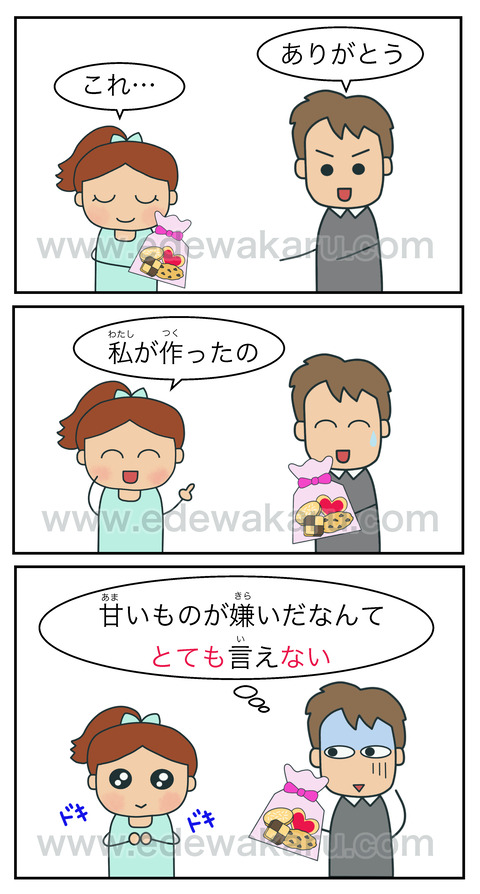
Meaning
Absolutely cannot …
No matter how hard one tries, it is impossible.
Explanation
“とても〜ない” is a sentence pattern meaning “absolutely cannot …” or “impossible no matter how hard one tries.” It is used to emphasize the feeling “I can’t …” or “It’s impossible to ….” 😀
【For intermediate to advanced learners】
A more formal way to say “とても〜ない” is “到底〜ない.”
[Examples]
①甘いものが嫌いだなんて、
とても
言え
ない
=甘いものが嫌いだなんて、
到底
言え
ない
I absolutely can’t say that I hate sweets.
=I absolutely cannot say that I hate sweets.
②このカレーは辛すぎて、
とても
食べられ
ない
=このカレーは辛すぎて、
到底
食べられ
ない
This curry is so spicy that I absolutely can’t eat it.
=This curry is so spicy that I absolutely cannot eat it.
③1時間で単語を1000個覚えるなんて、
とても
でき
ない
=1時間で単語を1000個覚えるなんて、
到底
でき
ない
There’s no way I can memorize 1,000 words in an hour.
=There’s no way I can memorize 1,000 words in an hour.
“到底〜ない” is hardly ever used in conversation. 😅 Use “とても〜ない” in everyday conversation.
In context 3 examples
甘いものが嫌いだなんて、とても言えない(復習:〜なんて)
→甘いものが嫌いだなんて、絶対に言えないI absolutely can’t say that I hate sweets. (Review: 〜なんて) →I absolutely can’t say that I hate sweets.
このカレーは辛すぎて、とても食べられない
→このカレーは辛すぎて、絶対に食べられないThis curry is so spicy that I absolutely can’t eat it. →This curry is so spicy that I absolutely can’t eat it.
1時間で単語を1000個覚えるなんて、とてもできない
→1時間で単語を1000個覚えるなんて、どんなにがんばっても無理だThere’s no way I can memorize 1,000 words in an hour. →No matter how hard I try, it’s impossible to memorize 1,000 words in an hour.
Read the original source text
Meaning
絶対に〜できない
どんなにがんばっても無理だ
Explanation
「とても〜ない」は「絶対に〜できない」「どんなにがんばっても不可能だ」という意味を表す文型です。「〜できない」「〜するのは無理だ」という気持ちを強調したい時に使用されます😀
【中級〜上級レベルの人へ】
「とても〜ない」のかたい言い方は「到底〜ない」です。
[例]
①甘いものが嫌いだなんて、
とても
言え
ない
=甘いものが嫌いだなんて、
到底
言え
ない
②このカレーは辛すぎて、
とても
食べられ
ない
=このカレーは辛すぎて、
到底
食べられ
ない
③1時間で単語を1000個覚えるなんて、
とても
でき
ない
=1時間で単語を1000個覚えるなんて、
到底
でき
ない
「到底〜ない」は、ほとんど会話では使いません😅日常会話(にちじょうかいわ)では「とても〜ない」を使いましょう。
日本語文型辞典
Meaning
Expresses an extreme degree: “very,” “extremely.”
Expresses the speaker's subjective judgment that something is impossible or cannot be done, no matter what means are tried. In writing, it can be paraphrased as 「とうてい…ない」.
How to use it
とても
とても…ない
In context 5 examples
あの映画はとても面白かった。
That movie was very interesting.
今度の新入社員はとてもよく働く。
This new employee works very hard.
こんな難しい問題はとても私には解けません。
I could never solve such a difficult problem.
一度にこんなにたくさんの単語はとても覚えられません。
I could never memorize this many words all at once.
あの美しさはとても言葉では表現できない。
That beauty cannot be expressed in words at all.
Read the original source text
Meaning
程度がはなはだしいことを表す。たいへん、ひじょうに。
どのような方法を尽くしても無理だ、できないという話し手の主観的な判断を表す。書きことばでは「とうてい…ない」と言いかえられる。
How to use it
とても
とても…ない
日本語文型辞典 英語版
Meaning
Expresses an extreme degree of something. Very, remarkably, extremely.
Expresses a subjective judgment by the speaker that something is futile or impossible, no matter what methods or means s/he might try to use. In written language, とても...ない can be replaced by とうてい...ない.
How to use it
1. とても
2. とても...ない
In context 5 examples
あの映画はとても面白かった。
That movie was really interesting!
今度の新入社員はとてもよく働く。
The new employee works very hard.
こんな難しい問題はとても私には解けません。
A problem this difficult is quite impossible for me to solve.
一度にこんなにたくさんの単語はとても覚えられません。
There’s absolutely no way I can memorize so many words all at once.
あの美しさはとても言葉では表現できない。
That kind of beauty really cannot be expressed in words.
Read the original source text
Meaning
Expresses an extreme degree of something. Very, remarkably, extremely.
Expresses a subjective judgment by the speaker that something is futile or impossible, no matter what methods or means s/he might try to use. In written language, とても...ない can be replaced by とうてい...ない.
How to use it
1. とても
2. とても...ない
日本語NET JLPT文法解説まとめ
Meaning
Expresses a high degree.
Explanation
"very"
Indicates that the degree is large.
「とっても」is also used as an emphatic or casual form.
In context 9 examples
この本、とても面白いですよ。
This book is very interesting.
毎日とても忙しいです。
I'm very busy every day.
2月はとても寒いです。
February is very cold.
彼はとてもよく働きます。
He works very hard.
この料理、とても辛いですね。
This dish is very spicy, isn't it?
このカバンはとても高くて、買うことができません。
This bag is very expensive, so I can't buy it.
昨日見た映画はとても面白かった。
The movie I saw yesterday was very interesting.
桜はとてもきれいですね。
Cherry blossoms are very beautiful, aren't they?
アンナさんが作った料理はとても美味しいです。
The food Anna made is very delicious.
Read the original source text
Meaning
程度が大きいことを表す。
Explanation
"very"
Indicates that the degree is large.
強調した言い方やカジュアルな言い方として「とっても」も使われる。
毎日のんびり日本語教師
How to use it
とても~ない
とてもじゃないが~ない
Explanation
“とても~ない” indicates that something is impossible by any means. “とてもじゃないが~ない” is an even more emphatic expression. The following part must be in the negative form.
Notes
Nothing in particular.
In context 7 examples
少し気分転換に行ってこいと言われたが、とてもそんな気分ではない。
I was told to go out and get a change of scenery, but I'm really not in the mood.
この問題はとてもじゃないが、解決出来ないだろう。
There's no way this problem can be solved.
観光で行くなら良いが、住めと言われたらとてもじゃないができない。
It would be fine to go there as a tourist, but if I were told to live there, there is no way I could.
これほどの金額、高校生の私にはとてもじゃないが高くて買えない。
An amount this large is far too expensive for me, a high school student, to buy.
命令するほうは楽だろうが、この仕事、とてもじゃないが1週間ではできない。
Giving orders may be easy, but there's no way this job can be done in a week.
あのギターの速弾き、とてもじゃないが真似できない。
There's no way I could imitate that guitar's fast picking.
今日も疲れた。とてもじゃないが家でメシを作る気にはなれない。
I'm tired again today. There's no way I feel like cooking at home.
Read the original source text
How to use it
とても~ない
とてもじゃないが~ない
Explanation
「とても~ない」はいかなる方法をもってしても不可能であることを表します。「とてもじゃないが~ない」はそれよりもさらに強調した表現です。後項には必ず否定形が呼応します。
Notes
特になし
Bunpro Grammar Reference
Meaning
Not ~ at all, Cannot ~ at all
How to use it
とても + Verb[ない]
Nuance
An expression meaning not at all (A), or (A) is impossible. Literally, in every way, not (A).
Explanation
When seen in sentences containing verbs negated with the auxiliary verb ない, とても carries the nuance of 'not (A) at all', or 'cannot (A) at all'. とても is supposed to only be used when expressing 'impossibility', 不可能. Due to this, it will primarily appear alongside the potential form of verbs.
その考え方はとても理解できない。
I cannot understand that way of thinking at all.
彼はいつも嘘ばかり言うから、彼の言う事はとても信じられない。
He always just lies, so I cannot trust what he says at all.
Fun Fact
As long as some part of the sentence expresses the speaker's view about the impossibility of (A), the verb is not always required to be in the negative form.
彼に子供ができたの!?彼が親になることを想像するのはとても無理だ。
He has a baby coming? I cannot imagine him becoming a parent at all.
どこの航空会社も今はチケットを売っていないから、旅行をするのがとても無理だ。
No airline company is selling airline tickets, so it is not possible to travel at all.
In context 16 examples
- とても考えられない。
I cannot think of it at all.
- その考え方はとても理解できない。
I cannot understand that way of thinking at all.
- 彼はいつも嘘ばかり言うから、彼の言う事はとても信じられない。
He always just lies, so I cannot trust what he says at all.
- とても観光できない。
I cannot do any sight-seeing at all.
- とても観察できない。
I cannot do any observations at all.
- とても完成させられない。
I cannot complete it at all.
- とても記憶できない。
I can't memorize anything at all.
- 僕にはとても車は買えません。
I cannot buy a car at all.
- 君の能力にはとても敵わない。
I am no match for your abilities at all.
- そんなうまい話、とても信じられません。
It's too good to be true, I cannot believe it at all.
- 今の僕の力ではとても歯が立たない。
I have no chance at all of beating him/her with my current ability.
- 僕は寒がりだから、北海道の寒さにはとても耐えられません。
I am sensitive to the cold, so I can't stand Hokkaido's chill at all.
- こんなにたくさん出されても、とても食べ切れないよ。
Even if all of these foods are provided, there is no way at all that I will be able to eat it all.
- 君の考えはとても理解できない。
I can't understand your thinking at all.
- 彼に子供ができたの!?彼が親になることを想像するのはとても無理だ。
He has a baby coming? I cannot imagine him becoming a parent at all.
- どこの航空会社も今はチケットを売っていないから、旅行をするのがとても無理だ。
No airline company is selling airline tickets, so it is not possible to travel at all.
Read the original source text
Meaning
Not ~ at all, Cannot ~ at all
How to use it
とても + Verb[ない]
Nuance
An expression meaning not at all (A), or (A) is impossible. Literally, in every way, not (A).
Explanation
When seen in sentences containing verbs negated with the auxiliary verb ない, とても carries the nuance of 'not (A) at all', or 'cannot (A) at all'. とても is supposed to only be used when expressing 'impossibility', 不可能. Due to this, it will primarily appear alongside the potential form of verbs.
その考え方はとても理解できない。
I cannot understand that way of thinking at all.
彼はいつも嘘ばかり言うから、彼の言う事はとても信じられない。
He always just lies, so I cannot trust what he says at all.
Fun Fact
As long as some part of the sentence expresses the speaker's view about the impossibility of (A), the verb is not always required to be in the negative form.
彼に子供ができたの!?彼が親になることを想像するのはとても無理だ。
He has a baby coming? I cannot imagine him becoming a parent at all.
どこの航空会社も今はチケットを売っていないから、旅行をするのがとても無理だ。
No airline company is selling airline tickets, so it is not possible to travel at all.
Nuance · 日本語
(A)とは全く違う、(A)はあり得ないということを表す表現。文字通り、(A)とは違う。
Explanation · 日本語
「とても〜ない」は、動詞の否定形を含む文に、「とても」を付けた形で、「絶対に (A) はできない」という意味を表します。「とても」は、不可能だというときに使われるので、多くの場合、動詞は可能形になります。
その考え方はとても理解できない。
I cannot understand that way of thinking at all.
彼はいつも嘘ばかり言うから、彼の言う事はとても信じられない。
He always just lies, so I cannot trust what he says at all.
豆知識
話し手が「(A) は不可能だ」と感じていることがわかる文なら、動詞が否定形である必要はありません。
彼に子供ができたの!?彼が親になることを想像するのはとても無理だ。
He has a baby coming? I cannot imagine him becoming a parent at all.
どこの航空会社も今はチケットを売っていないから、旅行をするのがとても無理だ。
No airline company is selling airline tickets, so it is not possible to travel at all.