絵でわかる日本語
Usage 1
Read this source entry ↗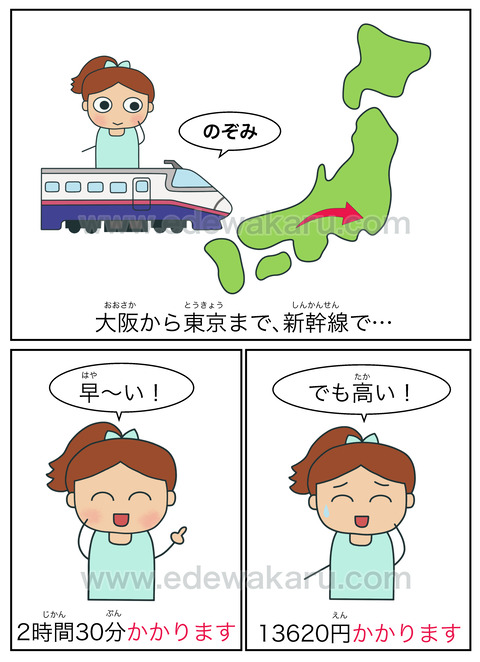
Meaning
~ hours are needed
~ yen are needed
How to use it
time + かかる
amount of money + かかる
Explanation
“〜かかる” is used with [time] or [amount of money] to mean “〇〇 hours are needed” or “〇〇 yen are needed.” For [time], expressions such as “〜秒・〜分・〜時間・〜日・〜週間・〜か月・〜年” are used. For [amount of money], “yen,” “dollars,” “euros,” etc. are used. 😊
(Review: 〜など・〜なんか・〜なんて)
[Be careful]
When “〇〇時間” or “〇〇円” comes before “〜かかる,” the particle “が” is not inserted. But when simply saying “time” or “money,” “が” is used. 😨
[Examples]
⭕️ The repair will take five days.
❌ The repair will take five daysが.
⭕️ The repair will cost 10,000 yen.
❌ The repair will cost 10,000 yenが.
❌ The repair takes time.
⭕️ The repair takes timeが.
❌ The repair costs money.
⭕️ The repair costs moneyが.
This pattern is taught at the beginner level, but it is used very frequently in conversation, so review it 😉
In context 4 examples
大阪から東京まで、新幹線で2時間30分かかります
→大阪から東京まで、新幹線で2時間30分必要ですIt takes two hours and thirty minutes to get from Osaka to Tokyo by Shinkansen. → It requires two hours and thirty minutes to get from Osaka to Tokyo by Shinkansen.
大阪から東京まで、新幹線で13620円かかります
→大阪から東京まで、新幹線で13620円必要ですIt costs 13,620 yen to get from Osaka to Tokyo by Shinkansen. → It requires 13,620 yen to get from Osaka to Tokyo by Shinkansen.
車を修理するのに1万円かかった
→車を修理するのに1万円必要だったIt cost 10,000 yen to repair the car. → It required 10,000 yen to repair the car.
ひらがなを覚えるのに1か月かかっちゃった
→ひらがなを覚えるのに1か月必要だった(復習:口語形「〜ちゃう・〜じゃう」)It ended up taking a month to memorize hiragana. → It took a month to memorize hiragana. (Review: colloquial forms “〜ちゃう・〜じゃう”)
Read the original source text
Meaning
〜時間必要だ
〜円必要だ
How to use it
時間+かかる
金額+かかる
Explanation
「〜かかる」は【時間】や【金額】について「〇〇時間必要だ」「〇〇円必要だ」という意味を表します。【時間】には「〜秒・〜分・〜時間・〜日・〜週間・〜か月・〜年」などを使います。また【金額】には「円・ドル・ユーロ」などが使われます😊
(復習:〜など・〜なんか・〜なんて)
【注意しましょう】
「〜かかる」の前に、「〇〇時間」「〇〇円」がくる場合は助詞の「が」を入れませんが、単に「時間」「お金」という場合には「が」が入ります😨
[例]
⭕️修理に5日
かかります
❌修理に5日が
かかります
⭕️修理に1万円
かかります
❌修理に1万円が
かかります
❌修理に時間
かかります
⭕️修理に時間が
かかります
❌修理にお金
かかります
⭕️修理にお金が
かかります
初級で勉強する文型ですが、会話でもとてもよく使いますので復習をしておきましょう😉
Usage 2
Read this source entry ↗Meaning
~ hours are needed
~ yen are needed
How to use it
time + かかる
amount of money + かかる
Explanation
“〜かかる” is used with [time] or [amount of money] to mean “〇〇 hours are needed” or “〇〇 yen are needed.” For [time], expressions such as “〜秒・〜分・〜時間・〜日・〜週間・〜か月・〜年” are used. For [amount of money], “yen,” “dollars,” “euros,” etc. are used. 😊
(Review: 〜など・〜なんか・〜なんて)
[Be careful]
When “〇〇時間” or “〇〇円” comes before “〜かかる,” the particle “が” is not inserted. But when simply saying “time” or “money,” “が” is used. 😨
[Examples]
⭕️ The repair will take five days.
❌ The repair will take five daysが.
⭕️ The repair will cost 10,000 yen.
❌ The repair will cost 10,000 yenが.
❌ The repair takes time.
⭕️ The repair takes timeが.
❌ The repair costs money.
⭕️ The repair costs moneyが.
This pattern is taught at the beginner level, but it is used very frequently in conversation, so review it 😉
In context 4 examples
大阪から東京まで、新幹線で2時間30分かかります
→大阪から東京まで、新幹線で2時間30分必要ですIt takes two hours and thirty minutes to get from Osaka to Tokyo by Shinkansen. → It requires two hours and thirty minutes to get from Osaka to Tokyo by Shinkansen.
大阪から東京まで、新幹線で13620円かかります
→大阪から東京まで、新幹線で13620円必要ですIt costs 13,620 yen to get from Osaka to Tokyo by Shinkansen. → It requires 13,620 yen to get from Osaka to Tokyo by Shinkansen.
車を修理するのに1万円かかった
→車を修理するのに1万円必要だったIt cost 10,000 yen to repair the car. → It required 10,000 yen to repair the car.
ひらがなを覚えるのに1か月かかっちゃった
→ひらがなを覚えるのに1か月必要だった(復習:口語形「〜ちゃう・〜じゃう」)It ended up taking a month to memorize hiragana. → It took a month to memorize hiragana. (Review: colloquial forms “〜ちゃう・〜じゃう”)
Read the original source text
Meaning
〜時間必要だ
〜円必要だ
How to use it
時間+かかる
金額+かかる
Explanation
「〜かかる」は【時間】や【金額】について「〇〇時間必要だ」「〇〇円必要だ」という意味を表します。【時間】には「〜秒・〜分・〜時間・〜日・〜週間・〜か月・〜年」などを使います。また【金額】には「円・ドル・ユーロ」などが使われます😊
(復習:〜など・〜なんか・〜なんて)
【注意しましょう】
「〜かかる」の前に、「〇〇時間」「〇〇円」がくる場合は助詞の「が」を入れませんが、単に「時間」「お金」という場合には「が」が入ります😨
[例]
⭕️修理に5日
かかります
❌修理に5日が
かかります
⭕️修理に1万円
かかります
❌修理に1万円が
かかります
❌修理に時間
かかります
⭕️修理に時間が
かかります
❌修理にお金
かかります
⭕️修理にお金が
かかります
初級で勉強する文型ですが、会話でもとてもよく使いますので復習をしておきましょう😉
IMABI
The Verbs かかる & かける
Read this IMABI lesson ↗Explanation
The Verbs かかる & かける
The verbs かかる (intransitive) and かける (transitive) are by far two of the most extensively used verbs in Japanese. Aside from the specific かかる and かける being discussed in this lesson, there are also other homophonous “かかる” and “かける” verbs.
The Independent Verbs かける・かかる
Transitivity Note: Note that the translations take advantage of the lack of morphologically distinct transitive and intransitive forms for most verbs in English. When necessary, notes will be provided.
漢字 Note: These verbs are typically written in ひらがな. 掛ける・掛かる is typically alright. When there is another spelling common for a particular nuance, this will be evident in the examples and noted.
1. To hang; sit; weigh on; attach/wear.
1. 出口に注意の標識をかけたので、災害があったら、安全に逃げられるだろう。
Since we hung a warning sign at the exit, if there were a disaster, people could escape safely.
2. 空に美しい虹が懸かることは神の意の印の一つであるという。
They say that a beautiful rainbow hanging in the sky is one of the signs of God’s will.
3. ローマ帝国では罪人が十字架に架けられた。
Sinners were hung on crosses in the Roman Empire.
4. 山の頂上に白雲がかかっていた。
White clouds wrapped around the tops of the mountains.
5. 調査委員会に圧力が掛かった。
Pressure hung over the investigation commission.
6. 心配をかけてごめんね。
Sorry for making you worry.
7. 優勝がかかってるぞ。(Masculine)
Victory is at our reach!
8. ハンドルに手を掛ける。
To sit one’s hand on a handle.
9. 積荷がずしりとかかっていたから、どんどん腕が痛くなってきた。
The pain was quickly getting worse because of the load weighing down on my arms.
10. 重心を失って左足に躓きかけてしまう。
To end up weighing down and stumbling on one’s left foot (by) losing one’s balance.
11. 彼は眼鏡を掛けた。
He wore glasses.
12. 試験のことなど歯牙にもかけないやつだな。
He’s a guy that pays no attention to stuff like the exam, isn’t he?
漢字Note: Usually in かな. Most commonly written in 漢字 as 掛ける・掛かる. For a true physical sense of “to hang/be hung”, use 架ける・架かる. 懸ける・懸かる gives a sense of hanging over.
2. To do with a tool of some sort; only a usage of かける.
13. エンジンをかける。
To start an engine.
14. 午前6時に目覚まし時計をかけた。
I set an alarm for 6 A.M.
15. 一晩中ラジオの音がかかっていた。
The sound of the radio was going on all night long.
16. CDをかける。
To play a CD.
17. 袖にミシンをかける。
To use a sewing machine on a sleeve.
18. 清掃員が廊下に掃除機をかけたが、生徒は一週間でまた汚した。
Although the janitor vacuumed the hallway, the students made it messy again in just a week.
19. 両手に手錠がかかった。
The cuffs were locked on both his hands.
20. 戸に鍵をかけたか。
Did you lock the door with the key?
3. In 目に掛かる meaning “to keep in one’s eyes”. In honorifics, it is the humble form of 見る. And, にお目に掛かる is an honorific equivalent of お会いにする.
21. 半弓を似て目にかかる敵を射て
Shoot the enemy in one’s eyes resembling a small bow
From 鷗外
22. お初にお目にかかります。
It’s a pleasure to meet you.
4. Without seeing a resolution and the mind unsettled. In a transitive sense, it is closest to not forgetting anything.
23. 今日一日中、試験の結果のことが気にかかっていたんだ。
The results of the exam hung in my mind all day long.
24. いつも私のことを心に懸けて下さってありがたいことです。
I am grateful that you always kept me in mind.
25. 思いを懸ける。
To burden with thought.
漢字 Note: Often written with 懸ける・懸かる.
5. To span; to straddle; wrap around.
26. 多摩川に鉄橋を架ける。
To build a steel bridge over the Tama River.
27. 本州・四国間に橋が架かっている。
A bridge spans between Honshu and Shikoku.
28. アオカケスが軒下に巣をかけることが多い。
Blue jays often build nests in the overhangs of roofs.
29. 泥棒に縄をかけたよ。
I bound the rope on the burglar!
30. 肩に襷をかける。
Idiom: To exaggerate one’s circle in a conversation.
漢字 Note: Excluding the last two examples, this usage is usually spelled with 架ける・架かる.
6. To fictionalize; perform.
31. 芝居小屋を掛ける。
To fictionalize theater.
32. 公園に芝居がかかっている。
Drama is being played in the park.
33. 忠臣蔵がかかっている。
A play based off of the 47 ronin is being played.
7. To squirt; to pour spices on; cover; set on fire (which is covering fire over something).
34. この料理の最後の手順はフライにソースをかけることだ。
The last thing in making this dish is putting sauce in the fry pan.
35. 庭木に水をかけましたか。
Did you squirt water on the garden trees?
36. 埃が頭にかかった。
Dust dropped onto my head.
37. クラッシュドレッドペッパーのかかったスパゲッティはおいしい!
Spaghetti with red pepper poured on it is delicious!
38. 日本では布団をかけて寝ますよ。
In Japan, you sleep on a futon.
39. 我々は敵の城に火をかけた。
We set the enemy’s castle on fire.
8. To offer words.
40. 彼に後ほどお礼の電話を掛けさせていただきます。
I will give him a telephone call of gratitude.
41. 声をかけたが、まだ聞こえなかったようだ。
I raised my voice, but it looks like he still couldn’t hear.
42. 若旦那からお座敷がかかりました。
A gathering was made from the young master.
Cultural Note: A 座敷 was a gathering one was invited to perform as a geisha.
43. 発破をかける。
To motivate someone with harsh words.
9. A skill is done on an opponent well. Deceiving and trapping are good examples.
44. 王女に魔法をかけよう!
Let’s put a spell on the queen!
45. 睡眠術に掛かる。
To be under hypnosis.
46. ぺてんにかけて金品を奪う。
To trick and mug.
47. 詐欺に(引っ)かかった。
I was tricked in a fraud.
48.猪いのししをかける。
To trap a wild boar.
49. 逃走犯を検問にかけた。
I trapped an escapee in examination.
10. To wish for divine help.
50. 合格できますようにと神様に願を懸けました。
I prayed to God in order to pass.
51. 望みをかける。
To wish for hope.
漢字 Note: 懸ける is the most common spelling.
11. To cost time, expenses, labor; to tax.
52. 完成までに二年かかったうえに、十億円かかった。
It cost two years and a billion dollars by completion.
53. 出入時には保護関税がかかる。
There is a protective tariff during exporting.
54. 所得税をかける。
To impose an income tax.
55. 12日朝からは、復旧作業が始まっているということですが、発電所の安全確認などには時間がかかりそうだということです。
Restoration efforts are said to be starting from the morning of the 12th, but the confirmation of safety of the power plants will take time.
From NHK following the 2011 earthquake.
12. ~にかけて(は): See Lesson 177.
13. In “鼻にかける” meaning “to boast” or in “鼻にかかる” referring to hanging in the nose.
56. 自分の日本語の能力を鼻にかける。
To boast about one’s Japanese skills.
57. 先生の声が風邪で鼻にかかって聞き苦しかったよ。
The teacher’s voice hanged in his nose due to a cold and was unpleasant to hear.
14. To come to.
58. 道路が湖畔にかかる辺りで新車が故障したみたいだ。
It looks like a new car is broken-down coming near the bank passing the road on the lake shore.
59. 勝負は終盤にかかってとても緊迫した展開となりました。
The match came to its final stage and became a very tense development.
15. To be a part; undertaken in; only a usage of かかる.
60. 映画の創作にこれからかかるとしたら、どんなことをするだろう。
If I were to be a part in the production of a movie, what kind of things would I do?
61. 整理にかかっている。
To be engaged in organizing.
62. 今すぐ準備にかかれ。
Be getting prepared right now!
63. 明日の仕事にかかるまでしばらく休もう。
Let’s sleep for a while until we undertake in tomorrow’s work.
16. To be produced due to an effect.
64. 髪にパーマをかけた。
I got a perm in my hair.
65. 仕事にエンジンがかかった。 (Idiomatic)
To get back to normal in one’s job.
66. 磨きをかけることはいいことです。
Polishing up (one’s skills) is always a good thing.
17. にかけて shows the “to” that you swear “to”.
67. 神にかけて誓った。
I swore to God.
68. 神仏に懸けて誓うのはよくないです。
Swearing to God is bad.
漢字 Note: Either spelled as 懸ける or 賭ける, but the latter spelling is the most common.
18. To carry out something while prepared to lose; only a usage of かける.
69. 威信を賭けて戦うのは賢い決意だというわけではありません。
Fighting through with one’s dignity is not a wise decision.
70. 一発逆転を懸ける。
To turn the tables around.
71. ポーカーに沢山の金を賭ける。
To gamble a lot of money in poker.
72. 雨が降る降らないに昼飯をかけるのは子供っぽいゲームじゃないか。
Isn’t betting your lunch on whether it’s going to rain or not a childish game?
漢字 Note: 賭ける is the most important spelling.
19. In “…てかかる” meaning “to cope with”.
73. 敵を嘗めてかかる。
To deal with an enemy putting him down.
74. 心してかかることが肝心です。
Things you carefully cope with are crucial.
20. In “にかかる” following the 連用形 of a transitive verb meaning “to do…as an action of starting out”.
75. 弱いと見るとすぐさま脅おどしにかかるのは自然な反応ではないか。
Isn’t starting to threaten someone immediately when you see them as being weak a natural reaction?
76. 引き止めにかかったが、どうしても応じなかったんだ。
I started to restrain (him), but I didn’t get (him) to comply in the long run.
Usage Note: This usage is not used to show habit and is used to show a temporary action.
21. In “(よ)うとかかる”, a stronger version of “(よ)うとする”.
77. 彼はあの手この手で説得しようとかかってきたが、結局説得できなかったよ。
He tried to persuade us this way and that, but he couldn’t persuade us (about) anything well.
22. To fight against; only a usage of かかる.
78. 不良が突っかかってきた。
A delinquent charged at me.
79. 者ども、掛かれ!
Men, fight!
23. To receive medical care or a doctor’s examination.
80. すぐにお医者さんにかかりなさい。
Please have a doctor see you immediately.
81. 重症ですから、すぐ医者にかかるべきですよ。
Because it’s a serious illness, you should see a doctor soon.
24. To sell at an auction; only a usage of かける.
82. 競売にかける。
To hold auction.
25. To adopt legislation or measures; bind an agreement.
83. 事件を裁判にかけます。
We will give a judgment in the case.
84. 案件を会議に懸けました。
We adopted the matter in question in the meeting.
85. 毒殺事件が裁判にかけられた。
A judgment was given in the poisoning case.
86. 自分の生命に保険をかけるのはとても大切なのです。
To get an insurance agreement for one’s own life is very important.
漢字 Note: 懸ける・懸かる is most appropriate. However, it is usually written in ひらがな.
26. To carry traits or tendencies; only a usage of かかる.
87. 青みのかかった緑色
Blue-tinged green
88. 彼は凄みのかかった顔で睨み付けた。
He glared at me with a ghastly look.
27. To dispose of oneself.
89. 自らの手にかける。
To kill oneself with one’s own hands.
90. 敵の手にかかる。
To be disposed of by the enemy’s hand.
28. “To be concerned”, “be the work of”, or “to concern”. Only a usage of 係る.
91. 止利仏師の制作にかかった仏像でございます。
This is a Buddhist statue in the image of the works of Toribusshi.
92. 賜杯の行方は大名の活躍に係っている。
The whereabouts of the Emperor’s cup is controlled by the great efforts of the Daimyo.
93. 試合の成否は努力いかんに係っている。
The outcome of the contest depends on your effort.
94. この副詞の意味は文末の動詞に係っている。
The meaning of this adverb is linked to the verb at the end of the sentence.
29. To give a ball an extraordinary rotation; only a usage of かける.
95. 打球に回転をかける。
To have one’s ball spin.
30. To multiply; only a usage of かける.
96. 8×(かける)2は16。
8 times 2 equals 16.
31. To overcharge; only a usage of かける.
97. 定価に二倍をかけて売る。
To buy at two times the standard price.
32. To pay bills regularly; only a usage of かける.
98. 保険金をかけている。
I’m paying insurance.
33. To crossbreed; only a usage of かける.
99. 雌馬にロバをかける。
To breed a female horse with a donkey.
34. To play on words; only a usage of かける.
100. 『秋風ぞ立つ』の『秋』に『飽き』をかける。
To imply “weariness” in the “autumn” of “rise autumn wind”.
The Suffix -かかる
1. Same as usage 26 from earlier with the only difference being that it attaches itself to nouns instead.
101. あいつは左がかった意見を持ってるね。
That guy has a leftist opinion, doesn’t he.
2. Shows the possession of color traits.
102. オレンジがかった赤い色
An orange tinted red color
103. 黒みがかった紺色
A black tinted navy blue
104. 娘はむらさきと白の細かい矢がすりのきものに、臙脂えんじがかったむらさきの袴をはいていた。
She was wearing a fine white and purple arrow feather kimono atop a rouge-tinged hakama.
From 不死 by 川端康成.
罹る
This “かかる” verb means “to catch a disease” or “to be caught in a problem”.
105. いとこは食中毒に罹った。
My cousin got food poisoning.
106. 結核に罹ると、ときどき命の危険がある。
When you get tuberculosis, there may be a risk to your life.
107. 放射線を浴びて、原子病に罹ってしまう。
To contract radiation sickness from radiation.
The 連体詞 斯かる
斯かる is the classical version of このような.
欠ける
This “かける” verb is intransitive, and its transitive form is 欠く.
1. For a part of a sold item to break of; to chip.
108. 机の縁が欠けた。
The edge of the desk got chipped.
109. コーヒーカップの取っ手が欠けてしまったから、滴がじんわりと漏れてるよ。
Because the coffee cup’s handle accidentally got chipped, drops are slowly leaking.
2. To be missing.
110. グループのメンバーの三人が欠けている。
Three people are missing out of the group.
111. この取扱説明書は5ページ欠けています。
There are 5 pages missing in this user’s manual.
3. To lack; to be negligent toward.
112. 攻撃は決め手に欠けたから、失敗した。
Because the attack lacked a decisive move, it filled.
113. 最新記録に一秒欠ける。
To lack 1 second of a record.
114. 1ドルから一セント欠ける。
To lack a cent from a dollar.
4. To wane.
115. 満月が段々円形でなくなるのは常識だ。
A full moon waning gradually losing in round shape is common knowledge.
翔ける
This “かける” verb is transitive and means “to fly through the heavens”.
116. 魂魄が天空を翔ける。
Souls fly through the heavens.
駆・駈ける
This “かける” verb has two usages related to each other and is transitive. It either means “to dash” or “to fly through the sky”.
117. 神風が大空を駈けた。
Divine wind flew through the skies.
118. 時空を駆ける。
To dash through time and space.
119. 虎が熱帯林を駆けた。
The tiger dashed through the tropical forest.
The Potential Form of Verbs
Finally, to end this lesson, かける may also be the potential form of the verbs to write 書く, to scratch 掻く, and to draw 描く.
120. 漢字で書けない。
I can’t write in Kanji.
121. 美しい絵が描ける。
To be able to draw a beautiful picture.
In context 141 examples
出口に注意の標識をかけたので、災害があったら、安全に逃げられるだろう。
Since we hung a warning sign at the exit, if there were a disaster, people could escape safely.
空に美しい虹が懸かることは神の意の印の一つであるという。
They say that a beautiful rainbow hanging in the sky is one of the signs of God’s will.
ローマ帝国では罪人が十字架に架けられた。
Sinners were hung on crosses in the Roman Empire.
山の頂上に白雲がかかっていた。
White clouds wrapped around the tops of the mountains.
調査委員会に圧力が掛かった。
Pressure hung over the investigation commission.
心配をかけてごめんね。
Sorry for making you worry.
優勝がかかってるぞ。(Masculine)
Victory is at our reach!
ハンドルに手を掛ける。
To sit one’s hand on a handle.
積荷がずしりとかかっていたから、どんどん腕が痛くなってきた。
The pain was quickly getting worse because of the load weighing down on my arms.
重心を失って左足に躓きかけてしまう。
To end up weighing down and stumbling on one’s left foot (by) losing one’s balance.
彼は眼鏡を掛けた。
He wore glasses.
試験のことなど歯牙にもかけないやつだな。
He’s a guy that pays no attention to stuff like the exam, isn’t he?
To do with a tool of some sort; only a usage of かける.
To start an engine.
エンジンをかける。
To start an engine.
午前6時に目覚まし時計をかけた。
I set an alarm for 6 A.M.
一晩中ラジオの音がかかっていた。
The sound of the radio was going on all night long.
CDをかける。
To play a CD.
袖にミシンをかける。
To use a sewing machine on a sleeve.
清掃員が廊下に掃除機をかけたが、生徒は一週間でまた汚した。
Although the janitor vacuumed the hallway, the students made it messy again in just a week.
両手に手錠がかかった。
The cuffs were locked on both his hands.
戸に鍵をかけたか。
Did you lock the door with the key?
In 目に掛かる meaning “to keep in one’s eyes”. In honorifics, it is the humble form of 見る. And, にお目に掛かる is an honorific equivalent of お会いにする.
Shoot the enemy in one’s eyes resembling a small bow
半弓を似て目にかかる敵を射て
Shoot the enemy in one’s eyes resembling a small bow
お初にお目にかかります。
It’s a pleasure to meet you.
今日一日中、試験の結果のことが気にかかっていたんだ。
The results of the exam hung in my mind all day long.
いつも私のことを心に懸けて下さってありがたいことです。
I am grateful that you always kept me in mind.
思いを懸ける。
To burden with thought.
多摩川に鉄橋を架ける。
To build a steel bridge over the Tama River.
本州・四国間に橋が架かっている。
A bridge spans between Honshu and Shikoku.
アオカケスが軒下に巣をかけることが多い。
Blue jays often build nests in the overhangs of roofs.
泥棒に縄をかけたよ。
I bound the rope on the burglar!
肩に襷をかける。
Idiom: To exaggerate one’s circle in a conversation.
芝居小屋を掛ける。
To fictionalize theater.
公園に芝居がかかっている。
Drama is being played in the park.
忠臣蔵がかかっている。
A play based off of the 47 ronin is being played.
この料理の最後の手順はフライにソースをかけることだ。
The last thing in making this dish is putting sauce in the fry pan.
庭木に水をかけましたか。
Did you squirt water on the garden trees?
埃が頭にかかった。
Dust dropped onto my head.
クラッシュドレッドペッパーのかかったスパゲッティはおいしい!
Spaghetti with red pepper poured on it is delicious!
日本では布団をかけて寝ますよ。
In Japan, you sleep on a futon.
我々は敵の城に火をかけた。
We set the enemy’s castle on fire.
彼に後ほどお礼の電話を掛けさせていただきます。
I will give him a telephone call of gratitude.
声をかけたが、まだ聞こえなかったようだ。
I raised my voice, but it looks like he still couldn’t hear.
若旦那からお座敷がかかりました。
A gathering was made from the young master.
発破をかける。
To motivate someone with harsh words.
王女に魔法をかけよう!
Let’s put a spell on the queen!
睡眠術に掛かる。
To be under hypnosis.
ぺてんにかけて金品を奪う。
To trick and mug.
詐欺に(引っ)かかった。
I was tricked in a fraud.
猪いのししをかける。
To trap a wild boar.
逃走犯を検問にかけた。
I trapped an escapee in examination.
合格できますようにと神様に願を懸けました。
I prayed to God in order to pass.
望みをかける。
To wish for hope.
完成までに二年かかったうえに、十億円かかった。
It cost two years and a billion dollars by completion.
出入時には保護関税がかかる。
There is a protective tariff during exporting.
所得税をかける。
To impose an income tax.
12日朝からは、復旧作業が始まっているということですが、発電所の安全確認などには時間がかかりそうだということです。
Restoration efforts are said to be starting from the morning of the 12th, but the confirmation of safety of the power plants will take time.
~にかけて(は): See Lesson 177.
To boast about one’s Japanese skills.
In “鼻にかける” meaning “to boast” or in “鼻にかかる” referring to hanging in the nose.
To boast about one’s Japanese skills.
自分の日本語の能力を鼻にかける。
To boast about one’s Japanese skills.
先生の声が風邪で鼻にかかって聞き苦しかったよ。
The teacher’s voice hanged in his nose due to a cold and was unpleasant to hear.
道路が湖畔にかかる辺りで新車が故障したみたいだ。
It looks like a new car is broken-down coming near the bank passing the road on the lake shore.
勝負は終盤にかかってとても緊迫した展開となりました。
The match came to its final stage and became a very tense development.
To be a part; undertaken in; only a usage of かかる.
If I were to be a part in the production of a movie, what kind of things would I do?
映画の創作にこれからかかるとしたら、どんなことをするだろう。
If I were to be a part in the production of a movie, what kind of things would I do?
整理にかかっている。
To be engaged in organizing.
今すぐ準備にかかれ。
Be getting prepared right now!
明日の仕事にかかるまでしばらく休もう。
Let’s sleep for a while until we undertake in tomorrow’s work.
髪にパーマをかけた。
I got a perm in my hair.
仕事にエンジンがかかった。 (Idiomatic)
To get back to normal in one’s job.
磨きをかけることはいいことです。
Polishing up (one’s skills) is always a good thing.
にかけて shows the “to” that you swear “to”.
I swore to God.
神にかけて誓った。
I swore to God.
神仏に懸けて誓うのはよくないです。
Swearing to God is bad.
To carry out something while prepared to lose; only a usage of かける.
Fighting through with one’s dignity is not a wise decision.
威信を賭けて戦うのは賢い決意だというわけではありません。
Fighting through with one’s dignity is not a wise decision.
一発逆転を懸ける。
To turn the tables around.
ポーカーに沢山の金を賭ける。
To gamble a lot of money in poker.
雨が降る降らないに昼飯をかけるのは子供っぽいゲームじゃないか。
Isn’t betting your lunch on whether it’s going to rain or not a childish game?
In “…てかかる” meaning “to cope with”.
To deal with an enemy putting him down.
敵を嘗めてかかる。
To deal with an enemy putting him down.
心してかかることが肝心です。
Things you carefully cope with are crucial.
In “にかかる” following the 連用形 of a transitive verb meaning “to do…as an action of starting out”.
Isn’t starting to threaten someone immediately when you see them as being weak a natural reaction?
弱いと見るとすぐさま脅おどしにかかるのは自然な反応ではないか。
Isn’t starting to threaten someone immediately when you see them as being weak a natural reaction?
引き止めにかかったが、どうしても応じなかったんだ。
I started to restrain (him), but I didn’t get (him) to comply in the long run.
In “(よ)うとかかる”, a stronger version of “(よ)うとする”.
He tried to persuade us this way and that, but he couldn’t persuade us (about) anything well.
彼はあの手この手で説得しようとかかってきたが、結局説得できなかったよ。
He tried to persuade us this way and that, but he couldn’t persuade us (about) anything well.
To fight against; only a usage of かかる.
A delinquent charged at me.
不良が突っかかってきた。
A delinquent charged at me.
者ども、掛かれ!
Men, fight!
すぐにお医者さんにかかりなさい。
Please have a doctor see you immediately.
重症ですから、すぐ医者にかかるべきですよ。
Because it’s a serious illness, you should see a doctor soon.
To sell at an auction; only a usage of かける.
To hold auction.
競売にかける。
To hold auction.
事件を裁判にかけます。
We will give a judgment in the case.
案件を会議に懸けました。
We adopted the matter in question in the meeting.
毒殺事件が裁判にかけられた。
A judgment was given in the poisoning case.
自分の生命に保険をかけるのはとても大切なのです。
To get an insurance agreement for one’s own life is very important.
To carry traits or tendencies; only a usage of かかる.
Blue-tinged green
青みのかかった緑色
Blue-tinged green
彼は凄みのかかった顔で睨み付けた。
He glared at me with a ghastly look.
自らの手にかける。
To kill oneself with one’s own hands.
敵の手にかかる。
To be disposed of by the enemy’s hand.
“To be concerned”, “be the work of”, or “to concern”. Only a usage of 係る.
This is a Buddhist statue in the image of the works of Toribusshi.
止利仏師の制作にかかった仏像でございます。
This is a Buddhist statue in the image of the works of Toribusshi.
賜杯の行方は大名の活躍に係っている。
The whereabouts of the Emperor’s cup is controlled by the great efforts of the Daimyo.
試合の成否は努力いかんに係っている。
The outcome of the contest depends on your effort.
この副詞の意味は文末の動詞に係っている。
The meaning of this adverb is linked to the verb at the end of the sentence.
To give a ball an extraordinary rotation; only a usage of かける.
To have one’s ball spin.
打球に回転をかける。
To have one’s ball spin.
To multiply; only a usage of かける.
8 times 2 equals 16.
8×(かける)2は16。
8 times 2 equals 16.
To overcharge; only a usage of かける.
To buy at two times the standard price.
定価に二倍をかけて売る。
To buy at two times the standard price.
To pay bills regularly; only a usage of かける.
I’m paying insurance.
保険金をかけている。
I’m paying insurance.
To crossbreed; only a usage of かける.
To breed a female horse with a donkey.
雌馬にロバをかける。
To breed a female horse with a donkey.
To play on words; only a usage of かける.
To imply “weariness” in the “autumn” of “rise autumn wind”.
『秋風ぞ立つ』の『秋』に『飽き』をかける。
To imply “weariness” in the “autumn” of “rise autumn wind”.
あいつは左がかった意見を持ってるね。
That guy has a leftist opinion, doesn’t he.
オレンジがかった赤い色
An orange tinted red color
黒みがかった紺色
A black tinted navy blue
娘はむらさきと白の細かい矢がすりのきものに、臙脂えんじがかったむらさきの袴をはいていた。
She was wearing a fine white and purple arrow feather kimono atop a rouge-tinged hakama.
いとこは食中毒に罹った。
My cousin got food poisoning.
結核に罹ると、ときどき命の危険がある。
When you get tuberculosis, there may be a risk to your life.
放射線を浴びて、原子病に罹ってしまう。
To contract radiation sickness from radiation.
机の縁が欠けた。
The edge of the desk got chipped.
コーヒーカップの取っ手が欠けてしまったから、滴がじんわりと漏れてるよ。
Because the coffee cup’s handle accidentally got chipped, drops are slowly leaking.
グループのメンバーの三人が欠けている。
Three people are missing out of the group.
この取扱説明書は5ページ欠けています。
There are 5 pages missing in this user’s manual.
攻撃は決め手に欠けたから、失敗した。
Because the attack lacked a decisive move, it filled.
最新記録に一秒欠ける。
To lack 1 second of a record.
1ドルから一セント欠ける。
To lack a cent from a dollar.
満月が段々円形でなくなるのは常識だ。
A full moon waning gradually losing in round shape is common knowledge.
魂魄が天空を翔ける。
Souls fly through the heavens.
神風が大空を駈けた。
Divine wind flew through the skies.
時空を駆ける。
To dash through time and space.
虎が熱帯林を駆けた。
The tiger dashed through the tropical forest.
漢字で書けない。
I can’t write in Kanji.
美しい絵が描ける。
To be able to draw a beautiful picture.
Start to II: ~かける & ~かかる
Read this IMABI lesson ↗Explanation
Start To II: ~かける & ~かかる
In this lesson, we will learn about the compound verb endings (V2) ~かける and ~かかる, which may both function as aspect markers in their own unique ways when compared to similar markers like ~出す.
~かける
Similarly to how ~出す has two different yet interrelated interpretations, so does ~かける. Furthermore, those two usages happen to mirror those of ~出す as far as how they behave grammatically.
Meaning ① of ~かける can be described as a “semantic compound verb” ending which denotes directionality (指向性) – whether it be physical or psychological – in which the phenomenon is placed “onto” the receiver of the action/event.
Meaning ② of ~かける denotes the very early stages of some action being started or event starting. This meaning is what can be defined as an aspect marker.
Meaning ①: 『指向』を表す「~かける」
The directionality that ~かける denotes depends on the surrounding grammatical structures, but they can also all be linked back to the many nuances of the standalone verb かける.
Preceding Sentence StructureTransitivity of V1Transitivity of Compound指向性Verb
Object + に・へ + Object + を 他他Rest/rely on立てかける
to set against
Object + に(向かって)
・をめがけて + Object + を他他Launch onto吐きかける
to spit at
Object (Person) + に(向かって)自
他自
他Subject to笑いかける
to grin at
Object (Destination) +
に(向かって)・をめがけて他自Direct into詰めかける
to crowd into
Object + を他他Seize onto追いかける
to chase/pursue
Object + を他他Eyes onto見かける
to happen to see
A major taking point from these sentence structures is that particle usage pertaining to the compound verb as a whole reflects the literal meaning of かける invoked, of which we see there are roughly five different angles.
Take for instance 詰めかける (to crowd into). While the basic sentence structure of V1 (詰める = “to stuff in”) is “object + を + (object + に) 詰める,” the basic sentence structure of 詰めかける is, as stated in the chart above, “object (destination) + に 詰めかける.”
1. 彼の顔に煙けむりをぷっと吹きかけた。
(I) puffed smoke into his face.
2. 梯子を壁に立てかけなさい。
Set the ladder against the wall.
3. 私は、彼のつまらない冗談に笑いかけた。
I smiled at his lame joke.
4. 大勢の観客がスタジアムに詰めかけた。
A large number of spectators crammed into the stadium.
5. 思わず、そばに立っている男にゲロを吐きかけてしまった。
I unintentionally threw up all over a man standing next to me.
6. タオルをひっかけた足を上に伸ばし、下ろしている足の膝もできるだけ伸ばしましょう。
Stretch the leg with the towel caught around it upward, and stretch the knee of the leg you have resting as much as you can too.
7. 塩を振りかけたら、30分置いて焼きましょう。
Once you’ve sprinkled over salt on it, have it grill for 30 minutes.
8. 追いかけてきてほしい。
I want to be pursued (by someone).
9. 警察は犯罪者に問いかけた。
The police questioned the criminal.
10. 社長が盗聴器を仕掛けているようです。
The company president appears to have set wiretaps.
Orthography Note: The kanji 掛 is hardly used to write either ~かける or ~かかる, but the phrase 仕掛ける in the sense of “to set (a trap)” is frequently spelled as such.
Meaning ②: 『始動態』『将現態』を表す「~かける」
As for the aspect marker ~かける, the nature of how V1 is starting can be described as:
The agent is entering the first stage of an action (V1) presumed to continue further, in which case, the process can be described as being “on the verge” of being carried through, and in some contexts, “on the verge” of even starting.
This can then be explicitly bifurcated to the concept of 『始動態』and『将現態』described by 金田一 (1976) as:
始動態: “Aspect” which denotes the start of an action which is “on the verge of” being carried through, thus partially done (even if it is in the initial stages).
将現態: “Aspect” which denotes that an action is “on the verge” of starting but has not yet actually taken place.
Whereas particle usage pertaining to the compound verb as a whole reflects the literal meaning of かける invoked by Meaning ①, when used as an aspect marker under Meaning ②, particle usage reflects whatever V1 would be used with.
11. 何かを言いかけたよね?
You started saying something, didn’t you?
You almost said something, didn’t you?
12. 彼女は二度と死にかけた。
She almost died twice.
13. 夜が明けかけている。
The day is breaking.
14. 見知らぬ人に話しかけてはいけない。
Don’t talk to strangers!
15. 宿題をやりかけたところで寝落ちしてしまった。
Just as I was starting to do my homework, I fell asleep.
16. 料理をしかけたところで電話が鳴り出した。
Just as I was starting to cook, the phone started ringing.
17. 石に躓いて溝に落ちかけた。
I tripped on a rock and almost fell in a ditch.
When the particle の follows the 連用形 of a ~かける compound, the action implied will always be unfinished and most likely just started.
18. 飲みかけのビールをテーブルの上に置いたまま、食事の準備をしていた。
I left my unfinished beer on the table as I prepared dinner.
19. 読みかけの本を読み終わらないうちに、新しい本を読みだすな。
Don’t start reading a new book before you’ve finished reading a book you’ve only partially read.
Because Meaning ① is indicative of a “semantic compound verb” ending while Meaning ② corresponds to a “syntactical compound verb” ending, that means that given the proper context, ~かける could be doubled up, with the first instance being Meaning ① and the immediately following second instance being Meaning ②.
20. ロケット団のムサシ・コジロウ・ニャースの3人が、ピカチュウを捕えようと罠をしかけかけた。
The three members of Team Rocket, Jesse, James, and Meowth, were beginning to lay down a trap so they could capture Pikachu.
~かかる
Just as ~かける had two different meanings based on whether it is being used as a “semantic compound verb” ending or as a “syntactical compound verb,” the same can be said for ~かかる. In either case to be described, ~かかる is far less productive than ~かける. Meaning, you will not see nearly as many examples. This can be attributed to the more finetuned environments in which it appears.
Meaning ①: 『指向』を表す「~かかる」
The directionality that ~かかる denotes depends on the surrounding grammatical structures, but they can also all be linked back to the many nuances of the standalone verb かかる. Notably, though, the contexts in which ~かかる may be used are not as diverse as those with ~かける.
Preceding Sentence StructureTransitivity of V1Transitivity of CompoundDirectionalityVerb
Object + に・へ + に自
自
自・他自
自
自Fall onto
Rest on
Launch onto降りかかる
寄りかかる
襲いかかる
Object (Place) + に・へ・を 自自Come across通りかかる
From this chart, it is apparent that ~かかる differs considerably with ~かける in that all instances are intransitive. Just as Meaning ① with ~かける behaves, though, is that the particles chosen for the basic sentence structure with a given compound with ~かかる will reflect the literal meaning of かかる that is invoked.
Take for instance 飛びかかる (to spring at). Whereas V1 (飛ぶ) exhibits the basic sentence structure “agent + が + medium in space/time + を + 飛ぶ,” the basic sentence structure of 飛びかかる is “agent + が + object + に + 飛びかかる.”
21. 心痛しんつうが重く伸しかかった。
Mental agony weighed heavily on her.
22. 熊はやにわに獲物に飛びかかった。
The bear sprang at its prey in an instant.
23. 電車の中で座っていて、隣の人に寄りかかられたときの正しい対処法について説明したいと思います。
I’d like to explain the proper means of handling when the person sitting next to you as you’re sitting on the train leans over on you.
24. どんなに辛い現実が押しかかったとしても、逃げずに踏ん張って、立ち向かうことによって必ず道は見えてくる。
No matter how tough reality weighs down on you, a path (forward) will always appear to you by not running away (from that reality), standing your ground, and addressing it.
25. 「建物が燃えている」と、近くを通りかかった人から通報があった。
There was a report from someone who had passed nearby where “a building was on fire.”
Meaning ②: 『始動態』を表す「~かかる」
~かかる may also be used to mean “to begin,” but it implies that one is on the verge of meeting the end result (or will certainly end up that way).
When used as an aspect marker, V1 is largely limited to unaccusative verbs, which encompasses many intransitive verbs as well as the passive forms of transitive verbs, but it is not capable of being used with any and all intransitive verbs. Rather, unaccusative verbs specifically refer to intransitive verbs whose subjects do not initiate what happens.
26. 死にかかる魚って見たことがあまりない。
I have seldom seen fish at the point of death.
27. 何時から仕事に取りかかりますか。
When will you get to work on the job?
28. 「やっと着いたな」と汽車を降りる準備(を)しかかったとき、席を立たずにじっとしているよう命じられた。
As I was preparing to get off the train, thinking “yes, we’ve finally arrived,” I was ordered to stay put and not to get up from my seat.
Grammar Note: しかかる is a notable exception in which ~かかる does attach to a transitive verb, and we see that as opposed to しかける which could either imply an attempt by the agent or that the agent is about to proceed with said action, しかかる implies that the action is, in fact, underway.
29. 津田はすぐ第二の予防策に取りかかった。
Tsuda swiftly got to work on a second preventative measure.
From 『明暗』 by 夏目漱石.
30. こういう言葉がつい口の先へ出かかったのを、彼は驚いて、引っ込ましてしまったのである。
He was shocked at the fact that these words were even on the tip of his tongue, which is (why) he drew them back.
From 『明暗』 by 夏目漱石.
Grammar Note: While the act of uttering what was on the speaker’s mind was not ultimately carried out, the words themselves were treated metaphorically as an object that had already traveled to the tip of the tongue and about to fulfill the action of escaping through the lists. Thus, ~かかる does not quite ever describe 将現態 in the way ~かける can.
参照
姫野1999
金田一1976
複合動詞「Vかかる」「Vかける」の文法化
In context 30 examples
彼の顔に煙けむりをぷっと吹きかけた。
(I) puffed smoke into his face.
梯子を壁に立てかけなさい。
Set the ladder against the wall.
私は、彼のつまらない冗談に笑いかけた。
I smiled at his lame joke.
大勢の観客がスタジアムに詰めかけた。
A large number of spectators crammed into the stadium.
思わず、そばに立っている男にゲロを吐きかけてしまった。
I unintentionally threw up all over a man standing next to me.
タオルをひっかけた足を上に伸ばし、下ろしている足の膝もできるだけ伸ばしましょう。
Stretch the leg with the towel caught around it upward, and stretch the knee of the leg you have resting as much as you can too.
塩を振りかけたら、30分置いて焼きましょう。
Once you’ve sprinkled over salt on it, have it grill for 30 minutes.
追いかけてきてほしい。
I want to be pursued (by someone).
警察は犯罪者に問いかけた。
The police questioned the criminal.
社長が盗聴器を仕掛けているようです。
The company president appears to have set wiretaps.
何かを言いかけたよね?
You started saying something, didn’t you?
彼女は二度と死にかけた。
She almost died twice.
夜が明けかけている。
The day is breaking.
見知らぬ人に話しかけてはいけない。
Don’t talk to strangers!
宿題をやりかけたところで寝落ちしてしまった。
Just as I was starting to do my homework, I fell asleep.
料理をしかけたところで電話が鳴り出した。
Just as I was starting to cook, the phone started ringing.
石に躓いて溝に落ちかけた。
I tripped on a rock and almost fell in a ditch.
飲みかけのビールをテーブルの上に置いたまま、食事の準備をしていた。
I left my unfinished beer on the table as I prepared dinner.
読みかけの本を読み終わらないうちに、新しい本を読みだすな。
Don’t start reading a new book before you’ve finished reading a book you’ve only partially read.
ロケット団のムサシ・コジロウ・ニャースの3人が、ピカチュウを捕えようと罠をしかけかけた。
The three members of Team Rocket, Jesse, James, and Meowth, were beginning to lay down a trap so they could capture Pikachu.
心痛しんつうが重く伸しかかった。
Mental agony weighed heavily on her.
熊はやにわに獲物に飛びかかった。
The bear sprang at its prey in an instant.
電車の中で座っていて、隣の人に寄りかかられたときの正しい対処法について説明したいと思います。
I’d like to explain the proper means of handling when the person sitting next to you as you’re sitting on the train leans over on you.
どんなに辛い現実が押しかかったとしても、逃げずに踏ん張って、立ち向かうことによって必ず道は見えてくる。
No matter how tough reality weighs down on you, a path (forward) will always appear to you by not running away (from that reality), standing your ground, and addressing it.
「建物が燃えている」と、近くを通りかかった人から通報があった。
There was a report from someone who had passed nearby where “a building was on fire.”
死にかかる魚って見たことがあまりない。
I have seldom seen fish at the point of death.
何時から仕事に取りかかりますか。
When will you get to work on the job?
「やっと着いたな」と汽車を降りる準備(を)しかかったとき、席を立たずにじっとしているよう命じられた。
As I was preparing to get off the train, thinking “yes, we’ve finally arrived,” I was ordered to stay put and not to get up from my seat.
津田はすぐ第二の予防策に取りかかった。
Tsuda swiftly got to work on a second preventative measure.
こういう言葉がつい口の先へ出かかったのを、彼は驚いて、引っ込ましてしまったのである。
He was shocked at the fact that these words were even on the tip of his tongue, which is (why) he drew them back.