AIUEO JLPT Grammar
Meaning
This sentence pattern indicates that one event or action overlaps with another in terms of timing.
How to use it
Verb dictionary form + ところに or ところへ; verb ta-form + ところに or ところへ; verb te-form + いる + ところに or ところへ
In context 5 examples
ちょうど出かけようとしているところに、電話がかかってきた。
Just as I was about to leave, the phone rang.
料理を作り終えたところへ、友人が訪ねてきた。
Just after I finished cooking, my friend visited.
困っているところに、友達が助けに来てくれた。
When I was in trouble, my friend came to help me.
部屋でリラックスしているところへ、急な仕事の電話が入った。
Just as I was relaxing in my room, I received an urgent work call.
学校に行こうとしているところに、母が呼び止めた。
Just as I was about to go to school, my mother called out to me.
Read the original source text
Meaning
This sentence pattern indicates that one event or action overlaps with another in terms of timing.
How to use it
動詞辞書形+ところにorところへ動詞た形+ところにorところへ動詞て形+いる+ところにorところへ
Explanation · 日本語
この文型は、ある行動や状態のタイミングに別の出来事や行動が重なることを表す表現です。
Bunpro Grammar Reference
Meaning
At the time, When, While, Timing
How to use it
Verb[ている]+ ところ(に (1))
Verb[ていた]+ ところ(に (1))
(1) へ
Nuance
A construction which puts emphasis on being in the state or situation in which (A) is happening, or has just happened.
Explanation
ところに will be used to highlight the time of (A), and can be interpreted as 'at the time of (A)', 'while (A)', or 'with the timing of (A)'. As it is a structure that makes use of the noun ところ 'place' or 'spot', it puts more emphasis on the scene or situation, rather than the action itself.
This pattern follows verbs in their ている or ていた forms. Also, rather than appearing with に, へ is sometimes used instead. Depending on the form of the verb, ところに may indicate being 'on the verge of (A)', 'partway through (A)', or having 'just finished (A)'.
車で左折しているところに、急に自転車が飛び出してきた。
I was making a left turn in my car when a bicycle suddenly came out of nowhere.
休憩室で踊っていたところに後輩たちが休憩室に入ってきた。
I was dancing in the break room when my juniors came in.
倉庫を取り壊しているところへ近所の人が来て手伝ってくれた。
My neighbor came to help me when I was tearing down the shed.
上司に怒られて落ち込んでいたところへ、先輩がきて慰めてくれた。
My senpai came to comfort me when I was feeling down because I was yelled at by my boss.
Compared to other ところ based structures, the addition of に or へ will often precede a (B) statement indicating that 'at the precise moment of (A), (B) happened'. This may either be positive or negative.
Caution
In many cases, ところに will be used when (A) is either a 'situation' or an 'emotion', and will not often be used in relation to unimportant or trivial actions, unless expressing the 'precise moment' where something unexpected happened during that trivial action.
Caution
When appearing with nouns, な-Adjectives, or い-Adjectives, ところに, へ, で, and を simply highlight that 'state of (A)'.
お見苦しいところをお見せして申し訳ございません。
I am terribly sorry that you had to see such a thing.
正直なところ、彼の言うことはあまり信じない方がいい。
To be honest, you shouldn't trust what he says.
先輩、お休みのところすみません。今お時間大丈夫でしょうか。
Senpai, I'm sorry to bother you on your break. Do you have some time right now?
In context 19 examples
- 犬を散歩させているところにTさんに出くわした。
When I was walking the dog, I came across T-san.
- 車で左折しているところに、急に自転車が飛び出してきた。
I was making a left turn in my car when a bicycle suddenly came out of nowhere.
- 休憩室で踊っていたところに後輩たちが休憩室に入ってきた。
I was dancing in the break room when my juniors came in.
- 倉庫を取り壊しているところへ近所の人が来て手伝ってくれた。
My neighbor came to help me when I was tearing down the shed.
- 上司に怒られて落ち込んでいたところへ、先輩がきて慰めてくれた。
My senpai came to comfort me when I was feeling down because I was yelled at by my boss.
- ちょうどジャガイモの皮をむこうとしているところに電話が鳴った。
The telephone rang while I was trying to peel the potatoes.
- セメントを入れているところへ猫がやって来て足跡を付けた。
A cat came by and left prints when the cement was being poured.
- 店を閉めているところへお客さんが来ちゃった。
A customer came right when I was closing up the shop.
- 車を洗っていたところにウチの犬がやってきて、車にオシッコをした。
While I was washing the car, my dog came over and peed on it.
- 一人で歌っているところに友達がやってきた。恥ずかしいわあ。
My friend came along when I was singing by myself. I am so embarrassed.
- ドアに鍵をかけているところに急にドアが開いて、妹が入ってきた。
When I was locking the door, it suddenly opened and my sister came in.
- 私は、ゲームをしているところに、母に晩御飯に呼び出されたので、怒った。
I got mad because my mom called me to dinner while I was playing the game.
- 片付けているところに急に男友達が来て、散らかった部屋を見られてしまったの。
A male friend suddenly came while I was tidying up, so my messy room was unfortunately seen.
- 警察官は、犯人が盗品を袋に入れているところに、たまたま通りかかった。
The policeman happened to pass by when the criminal was putting loot into the bag.
- ジャムの瓶を開こうとしているところに、ちょうど夫が来て、手伝ってくれた。
Just when I was trying to open the jam jar, my husband came and helped me.
- 清掃が終わったところに限っていつも汚れた靴のお客さんが入ってくる。
Always when I am finishing up cleaning, a customer with dirty shoes comes in...
- お見苦しいところをお見せして申し訳ございません。
I am terribly sorry that you had to see such a thing.
- 正直なところ、彼の言うことはあまり信じない方がいい。
To be honest, you shouldn't trust what he says.
- 先輩、お休みのところすみません。今お時間大丈夫でしょうか。
Senpai, I'm sorry to bother you on your break. Do you have some time right now?
Read the original source text
Meaning
At the time, When, While, Timing
How to use it
Verb[ている]+ ところ(に (1))
Verb[ていた]+ ところ(に (1))
(1) へ
Nuance
A construction which puts emphasis on being in the state or situation in which (A) is happening, or has just happened.
Explanation
ところに will be used to highlight the time of (A), and can be interpreted as 'at the time of (A)', 'while (A)', or 'with the timing of (A)'. As it is a structure that makes use of the noun ところ 'place' or 'spot', it puts more emphasis on the scene or situation, rather than the action itself.
This pattern follows verbs in their ている or ていた forms. Also, rather than appearing with に, へ is sometimes used instead. Depending on the form of the verb, ところに may indicate being 'on the verge of (A)', 'partway through (A)', or having 'just finished (A)'.
車で左折しているところに、急に自転車が飛び出してきた。
I was making a left turn in my car when a bicycle suddenly came out of nowhere.
休憩室で踊っていたところに後輩たちが休憩室に入ってきた。
I was dancing in the break room when my juniors came in.
倉庫を取り壊しているところへ近所の人が来て手伝ってくれた。
My neighbor came to help me when I was tearing down the shed.
上司に怒られて落ち込んでいたところへ、先輩がきて慰めてくれた。
My senpai came to comfort me when I was feeling down because I was yelled at by my boss.
Compared to other ところ based structures, the addition of に or へ will often precede a (B) statement indicating that 'at the precise moment of (A), (B) happened'. This may either be positive or negative.
Caution
In many cases, ところに will be used when (A) is either a 'situation' or an 'emotion', and will not often be used in relation to unimportant or trivial actions, unless expressing the 'precise moment' where something unexpected happened during that trivial action.
Caution
When appearing with nouns, な-Adjectives, or い-Adjectives, ところに, へ, で, and を simply highlight that 'state of (A)'.
お見苦しいところをお見せして申し訳ございません。
I am terribly sorry that you had to see such a thing.
正直なところ、彼の言うことはあまり信じない方がいい。
To be honest, you shouldn't trust what he says.
先輩、お休みのところすみません。今お時間大丈夫でしょうか。
Senpai, I'm sorry to bother you on your break. Do you have some time right now?
Nuance · 日本語
(A)が行われている、又は行われていた状況や状態を強調する時に使われる表現。
Explanation · 日本語
「ところに」は (A) が起こる時間を示し、「(A) している時に」や「ちょうど (A) のときに」のような意味を表す文型です。この表現には名詞の「ところ」が含まれるため、動作そのものよりも、その場面や状況に焦点が当たります。
この文法はテイル形またはテイタ形の動詞の後に続きます。また、「に」ではなく「へ」が使われることもあります。動詞の形によって、「ところに」は「今にも (A) しようとしているときに」「(A) の途中で」「(A) し終わったときに」のような意味を表すことがあります。
車で左折しているところに、急に自転車が飛び出してきた。
I was making a left turn in my car when a bicycle suddenly came out of nowhere.
休憩室で踊っていたところに後輩たちが休憩室に入ってきた。
I was dancing in the break room when my juniors came in.
倉庫を取り壊しているところへ近所の人が来て手伝ってくれた。
My neighbor came to help me when I was tearing down the shed.
上司に怒られて落ち込んでいたところへ、先輩がきて慰めてくれた。
My senpai came to comfort me when I was feeling down because I was yelled at by my boss.
「ところ」を含むほかの文法と比べると、この文法は「に」や「へ」が付いているため、「まさに (A) の瞬間に (B) の出来事が起こったこと」を強く伝える表現になっています。この表現は肯定的にも否定的にも使われます。
注意点
多くの場合、「ところに」は、(A) が「状況」や「感情」であるときに使われます。(A) がそれほど重要ではない場合にはあまり使われませんが、(A) のまさにその瞬間に予想外の出来事が起こったことを述べる場合は、(A) が大して重要な行動でなくても使うことができます。
注意点
名詞やナ形容詞、イ形容詞と一緒に使われる「ところに・へ・で・を」は、単に「(A) の状態」を示します。
お見苦しいところをお見せして申し訳ございません。
I am terribly sorry that you had to see such a thing.
正直なところ、彼の言うことはあまり信じない方がいい。
To be honest, you shouldn't trust what he says.
先輩、お休みのところすみません。今お時間大丈夫でしょうか。
Senpai, I'm sorry to bother you on your break. Do you have some time right now?
絵でわかる日本語
Meaning
While ~ is happening
When ~ was happening
Just when ~
How to use it
Verb [〜ている] + ところに
Verb [〜た] + ところに
い-adjective [〜い] + ところに
Explanation
“AところにB” is a sentence pattern meaning “B while A is happening” or “B just when A.” It is used when you want to say that B happened while A was in progress. In many cases, it is used to say that B happened while someone was doing A, interrupting the action A. It can also be changed to “AところへB.” Remember some verbs that are often used after it.
[Commonly used verbs]
・〜ところに+
come
・〜ところに+
go
・〜ところに+
come (toward the speaker)
・〜ところに+
pass by
etc.
Remember “〜ところに・〜ところへ” together with “〜ところを” and “〜ところで.” There are many sentence patterns containing “ところ,” so review them.
[Related patterns]
[List of patterns containing “〇〇”]
In context 5 examples
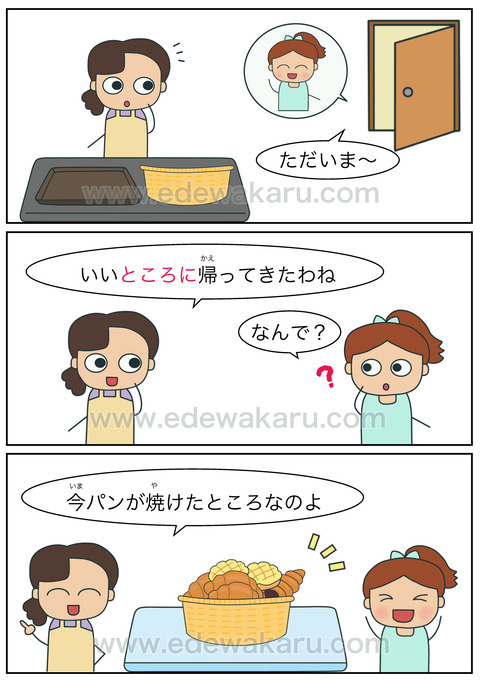
娘:ただいま〜母:いいところに帰ってきたわね。今パンが焼けたところなのよ
→いい時に帰ってきたねDaughter: I’m home! Mother: You came back at just the right time. The bread just came out of the oven. →You came back at just the right time.
ごはんを食べているところに、友達が遊びに来た
→ちょうどごはんを食べている時に、友達が遊びに来たA friend came over just as I was eating. →A friend came over just when I was eating.
お風呂に入ろうとしていたところに、上司から電話がかかってきた
→お風呂に入ろうとした時に、上司から電話がかかってきたJust as I was about to get into the bath, my boss called. →My boss called just when I was about to get into the bath.
悪口を言っているところに、本人がやってきた
→ちょうど悪口を言っていた時に、本人がやってきたThe person we were badmouthing showed up just then. →The person showed up just when we were badmouthing them.
こっそりゲームをしていたところに、お母さんが帰ってきた
→こっそりゲームをしていた時に、お母さんが帰ってきたMy mother came home just as I was secretly playing a game. →My mother came home while I was secretly playing a game.
Read the original source text
Meaning
〜ている時に
〜ていた時に
ちょうど〜の時に
How to use it
動詞[ーている]+ところに
動詞[ーた]+ところに
い形容詞[ーい]+ところに
Explanation
「AところにB」は「Aている時にB」「ちょうどAの時にB」という意味を表す文型です。「Aが進行中(しんこうちゅう)の場面で、Bが起きたと言いたい時に使います。多くの場合は、「A」をしている時に「B」が起きて「A」の動作がストップしてしまったと言いたい時に使われます。また、「AところへB」にチェンジすることができます。後ろによく使用される動詞をいくつか覚えておきましょう。
[よく使われる動詞]
・〜ところに+
来る
・〜ところに+
行く
・〜ところに+
〜てくる
・〜ところに+
通りかかる
など
「〜ところに・〜ところへ」は「〜ところを」「〜ところで」と一緒に覚えておきましょう。
また、「ところ」がつく文型はたくさんありますので復習をしておきましょう。
【関連文型】
【「〇〇」がつく文型リスト】
日本語文型辞典
Meaning
Basic information: V-ている/V-た ところに. Explanation: In 「…ところに/ところへ」, means “while … was happening” or “when … happened.” Used when an event occurs that changes or alters the situation at a certain stage. In many cases, as in ① and ②, the event obstructs or interrupts the progress of something, but sometimes, as in ③, it changes the situation for the better. Examples: ① Just as I was about to leave, the phone rang. ② Just as we had finally agreed to go ahead, an unexpected obstacle arose. ③ While I was in trouble because I had lost my wallet, someone I knew happened to pass by, and I managed to get home safely.
Read the original source text
Meaning
基本情報V-ている/V-た ところに説明「…ところに/ところへ」で、「-している/したときに」の意味。ある段階における状況を変化・変更させるような出来事が起こることを表す場合に用いる。たいていは、①②のようにものごとの進行を妨害・邪魔するような出来事のことが多いが、③のように現状をよい方向に変えるような場合もある。例文① 出掛けようとしたところに電話がかかってきた。② ようやく実行する方向に意見がまとまったところへ思わぬ邪魔が入った。③ 財布をなくして困っているところに偶然知り合いが通りかかり、無事家までたどり着くことができた。
日本語文型辞典 英語版
Meaning
【ところに】[V-ている/V-た ところに]
Takes the form ...ところに or ...ところへ and means “when I was ...ing” or “when I did....”
Used to express the occurrence of an event that alters or changes a situation that is at a certain stage. In most cases, the event is one that impedes or blocks something’s progress, as in
(1)
and
(2)
. However, it can also be something that changes the current situation for the better, as in
(3)
.
In context 3 examples
出掛けようとしたところに電話がかかってきた。
Just as we were leaving, the telephone rang.
ようやく実行する方向に意見がまとまったところへ思わぬ邪魔が入った。
We had finally agreed on a plan of action when there was an unexpected snag.
財布をなくして困っているところに偶然知り合いが通りかかり、無事家までたどり着くことができた。
When I was in a real fix after losing my wallet, an acquaintance happened to come by and I was able to get home safely.
くらべてわかる日本語表現文型辞典
Meaning
Meaning 1: Indicates the moment just before doing A, the middle of A, or the time when A has just been completed. The time expressed varies according to the verb form.
Meaning 2: B occurs just when the situation is A.
Meaning 3: In the form 「A ようとしたところ」. B occurs immediately before A.
Meaning 4: A should have happened, or was almost certain to happen, but in fact it did not.
Meaning 5: B occurs at/in/to/through the scene or state of A.
How to use it
A ところ(に・へ・で・を)B (A ようとしたところ)
Connection 1:
[Verb — dictionary form / past form / ている] ところ
Connection 2:
[Verb — ている/ていた] ところ
Connection 3:
[Verb — volitional form] としたところ
Connection 4:
[Verb — dictionary form] + (べき) + ところ
[Verb — ている] ところ
Connection 5:
[i-adjective — い] ところ
[na-adjective — な] ところ
[Noun — の] ところ
Explanation
【Contrast 1】
「A ばかり」(Meaning 4, p. 275)
Notes
【Note 2】
・A is often a verb expressing a situation or feeling. It is difficult to form 「悲しむところ」or 「悲しんだところ」; it is almost always in the 「テイル」form.
【Note 5】
・This is often used in greetings.
○おとりこみのところ ○お楽しみのところ ○お寒いところ
In context 20 examples
いまご飯を食べたところだから、お腹いっぱいです。(直後)
I’ve just eaten, so I’m full. (Immediately afterward)
私もさっき彼からその話を聞いたところです。(直後)
I just heard that from him a little while ago too. (Immediately afterward)
「もう、用意できましたか?」
「ちょっと待って。いま着替えているところなのよ。」(途中)“Are you ready yet?” “Wait a bit. I’m getting dressed right now.” (In progress)
交差点を渡っていたら、突然トラックが走ってきてもう少しでひかれるところだったよ。(寸前)
As I was crossing the intersection, a truck suddenly came speeding by, and I almost got run over. (Just about to)
悲しんでいるところに、今度はいい知らせが舞い込んだ。
Just as I was feeling sad, some good news came in.
老人が苦しんでいたところに、ちょうど行きあわせた。
I happened to arrive just as an elderly person was suffering.
大声で笑っているところに、いきなり先生が入ってこられた。
Just as I was laughing out loud, the teacher suddenly came in.
鍋がグツグツいっているところに卵を入れて火を止めます。
Add the egg while the pot is bubbling away, then turn off the heat.
出かけようとしたところに、彼女が訪ねてきた。
Just as I was about to go out, she came to visit.
最後の問題に取りかかろうとしたところで時間切れになった。
Just as I was about to start on the last problem, time ran out.
犬は道を渡ろうとしたところで、車にはねられてしまった。
Just as the dog was about to cross the road, it was hit by a car.
店を閉めようとしたところへ、客が駆け込んできた。
Just as I was about to close the shop, a customer rushed in.
今頃は温泉でのんびりしているところだったのに…。
I should have been relaxing at a hot spring around now….
本来ならこちらから出向くべきところ、わざわざすみません。
I should be the one coming to you, so I’m sorry you went to the trouble.
あと一歩で危うく転落するところだった。
I very nearly fell, just one step away.
もう少しで犯人を捕まえられるところだったのに、逃がしてしまった。
I was just about to catch the culprit, but I let them get away.
お恥ずかしいところをお見せして申し訳ない。
I’m sorry to show you such an embarrassing side of myself.
いいところに来ましたね。一緒にケーキを食べましょう。
You came at just the right time. Let’s eat cake together.
ご多忙なところ、時間を割いていただいて、ありがとうございます。
Thank you for taking the time out of your busy schedule.
お休みのところにおじゃまして恐縮です。
I’m sorry to bother you while you’re resting.
Read the original source text
Meaning
意味1:Aをする寸前、Aの途中、Aをし終わった時を表す。動詞の形によって、表す時が異なる。
意味2:ちょうどAの状況のときにB。
意味3:「Aようとしたところ」の形で。Aのまさに直前にB。
意味4:本当はAになるべきなのに、またはほとんどAになるはずだったのに、実際はAにならなかった。
意味5:Aの場面・状態(に・へ・で・を)B。
How to use it
Aところ(に・へ・で・を)B(Aようとしたところ)
接続1:
[動詞-る形/た形/ている]ところ
接続2:
[動詞-ている/ていた]ところ
接続3:
[動詞-意向形]としたところ
接続4:
[動詞-る形]+(べき)+ところ
[動詞-ている]ところ
接続5:
[イ形-い]ところ
[ナ形-な]ところ
[名詞-の]ところ
Explanation
【対比1】
「Aばかり」(意味4 P.275)
Notes
【注意2】
・Aは状況や感情を表す動詞が使われることが多い。ほとんど「テイル」の形で「悲しむところ」「悲しんだところ」は作りにくい。
【注意5】
・あいさつに使われることが多い。
○おとりこみのところ ○お楽しみのところ ○お寒いところ
NINJAL 日本語文型データベース
Meaning
Used when you want to say that an action or event occurs just when a certain situation is underway in a sequence of actions or events. It is often used when the action or event changes the situation for the better or worse.
When “〜” is in the dictionary form, it indicates the point just before the action or event “〜.”
In the ta-form, it indicates just after the action or event “〜” has been completed.
In the 「〜ている」 form, it indicates that the action or event “〜” is in progress at that point.
In the 「〜ていた」 form, it indicates that the action or event “〜” had been in progress up to that point.
How to use it
Vるところに・Vているところに・Vたところに・Vていたところに
Notes
The clause after 「〜ところに」 takes a verb sentence that uses 「に」 to indicate a destination. It often uses verbs that express the appearance of a person, thing, or situation, such as 「来る・やってくる・出てくる」 (come, arrive, appear).
In context 8 examples
発車ベルが鳴って、新幹線のドアが閉まるところに飛び乗った。
As the departure chime sounded and the Shinkansen doors were about to close, I jumped aboard.
ちょうど乾杯をし終わるところに一品目の料理が運ばれてきた。
Just as we had finished making a toast, the first dish was brought out.
授業に遅刻するかと思って焦ったが、なんとか先生が出席をとっているところに滑り込んだ。
I panicked, thinking I might be late for class, but managed to slip in just as the teacher was taking attendance.
自分の部屋でオンライン会議に参加しているところに猫が入ってきた。
A cat came into my room while I was taking part in an online meeting.
桜が満開になったところに大風が吹いて、かなり散ってしまった。
Just as the cherry blossoms were in full bloom, a strong wind blew and scattered a lot of them.
釣りに出かけた。なかなか思うように釣れなくて、今日はもうだめかなと思い始めたところに大物がかかった。
I went fishing. I wasn’t having much luck, and I was starting to think today might be a bust when a big fish took the bait.
ちょうど転職を考えていたところに今の仕事を紹介された。
Just when I was thinking about changing jobs, I was told about my current job.
漫画の続きが早く読みたいと思っていたところに、新刊発売のお知らせが出た。
Just when I was wishing I could read the next part of the manga soon, an announcement about the new volume’s release came out.
Read the original source text
Meaning
一連の動作・出来事の流れの中で、ちょうど〜の状況のとき、ある動作や出来事が生じると言いたいときに使います。状況をよくない方向、またはいい方向に変化させる動作・出来事が生じるときに使うことが多いです。
「〜」が動詞の辞書形の場合、「~」の動作・出来事の直前の時点であることを表します。
タ形の場合、〜の動作・出来事の完了直後であることを表します。
「〜ている」の形の場合、その時点で~の動作・出来事が進行中であることを表します。
「〜ていた」の形の場合、その時点まで〜の動作・出来事が進行中だったことを表します。
How to use it
Vるところに・Vているところに・Vたところに・Vていたところに
Notes
「〜ところに」の後には、帰着点を表す「に」を使う動詞の文がきます。「来る・やってくる・出てくる」など、人・もの・事態が出現することを表す動詞を使うことが多いです。