日本語文型辞典
Meaning
Used to state whether or not one has experienced an event. Verbs are used mainly, but the form “noun+だった” is also possible, as shown below.
The form V-なかったことがある is also used to describe the experience of not doing something.
Indicates that an event happens sometimes or occasionally. It cannot be used for events that occur frequently.
How to use it
V-たことが ある/ない
V-る/V-ない
In context 17 examples
A:京都へ行ったことがありますか。
B:いいえ、まだないんです。A: Have you ever been to Kyoto? B: No, I haven’t yet.
ああ、その本なら子供の頃読んだことがあります。
Oh, I’ve read that book before, when I was a child.
そんな話は聞いたこともないよ。
I’ve never even heard of such a story.
高橋さんにはこれまでに2度お会いしたことがあります。
I’ve met Mr. Takahashi twice so far.
高橋さんにはまだお会いしたことがありませんが、お噂はよく聞いています。
I haven’t met Mr. Takahashi yet, but I’ve often heard about him.
このあたりは過去に何回か洪水に見舞われたことがある。
This area has been hit by floods several times in the past.
(例) あのホテルはできるだけ早く予約した方がいいよ。3ヶ月前に電話したのに満員だったことがあるんだ。
(Example) You should book that hotel as early as possible. I once called three months in advance, but it was full.
(例) 財布を拾ったのに警察に届けなかったことがある。
(Example) I once found a wallet but didn’t take it to the police.
子供たちは仲がいいのですが、たまに喧嘩をすることがあります。
The children get along well, but sometimes they fight.
これだけ練習していても、時として失敗することがある。
Even after practicing this much, I sometimes make mistakes.
天気のいい日に子供と散歩することがあるぐらいで、ふだんはあまり運動しません。
I hardly ever exercise, except for occasionally taking a walk with my child on a nice day.
A:最近、外で食事することはありますか。
B:最近はあまりないですねえ。A: Have you eaten out lately? B: Not much lately.
長雨が続くと、害虫の被害を受けることがある。
When the rainy weather continues for a long time, there are times when crops suffer damage from pests.
彼は仕事が忙しくて、食事の時間をとれないこともあるそうだ。
I hear that sometimes he’s so busy with work that he can’t make time to eat.
乾期にはいると2ヶ月以上も雨が降らないことがある。
Once the dry season begins, there are times when it doesn’t rain for more than two months.
(誤) このあたりはよく事故が起こることがある。
(Incorrect) Accidents often happen around here.
(正) このあたりはよく事故が起こる。
(Correct) Accidents often happen around here.
Read the original source text
Meaning
ある出来事を経験したかしないかを述べるのに用いる。主として動詞が用いられるが、次のように「名詞+だった」という形が用いられることもある。
また、「V-なかったことがある」という形で、「…しなかった」という経験を述べる場合もある。
ときどき、あるいはたまに何かの出来事が生じることを表す。頻度の多い出来事の場合は使えない。
How to use it
V-たことが ある/ない
V-る/V-ない
絵でわかる日本語
Meaning
sometimes do 〜
do 〜 occasionally
How to use it
Verb [dictionary form] + ことがある
Verb [ない-form] + ことがある
Explanation
“〜ことがある” is a sentence pattern meaning “sometimes do 〜” or “do 〜 occasionally.” Since it means “do 〜 occasionally,” it cannot be used with words expressing high frequency, such as “often” or “always.” 😨
❌
often
meet Yamada
ことがある
⭕️
often
meet Yamada
There is also a beginner-level pattern “〜ことがある” expressing 【experience】, but that one is used with the verb た-form, so you need to learn to distinguish them. 😮
【Experience: Verb [た-form] + ことがある】I have
met Yamada before.
【Sometimes do 〜: Verb [dictionary form] + ことがある】I sometimes
meet Yamada.
Be careful: the meaning is completely different depending on whether it is used with the た-form or with the dictionary or ない-form. 😉
In context 4 examples
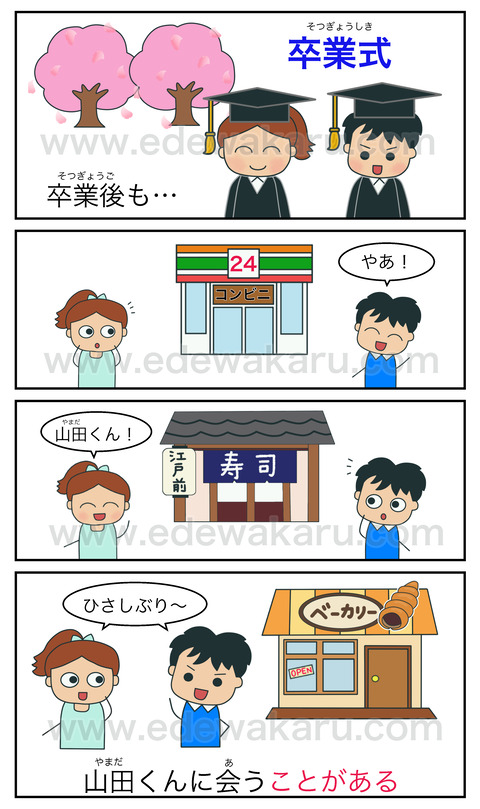
卒業後も、山田くんに会うことがある
→卒業後も、たまに山田くんに会うI sometimes meet Yamada even after graduation. → I sometimes meet Yamada even after graduation.
最近寝られないことがある
→最近、時々寝られない日があるRecently, there are times when I can’t sleep. → Recently, there are days when I sometimes can’t sleep.
日本に出張することがある
→たまに日本に出張するI sometimes go on business trips to Japan. → I occasionally go on business trips to Japan.
お母さんはいつも優しいが、怒ることもある
→お母さんはいつも優しいが、たまに怒るMy mother is always kind, but she sometimes gets angry. → My mother is always kind, but she occasionally gets angry.
Read the original source text
Meaning
時々〜する
たまに〜する
How to use it
動詞[辞書形]+ことがある
動詞[ない形]+ことがある
Explanation
「〜ことがある」は「たまに〜する」「時々〜する」という意味を表す文型です。「たまに〜する」という意味ですので、
「よく」や「いつも」など、頻度が多いことを表す単語とは使用することはできません
😨
❌
よく
山田くんに会う
ことがある
⭕️
よく
山田くんに会う
初級の文法で【経験】を表す「〜ことがある」という文型がありますが、これは動詞の「た形」に使いますので、区別して覚えておかなければなりません😮
【
経験:動詞[た形]+ことがある】山田くんに
会ったことがある
【
たまに〜する:動詞[辞書形]+ことがある】山田くんに
会う
ことがある
「た形」に使うか、「辞書形・ない形」に使うかで意味が全然違いますので気をつけてくださいね😉
日本語NET JLPT文法解説まとめ
Meaning
It doesn’t happen all the time, but it happens sometimes.
How to use it
V (dictionary form / nai-form) + ことがある / 〜こともある
Explanation
It's not always the case, but sometimes I do...
In context 10 examples
大学をしてからも、たまに同じ学部だった友達に会うことがあります。
Even after graduating from university, I sometimes meet friends who were in the same department.
深夜に夫のいびきで、目が覚めることがあります。
Sometimes I wake up in the middle of the night because of my husband’s snoring.
普段は母がご飯を作りますが、私が作ることもあります。
My mother usually cooks, but sometimes I do too.
時々、テレビをつけたまま寝てしまうことがあります。
Sometimes I fall asleep with the TV on.
私は会議中でも、寝てしまうことがある。
I sometimes fall asleep even during meetings.
山下先輩はとても優しいですが、怒ることもあります。
Yamashita-senpai is very kind, but sometimes gets angry too.
木村部長はとても仕事ができる人ですが、失敗することもあります。
Manager Kimura is very capable at work, but sometimes makes mistakes too.
一人暮らしをしていると、実家が恋しくなることがある。
When you live alone, sometimes you start to miss your family home.
時々、頭が痛くて寝られないことがあるんですが・・・。
Sometimes my head hurts so much that I can’t sleep...
プロでもミスをすることがある。
Even professionals sometimes make mistakes.
Read the original source text
Meaning
いつもではないが、時々〜する
How to use it
V(辞書形 / ナイ形)+ ことがある / 〜こともある
Explanation
It's not always the case, but sometimes I do...
毎日のんびり日本語教師
How to use it
Verb dictionary form + ことがある/こともある
Verb ない-form + ことがある/こともある
Explanation
It attaches to a verb in the dictionary form or its negative form and indicates that something happens sometimes or occasionally.
It often occurs with expressions such as 「今でも」「たまに」「ときどき」「まれに」.
Notes
Similar grammar: 「【N3文法】~たことがある/たことがない」
In context 5 examples
寝ている時、いまでもおしっこを漏らすことがある。(即使现在也有睡着了尿床的时候。)
Even now, I sometimes wet the bed while sleeping. (Even now, there are times when I wet the bed in my sleep.)
その時の苦い経験をたまに思い出すことがある。
I sometimes remember that bitter experience from back then.
考え事が多いと眠れないことがある。(想太多了有时候会睡不着。)
When I have a lot on my mind, there are times when I can't sleep. (Sometimes, when I think too much, I can't sleep.)
時間があるときは自分で料理を作ることもあります。
When I have time, I sometimes cook for myself.
頭の中に突然変な声が聞こえてくることがあります。(有的时候脑袋里会突然响起奇怪的声音。)
Sometimes a strange voice suddenly comes into my head. (Sometimes a strange voice suddenly rings out in my head.)
Read the original source text
How to use it
動詞辞書形+ことがある/こともある
動詞ない形+ことがある/こともある
Explanation
動詞の辞書形あるいは否定形に接続して、時々、あるいはたまに発生することを表します。
「今でも」「たまに」「ときどき」「まれに」などと呼応したりします。
Notes
似ている文法「【N3文法】~たことがある/たことがない」
日本語文型辞典 英語版
Meaning
B:いいえ、まだないんです。
No, not yet.
Used to state whether or not a certain event has been experienced. Used mainly with verbs, but may also take the form N+だった, as shown in the examples below.
(例)あのホテルはできるだけ早く予約した方がいいよ。3ヶ月前に電話したのに満員だったことがあるんだ。
It’s best to make reservations at that hotel as early as possible. What happened to me once is that even though I called them three months in advance, they were already fully booked.
This pattern can also be used in the form V-なかったことがある, to state the experience of not having done something.
(例)財布を拾ったのに警察に届けなかったことがある。
Once I picked up a wallet on the street, but I didn’t take it to the police.
B:最近はあまりないですねえ。
These days, not very often.
Indicates that a certain event happens sometimes or occasionally. Cannot be used regarding an event that happens frequently.
(×)このあたりはよく事故が起こることがある。
Accidents often occur sometimes around here.
(○)このあたりはよく事故が起こる。
Accidents often occur around here.
How to use it
1. V-たことが ある/ない
2. V-る/V-ない ことがある
In context 13 examples
A:京都へ行ったことがありますか。
Have you ever been to Kyoto?
ああ、その本なら子供の頃読んだことがあります。
Oh, I read that book once when I was a child.
そんな話は聞いたこともないよ。
I’ve never heard such a story.
高橋さんにはこれまでに2度お会いしたことがあります。
I’ve met Takahashi-san previously on two occasions.
高橋さんにはまだお会いしたことがありませんが、お噂はよく聞いています。
I have not met Takahashi-san yet, but I have heard a lot about him.
このあたりは過去に何回か洪水に見舞われたことがある。
This area has been struck by flooding several times in the past.
子供たちは仲がいいのですが、たまに喧嘩をすることがあります。
The kids get along with each other, but they do squabble at times.
これだけ練習していても、時として失敗することがある。
Even though I practice this much, sometimes I do make mistakes.
天気のいい日に子供と散歩することがあるぐらいで、ふだんはあまり運動しません。
On nice days I occasionally go for a walk with my children, but I usually don't get very much exercise.
A:最近、外で食事することはありますか。
Do you sometimes dine out these days?
長雨が続くと、害虫の被害を受けることがある。
When there’s a long spell of rainy weather, we sometimes get pest damage.
彼は仕事が忙しくて、食事の時間をとれないこともあるそうだ。
I heard that sometimes he can’t find the time to eat because he’s too busy with work.
乾期にはいると2ヶ月以上も雨が降らないことがある。
When the dry season starts, we sometimes have no rain for more than two months.
Read the original source text
Meaning
B:いいえ、まだないんです。
No, not yet.
Used to state whether or not a certain event has been experienced. Used mainly with verbs, but may also take the form N+だった, as shown in the examples below.
(例)あのホテルはできるだけ早く予約した方がいいよ。3ヶ月前に電話したのに満員だったことがあるんだ。
It’s best to make reservations at that hotel as early as possible. What happened to me once is that even though I called them three months in advance, they were already fully booked.
This pattern can also be used in the form V-なかったことがある, to state the experience of not having done something.
(例)財布を拾ったのに警察に届けなかったことがある。
Once I picked up a wallet on the street, but I didn’t take it to the police.
B:最近はあまりないですねえ。
These days, not very often.
Indicates that a certain event happens sometimes or occasionally. Cannot be used regarding an event that happens frequently.
(×)このあたりはよく事故が起こることがある。
Accidents often occur sometimes around here.
(○)このあたりはよく事故が起こる。
Accidents often occur around here.
How to use it
1. V-たことが ある/ない
2. V-る/V-ない ことがある
AIUEO JLPT Grammar
Meaning
This sentence pattern is used to express that something happens occasionally. “〜ことがある” means that the action or situation occurs from time to time, while “〜ないことがある” means that it occasionally does not happen.
How to use it
Verb dictionary form + ことがある or こともある; verb in ない-form + ことがある or こともある
In context 5 examples
朝ごはんを食べないことがある。
Sometimes I skip breakfast.
薬を飲み忘れることがあります。
Sometimes I forget to take my medicine.
ソフトウェアが動かないことがある。
Sometimes the software doesn't work.
友達と会うことがある。
Sometimes I meet with friends.
家族と一緒に夕食を食べないこともある。
Sometimes I have dinner without my family.
Read the original source text
Meaning
This sentence pattern is used to express that something happens occasionally. “〜ことがある” means that the action or situation occurs from time to time, while “〜ないことがある” means that it occasionally does not happen.
How to use it
動詞辞書形+ことがあるorこともある動詞ない形+ことがあるorこともある
Explanation · 日本語
この文型は、何かが時々起こることを表す表現です。「〜ことがある」は、時々その行為や状況が発生することを意味し、「〜ないことがある」は、時々その行為や状況が発生しないことを意味します。
Bunpro Grammar Reference
Meaning
Something is possible, Sometimes, Occasionally, There are times when
How to use it
Verb[る](1) + こと + が(2)ある
[い]Adjective + こと + が(2)ある
[な]Adjective + な + こと + が(2)ある
(1) Verb[ない]
(2) も
Verb[る](1) + こと + が(2)あります
[い]Adjective + こと + が(2)あります
[な]Adjective + な + こと + が(2)あります
(1) Verb[ない]
(2) も
Nuance
A grammar point that expresses something as being possible, or occasionally happening. There is that which is (A).
Explanation
ことがある is an expression in Japanese that combines the noun こと with the case marking particle が, and the う - Verb, ある. It is often translated as 'to be possible', 'to occasionally occur', or 'to sometimes occur'. However, the more literal translation of ことがある is '(A) is a thing that exists'.
ことがある may be paired with the attributive form of any other word.
この馬は人を蹴ることがあるので、馬の後ろに立たないで下さい。
This horse kicks people sometimes, so please don't stand behind him.
タナカ先生の授業はたまに楽しいことがある。
There are times where Mr. Tanaka's classes are fun.
仕事はだいたい大変だけれども、たまには楽なことがある。
Work is usually difficult, but there are times where it is easy.
Occasionally, が may be replaced by も. In these situations, it implies that '(A) is also a thing that exists'. Basically this just highlights that (A) is something that needs to be considered (among other things).
仕事は楽しいけど、大変なこともある。
Work is fun, but there are times where it gets difficult.
先生はいつも怒っているけど、優しいこともある。
Our teacher is always angry, but there are times when he is nice.
Caution
ことがある differs from たことがある (a phrase commonly paired with the past form of verbs). たことがある highlights a single event in which the (A) verb was completed. However, when the verb is not in past form, it simply implies that there are 'times' when the verb happens, as opposed to a single/specific time.
週に一回のペースでラーメンを食べることがある。
There are times when I eat ramen once a week.
このラーメンは食べたことがあると思う。
I think I have eaten this ramen before.
In context 19 examples
- 頑張ってもうまくいかない事がある。
There are times when no matter how hard you try, it doesn't go well.
- この馬は人を蹴ることがあるので、馬の後ろに立たないで下さい。
This horse kicks people sometimes, so please don't stand behind him.
- 仕事はだいたい大変だけれども、たまには楽なことがある。
Work is usually difficult, but there are times where it is easy.
- タナカ先生の授業はたまに楽しいことがある。
There are times where Mr. Tanaka's classes are fun.
- 仕事は楽しいけど、大変なこともある。
Work is fun, but there are times where it gets difficult.
- 先生はいつも怒っているけど、優しいこともある。
Our teacher is always angry, but there are times when he is nice.
- 学校に送ってもらう事がある。
I sometimes get a ride to school.
- 友達は昼2時まで寝る事がある。
There are times when my friend sleeps until two in the afternoon.
- あの番組ならたまに見る事がある。
(There are times that ) I sometimes watch that TV program.
- 一日に二、三回ぐらい、ラーメンを食べる事がある。
There are days where I eat ramen two or three times.
- 友達に日本語を教える事がある。
There are times that I teach Japanese to my friend.
- 気になることがありすぎて、夜眠れない事がある。
There are times that I can't sleep at night for I feel anxious about too many things.
- 化学物質は、触るだけでも危険な事がある。
There are times when chemical substances are dangerous, even if only touched.
- 高級な洋服店だが服が安い事もある。
Although this is a high-end Western clothing store, there are also times when the clothes are cheap.
- たまに手を抜く事があるが、普段は真面目な人だ。
There are times that he cuts corners at work, but he is usually a very serious person.
- 「あの時もっと頑張れば良かった」と思う事がある。
There are times when I think 'I should have tried harder then.'
- ルームメイトの無作法な振る舞いに注意したい事がよくある。でも、私は気が弱すぎる・・・
There are many times when I want to warn my roommate about his rude behavior. However, I am just too timid.
- 週に一回のペースでラーメンを食べることがある。
There are times when I eat ramen once a week.
- このラーメンは食べたことがあると思う。
I think I have eaten this ramen before.
文法
Meaning
It doesn’t happen all the time, but it happens sometimes.
How to use it
V (dictionary form / nai-form) + ことがある / 〜こともある
In context 10 examples
大学をしてからも、たまに同じ学部だった友達に会うことがあります。
Even after graduating from university, I sometimes meet friends who were in the same department.
深夜に夫のいびきで、目が覚めることがあります。
Sometimes I wake up in the middle of the night because of my husband’s snoring.
普段は母がご飯を作りますが、私が作ることもあります。
My mother usually cooks, but sometimes I do too.
時々、テレビをつけたまま寝てしまうことがあります。
Sometimes I fall asleep with the TV on.
私は会議中でも、寝てしまうことがある。
I sometimes fall asleep even during meetings.
山下先輩はとても優しいですが、怒ることもあります。
Yamashita-senpai is very kind, but sometimes gets angry too.
木村部長はとても仕事ができる人ですが、失敗することもあります。
Manager Kimura is very capable at work, but sometimes makes mistakes too.
一人暮らしをしていると、実家が恋しくなることがある。
When you live alone, sometimes you start to miss your family home.
時々、頭が痛くて寝られないことがあるんですが・・・。
Sometimes my head hurts so much that I can’t sleep...
プロでもミスをすることがある。
Even professionals sometimes make mistakes.
Read the original source text
Meaning
いつもではないが、時々〜する
How to use it
V(辞書形 / ナイ形)+ ことがある / 〜こともある
NINJAL 日本語文型データベース
Usage 1
Meaning
Expresses that an action or event that does not normally occur happens from time to time.
How to use it
Notes
It is not used for things that happen often.
In context 23 examples
このパソコンは最近フリーズすることがある。
This computer sometimes freezes lately.
嫌な夢を見て、夜中に目が覚めることがあります。
Sometimes I have a bad dream and wake up in the middle of the night.
このそば屋はとても人気があって、日によっては1時間以上並ぶことがあります。
This soba restaurant is very popular, and on some days you may have to wait in line for over an hour.
雨の日はバスが渋滞して時間がかかることがあるから、今日は早めに家を出よう。
On rainy days, buses can get caught in traffic and take a long time, so let’s leave home early today.
「まだレストランの予約はしていないけど、平日だから大丈夫だよね」「平日でも満席になることがあるから、早めに予約しておいたほうがいいよ」
“I haven’t made a reservation at the restaurant yet, but it’s a weekday, so it’ll be fine, right?” “Even on weekdays it can be full, so you should make a reservation early.”
最近、目覚ましをかけた時間に起きられないことがある。
Recently, sometimes I can’t get up at the time I set my alarm for.
最近の子どもの名前は、漢字の読み方が難しくてわからないことがあります。
Recently, children’s names can have such difficult kanji readings that sometimes I can’t figure them out.
時々メールの返信をするのが面倒くさいことがある。
Sometimes I find it bothersome to reply to emails.
時には子どもの言うことのほうが正しいことがあります。
Sometimes what children say is more correct.
毎日ではないんですが、母は血圧がひどく高いことがあるようです。
Not every day, but it seems my mother’s blood pressure is sometimes extremely high.
「田中さんの言い方は、たまにとてもきついことがあるけど、気にしないほうがいいよ」
“Tanaka’s way of speaking can sometimes be very harsh, but you shouldn’t take it to heart.”
「木村会長の話、とっても長いことがあるよね。要点だけ話せばいいのに」
“Chairman Kimura’s talks can be so long sometimes, can’t they? He should just stick to the main points.”
このラジオは調子がよくないことがある。もう捨てたほうがいいかな。
This radio sometimes doesn’t work very well. Maybe I should just throw it away.
アンケートで、3割の子どもが「学校に行きたくないことがある」と答えたそうだ。
Apparently, in a survey, 30 percent of the children answered, “Sometimes I don’t want to go to school.”
母はいつもは明るいのだが、ときどき不機嫌なことがある。
My mother is usually cheerful, but sometimes she is in a bad mood.
彼の言うことはときどき不自然なことがある。何か隠しているのだろうか。
What he says is sometimes unnatural. I wonder if he’s hiding something.
あの店は接客があまり丁寧でないことがあって、いまひとつだ。
That shop is sometimes not very courteous in its customer service, so it’s not that great.
クレジットカードについている保険では保証内容が十分ではないことがありますので、別に海外旅行保険に入ることをお勧めします。
The coverage provided by insurance included with a credit card may sometimes be insufficient, so we recommend purchasing separate overseas travel insurance.
この有料駐車場はすごく高いけど、それでもたまに満車のことがある。
This paid parking lot is very expensive, but even so, it is sometimes full.
海外で本物だと思って買ったブランド品が偽物のことがある。用心したい。
Brand-name goods that I bought overseas thinking they were genuine are sometimes counterfeit. I need to be careful.
ストレスが胃腸炎の原因であることがある。
Stress can sometimes be the cause of gastroenteritis.
入社決定といっても、最初の数か月は試用期間であることがある。その期間の仕事ぶりで本採用が決まる。
Even if you've been hired, the first few months may be a probationary period. Whether you are officially hired will be decided based on your work during that period.
子どもの言うことは、たまに本当じゃないことがあるから、困る。
It’s a problem because what children say is sometimes not true.
Read the original source text
Meaning
通常起こらない動作や出来事がときどき起こることを表します。
How to use it
Notes
よく起こることには使いません。
Usage 2
Meaning
Expresses experiences up to the time of speaking. It is used when talking about experiences of actions or events that the speaker is aware of at the time of speaking.
How to use it
Notes
It is not usually used with words that refer to things done routinely, such as 「よく・いつも」, or words that refer to the recent past, such as 「昨日・先月」. It is also not used with words that refer to a specific point in the past, such as 「2010年3月」, but it can be used with words that refer to a broader period, such as 「昔・子どもの頃」.
In context 19 examples
私はあの俳優に一度会ったことがあります。
I have met that actor once.
海外旅行中に体調が悪くなったことが何回かあります。
I have become ill a few times while traveling abroad.
子どもの頃、大けがをして入院したことがあります。
When I was a child, I suffered a serious injury and was hospitalized.
前に、うちの家族は北海道の離島に住んでいたことがある。
Our family used to live on a remote island in Hokkaido.
理由は何だったか思い出せないが、父にひどく怒られたことがある。
I can’t remember what the reason was, but there was a time when my father got very angry with me.
アルバイトをしたことがあるなら、お金を稼ぐことの厳しさは知っているでしょう。
If you have worked part-time, you probably know how hard it is to earn money.
どこかで見たことがある人と道ですれ違った。そうだ、よく行くスーパーのレジの人だ。
I passed someone on the street whom I had seen somewhere before. Oh, right—it was the cashier at the supermarket I often go to.
パスポートが切れていて、飛行機に乗れなかったことがある。
There was a time when my passport had expired and I couldn’t get on the plane.
今、私の髪はショートですが、昔、腰まで長かったことがあるんです。
My hair is short now, but there was a time when it reached my waist.
外車が本当にほしかったことがあるが、今はもう興味もない。
There was a time when I really wanted a foreign car, but now I’m no longer interested in them at all.
小学生のとき、クラスになじめなくて転校したかったことがあります。
When I was in elementary school, I didn’t fit in with my class and wanted to transfer schools.
妻「今日の料理、おいしいね」夫「僕の作った料理で、おいしくなかったことがある?」
Wife: “Today’s food is delicious.” Husband: “Has anything I’ve cooked ever not been delicious?”
以前、うちはとても貧乏だったことがある。
We used to be very poor.
かつて僕は母に対して反抗的だったことがあります。
There was a time when I was rebellious toward my mother.
今は人とよく話しますが、30代のころ、私はひどく無口だったことがあるんです。
I talk to people a lot now, but there was a time in my thirties when I was extremely quiet.
あの食堂で食事をしたとき、出された食器の洗い方が十分ではなかったことがあって、不快だった。
Once, when I ate at that dining hall, the dishes they served me had not been washed properly, and I found it unpleasant.
父は昔、プロレスラーだったことがあるそうだ。
I hear my father used to be a professional wrestler.
この歌手は、まだ売れていなかったころ、ライブの客が5、6人だったことがあるらしい。
I hear that when this singer hadn’t become popular yet, there were times when only five or six people came to their live shows.
今は英語の同時通訳をしているが、若いころは担当言語が英語ではなかったことがある。
I now do simultaneous interpretation into English, but when I was young, there was a time when English was not my assigned language.
Read the original source text
Meaning
発話時までの経験を表します。話し手が発話の時点で自覚している動作、出来事の経験を言うときに使います。
How to use it
Notes
ふつう「よく・いつも」など日常的にしていることを表す言葉や、「昨日・先月」など近い過去を表す言葉とは一緒に使いません。また、「2010年3月」のような過去のある時点を表す言葉とは一緒に使いませんが、「昔・子どもの頃」のような幅のある期間を表す言葉は使えます。
IMABI
Expressions with こと
Read this IMABI lesson ↗Explanation
Expressions with こと
The nominalizer こと appears in many grammatical structures, and in all the structures showcased in this lesson, it has no interchangeability with the nominalizer の. So, as you go through each structure, this will be a great opportunity to better internalize these two nominalizers and how they are fundamentally different.
~ことがある: Experience(S) One Has
When こと follows a verbal predicate, either in the non-past form or the past form, it indicates experiences one has. The difference tense plays determines whether said experience is one that one “(often) has” or “has had.”
Vnon-past + ~ことがあるagent (often) does/experiences doing…
Vpast + ~ことがあるagent has/have done… (before)
In practice, ~たことがある is more practically translated as “has/have…” as in having done something before—an experience that is unequivocally in the past as an experience had. Meaning, this pattern may not be used to reflect the present perfect use of “have” like in “I have done my work,” in which the speaker may be referring to actions that they have just completed. ~たことがある should also NOT be misconstrued as a wordier replacement of plain past tense, either.
i. きのう、日本語を勉強したことがある。X
Intended: Yesterday, I studied Japanese.
ii. 仕事をやったことがある。??
Intended: I have done my work.
Actual Meaning: I have done a job.
iii. 営業事務の仕事をやったことがある。
I have worked in sales administration (before).
Particle Note: Whether が, は, も, or no particle at all is used in this structure is ultimately determined by the intended nuancing of the statement. With the particle は, the experience (being) had is being contrasted with other scenarios. With the particle も, the experience (being) had is in addition to other stated experiences. No particle being used is indicative of casual speech in which case the added nuances provided by は・も are not relevant as well as が’s own exhaustive-listing nuancing being irrelevant.
While it may go without saying, this construct can be used in negative sentences, in which case ある conjugates to its respective negative forms.
iv. 北京ダックを食べたことがない。
I have not had Peking duck (before).
It must also be noted that Vnon-past before こと may also be in the negative, and it is even possible for ある to be in the negative in tandem. However, each scenario is distinctly different.
v. それほど頻繁に食べることはないかもしれませんが、高塩分の食品の摂取量が多いと、胃癌リスクが高まりますよ。
Although you may not eat them that frequently, high intake of salty foods will increase your risk of stomach cancer.
vi. 鶏肉は、食べないことはないですが、あまり好きではありませんね。
While it’s not that I don’t ever eat chicken, I don’t really care for it.
While conjugating verbs into plain/polite and affirmative/negative forms should not be problematic by this point, here are the relevant forms of ある with the structure ~ことがある.
PlainPolite
Affirmative~ことがある~ことがあります
Negative~ことがない~ことがないです
~ことがありません
Past※~ことがあった~ことがありました
Negative Past※~ことがなかった~ことがなかったです
~ことがありませんでした
※While Japanese does not exhibit tense agreement, there are instances in which the pattern ~ことがある utilizes ~た for both the verb こと attaches to and ある, or even just the past tense marker on ある itself (see Exs. 14-17).
1. 富士山に登った1こともありますか。
Have you also climbed Mt. Fuji before?
2. マシュマロ入りのホットチョコレートを飲んだことがありますか。
Have you ever had hot chocolate with marshmallows?
3. 雲が多くなる時間2もあるが、雨が降ることはない。
There are times when it gets cloudy, but it will never rain.
4. 夏場でも鍋物を食べることがある。
Even during summertime, I (often) have hotpot.
5. 映画では同じようなアイデアが何度も繰り返し使われることが多い3ので、似たようなシーンを別の映画で見かけることがあるかもしれない。
In movies, similar ideas are used over and over again a lot, so you may often encounter similar scenes (to what you have seen) in other films.
6. 久しぶりに訪れた場所で道に迷うことがあります。
I often get lost when I visit places I haven’t been in a while.
7. 基本的に引き篭もっているのですが、休日に母と買い物に行くことがある。
I basically stay at home, but sometimes I go shopping with my mother on the weekends.
8. 「香港に行ったことがあるの?」「一度行ったことがあるよ。」
“Have you been to Hong Kong before?” “I’ve been there once.”
9. 歯磨きをしないで寝たことがありますか。
Have you ever gone to sleep without brushing your teeth?
10. ラーメンを食べたことある?
Have you ever had ramen?
11. 歌舞伎を観たことはありますか。
Have you seen kabuki before?
12. 外国人に日本語を教えたことがあります。
I have taught Japanese to foreigners before.
13. あまり気にすることはないよ。
There really isn’t anything to worry about.
As for when ~たことがあった is used, an experience “that had been had, or “had not been had” in the negative, is mentioned as a retelling of the past. At times, this could be done as an attempt to confirm such event occurred, either to oneself or to whoever might be listening.
14. この場所で子供のころ、よく遊んだんだよ。あの滑り台の上から飛び降りて怪我をしたことがあったな。
I used to play here a lot as a kid. I once jumped off the top of that slide and got hurt.
15. 娘の父親は東京の江戸川区で育って幼稚園へ通ったことがあったが、母親の私のほうは、幼稚園へ行かなかった。
My daughter’s father grew up in Edogawa Ward, Tokyo, and had gone to kindergarten, but I, her mother, did not go to kindergarten.
Similarly, Vnon-past+ ~ことがあった is used when the speaker is retelling common occurrences, or lack thereof when in the negative, from the past.
16. 母だって子守唄を歌うことがあっただろうが、思い出せない。
I’m sure my mother of all people sometimes sang lullabies to me, but I can’t remember.
17. 毎年きっと1冊か2冊、ときには三冊も四冊も出版することがあった。
Ever year, I would publish one or two books, sometimes three or four.
Insofar, we have only see situations in which the verb used with ~ことがある indicates the volition of an agent (doer). However, When there is no agent, the structure ought to be interpreted as indicating what “may (often) be the case.”
18. 届出に不備などがあると加入手続きが遅れることがあるのでご注意ください。
Please note that if there are any issues in your filing, the enrollment process may be delayed.
19. 何か相手の気に入らないことがあったとしか思えませんね。
The only thing I can think of is that there must’ve been something that didn’t bode well with the other person.
~ことがある w/ Adjectival Predicates
One leap away from non-volitional verbs would be adjectival predicates. In fact, adjectives and adjectival nouns may also be used with ~ことがある for describing having (had) experiences in a certain situation, tense dynamics permitting. Arguably more care must be taken to ensure that the context is not best described with the past tense, however, as the context at had must still be understood as “experience(s) in which such a state is/was so” as opposed to simply stating that “something was so.” The latter situation would be within the domain of the past tense.
20. この先、楽しいことがあるとは思えません。
I just can’t see there being anything fun to be had in the future.
21. アボカドの熟成の見極めは難しいですねえ。私も切ってみたら、すごく硬かったことがあります。
It sure is hard to judge the ripeness of an avocado, huh. I once cut into one that was really hard.
22. ときどき大変なこともあるけど、ポジティブに考えるようにしているよ。
It can be hard at times, but I try to think positively.
23. 単品だと500円なんだけど、以前はもうちょっと安かったことがあったの。
It’s 500 yen à la carte, sure, but I had bought it a little cheaper than that in times past.
24. 怖そうな人でも優しいこともあるんだよ。
Even scary people are sometimes nice.
25. 北多摩は神奈川県だったことがある。
Kita Tama has once been (in) Kanagawa Prefecture.
NON-REMODELED CONTENT BELOW
~ことにする・こととする: To decide.
26. あいつを忘れることにしただけさ。(Very colloquial)
I’ve just decided to just forget that guy.
27. 私はお酒を飲むのをやめることとしました。 (Slightly formal)
I have decided to quit drinking liquor.
~ことにしている shows that one makes a routine of doing something or that one is determined/has a strong commitment to doing something.
28. 毎日カルピスを飲むことにしています。
I’ve made it a rule to drink Calpis every day.
29. 英語では話さないことにしています。
I’ve made it a rule not to speak in English.
~ことになる・こととなる: To be decided
30. 今年日本に行くことになりました。
It has been decided that I will go to Japan this year.
31. 新製品は5月10日に発表することになりました。
It has been decided that we will announce the new product on May 10th.
山を登る, while grammatically valid, does not mean the same thing as 山に登る. In this scenario, を functions as a transition marker, indicating that the mountain is not, per se, what is being climbed, but a point along one’s hiking journey. ↩︎
This example exemplifies are こと in this pattern may be replaced with similar yet concrete nouns like 時間・時 (time). ↩︎
This example exemplifies two things: that the pattern ~ことがある can be used with passive verbs and that ある can be replaced with similar words such as 多い (for there to be a lot of…). With this in mind, [高塩分の食品の摂取量] from v. may also be viewed as a paraphrasing of [Verb + ~こと]. ↩︎
In context 31 examples
富士山に登った1こともありますか。
Have you also climbed Mt. Fuji before?
マシュマロ入りのホットチョコレートを飲んだことがありますか。
Have you ever had hot chocolate with marshmallows?
雲が多くなる時間2もあるが、雨が降ることはない。
There are times when it gets cloudy, but it will never rain.
夏場でも鍋物を食べることがある。
Even during summertime, I (often) have hotpot.
映画では同じようなアイデアが何度も繰り返し使われることが多い3ので、似たようなシーンを別の映画で見かけることがあるかもしれない。
In movies, similar ideas are used over and over again a lot, so you may often encounter similar scenes (to what you have seen) in other films.
久しぶりに訪れた場所で道に迷うことがあります。
I often get lost when I visit places I haven’t been in a while.
基本的に引き篭もっているのですが、休日に母と買い物に行くことがある。
I basically stay at home, but sometimes I go shopping with my mother on the weekends.
「香港に行ったことがあるの?」「一度行ったことがあるよ。」
“Have you been to Hong Kong before?” “I’ve been there once.”
歯磨きをしないで寝たことがありますか。
Have you ever gone to sleep without brushing your teeth?
ラーメンを食べたことある?
Have you ever had ramen?
歌舞伎を観たことはありますか。
Have you seen kabuki before?
外国人に日本語を教えたことがあります。
I have taught Japanese to foreigners before.
あまり気にすることはないよ。
There really isn’t anything to worry about.
この場所で子供のころ、よく遊んだんだよ。あの滑り台の上から飛び降りて怪我をしたことがあったな。
I used to play here a lot as a kid. I once jumped off the top of that slide and got hurt.
娘の父親は東京の江戸川区で育って幼稚園へ通ったことがあったが、母親の私のほうは、幼稚園へ行かなかった。
My daughter’s father grew up in Edogawa Ward, Tokyo, and had gone to kindergarten, but I, her mother, did not go to kindergarten.
母だって子守唄を歌うことがあっただろうが、思い出せない。
I’m sure my mother of all people sometimes sang lullabies to me, but I can’t remember.
毎年きっと1冊か2冊、ときには三冊も四冊も出版することがあった。
Ever year, I would publish one or two books, sometimes three or four.
届出に不備などがあると加入手続きが遅れることがあるのでご注意ください。
Please note that if there are any issues in your filing, the enrollment process may be delayed.
何か相手の気に入らないことがあったとしか思えませんね。
The only thing I can think of is that there must’ve been something that didn’t bode well with the other person.
この先、楽しいことがあるとは思えません。
I just can’t see there being anything fun to be had in the future.
アボカドの熟成の見極めは難しいですねえ。私も切ってみたら、すごく硬かったことがあります。
It sure is hard to judge the ripeness of an avocado, huh. I once cut into one that was really hard.
ときどき大変なこともあるけど、ポジティブに考えるようにしているよ。
It can be hard at times, but I try to think positively.
単品だと500円なんだけど、以前はもうちょっと安かったことがあったの。
It’s 500 yen à la carte, sure, but I had bought it a little cheaper than that in times past.
怖そうな人でも優しいこともあるんだよ。
Even scary people are sometimes nice.
北多摩は神奈川県だったことがある。
Kita Tama has once been (in) Kanagawa Prefecture.
あいつを忘れることにしただけさ。(Very colloquial)
I’ve just decided to just forget that guy.
私はお酒を飲むのをやめることとしました。 (Slightly formal)
I have decided to quit drinking liquor.
毎日カルピスを飲むことにしています。
I’ve made it a rule to drink Calpis every day.
英語では話さないことにしています。
I’ve made it a rule not to speak in English.
今年日本に行くことになりました。
It has been decided that I will go to Japan this year.
新製品は5月10日に発表することになりました。
It has been decided that we will announce the new product on May 10th.
どんなときどう使う 日本語表現文型辞典
Meaning
there are times
How to use it
Vる・Vない+ことがある (sometimes; there are times when)
Explanation
「いつもではないが、ときどきそうする、そうなる」と言いたいときに使う。
Something isn't always a certain way, but becomes so occasionally.
In context 6 examples
会社まで近いので、ときどき自転車で行くことがあります。
Since it's close to the office, I sometimes go by bicycle.
たいてい家で勉強するのですが、たまに友だちの家で勉強することもあります。でも、図書館で勉強することはありません。
I usually study at home, but sometimes I study at a friend's house too. I never study at the library, though.
遅く帰ったときは、おふろに入らないで寝ることもあります。
When I get home late, sometimes I go to bed without taking a bath.
大雪のときは、電車が遅れることがあります。
When there's heavy snow, trains sometimes run late.
あの人は、あいさつしても返事をしないことがあります。
That person sometimes doesn't reply even when I greet them.
ぼくは土曜日の夜は家にいないことがあるよ。
I'm sometimes not at home on Saturday nights.
Read the original source text
Meaning
there are times
How to use it
Vる・Vない+ことがある
Explanation
「いつもではないが、ときどきそうする、そうなる」と言いたいときに使う。
Something isn't always a certain way, but becomes so occasionally.