絵でわかる日本語
NINJAL 日本語文型データベース
Meaning
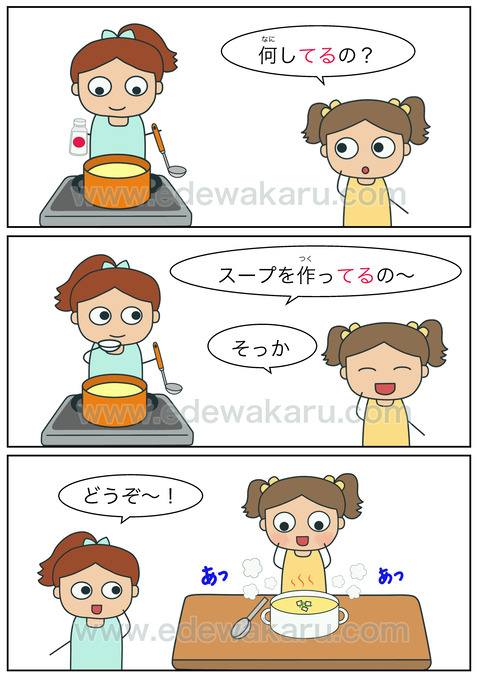
[1] Indicates that an action or event is in progress or continuing.
This is a phonetically altered form of “〜ている.”
[2] Indicates that an action or event continues repeatedly or habitually over a certain period. It is also used when stating one’s occupation or status.
This is a phonetically altered form of “〜ている.”
[3] Indicates an experience in the past. It is used when that experience affects the present situation.
This is a phonetically altered form of “〜ている.”
[4] Indicates that an action or event has been completed before a certain point in time.
This is a phonetically altered form of “〜ている.”
[5] Indicates a state in which the result of an event or action expressed by “〜” continues unchanged. This expression focuses only on the state of the subject. It does not take into consideration whether the change was caused by a person’s action or occurred naturally.
This is a phonetically altered form of “〜ている.”
[6] Used to describe the appearance, look, or state of an object. It refers to an unchanging feature or shape that the object has, rather than a temporary appearance or state.
This is a phonetically altered form of “〜ている.”
How to use it
Vてる
Vてる
Notes
[1] The “~” slot takes verbs expressing ongoing actions or events, such as 「読む・待つ・働く・降る」 (read, wait, work, fall).
[5] The “〜” slot takes verbs expressing a change of state. It often uses intransitive verbs describing instantaneous changes, such as 「壊れる・消える・開く」 (break, disappear, open), but it can also use transitive verbs describing a change in a part of the body, such as 「目を開ける・手を挙げる」 (open one’s eyes, raise one’s hand), and transitive verbs describing putting on or taking off clothing, such as 「着る・かぶる」 (wear, put on one’s head).
In context 36 examples
「私? 今、ショパンを聴いてる。洋君はそっちで何してるの?」
“Me? I’m listening to Chopin right now. What are you doing over there, Yo?”
もう30分も友達を待ってるけど、まだ来ない。
I’ve been waiting for my friend for 30 minutes already, but they still haven’t come.
「2階の部屋で本を読んでるから、用事があるときは呼んでね」
“I’m reading a book in the upstairs room, so call me if you need anything.”
「テレビ見てないで、ここ片づけて。ねえ、聞いてる?」
“Don’t watch TV; tidy this up. Hey, are you listening?”
「今、体育館で卓球の試合やってるから見に行かない?」
“There’s a table tennis match going on in the gym right now. Want to go watch?”
「台風の影響、どう?」「さっきまでだいぶ強い風が吹いてたけど、今はおさまったみたい」
“How’s the typhoon affecting things?” “The wind was pretty strong until a little while ago, but it seems to have died down now.”
うちの猫には1日2回缶詰のえさをあげてます。
I give my cat canned food twice a day.
「食事、どうしてるの?」「たいてい何か自分で作って食べてる。心配しないで」
“What do you do for meals?” “I usually make something myself and eat it. Don’t worry.”
「また傘、なくしたの? 月に1度はなくしてるね」
“You lost your umbrella again? You lose one at least once a month.”
「僕たち、練習中に本当によく怪我してるよね。もっと注意しなきゃね」
“We really do get hurt a lot during practice, don’t we? We need to be more careful.”
「子どものころは、夕方テレビでいろんなアニメが放送されてて、よく見てたよ。最近はあんまり放送されてないみたいだけど」
“When I was a child, all kinds of anime were broadcast on TV in the evenings, and I used to watch them a lot. It seems they don’t show many these days, though.”
「はじめまして。兄がいつもお世話になってます」
“Nice to meet you. My older brother is always in your care.”
「お母さんは、お勤めは?」「母はしばらくデパートに勤めてましたけど、だいぶ前にやめました」
“Where does your mother work?” “She worked at a department store for a while, but quit quite some time ago.”
「私、中学のとき、生徒会長をやってたんです」
“I was student council president when I was in middle school.”
あれ、この映画、前に見てる。これはそんなに面白くなかったから、ほかのにしよう。
Oh, I’ve seen this movie before. It wasn’t that interesting, so let’s watch something else.
「今度の試合の相手校は10年前に全国優勝してるんだ。油断できないよ」
“Our opponent school in the upcoming match won the national championship ten years ago. We can’t let our guard down.”
弟はタイが好きで3回も行ってるから、私が行くときはおすすめの場所を教えてもらおう。
My younger brother loves Thailand and has been there three times, so I’ll ask him to recommend places when I go.
一度軽い交通事故起こしてるんで、車の運転はちょっと怖い。
I was in a minor traffic accident once, so driving a car scares me a little.
その人は遠い親戚らしいけど、私は一度も会ってないから、よく知らない。
Apparently that person is a distant relative, but I’ve never met them, so I don’t know them well.
「冷凍庫の氷、もうできてる?」「ううん、まだできてない。さっき水入れたばっかりだから」
“Is the ice in the freezer ready yet?” “No, not yet. I only just put the water in.”
客「あのー、注文したコーヒー、まだ来てないんですが」
Customer: “Um, the coffee I ordered still hasn’t arrived.”
「このデータの入力は?」「それなら、もう済んでます」
“What about entering this data?” “That’s already done.”
私が店に行ったときには、一番人気のからあげ弁当はもう売り切れてました。
By the time I got to the shop, its most popular fried chicken bento was already sold out.
帰りが遅くなってしまった。私が家に着くころには、子どもたちはもう寝てるだろうな。
I got home late. The children will probably be asleep by the time I get there.
「見て、きれいな花がたくさん咲いてるよ」
“Look, lots of beautiful flowers are blooming!”
あ、爪が伸びてる。切らなくちゃ。
Oh, my nails have grown. I have to cut them.
穴があいてる靴下をはいてきちゃった。
I came wearing socks with holes in them.
「この意見に賛成の人は? ……あ、5人が手を挙げてるね」
“Who agrees with this opinion? … Oh, five people have raised their hands.”
あのサングラスをかけてる人は誰だろう。
I wonder who that person wearing sunglasses is.
あれ、ドアに鍵がかかってない。かけ忘れたのかな。
Huh, the door isn’t locked. I wonder if I forgot to lock it.
「このコップ、ひびが入ってて危ないね」
“This cup has a crack in it, so it’s dangerous.”
この道は右に左にカーブしてるから、運転に気をつけないと。
This road curves back and forth, so I have to be careful driving.
「ほら、私の中指、少し右に曲がってるでしょ。祖母の遺伝なの」
“Look, my middle finger bends a little to the right, doesn’t it? I inherited it from my grandmother.”
「あの山頂がとんがってる山は、何ていう山?」「ああ、あれは剣岳だよ」
“What’s the name of that mountain with the pointed peak?” “Oh, that’s Mount Tsurugi.”
私、接客の仕事、向いてないのかな。頑張ってもうまくいかない。
Maybe I’m not suited to customer service work. No matter how hard I try, things don’t go well.
「うちの猫、背中の模様がハートの形になってて、かわいいでしょう」
“Our cat has a heart-shaped pattern on its back. Cute, isn’t it?”
Read the original source text
Meaning
[1] 動作や出来事が、進行中・継続中であることを表します。
「〜ている」が音声的に変化した形です。
[2] ある動作や出来事が、一定期間、反復的または習慣的に続くことを表します。職業や身分を言うときにも使います。
「〜ている」が音声的に変化した形です。
[3] 過去に経験したことを表します。そのことが現在の状況に影響を及ぼしている場合に使います。
「〜ている」が音声的に変化した形です。
[4] ある動作や出来事が、ある時点よりも前に完了した状態であることを表します。
「〜ている」が音声的に変化した形です。
[5] ~という出来事や動作の結果がそのまま続いている状態を表します。対象の状態だけに注目する言い方です。その変化が人の行為で起こった変化か自然に起こった変化かは意識していません。
「〜ている」が音声的に変化した形です。
[6] 物の外見・様子・状態などを説明するときに使います。一時的な様子や状態ではなく、その物が持つ変わらない特徴や形状などを言います。
「〜ている」が音声的に変化した形です。
How to use it
Vてる
Vてる
Notes
[1] 「~」には、「読む・待つ・働く・降る」など、継続的な動作や出来事を表す動詞がきます。
[5] 「〜」には、状態が変化することを表す動詞がきます。「壊れる・消える・開く」など、瞬間的な動きを表す自動詞を使うことが多いですが、「目を開ける・手を挙げる」など、体の一部の変化を表す他動詞、「着る・かぶる」など、服装などの着脱を表す他動詞も使います。
Bunpro Grammar Reference
Meaning
Does, Is doing
How to use it
Verb[て]+ る
Verb[て̶] + とる
Nuance
A casual Kansai verb pattern used to show that an action, activity or state is ongoing.
Explanation
A common abbreviation that is used in the Kansai region is てる, and とる. Both of these expressions replace ている, the combination of the conjunction particle て, and the る - Verb, いる. These structures convey the same meaning as ている, and express that something is ongoing.
てる is used equally by both genders, and is also relatively common in standard Japanese. とる on the other hand tends to be used almost exclusively by males, and is more unique to 関西弁.
Caution
As とる interacts with verbs in the same way as ている, と will change to ど with the same verbs that て would usually change to で.
Notes
Kansai dialect
In context 12 examples
- 私はここでサッカーをしている。
私はここでサッカーをしてる。I play soccer here.
- めっちゃ緊張しとるな。
You are being so nervous. (You look so nervous)
- 今勉強しとるから、あとでかけなおすな。
I'm studying right now, so I will call you back later.
- 久しぶり!元気にしてる?
Long time no see! Are you healthy? (It's been a long time! How are you doing)
- 今何してる?暇やったら、飲みに行かへん?
What are you doing right now? If you are free, do you want to go out for a drink?
- トムと話している。
トムと話してる。I am talking with Tom.
- 何をしている?
何しとる?What are you doing?
- 兄はアメリカに住んでいる。
兄はアメリカにすんどる。My older brother is living in the United States.
- 今デートをしている。
今デートしてる。I am on a date now.
- 寿司を食べている。
寿司たべとる。I am eating sushi.
- お祖母ちゃん、ちゃんと毎日薬飲んどる?ちゃんと毎日飲まんとあかんで。
Grandma, are you taking your meds everyday? You have to make sure to take them everyday.
- 今日も道が混んどるな。
The road is congested today also. (The traffic is terrible today too)
Read the original source text
Meaning
Does, Is doing
How to use it
Verb[て]+ る
Verb[て̶] + とる
Nuance
A casual Kansai verb pattern used to show that an action, activity or state is ongoing.
Explanation
A common abbreviation that is used in the Kansai region is てる, and とる. Both of these expressions replace ている, the combination of the conjunction particle て, and the る - Verb, いる. These structures convey the same meaning as ている, and express that something is ongoing.
てる is used equally by both genders, and is also relatively common in standard Japanese. とる on the other hand tends to be used almost exclusively by males, and is more unique to 関西弁.
Caution
As とる interacts with verbs in the same way as ている, と will change to ど with the same verbs that て would usually change to で.
Notes
関西弁
Nuance · 日本語
関西弁で、カジュアルに動作、状況、又は状態が進行中であることを示す際に使われる動詞活用法。