DoJG 日本語文法辞典(全集)
Meaning
Even though ~ try/want to ~; even though ~ be thinking of doing ~; although ~ try/want to ~; although ~ be thinking of doing ~
How to use it
Vvolitional | にも(~ない) | |
| 話そうにも(~ない) | (not) even though someone tries to talk |
| 教えようにも(~ない) | (not) even though someone tries to teach |
Explanation
ようにも(~ない) A conjunctive phrase that indicates concession: "even though someone tries to do something, he/she cannot do it for some reason".
In context 9 examples
徹に連絡しようにも電話番号もメールアドレスも知らない。
Even though I want to contact Toru, I don't know either her phone number or her e-mail address.
ひどく頭が痛くて起きようにも起きられない。
I have a terrible headache, and I cannot get up even though I want to.
記事を書こうにも書く材料がない。
Even though I'm thinking of writing an article, I have nothing to write about.
苦情を言おうにも誰に言っていいか分からなかった。
Although I wanted to complain, I didn't know who to complain to.
体を動かそうにもあちこち痛くて腕も上げられない。
Although I'm trying to move my body, every part aches and I can't even lift my arms.
気の毒に彼女は悩み事を相談しようにも相談できる人が近くにいない。
It's sad that even though she wants to talk to someone about her troubles, she has no one to talk to near her.
カウンセリングに行こうにも、その質や学派も様々でついつい懐疑的になってしまいます。
Although I am thinking of going for counselling, the variation in quality and schools of thought makes me sceptical.
その本は買おうにも絶版だった。
Although I wanted to buy the book, it was out of print.
携帯電話の電池が切れたので、電話をかけようにもかけられない。
Because my cell phone battery is dead, I cannot make a call even though I want to.
どんなときどう使う 日本語表現文型辞典
Meaning
can't even though want to
How to use it
Vよう + にも + Vない
Explanation
ようにも~ない
~しようと思ってもできない
1)「あることをしようと思っても、それを妨げる事情があってできない」という意味。
2)「にも」の前後は同じ動詞を使い、前は意志動詞の意志形、後はその可能動詞であることが多い。(他の辞書は「〜ない」や可能形の否定形がくる場合も挙げています)
3)どちらかというと、言い訳のような、消極的な気持ちを表すことが多い。
1)Even though speaker would like to do something, is prevented by circumstances.
2)Same verb is used before and after pattern. Verb is in volitional form pre-ceding pattern, and in potential form after.
3)Often expresses rather passive excuses.
In context 4 examples
大切な電話が来ることになっているので、出かけようにも出かけられません。
I’m expecting an important phone call, so even if I wanted to go out, I couldn’t.
なにしろ言葉が通じないのだから、道を聞こうにも聞けなくて困った。
Since we couldn’t make ourselves understood, we couldn’t even ask for directions, which was a problem.
お金に困っている後輩から借金を頼まれて、断ろうにも断れなかった。
A junior colleague who was short of money asked me for a loan, and I couldn’t refuse even if I wanted to.
早く電話をかけようにも、近くに電話がなくてかけられなかったのです。
Even though I wanted to call right away, there wasn’t a phone nearby, so I couldn’t.
Read the original source text
Meaning
can't even though want to
How to use it
Vよう+にも+Vない
Explanation
ようにも~ない
~しようと思ってもできない
1)「あることをしようと思っても、それを妨げる事情があってできない」という意味。
2)「にも」の前後は同じ動詞を使い、前は意志動詞の意志形、後はその可能動詞であることが多い。(他の辞書は「〜ない」や可能形の否定形がくる場合も挙げています)
3)どちらかというと、言い訳のような、消極的な気持ちを表すことが多い。
1)Even though speaker would like to do something, is prevented by circumstances.
2)Same verb is used before and after pattern. Verb is in volitional form pre-ceding pattern, and in potential form after.
3)Often expresses rather passive excuses.
絵でわかる日本語
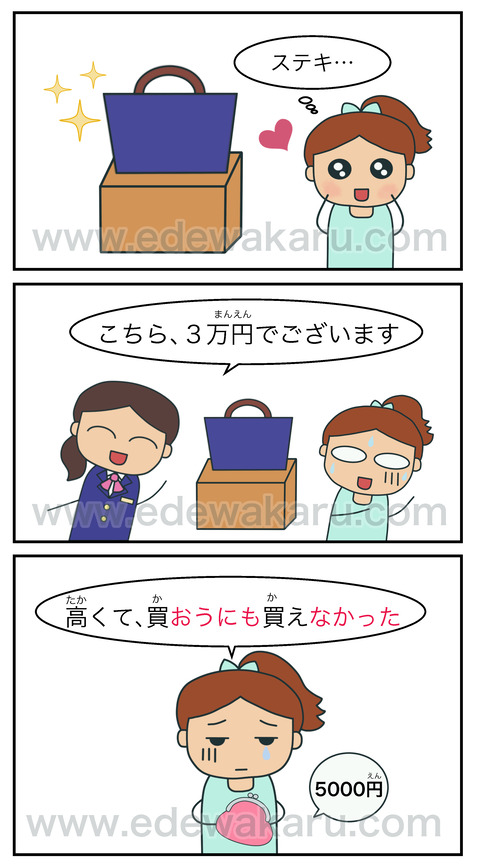
Meaning
〜cannot do 〜 even though one wants to
How to use it
Verb [volitional form] + にも〜ない
Explanation
“〜ようにも〜ない” is a grammar pattern meaning “cannot do 〜 even though one wants to.” It is used when something is simply impossible to do 😊 The form may be followed by “〜ない” or by the negative form of the potential form 😮
Remember that when the negative potential form follows, the same verb is repeated 😉
[When “〜ない” follows]
It is expensive, so I don’t have the money to buy it.
There are no trains, so I can’t go home.
[When the negative potential form follows]
It is expensive, so I can’t buy it even if I want to.
There are no trains, so I can’t go home even if I want to.
In context 3 examples
高すぎて、買おうにも買えなかった
→高すぎて、買おうと思っても買えなかったIt was too expensive, so I couldn’t buy it even though I wanted to. →It was too expensive, so even though I wanted to buy it, I couldn’t.
買おうにもお金がなかったんです
→買おうと思っても、お金がなかったんですI didn’t have the money, even though I wanted to buy it. →I didn’t have the money, even though I wanted to buy it.
終電がなくなったので、帰ろうにも帰れない
→終電がなくなったので、帰ろうと思っても帰れないThe last train is gone, so I can’t get home even though I want to. →The last train is gone, so I can’t get home even though I want to.
Read the original source text
Meaning
〜しようと思っても〜できない
How to use it
動詞[意向形]+にも〜ない
Explanation
「〜ようにも〜ない」は「〜しようと思っても〜できない」という意味を表す文型です。どうしてもできない場合などに使います😊 後ろには「〜ない」がくる場合と「可能形の否定形」がくる場合があります😮
「可能形の否定形」がくる場合は同じ動詞を繰り返して使うと覚えておきましょう
😉
[「〜ない」がくる場合]
高くて、買
おうにも
お金が
ない
帰
ろうにも
電車が
ない
[「可能形の否定形」がくる場合]
高くて、買
おうにも
買え
ない
電車がなくて、帰
ろうにも
帰れない
くらべてわかる日本語表現文型辞典
Meaning
I wanted to do A, but (because of some circumstance) I can’t.
How to use it
A₁ようにもA₂ない
[Verb—volitional form] にも [Verb—potential form] ない
Explanation
【Contrast 1】
“A₁にA₂ない” (Meaning 1, p. 210)
“A₁にA₂ない” means that one cannot do it because of psychological circumstances, while “AようにもAない” strongly implies that it is physically impossible.
○箸がなければ、ご飯を食べようにも食べられないじゃないか。 — Without chopsticks, how can I eat rice? I can’t even try to eat it.
×箸がなければ、ご飯を食べるに食べられないじゃないか。 — Without chopsticks, I can’t bring myself to eat rice.
“A₁たくてもA₂ない” (Meaning 1, p. 113)
“A₁たくてもA₂ない” means that the speaker wants to do it but cannot.
“A₁ようにもA₂ない” expresses that the speaker recognizes that it is impossible, due to some circumstance.
○胃の手術をしたばかりだから、飲もうにも飲めない。(体が受けつけない) — I just had stomach surgery, so I can’t drink even if I try. (My body can’t tolerate it.)
○胃の手術をしたばかりだから、飲みたくても飲めない。(医者に止められている) — I just had stomach surgery, so I can’t drink even though I want to. (The doctor has forbidden it.)
“AとしてもB (A₁ようとしてもA₂ない)” (Meaning 5, p. 179)
In context 4 examples
財布を落としてしまって、バスに乗ろうにも乗れなかった。
I dropped my wallet, so I couldn’t take the bus even though I wanted to.
毎日忙しくて、ゆっくり本を読もうにも読めない。
I’m busy every day, so I can’t even try to read a book at leisure.
駅がどこにあるかを聞こうにも、言葉が通じないので聞けなかった。
I couldn’t ask where the station was, even though I wanted to, because we couldn’t understand each other.
仕事が山ほど残っていて、早く帰ろうにも帰れなかったんだ。
I had a mountain of work left, so I couldn’t leave early even though I wanted to.
Read the original source text
Meaning
Aをしたいと思ったが(何かの事情があって)できない。
How to use it
A₁ようにもA₂ない
[動詞-意向形]にも[動詞-可能]ない
Explanation
【対比1】
「A₁にA₂ない」(意味1 P.210)
「A₁にA₂ない」は、心理的な事情でできないのであり、「AようにもAない」は物理的に不可能という意味合いが強い。
○箸がなければ、ご飯を食べようにも食べられないじゃないか。
×箸がなければ、ご飯を食べるに食べられないじゃないか。
「A₁たくてもA₂ない」(意味1 P.113)
「A₁たくてもA₂ない」は話し手はしたいと望んでいるができない。
「A₁ようにもA₂ない」はなんらかの事情で話し手自身も不可能なことを認めている。
○胃の手術をしたばかりだから、飲もうにも飲めない。(体が受けつけない)
○胃の手術をしたばかりだから、飲みたくても飲めない。(医者に止められている)
「AとしてもB(A₁ようとしてもA₂ない)」(意味5 P.179)
IMABI
~(よ)うにも & ~(よ)うものなら
Read this IMABI lesson ↗Explanation
~(よ)うにも & ~(よ)うものなら
In past lessons, we have learned about the auxiliary ~(よ)う and how it is used to mark volition, supposition, and with both properties implicated when followed by the conjunctive particles が・と(も). Incidentally, there are other patterns which utilize the auxiliary ~(よ)う in conditionals, each with its unique relationship between Situation A (the conditional) and Situation B (the main clause). The ones to be introduced in this lesson are:
~(よ)うにも
~(よ)うものなら
As for the bases of the auxiliary ~(よ)う, it only possesses two:
終止形(yo)u
連体形(yo)u
The 終止形 is utilized in ~(よ)うにも and the 連体形 is utilized in ~(よ)うものなら.
~(よ)うにも
The contrastive conditional relationship established by ~(よ)うにも is:
Even if the agent were to try to execute Situation A, Situation B prevents/conflicts with said execution of Situation A.
Because of this relationship, the main clause (Situation B) must be in the negative with a form of ~ない, and the predicate itself is most often the same verb as Situation A but in its potential negative form.
1. 家出をしようにも、お金がないよ。
Even if (you) were to run away, (you) don’t have any money.
2. スマホが壊れているので、友達に連絡を取ろうにも取れない。
My smartphone is broken, so I can’t contact my friends even if I were to try to.
3. 終電を逃してしまい、帰ろうにも帰れない。
I missed the last train, so I can’t get back home even if were to try to.
4. 昨日飲みすぎて、頭がガンガンするから、起きようにも起きられない。
I drank too much yesterday and my head is pounding, so I can’t get up even if I were to try.
5. 忙しくて休もうにも休めない。
I’m so busy that I can’t take a break even if were to try to.
6. 断ろうにも断れず、テイラー君にお金を貸してしまった。
Unable to refuse even if I were to try to, I lent money to Taylor-kun.
7. プールの中で歩こうにも中々抵抗ていこうで歩けない。
Even if you walk inside a pool, you can’t quite walk even with significant resistance.
8. 歌を歌おうにも高音こうおんが出にくい。
Even if I try to sing the song, it’s hard to reach the high tones.
9. 急ごうにも急げる体でもない。
I’m not in the physical condition to be able to hurry.
10. 履歴書りれきしょを書こうにも電話番号の記入は必須ひっすだから、携帯が無いと履歴書を作れない。
Even if I were to write a resume, because phone number is a required field, if I don’t have a cellphone, I can’t make a resume.
11. 今から就職活動しようにも、やりたい事もないし資格とかも持っていない。
Even if I were to start looking for a job now, there’s nothing I want to do or really have the qualifications for.
12. 塾じゅくで学んだ事を復習させようにも、ほとんど時間が確保出来ない。
Even if I were to have (the students) review what they’ve learned in cram school, I could not secure hardly any time.
~にも~ない
The pattern ~(よ)うにも utilizes the conjunctive particle に, which is why this pattern is structurally like other contrastive conditional patterns, and it just so happens that the conjunctive particle に may appear after the volitional form (意向形) or the non-past form of a verb. The difference in nuance is as follows:
V1 (Non-Past) + ~に V1 (Potential Negative)Emotionally based contexts where the realization of Situation B is deemed not possible, and so no attempt is even made in the first place.
V1 (Volitional) + ~にも V1 (Potential Negative)Situation B shown impossible even with an attempt made to make it happen.
These patterns hinge on the presence of volition in respect to V1, which would indicate that the latter part of the grammar, ~にも V1 (Potential Negative), behaves the same. Thus, we are looking at the same pattern with the addition of the auxiliary ~(よ)う adding its layer of modality into the dynamic – changing the execution of V1 as something deemed out of reach (in an emotionally charged context no less) to something that is proven to be out of reach through the execution of the agent’s volition.
13. 売るに売れないものだ。
It’s something I can’t sell even if I wanted to.
14. 今朝からずっと雨で、行くに行けない。
It’s been raining ever since this morning, and so I just can’t go.
15.ドリンクが来ないと歌うに歌えないですよね。
You really can’t sing if your drink doesn’t come, huh.
16. 行くに行けない雰囲気になった。
The atmosphere became one that I couldn’t go.
17. 帰るに帰れないかもなあ。
Looks like I/we can’t go home…
18. トイレに行くに行けない状況になった時は、精神的にかなりきつい。
It’s psychologically very tense whenever you’re in a situation you can’t go to the restroom.
19. 泣くに泣けない凡ぼんミスだった。
It was a trivial mistake too bitter to cry about.
20. 越こすに越されぬ1大きな川
A river impossible to traverse
Aspect-wise, the non-past tense sets the speaker(=agent)’s mind to a theoretical timeline in which the agent is to carry it out, the circumstances prevent it from being a reality, removing the agent’s control from the equation. This holds true for when the volitional form is used, too, however, as the tense of the dependent clause does not change. What does change is that the agent’s execution of their control still means nothing.
~(よ)うものなら
The conditional relationship established by ~(よ)うものなら is:
Provided that Situation A does come to pass, Situation B occurs, and as for Situation B, it is a very dire consequence.
This grammar point utilizes the suppositional nuance of ~(よ)うものなら.
21. 先生に厚かましくも口答えをしようものなら、大目玉を食らうだろう。
Should you ever have the nerve to talk back to your teacher, you will surely get scolded severely.
22. 火事になろうものなら、大変だぞ。
It would be a grave situation should there be a fire.
~ものなら
Without the layer of nuance provided by ~(よ)う , ~ものなら after the non-past form of a verb creates the following conditional relationship:
Situation A is an action that the speaker really wishes were possible, and Situation B is the same action in whatever capacity the speaker(=agent) would execute it.
The verbal predicate preceding ~ものなら is almost always in its potential form. The use of the nominalizer もの, as opposed to the other nominalizers, is what adds a sense of tangibleness to the preceding verbal predicate it nominalizes.
23. もし過去に戻れるものなら、戻って現在を変えたい。
If I could go back in time, I would go back and change the present.
24. 会えるものなら、天国の愛犬にもう一度会いたいです。
If I could, I would like to see my beloved dog in heaven again.
25. 住めるものなら、大きな家に住みたいです。
If I could, I would like to live in a big house.
26. 言えるものなら言いたいけど、今はまだ言えないよ。
I wish I could say, but I’m unable to yet.
27. できるものなら、今すぐ帰国したいぐらいです。
If I could, I would like to go back to my country right here and now.
If the statement is directed at someone else, then ~ものなら takes on a provocative tone, implying that the listener(=potential agent) has no chance of actually being able to do said action.
28. 掴つかめるものなら、掴んでごらん。
If you think you can grab it, go right ahead.
29. ひとりで行けるものなら、行ってみなさい。
If you think you can go alone, go ahead and try to.
In casual conversation, ~ものなら often manifests as ~もんなら.
30. 浮気できるもんなら、してみろ。
If you (think) you can cheat, go ahead and do it.
31. 寝れるもんなら寝てみろや。
If you (think) you can sleep, go ahead and try.
越されぬ is, in fact, an old-fashioned potential negative form of the verb 越す. Prior to the emergence of the potential form for 五段 verbs, potential was marked by the auxiliary ~れる for 五段 verbs. ↩︎
In context 31 examples
家出をしようにも、お金がないよ。
Even if (you) were to run away, (you) don’t have any money.
スマホが壊れているので、友達に連絡を取ろうにも取れない。
My smartphone is broken, so I can’t contact my friends even if I were to try to.
終電を逃してしまい、帰ろうにも帰れない。
I missed the last train, so I can’t get back home even if were to try to.
昨日飲みすぎて、頭がガンガンするから、起きようにも起きられない。
I drank too much yesterday and my head is pounding, so I can’t get up even if I were to try.
忙しくて休もうにも休めない。
I’m so busy that I can’t take a break even if were to try to.
断ろうにも断れず、テイラー君にお金を貸してしまった。
Unable to refuse even if I were to try to, I lent money to Taylor-kun.
プールの中で歩こうにも中々抵抗ていこうで歩けない。
Even if you walk inside a pool, you can’t quite walk even with significant resistance.
歌を歌おうにも高音こうおんが出にくい。
Even if I try to sing the song, it’s hard to reach the high tones.
急ごうにも急げる体でもない。
I’m not in the physical condition to be able to hurry.
履歴書りれきしょを書こうにも電話番号の記入は必須ひっすだから、携帯が無いと履歴書を作れない。
Even if I were to write a resume, because phone number is a required field, if I don’t have a cellphone, I can’t make a resume.
今から就職活動しようにも、やりたい事もないし資格とかも持っていない。
Even if I were to start looking for a job now, there’s nothing I want to do or really have the qualifications for.
塾じゅくで学んだ事を復習させようにも、ほとんど時間が確保出来ない。
Even if I were to have (the students) review what they’ve learned in cram school, I could not secure hardly any time.
売るに売れないものだ。
It’s something I can’t sell even if I wanted to.
今朝からずっと雨で、行くに行けない。
It’s been raining ever since this morning, and so I just can’t go.
ドリンクが来ないと歌うに歌えないですよね。
You really can’t sing if your drink doesn’t come, huh.
行くに行けない雰囲気になった。
The atmosphere became one that I couldn’t go.
帰るに帰れないかもなあ。
Looks like I/we can’t go home…
トイレに行くに行けない状況になった時は、精神的にかなりきつい。
It’s psychologically very tense whenever you’re in a situation you can’t go to the restroom.
泣くに泣けない凡ぼんミスだった。
It was a trivial mistake too bitter to cry about.
越こすに越されぬ1大きな川
A river impossible to traverse
先生に厚かましくも口答えをしようものなら、大目玉を食らうだろう。
Should you ever have the nerve to talk back to your teacher, you will surely get scolded severely.
火事になろうものなら、大変だぞ。
It would be a grave situation should there be a fire.
もし過去に戻れるものなら、戻って現在を変えたい。
If I could go back in time, I would go back and change the present.
会えるものなら、天国の愛犬にもう一度会いたいです。
If I could, I would like to see my beloved dog in heaven again.
住めるものなら、大きな家に住みたいです。
If I could, I would like to live in a big house.
言えるものなら言いたいけど、今はまだ言えないよ。
I wish I could say, but I’m unable to yet.
できるものなら、今すぐ帰国したいぐらいです。
If I could, I would like to go back to my country right here and now.
掴つかめるものなら、掴んでごらん。
If you think you can grab it, go right ahead.
ひとりで行けるものなら、行ってみなさい。
If you think you can go alone, go ahead and try to.
浮気できるもんなら、してみろ。
If you (think) you can cheat, go ahead and do it.
寝れるもんなら寝てみろや。
If you (think) you can sleep, go ahead and try.
AIUEO JLPT Grammar
Meaning
This sentence pattern expresses that, even though one tries to do something, it is impossible due to certain reasons or situations. It highlights that despite one’s intent, physical, emotional, or environmental constraints prevent action.
How to use it
Verb (volitional form) にも + Verb (ない-form)
In context 5 examples
忘れようにも忘れられないことがある。
There are things I try to forget, but I just can’t.
鍵を失くしてしまって、家に入ろうにも入れない。
I lost my keys, so even if I try to enter my house, I can’t.
うるさすぎて集中しようにも集中できない。
It's so noisy that I can't concentrate even if I try.
仕事が山積みで、休もうにも休めなかった。
I had too much work, so even if I want to rest, I can’t.
資料がないから、調べようにも調べられないんです。
I don’t have the materials, so even if I want to research, I can’t.
Read the original source text
Meaning
This sentence pattern expresses that, even though one tries to do something, it is impossible due to certain reasons or situations. It highlights that despite one’s intent, physical, emotional, or environmental constraints prevent action.
How to use it
動詞意向形にも+動詞ない形
Explanation · 日本語
この文型は、何かをしようと試みても、何らかの理由や状況によりそれができないことを表す表現です。意志があっても、物理的、感情的、または環境的な制約によって行動が不可能である状況を強調します。
文法
Meaning
Try as one might, one cannot ~ / Even if one wants to ~, one cannot (for some reason).
How to use it
V (volitional form) + にも + V (ない-form) ない
In context 6 examples
大学の友達に連絡をとりたいんだけど、電話番号もFacebookも知らないので、連絡を取ろうにも取れない。
I want to get in touch with my university friends, but I don’t know their phone numbers or Facebook accounts, so I can’t contact them even if I try.
タイに来たんだけど、英語が通じなくて道を聞こうにも聞けない。
I came to Thailand, but people don’t understand English, so I can’t ask for directions even if I try.
夜中の2時まで飲んでしまって、もう終電もないし、タクシーもないので、帰ろうにも帰れない。
I drank until two in the morning, and now there are no more trains and no taxis, so I can’t get home even if I try.
バイクを運転中に転倒してしまい、起きようにも起きれない状態だ。
I fell while riding my motorcycle, and now I’m in a state where I can’t get up even if I try.
明日は休みたかったんだけど、システムトラブルのせいで、休もうにも休めない。
I wanted to take tomorrow off, but because of a system problem, I can’t, even if I try.
お金がなくて困っている友達があまりにも可哀想だったので、断ろうにも断れず、お金を貸してしまった。
My friend, who was struggling because they had no money, looked so pitiful that I couldn’t refuse, even though I tried, and ended up lending them money.
Read the original source text
Meaning
〜しようとしてもできない / 〜したいと思っても(理由があって)できない。
How to use it
V(意向形) + にも + V(ナイ形)ない
日本語NET JLPT文法解説まとめ
Meaning
Try as one might, one cannot ~ / Even if one wants to ~, one cannot (for some reason).
How to use it
V (volitional form) + にも + V (ない-form) ない
Explanation
Even though I try to (do something), I can't (do it).
In context 6 examples
大学の友達に連絡をとりたいんだけど、電話番号もFacebookも知らないので、連絡を取ろうにも取れない。
I want to get in touch with my university friends, but I don’t know their phone numbers or Facebook accounts, so I can’t contact them even if I try.
タイに来たんだけど、英語が通じなくて道を聞こうにも聞けない。
I came to Thailand, but people don’t understand English, so I can’t ask for directions even if I try.
夜中の2時まで飲んでしまって、もう終電もないし、タクシーもないので、帰ろうにも帰れない。
I drank until two in the morning, and now there are no more trains and no taxis, so I can’t get home even if I try.
バイクを運転中に転倒してしまい、起きようにも起きれない状態だ。
I fell while riding my motorcycle, and now I’m in a state where I can’t get up even if I try.
明日は休みたかったんだけど、システムトラブルのせいで、休もうにも休めない。
I wanted to take tomorrow off, but because of a system problem, I can’t, even if I try.
お金がなくて困っている友達があまりにも可哀想だったので、断ろうにも断れず、お金を貸してしまった。
My friend, who was struggling because they had no money, looked so pitiful that I couldn’t refuse, even though I tried, and ended up lending them money.
Read the original source text
Meaning
〜しようとしてもできない / 〜したいと思っても(理由があって)できない。
How to use it
V(意向形) + にも + V(ナイ形)ない
Explanation
Even though I try to (do something), I can't (do it).
NINJAL 日本語文型データベース
Meaning
Used when you want to say that you want to do something but cannot because necessary conditions are not in place, such as lacking the means to do it.
How to use it
V (よ)うにも Vない
Notes
The two instances of “〜” often use the same verb expressing an intentional action.
「~ない」 is the potential negative form in the nai-form.
In context 7 examples
あれ? 鍵がない。これじゃ、中に入ろうにも入れない。
Huh? The key’s gone. I can’t get inside even if I try.
こんな大雪では出かけようにも出かけられません。
With snow this heavy, we can’t go out even if we want to.
工事の音がうるさくて、勉強しようにもできないんです。
The construction noise is so loud that I can’t study even if I try.
願書の締め切りに間に合わなかったため、試験を受けようにも受けられなくなってしまった。
Because I missed the application deadline, I ended up unable to take the exam even if I wanted to.
「きちんと話してくれなければ、君の気持ちを理解しようにも理解できないよ」
“If you don’t explain properly, I can’t understand how you feel no matter how hard I try.”
彼の北極圏探検の計画は少し危険だと思ったが、決心が固くて止めようにも止められなかった。
I thought his plan to explore the Arctic was a little dangerous, but he was so determined that I couldn’t stop him even if I tried.
「現地からの連絡がないので、社員の事故につきましては、今は詳しいことはお答えしようにもお答えできない状況なんです」
“Since we have had no contact from the site, we are currently in a situation where we cannot provide details about the employee’s accident, even if we wanted to.”
Read the original source text
Meaning
~したい気持ちはあるが、手段がないなど必要な条件がそろわないという事情で、~できないと言いたいときに使います。
How to use it
V(よ)うにもVない
Notes
2つの「〜」には、意志的な行為を表す同じ動詞がくることが多いです。
「~ない」は可能の形のナイ形です。