DoJG 日本語文法辞典(全集)
Usage 1
Meaning
Even if ~
How to use it
(i) Vinformal past | って | |
| 話したって | Even if someone talks/talked |
| 食べたって | Even if someone eats/ate |
(ii) Adjective い stem | くたって | |
| 高くたって | Even if something is/were expensive |
(iii) {Adjective な stem/ N} | だっ(たっ)て | |
| 静かだっ(たっ)て | Even if something is/were quiet |
| 先生だっ(たっ)て | Even if someone is/were a teacher |
Explanation
Even if someone did something or something were in some state (the desired result would not come about) or even if someone or something is in some state.
In context 7 examples
あの人には話したって分からない・分かりません。
Even if I tell him that, he won't understand it.
僕はその切符を高くたって買う・買います。
I will buy the ticket even if it is expensive.
お金があったって車は買いたくない。
Even if I had money, I wouldn't want to buy a car.
本を買ったって、忙しくて読めない。
Even if I buy books, I'm too busy to read them.
汚くたって構いません。
I don't care even if it is dirty.
遠くて不便だってマイ・ホームなら構いません。
Even if it is far away and inconvenient, it doesn't matter if it is 'my home'.
どんなにいい先生だって時々間違います。
No matter how good a teacher may be, he sometimes makes mistakes.
Usage 2
Meaning
Even if; if; whether; no matter what/who/how/etc.
How to use it
(i) Vinformal past | って | |
| 話したって | Even if someone talks/talked |
| 食べたって | Even if someone eats/ate |
(ii) Adjective い stem | くたって | |
| 高くたって | Even if something is/were expensive |
(iii) {Adjective な stem/ N} | だっ(たっ)て | |
| 静かだっ(たっ)て | Even if something is/were quiet |
| 先生だっ(たっ)て | Even if someone is/were a teacher |
Explanation
(っ)たって (1)The informal form of ても.
In context 11 examples
一人で旅行に行ったって面白くない。
It's not fun traveling (literally: if I travel) alone.
私は少しくらい高く(っ)たって、質のいいものを買うことにしている。
I make it a rule to buy good quality things even if they are a little more expensive.
いくら日本語が上手だって専門知識がなかったらこの翻訳はできないよ。
No matter how good someone's Japanese is, he/she cannot do this translation without technical knowledge (in this field).
プロだって失敗することもある。
Even professionals make mistakes. (literally: Even if he is a professional, there are times when he makes a mistake.)
仕事を変えたって問題は解決しない。
Even if you change your job, it won't solve the problem.
苦しくったって諦めちゃいけない。
Even if it's a struggle, you shouldn't give up.
古くたって新しくたって、よいものはよいのだ。
Whether it's old or new, a good thing is good.
いくら通勤に便利だってこの家賃は高すぎる。
No matter how convenient (the location) is for commuting, the rent is too high.
誰だってそんなことを言われたら腹が立つよ。
No matter who it is, anyone would get mad if you said that to him.
コンピュータがなくったってこの仕事はできる。
You can do this job even if you don't have a computer.
自分で料理しなくたって、お金さえ出せば食べたいものが簡単に手に入るようになった。
Even if you don't cook yourself, you can easily get what you want to eat now if you just pay for it.
Usage 3
Meaning
Even if (someone says that); even if someone tries to; although
How to use it
(i) Vinformal past | って | |
| 話したって | Even if someone talks/talked |
| 食べたって | Even if someone eats/ate |
(ii) Adjective い stem | くたって | |
| 高くたって | Even if something is/were expensive |
(iii) {Adjective な stem/ N} | だっ(たっ)て | |
| 静かだっ(たっ)て | Even if something is/were quiet |
| 先生だっ(たっ)て | Even if someone is/were a teacher |
Explanation
(っ)たって (2) The contracted form of と言っても or としても.
In context 12 examples
一人でしよう(っ)たって、それは無理だ。
You'll never be able to do it alone! (literally: Even if you try to do it alone, that's impossible.)
今すぐ買いに行く(っ)たって、もう店はみんな閉まっている。
Even if you wanted to go buy it right now, the stores are all already closed.
高い(っ)たって、100万円はしないだろう。
Even though it's said to be expensive, my guess is it won't cost more than one million yen.
日本語教育の経験者(だ)ったって、彼女はまだ日本以外で教えたことはない。
Although she has experience teaching Japanese, she hasn't yet taught anywhere outside of Japan.
あの家は君が買おうったって買えるようなものじゃない。
That house is not something you could buy even if you wanted to.
僕を騙そうったってそうはいかない。
It won't work if you try to cheat me.
彼が何を言おうったってそれをとめようとは思わない。
Whatever he may want to say, I don't think I'll stop it.
今から帰るったってもう電車はないよ。
There are no more trains even if (you say) you want to go home now.
調べるったって、こんなたくさんある資料を一人で調べるのは無理だ。
Even if you say you'll look through the materials, it's impossible for you to do it alone because there are so many.
近いったってとても歩いて行ける距離じゃない。
Although (I say) it's close, it's not a distance you can walk at all.
いくら簡単ったって、やっぱり最低限のパソコン知識がなくては使えない。
No matter how simple (they say) it is, in fact you won't be able to use it without a minimum knowledge of computers.
「断食」ったって、全く何も口に入れないんじゃない。1日に2回、野菜ジュースを飲むことはできる。
Although I say ""fasting,"" it's not like you can't put anything in your mouth. You can drink vegetable juice twice a day.
日本語文型辞典
Meaning
A casual spoken form of ても.
⇾ ても
a. …ったって
A casual way of saying といっても, with たって as a contraction. For なんてったって in ③, the form なんたって is also used.
⇾ といっても
b. V-ようったって
A casual spoken form of V-ようといっても. Means “even if one says they’ll do something.” It is followed by an expression such as “that’s difficult” or “that’s impossible.”
How to use it
…たって
A-くたって
V-たって
…たって
In context 13 examples
遅くなったって、必ず行きますよ。
Even if I’m late, I’ll definitely go.
あの人はいくら食べたって太らないんだそうだ。
Apparently, no matter how much that person eats, they don’t gain weight.
いまごろ来たって遅い。食べ物は何も残っていないよ。
It’s too late to come now. There’s no food left.
あの人はどんなにつらくたって、決して顔に出さない人です。
No matter how painful things are for that person, they never let it show.
いくら高くたって買うつもりです。めったに手に入りませんから。
I intend to buy it no matter how expensive it is. You hardly ever get a chance to buy one.
笑われたって平気だ。たとえ一人になっても最後までがんばるよ。
I don’t care if people laugh at me. Even if I’m left all alone, I’ll keep going to the end.
高いったって一万円も出せば買える。
Even if it’s expensive, you can buy it for just 10,000 yen.
A:日曜日なんだから、どっか出かけましょうよ。
B:出かけるったって、どこも人でいっぱいだよ。A: It’s Sunday, so let’s go somewhere. B: Even if we go out, everywhere will be packed with people.
ストレス解消には、なんてったってスポーツが一番ですよ。
For relieving stress, nothing beats sports.
帰ろうったって、こんな時間じゃもう電車もバスもない。
Even if I try to go home, at this hour there are no trains or buses anymore.
こんなにへいが高くては、逃げようったって逃げられない。
With the wall this high, there’s no way to escape, even if I try.
連絡しようったって、どこにいるかさえわからないのに無理だ。
Even if I try to contact them, it’s impossible when I don’t even know where they are.
A:ちょっと休もうよ。
B:休もうたってベンチもなにもなしよ。A: Let’s take a short break. B: Even if we want to rest, there isn’t a bench or anything.
Read the original source text
Meaning
「ても」のくだけた話しことばの言い方。
⇾ても
a. …ったって
「といっても」のくだけた言い方で、「たって」のつまったもの。③の「なんてったって」には「なんたって」という言い方もある。
⇾といっても
b. V-ようったって
「V-ようといっても」のくだけた話しことばの言い方。「なにかをしようといっても」という意味。あとに「そんなことはむずかしい、無理だ」というような表現が続く。
How to use it
…たって
A-くたって
V-たって
…たって
絵でわかる日本語
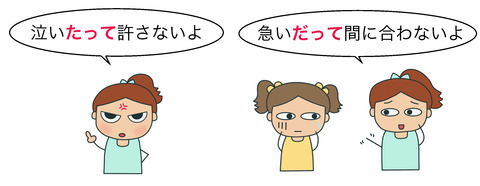
どんなときどう使う 日本語表現文型辞典
Meaning
no matter how
How to use it
Vた / イAく + た / ナAだ / Nだ + ってS
Explanation
「たって」は「ても」、「だって」は「でも」の意味。くだけた話し言葉。
たって has same meaning as ても, だって as でも. Informal expression.
In context 3 examples
いくら安くたって、好きじゃないものは買わない。
No matter how cheap it is, I won't buy something I don't like.
何回電話をかけたって、一郎は電話に出ない。なんだか変だ。
No matter how many times I call, Ichiro won't answer. Something feels strange.
このパソコンソフトは簡単だから、子どもだって使えます。
This computer software is easy, so even children can use it.
Read the original source text
Meaning
no matter how
How to use it
Vた/イAく+た/ナAだ/Nだ+ってS
Explanation
「たって」は「ても」、「だって」は「でも」の意味。くだけた話し言葉。
たって has same meaning as ても, だって as でも. Informal expression.
日本語文型辞典 英語版
Meaning
An informal, spoken language equivalent of ても.
→
B:出かけるったって、どこも人でいっぱいだよ。
Go out? But everywhere it’s packed with people.
This is an informal equivalent of といっても and a variant of たって, pronounced with a glottal stop (っ). In addition to なんてったって, as in
(3)
, the expression なんたって can also be used.
→
【といっても】b. V-ようったって
B:休もうたってベンチもなにもないよ。
You say let’s rest, but there aren’t any benches or anything.
An informal, spoken language equivalent of V-ようといっても. Means “although one wants to do something....” Followed by expressions that mean “such a thing is difficult or impossible.”
How to use it
1. ...たって[A-くたって][V-たって]
2. ...たってa. ...ったって
In context 13 examples
遅くなったって、必ず行きますよ。
Even if I’m late, I’ll definitely go.
あの人はいくら食べたって太らないんだそうだ。
I hear that man doesn’t put any weight on, no matter how much he eats.
いまごろ来たって遅い。食べ物は何も残っていないよ。
It’s too late to be arriving at this hour. There isn’t any food left.
あの人はどんなにつらくたって、決して顔に出さない人です。
No matter how hard things are for that woman, she never shows it.
いくら高くたって買うつもりです。めったに手に入りませんから。
No matter how expensive it is, I’m going to buy it. Because it’s almost never available.
笑われたって平気だ。たとえ一人になっても最後までがんばるよ。
I don’t care if people laugh at me. Even if I’m the only one, I’ll stick it out to the end.
高いったって一万円も出せば買える。
You may think it’s expensive, but you can buy it if you shell out 10,000 yen.
A:日曜日なんだから、どっか出かけましょうよ。
It’s Sunday, so let’s go out somewhere.
ストレス解消には、なんてったってスポーツが一番ですよ。
When all is said and done, the best thing for getting rid of stress is sports.
帰ろうったって、こんな時間じゃもう電車もバスもない。
Even if I wanted to go home, there aren’t any more trains or buses at this hour.
こんなにへいが高くては、逃げようったって逃げられない。
With a fence this high, I couldn’t escape even if I wanted to.
連絡しようったって、どこにいるかさえわからないのに無理だ。
We don’t even know where he is, so it wouldn’t be possible to contact him even if we wanted to.
A:ちょっと休もうよ。
Let’s stop and rest for a while.
Read the original source text
Meaning
An informal, spoken language equivalent of ても.
→
B:出かけるったって、どこも人でいっぱいだよ。
Go out? But everywhere it’s packed with people.
This is an informal equivalent of といっても and a variant of たって, pronounced with a glottal stop (っ). In addition to なんてったって, as in
(3)
, the expression なんたって can also be used.
→
【といっても】b. V-ようったって
B:休もうたってベンチもなにもないよ。
You say let’s rest, but there aren’t any benches or anything.
An informal, spoken language equivalent of V-ようといっても. Means “although one wants to do something....” Followed by expressions that mean “such a thing is difficult or impossible.”
How to use it
1. ...たって[A-くたって][V-たって]
2. ...たってa. ...ったって
AIUEO JLPT Grammar
Meaning
「たって・だって」is a conjunction particle used to express a contrast, similar to “ても・でも.” It is used to indicate that even if something happens or is the case, the result or situation will not change. This expression is more colloquial and often used in casual conversations.It is frequently used in spoken language with a casual tone.
How to use it
Verb た-form + たって; adjective く-form + たって; な-adjective + だって; noun + だって
In context 5 examples
急いだって間に合わないよ。
Even if you hurry, you won’t make it on time.
謝ったって許してくれないかもしれない。
Even if I apologize, they might not forgive me.
寒くたって、外で遊びたい。
Even if it’s cold, I want to play outside.
子供だってできるよ。
Even a child can do it.
休日だってやることはいっぱいある。
Even on my day off, I still have a lot to do.
Read the original source text
Meaning
「たって・だって」is a conjunction particle used to express a contrast, similar to “ても・でも.” It is used to indicate that even if something happens or is the case, the result or situation will not change. This expression is more colloquial and often used in casual conversations.It is frequently used in spoken language with a casual tone.
How to use it
動詞た形+たって形容詞く形+たって形容動詞+だって名詞+だって
Explanation · 日本語
「たって・だって」は、「ても・でも」と同じように、逆接の意味を表す接続助詞で、何かが起こったり、そうであったりしても、それに影響されない結果や状況を示す場合に使われます。特に口語的な表現であり、カジュアルな場面でよく使われます。
Bunpro Grammar Reference
Meaning
Even if, Even though, No matter how
How to use it
Verb[た]+ って
Verb[なくて̶] + たって
[い]Adjective[く]+ たって
[い]Adjective[なくて] + たって
[な]Adjective + だって
[な]Adjective + じゃなくたって
Noun + だって
Noun + じゃなくたって
Nuance
A very casual expression which indicates that even if (A), (B), or no matter how (A), (B).
Explanation
たって is a casual structure that carries the same meaning as 'ても' or 'でも', and can be used with a wide variety of words. Common translations include 'even if (A)', 'even though (A)', or 'no matter how (A)'.
In the case of verbs, たって conjugates in the standard way that the た past-tense form usually would.
彼女に謝ったってどうせ許してくれないだろう。
Even if I apologized to her, she wouldn't forgive me anyway.
先生に聞いたって、何も教えてくれないからインターネットで調べる。
Even if I ask the teacher, they won't tell me anything, so I am going to look it up on the internet.
For い-Adjectives, たって attaches to the conjugative く-form.
どんなに欲しくたって、万引きをしてはいけない。
No matter how much you want something, you must not shoplift.
稽古がどんなに楽しくなくたって、稽古中には欠伸をしてはならない。
No matter how boring the lesson might be, you must not yawn during a lesson.
For nouns and な-Adjectives, た will change to だ, and だって will then be used with the stem noun or adjective.
こんな簡単な問題馬鹿だってわかるよ!
Even an idiot can figure out a simple problem like this!
友達だって喧嘩をすることがある。
Even friends can get into fights.
Fun-fact
Although たって is widely considered a casual form of ても, it originally stems from たとて, which is a combination of the auxiliary verb た, and the particle とて, which itself is thought to be an old-fashioned abbreviation of と言っても. In this way, the modern abbreviation of たって still reflects the original extended nuance of たと言っても 'even if (A) is said, (B)'.
In context 18 examples
- パーティーにはピザじゃなくたってかまわないよね。
Even if it is not a pizza party, I don't mind.
- 先生に聞いたって、何も教えてくれないからインターネットで調べる。
Even if I ask the teacher, they won't tell me anything, so I am going to look it up on the internet.
- どんなに欲しくたって、万引きをしてはいけない。
No matter how much you want something, you must not shoplift.
- 友達だって喧嘩をすることがある。
Even friends can get into fights.
- こんな簡単な問題馬鹿だってわかるよ!
Even an idiot can figure out a simple problem like this!
- 彼女に謝ったってどうせ許してくれないだろう。
Even if I apologized to her, she wouldn't forgive me anyway.
- 稽古がどんなに楽しくなくたって、稽古中には欠伸をしてはならない。
No matter how boring the lesson might be, you must not yawn during a lesson.
- ブロッコリーが健康に良くたって、もう食べたくない!
Even if broccoli is good for your health, I still don't want to eat it.
- どんなに押したくたって、この赤いボタンを押してはダメ。
No matter how much you want to press it, you must not press the red button.
- 海水浴に行ったって僕は泳げないからつまらない。
Even if I went to the beach, since I can't swim, it would be boring.
- たとえ彼がどこにいるか知っているとしたって、それでもお前には教えない。
Even if (we assume that) I did know where he is, I still would not tell you!
- この試合に勝ったって、準々決勝には進めないよ。
Even if I win the match I won't proceed to the quarterfinals!
- たとえ家が大きくなくたって、オレンジ色の屋根があればそれでいい。
Even if a house is not large, I will be fine if the roof is orange.
- そんなに改造したってエンジンが古すぎるから無駄だと思うよ。
Even if we did that much remodeling, the engine is too old, so it would be a waste I think.
- 日本語が上手にできなくたって、それでも日本旅行を楽しめるよね。
Even if you are not capable in Japanese, you can still enjoy your time in Japan.
- 真剣に告白したって、彼女は冗談だと思うかもしれない。
Even if I confess (my love) in all seriousness, she might think it is a joke.
- まさか、また宿題忘れたの?あたしの友達だって、いちいち写させることができないわ。もっとしっかりしなさい!
No way, you forgot the homework again?! Even if you are my friend, I can't let you copy it every single time! Get a grip!
- A(エー):「バンジージャンプをしてみるのはどうだろう?やらずに後悔するよりやって後悔したほうがいい。」
B(ビー):「カッコよく言ったってダメ。」A: 'What about trying bungee jumping? It is better to regret doing something than to regret not doing it.' B: 'Even if you say it in a cool way, I will not allow it.'
NINJAL 日本語文型データベース
Meaning
This expresses that when ~ is established, something else should naturally follow, but does not.
This is the form used when 「〜」 is a verb, an i-adjective, the negative form of a na-adjective, or the negative form of a noun.
How to use it
Notes
「~」 may refer to a fact or a hypothetical situation. After 「〜たって」 comes a sentence expressing a situation different from what is expected.
In context 20 examples
学校まで30分かかる。今から走って行ったって間に合わない。
It takes 30 minutes to get to school. Even if I run there now, I won’t make it in time.
電車が止まっているから、どんなに急いだって仕方ありません。
The trains have stopped, so there’s no point in hurrying, no matter how fast you go.
何度電話をかけたって、彼女はもう電話に出てくれないだろう。
No matter how many times I call, she probably won’t answer the phone anymore.
あえて言わなくたって私の気持ちは恋人に伝わっているはずだ。
I shouldn’t have to say it explicitly; my feelings should have gotten through to my partner.
両親は私のことをよくわかってくれていて、話さなくたって私の気持ちに寄り添ってくれる。
My parents understand me well, and they empathize with how I feel even without my having to talk.
たとえ安くたって、必要ないものは買いたくない。
Even if it’s cheap, I don’t want to buy things I don’t need.
「苦いジュースですね……」「おいしくなくたって体にいいですよ。飲んでください」
“This juice is bitter…” “Even if it doesn’t taste good, it’s good for you. Please drink it.”
好きなアイドルのグッズなら、安くなくたって買うつもりです。
If it’s merchandise from my favorite idol, I intend to buy it even if it isn’t cheap.
アイドルの番組を見たら、仕事がどんなにつらくたって頑張れます。
When I watch my favorite idol’s show, I can keep going no matter how hard work is.
商品がどれだけ良くたって、消費者に伝わらなければあまり意味がない。
No matter how good a product is, it doesn’t mean much if consumers don’t hear about it.
いくら勉強が好きではなくたって、毎日するべきだ。
No matter how much you dislike studying, you should do it every day.
たとえ得意でなくたって少しは漢字の勉強をしたほうがいい。
Even if you’re not good at it, you should study at least a little kanji.
どんなに野菜が好きじゃなくたって、健康のために食べなければならない。
No matter how much you dislike vegetables, you have to eat them for your health.
上手じゃなくたって、毎日少しずつ練習していけばできるようになるはずです。
Even if you’re not good at it, you should be able to learn by practicing a little every day.
料理が得意ではなくたって、夫には家族のために練習して少しはできるようになってほしい。
Even if he isn’t good at cooking, I want my husband to practice for the family and get at least a little better.
易しい問題は、先生ではなくたって説明できる。
Even someone who isn’t a teacher can explain an easy problem.
日本人でなくたって和食が大好きな人は多いです。
Many people love Japanese food even though they aren’t Japanese.
お金持ちでなくたって、みんな少額からの投資をしています。
Even people who aren’t rich are investing small amounts.
交換留学ではなくたって、私費留学で外国に行くこともできる。
You can go abroad to study at your own expense, even if it isn’t an exchange program.
たとえ期待通りの人生じゃなくたって、幸せな人生を歩めます。
Even if your life hasn’t turned out as you expected, you can still lead a happy life.
Read the original source text
Meaning
~が成立すると、当然あることも成り立つはずなのに成り立たないということを表します。
「〜」が動詞、イ形容詞と、ナ形容詞の否定、名詞の否定の場合の形です。
How to use it
Notes
「~」は事実でも仮定のことでもいいです。「~たって」の後には、予想されることとは異なる事態を表す文がきます。
IMABI
The Particles って, たって, & だって
Read this IMABI lesson ↗Explanation
The Particles って, たって, & だって
In this lesson we will learn about the particles って, たって, and だって which are necessary in improving your colloquial Japanese skills.
The Particle って
The Case Particle って: Colloquial Citation
This is a very important feature of casual Japanese. The particle と is very frequently seen as って in spoken Japanese. Although it originally came from the contraction of という, it has since taken on と’s function as a citation particle.
1. 難しいって思った。
I thought it was difficult.
2. 負けたよって言われてもなあ。
Even if you would have said you lost.
3. お母さんにどうぞよろしくって伝えてくださいね。
Please say nice to meet you to her mother.
4. 田中さんって知ってる?
Do you know Mr. Tanaka?
気にしなくてもいいってことだ。
It’s nothing you may need to be worried about.
“…の…の(と)” is used to list things in contrast or emphatically and “…の…ないの(って)” shows excess. As is noted, sometimes using it may be uncommon or even old-fashioned.
5. 何なんのかんのと文句もんくをつける。
To complain of what and that.
6. 死ぬの生きるのと大騒おおさわぎだ。
Dying and living is all turmoil.
7. うるさいのなんのって、耳が聞こえなくなったほどだ。
It’s so loud to the point I’ve lost my hearing.
8. 無職むしょくになるの、離婚りこんするの、散々さんざんな目にあったな。(Not so common)
Becoming unemployed and divorced, I’ve met a lot of terrible things hasn’t it!
9. 寒いの暑いのと言っていないで、ジョギングは毎朝まいあさしなさい。
Don’t complain about it being hot or cold, you must go jogging every day.
10. 痛いたいの痛くないのと、飛とび上あがってしまったよ。(古い言い方)
It hurt so bad I accidentally jumped up.
The Adverbial Particle って: Emphatic
It takes up the subject with slight exclamation and is equivalent to というのは. It’s also used in repeating what someone said.
11. オレって、なんてバカなんだ。
I’m such an idiot.
12. 誰かに出会える時っていつもこうだ。
Meeting someone is always the same way.
13. したくないって、どういう意味だ。
You don’t want to do it, what do you mean?
14. 誰が{殺人・殺人者・人殺し・犯人}かって、あいつに決まってるよ。
It’s settled that who the, um, murderer is that guy over there.
Word Note: 殺人者 is a rather formal word and not used much in actual conversation, although it is common in books. 人殺し is a graphic word that bring images of the bloody crime scene. So, it is considered a sensitive word and often avoided. 犯人, although it only means “criminal”, it is the most likely word to use in this situation, and most people would realize automatically that the sentence is about murder anyways.
The Final Particle って: All of the Above
15. すぐ帰れってさ。
He said like to hurry home.
16. 間に合うだろうって。
They said they would probably make it on time.
With a high intonation, it shows confirmation.
17. 離婚するんですって。
You’re getting divorced?
18. 病気だったんですってねー。
It was sickness, right?
In a downward intonation, it passes down an assertion strongly. It is often used to (re)assure someone like in Ex. 19.
19. 大丈夫だって。
It’s OK.
20. きっと合格するって。
I’ll surely pass.
The Conjunctive Particle って
1. When used with ~た.
Even if you; no matter how.
っていい, ってかまわない, and って差し支つかえない to show permission.
21a. どう叫んだって、聞こえない。(Less common)
21b. どれほど叫んだって聞こえない。
Even if you somehow shout, he can’t hear.
22. どう見えたって、校長は校長だ。
No matter how you look at it, the principal is the principal.
23. やったっていいじゃん。
Isn’t it OK to do it?
Grammar Note: When used with ん, って is often changed to て. It’s also common as ってー.
The Particle たって
For the most part, たって is ~た + って. However, there is one usage of たって that makes it unique.
The Conjunctive Particle たって
Often with a 促音そくおん, it is used as a colloquial variant of the phrase といっても meaning “even if you say that”. There are several set expressions that accompany this.
Tense Meaning
Non-past Even though (pronoun)…
Past Even if you (past tense verb)…
Volitional Even if (pronoun) going to…
Adjectives Even if you…
24. ハワイに行こうったって、どこも満員だよ。
Even if we’re going to Hawaii, everywhere is full.
25. 無くったって、生きてはゆけるだろう?
Even if you don’t have it, wouldn’t you still go on living?
26. そうだと思ったとしても、そうと決まったわけじゃないだろ。
Even if you thought that, that doesn’t mean that it’s supposed to still occur that way you know.
Grammar Note: Of course, there are some situations in which たって would be unnatural.
The Particle だって
At times だって is merely a combination of だ and って or the voiced version of the particle だって. However, だって is also seen in unique situations.
The Adverbial Particle だって
1. It presents something with an added feeling of rebuttal in response to an assumption and is equivalent to もまた–“even (does)”.
27. 犬だってそれくらい分かるだろう!?
Even a dog should understand that!?
28. 僕だって辛つらいのだ。
Even I’m bitter (about it).
29. 乞食こじきにだって言い分ぶんはある。
Even a beggar has one’s say.
2. “AだってBだって” arranges like things with the hint that other things are applicable as well.
30. 学校だって、大学だって、同じところじゃないか。
Isn’t it the same place, whether it’s school or college?
31. ペットを飼うなら犬だって猫だって同じようなもんじゃないか。
If you’re going to raise a pet, isn’t a dog or cat the same?
32. イルカだってクジラだって哺乳類なんだよ。
Whether a dolphin or a whale, it’s still a mammal.
33. 子どもだって大人だって遊びたいときは思いっきり遊ぶんだよ。
Whether a kid or an adult, when people want to play, they play with all their heart.
34. 宝石だって着物だって買う。
To buy things whether it is jewelry or clothing.
3. With a feeling of rebuttal and attached to a phrase showing high value, it strengthens the meaning of a sentence and is equivalent to さえも meaning “even also”.
35. うそ(だ)、決定的な証拠だってあるぞ。
Lie, there’s even definitive evidence.
36. クラスにはピアニストだっているよ。
There’s even a pianist in the classroom.
4. Attached to a phrase showing the “smallest” of something and followed by a negative expression, it is used to show complete negation.
37. いとこにとってはこんな大学は一日だって我慢がまんできないだろう。
My cousin wouldn’t last in this kind of a college for even a day.
38. 僅わずかだって許されない。
Not even a little bit will be forgiven.
5. Attached to an interrogative, it is used to mean “all without exception”, and is equivalent to “interrogative + でも”.
39. いつだっていいさ。
Anytime is good.
40. 誰だってそんなこと{は・を}したく(は)ないね。
Nobody wants to do a thing like that.
6. 何だって asks for a reason with a feeling of criticism–why”.
41. 何だってそんなことをしたんだ。
Why did you do even such a thing as that?
The Final Particle だって
1. Directly quotes the words of someone of which one thought to be unsuitable and is equivalent to だと.
42. 彼は、金を貸さなかったんだって。
He said, I didn’t lend any money.
43. 知らなかったんだって。
You didn’t know?
44. 遊びたくないだって?
You don’t want to play?
Phrase Note: This usage is a contraction of だとて.
2. のだって quotes what someone said.
45. あの田中さん、行いきたくないんだって。
Mr. Tanaka says he don’t want to go.
46. あいつは来るんだって。
He’s coming?
3. Asks about the information of something passed down when attached to a phrase of question or doubt.
47. 何だって?
What was it?
48. 食費はいくらって?
How much was the food expenses?
Variant Note: だって may be changed to ですって in polite context.
In context 57 examples
難しいって思った。
I thought it was difficult.
負けたよって言われてもなあ。
Even if you would have said you lost.
お母さんにどうぞよろしくって伝えてくださいね。
Please say nice to meet you to her mother.
田中さんって知ってる?
Do you know Mr. Tanaka?
何なんのかんのと文句もんくをつける。
To complain of what and that.
死ぬの生きるのと大騒おおさわぎだ。
Dying and living is all turmoil.
うるさいのなんのって、耳が聞こえなくなったほどだ。
It’s so loud to the point I’ve lost my hearing.
無職むしょくになるの、離婚りこんするの、散々さんざんな目にあったな。(Not so common)
Becoming unemployed and divorced, I’ve met a lot of terrible things hasn’t it!
寒いの暑いのと言っていないで、ジョギングは毎朝まいあさしなさい。
Don’t complain about it being hot or cold, you must go jogging every day.
痛いたいの痛くないのと、飛とび上あがってしまったよ。(古い言い方)
It hurt so bad I accidentally jumped up.
オレって、なんてバカなんだ。
I’m such an idiot.
誰かに出会える時っていつもこうだ。
Meeting someone is always the same way.
したくないって、どういう意味だ。
You don’t want to do it, what do you mean?
誰が{殺人・殺人者・人殺し・犯人}かって、あいつに決まってるよ。
It’s settled that who the, um, murderer is that guy over there.
すぐ帰れってさ。
He said like to hurry home.
間に合うだろうって。
They said they would probably make it on time.
離婚するんですって。
You’re getting divorced?
病気だったんですってねー。
It was sickness, right?
大丈夫だって。
It’s OK.
きっと合格するって。
I’ll surely pass.
When used with ~た.
Even if you; no matter how.
どう叫んだって、聞こえない。(Less common)
Even if you somehow shout, he can’t hear.
どれほど叫んだって聞こえない。
Even if you somehow shout, he can’t hear.
どう見えたって、校長は校長だ。
No matter how you look at it, the principal is the principal.
やったっていいじゃん。
Isn’t it OK to do it?
ハワイに行こうったって、どこも満員だよ。
Even if we’re going to Hawaii, everywhere is full.
無くったって、生きてはゆけるだろう?
Even if you don’t have it, wouldn’t you still go on living?
そうだと思ったとしても、そうと決まったわけじゃないだろ。
Even if you thought that, that doesn’t mean that it’s supposed to still occur that way you know.
It presents something with an added feeling of rebuttal in response to an assumption and is equivalent to もまた–“even (does)”.
Even a dog should understand that!?
犬だってそれくらい分かるだろう!?
Even a dog should understand that!?
僕だって辛つらいのだ。
Even I’m bitter (about it).
乞食こじきにだって言い分ぶんはある。
Even a beggar has one’s say.
“AだってBだって” arranges like things with the hint that other things are applicable as well.
Isn’t it the same place, whether it’s school or college?
学校だって、大学だって、同じところじゃないか。
Isn’t it the same place, whether it’s school or college?
ペットを飼うなら犬だって猫だって同じようなもんじゃないか。
If you’re going to raise a pet, isn’t a dog or cat the same?
イルカだってクジラだって哺乳類なんだよ。
Whether a dolphin or a whale, it’s still a mammal.
子どもだって大人だって遊びたいときは思いっきり遊ぶんだよ。
Whether a kid or an adult, when people want to play, they play with all their heart.
宝石だって着物だって買う。
To buy things whether it is jewelry or clothing.
With a feeling of rebuttal and attached to a phrase showing high value, it strengthens the meaning of a sentence and is equivalent to さえも meaning “even also”.
Lie, there’s even definitive evidence.
うそ(だ)、決定的な証拠だってあるぞ。
Lie, there’s even definitive evidence.
クラスにはピアニストだっているよ。
There’s even a pianist in the classroom.
いとこにとってはこんな大学は一日だって我慢がまんできないだろう。
My cousin wouldn’t last in this kind of a college for even a day.
僅わずかだって許されない。
Not even a little bit will be forgiven.
Attached to an interrogative, it is used to mean “all without exception”, and is equivalent to “interrogative + でも”.
Anytime is good.
いつだっていいさ。
Anytime is good.
誰だってそんなこと{は・を}したく(は)ないね。
Nobody wants to do a thing like that.
何だって asks for a reason with a feeling of criticism–why”.
Why did you do even such a thing as that?
何だってそんなことをしたんだ。
Why did you do even such a thing as that?
Directly quotes the words of someone of which one thought to be unsuitable and is equivalent to だと.
He said, I didn’t lend any money.
彼は、金を貸さなかったんだって。
He said, I didn’t lend any money.
知らなかったんだって。
You didn’t know?
遊びたくないだって?
You don’t want to play?
のだって quotes what someone said.
Mr. Tanaka says he don’t want to go.
あの田中さん、行いきたくないんだって。
Mr. Tanaka says he don’t want to go.
あいつは来るんだって。
He’s coming?
何だって?
What was it?
食費はいくらって?
How much was the food expenses?
Dare To: 強いて, 敢えて, 押して, & 達て
Read this IMABI lesson ↗Explanation
Dare To: 強いて, 敢えて, 押して, & 達て
This lesson is about four adverbs which all translate roughly to “dare to” in the sense of pushing for something to happen.
強いて
The verb 強いる means “to force/compel/coerce.” When its te-form is used adverbially, it may be literary translated as “by force.” How “dare” comes into the fold is that it is often used when the speaker feels bad about pushing through with an action despite difficulty, resistance, or opposition.
1. 嫌がる子に強いてやれとは言わない。
I wouldn’t force a kid by telling them to do it.
2. 選手たちにはかなりの負担を強いた。
(The coach) pressed the athletes to bear responsibility quite a bit.
3. 無理を強いてやってのけた。
(He) managed to pull through by pushing the impossible.
4. 正しいことも強いてやれば強制です。
Even the right thing is coercion if you force it done.
5. 鉄道は、本数が多いバスや航空機に押されて苦戦を強いられている。
Rail has been forced to struggle from being pressured by how many busses and aircrafts there are.
It is most commonly seen in the phrase 強いて言うなら・強いて言えば, which translate to “if I must say.” Of course, any similar verb would be interpreted in much the same way.
6. 特に問題はありませんが、強いて挙げるなら都会より蚊が多いように感じることくらいでしょうか。
There aren’t any particularly problems, but if I had to raise one, it’d just be there being more mosquitos than the city, I feel.
7. 強いて例を挙げるならこんな感じです.
If I had to give an example, it’d be like this.
8. 強いて挙げるならば臣下の浩がおりますが。
If I must say, it would be your retainer Hiroshi…
9. 貴方が強いてと仰れば是を呑んで死ぬばかりでございます。
If you were to be compelled (to command me), I would drink this and die right here, right now.
10. 強いて言えば寒さ対策が大きな課題となっている。
If I must say, handling the cold has become a major issue.
11. 条件はほとんどございませんが、強いて申し上げますと以下の2点になります。
Although there are hardly any conditions, if I had to mention any, it would be these two points.
敢えて
Although very similar to 強いて, 敢えて gives the impression that the speaker still dares to go along with doing something.
12. 大統領を敢えて非難するつもりはないです。
I wouldn’t dare criticize the president.
13. 敢えてもう一度やる覚悟があるのか?
You dare have the courage to try again?
When you are daring to do something, 敢えて is there to also imply that it really isn’t necessary, which makes it different than “deliberately.”
14. 敢えて言うかね?!
You dare say?!
15. 敢えていいますが、〇〇さんが嫌いです。
Dare I say it, I hate ##.
16. 敢えてもう一度言いましょう。
Dare I say it again.
17. 敢えて言えばかつ丼がおススメかな。
If I had to say, I’d recommend the katsudon, I guess?
It may also be more appropriate to interpret it as showing deliberate action that seems unexpected and/or counterproductive.
18. 任期を終えた大統領をあえて弾劾する必要があるのかという声も出ている。
There are also voices that are questioning whether it’s even necessary to set out to censure a president who has completed his term.
Also unlike 強いて, 敢えて can also be synonymous with 必ずしも to mean “not necessarily/particularly.” For this meaning, the verb must be in the negative.
19. テイラー君の日本語が上手だからといって、敢えて驚くにはあたらない。彼の妻も喋れるから。
Just because Taylor’s Japanese is good, it’s nothing to be be particularly surprised about. That’s because his wife also speaks Japanese.
20. 敢えて行くには及ばぬ。(Literary)
It is not particularly worth going to.
21. テストの範囲について学生たちにあえて言う必要はない。
It is not particularly necessary to tell your students about the extent of the test.
22. 健康上の理由などからではなく、あえてお酒を飲まない。
It’s not for any health reason; I just don’t particularly drink.
Sometimes, 敢えて may be more on the lines of 少しも/全く.
23. 世界第一と言うも敢えて過言にあらず。(Literary)
It would not be an exaggeration whatsoever to call it a first in the world.
押して
The te-form of 押す (to push) in the sense of “to compel” may be used adverbially to mean “by compulsion” or “in defiance/spite of.” Its use in this capacity is limited to certain set phrases.
24. 押してお願いします。
I ask of you in spite of myself.
25. 風邪を押して出かけた甲斐があった。
There was meaning to heading (there) in spite of my cold.
26. 熱を押して出勤する国、ヨーロッパにもあるのか。
Are there countries even in Europe where people go to work despite of a fever?
Curriculum Note: See also Lesson 303.
達て
This adverb is used to indicate a sincere desire/request that the speaker knows is unreasonable or difficult to be brought into fruition. This is how it may take on the meaning of “dare,” but translating into English becomes more circumstantial in set expressions.
Orthography Note: This adverb is usually written in Hiragana.
27. たってのお願いです。
This is my strong wish (which I know may be hard to make happen).
28. たって言おうなら・・・ (Stiff literary tone)
If I dare push myself to speak of it…
29. たってほしいというのではない。
It’s not that I desire it no matter what.
In context 29 examples
嫌がる子に強いてやれとは言わない。
I wouldn’t force a kid by telling them to do it.
選手たちにはかなりの負担を強いた。
(The coach) pressed the athletes to bear responsibility quite a bit.
無理を強いてやってのけた。
(He) managed to pull through by pushing the impossible.
正しいことも強いてやれば強制です。
Even the right thing is coercion if you force it done.
鉄道は、本数が多いバスや航空機に押されて苦戦を強いられている。
Rail has been forced to struggle from being pressured by how many busses and aircrafts there are.
特に問題はありませんが、強いて挙げるなら都会より蚊が多いように感じることくらいでしょうか。
There aren’t any particularly problems, but if I had to raise one, it’d just be there being more mosquitos than the city, I feel.
強いて例を挙げるならこんな感じです.
If I had to give an example, it’d be like this.
強いて挙げるならば臣下の浩がおりますが。
If I must say, it would be your retainer Hiroshi…
貴方が強いてと仰れば是を呑んで死ぬばかりでございます。
If you were to be compelled (to command me), I would drink this and die right here, right now.
強いて言えば寒さ対策が大きな課題となっている。
If I must say, handling the cold has become a major issue.
条件はほとんどございませんが、強いて申し上げますと以下の2点になります。
Although there are hardly any conditions, if I had to mention any, it would be these two points.
大統領を敢えて非難するつもりはないです。
I wouldn’t dare criticize the president.
敢えてもう一度やる覚悟があるのか?
You dare have the courage to try again?
敢えて言うかね?!
You dare say?!
敢えていいますが、〇〇さんが嫌いです。
Dare I say it, I hate ##.
敢えてもう一度言いましょう。
Dare I say it again.
敢えて言えばかつ丼がおススメかな。
If I had to say, I’d recommend the katsudon, I guess?
任期を終えた大統領をあえて弾劾する必要があるのかという声も出ている。
There are also voices that are questioning whether it’s even necessary to set out to censure a president who has completed his term.
テイラー君の日本語が上手だからといって、敢えて驚くにはあたらない。彼の妻も喋れるから。
Just because Taylor’s Japanese is good, it’s nothing to be be particularly surprised about. That’s because his wife also speaks Japanese.
敢えて行くには及ばぬ。(Literary)
It is not particularly worth going to.
テストの範囲について学生たちにあえて言う必要はない。
It is not particularly necessary to tell your students about the extent of the test.
健康上の理由などからではなく、あえてお酒を飲まない。
It’s not for any health reason; I just don’t particularly drink.
世界第一と言うも敢えて過言にあらず。(Literary)
It would not be an exaggeration whatsoever to call it a first in the world.
押してお願いします。
I ask of you in spite of myself.
風邪を押して出かけた甲斐があった。
There was meaning to heading (there) in spite of my cold.
熱を押して出勤する国、ヨーロッパにもあるのか。
Are there countries even in Europe where people go to work despite of a fever?
たってのお願いです。
This is my strong wish (which I know may be hard to make happen).
たって言おうなら・・・ (Stiff literary tone)
If I dare push myself to speak of it…
たってほしいというのではない。
It’s not that I desire it no matter what.