AIUEO JLPT Grammar
Meaning
This sentence pattern indicates that results can vary depending on the method or approach used, emphasizing that creativity or effort can lead to different outcomes.
How to use it
Verb masu-form + ように + よっては
In context 5 examples
考えようによっては、この失敗もいい経験になる。
Depending on how you think about it, this failure could become a valuable experience.
伝えようによっては、彼の意見は共感されるかもしれない。
Depending on how he expresses it, his opinion may be relatable.
お金の使いようによっては、もっと良い結果が得られるかもしれない。
Depending on how you spend your money, you might get better results.
話しようによっては、誤解を解くことができるだろう。
Depending on how you explain it, you might be able to clear up the misunderstanding.
作りようによっては、この料理も豪華に見える。
Depending on how it’s prepared, even this dish can look fancy.
Read the original source text
Meaning
This sentence pattern indicates that results can vary depending on the method or approach used, emphasizing that creativity or effort can lead to different outcomes.
How to use it
動詞ます形+ように+よっては
Explanation · 日本語
この文型は、何かの行動や方法次第で結果が変わることを示す表現で、工夫ややり方によって異なる結果や効果が得られる可能性を強調します。
Bunpro Grammar Reference
Meaning
Depending on the way, Depending on how
How to use it
Verb[stem]+ ようによっては + Phrase
Nuance
An expression showing that depending on the manner in which someone does (A), (B).
Explanation
ようによっては is used in Japanese to indicate that the way in which something is done will determine the result. This structure is a combination of the noun 様 ‘manner’, or ‘way’, the case-marking particle に, the て-form of the う-Verb, よる ‘to depend on (A)’, or ‘to be due to (A)’, and the adverbial particle は. The standard translation is ‘depending on the way that (A), (B)’.
ようによっては will often highlight results that vary greatly from person to person, or from one method to the other.
This grammar pattern will appear after the conjunctive form of verbs.
この映画は見ようによってはコメディーだと感じる人もいるだろう。
Some people may see this movie as a comedy film, depending on how they watch it.
45分で行けるはずだけど、混みようによっては1時間半かかることもあり得るから明日は少し早く家を出よう。
We should be able to get there in 45 minutes, but depending on how congested the road is, it could take an hour and a half, so let’s leave a bit early tomorrow.
どんなに安全な機械であっても使いようによってはとても危険になることもある。
No matter how safe a machine is, it could become very dangerous depending on how you use it.
Caution
This phrase may be simply considered to be a more advanced version of the suffix 方, which also highlights a ‘way’. In fact, the two suffixes are completely interchangeable, with 様 being the more formal of the two.
この絵は見方によっては奇麗な女性かウサギに見える。
Depending on how you look at this picture, it may look like a beautiful lady or a rabbit.
In context 17 examples
- このドレスの色は見ようによっては「青と黒」か「白と金」に見えるかもしれない。
Depending on how you look at it, the color of this dress may seem like it's 'blue and black' or 'white and gold'.
- 45分で行けるはずだけど、混みようによっては1時間半かかることもあり得るから明日は少し早く家を出よう。
We should be able to get there in 45 minutes, but depending on how congested the road is, it could take an hour and a half, so let’s leave a bit early tomorrow.
- この映画は見ようによってはコメディーだと感じる人もいるだろう。
Some people may see this movie as a comedy film, depending on how they watch it.
- どんなに安全な機械であっても使いようによってはとても危険になることもある。
No matter how safe a machine is, it could become very dangerous depending on how you use it.
- 「結構です」は聞きようによっては肯定にでも否定にでもどちらにでも受け取れる。
Depending on the way you hear it, '結構です' can be taken either as affirmation or denial.
- 経済危機は、一見絶望しかないように見えるが、考えようによっては素晴らしい機会とも言えるかもしれない。
The economic crisis may seem to be nothing but despair. However, depending on the way you think about it, it might also be called a great opportunity.
- 確かに、この大きな目のクモは、見ようによっては可愛いらしいと言えなくもない。
Needless to say, depending on the way you look at this big-eyed spider, it can kind of be called adorable.
- このツイートは読みようによっては皮肉にも取れるだろう。
Depending on the way you read this tweet, you could take it as irony, right!?
- この試合はやりようによっては勝てるんじゃないか。
Depending on how we play this match, we can probably win.
- 考えようによっては、上司の厳しさは私のためを思っているとも言える。
Depending on the way you think, I could say that my boss’ strictness can be thought of as being for my benefit.
- 上司に「働きようによっては一ヶ月で100万円くらい稼げるよ。」と言われ、やる気が出た。
I was told ‘Depending on the way you work, you can earn up to $10,000 a month’ by my boss, so I got fired up.
- 私が経営するカフェは資金も人員も限られているが、やりようによっては上手くやれる。
The cafe that I manage is limited in funds and personnel, but depending on the way we do things, it can go well.
- 勉強はやりようによっては、少ない時間・少ない努力でも力をつける事が出来ます。
Depending on the way you study, you can make progress with even little effort or little time.
- ソーシャルメディア上での営業は、使いようによっては良くも悪くも、どちらにもなり得ります。
When it comes to social media enterprises, it can either go good or bad depending on the way it is used.
- 独り言:「僕は彼女に振られて、仕事も失って、どん底にいるけれど、考えようによっては、これは人生を変えるチャンスだ!」
Talking to oneself: ‘I was dumped by my girlfriend, lost my job, and am at rock bottom, but depending on the way you think about it, this is a chance to change my life!’
- 彼は正直すぎて相手の気分を害してしまう事もしばしばあるが、使いようによっては営業に向いているかもしれない。
He frequently wrecks the mood of his clients due to being too straightforward, but depending on the way we use him, he may be suited to sales.
- この絵は見方によっては奇麗な女性かウサギに見える。
Depending on how you look at this picture, it may look like a beautiful lady or a rabbit.
絵でわかる日本語
Meaning
Depending on how 〜 is done
Depending on the state of 〜
How to use it
Verb [ます-form] + ようによっては
Explanation
In “〜ようによっては,” “よう” expresses [method] or [state]. “〜ようによっては” is a pattern meaning “depending on how 〜 is done,” “depending on the way one does 〜,” or “depending on the state of 〜.” It is used to say that “if the way of thinking or doing things changes, the result changes,” or “the result changes depending on the state of things.”
There are many grammar patterns that include “よう,” so let’s review them 😊
In context 6 examples
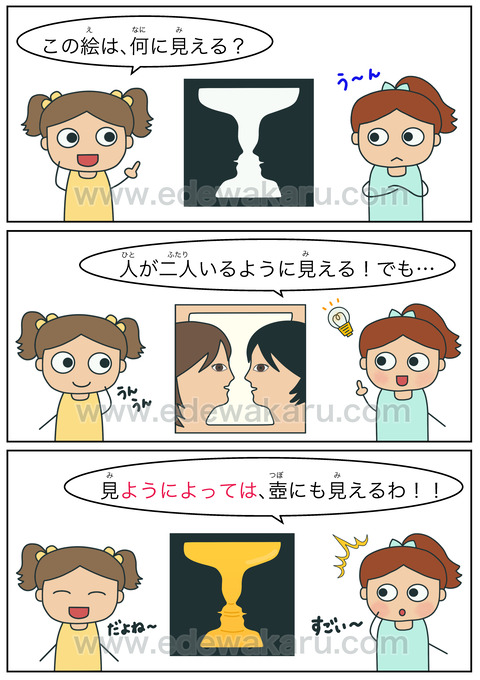
A:この絵は、何に見える?B:二人の人がいるように見えるけど、見ようによっては壺にも見えるわ!
→見方によっては、壺にも見えるわ!A: What do you see in this picture? B: It looks like there are two people, but depending on how you look at it, it also looks like a vase! →Depending on how you look at it, it also looks like a vase!
勉強はやりようによっては楽しくなる
→勉強のやり方によっては楽しくなるDepending on how you study, studying can become fun. →Depending on your way of studying, it can become fun.
考えようによっては、お金がなくても幸せだと言えるかもしれない
→考え方によっては、お金がなくても幸せだと言えるかもしれないDepending on how you think about it, you might be able to say you’re happy even without money. →Depending on your way of thinking, you might be able to say you’re happy even without money.
やりようによっては、大掃除を早く終わらせることもできるわよ
→やり方によっては、大掃除を早く終わらせることもできるわよDepending on how you do it, you can finish the big cleanup quickly. →Depending on the way you do it, you can finish the big cleanup quickly.
A:デパートまで、車で30分くらい?B:道の混みようによっては、1時間以上かかることもあるよ
→道の混んでいる状態によっては、1時間以上かかることもあるよA: Is it about 30 minutes by car to the department store? B: Depending on how congested the roads are, it can take over an hour. →Depending on how congested the roads are, it can take over an hour.
娘:今度の試験に合格したら、このバッグを買ってくれる?母:そうね。がんばりようによっては、買ってあげなくもないわよ
→がんばっている様子によっては、買ってあげなくもないわよDaughter: If I pass the upcoming exam, will you buy me this bag? Mother: Well, depending on how hard you work, I might buy it for you. →Depending on how hard you work, I might buy it for you.
Read the original source text
Meaning
〜方によっては
〜の様子によっては
How to use it
動詞[ます形]+ようによっては
Explanation
「〜ようによっては」の「よう」は[方法]や[様子]を表します。「〜ようによっては」は「〜方によっては」「やり方によっては〜」「〜の状態によっては」という意味を表す文型です。「考え方や、やり方などの方法を変えると、結果が変わる」「どのような状態かによって、結果が変わる」と言いたい時に使われます。
「よう」がつく文型はたくさんありますので、復習しておきましょう😊
くらべてわかる日本語表現文型辞典
Meaning
B depends on how A is done. B turns out one way or another depending on how A is done.
How to use it
AようによってはB (Aようによる)
[Verb—ます-stem] ようによっては
In context 4 examples
原子力は平和利用ならよいが、使いようによっては恐ろしい兵器だ。
Nuclear power is fine when used peacefully, but depending on how it is used, it can be a terrifying weapon.
彼の話は聞きようによっては嫌味とも取れる。
Depending on how you interpret his story, it could be taken as sarcasm.
いじめやセクハラは被害者の受け止めようによるといえる。
You could say that bullying and sexual harassment depend on how the victim perceives them.
高速道での運転は怖いというが、信号もないし歩行者もいないので、考えようによっては安全で走りやすいのだ。
People say driving on the expressway is scary, but there are no traffic lights or pedestrians, so depending on how you look at it, it’s safe and easy to drive on.
Read the original source text
Meaning
Aのやり方次第でB。どのようにAかでBになる。
How to use it
AようによってはB(Aようによる)
[動詞-ます形]ようによっては
毎日のんびり日本語教師
How to use it
Verb ます-form + ようによって(は)
Verb ます-form + ようで(は)
Explanation
A pattern stating that the result changes depending on the method or circumstances.
Originally, 「~よう」 indicates a method when attached to the ます-form of a transitive verb, while 「によって」 indicates a basis. This expression combines the two.
Notes
The “よう” series
In context 8 examples
この選手は癖が強いが、使いようによってはチームの中でうまく機能するはずだ。
This player has some strong quirks, but depending on how he’s used, he should fit in well with the team.
圧倒的な戦力差があるものの、やりようによっては勝てるだろう。
Although there is an overwhelming difference in strength, depending on how we approach it, we might be able to win.
不運だと思われることも、考えようによっては前向きに捉えられる。
Even things that seem like bad luck can be viewed positively, depending on how you think about them.
ここから目的地まで、道の混みようによっては1時間かかる場合もある。
Depending on how congested the roads are, it may take an hour to get from here to the destination.
見ようでは善にも悪にもなる。
Depending on how you look at it, it can be good or bad.
やりようによってはどうにでもなる。
Depending on how you do it, anything is possible.
気の持ちようで、辛いことも乗り越えられる。
With the right attitude, even painful things can be overcome.
質素な生活も考えようでは悪くない。(想想朴素的生活也不错。)
Even a simple life isn’t bad, depending on how you think about it. (A simple life isn’t so bad when you think about it.)
Read the original source text
How to use it
動ます形+ようによって(は)
動ます形+ようで(は)
Explanation
方法や状況が異なると結果も変わってくることを述べる文型です。
もともと「~よう」は他動詞のます形に接続したときに方法を表し、「によって」は根拠を表します。この2つを組み合わせた言い方です。
Notes
「よう」シリーズ