AIUEO JLPT Grammar
Meaning
「〜続ける」is a compound verb used to express that an action continues or is performed over a long period of time.
How to use it
Verb in ます-form + 続ける
In context 5 examples
彼は本を読み続けています。
He continues to read the book.
彼女は会社で働き続けた。
She continued working at the company.
学生たちは問題を考え続けています。
The students continue to think about the problem.
彼らは努力し続けるでしょう。
They will keep trying.
彼は毎日勉強し続けています。
He continues to study every day.
Read the original source text
Meaning
「〜続ける」is a compound verb used to express that an action continues or is performed over a long period of time.
How to use it
動詞ます形+続ける
Explanation · 日本語
「〜続ける」は、動作が継続していることや、長時間にわたって行われることを示す複合動詞です。
文法
Meaning
Expresses the continuation of an action or habit.
How to use it
V (ます-stem) + つづける
In context 14 examples
母からもらった万年筆を今も使い続けています。
I still use the fountain pen I got from my mother.
私はこの鞄を10年以上も使い続けています。
I've been using this bag for over ten years.
どんなに大変だったとしても、やり続けることが大切です。
No matter how difficult it was, it's important to keep going.
努力し続けると、いつかきっと成功するはずです。
If you keep working hard, you are sure to succeed someday.
日本語学校を卒業しても、日本語を勉強し続けるつもりです。
Even after graduating from Japanese language school, I intend to keep studying Japanese.
私はこの街が大好きですから、結婚してもここに住み続けるつもりです。
I love this town, so I intend to keep living here even after I get married.
かなり危ない現場なのに、最後までカメラマンは撮り続けていた
Even though it was a very dangerous scene, the cameraman kept filming until the end.
スマホの画面を見続けると目によくない。
Staring at your smartphone screen continuously is bad for your eyes.
部長は10分前からずっと話し続けています
The department manager has been talking continuously for the past ten minutes.
たくさんの参考書を使って勉強するよりも、1つの参考書を何度も繰り返しやり続けるほうが大切です。
Rather than studying with lots of reference books, it's more important to keep working through one reference book over and over.
1時間以上待ち続けているが、まだ飛行機が来ない。
I've been waiting for over an hour, but the plane still hasn't arrived.
年々、若い人材は減り続けています。
The number of young workers continues to decrease year by year.
商品を置かせて欲しいと、色々な店をまわったが、断られ続けた。
I went around to various stores asking them to let me carry their products, but I kept getting turned down.
どんなに辛くても最後まであきらめずに走り続けます。
No matter how painful it gets, I'll keep running without giving up until the very end.
Read the original source text
Meaning
動作や習慣の継続を表す。
How to use it
V(ます形)ます + つづける
Bunpro Grammar Reference
Meaning
To continue
How to use it
Verb[stem]+ 続ける
Verb[stem]+ 続けます
Nuance
A phrase that highlights (A) as an action that is being continued, or occuring over and over.
Explanation
By attaching the verb 続ける 'to continue' to the conjunctive form of another verb, we will be able to express that '(A) is continuing'. Let's have a look at a few examples of this structure.
サリーは暗くなるまで走り続ける。
Sally will continue to run until it gets dark.
私は漢字を覚えるまで、同じ漢字を書き続ける。
I will continue to write the same kanji until I memorize it.
Caution
There is a difference in nuance between connecting one verb to another verb through the conjunctive form, or through the use of the conjunction particle て. The former implies that '(A) is being done in the way of (B)', while the latter implies that '(A) is being done, and then (B)'.
日本語は難しいけど、勉強を頑張って続ける。
Japanese is difficult, but I will give it my best and continue with study. (Emphasis on the continuation of studying)
日本語は難しいけど、勉強を頑張り続ける。
Japanese is difficult, but I will continue giving it my best with study. (Emphasis on the continuation of giving it one's best)
In context 16 examples
- テレビを見続けるつもりですか。
Do you plan to continue to watch TV?
- サリーは暗くなるまで走り続ける。
Sally will continue to run until it gets dark.
- 私は漢字を覚えるまで、同じ漢字を書き続ける。
I will continue to write the same kanji until I memorize it.
- まっすぐ見て、歩き続けなさい!
Look straight, and continue walking!
- 文法の間違えを直し続けてみたらどうだ?
Why don't you try continuing to fix your grammar mistakes?
- 大きい魚を釣るまで釣り続けます。
I will continue to fish until I catch a big fish.
- あの警察官は一時間以上見回り続けた。
That police officer continued to patrol around for over one hour.
- 餌をあげても、その犬は鳴き続けるよ。
Even if you give that dog a treat, it will continue to bark.
- 携帯が鳴っていたが、彼は無視して、話し続けた。
His phone was ringing, but he ignored it and continued talking.
- 文法の勉強を毎日し続けたら、すぐ上手になるだろう。
If you continue to study grammar everyday, you will become more proficient.
- お母さんにテレビを消しなさいと言われているのに、まだ見続けるの?
Even though mom told you to turn off the TV, you still continue to watch it?
- 怪我をしたし、水ももうなくなったが彼がマラソンを走り続けるって。
I heard that even though he got injured and is out of water, he will continue to run the marathon.
- 大学を卒業したので、どうやってこれから日本語の勉強をし続けたらいいのだろう?
Since I graduated university, how am I supposed to continue my Japanese studies?
- 今日の天気は晴れのはずだったのに、雨が降り続けていますね。
It was supposed to be a clear day today, but it is continuing to rain.
- 日本語は難しいけど、勉強を頑張って続ける。
Japanese is difficult, but I will give it my best and continue with study. (Emphasis on the continuation of studying)
- 日本語は難しいけど、勉強を頑張り続ける。
Japanese is difficult, but I will continue giving it my best with study. (Emphasis on the continuation of giving it one's best)
どんなときどう使う 日本語表現文型辞典
Meaning
keep on; do on and on
How to use it
Vます + 続ける
Explanation
動作や習慣を続けたり、作用が続いたりするという意味を表す。「ずっとしている・ずっと続いている」ことを特に言いたいとき使う。
Movement, practice, or action continues. Specifically stresses length of time of action.
In context 4 examples
山道を1日中歩き続けて、足が痛くなりました。
I walked along the mountain trail all day, and my feet started to hurt.
わたしは小学校から高校まで12年間もこの学校に通い続けました。
I kept attending this school for 12 years, from elementary school through high school.
一つのことをやると決めたら、やり続けることが大切です。
Once you decide to do something, it's important to keep doing it.
うちの庭では、冬の間もいろいろな花が咲き続けます。
Various flowers continue blooming in our garden even during the winter.
Read the original source text
Meaning
keep on; do on and on
How to use it
Vます+続ける
Explanation
動作や習慣を続けたり、作用が続いたりするという意味を表す。「ずっとしている・ずっと続いている」ことを特に言いたいとき使う。
Movement, practice, or action continues. Specifically stresses length of time of action.
絵でわかる日本語
Usage 1
Read this source entry ↗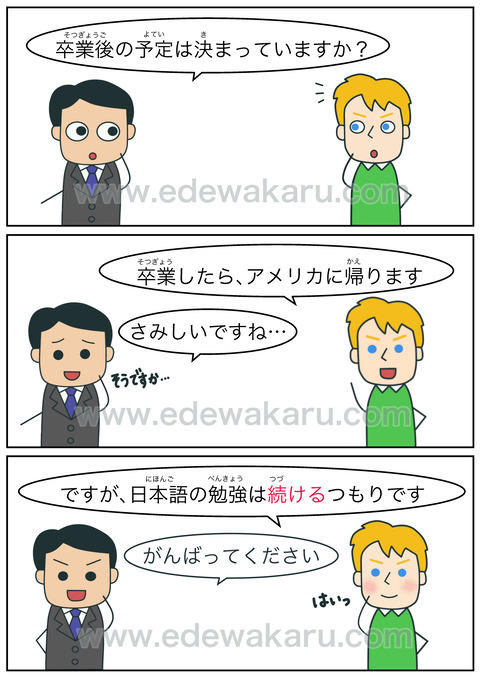
Meaning
Expresses continuation.
How to use it
Verb [ます-form] + 続ける
Explanation
“A続ける” is a sentence pattern meaning “the state of A continues” or “the action of A continues.” It is also used to say that a habit of A continues.
[Examples]
①Even after I graduate, I plan to keep studying Japanese.
[Continuation of an action]
②I’ve been waiting for an hour, but she still hasn’t come.
[Continuation of a state]
③I’m still using the dictionary someone bought for me ten years ago.
[Continuation of an action]
④It is very important to keep making an effort.
[Continuation of an action]
⑤I’ve kept a diary every day for 20 years.
[Continuation of an action or habit]
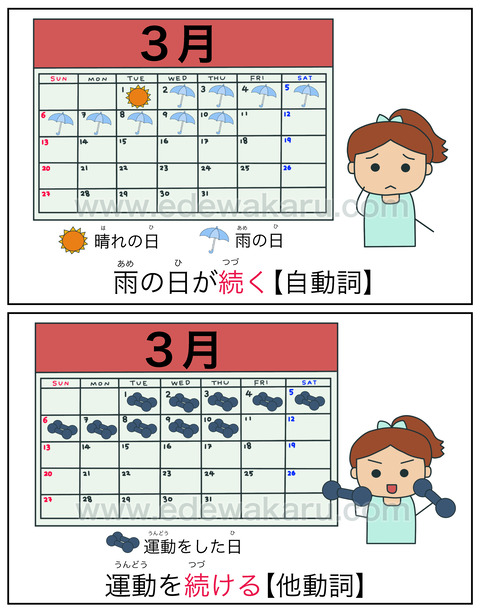
Review the intransitive/transitive verb pair “続く・続ける” 😉
In context 5 examples
卒業しても、日本語の勉強は続けるつもりです
Even after I graduate, I plan to keep studying Japanese.
1時間待ち続けているのに、彼女はまだ来ない
I’ve been waiting for an hour, but she still hasn’t come.
10年前に買ってもらった辞書を、まだ使い続けている
I’m still using the dictionary someone bought for me ten years ago.
努力し続けることは、とても大切だ
It is very important to keep making an effort.
20年間、毎日日記を書き続けています
I’ve kept a diary every day for 20 years.
Read the original source text
Meaning
継続を表す
How to use it
動詞[ます形]+続ける
Explanation
「A続ける」は「Aという状態が継続している」「Aの動作を継続している」という意味の文型です。「Aという習慣を継続している」と言いたい時にも使われます。
[例]
①卒業しても、日本語の勉強は
続ける
つもりです
【動作の継続】
②1時間待ち
続けている
のに、彼女はまだ来ない
【状態の継続】
③10年前に買ってもらった辞書を、まだ使い
続けている
【動作の継続】
④努力し
続ける
ことは、とても大切だ
【動作の継続】
⑤20年間、毎日日記を書き続けています
【動作・習慣の継続】
自動詞・他動詞ペア「続く・続ける」の復習をしておきましょう😉
日本語NET JLPT文法解説まとめ
Meaning
Expresses the continuation of an action or habit.
How to use it
V (ます-form)ます + つづける
Explanation
"keep on / continue to do"
Indicates the continuation of an action or habit.
In context 14 examples
母からもらった万年筆を今も使い続けています。
I still use the fountain pen I got from my mother.
私はこの鞄を10年以上も使い続けています。
I've been using this bag for over ten years.
どんなに大変だったとしても、やり続けることが大切です。
No matter how difficult it was, it's important to keep going.
努力し続けると、いつかきっと成功するはずです。
If you keep working hard, you are sure to succeed someday.
日本語学校を卒業しても、日本語を勉強し続けるつもりです。
Even after graduating from Japanese language school, I intend to keep studying Japanese.
私はこの街が大好きですから、結婚してもここに住み続けるつもりです。
I love this town, so I intend to keep living here even after I get married.
かなり危ない現場なのに、最後までカメラマンは撮り続けていた。
Even though the site was quite dangerous, the cameraman kept filming until the very end.
スマホの画面を見続けると目によくない。
Staring at your smartphone screen continuously is bad for your eyes.
部長は10分前からずっと話し続けています。
The department head has been talking continuously since ten minutes ago.
たくさんの参考書を使って勉強するよりも、1つの参考書を何度も繰り返しやり続けるほうが大切です。
Rather than studying with lots of reference books, it's more important to keep working through one reference book over and over.
1時間以上待ち続けているが、まだ飛行機が来ない。
I've been waiting for over an hour, but the plane still hasn't arrived.
年々、若い人材は減り続けています。
The number of young workers continues to decrease year by year.
商品を置かせて欲しいと、色々な店をまわったが、断られ続けた。
I went around to various stores asking them to let me carry their products, but I kept getting turned down.
どんなに辛くても最後まであきらめずに走り続けます。
No matter how painful it gets, I'll keep running without giving up until the very end.
Read the original source text
Meaning
動作や習慣の継続を表す。
How to use it
V(ます形)ます + つづける
Explanation
"keep on / continue to do"
Indicates the continuation of an action or habit.
毎日のんびり日本語教師
How to use it
Verb in ます-form + 続ける
Explanation
Attaches to the verb in ます-form to express the continuation or persistence of an action.
Notes
Nothing in particular.
In context 8 examples
以前もらったペンを今でも使い続けている。
I’m still using the pen I got before.
努力し続けると必ず花開く。(坚持努力就会成功)
If you keep working hard, you’ll surely blossom.
夢の中で見知らぬ男に追われ続け、起きた時には汗だくだった。
I was chased relentlessly by a strange man in my dream, and when I woke up, I was drenched in sweat.
世界人口が増え続けている。
The world’s population continues to grow.
画面を見続けると目に悪い。
Continuously looking at a screen is bad for your eyes.
1時間待ち続けたけど、結局彼は来なかった。
I kept waiting for an hour, but in the end he never came.
定年までこの仕事をし続けるつもりはない。
I don’t intend to keep doing this job until retirement.
昨晩から雨が降り続いている。
It has been raining continuously since last night.
Read the original source text
How to use it
動ます形+続ける
Explanation
動ます形に接続して動作の継続・持続を表します。
Notes
特になし
NINJAL 日本語文型データベース
Meaning
Expresses continuing an action or habit, or an event continuing over time. Used especially when you want to emphasize the continuation.
How to use it
Vます+続ける
Notes
“~” is usually a verb expressing an ongoing action or event, such as “歩く,” “働く,” or “降る.” However, when momentary actions or events continue to occur repeatedly over time, verbs expressing momentary actions or events, such as “咲く” and “失敗する,” can also be used.
In context 5 examples
佐藤氏は、誰も真剣に聞いていないことに気づかないで、話し続けた。
Mr. Sato continued talking, unaware that no one was listening seriously.
どんな一流企業も、常に時代の先端を走り続けることは難しいだろう。
It is probably difficult for even a top-class company to always stay at the forefront of the times.
この薬を毎日1錠ずつ、飲みつづけてみてください。
Please try taking one tablet of this medicine every day.
ここは世界遺産に登録されてから、観光客が増え続けている。
Since this place was registered as a World Heritage site, the number of tourists has continued to increase.
この公園にはいろいろな種類の桜があって、咲き始める時期が少しずつ違います。ですから、この公園では毎年1か月以上、違う種類の桜が咲きつづけます。
This park has various kinds of cherry trees, and they begin blooming at slightly different times. So, different kinds of cherry blossoms continue to bloom in this park for more than a month every year.
Read the original source text
Meaning
行為や習慣をずっと続けたり、ある出来事がずっと続いたりすることを表します。特に継続を強調して言いたいときに使います。
How to use it
Notes
「~」はふつう、「歩く・働く・降る」など、継続的な動作や出来事を表す動詞です。ただし、瞬間的な動作や出来事がずっと何度も続いている場合には、「咲く・失敗する」など、瞬間的な動作や出来事を表す動詞も使えます。
IMABI
The Verbs 続く & 続ける
Read this IMABI lesson ↗Explanation
Verbs of Continuation 継続を示す動詞
The basic verbs in Japanese which mean “to continue” are 続く (intransitive 五段 verb) and 続ける (transitive 一段 verb) respectively. These words are heavily used and may also function as supplementary endings, which will be a major focus of this lesson.
We’ll first exam the basic meanings of both verbs and important synonyms, after which point we’ll discuss various grammar points utilizing said verbs and more similar phrases. Once we’ve cleared those hurtles, we’ll talk about the grammar behind ~続ける and how this fits into Japanese grammar in totality.
The Verbs 続く & 続ける
続く
The verb 続く is an intransitive verb with the primary meaning of “to continue,” describing how the same event remains persistent. It also has various other nuances such as describing a condition that is uninterrupted, similar events happening in succession of each other, etc.
Particle Note: The particle が is used if the subject is what is in the state of continuation while the particle に is used if 続く describes a succession of action or situation.
1. 夏も近いというのに雨の日が続いている。
Though they say summer is also around the corner, rainy days continue.
2. 活発な火山活動が続いている。
Active volcanic activity continues.
3. この通りの両側には家並みが続いている。
Rows of houses continue down both sides of this road.
4. 地震に続いて津波が起こった。
A tsunami occurred following the earthquake.
5. いまだに余震が続いていて、日常に戻ってくる兆しも感じられない。
Aftershocks are continuing as of yet, and you can’t even sense when things will return back to normal.
6. 用意された答えが無いと記者の単純な質問にも回答できないレベルはご存じのとおり、大統領に続く副大統領だけのことはある。
As you know, it’s no wonder that the president and the vice president who follows are at the level where they are unable to answer even simple questions from reporters if they don’t have prepared answers.
Phrase Note: 続く may mean “to succeed” in terms of rank.
7. ローマへ続く道沿いを一緒に旅しましょう!
Let’s travel together along the road to Rome!
Phrase Note: When 続く means “to lead to,” it may be used with either に or へ, with the difference based on how spatially distant the destination is–far off destinations being more fitting for へ.
8. せっかく合格しても学費が続かない。
Even if you go through all the trouble to pass, tuition isn’t covered.
Phrase Note: 続く may mean “to keep up (with)” in reference to money flow.
9. オミクロン株はどこまで感染が拡大するかはわからないが、当面続くだろうと考えている。
As for the omicron variant, although we don’t know how far infection will spread, we believe it will likely last for the meantime.
続ける
The transitive verb 続ける has the primary meaning of “to continue” some current/ongoing action. It may also mean “to keep on doing (consistently/habitually).” This is a transitive verb, so the action being done has an active agent, and the direct object is, thus, marked by the particle を.
10. ちゃんと食事制限と運動を続けているんですか。
Are you properly continuing with exercise and dietary restrictions?
11. 英会話を続けています。
I’m continuing with English conversation.
12. 作業を続けてください。
Please continue with your work.
13. 失敗を続けて辛いと感じることがあるかもしれない。
You may have moments where you feel bitter from repeating failure.
14. そもそも勉強は毎日続けないと意味がないよ。
For starters, there’s no meaning to studying if you don’t continue doing it every day.
15. この仕事を続けたいと思う。
I want to continue doing this job.
続ける may also occasionally be used with the meaning of “to link things together.” For instance, say you’re designing an apartment space and want to link the living area and kitchen area as one room.
16. リビングとキッチンを続けて1部屋にした。
I had the living and kitchen put together as one room.
継続・持続・連続
継続するThe Sino-Japanese equivalent of both 続く and 続ける is 継続する. Many Sino-Japanese verbs feature duality in transitivity. Which mode is intended will be made evident by the accompanying grammar. 継続する has a more limited meaning than either verb, however. It is only used to describe a (willful) continuation of the same phenomenon that had been underway/ongoing.
17. 経済回復は継続している。(Intransitive)
The economy recovery is continuing.
18. 現在営業を継続している店舗であっても、政府・自治体から改めて休業の要請が行われた場合、休業せざるを得なくなる。(Transitive)
Even for stores that are presently continuing operations, in the event they’re requested by the government/municipality to suspend operations, they will have no choice but to do so.
19. この水準が継続すると、欧州人口の半分以上が感染してしまう恐れがある。
If this level (of infection) continues, over half of Europe’s population may become infected.
持続する
持続する is another Sino-Japanese verb regarding continuation, but it’s closer to “to persist.” It pertains only to situations lasting and can be used as either a transitive or an intransitive verb depending on the context.
20. 中国の経済は現在も高成長を持続している。
The Chinese economy is sustaining its high growth even now.
21. 1週間以上、発熱が持続している。
Fever is persisting greater than a week.
連続する
連続する means “to continue successively” in the intransitive sense and it may also be used in the transitive sense of “to do the same thing successively.”
22. 短すぎる文が連続している。
Too short of sentences are following one after another.
23. スタートの失敗を連続する。
To fail at the start successively.
Special Usages of Their て-Forms ~て形を使った特殊な用法
続いて
続いて is often seen as a conjunction, usually accompanied with the particle は, to mean “subsequently/next.”
24. 続いてはニュースです!
Next is the news!
25. 続いて新しく学んだ文法を使って英文を作りましょう!
Next, let’s create English sentences using the grammar we’ve newly learned!
続けて
続けて when used at the start of a verb phrase means “in a row.” This usage is completely adverbial, which means that originating from a transitive verb doesn’t restrict the verbs it can be used with. If 続ける were to attach to the end of the verb (below), the situation would be persistent without pause where there is an implied pause between each instance with this usage of 続けて. You can tell this apart from just the typical て-form of 続ける if “continue” is not the verb of the clause.
26. 同じメールを続けて2回読みました。
I read the same e-mail twice in a row.
27. バッテリーの残量が少ないときの信号音が5回続けて鳴った。
The alert sound for when the battery is low went off five times in a row.
28. レッスンの書き直しを四日も済ませずに続けての投稿で大変申し訳ございません。
I sincerely apologize for posting again without having finished rewriting the lesson despite taking four days.
Grammar Note: The adverb 続けて can be used with the particle の to be used as an attribute in the same way other adverbial gerunds such as はじめて (first) can.
連続で
The Sino-Japanese equivalent of 続けて is 連続で, which is just as common. Although 連続で may appear before or after counter expressions, as is the case with 続けて, when it means “in one stretch” when used with periods of time, it must be placed after that said counter expression (Ex. 30).
29. 同じ映画を連続で2回観てしまった。
I watched the same movie in a row twice.
30. 去年11月の時点で全国の失業者数は約180万人となっており、5か月連続で減少している。
The whole country’s number of unemployed individuals as of November of last year was at approximately 1.8 million, having been decreasing for five months consecutively.
連続して
Completely synonymous to 連続で, 連続して is most often translated as “consecutively.
31. 三日連続して思った。
I thought about it for three days consecutively.
32. 同じ現象があと何回か連続して起こった。
The same situation occurred several times consecutively afterward.
継続して
継続して is used adverbially to mean “continuously/continue to…” and functions grammatically identically to 続けて, although their meanings are not exactly the same. Although there may be pause between each instance of the phenomenon being ‘continued’ with 継続して, each occurrence may not necessarily be right after another. In any event, the phenomenon is still ‘ongoing.’
33. 北朝鮮が継続してミサイルを発射していることは極めて遺憾である。
It is deeply regrettable that North Korea is continuously firing missiles.
Comparison Note: It is not the case that North Korea is nonstop firing missiles. However, their activity is ‘ongoing,’ which is why 継続して is used. If 続けて or 連続で were used, it might be in a context in which they consecutively fired multiple missile heads.
34. 名義変更の際に継続してご利用になれるものと、引き継がれないサービスについてご案内します。
I will be guiding you about which services you can continue to use and which won’t transfer over upon changing your name.
Usage Note: Speakers of Chinese and Korean will need to avoid overusing 継続して as the Japanese iteration is conversely most common in formal/written language and not so much in the spoken language.
継続的に・持続的に
You may also see 継続 and 持続 used with the adjective-making suffix ~的 to create 継続的な (continual) and 持続的な (sustainable) respectively. Then, their adverbial forms are 継続的に “on a continual basis/continually (without pause)” and 持続的に “in a sustainable way” respectively.
35. きょうは会議を継続的に行った。
Today, we held a meeting continuously (without pause).
36. 彼女はほとんど継続的に10キロほど走った。
She ran around 10 kms almost entirely continuously.
37. この地域では継続的な支援が必要になっている。
Continuous aid is needed in this region.
38. 持続的に教育を受ける権利を保つが大事です。
It is crucial to maintain the right to receive an education sustainably.
39. この会社は持続的な成長を遂げている。
This company is accomplishing sustainable growth.
連続的に
The forms 連続的な (consecutive/successive) and 連続的に (successively/consecutively) also exist for 連続. Neither are used directly after counter phrases like is the case with 連続で, but when a counter phrase is not present, 連続的に is, in fact, interchangeable with 連続で. These words are used to describe the same phenomenon occurring one after another, but the instances will still be separate.
40. 殺人事件が【連続的に・連続で】発生している。
Murder cases are occurring consecutively.
41. 努力を重ねれば必ずしも連続的な変化が起こるとは限らない。
It isn’t a guarantee that if you repeat your efforts that consecutive change will happen.
~続ける VS ~続く
At last, we have come to the grammar point of most importance in this lesson. To create expressions like “to continue singing,” “to continue watching,” etc., you attach ~続ける to the 連用形 of a verb. This ending attaches to both intransitive and transitive verbs alike, and it is also indiscriminate when it comes to verbs of volition and non-volition. Thus, it can describe phenomena continuing just as much as it can describe continued action.
Intransitive + ~続ける Transitive + ~続ける ~続く
降り続ける (to continue falling) やり続ける (to continue doing) 降り続く*
(to continue falling)
鳴り続ける (to continue ringing)歌い続ける (to continue singing) 打ち続く*
(to continue for a long time)
燃え続ける (to continue burning) 建て続ける (to continue building) 引き続く*
(to continue)
であり続ける* (to continue being) 見続ける(to continue watching)
Before looking at typical sentences, let’s go over the abnormalities noted in the chart.
————————————————————————————————————————————-
打ち続く・引き続く
Firstly, you’ll see that there are three examples of ~続く. Of these, 打ち続く and 引き続く are both viewed as emphatic versions of 続く. Meaning, rather than viewing them as a combination of ~続く with the verbs 打つ and 引く, those morphemes are acting instead as prefixes rather than functioning with their literal meanings. It must be noted that both emphatic forms are restricted to literary language.
42. 打ち続く長雨のため各地で洪水が起こりやすくなっている。
Due to the prolonged spell of rain, floods are occurring everywhere.
43. 今後も厳しい経済不況が引き続く状況を踏まえると、更に市税収入が減収となることが見込まれる。
If taking into account conditions in which a severe economic depression continues even hereafter, it is expected that city tax revenue will decrease further.
降り続く・降り続ける
As for 降り続く, however, this is truly one of a kind. It is the only example of ~続く functioning as a true supplementary verb. What’s even more interesting is how it is used interchangeably with 降り続ける with no change in meaning. Although it is not as common as 降り続ける, the rate of use is still at a 40/60 ratio, a really high rate for being irregular. You will hear both forms used heavily in weather reports and everyday language.
44. 雨・雪が降り【続いている 〇・続けている ◎】。
It continues to rain/snow.
~であり続ける
If ~続ける can attach to any intransitive verb, it would only make sense for it to also attach to the copula. In which case, it attaches to である, which in turn can be used with true nouns and adjectival nouns.
45. 猫はただ猫であり続けている。
Cats simply remain as cats.
46. いつまでも自由であり続けたい。
I want to remain free forever.
To attach ~続ける to adjectives, ある must follow the 連用形 of an adjective, resulting in ~くあり続ける.
47a. 美しくあり続けたい。
47b. 美しいままでいたい。
I want to continue/stay being beautiful.
Such examples are not so common, though, and are overshadowed by ~ままで(ある・いる) , with the choice between ある or いる being decided on whether the adjective strongly depicts the speaker’s want (→ いる) or is simply describing an unchanged state (→ ある).
48a. 不人気のポケモンは弱くあり続けるべきだ。
48b. 不人気のポケモンは弱いままであるべきだ。
Unpopular Pokemon ought to remain weak.
————————————————————————————————————————————-
With the complicated details out of the way, it’s time to see examples of ~続ける with all kinds of verbs. Since this grammar is used so heavily, you will continue to encounter it on a daily basis.
49. 日本語を勉強し続けてください。
Please continue studying Japanese.
50. 学び続けない社会人は生き残れない。
Full-fledged adults who don’t continue learning won’t make it.
51. キーを何秒間か押し続けないと文字が入力できない。
If you don’t continue pressing the key for several seconds, you won’t be able to type the character.
52. 彼氏んちまで歩き続けた。
I continued walking up to my boyfriend’s house.
Dialect Note: ~んち is a dialectal equivalent of ~の家 that is commonly used in casual speech by people predominantly from Eastern Japan.
53. 電話のベルは鳴り続けた。
The phone continued ringing.
54. ハチ公は来る日も来る日も主人の帰りを待ち続けた。
Hachiko waited day after day for his master to return.
Culture Note: ハチ公 is a dog that was so loyal to his master, it waited for him to return at the station even after the owner’s death.
55. 赤ちゃんはぐっすりと眠り続けていた。
The baby was continuing to sleep soundly.
“Verb + ~続ける” VS “Verb + ~のを続ける”
As is the case with any supplementary verb, there is always going to be a way around using it grammatically speaking. To use 続ける, all you need is a subject and an object, and nominalizing a verb phrase for the object works. How, though, does circumventing “連用形+続ける” affect nuancing?
First, let’s visualize the problem with two parallel verb phrases.
i. ~を見るのを続ける (to continue watching)
ii. ~を見続ける (to continue watching)
There is no perfect way to distinguish these structures in standalone translations, so let’s see some contexts.
56. まだテレビを見続けているの?
Are you still watching TV?
In this sentence, the agent is actively watching TV. In this situation, ~のを続ける is NEVER appropriate.
57. テレビを見るのをやめるか続けるか決めなさい。
Decide whether you will stop watching or continue watching TV.
As for Ex. 57, maintaining grammatical parallelism is a major factor behind ~のを続ける. As やめる cannot function as a supplementary verb and is stated first, it forces the second verb, which happens to be 続ける, to not be paired with the verb that’s nominalized. On semantic grounds, Ex. 57 is about habit and not literal continuous action. This is a prerequisite to using ~のを続ける; however, “連用形+続ける” may also denote habitual behavior as is demonstrated by Ex. 58.
58. テレビを見続けるか、それともやめるか、どっちを選ぶ?
Continue watching TV or stop (watching) it, which do you choose?
When given the opportunity, “連用形+続ける” reigns supreme. Furthermore, grammatical parallelism is actually maintained if one views 見続ける as its own unique verb as テレビをやめる can be interpreted as “to stop watching TV” without any problem.
So, how would a sentence need to be constructed to only allow for ~のを続ける? Unfortunately, grammatical instances such as Ex. 57 involving an intervening opposing structure would be the only context in which either route couldn’t coexist as “連用形+続ける” is capable of expressing habit just as much as it can real-time continuous action.
If you were to impose using ~のを続ける with lengthy nominalized verb phrases, you’d be opening the possibility for substituting the long phrase altogether with a simple sentence equivalent.
59a. 片側(の歯)ばかりで噛み続けると、顎が歪んでしまう。◎
If you continue chewing with just (the teeth) on one side, your jaw will become bent.
59b. 片側(の歯)ばかりで噛むのを続けてしまうと、顎の歪みの原因となる。△
If you continue to chew with just (the teeth) on one side, this will become the cause of jaw disfigurement.
59c. 片(側)噛みを続けてしまうと、顎の歪みの原因となる。
If you continue chewing on one side, this will become the cause of jaw disfigurement.
59d. 偏咀嚼を続けてしまうと顎の歪みの原因となる。〇
If you continue one-sided mastication, this will become the cause of jaw disfigurement.
59a starts off with a description akin to typical conversation and/or layman’s talk. Then, we jump to 59b which has ~のを続ける imposed on it. Though the sentence is not ungrammatical, by trying to become more technical sounding in describing the habit at hand, opting for jargon as seen in 59c and 59d would be more logical.
~のが続く
If transitive and intransitive verbs can be nominalized, it would make sense for there to be situations in which ~のが続く is possible. Although “連用形+続く” doesn’t functionally exist, ~が続く does, so we just need to know which nominalized intransitive verb phrases go with it. First off, verbs used with ~のが続く CANNOT express volition. Unchanging situations, negative statements, passive statements, etc. fit this bill.
60. この対策は【変わらないのが続く〇・当面変わらない◎】だろう。
This countermeasure will likely continue to not change.
61. 【吐くのが続く 〇・吐き続ける ◎】と、身体に負担がかかってしまう。
If [coughing continues/you continue to cough], that’ll put strain on the body.
62. じっと【見られるのが続く 〇 ・見られ続ける 〇・見られていると ◎】とムカついてくる。
I get irritated if I keep being stared at.
63. 認められない【のが続く 〇・ままだ ◎」と、気持ちが「どうせだめだ」と落ち着いてしまう。
If you remain unable to accept (the situation), your feelings will settle on thinking “it’s no use.”
As these examples demonstrate, other routes will usually be more natural/common than ~のが続く.
~(ら)れ続ける
In Ex. 62 we see that ~続ける can be used with passive expressions, which is actually quite common. It is also possible to see it used with the causative-passive (Ex. 66).
64. レゴはなぜ世界中で愛され続けているんでしょうか。
Why does Lego remain loved around the world?
65. 開拓のため世界の森が破壊され続けている。
The world’s forest continue being destroyed due to development.
66. ダンジョンに入ってすぐの敵に全滅させられ続けてる!
I’m still being annihilated by the first enemy when you enter the dungeon!
立て続けに・続けざまに
To add to the grammar we’ve already learned about, we’ll look at examples of 立て続けに and 続けざまに, which are synonymous phrases meaning “one after another.” Between the two, 立て続けに is more appropriate for describing separate instances of the same phenomenon occurring whereas 続けざまに is more appropriate for implying that the same action/situation spans several instances in rapid succession of each other. Even with these definitions, there is significant overlap.
67. 選手は【立て続けに・続けざまに】ボールを打ってみせた。
The player demonstrated himself hitting the balls [in quick succession/in rapid fire].
68. ここら辺では殺人事件が立て続けに起こっている。
Murder cases are occurring one after another around this area.
69. 襲撃者は続けざまに人を斬り倒した。
The assailant chopped down people one after another.
70. 頻度は多くないが、続けざまに感染することもあるという。
Although the frequency isn’t much, they say that there are instances of being infected in quick succession.
In context 75 examples
夏も近いというのに雨の日が続いている。
Though they say summer is also around the corner, rainy days continue.
活発な火山活動が続いている。
Active volcanic activity continues.
この通りの両側には家並みが続いている。
Rows of houses continue down both sides of this road.
地震に続いて津波が起こった。
A tsunami occurred following the earthquake.
いまだに余震が続いていて、日常に戻ってくる兆しも感じられない。
Aftershocks are continuing as of yet, and you can’t even sense when things will return back to normal.
用意された答えが無いと記者の単純な質問にも回答できないレベルはご存じのとおり、大統領に続く副大統領だけのことはある。
As you know, it’s no wonder that the president and the vice president who follows are at the level where they are unable to answer even simple questions from reporters if they don’t have prepared answers.
ローマへ続く道沿いを一緒に旅しましょう!
Let’s travel together along the road to Rome!
せっかく合格しても学費が続かない。
Even if you go through all the trouble to pass, tuition isn’t covered.
オミクロン株はどこまで感染が拡大するかはわからないが、当面続くだろうと考えている。
As for the omicron variant, although we don’t know how far infection will spread, we believe it will likely last for the meantime.
ちゃんと食事制限と運動を続けているんですか。
Are you properly continuing with exercise and dietary restrictions?
英会話を続けています。
I’m continuing with English conversation.
作業を続けてください。
Please continue with your work.
失敗を続けて辛いと感じることがあるかもしれない。
You may have moments where you feel bitter from repeating failure.
そもそも勉強は毎日続けないと意味がないよ。
For starters, there’s no meaning to studying if you don’t continue doing it every day.
この仕事を続けたいと思う。
I want to continue doing this job.
リビングとキッチンを続けて1部屋にした。
I had the living and kitchen put together as one room.
経済回復は継続している。(Intransitive)
The economy recovery is continuing.
現在営業を継続している店舗であっても、政府・自治体から改めて休業の要請が行われた場合、休業せざるを得なくなる。(Transitive)
Even for stores that are presently continuing operations, in the event they’re requested by the government/municipality to suspend operations, they will have no choice but to do so.
この水準が継続すると、欧州人口の半分以上が感染してしまう恐れがある。
If this level (of infection) continues, over half of Europe’s population may become infected.
中国の経済は現在も高成長を持続している。
The Chinese economy is sustaining its high growth even now.
1週間以上、発熱が持続している。
Fever is persisting greater than a week.
短すぎる文が連続している。
Too short of sentences are following one after another.
スタートの失敗を連続する。
To fail at the start successively.
続いてはニュースです!
Next is the news!
続いて新しく学んだ文法を使って英文を作りましょう!
Next, let’s create English sentences using the grammar we’ve newly learned!
同じメールを続けて2回読みました。
I read the same e-mail twice in a row.
バッテリーの残量が少ないときの信号音が5回続けて鳴った。
The alert sound for when the battery is low went off five times in a row.
レッスンの書き直しを四日も済ませずに続けての投稿で大変申し訳ございません。
I sincerely apologize for posting again without having finished rewriting the lesson despite taking four days.
同じ映画を連続で2回観てしまった。
I watched the same movie in a row twice.
去年11月の時点で全国の失業者数は約180万人となっており、5か月連続で減少している。
The whole country’s number of unemployed individuals as of November of last year was at approximately 1.8 million, having been decreasing for five months consecutively.
三日連続して思った。
I thought about it for three days consecutively.
同じ現象があと何回か連続して起こった。
The same situation occurred several times consecutively afterward.
北朝鮮が継続してミサイルを発射していることは極めて遺憾である。
It is deeply regrettable that North Korea is continuously firing missiles.
名義変更の際に継続してご利用になれるものと、引き継がれないサービスについてご案内します。
I will be guiding you about which services you can continue to use and which won’t transfer over upon changing your name.
きょうは会議を継続的に行った。
Today, we held a meeting continuously (without pause).
彼女はほとんど継続的に10キロほど走った。
She ran around 10 kms almost entirely continuously.
この地域では継続的な支援が必要になっている。
Continuous aid is needed in this region.
持続的に教育を受ける権利を保つが大事です。
It is crucial to maintain the right to receive an education sustainably.
この会社は持続的な成長を遂げている。
This company is accomplishing sustainable growth.
殺人事件が【連続的に・連続で】発生している。
Murder cases are occurring consecutively.
努力を重ねれば必ずしも連続的な変化が起こるとは限らない。
It isn’t a guarantee that if you repeat your efforts that consecutive change will happen.
打ち続く長雨のため各地で洪水が起こりやすくなっている。
Due to the prolonged spell of rain, floods are occurring everywhere.
今後も厳しい経済不況が引き続く状況を踏まえると、更に市税収入が減収となることが見込まれる。
If taking into account conditions in which a severe economic depression continues even hereafter, it is expected that city tax revenue will decrease further.
雨・雪が降り【続いている 〇・続けている ◎】。
It continues to rain/snow.
猫はただ猫であり続けている。
Cats simply remain as cats.
いつまでも自由であり続けたい。
I want to remain free forever.
美しくあり続けたい。
I want to continue/stay being beautiful.
美しいままでいたい。
I want to continue/stay being beautiful.
不人気のポケモンは弱くあり続けるべきだ。
Unpopular Pokemon ought to remain weak.
不人気のポケモンは弱いままであるべきだ。
Unpopular Pokemon ought to remain weak.
日本語を勉強し続けてください。
Please continue studying Japanese.
学び続けない社会人は生き残れない。
Full-fledged adults who don’t continue learning won’t make it.
キーを何秒間か押し続けないと文字が入力できない。
If you don’t continue pressing the key for several seconds, you won’t be able to type the character.
彼氏んちまで歩き続けた。
I continued walking up to my boyfriend’s house.
電話のベルは鳴り続けた。
The phone continued ringing.
ハチ公は来る日も来る日も主人の帰りを待ち続けた。
Hachiko waited day after day for his master to return.
赤ちゃんはぐっすりと眠り続けていた。
The baby was continuing to sleep soundly.
まだテレビを見続けているの?
Are you still watching TV?
テレビを見るのをやめるか続けるか決めなさい。
Decide whether you will stop watching or continue watching TV.
テレビを見続けるか、それともやめるか、どっちを選ぶ?
Continue watching TV or stop (watching) it, which do you choose?
片側(の歯)ばかりで噛み続けると、顎が歪んでしまう。◎
If you continue chewing with just (the teeth) on one side, your jaw will become bent.
片側(の歯)ばかりで噛むのを続けてしまうと、顎の歪みの原因となる。△
If you continue to chew with just (the teeth) on one side, this will become the cause of jaw disfigurement.
片(側)噛みを続けてしまうと、顎の歪みの原因となる。
If you continue chewing on one side, this will become the cause of jaw disfigurement.
偏咀嚼を続けてしまうと顎の歪みの原因となる。〇
If you continue one-sided mastication, this will become the cause of jaw disfigurement.
この対策は【変わらないのが続く〇・当面変わらない◎】だろう。
This countermeasure will likely continue to not change.
【吐くのが続く 〇・吐き続ける ◎】と、身体に負担がかかってしまう。
If [coughing continues/you continue to cough], that’ll put strain on the body.
じっと【見られるのが続く 〇 ・見られ続ける 〇・見られていると ◎】とムカついてくる。
I get irritated if I keep being stared at.
認められない【のが続く 〇・ままだ ◎」と、気持ちが「どうせだめだ」と落ち着いてしまう。
If you remain unable to accept (the situation), your feelings will settle on thinking “it’s no use.”
レゴはなぜ世界中で愛され続けているんでしょうか。
Why does Lego remain loved around the world?
開拓のため世界の森が破壊され続けている。
The world’s forest continue being destroyed due to development.
ダンジョンに入ってすぐの敵に全滅させられ続けてる!
I’m still being annihilated by the first enemy when you enter the dungeon!
選手は【立て続けに・続けざまに】ボールを打ってみせた。
The player demonstrated himself hitting the balls [in quick succession/in rapid fire].
ここら辺では殺人事件が立て続けに起こっている。
Murder cases are occurring one after another around this area.
襲撃者は続けざまに人を斬り倒した。
The assailant chopped down people one after another.
頻度は多くないが、続けざまに感染することもあるという。
Although the frequency isn’t much, they say that there are instances of being infected in quick succession.