絵でわかる日本語
Usage 1
Read this source entry ↗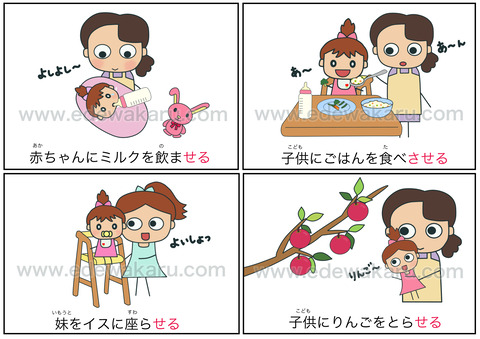
Meaning
Do something for someone
Help someone do something
How to use it
Verb I [ない-form] + せる
Verb II [ない-form] + させる
する → させる
来る → 来させる
Explanation
“AはBにCさせる” is a causative verb form used to mean “A helps B do C” or “A does C for B.” “B” is something like [a baby, a child, or a sick person], and it is used when you want to say that you help “B,” who cannot do C on their own.
The verbs and situations in which this is used are mostly fixed, so it may be a good idea to memorize the example sentences 😉
[Examples]
①Give the baby milk.
[A] Mother
[B] Baby
[C] Drink milk
→ Since the baby cannot drink milk on their own, the mother helps them drink it.
②Feed the child.
[A] Mother
[B] Child
[C] Eat a meal
→ Since the child cannot eat a meal on their own, the mother helps them eat.
③Help my little sister sit on a chair.
[A] Me
[B] Little sister
[C] Sit on a chair
→ Since my little sister cannot sit on a chair by herself, I help her sit down.
④Help the child pick an apple.
[A] Mother
[B] Child
[C] Pick an apple
→ Since the child cannot pick an apple by themselves, I help them pick it.
⑤Teach my daughter to hold a spoon.
[A] Mother
[B] Daughter
[C] Hold a spoon
→ Since my daughter does not know how to hold a spoon, her mother teaches her how.
⑥Help my little sister put on her shoes.
[A] Me
[B] Little sister
[C] Put on shoes
→ Since my little sister cannot put on her shoes by herself, I help her.
⑦Feed my sick mother.
[A] Me
[B] Mother
[C] Eat a meal
→ Since my mother is sick and cannot eat by herself, I help her eat.
There are not many opportunities to study this usage, but remember it as one of the uses of the causative form 😊
[Causative form series]
In context 7 examples
赤ちゃんにミルクを飲ませる
Give the baby milk.
子供にごはんを食べさせる
Feed the child.
妹をイスに座らせる
Help my little sister sit on a chair.
子供にりんごをとらせる
Help the child pick an apple.
娘にスプーンを持たせる
Teach my daughter to hold a spoon.
妹に靴をはかせる
Help my little sister put on her shoes.
病気のお母さんにごはんを食べさせてあげる
Feed my sick mother.
Read the original source text
Meaning
〜に〜をしてあげる
〜が〜するのを手伝ってあげる
How to use it
動詞I[ない形]+せる
動詞Ⅱ[ない形]+させる
する→させる
来る→来させる
Explanation
「AはBにCさせる」は動詞の使役形で「AはBがCするのを手伝う」「AはBにCてあげる」という意味で使われます。「B」には[赤ちゃん・子供・病気の人]などが入り、自分ではCすることができない「B」の手伝いをしてあげると言いたい時に使用します。
使われる動詞や場面はほとんど決まっています
ので例文を暗記しておくといいと思います😉
[例]
①赤ちゃんにミルクを飲ま
せる
【A】お母さん
【B】赤ちゃん
【C】ミルクを飲む
→赤ちゃんは自分でミルクが飲めないので、お母さんが飲むのを手伝う
②子供にごはんを食べ
させる
【A】お母さん
【B】子供
【C】ごはんを食べる
→子供は自分でごはんを食べられないので、お母さんが食べるのを手伝う
③妹をイスに座ら
せる
【A】私
【B】妹
【C】イスに座る
→妹は自分でイスに座れないので、座るのを手伝ってあげる
④子供にりんごをとら
せる
【A】お母さん
【B】子供
【C】りんごをとる
→子供は自分ではりんごがとれないので、取るのを手伝ってあげる
⑤娘にスプーンを持た
せる
【A】お母さん
【B】娘
【C】スプーンを持つ
→娘はスプーンの持ち方を知らないので、お母さんが持ち方を教えてあげる
⑥妹に靴をはか
せる
【A】私
【B】妹
【C】靴をはく
→妹は自分では靴がはけないので、私が手伝ってあげる
⑦病気のお母さんにごはんを食べ
させてあげる
【A】私
【B】お母さん
【C】ごはんを食べる
→お母さんは病気で自分ではごはんが食べられないので、食べるのを手伝う
この用法は勉強する機会があまりありませんが、使役形の用法の1つとして覚えておきましょう😊
【使役形シリーズ】
Usage 2
Read this source entry ↗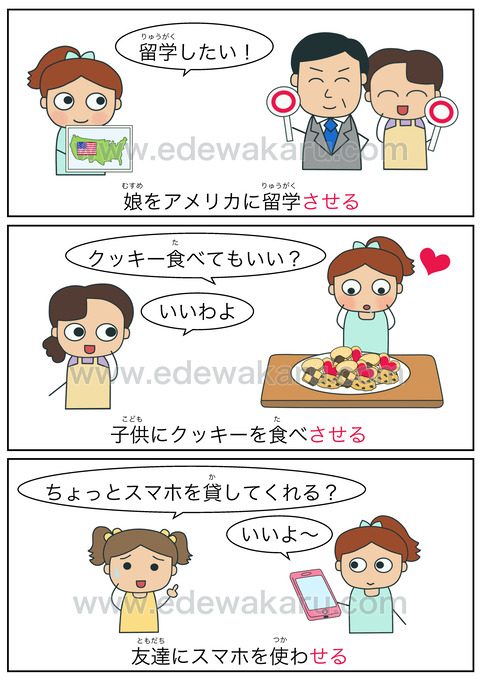
Meaning
Allow someone to do something
Leave things as they are
How to use it
Verb I [ない-form] + せる
Verb II [ない-form] + させる
する → させる
来る → 来させる
Explanation
“〜せる・〜させる” are causative verb forms that express [permission or letting someone do something]. They are used when you permit someone to do something or leave them doing what they are doing. When expressing [letting someone do something], the form “〜させておく” is often used.
[Examples]
①Let my daughter study abroad in America.
→ [Permission] to study abroad.
②Let the child eat cookies.
→ [Permission] to eat cookies.
③Let my friend use my smartphone.
→ [Permission] to use my smartphone.
④Let them play games for just one hour a day.
→ [Permission] to play games for just one hour.
⑤Wife: That child says they want to quit university.
Husband: Then I think you should let them quit.
→ [Permission] to quit university.
⑥I let my daughter buy the cake she wanted.
→ [Permission or letting her] buy the cake she wanted.
⑦A: Yamada is complaining…
B: Just let him complain.
→ [Let him] keep complaining.
⑧Employee: Manager, I have a headache today, so please let me go home.
→ Please give me [permission] to go home.
⑨They seemed tired, so I let them keep sleeping.
→ Leave them in the state of sleeping. [Letting them]
The causative form has many meanings, so review them 😊
[Causative form series]
In context 9 examples
娘をアメリカに留学させる
Let my daughter study abroad in America.
子供にクッキーを食べさせる
Let the child eat cookies.
友達にスマホを使わせる
Let my friend use my smartphone.
1日1時間だけゲームをさせる
Let them play games for just one hour a day.
妻:あの子、大学をやめたいって言ってるの夫:じゃあ、やめさせればいいと思うよ
Wife: That child says they want to quit university. Husband: Then I think you should let them quit.
娘に好きなケーキを買わせた
I let my daughter buy the cake she wanted.
A:山田くんが文句を言っているよ…B:言わせておけばいいよ
A: Yamada is complaining… B: Just let him complain.
社員:店長、今日は頭が痛いので帰らせてください店長:いいよ。お大事にね
Employee: Manager, I have a headache today, so please let me go home. Manager: Sure. Take care.
疲れているみたいだったので、そのまま眠らせておいた
They seemed tired, so I let them keep sleeping.
Read the original source text
Meaning
相手に許可する
そのままにしておく
How to use it
動詞I[ない形]+せる
動詞Ⅱ[ない形]+させる
する→させる
来る→来させる
Explanation
「〜せる・〜させる」は動詞の使役形で【許可・放任】を表します。相手がすることを許可したり、相手がしていることをそのままの状態にしている時に使います。【放任】を表す場合は
「〜させておく」
という形がよく使われます。
[例]
①娘をアメリカに留学
させる
→留学することを【許可】
②子供にクッキーを食べ
させる
→クッキーを食べることを【許可】
③友達にスマホを使わ
せる
→自分のスマホを使うことを【許可】
④1日1時間だけゲームを
させる
→1時間だけゲームをすることを【許可】
⑤妻:あの子、大学をやめたいって言ってるの
夫:じゃあ、やめ
させればいい
と思うよ
→大学をやめることを【許可】
⑥娘に好きなケーキを買わ
せた
→好きなケーキを買うことを【許可・放任】
⑦A:山田くんが文句を言っているよ…
B:言わ
せておけばいい
よ
→山田くんが文句を言っていることを【放任】
⑧社員:店長、今日は頭が痛いので帰ら
せてください
→帰ることを許可してください【許可】
⑨疲れているみたいだったので、そのまま眠ら
せておいた
→寝ている状態のままにしておく【放任】
【使役形】にはたくさん意味がありますので、復習をしておきましょう😊
【使役形シリーズ】
Usage 3
Read this source entry ↗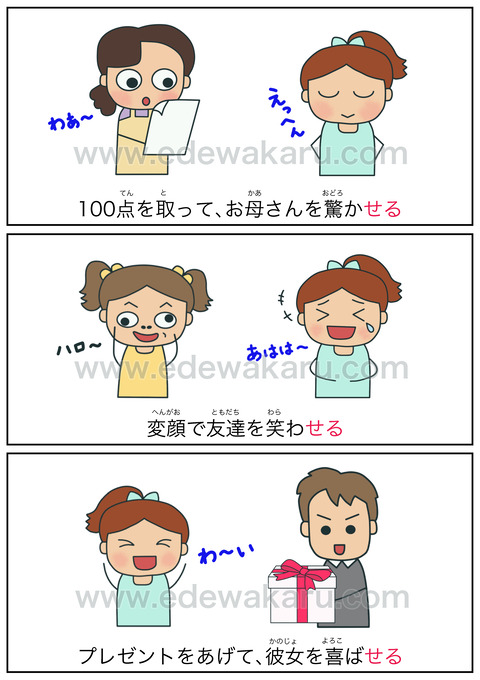
Meaning
Something causes someone to feel a certain emotion.
How to use it
Verb I [ない-form] + せる
Verb II [ない-form] + させる
する → させる
来る → 来させる
Explanation
“〜せる・〜させる” are causative verb forms that express [the cause of an emotion]. They are used in the form “AはBをCさせる” and mean “A causes B to do C.” An emotion verb goes in place of “C.”
[Examples]
①Getting 100 points surprises my mother.
[A] 100 points
[B] Mother
[C] Be surprised
→ My mother was surprised because I got 100 points.
②Make my friends laugh with a funny face.
[A] Funny face
[B] Friends
[C] Laugh
→ My friends laughed because I made a funny face.
③Give her a present and make her happy.
[A] Give a present
[B] Girlfriend
[C] Be happy
→ She was happy because I gave her a present.
④I broke a plate and made my mother angry.
[A] Break a plate
[B] Mother
[C] Get angry
→ My mother got angry because I broke a plate.
⑤My older brother broke a toy and made my younger brother cry.
[A] My older brother breaks a toy
[B] Younger brother
→ My younger brother cried because my older brother broke a toy.
⑥My daughter made her mother worry.
[A] Daughter
[B] Mother
→ Her mother worried because of her daughter.
⑦My younger sister cried all night and made my mother worry.
[A] My younger sister cried all night
[B] Mother
→ My mother was troubled because my younger sister cried all night.
⑧A: I canceled our date at the last minute, and my girlfriend cried…
B: You shouldn’t make her sad!
[A] Canceling the date at the last minute
[B] Girlfriend
→ She was sad because her boyfriend canceled at the last minute.
“Causative forms” have many uses, so review them 😀
[Causative form series]
In context 8 examples
100点を取って、お母さんを驚かせる
Getting 100 points surprises my mother.
変顔で、友達を笑わせる
Make my friends laugh with a funny face.
プレゼントをあげて、彼女を喜ばせる
Give her a present and make her happy.
お皿を割って、お母さんを怒らせた
I broke a plate and made my mother angry.
おもちゃを壊して、弟を泣かせる
He broke the toy and made his younger brother cry.
娘はお母さんを心配させた
My daughter made her mother worry.
妹は一晩中(ひとばんじゅう)泣き通して、お母さんを困らせた
My younger sister cried all night and made my mother worry.
A:デートをドタキャンしたら彼女が泣いちゃったんだ…B:彼女のことを悲しませたらだめだよ!
A: I canceled our date at the last minute, and my girlfriend started crying… B: You shouldn’t make her sad!
Read the original source text
Meaning
〜が原因で、相手に〜という感情が発生する
How to use it
動詞I[ない形]+せる
動詞Ⅱ[ない形]+させる
する→させる
来る→来させる
Explanation
「〜せる・〜させる」は動詞の使役形で【感情の原因】を表します。「AはBをCさせる」の形で使われ、「Aが原因になって、BがCする」という意味になります。「C」には感情を表す動詞が入ります。
[例]
①100点を取って、お母さんを驚か
せる
【A】100点
【B】お母さん
【C】驚く
→100点を取ったので、お母さんが驚いた
②変顔で、友達を笑わ
せる
【A】変顔
【B】友達
【C】笑う
→変顔をしたので、友達が笑った
③プレゼントをあげて、彼女を喜ば
せる
【A】プレゼントをあげる
【B】彼女
【C】喜ぶ
→プレゼントをあげたので、彼女が喜んだ
④お皿を割って、お母さんを怒ら
せた
【A】お皿を割る
【B】お母さん
【C】怒る
→お皿を割ったので、お母さんが怒った
⑤兄はおもちゃを壊して、弟を泣か
せる
【A】兄がおもちゃを壊す
【B】弟
→兄がおもちゃを壊したので、弟がないた
⑥娘はお母さんを心配
させた
【A】娘
【B】お母さん
→娘の事で、お母さんが心配した
⑦妹は一晩中泣き通して、お母さんを困ら
せた
【A】妹が一晩中泣き通した
【B】お母さん
→妹が一晩中泣き通したので、お母さんは困った
⑧A:デートをドタキャンしたら彼女が泣いたんだ…
B:彼女のことを悲しま
せたらだめだ
よ!
【A】デートをドタキャンしたこと
【B】彼女
→彼氏がドタキャンしたので、彼女が悲しんだ
【使役形】には、たくさんの用法がありますので復習をしておきましょう😀
【使役形シリーズ】
Usage 4
Read this source entry ↗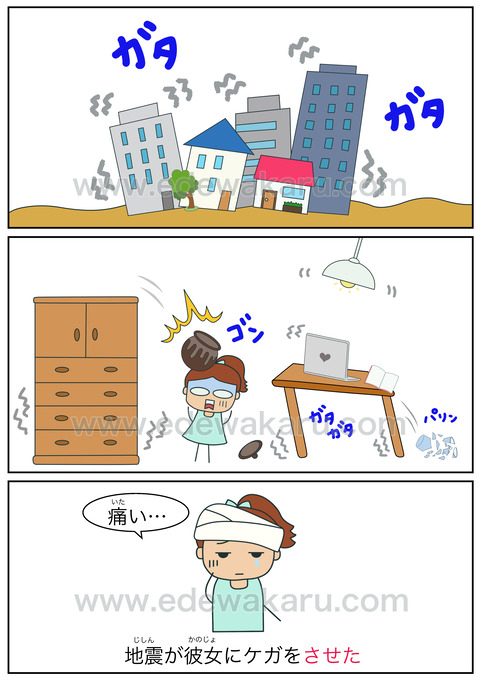
Meaning
Something becomes a certain way because of something.
How to use it
Verb I [ない-form] + せる
Verb II [ない-form] + させる
する → させる
来る → 来させる
Explanation
“〜せる・〜させる” means “something becomes a certain way because of something” and is a causative use that expresses [cause]. It is used in the forms “AがBにCさせる” and “AがBをCさせる” when you want to say “A causes C to happen.” [Cause] goes in place of “A” and [result] goes in place of “C.”
[Examples]
①The earthquake caused her to be injured.
[A] Earthquake
[B] Her
[C] Get injured
→ The earthquake caused her to get injured.
②Thanks to the teacher, I was able to get my daughter to pass N1.
[A] Teacher
[B] Daughter
[C] Pass N1
→ Thanks to the teacher, my daughter passed N1.
③Heavy snow delayed the train’s arrival.
[A] Heavy snow
[B] The train’s arrival
[C] Be delayed
→ Heavy snow caused the train’s arrival to be delayed.
④Lending and borrowing money made those two’s relationship worse.
[A] Lending and borrowing money
[B] Those two
[C] Make the relationship worse
→ Lending and borrowing money caused their relationship to worsen.
“〜せる・〜させる” used to express [cause] is stiffer in tone than other uses of the causative form.
There is also a causative use that expresses [the cause of an emotion], so learn that together 😊
[Causative form series]
In context 4 examples
地震が彼女にケガをさせた
The earthquake caused her to be injured.
先生のおかげで、娘をN1に合格させることができました
Thanks to the teacher, I was able to get my daughter to pass N1.
大雪が電車の到着を遅れさせた
Heavy snow delayed the train’s arrival.
お金の貸し借りが、あの2人の関係を悪くさせた*「貸し借り」とは、お金を貸したり借りたりすることです
Lending and borrowing money made those two’s relationship worse. *“Lending and borrowing” means lending or borrowing money.
Read the original source text
Meaning
〜が原因で〜になる
How to use it
動詞I[ない形]+せる
動詞Ⅱ[ない形]+させる
する→させる
来る→来させる
Explanation
「〜せる・〜させる」は「〜が原因で〜になる」という意味で、使役形の【原因】を表す用法です。「AがBにCさせる」「AがBをCさせる」の形で使われ、「Aが原因で、Cが起こる」と言いたい時に使います。「A」には【原因】、「C」には【結果】が入ります。
[例]
①地震が彼女にケガを
させた
【A】地震
【B】彼女
【C】ケガをする
→地震が原因で、彼女がケガをした
②先生のおかげで、娘をN1に合格
させる
ことができました
【A】先生
【B】娘
【C】N1に合格する
→先生のおかげで、娘がN1に合格した
③大雪が電車の到着を遅れ
させた
【A】大雪
【B】電車の到着
【C】遅れる
→大雪が原因で、電車の到着が遅れた
④お金の貸し借りが、あの2人の関係を悪く
させた
【A】お金の貸し借り
【B】あの2人
【C】関係を悪くする
→お金の貸し借りが原因で、あの2人の関係が悪くなった
【原因】を表す「〜せる・〜させる」は、他の使役形の用法よりもかたい言い方です。
【原因】を表す使役形には【感情の原因】を表すものもあります
ので、一緒に覚えておきましょう😊
【使役形シリーズ】
Usage 5
Read this source entry ↗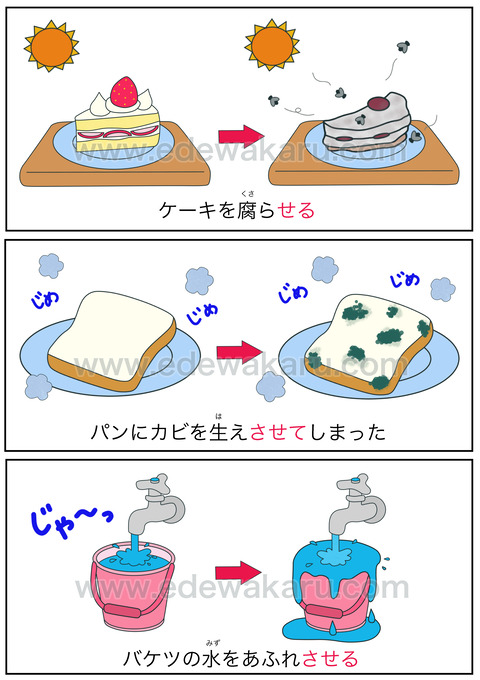
Meaning
Leave something unattended and make it become a certain state.
How to use it
Verb I [ない-form] + せる
Verb II [ない-form] + させる
する → させる
来る → 来させる
Explanation
“〜せる・〜させる” are causative verb forms used with the meaning of [leaving something unattended]. In the form “AをBさせる,” they are used when you want to say “leave A as it is and make it become state B.”
[Examples]
①Let a cake spoil.
[A] Cake
[B] Spoil
→ If you leave the cake as it is without putting it in the refrigerator, it spoils.
*It is also OK to express [self-blame].
②I ended up letting mold grow on the bread.
[A] Bread
[B] Mold grows
→ I left the bread unattended and ended up letting it become moldy.
*It is also OK to express [self-blame].
③Let the water in the bucket overflow.
[A] Water
[B] Overflow
→ If you leave the water running, it overflows.
*It is also OK to express [self-blame].
④Let the pudding set in the refrigerator.
[A] Pudding
[B] Set
→ If you leave the pudding in the refrigerator, it sets.
⑤Juice tastes good when you freeze it~
[A] Juice
[B] Freeze
→ Juice that has been put in the freezer and frozen tastes good.
Causative forms have many meanings, so review them 😊
[Causative form series]
In context 5 examples
ケーキを腐らせる
Let a cake spoil.
パンにカビを生えさせてしまった
I ended up letting mold grow on the bread.
バケツの水をあふれさせる
Let the water in the bucket overflow.
冷蔵庫でプリンを固まらせる
Let the pudding set in the refrigerator.
ジュースを凍らせて飲むとおいしいよ〜
Juice tastes good when you freeze it~
Read the original source text
Meaning
〜を放置して、〜の状態にする
How to use it
動詞I[ない形]+せる
動詞Ⅱ[ない形]+させる
する→させる
来る→来させる
Explanation
「〜せる・〜させる」は動詞の使役形で【放置】の意味を表します。「AをBさせる」の形で、「Aをそのままにしておいて、Bの状態にする」と言いたい時に使います。
[例]
①ケーキを腐ら
せる
【A】ケーキ
【B】腐る
→ケーキを冷蔵庫に入れずそのままにしておいたら腐った
*[自責]でもOK
②パンにカビを生え
させて
しまった
【A】パン
【B】カビが生える
→パンを放置して、カビが生えた状態にしてしまった
*[自責]でもOK
③バケツの水をあふれ
させる
【A】水
【B】あふれる
→水を出したままにしたら、あふれた
*[自責]でもOK
④冷蔵庫でプリンを固まら
せる
【A】プリン
【B】固まる
→プリンを冷蔵庫に入れたままにしておくと固まる
⑤ジュースを凍ら
せて
飲むとおいしいよ〜
【A】ジュース
【B】凍る
→冷凍庫に入れて凍った状態のジュースはおいしいよ
使役形にはたくさん意味がありますので、復習をしておきましょう😊
【使役形シリーズ】
Usage 6
Read this source entry ↗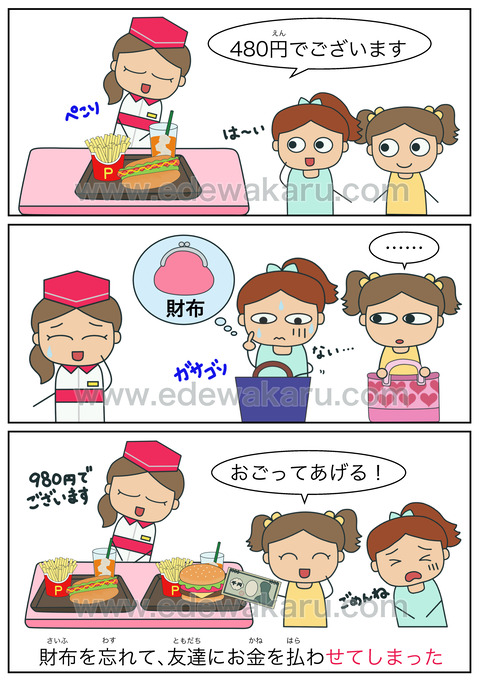
Meaning
(I didn’t intend to do it, but) I put someone in a situation where they had to do something.
(I didn’t intend to do it, but) someone ended up in a certain situation.
How to use it
Verb I [ない-form] + せる
Verb II [ない-form] + させる
する → させる
来る → 来させる
Explanation
“〜せる・〜させる” are causative verb forms that express a feeling of [responsibility], as in “It was my fault” or “I caused something to happen.” In most cases, the forms “AはBにCさせてしまった” and “AはBをCさせてしまった” are used, meaning “I did not intend to, but because of A’s carelessness, B ended up in a situation where they did C” or “[Because of something unexpected, B ended up in a situation where they did C].” This usage is used when you want to say, “It is A’s responsibility that B ended up in the situation of C.” In many cases, it expresses regret.
[Examples]
①I forgot my wallet and ended up making my friend pay.
[A] Me
[B] Friend
[C] Pay money
→ I carelessly forgot my wallet, and my friend ended up in a situation where they had to pay.
②The train was delayed, and I ended up making my boyfriend wait.
[A] Me
[B] Boyfriend
[C] Wait
→ The train was delayed, and my boyfriend ended up in a situation where he had to wait.
*The train being late was not my fault, but I feel responsible for making my boyfriend wait.
③I forgot to water the flowers and ended up letting them wilt.
[A] Me
[B] Flowers
[C] Wilt
→ Because of my carelessness, the flowers ended up wilting.
④I caused my pet to die in an accident.
[A] Me
[B] Pet
[C] Die
→ Because of my carelessness, there was an accident and my pet died.
*I feel responsible for my pet’s death.
⑤Because of my carelessness, I caused my child to get hurt.
[A] Me
[B] Child
[C] Get hurt
→ Because of my carelessness, my child ended up getting hurt.
By the way, the expressions often used in everyday conversation
“お待たせしました” and “お待たせいたしました”
are examples of this usage 😊 “Causative forms” have many uses, so review them 😀
[Causative form series]
In context 5 examples
財布を忘れて、友達にお金を払わせてしまった
I forgot my wallet and ended up making my friend pay.
電車が遅れて、彼氏を待たせてしまった
The train was delayed, and I ended up making my boyfriend wait.
水をあげるのを忘れて、花を枯れさせてしまった
I forgot to water the flowers and ended up letting them wilt.
事故でペットを死なせてしまった
I caused my pet to die in an accident.
私の不注意で、子供にケガをさせてしまった
Because of my carelessness, I caused my child to get hurt.
Read the original source text
Meaning
(〜するつもりはなかったが)〜が〜しなければいけない状況にしてしまった
(〜するつもりはなかったが)〜が〜という状況になってしまった
How to use it
動詞I[ない形]+せる
動詞Ⅱ[ない形]+させる
する→させる
来る→来させる
Explanation
「〜せる・〜させる」は動詞の使役形で「自分が悪かった」「自分のせいで〜した」というように【責任】の気持ちを表します。ほとんどの場合「AはBにCさせてしまった」「AはBをCさせてしまった」の形が使われ、「〜する意志はなかったが、Aの不注意でBがCする状況になってしまった」[予想外の〜で、BがCする状況になってしまった]という意味になります。「BがCという状況になってしまったのは、Aの責任だ」と言いたい時に使われる用法です。多くの場合は後悔する気持ちを表します。
[例]
①財布を忘れて、友達にお金を払わ
せてしまった
【A】私
【B】友達
【C】お金を払う
→不注意で財布を忘れ、友達がお金を払う状況になってしまった
②電車が遅れて、彼氏を待た
せてしまった
【A】私
【B】彼氏
【C】待つ
→電車が遅れて、彼氏が待つという状況になってしまった
*電車が遅れたのは自分のせいではないが、彼氏を待たせたのは自分の責任だと思っている
③水をあげるのを忘れて、花を枯れ
さ
せてしまった
【A】私
【B】花
【C】枯れる
→私の不注意で、花が枯れるという状況になってしまった
④事故でペットを死な
せてしまった
【A】私
【B】ペット
【C】死ぬ
→私の不注意で事故が起こり、ペットが死ぬという状況になってしまった
*ペットが死んだのは、自分の責任だと思っている
⑤私の不注意で、子供にケガを
させてしまった
【A】私
【B】子供
【C】ケガをする
→私の不注意で、子供がケガをするという状況になってしまった
ちなみに、日常会話(にちじょうかいわ)でよく使われる
「お待たせしました」「お待たせいたしました」
はこの用法です😊「使役形」にはたくさん用法がありますので、復習をしておきましょう😀
【使役形シリーズ】
Usage 7
Read this source entry ↗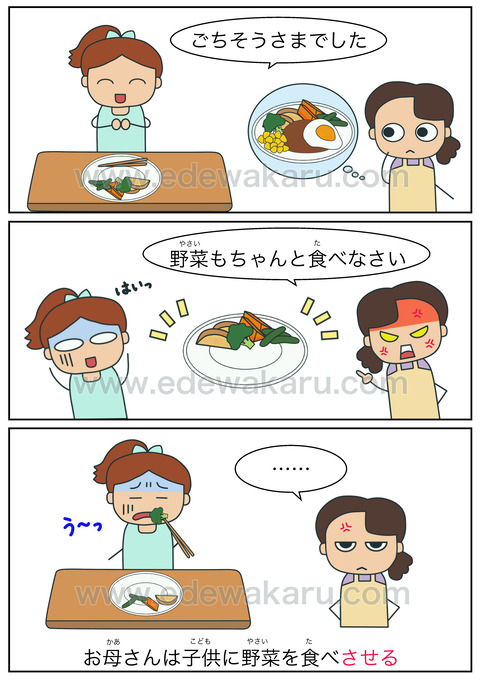
Meaning
Force someone to do something
Instruct someone to do something
How to use it
Verb I [ない-form] + せる
Verb II [ない-form] + させる
する → させる
来る → 来させる
Explanation
“〜せる・〜させる” are causative verb forms that express [coercion or instruction]. They are used when forcing or instructing someone to do something. They are used by someone of higher status to someone of lower status, such as “parent → child,” “teacher → student,” or “supervisor → subordinate.”
[Examples]
①A mother makes her child eat vegetables.
→ The child does not want to eat vegetables, but the mother forces them to eat.
②The teacher had Yamada read the example sentence.
→ The teacher instructed Yamada to read the example sentence.
③The supervisor made their subordinate drink alcohol.
→ The subordinate did not want to drink alcohol, but the supervisor forced them to.
④The mother made her daughter go shopping.
→ The daughter did not want to go shopping, but the mother forced her to.
⑤The father makes the child do their homework.
→ The child does not want to do homework, but the father makes them do it.
⑥The teacher made her stand.
→ The teacher instructed her to stand.
⑦The older sister made her younger sister clean the room.
→ The younger sister did not want to clean, but her older sister made her.
The causative form is beginner-level grammar, but it has many and complex meanings. It is also often used in conversation, so be sure to review it 😊
[Causative form series]
In context 7 examples
お母さんは子供に野菜を食べさせる
A mother makes her child eat vegetables.
先生は山田くんに例文を読ませた
The teacher had Yamada read the example sentence.
上司は部下にお酒を飲ませた
The supervisor made their subordinate drink alcohol.
お母さんは娘を買い物に行かせた
The mother made her daughter go shopping.
お父さんは子供に宿題をさせる
The father makes the child do their homework.
先生は彼女を立たせた
The teacher made her stand.
姉は妹に部屋を掃除させた
The older sister made her younger sister clean the room.
Read the original source text
Meaning
相手に強制する
相手に指示する
How to use it
動詞I[ない形]+せる
動詞Ⅱ[ない形]+させる
する→させる
来る→来させる
Explanation
「〜せる・〜させる」は動詞の使役形で【強制・指示】を表します。相手に何かを強制したり、指示したりする場合に使われます。「親→子供」「先生→学生」「上司→部下」などのように、目上の人から目下の人に使われます。
[例]
①お母さんは子供に野菜を食べ
させる
→子供は野菜を食べたくないが、お母さんが食べるように強制
②先生は山田くんに例文を読ま
せた
→先生は山田くんに例文を読むように指示
③上司は部下にお酒を飲ま
せた
→部下はお酒を飲みたくないが、上司は飲むように強制
④お母さんは娘を買い物に行か
せた
→娘は買い物に行きたくないが、お母さんが行くように強制
⑤お父さんは子供に宿題を
させる
→子供は宿題をしたくないが、お父さんがするように強制
⑥先生は彼女を立た
せた
→先生は彼女に立つように指示
⑦姉は妹に部屋を掃除
させた
→妹は掃除したくないが、姉が掃除するように強制
【使役形】は初級文法ですが意味もたくさんあり、複雑です。会話でもよく使われますので、しっかりと復習をしておきましょう😊
【使役形シリーズ】
毎日のんびり日本語教師
How to use it
五段 verb ない-form + せる
一段 verb ない-form + させる
する → させる
来る → 来させる
Explanation
This grammar is also called the causative form. It expresses making someone do something, or permitting or letting an action happen.
With a transitive verb, the person being made to act takes the particle “に”; with an intransitive verb, it takes the particle “を.”
There are exceptions, however. “待つ” is a transitive verb, but the person being made to wait takes “を.” (3)
Notes
Grammar related to voice
【N4 Grammar】~れる/られる/できる (potential voice)
【N4 Grammar】~れる/られる/される (passive voice)
【N4 Grammar】~せる/させる (causative voice)
【N4 Grammar】~(さ)せられる (causative-passive voice)
【N3 Grammar】~れる/られる/される (spontaneous voice)
In context 8 examples
母は私を買い物に行かせた。
My mother made me go shopping.
風が入ってきて寒いので、友達に窓を閉めさせた。
Since the wind was coming in and it was cold, I had my friend close the window.
彼女を待たせているので早く行かなければ。
I’m keeping her waiting, so I have to hurry.
部下に今日は残業せず帰りたいと言われたのですぐ帰らせた。
My subordinate said they wanted to go home today without working overtime, so I let them go home right away.
子供がやりたいと言ったことはやらせてあげたい。(想让孩子做他想做的事情。)
I want to let my child do what they say they want to do.
地下鉄サリン事件は当時日本中を震撼させた。(地铁沙林事件让当时全日本都震惊了。)
The Tokyo subway sarin attack shocked all of Japan at the time.
たった15分でも昼寝するだけで頭をすっきりさせることができる。
Even just a 15-minute nap can clear your head.
不注意で子供に怪我をさせてしまった。(由于我的疏忽让孩子受伤了。)
I accidentally caused my child to get hurt through my carelessness.
Read the original source text
How to use it
五段動詞のない形+せる
一段動詞のない形+させる
する→させる
来る→来させる
Explanation
使役形とも呼ばれる文法です。他人に物事を強制したり、動作の許可や放任の意味を表します。
他動詞の時は被使役者に助詞「に」を使い、自動詞の時は助詞「を」を使います。
ただし例外もあります。「待つ」は他動詞ですが、被使役者には「を」が使われます。(3)
Notes
ヴォイス系の文法
【N4文法】~れる/られる/できる(可能態)
【N4文法】~れる/られる/される(受身/受動態)
【N4文法】~せる/させる(使役態)
【N4文法】~(さ)せられる(使役受身/使役受動態)
【N3文法】~れる/られる/される(自発態)
NINJAL 日本語文型データベース
Meaning
[1] Expresses forcing or instructing another person to perform an action.
[2] Expresses permitting or allowing another person to perform an action. It can also express not interfering with another person’s actions and leaving things as they are.
It is also often used in forms such as “〜(さ)せてあげる・〜(さ)せてもらう・〜(さ)せてくれる” and “〜(さ)せておく.”
[3] Expresses that an action by someone or an event causes another person to feel something.
[4] Expresses that someone bears responsibility for an undesirable event having occurred. When the speaker is responsible, it conveys regret; when the listener or a third party is responsible, it conveys blame.
It is also often used in the form “〜(さ)せてしまう.”
[5] Expresses helping another person perform an action. It is used when that person cannot perform the action well by their own will alone. It can also be used to mean controlling the movement of something that would otherwise move differently if not controlled.
[6] Expresses that an action by someone or an event causes a certain situation to occur.
[7] A way of using the causative form of an intransitive verb as a verb that takes an object, like a transitive verb.
[8] Used when describing a change in part of a person or thing as if that person or thing were acting on that part.
How to use it
V (causative form)
Notes
[1] Often used when someone in a higher position forces or instructs someone in a lower position to perform an action.
Usually, when “〜” is a transitive verb, the person who actually performs the action is marked by “~に.” When “〜” is an intransitive verb, the person who actually performs the action is marked by “~を.” However, with intransitive verbs that require “を,” such as “(橋を)渡る・(歩道を)歩く,” the person is marked by “~に.”
[2] Usually, when “〜” is a transitive verb, the person who is given permission or allowed to do something is marked by “~に.” When “〜” is an intransitive verb, that person is marked by “~を.”
[3] “〜” takes an intransitive verb that expresses a change of mind or feeling, such as “驚く・怒る・笑う・心配する.”
The person who actually feels the emotion is usually marked by “~を.”
The cause of the emotion is often expressed with “〜て.”
[4] Usually, when “〜” is a transitive verb, the subject of the event is marked by “~に.” When “〜” is an intransitive verb, the subject of the event is marked by “~を.”
[5] Usually, when “〜” is a transitive verb, the person performing the action, etc., is marked by “~に.” When “〜” is an intransitive verb, that person is marked by “~を.”
[6] “〜” takes an intransitive verb that expresses the situation that occurs as a result.
The cause is marked by “〜が.” The thing that changes as a result is marked by “〜を.”
[7] “〜” is an intransitive verb.
It is used in the form “~が~を~(さ)せる.” “~が” indicates a person, a person’s action, an event, etc. “~を” indicates the thing that changes.
[8] “〜” is an intransitive verb.
It is used in the form “~が~を~(さ)せる.” “~が” indicates the person or thing that acts on something. “~を” indicates the part that is acted upon.
In context 45 examples
先生は生徒たちに将来の目標について作文を書かせた。
The teacher had the students write an essay about their goals for the future.
子どもが食べたがらないものを無理に食べさせるのは、よくないだろうか。
Is it wrong to force children to eat something they don’t want to eat?
小学校の入学式では、子どもにきちんとした服を着させないと。
For the elementary school entrance ceremony, I have to make sure the child wears proper clothes.
運動部のコーチ「試合が近いから、来週から部員たちを朝7時に学校へ来させよう。授業前に練習をさせたいんだ」
Sports club coach: “The match is coming up, so starting next week, let’s have the team members come to school at seven in the morning. I want them to practice before class.”
運転者には、後部座席の同乗者にもシートベルトを着用させる義務があります。もしシートベルトをさせなかった場合は警官に注意を受けると思います。
Drivers are required to have their passengers in the back seat wear seat belts, too. If they don’t make them wear seat belts, I think the police will warn them.
この道路は、信号がなくて危ないので、子どもたちにはきちんと歩道橋を渡らせている。
This road is dangerous because there are no traffic lights, so I make sure the children cross using the pedestrian overpass.
今日はスーパーで子どもたちに自由に好きなお菓子を買わせた。
Today at the supermarket, I let the children freely choose and buy whichever snacks they liked.
何をやっても文句を言う人はどこにでもいるから、言いたい人には言わせておけばいい。
There are people everywhere who complain about anything you do, so if someone wants to say something, just let them say it.
めぐみは疲れているようだから、起こさずにこのまま寝させておこう。
Megumi seems tired, so let’s leave her asleep like this without waking her.
小学生のころ、うちではテレビゲームをやらせてもらえなかった。
When I was in elementary school, I wasn’t allowed to play video games at home.
本人の希望通り、部長は山田さんをアメリカに駐在させました。
In accordance with his wishes, the department head assigned Mr. Yamada to work in the United States.
私のことを束縛しないで好き勝手にさせてくれた両親に感謝しています。
I’m grateful to my parents, who didn’t restrict me and let me do as I pleased.
子どもの夢をかなえるために、イギリスに留学させてやることにした。
To help my child fulfill their dream, I decided to send them to study in Britain.
田中君はいつも面白いことを言ってみんなを笑わせる。
Tanaka-kun always says funny things and makes everyone laugh.
結婚しないと言っていた佐藤さんが一番早く結婚して、友達をびっくりさせました。
Mr. Sato, who had said he would never marry, got married first of all his friends and surprised them.
若いころはわがままを言って、よく母を怒らせたり悲しませたりしたものだ。
When I was young, I used to be selfish and often make my mother angry or sad.
夏休みに家族とハワイへ行く予定だったが、仕事が入って行けなくなり、家族をがっかりさせてしまった。
We had planned to go to Hawaii as a family during summer vacation, but work came up and I couldn’t go, so I ended up disappointing my family.
自分が楽しむだけでなく、他の人を楽しませられるようになりたい。
I want to become able to make other people happy, not just enjoy myself.
11月なのに今日は暖かくて、春を思わせる一日でした。
Even though it’s November, it was warm today—a day that reminded me of spring.
私の不注意で子どもにやけどをさせてしまった。
Because of my carelessness, I accidentally caused my child to get burned.
うちの金魚を死なせたのは私だ。えさをやりすぎた。
I’m the one who caused our goldfish to die. I fed it too much.
「遅くなりました。お待たせしてすみません」
“Sorry to have kept you waiting.”
親「使ったものは、元の場所にしまいなさい。同じことを何度も言わせないで」子「ごめんなさい」
Parent: “Put away what you’ve used in its proper place. Don’t make me tell you the same thing over and over.” Child: “I’m sorry.”
父が肥料のやり方を間違えて、バラを弱らせてしまった。
My father used the fertilizer incorrectly and ended up weakening the roses.
妹はいつも高い服を欲しがって、祖父母にたくさんお金を使わせてしまう。
My younger sister always wants expensive clothes and ends up making our grandparents spend a lot of money.
散歩の時間になると、保育士たちが子どもたちに靴を履かせる。
When it’s time for a walk, the nursery teachers put shoes on the children.
赤ちゃんにミルクを飲ませたり遊ばせたりしていると、1日があっという間に終わってしまいます。
When you spend your time feeding the baby milk and letting them play, the day passes in no time.
この電車、走るのが遅くなってきたな。新しい電池を入れて、もっと速く走らせよう。
This train has started running slowly. Let’s put in new batteries and make it run faster.
コロンブスがみんなの目の前で卵を立たせたというエピソードを知っていますか。
Do you know the story about Columbus making an egg stand upright right in front of everyone?
ユーラシア大陸からの冷たい空気が日本海側の地方に雪を降らせる。
Cold air from the Eurasian continent causes snow to fall in regions along the Sea of Japan.
言語の獲得は人類の思考能力を大きく発達させた。
The acquisition of language greatly developed humankind’s ability to think.
田中先生の優しい一言が一郎を再び立ち上がらせた。
A kind word from Mr. Tanaka got Ichiro back on his feet.
環境破壊が地球の生態系を変化させている。
Environmental destruction is changing the Earth’s ecosystems.
ストレスや環境の変化は、うつ病を悪化させる原因となる。
Stress and changes in the environment can cause depression to worsen.
火山の噴火が町を消滅させた。
The volcanic eruption wiped out the town.
2年かけて、展覧会に出す作品を完成させた。
It took two years, but I completed the work to be shown at the exhibition.
今日は早く仕事を終わらせたい。
I want to finish work early today.
大統領は自国の経済を安定させるために、輸入品に高い関税をかけた。
The president imposed high tariffs on imports to stabilize his country’s economy.
古代ギリシアの医師ヒポクラテスは、科学的な医学を発展させた賢人だ。
Hippocrates, the ancient Greek physician, was a wise man who advanced scientific medicine.
私はガーデニングが好きですが、毎年きれいな花を咲かせるのは難しいです。
I like gardening, but it’s difficult to get beautiful flowers to bloom every year.
仕事が忙しいときには、疲れた脳をリフレッシュさせることも大切です。
When work is busy, it is also important to refresh your tired brain.
桜の木もつぼみを膨らませています。もう春です。
The cherry trees are swelling their buds, too. Spring is here.
あの子は口をとがらせて母親に何か文句を言っている。
That child is pouting and complaining to their mother about something.
子どもは目を輝かせながら大好きなゲームをしていた。
The child was playing their favorite game with their eyes shining.
サッカーの練習の後、息子はおなかをすかせて帰ってきた。
After soccer practice, my son came home hungry.
Read the original source text
Meaning
[1] ほかの人にある行為をすることを強制したり指示したりすることを表します。
[2] ほかの人がある行為をすることを許可・容認することを表します。また、ほかの人の行動を妨げないで、そのままの状態にしておくことを表します。
「〜(さ)せてあげる・〜(さ)せてもらう・〜(さ)せてくれる」や「〜(さ)せておく」という形で使うことも多いです。
[3] ある人の行為やある出来事が原因で、他の人が何かの感情を持つことを表します。
[4] 好ましくない出来事が起こったことについて、何かの責任があることを表します。話し手自身に責任があるときは後悔、聞き手や第三者に責任があるときは非難の意味になります。
「〜(さ)せてしまう」の形で使うことも多いです。
[5] ほかの人の動作を手助けすることを表します。その人の意志だけでは動作がよくできない場合に使います。また、コントロールしなければ別の動きをしてしまう物の動きをコントロールするという意味でも使うことがあります。
[6] ある人の行為や出来事が原因で、ある事態が起こることを表します。
[7] 自動詞の使役の形を、他動詞のように目的語をとる動詞として使う言い方です。
[8] 人や物の部分の変化を、その人や物がその部分に作用を与えるかのように表現するときに使います。
How to use it
V(使役の形)
Notes
[1] 立場が上の人が立場が下の人に行為の強制や指示をするときに使うことが多いです。
ふつう、「〜」が他動詞の場合は、実際に行為をする人を「~に」で示します。「〜」が自動詞の場合、実際に行為をする人を「~を」で示します。ただし、「(橋を)渡る・(歩道を)歩く」など、「を」が必要な自動詞の場合は「~に」で示します。
[2] ふつう、「〜」が他動詞の場合は、許可・容認してもらう人を「~に」で表します。「〜」が自動詞の場合は、許可・容認してもらう人を「~を」で表します。
[3] 「〜」には、心の動きを表す自動詞(「驚く・怒る・笑う・心配する」など)がきます。
実際に感情を持つ人をふつう「~を」で示します。
感情の原因を「〜て」で表すことが多いです。
[4] ふつう、「〜」が他動詞の場合は、出来事の主体を「~に」で示します。「〜」が自動詞の場合は、出来事の主体を「~を」で示します。
[5] ふつう、「〜」が他動詞の場合は、動作をする人などを「~に」で表します。「〜」が自動詞の場合は、動作をする人などを「~を」で表します。
[6] 「〜」には、結果として起こる事態を表す自動詞がきます。
原因を「〜が」で示します。その結果として変化する物事を「〜を」で示します。
[7] 「〜」は自動詞です。
「~が~を~(さ)せる」という形で使います。「〜が」は、人・人の行為・出来事などを示します。「〜を」は、変化する物事を示します。
[8] 「〜」は自動詞です。
「~が~を~(さ)せる」という形で使います。「〜が」は、作用を与える人や物を示します。「~を」は、作用を受ける部分を示します。
IMABI
The Causative I: ~させる & ~せる
Read this IMABI lesson ↗Explanation
The Causative I: ~させる & ~せる
The auxiliary verbs ~させる and ~せる create what is known as the “causative form” (使役形), which equates to “A (the subject) makes/lets an agent (X) do a certain action (Y).”
Before we look at what “causation” means and the grammatical restrictions had with it in Japanese, know that unlike many languages including English and Korean, the verb 作る meaning “to make (something)” is not used to mean “to make” as in the causative form, which pertains to someone making someone else do something.
1a. Xを怒る作る X
1b. Xを怒らせる 〇
Literally: To make X be angry.
To anger X.
The notion of the causative form – “A makes X do Y” – is often confused with the grammar pattern “XをYにする,” which is used to show that “A makes/has something (X) be a certain way (Y).”
2. 音楽が小さくなった。
The music(‘s volume) got smaller/quieter.
3. 音楽を小さくした。
(I) turned down the music.
4. 彼に音楽を小さくさせた。
I made him turn down the music.
The Causative Auxiliaries ~させる & ~せる
「使役形」の助動詞、~させる・せる
The causative form (使役形) is used with both transitive and intransitive verbs alike, but as we shall see, this does present the question of how the “person being made to the act” and the object of said verb are denoted via particles.
These auxiliaries both follow the 未然形 of verbs and they both exhibit 一段 conjugation. They differ only by what verb classes they follow. As shown below, both these auxiliaries have dialectal1 五段-conjugating variants: ~さす and ~す.
Verb Class Auxiliary Example Auxiliary Example
一段 ~させる 食べさせる ~さす 食べさす
五段 ~せる 行かせる ~す 行かす
する ~せる させる ~す さす
来る ~させる 来させる ~さす 来さす (X/△)
The 一段-conjugating auxiliaries ~させる・せる are not restricted in the way their 五段-conjugating auxiliaries ~さす・す are, which is due to their corrupted etymology2.
ClassVerb使役形
終止形・連体形Neg. Past
一段見る
(to see)見させる
見さす (X/△)見させない見させた ◎
見さした
五段言う
(to say)言わせる◎
言わす言わせない言わせた◎
言わした
五段死ぬ
(to die)死なせる
死なす死なせない死なせた ◎
死なした
五段微笑む
(to smile)微笑ませる◎
微笑ます微笑ませない微笑ませた◎
微笑ました
サ変する
(to do)させる
さす(X/△)させないさせた◎
さした
カ変来る
(to come)来(こ)さす(X/△)来(こ)させない来させた ◎
来さした
Although the copula (either in noun-predicates or in adjectival-noun predicates) and adjectives are not directly modified by these causative auxiliaries, the pattern XをYにする can be rendered in the causative form as “AがXにZをY[にさせる].” While X is still the agent of Y, Z is the object of the resulting action. In this scenario, に serves to mark who the subject allocates the task.
ExampleCausative
名詞+だ馬鹿だ
(to be an idiot)馬鹿にさせる
(A makes X make Y out to be an idiot)
形容詞新しい
(to be new)新しくさせる
(A has X make Y be new)
形容動詞(+だ)簡単だ
(to be easy)簡単にさせる
(A makes X make Y be easy)
The Causative w/ Transitive Verbs
When using transitive verbs in the causative, the direct object is marked with を. Meanwhile, the agent allocated/made to carry out the predicate by the subject of the sentence is marked with に.
5. 弟にゴミを出させる。
I make my younger brother take out the trash.
6. 太郎君にカメを殺させる。
To make Taro-kun kill a turtle.
7. 母は弟に犬にエサをやらせた。
My mom made my little brother feed the dog.
Sentence Note: The first に marks the brother as the person being made to do the action (the actual agent of the action) and the second に marks the dog as the recipient of the food (indirect object).
The Causative W/ Intransitive Verbs
When using intransitive verbs in the causative, the choice between を and に for marking the agent (the one being made to do the action = 被使役者) appears less clear-cut.
Most resources fail to address the semantic factors that compel speakers to use one particle over the other.
As for when the particle を is chosen, its use may imply a compelling/overbearing force, and when the agent happens to be an emotion-less/inanimate entity (非情物), its use becomes obligatory.
8. 友達を怒らせる。
To anger a friend.
9. 風が木を揺らせていた。
The wind shook the tree(s).
10. ネズミを死なせる。
To make the rat die.
を is also expected in situations in which, as we saw with “AがXにZをY[にさせる],”
the direct object is being acted upon by someone being made to act by the subject, as opposed to the subject simply having the direct object be a certain way.
In this scenario, Y is simply an intransitive verb + ~させる・せる.
11a. (Aが)心を乱れさせる。
11b. (Aが)心を乱す。
11a. (For A) to have… mess with (someone’s) mind.
11b. (For A) to mess with (one’s/someone’s) mind.
The choice of に over を may indicate the subject’s recognition of the will of the person being made to do something, rendering an interpretation of “to let” as opposed to being viewed as meaning “to make.”
12. 父親は子ども{を ◎・に} プールで泳がせてあげました。
The father let his child swim in the pool.
13. 今回は山本{を・に}行かせましょうか。
Next time, let’s [have/let] Yamamoto go.
When another function of に is in use, or such function is implied in context, the use of に becomes unnatural.
14. 子ども{を 〇・に X}ベンチに座らせる。
To make the/a child(ren) sit on the bench.
15. 子ども{を 〇・に 〇/△}座らせる。
To make the/a child(ren) sit.
16. 先生は吉田さん{を ◎・に 〇}そこへ座らせました。
The teacher [had/let] Yoshida-san sit there.
17. 毎朝犬に公園を散歩させます。
I let my dog walk through the park every morning.
18. 子供{を 〇・に △/X}おつかいに行かせる。
To make/let a kid go do an errand.
19. 親は子供{を 〇・に △/X}買い物に行かせた。
The parent made/had his/her child(ren) go shopping.
20. ワンちゃんに道の内側を歩かせる。
To make the dog walk inside the road.
Though the particle を is not used in Ex. 20 to mark a direct object, the particle に is used to mark the 被使役者 so as to avoid the doubling of を, but it can also be said that に adds a sense of directionality behind the subject’s coaxing of the agent.
Yet, with verbs such as 答える (to answer) in which the object is marked by に as opposed to を due to the strong sense of directionality behind the action, and with the substance of “the answer” being felt as the true direct object left unspoken, we see that in Ex. 21, it is both natural and obligatory to mark the agent with に despite there now being two に in the same clause. To help visualize why this is, consider also the paraphrasing of Ex. 21 which allows for を to be used.
21. 先生は、学生に[質問に答え=質問を解答]させる。
The teacher made/had his/her students answer (to) the questions.
22. 先生は学生を帰らせました。
The teacher sent his/her students home.
23. 毎朝犬{を ◎・に}散歩させます。
I [walk the dog/let the dog go on a walk] every morning.
24. 妹を大阪に来させるつもりだ。
I intend on making my younger sister come to Osaka.
25. 気分が悪そうなので生徒{を・に}先に帰らせた。
Since the student seemed to feel bad, I [had/let] him/her go home earlier.
26a. 人に立たせる。
26b. 人を立たせる
26a. To make someone have…stand.
26b. To make a person stand.
Causative Vs ~て{もらう・いただく}
When you say you had someone do something for you, instead of using the causative, you use ~てもらう・~ていただく. With expressions concerning emotions, those things are not in your control to cause. So, using them with the causative is fine. So, you can say something like 母を心配させた. This is because the causative does not have to be intentional. ~てもらう・~ていただく always are.
27. 先生に推薦状すいせんじょうを書いていただきました。(You didn’t make the teacher do it.)
I had my teacher write me a letter of recommendation.
28. 先生に推薦状を書かせました。(Not for your benefit at all)
I made the teacher write a letter of recommendation.
Also note that the use of に is different. In the first sentence it shows from whom you received the action. In the second sentence it marks who was forced to do the action.
29. 笑わせないでください。
Please don’t make me laugh.
30. 人を酔よわせる。
To intoxicate a person.
31. 方言は日本語をより美しくて、素晴らしい言語として成り立たせていると思います。
I think that dialects serve to make Japanese as a more beautiful and wonderful language.
32. 母が妹に掃除そうじさせたのにがらがらと笑ったんだ。
I laughed so hard about my mom making my younger sister wash the dishes.
33. でも、父が僕に空手を習わせたのは嫌だったよ。
But, I hated that my dad made me take karate.
34. 僕にもやらせてもらえない(か)?
Could you let me play it?.
35. 森林を焼けさせる。
To have/let the forests burn.
36. 祖母を休ませました。
We made our grandmother take a rest.
37. 弟は野菜が嫌きらいだが、母は弟に毎日野菜を食べさせるつもりだ。
My younger brother hates vegetables, but my mother plans to make him eat them every day.
38. 今働き始めたら、それだけ早く済ませるだろう。
If we were to start working now, the quicker we would probably finish.
39. 何と言っても金が世よの中を動かすのさ。
No matter what, money makes the world go round.
40. 演出家えんしゅつかは助言じょげんを与あたえるため度々たびたびリハーサルを中断ちゅうだんさせた。
The producer interrupted rehearsals frequently in order to give advice.
41.
A. あなたが、日本語の先生だったら、学生に何をさせますか。
B. 日本語の先生だったら、学生に{日本語で書かれた本 ◎・日本語の本・和書}を読むようにさせるでしょう。
A. If you were a Japanese teacher, what would you make your students do?
B. If I were a Japanese teacher, I’d make my students try to read Japanese words.
42.
A. あなたが、社長になったら、秘書に何をさせますか。
B. 週ごとに報告書を書かせるでしょう。
A. If you were a company president, what would you make your secretary do?
B. I would make (the secretary) write a report a week.
43.
A. 頭のいいロボットがいたら、何をさせますか。
B. 掃除をさせるでしょう。
A. If you had a smart robot, what would you make it do?
B. I’d make it do my laundry.
44.
A. 親になったら、子供に何をさせてあげますか。
B. 日本語と韓国語かんこくごを習わせてあげるでしょう。
A. When you become a parent, what would you have your children do?
B. I would have (them) study Japanese and Korean.
45.
A. 結婚したら、相手に何をさせてあげますか。
B. ハワイに旅行させてあげるでしょう。
A. When you’re married, what would you have your partner do?
B. I’d take him/her on a trip to Hawaii.
Unconcern or Let
“Making” someone do something and “letting” someone do something are very similar, as we have seen. In Japanese, context largely plays a role in determining whether the causative indicates “coercion (make)” vs. “approval (let),” especially in the case of transitive verbs in which を・に do not exhibit interchangeability.
As for intransitive verbs for which overlap is observed, we have seen how a compelling force is attached to を, whereas a recognition of the agent’s will often renders a “to let” interpretation. However, when the agent’s emotional status cannot be ascertained or is nonexistence, the difference between “to make” and “to let” is also consequentially nonexistent.
46. 昼に全生徒{を ◎・に △}帰らせました。 (Intransitive Causative = Compelling Force)
I let all of my students go home at noon.
47. お風呂ふろの水を溢あふれさせてしまったの!(Intransitive Causative = Emotionless Agent)
I accidentally let the water in the tub overflow!
48. 育て方を間違えて子供をいじけさせるのは親の最悪の悪夢だ。(Transitive Causative)
Incorrectly raising up one’s child and having that child grow perverse is a parent’s worst nightmare.
49. ちょっと考えさせてください。(Transitive Causative)
Please let me think about it.
50. 車を使わせてください。(Transitive Causative)
Please let me use your car.
~させて{もらう・いただく}
When paired with ~てもらう・ていただく, the speaker humbly takes permission to do something. Rather than simply saying “I will do something,” you are saying that you are taking it upon yourself, but you are aware of the person/people responsible for allowing you to even do it in the first place. This is why ~させていただきます is becoming ever more common in honorifics.
51. 会議を始めさせていただきます。(謙譲語)
I shall be commencing the meeting.
When the causative form is paired with ~てあげる・やる, ~てくれる, ~てもらう, the sense of permission becomes clear and distinguishable from the “make” definition.
52. 先生は学生{を・に}トイレに行かせてあげた。
The teacher let the student go to the restroom.
53. 父は僕に車を運転させてくれた。
My dad let me drive the car.
54.
A. 子供の時、皆の両親は、何をさせてくれませんでしたか。
B. 子供の時、一人で遊ばせてくれませんでした。
A. As a child, what did everyone’s parents not let them do?
B. When I was a child, I wasn’t allowed to play alone.
55.
A. 高校の時、皆の両親は、何をさせてくれませんでしたか。
B. {酒・アルコール}を飲ませてくれませんでした。
A. In high school, what did everyone’s parents not let them do?
B. They wouldn’t let me drink.
Though not considered ‘standard,’ this alternation to the conjugation norm is incredibly common in colloquial speech. ↩︎
The 五段-conjugating ~さす・す are corruptions of the Classical Japanese renditions of the 一段-conjugating ~させる・せる, whose 終止形 would have been rendered as ~さす・す. This corruption is only valid for the 連用形, which in turn provides 言わせた・言わした (made…say) as possible forms, albeit with the latter sounding dialectal. Another contending issue as to why 見さす is marked as unnatural/incorrect is that 見さす may be interpreted as 見る + the supplementary verb ~止(さ)す to mean “to pause watching.” ↩︎
In context 51 examples
Xを怒る作る X
Literally: To make X be angry.
Xを怒らせる 〇
Literally: To make X be angry.
音楽が小さくなった。
The music(‘s volume) got smaller/quieter.
音楽を小さくした。
(I) turned down the music.
彼に音楽を小さくさせた。
I made him turn down the music.
弟にゴミを出させる。
I make my younger brother take out the trash.
太郎君にカメを殺させる。
To make Taro-kun kill a turtle.
母は弟に犬にエサをやらせた。
My mom made my little brother feed the dog.
友達を怒らせる。
To anger a friend.
風が木を揺らせていた。
The wind shook the tree(s).
ネズミを死なせる。
To make the rat die.
(Aが)心を乱れさせる。
11a. (For A) to have… mess with (someone’s) mind.
(Aが)心を乱す。
11a. (For A) to have… mess with (someone’s) mind.
父親は子ども{を ◎・に} プールで泳がせてあげました。
The father let his child swim in the pool.
今回は山本{を・に}行かせましょうか。
Next time, let’s [have/let] Yamamoto go.
子ども{を 〇・に X}ベンチに座らせる。
To make the/a child(ren) sit on the bench.
子ども{を 〇・に 〇/△}座らせる。
To make the/a child(ren) sit.
先生は吉田さん{を ◎・に 〇}そこへ座らせました。
The teacher [had/let] Yoshida-san sit there.
毎朝犬に公園を散歩させます。
I let my dog walk through the park every morning.
子供{を 〇・に △/X}おつかいに行かせる。
To make/let a kid go do an errand.
親は子供{を 〇・に △/X}買い物に行かせた。
The parent made/had his/her child(ren) go shopping.
ワンちゃんに道の内側を歩かせる。
To make the dog walk inside the road.
先生は、学生に[質問に答え=質問を解答]させる。
The teacher made/had his/her students answer (to) the questions.
先生は学生を帰らせました。
The teacher sent his/her students home.
毎朝犬{を ◎・に}散歩させます。
I [walk the dog/let the dog go on a walk] every morning.
妹を大阪に来させるつもりだ。
I intend on making my younger sister come to Osaka.
気分が悪そうなので生徒{を・に}先に帰らせた。
Since the student seemed to feel bad, I [had/let] him/her go home earlier.
人に立たせる。
26a. To make someone have…stand.
人を立たせる
26a. To make someone have…stand.
先生に推薦状すいせんじょうを書いていただきました。(You didn’t make the teacher do it.)
I had my teacher write me a letter of recommendation.
先生に推薦状を書かせました。(Not for your benefit at all)
I made the teacher write a letter of recommendation.
笑わせないでください。
Please don’t make me laugh.
人を酔よわせる。
To intoxicate a person.
方言は日本語をより美しくて、素晴らしい言語として成り立たせていると思います。
I think that dialects serve to make Japanese as a more beautiful and wonderful language.
母が妹に掃除そうじさせたのにがらがらと笑ったんだ。
I laughed so hard about my mom making my younger sister wash the dishes.
でも、父が僕に空手を習わせたのは嫌だったよ。
But, I hated that my dad made me take karate.
僕にもやらせてもらえない(か)?
Could you let me play it?.
森林を焼けさせる。
To have/let the forests burn.
祖母を休ませました。
We made our grandmother take a rest.
弟は野菜が嫌きらいだが、母は弟に毎日野菜を食べさせるつもりだ。
My younger brother hates vegetables, but my mother plans to make him eat them every day.
今働き始めたら、それだけ早く済ませるだろう。
If we were to start working now, the quicker we would probably finish.
何と言っても金が世よの中を動かすのさ。
No matter what, money makes the world go round.
演出家えんしゅつかは助言じょげんを与あたえるため度々たびたびリハーサルを中断ちゅうだんさせた。
The producer interrupted rehearsals frequently in order to give advice.
昼に全生徒{を ◎・に △}帰らせました。 (Intransitive Causative = Compelling Force)
I let all of my students go home at noon.
お風呂ふろの水を溢あふれさせてしまったの!(Intransitive Causative = Emotionless Agent)
I accidentally let the water in the tub overflow!
育て方を間違えて子供をいじけさせるのは親の最悪の悪夢だ。(Transitive Causative)
Incorrectly raising up one’s child and having that child grow perverse is a parent’s worst nightmare.
ちょっと考えさせてください。(Transitive Causative)
Please let me think about it.
車を使わせてください。(Transitive Causative)
Please let me use your car.
会議を始めさせていただきます。(謙譲語)
I shall be commencing the meeting.
先生は学生{を・に}トイレに行かせてあげた。
The teacher let the student go to the restroom.
父は僕に車を運転させてくれた。
My dad let me drive the car.
Bunpro Grammar Reference
Meaning
To make/let/have (somebody do something)
How to use it
Examples:
[る1]Verb → 見る̶ + させる
[る5]Verb → 座る̶ + らせる
[う]Verb → 歌う̶ + わせる
[く]Verb → 歩く̶ + かせる
[す]Verb → 話す̶ + させる
[つ]Verb → 打つ̶ + たせる
[ぬ]Verb → 死ぬ̶ + なせる
[ぶ]Verb → 飛ぶ̶ + ばせる
[む]Verb → 休む̶ + ませる
[ぐ]Verb → 泳ぐ̶ + がせる
Exceptions:
する→させる
くる→ こさせる
Examples:
[る1]Verb → 見る̶ + させます
[る5]Verb → 座る̶ + らせます
[う]Verb → 歌う̶ + わせます
[く]Verb → 歩く̶ + かせます
[す]Verb → 話す̶ + させます
[つ]Verb → 打つ̶ + たせます
[ぬ]Verb → 死ぬ̶ + なせます
[ぶ]Verb → 飛ぶ̶ + ばせます
[む]Verb → 休む̶ + ませます
[ぐ]Verb → 泳ぐ̶ + がせます
Exceptions:
する→させます
くる→ こさせます
Nuance
An auxiliary verb that is used when someone either lets or makes someone do (A).
Explanation
In order to express that someone was 'made to do', or 'let do' something, the auxiliary verbs せる and させる will be used. The meaning that せる and させる will convey (when attached to a verb) is called 使役 (causative, employment, or using) in Japanese.
A common misconception is that せる and させる are standard conjugations of each verb. However, these auxiliary verbs should be thought of as having their own meaning, in a similar way to how たい, ない, だ, です, and other auxiliaries each have their own meanings.
In order to use these grammar structures, remove the る from る-Verbs, and then add させる. For う-Verbs, change the last kana to the あ sound kana from within the same column (except for う, which becomes わ), and then add せる (る becomes ら, む becomes ま, く becomes か, etc.).
息子に野菜を食べさせる。
I make my son eat vegetables.
友達にトマトを育てさせる。
I make my friend grow tomatoes.
忘年会で先輩たちが後輩に歌を歌わせた。
At the end of year party, the seniors made the juniors sing a song.
友達が私の携帯を壊したので、新しいのを買わせます。
Since my friend broke my phone, I will make them buy me a new one.
As usual, する and 来る have special conjugation rules. する will be replaced completely by させる (in a similar way to how できる completely replaces する in the 'potential' form). 来る will become 来させる.
嫌な仕事は後輩にさせる。
I make my juniors do the work that I don't want to do.
親を心配させることは、してはいけない。
You should not do anything that would make your parents worry.
夜遅くに会社に来させるのはよくない。
It is not good to make people come to the company late at night.
犬を呼んで、こっちに来させる。
To call the dog and make it come here.
Caution
With causative, either に, or を can mark the doer of the action that せる, or させる is linked to (not が). This is because the actual 'doer' of the action is considered to be the person that is making/letting someone perform that action. に will usually imply that someone was 'let' do something, while を implies 'make'.
誰かに心配をさせる。
To let someone worry about you.
誰かを心配させる。
To make someone worry about you.
Fun Fact
Because the actual 'doer' in causative verb sentences will be marked with が (as is always the case), the literal translation of せる and させる is closer to the following:
(A) が (B) に楽しませる - For (A) to cause fun 'in' (B).
(A) が (B) を楽しませる - For (A) to cause fun 'through' (B).
It is these standard meanings of the particles に (a location) and を (a target) that will create the 'let', or 'make' nuance when using せる, or させる.
In context 22 examples
- お兄ちゃんが妹を泣かせた。
My older brother made my younger sister cry.
- 息子に野菜を食べさせる。
I make my son eat vegetables.
- 夜遅くに会社に来させるのはよくない。
It is not good to make people come to the company late at night.
- 犬を呼んで、こっちに来させる。
To call the dog and make it come here.
- 忘年会で先輩たちが後輩に歌を歌わせた。
At the end of year party, the seniors made the juniors sing a song.
- 嫌な仕事は後輩にさせる。
I make my juniors do the work that I don't want to do.
- 親を心配させることは、してはいけない。
You should not do anything that would make your parents worry.
- 友達にトマトを育てさせる。
I make my friend grow tomatoes.
- 友達が私の携帯を壊したので、新しいのを買わせます。
Since my friend broke my phone, I will make them buy me a new one.
- 学校に行きたくない子を行かせる。
(Someone) makes the kid who doesn't want to go to school go.
- 友達を朝4時に起こして、帰らせた。
I woke my friend up at four in the morning and made him go home.
- 私は生徒に勉強することを楽しませます。
I make/let students enjoy studying.
- 友達を無理やりお化け屋敷に行かせたから、怒られた。
I was yelled at because I insistently made my friend go to a haunted house.
- 10年間スポーツをさせたから、うちの子は健康だ。
I made my child do sports for 10 years, so she is healthy.
- 子供に色々なことをさせる必要がある。
It is necessary to make/let children do many things.
- 今日は声が出ないから、自分のクラスにビデオを見させた。
I lost my voice today, so I let/made my class watch a video.
- 彼が凄い嫌と言っているが、このパーティーに来させた。
He is very bitter about it, but I made him come to this party.
- 友達がだんだん太ってきたから、運動させた。
Because my friend had gradually gotten fatter, I got him to work out.
- 赤ちゃんはまだ自分で食べることが出来ないから、食べさせなきゃいけない。
Babies cannot eat on their own, so we have to make them eat.
- お客さんが早めに来たから、息子に部屋を綺麗にさせてよかった。
The guests came early, so I am glad that I made my son clean his room.
- 誰かに心配をさせる。
To let someone worry about you.
- 誰かを心配させる。
To make someone worry about you.