日本語文型辞典
Meaning
V-るべく
A continuative form of the literary auxiliary verb “べし.” It is also used in modern language as a formal, literary expression. It attaches to the dictionary form of a verb. “する” is used in two forms, “するべく” and “すべく,” with “すべく” sounding more formal.
Means “in order to…” or “so that one can….” ③ means “Please deal with it appropriately.” A formal written expression.
Repeating the same verb, it expresses that something expected to happen naturally actually did happen. ① means “We were worried an accident might happen, and sure enough it did.” ② means “His victory was neither coincidence nor luck; given how hard he worked, it was only natural that he won.” A formal written expression.
Means “cannot possibly…” or “there is no way….” A stiff literary expression that is not used very often nowadays.
How to use it
…べくV-た
V…べくしてV-た
…べくもない
In context 8 examples
大学に進むべく上京した。
I moved to Tokyo in order to go on to university.
速やかに解決すべく努力致します。
We will make every effort to resolve this promptly.
しかるべく処置されたい。
Please take appropriate measures.
この機械の危険性は以前から何度も指摘されていた。この事故は起こるべくして起こったといえる。
The dangers of this machine had been pointed out many times before. It can be said that this accident was bound to happen.
彼が勝ったのは偶然ではない。練習につぐ練習を重ねて、彼は勝つべくして勝ったのだ。
His victory was no coincidence. Through one practice session after another, he won because he was destined to win.
多勢に無勢では勝つべくもない。
There’s no way to win when we’re outnumbered.
優勝は望むべくもない。
The championship is beyond our hopes.
突然の母の死を、遠く海外にいた彼は知るべくもなかった。
He, who was far away overseas, could not possibly have known of his mother’s sudden death.
Read the original source text
Meaning
基本情報V-るべく説明文語の助動詞「べし」の連用形。書きことば的なかたい表現として現代語でも使われる。動詞の辞書形に付く。「する」は「するべく」と「すべく」の二つの形が使われるが「すべく」のほうがかたい感じがする。
「…をするために」「…する事ができるように」という意味。③は「適切に処置してください」という意味。書きことば的なかたい表現。
同じ動詞を繰り返して、当然そうなるだろうと予想されていたことが実際におこつたという意味を表す。①は「事故が起こるかもしれないと心配していたら、やはり起こった」という意味。②は、「彼が勝ったのは偶然や幸運ではなくて、あんなに努力したのだから当然である」という意味になる。書きことば的なかたい表現。
「…することは、とてもできない」「…はずもない」という意味。かたい文語的な表現で、現在ではあまり使われなくなってきている。
How to use it
…べくV-た
V…べくしてV-た
…べくもない
IMABI
Phrases Made w/ the Bases of ~べきだ
Read this IMABI lesson ↗Explanation
Phrases Made w/ the Bases of ~べきだ: ~べくもない, ~べからず・ざる, ~べく, ~べくして, & ~べし
Back in our first lesson on ~べきだ, we learned how it is an auxiliary verb pertaining to “obligation” but that its scope of use has been diminished substantially in Modern Japanese. Nonetheless, the auxiliary still holds on, with most of its bases still functional despite having become archaic.
In this lesson, we will go over various advanced grammar points which are derived from its other bases, and in doing so, we will view these other bases as being derived from ~べきだ’s predecessor ~べし.
The Extant Bases of ~べし
The auxiliary “verb/adjective” ~べきだ is etymologically1 better viewed as an “auxiliary adjective,” as it is merely slightly corrupted by the addition of the copula verb to its 連体形. While this did give rise to its new, modern 終止形 of ~べきだ, it also rendered certain other bases obsolete, notably its /-kari/ 連用形 and its 已然形, whose functionalities have been taken over by the copula built into ~べきだ.
Nonetheless, this lesson will be more so an introduction to ~べし as it pertains to Modern Japanese than it is a second installment of ~べきだ. As such, without further ado, the bases of ~べし are as follows:
未然形連用形終止形連体形已然形命令形
べから-べく-
(べかり-)べしべき-・
(べかる-) (べけれ- ) 〇
Orthography Note: ~べし can rarely be seen written in kanji as 可し.
While the modern ~べきだ heavily emphasizes duty and what is deemed appropriate, in the past, these usages all stimmed for an overarching notion of latent potential as well as natural course of events, with agency or the lack thereof among other factors dictating the exact nuance of the auxiliary. The loss of nuances attached to latent potential (潜勢), nuances which we will soon touch upon in their individual environments, is likely attributed to the inclusion of the declarative copula だ into the structure.
~べからず・べからざる
The 未然形 of ~べし, べから-, is heavily used in Modern Japanese with the classical negative auxiliary verb ~ず in the context of to-the-point negative imperatives. While not so common in the spoken language, this pattern is great for signage. Think “DO NOT TOUCH” or “KEEP OFF THE GRASS” as perfect environments for this grammar to be employed.
1. 触るべからず!
DO NOT TOUCH!
2. 芝に入るべからず!
KEEP OFF THE GRASS!
3. この橋、渡るべからず
DO NOT CROSS THIS BRIDGE!
4. 関係者以外、敷地内に入るべからず
NO UNAUTHORIZED PERSONS ARE ALLOWED TO ENTER THE PREMISES
5. 働かざる者は食うべからず
Those who do not work shall not eat
The auxiliary ~べし largely revolves around the notion of obligation, which is also anchored in place by the notion of “latent potential.” The things that ought to be the case are the things that one naturally can and should do. As it pertains to negative structures, we see that while still quite archaic, ~べからず can still be used to mean ~することができない, with a heavy emphasis on it naturally being the case that the agent cannot perform X. Moreover, this lack of “latent potential” is more likely to be seen as ~べからざる with X directly modifying a nominal phrase. Note that ざる‐ is simply the 連体形 of the auxiliary ~ず.
6. 予測すべからざる事態
A situation that one cannot predict
7. 許すべからざる罪
An unforgivable sin/crime
8. 現代社会では、スマホやインターネットなどは欠くべからざる存在となっている。
In the modern age, things such as smartphones and the Internet have become indispensable things (in our lives).
9. 遼平君は、我がチームには、欠くべからざる一員である。
Ryohei-kun is an integral member of our team.
10. 羽はねなければ空をも飛ぶべからず。
If one has no wings, one cannot fly through the skies.
Another pattern utilizing ~べからず worth noting is ~ざるべからず, which is akin to the modern ~なければならない to indicate obligation via a double negative construction. Of the two, ~ざるべからず places even heavier emphasis on the duty bore by the agent.
11. 天皇てんのうを重おもんぜざるべからず。
One must honor the emperor.
~べくもない
~べくもない is a combination of the /ku/-type 連用形 of ~べし followed by the adverbial particle も and the negative auxiliary ~ない. Together, the structure translates to “there is no way/it is possible” even if there is intention to make it happen. While we view the modern ~べきだ as pertaining solely to “obligation,” several other usages existed for its predecessor ~べし which have since fallen out of use. Of these, the indication of “potential,” albeit always with negative forms, was one of those now obsolete meanings. Granted, this sense of “potential” does derive from the underlining meaning of “obligation/strong resolve/appropriateness,” with negation facilitating the inability for said impetus to be set in motion.
12. 将来、東京大学の教授になろうなんて望むべくもない。
There’s no way that I could ever become something like a Tokyo University professor in the future.
13. そう聞いても、ザイダさんには想像するべくもない光景だった。
Though Zaida-san was hearing about it, the scene was one that she couldn’t have ever imagined.
14. セスは遼平を死ぬほど愛している、これは疑うべくもない。
Seth loves Ryohei to death; there is no doubt about that.
The closest structure to ~べくもない would be ~できるはずがない, which focuses on there being no means, whereas with ~べくもない, the focus would be on there being no chance of that resolve or circumstance ever coming to pass in a very emotionally charged fashion. One other major difference, however, is that ~べくもない can also be paired with non-volitional verbs to indicate the zero chance of something ever occurring.
15. 季節の推移はやむべくもない。
The changing of the seasons is inevitable.
~べく
The /ku/-type 連用形 of ~べし, ~べく attaches to verbs of volition, which serves as the initiative that the speaker feels determined/obligated to pursuit, with the predicate Y that follows being the means. As such, ~べく is quite similar to ~ために but with added emphasis on duty.
16. 早く帰るべく、準備じゅんびをし始めた。
I’ve become to make preparations so that I may get home early.
17. 我々は、将来を担うべく努力することを誓います。
We vow to endeavor to bear the future.
18. 国民を守るべく、研鑽を欠かさない。
(He) never falls short of improving (himself) so that (he) may protect (his) citizenry.
19. 作文嫌いを克服すべく、毎日、セス先生が掲げてきた「The Document Challenge」に挑むことにしています。
So that I may overcome my dislike of writing, I have decided to take on “The Document Challenge” which Seth-sensei has touted up to this point.
20. 筆者は最近、社長になるべく日夜努力を重ねている。
I (the person writing to you) have been recently working day and night to become a company president.
One set phrase which utilizes ~べく that is of considerable importance in formal settings, is the word しかるべく which roughly translates to “as one sees fit.” It combines しかり―a contraction of しかあり meaning “absolutely the case”―and ~べく.
21. しかるべく対応いたします。
I shall handle the matter as is appropriate.
~べくして
Utilizing the conjunctive particle して, ~べくして is most often used to indicate the necessity behind something that is predicted by the speaker to happen having happened. Incidentally, in this construction, the verb that precedes ~べくして will also be the same verb that follows it, leading to a translation for ~べくして of “it’s only natural that.” This meaning of a “natural course of events” is inherently tied to the latent potential hinted at in other structures (like in ~べくもない in the negative).
While this structure is largely used with intransitive verbs, the commonality behind all examples of this pattern does not lie in transitivity but rather in how “volition” does not play a part in the action occurring.
22. これは勝つべくして勝った試合です。
As for what you see here, this match was one that we were naturally going to win.
23. チャンスを掴める人は、掴むべくして掴んでいる。
Those who snag chances are those who naturally grab them (as they come along).
24. 起こるべくして起こった出来事だ。
What occurred is what would have naturally taken place.
25. 負けるべくして負けた。
It’s only natural that (we) lost.
Though not nearly as common and not touched on at all in the JLPT N1, ~べくして does have a rarely seen 逆接 nuance of “even if one can do X, (outcome Y is unfeasible).” This can also be adapted in a way so that the verb standing in as Y is marked by a negative form of ~べし to capitalize on this unfeasibility, which in the case of Ex. is to indicate a negative command of the vein of “should not.”
26. その教科書を読むべくして理解しがたい。
Even if you can read the textbook, it is difficult to understand.
27. この説せつは言うべくして行うべからず。
Even if you can say the theory, you shouldn’t carry it out.
~べし
Though clearly archaic, from the sense of obligation, the 終止形 ~べし may also indicate a forceful command related to duty. It is the affirmative rendition of ~べからず mentioned earlier.
28. 辞職すべし。
You should resign!
29. 培った力を存分に発揮すべし!
You must make full use of the strength/skills you’ve nurtured!
~ざるべし
When ~べし follows the negative auxiliary verb ~ず, ~べし follows its 連体形2, and in this context, ~べし simply denotes the meaning of “absolute certainty” that the predicates is NOT the case, as it is being paired with the negative.
30. この人々の深き志は、この海にも劣らざるべし。
The deep kindness of those here surely outmatches that of this sea (in its depth).
From the 『土佐日記』.
~べし is believed to be derived from the adjective 宜(うべ)し, with a likely meaning of “to be certain.” ↩︎
The 連体形 is employed instead of the 終止形 with ラ変-type conjugations. ↩︎
In context 30 examples
触るべからず!
DO NOT TOUCH!
芝に入るべからず!
KEEP OFF THE GRASS!
この橋、渡るべからず
DO NOT CROSS THIS BRIDGE!
関係者以外、敷地内に入るべからず
NO UNAUTHORIZED PERSONS ARE ALLOWED TO ENTER THE PREMISES
働かざる者は食うべからず
Those who do not work shall not eat
予測すべからざる事態
A situation that one cannot predict
許すべからざる罪
An unforgivable sin/crime
現代社会では、スマホやインターネットなどは欠くべからざる存在となっている。
In the modern age, things such as smartphones and the Internet have become indispensable things (in our lives).
遼平君は、我がチームには、欠くべからざる一員である。
Ryohei-kun is an integral member of our team.
羽はねなければ空をも飛ぶべからず。
If one has no wings, one cannot fly through the skies.
天皇てんのうを重おもんぜざるべからず。
One must honor the emperor.
将来、東京大学の教授になろうなんて望むべくもない。
There’s no way that I could ever become something like a Tokyo University professor in the future.
そう聞いても、ザイダさんには想像するべくもない光景だった。
Though Zaida-san was hearing about it, the scene was one that she couldn’t have ever imagined.
セスは遼平を死ぬほど愛している、これは疑うべくもない。
Seth loves Ryohei to death; there is no doubt about that.
季節の推移はやむべくもない。
The changing of the seasons is inevitable.
早く帰るべく、準備じゅんびをし始めた。
I’ve become to make preparations so that I may get home early.
我々は、将来を担うべく努力することを誓います。
We vow to endeavor to bear the future.
国民を守るべく、研鑽を欠かさない。
(He) never falls short of improving (himself) so that (he) may protect (his) citizenry.
作文嫌いを克服すべく、毎日、セス先生が掲げてきた「The Document Challenge」に挑むことにしています。
So that I may overcome my dislike of writing, I have decided to take on “The Document Challenge” which Seth-sensei has touted up to this point.
筆者は最近、社長になるべく日夜努力を重ねている。
I (the person writing to you) have been recently working day and night to become a company president.
しかるべく対応いたします。
I shall handle the matter as is appropriate.
これは勝つべくして勝った試合です。
As for what you see here, this match was one that we were naturally going to win.
チャンスを掴める人は、掴むべくして掴んでいる。
Those who snag chances are those who naturally grab them (as they come along).
起こるべくして起こった出来事だ。
What occurred is what would have naturally taken place.
負けるべくして負けた。
It’s only natural that (we) lost.
その教科書を読むべくして理解しがたい。
Even if you can read the textbook, it is difficult to understand.
この説せつは言うべくして行うべからず。
Even if you can say the theory, you shouldn’t carry it out.
辞職すべし。
You should resign!
培った力を存分に発揮すべし!
You must make full use of the strength/skills you’ve nurtured!
この人々の深き志は、この海にも劣らざるべし。
The deep kindness of those here surely outmatches that of this sea (in its depth).
AIUEO JLPT Grammar
Meaning
This sentence pattern is used to highlight purpose or intent, expressing deliberate actions aimed at achieving a goal. It is not commonly used in daily conversation but often appears in writing or speeches.
How to use it
Verb dictionary form + べく
In context 5 examples
彼は成功をつかむべく、毎日努力を続けている。
He continues to work hard every day in order to achieve success.
平和を守るべく、国際社会は協力を強化する必要がある。
The international community needs to strengthen cooperation in order to maintain peace.
目的を達成すべく、全力を尽くす。
I will do my best in order to achieve the goal.
健康を維持すべく、毎朝運動をしている。
I exercise every morning in order to maintain my health.
問題に対処すべく、専門家が呼ばれた。
Experts were called in to address the problem.
Read the original source text
Meaning
This sentence pattern is used to highlight purpose or intent, expressing deliberate actions aimed at achieving a goal. It is not commonly used in daily conversation but often appears in writing or speeches.
How to use it
動詞辞書形+べく
Explanation · 日本語
この文型は、目的や意図を強調するときに使われる表現で、ある目標を達成するために意図的に行動することを表現します。現代の日常会話ではあまり使われませんが、文書やスピーチなどでよく見られます。
文法
Meaning
Intending to ~ / in order to ~
Used when you want to say that one does something with a purpose or strong intention.
How to use it
V (dictionary form) + べく
※「する」 may also be expressed as 「すべく」.
Notes
① A request, command, or sentence urging the other person to act does not follow.
② A formal expression.
In context 6 examples
人手不足という問題を解決すべく、 社内で緊急会議が開かれた。
An emergency meeting was held within the company in order to solve the labor shortage.
今年度の売上目標を達成すべく、社員一同さらに気を引き締め、業務に取り組む必要がある。
In order to meet this fiscal year's sales target, all employees need to buckle down further and work diligently.
子供の野菜嫌いを克服すべく、色々な調理法を試しているところだ。
We're trying out various cooking methods to help children overcome their dislike of vegetables.
花見の場所を確保すべく、若手社員が早朝に公園へ向かった。
Young employees headed to the park early in the morning to secure a spot for cherry blossom viewing.
優秀な若手社員を確保すべく、当社はインターンシップ制度を導入した。
Our company introduced an internship program in order to recruit talented young employees.
社員の幸せを優先すべく、当社は男性でも育児休暇制度を積極的に取れるようになっている。
To prioritize employee well-being, our company enables men as well to actively take childcare leave.
Read the original source text
Meaning
〜しようと思って / 〜ために目的や強い意志があって〜すると言いたい時に使う。
How to use it
V(辞書形)+ べく
※「する」は「すべく」という言い方もある。
Notes
①後ろに依頼文、命令文、相手に働きかける文は来ない
②硬い表現
Bunpro Grammar Reference
Meaning
For the purpose of, In order to, To ensure
How to use it
Verb[る]+ べく
Exceptions:
す(1) + べく
(1) する
Nuance
A formal word, implying that something is done in order to (A). So that (A) becomes permissable, (B).
Explanation
As the conjunctive form of the classical auxiliary verb べし, べく will be attached to the dictionary form of verbs in order to convey the purpose of an action. This will be translated as 'for the purpose of (A), (B)', 'in order to (A), (B)', or 'to ensure that (A), (B)'.
べく itself will only attach to verbs that can be done intentionally, with some purpose in mind. The (B) part of べく sentences will also indicate an intentional action that will be performed in order to reach the goal of (A).
地域の高齢者の安全を守るべく、交番が設置されました。
In order to ensure the safety of the elderly in the community, a police box has been set.
息子は医者になるべく、ここ3年間ほぼ寝ずに毎日勉強をしている。
In order to become a doctor, he has been studying these past 3 years without much sleep.
When combining する with べく, due to べく being a classical auxiliary verb, it will attach to the classical stem of する, す. However, in modern Japanese it is fairly common to see both すべく and するべく, with both forms being considered correct.
ここでの交通事故を防止すべく、ガードレールなどの設備を設置することになった。
In order to prevent car accidents here, things such as guardrails are to be installed.
次の大会で優勝するべく、彼らは毎日朝から夜まで練習をするようにしている。
They try to practice every day from morning to night in order to win the next competition.
べく itself is a very formal structure in modern Japanese, so will rarely be used in standard speech.
Fun Fact
Although べし and all of its conjugations have slightly different translations based on the grammar points that they appear in, the underlying meaning can be stemmed from the originating kanji 可し, meaning 'to be permissible'. The focus with this kanji and all forms of べし are just that the word it is attached to is being marked as a strong goal. This means that rather than 'in order to (A)', べく is closer to 'to attain (A)', in that it adds further emphasis.
In context 16 examples
- 彼は研修医となるべく、5年以上医科大学で修練しました。
In order to become a medical intern, he studied at a medical college for five years.
- 地域の高齢者の安全を守るべく、交番が設置されました。
In order to ensure the safety of the elderly in the community, a police box has been set.
- ここでの交通事故を防止すべく、ガードレールなどの設備を設置することになった。
In order to prevent car accidents here, things such as guardrails are to be installed.
- 息子は医者になるべく、ここ3年間ほぼ寝ずに毎日勉強をしている。
In order to become a doctor, he has been studying these past 3 years without much sleep.
- 次の大会で優勝するべく、彼らは毎日朝から夜まで練習をするようにしている。
They try to practice every day from morning to night in order to win the next competition.
- コーポレートサイト:「クライアントのニーズに応える可く、我が社は世界で初めて、AI(エーアイ)カスタマーサポートを生み出しました。」
Corporate site: 'In order to meet our customers' needs, our company has developed the world's first AI customer support.'
- 大学ウェブサイト:「IZU科学技術大学では、予定通り秋期講座を開講す可く、鋭意準備を進めてまいりました。」
University website: 'We, at the IZU university of science and technology, have been making preparations in order to launch lectures for the Fall Term as planned.'
- 伝記:「ホテル業界での有力者としての地位を固める可く、海外でもホテルを購入しようとしたが、拒否されてしまった。」
Biography: 'In order to cement his influential position in the hotel world, he also attempted to buy hotels abroad, but he was refused.'
- 記事:「BigSoftで培った経験を最大限に生かす可く、 会社を立ち上げて独立することに決めました。」
Article: 'In order to make the best possible use of the experience she gained at BigSoft, she decided to become independent by launching her own company.'
- 動物嫌いを克服すべく、最近は動物園や牧場に足を運ぶようにしています。
In order to overcome my dislike of animals, I have recently been making sure to lug myself off to places like the zoo and farms.
- 次の試合で勝つべく、僕たちのチームは毎日何時間も一生懸命に練習をしている。
To ensure that we win at the next match, our team is practicing with all of our might for umpteen hours daily.
- 上野公園でお花見の場所を確保するべく、私達は朝五時に起きて場所取りをしました。
In order to secure a spot for cherry blossom viewing in Ueno park, we woke up at 5am to stake out a place.
- 優秀な人材を確保するべく、我が社の人事部は各分野の学生と社会人に目を光らせている。
In order to secure an excellent candidate, our company's HR department keeps a watchful eye on students and workers within each and every field.
- 妻の負担を軽減して幸せを優先すべく、通常より倍ほどの期間に渡り育休を申請する事にしました。
To ensure the prioritization of my wife's happiness, and reduction of her load, I decided to apply for around twice the childcare leave time, compared to the usual amount.
- 試験で自分の実力を出すべく、お腹が空いたり眠くなったりしないように試験の一週間前からコンディションを整える予定だ。
In order to bring out my true potential in the examination, I plan to make sure not to do things like get hungry or become tired from one week before the test, so that I can sort out my condition.
- 社長の演説:「当社はCO(シーオー)2(ツー)排出量の低減義務を果たす可く、工場にCO(シーオー)2(ツー)専用フィルタの取り付けを決定いたしました。」
Company president speech: 'Our company has decided to install specialized CO2 filters in our factories to ensure that we meet CO2 emission reduction obligations.'
Read the original source text
Meaning
For the purpose of, In order to, To ensure
How to use it
Verb[る]+ べく
Exceptions:
す(1) + べく
(1) する
Nuance
A formal word, implying that something is done in order to (A). So that (A) becomes permissable, (B).
Explanation
As the conjunctive form of the classical auxiliary verb べし, べく will be attached to the dictionary form of verbs in order to convey the purpose of an action. This will be translated as 'for the purpose of (A), (B)', 'in order to (A), (B)', or 'to ensure that (A), (B)'.
べく itself will only attach to verbs that can be done intentionally, with some purpose in mind. The (B) part of べく sentences will also indicate an intentional action that will be performed in order to reach the goal of (A).
地域の高齢者の安全を守るべく、交番が設置されました。
In order to ensure the safety of the elderly in the community, a police box has been set.
息子は医者になるべく、ここ3年間ほぼ寝ずに毎日勉強をしている。
In order to become a doctor, he has been studying these past 3 years without much sleep.
When combining する with べく, due to べく being a classical auxiliary verb, it will attach to the classical stem of する, す. However, in modern Japanese it is fairly common to see both すべく and するべく, with both forms being considered correct.
ここでの交通事故を防止すべく、ガードレールなどの設備を設置することになった。
In order to prevent car accidents here, things such as guardrails are to be installed.
次の大会で優勝するべく、彼らは毎日朝から夜まで練習をするようにしている。
They try to practice every day from morning to night in order to win the next competition.
べく itself is a very formal structure in modern Japanese, so will rarely be used in standard speech.
Fun Fact
Although べし and all of its conjugations have slightly different translations based on the grammar points that they appear in, the underlying meaning can be stemmed from the originating kanji 可し, meaning 'to be permissible'. The focus with this kanji and all forms of べし are just that the word it is attached to is being marked as a strong goal. This means that rather than 'in order to (A)', べく is closer to 'to attain (A)', in that it adds further emphasis.
Nuance · 日本語
(A)をするために何かが行われたということを示す丁寧な言葉。(A)を可能にするために(B)をする。
Explanation · 日本語
「べく」は文語の助動詞「べし」の連用形で、動詞の辞書形に付けて使われます。この表現は「(A) という目的のために (B)」や「(A) を実現するために (B)」といった意味で使われます。
「べく」が付く動詞は、意図的に行われる動作を示すものに限られます。「べく」を用いた文の (B) の部分では、 (A) という目的を達成するための具体的な行動が述べられます。
地域の高齢者の安全を守るべく、交番が設置されました。
In order to ensure the safety of the elderly in the community, a police box has been set.
息子は医者になるべく、ここ3年間ほぼ寝ずに毎日勉強をしている。
In order to become a doctor, he has been studying these past 3 years without much sleep.
文語の助動詞である「べく」に「する」を付ける場合、文語の語幹「す」を用いた「すべく」とするのが本来の形です。しかし、現代では「すべく」も「するべく」もよく使われており、どちらも正しいとされています。
ここでの交通事故を防止すべく、ガードレールなどの設備を設置することになった。
In order to prevent car accidents here, things such as guardrails are to be installed.
次の大会で優勝するべく、彼らは毎日朝から夜まで練習をするようにしている。
They try to practice every day from morning to night in order to win the next competition.
「べく」は現代の日本語の中でもかなり硬い表現です。そのため、日常的な会話ではほとんど使われません。
豆知識
「べし」という助動詞は、使い方によって少しずつ意味が変わりますが、その元になっているのは、許容や可能などを表す漢字の「可し」です。この「可し」は強い意味を持っているので、「べく」も単に「(A) をするために」を意味する以上に、「必ず (A) を実現するために」という強い意思を感じさせる言い方になっています。
DoJG 日本語文法辞典(全集)
Meaning
In order to; to; for the purpose of; for; so that ~ (can)
How to use it
Vinformal nonpast | べく | Exception: する→{す/する}べく |
| 話すべく | In order to talk (to someone) |
| 勉強す(る) べく | In order to study |
Explanation
The verb modification form of the auxiliary bekida, which is used to indicate a purpose or aim.
In context 7 examples
この大学では、二学期制に変えるべく今準備が進められている。
At this university, preparation is under way for changing (the current system) to a semester system.
K社は人件費を削減すべく大規模なリストラを行う予定だ。
K Company plans to execute large-scale restructuring in order to reduce personnel expenses.
当社はいち早くお客さまの多様なニーズに対応すべく、最新の設備を導入してまいりました。
We (literally: our company) have installed the newest facilities so that we can quickly respond to our customers' various needs.
二児の母親ですが、現在フットセラピストとして独立すべく勉強中です。
I am a mother of two children and am currently studying to start my own practice as a foot therapist (literally: to become independent as a foot therapist).
本学は、経済的な理由で大学教育を受けられない海外の優秀な学生にその機会を与えるべく、奨学金を供与している。
We (literally: our university) provide scholarships to give educational opportunities to excellent students from overseas who cannot go on to higher education for financial reasons.
重大な事故が発生した場合、お客様の安全確保を最優先として迅速な対応を行うべく、社内システムの見直しを行いました。
We have re-examined our internal systems so that we can rapidly respond to major accidents in a manner that gives highest priority to customer safety.
より進んだ経営革新を行うためには、マネジメントシステム運用時の無駄を省くべく、システム間の重複をなくすことが重要である。
In order to engage in management innovation that is more advanced, it is important to remove redundancy in management systems so that we can eliminate unnecessary operations.
どんなときどう使う 日本語表現文型辞典
Meaning
thinking to; for the purpose of
How to use it
Vる + べく (する can also be すべく) W
Explanation
~しようと思って
1)「ある目的をもってそうする」と言いたいときに使う。硬い表現ではあるが、現代語でも使われる。
2)後の文には依頼や命令、働きかけを表す文は来ない。
◆ × ラムさんを迎えるべく空港まで行ってください。
1)Someone tries to achieve goal they set. Formal expression, but also used in modern speech.
2)Clauses of requests, commands, or appeals do not follow.
In context 4 examples
ひとこと鈴木さんに別れの言葉を言うべく彼のマンションを訪れたのですが、彼はすでに出発した後でした。
I visited Suzuki’s apartment to say a few words of farewell to him, but he had already left.
彼女は新しい気持ちで再出発するべく、長野県の山村に引っ越して行った。
She moved to a mountain village in Nagano Prefecture in order to make a fresh start with a new outlook.
田中氏は記者会見場に向かうべく、上着を着て部屋を出た。
Mr. Tanaka put on his jacket and left the room to head to the press conference venue.
ラムさんを迎えるべく空港まで行ったが、会えなかった。
I went to the airport to meet Ram, but I couldn’t see him.
Read the original source text
Meaning
thinking to; for the purpose of
How to use it
Vる+べく(「する」は「すべく」もある)W
Explanation
~しようと思って
1)「ある目的をもってそうする」と言いたいときに使う。硬い表現ではあるが、現代語でも使われる。
2)後の文には依頼や命令、働きかけを表す文は来ない。
◆ × ラムさんを迎えるべく空港まで行ってください。
1)Someone tries to achieve goal they set. Formal expression, but also used in modern speech.
2)Clauses of requests, commands, or appeals do not follow.
絵でわかる日本語
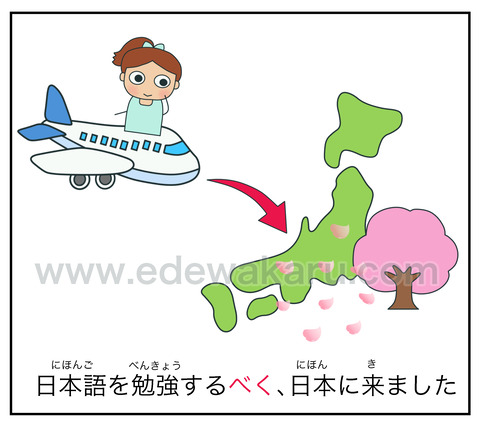
Meaning
in order to do ~
How to use it
Verb [dictionary form] + べく
Explanation
「〜べく」 is a grammatical pattern that expresses purpose, as in “in order to ~.” When using 「する」, there are two forms: 「するべく」 and 「すべく」.
😮
[Examples]
⭕️勉強を
する
べく、日本に来ました
⭕️勉強を
すべく、日本に来ました
This is a very formal way of speaking, so 「〜ために」 is generally used in conversations with family and friends. 😀
[Grammar patterns with 「べき」]
〜べからず・〜べからざる
〜べきだ
〜べきだった・〜べきではなかった
〜べく
〜べくして
〜べくもない
〜べし
In context 3 examples
日本語を勉強するべく、日本に来ました
→日本語を勉強するために、日本に来ましたI came to Japan in order to study Japanese. →I came to Japan to study Japanese.
車を買うべく、貯金をしている
→車を買うために、貯金をしているI’m saving money in order to buy a car. →I’m saving money to buy a car.
優勝するべく、毎日がんばって練習している
→優勝するために、毎日がんばって練習しているI’m practicing hard every day in order to win. →I’m practicing hard every day to win.
Read the original source text
Meaning
〜するために
How to use it
動詞[辞書形]+べく
Explanation
「〜べく」は「〜ために」というように、目的を表す文型です。また、
「する」を使う場合は「するべく」「すべく」というように2つの形があります
😮
[例]
⭕️勉強を
する
べく、日本に来ました
⭕️勉強を
すべく、日本に来ました
とてもかたい言い方ですので、家族や友達との会話では「〜ために」を使うのが一般的です😀
【「べき」がつく文型】
〜べからず・〜べからざる
〜べきだ
〜べきだった・〜べきではなかった
〜べく
〜べくして
〜べくもない
〜べし
日本語文型辞典 英語版
Meaning
【べく】[V-るべく]The verb stem of an auxiliary verb べし that is used in classical written language. It is used in modern Japanese as an expression that is formal and is in the style of written language.
Means “in order to do ...” or “so that ... can be done.”
(3)
is asking for an appropriate action to be taken. Used in formal expressions in the style of written language.
Means something has happened as it has been anticipated as a matter of course when the verb is repeated.
(1)
means that people had been worried that an accident might take place and indeed, an accident did happen.
(2)
means that it is no wonder he won because he had worked for it so hard, and it is not because of luck or coincidence.
A formal expression in the style of written language.
Means that something is not achievable, cannot be done, or something cannot happen. It is a formal expression in the style of written language, and it is not used very often in modern Japanese.
How to use it
1. ...べくV-た
2. V...べくしてV-た
3. ...べくもない
In context 8 examples
大学に進むべく上京した。
They went to Tokyo in order to go to university.
速やかに解決すべく努力致します。
We will do our best to resolve the issue promptly.
しかるべく処置されたい。
Please deal with the matter appropriately.
この機械の危険性は以前から何度も指摘されていた。この事故は起こるべくして起こったといえる。
The danger of this machinery has been pointed out on numerous occasions. It could be said that this accident was waiting to happen.
彼が勝ったのは偶然ではない。練習につぐ練習を重ねて、彼は勝つべくして勝ったのだ。
His victory was not coincidental. Practice after practice brought about his well-deserved victory.
多勢に無勢では勝つべくもない。
Being so outnumbered by our opponents, we have no chance of winning.
優勝は望むべくもない。
There is no hope of coming in first.
突然の母の死を、遠く海外にいた彼は知るべくもなかった。
Being so far away overseas, there was no way for him to learn of his mother’s sudden death.
Read the original source text
Meaning
【べく】[V-るべく]The verb stem of an auxiliary verb べし that is used in classical written language. It is used in modern Japanese as an expression that is formal and is in the style of written language.
Means “in order to do ...” or “so that ... can be done.”
(3)
is asking for an appropriate action to be taken. Used in formal expressions in the style of written language.
Means something has happened as it has been anticipated as a matter of course when the verb is repeated.
(1)
means that people had been worried that an accident might take place and indeed, an accident did happen.
(2)
means that it is no wonder he won because he had worked for it so hard, and it is not because of luck or coincidence.
A formal expression in the style of written language.
Means that something is not achievable, cannot be done, or something cannot happen. It is a formal expression in the style of written language, and it is not used very often in modern Japanese.
How to use it
1. ...べくV-た
2. V...べくしてV-た
3. ...べくもない
日本語NET JLPT文法解説まとめ
Meaning
“Intending to ~ / in order to ~”
Used to say that one does something with a purpose or strong intention.
How to use it
V (dictionary form) + べく
※「する」 may also be expressed as 「すべく」.
Explanation
“In order to”
It is used when you want to express a purpose or strong intention to do something.
① A request, command, or statement urging the other person to act does not follow it.
② This is a formal expression.
① There are no requests, commands, or persuasive statements following.
② This is a formal expression.
In context 6 examples
人手不足という問題を解決すべく、 社内で緊急会議が開かれた。
An emergency meeting was held within the company in order to solve the labor shortage.
今年度の売上目標を達成すべく、社員一同さらに気を引き締め、業務に取り組む必要がある。
In order to meet this fiscal year's sales target, all employees need to buckle down further and work diligently.
子供の野菜嫌いを克服すべく、色々な調理法を試しているところだ。
We're trying out various cooking methods to help children overcome their dislike of vegetables.
花見の場所を確保すべく、若手社員が早朝に公園へ向かった。
Young employees headed to the park early in the morning to secure a spot for cherry blossom viewing.
優秀な若手社員を確保すべく、当社はインターンシップ制度を導入した。
Our company introduced an internship program in order to recruit talented young employees.
社員の幸せを優先すべく、当社は男性でも育児休暇制度を積極的に取れるようになっている。
To prioritize employee well-being, our company enables men as well to actively take childcare leave.
Read the original source text
Meaning
"〜しようと思って / 〜ために"
目的や強い意志があって〜すると言いたい時に使う。
How to use it
V(辞書形)+ べく
※「する」は「すべく」という言い方もある。
Explanation
"in order to"
It is used when you want to express a purpose or strong intention to do something.
①後ろに依頼文、命令文、相手に働きかける文は来ない
②硬い表現
① There are no requests, commands, or persuasive statements following.
② This is a formal expression.
毎日のんびり日本語教師
Meaning
in order to ~
How to use it
Verb dictionary form + べく
Explanation
Expresses purpose. It can be rephrased as 「~ために」, but expresses a stronger will than 「~ために」. It is a stiff expression used in writing.
Note that する becomes 「すべく」 or 「するべく」.
Notes
Similar grammar: “【N1 Grammar】~ことのないよう(に)/ことがないよう(に)”
Similar grammar: “【N1 Grammar】~んがために/んがための”
In context 8 examples
食わず嫌いを克服すべく、食材を細かく切って調理してみる。
To overcome my picky eating, I’ll try preparing the ingredients by chopping them finely.
文章を書くのが苦手なので、それを克服すべく、短い文から少しずつ書いてみようと思う。
I’m not good at writing, so to overcome that, I think I’ll try writing little by little, starting with short sentences.
つまらない日々を打開すべく何かを本気で始めようと思う。
I’m thinking of seriously starting something to break out of these boring days.
ぐっすり寝るべく、早めにベッドに入った。
I went to bed early so I could get a good night’s sleep.
社長になるべく、資金と人材の確保に尽力している。
I’m working hard to secure funds and personnel so I can become company president.
試合で勝つべく、毎日の練習を怠らない。
I never neglect my daily practice so that I can win the match.
不慮の事故を防止すべく、設備の安全に留意する。
We take care to ensure the safety of the equipment in order to prevent unforeseen accidents.
全力を出すべく、ご飯をたらふく食べた。
I ate my fill so I could give it my all.
Read the original source text
Meaning
~するために
How to use it
動辞形+べく
Explanation
目的を表します。「~ために」に言い換えることができますが、「~ために」よりも強い意志が表れます。書き言葉で硬い表現です。
「する」は「すべく」か「するべく」になる点に注意してください。
Notes
似ている文法「【N1文法】~ことのないよう(に)/ことがないよう(に)」
似ている文法「【N1文法】~んがために/んがための」
NINJAL 日本語文型データベース
Meaning
Indicates the purpose of an action.
How to use it
Vるべく (「する」 may also take the form 「すべく」)
Notes
The subject of the sentence with 「〜」 and the sentence after 「〜べく」 is the same.
Both 「〜」 and the sentence after 「〜べく」 take verbs expressing intentional actions.
In context 5 examples
由美は声優になりたいという子どもの頃からの夢をかなえるべく、専門学校に入学した。
Yumi enrolled in a vocational school to fulfill her childhood dream of becoming a voice actor.
当社はお客様のあらゆるニーズにお応えするべく、多様な商品の提供に努めております。
Our company strives to offer a wide variety of products in order to meet all of our customers’ needs.
友人の失踪事件の真相を探るべく東京へ向かった山田は、謎の女性に出会う。
Yamada, who headed to Tokyo to uncover the truth behind his friend’s disappearance, meets a mysterious woman.
政府は外交問題を解決すべく、関係諸国に対して首脳会議を提案した。
The government proposed a summit meeting to the countries concerned in order to resolve the diplomatic issue.
与党はこの法案を通常国会で成立させるべく、急ピッチで審議を進める構えだ。
The ruling party plans to speed up deliberations so that this bill can be passed during the regular session of the Diet.
Read the original source text
Meaning
ある行為の目的を表します。
How to use it
Vるべく(「する」→「すべく」の形になることもある)
Notes
「〜」の文と「〜べく」の後の文の主語は同じです。
「〜」にも「〜べく」の後にも、意志的な行為を表す動詞の文がきます。