AIUEO JLPT Grammar
Meaning
「〜てみる」is used to express trying an action to see what happens, typically when doing something for the first time.
How to use it
Verb て-form + みる
In context 5 examples
新しいゲームをやってみよう。
Let’s try playing the new game.
この問題を解いてみてください。
Please try solving this problem.
このアプリを試してみましたか?
Did you try this app?
新しい方法を試してみる価値があります。
It is worth trying a new method.
新しい政策を導入してみたが、結果はまだ分からない。
We tried introducing new policies, but the results are still unknown.
Read the original source text
Meaning
「〜てみる」is used to express trying an action to see what happens, typically when doing something for the first time.
How to use it
動詞て形+みる
Explanation · 日本語
「〜てみる」は、試しにある行動をすることを表す表現で、初めてのことを試みるときに使われます。
文法
Meaning
To try something in practice and check by doing it, because you don't know whether it's good or not.
How to use it
V (て-form) + みる
Connects to volitional verbs.
In context 8 examples
似合うかどうかわからないので、履いてみます。
I don't know if it will suit me, so I'll try it on.
サイズが合うかどうかわからないので、着てみます。
I don't know if the size will fit, so I'll try it on.
美味しいかどうかわからないので、試しに食べてみます。
I don't know if it's tasty, so I'll try some.
もしお金がたくさんあったら、何をしてみたいですか。
If you had a lot of money, what would you like to try doing?
日本に行ったら、相撲を見てみたいです。
If I go to Japan, I'd like to try watching sumo.
一度でいいから海が綺麗な南の島でのんびり過ごしてみたいなぁ。
Just once would be enough; I'd love to relax on a beautiful southern island.
京都に行ったら、着物を着てみたいです。
If I go to Kyoto, I'd like to try wearing a kimono.
大人になったら、世界一周旅行をしてみたいです。
When I grow up, I'd like to try traveling around the world.
Read the original source text
Meaning
いいかどうかわからないので実際に行動して確かめる
How to use it
V(て形)+ みる
意志動詞と接続する。
Bunpro Grammar Reference
Meaning
To try to
How to use it
Verb[て]+ みる
Verb[て]+ みます
Nuance
A common way to express that (A) will be attempted. To do (A) and see how it goes.
Explanation
In order to express that you will (or someone else should) try something, the conjunction particle て will be paired with 見る (almost always without kanji). While this is translated as 'to try to (A)', the actual meaning is closer to 'to do (A), and see (whether the result is good or not)'.
This grammar construction is usually only used when someone tries something for the first time.
本当においしいの?今度食べてみるよ!
Is it really delicious? Next time I'll try it!
これ飲んでみる?
Do you want to try this drink?
As mentioned above, this phrase is also used when suggesting that someone else should try something. In these situations, (A) + てみて, or more formally, (A) + てみてください will be used.
だまされたと思って食べてみてよ。
Try and eat it as if I tricked you into eating it. (Believe it or not, this tastes good)
もう一度電源を切ってみてください。
Please try to turn it off once more.
Sometimes, in very casual requests, even the て of みて will be dropped, and (A) + てみ will be used by itself. This usually has the nuance of 'come on, just give it a go!'
このボール投げてみ。
Try and throw this ball.
Caution
When てみた appears in the past tense, it will imply that the attempt was successful, unless specifically stated otherwise by the speaker.
あの新しいショッピングモールに行ってみたよ!すごい良かった!
I tried going to that new shopping mall! It was so good!
タケルにもらった靴を履いてみたけど、俺の足がデカすぎるから入らなかった。
I tried to wear the shoes that Takeru gave me, but my feet were too big so they didn't fit.
Fun Fact
While the kanji for 見る may be used in this grammar point, it will result in the 'see' meaning being heavily stressed (rather than 'try'). This may cause a misunderstanding on the part of the person listening/reading.
In context 20 examples
- イルカと泳いでみたいです。
I want to try swimming with dolphins.
- 本当においしいの?今度食べてみるよ!
Is it really delicious? Next time I'll try it!
- だまされたと思って食べてみてよ。
Try and eat it as if I tricked you into eating it. (Believe it or not, this tastes good)
- これ飲んでみる?
Do you want to try this drink?
- もう一度電源を切ってみてください。
Please try to turn it off once more.
- このボール投げてみ。
Try and throw this ball.
- まず、食べてみてください。
First, please try to eat it.
- 柔道をしてみたいです。
I want to try to do Judo.
- 図書館で、調べてみるつもりです。
I intend to try to look it up at the library.
- 先週末、スキーをしてみた。
I tried skiing last weekend.
- 今年の夏は、海で泳いでみたいんです。
I want to try to swim in the ocean this summer.
- これを消してみてください。
Please try to erase this.
- このコーラを飲んでみます。
I will try to drink this cola.
- あの赤い靴を履いてみたい。
I want to try on those red shoes.
- 来週の金曜日は仕事に電車で行ってみます。
On Friday of next week, I will try to go to work by train.
- 今夜はフランス料理を作ってみます。
Tonight I will try to make French cuisine.
- 明日から、フランス語を学んでみるつもりです。
From tomorrow, I intend to try learning French. (Try to learn)
- 今週末に野球をしてみる。
I will try playing baseball this weekend.
- あの新しいショッピングモールに行ってみたよ!すごい良かった!
I tried going to that new shopping mall! It was so good!
- タケルにもらった靴を履いてみたけど、俺の足がデカすぎるから入らなかった。
I tried to wear the shoes that Takeru gave me, but my feet were too big so they didn't fit.
Read the original source text
Meaning
To try to
How to use it
Verb[て]+ みる
Verb[て]+ みます
Nuance
A common way to express that (A) will be attempted. To do (A) and see how it goes.
Explanation
In order to express that you will (or someone else should) try something, the conjunction particle て will be paired with 見る (almost always without kanji). While this is translated as 'to try to (A)', the actual meaning is closer to 'to do (A), and see (whether the result is good or not)'.
This grammar construction is usually only used when someone tries something for the first time.
本当においしいの?今度食べてみるよ!
Is it really delicious? Next time I'll try it!
これ飲んでみる?
Do you want to try this drink?
As mentioned above, this phrase is also used when suggesting that someone else should try something. In these situations, (A) + てみて, or more formally, (A) + てみてください will be used.
だまされたと思って食べてみてよ。
Try and eat it as if I tricked you into eating it. (Believe it or not, this tastes good)
もう一度電源を切ってみてください。
Please try to turn it off once more.
Sometimes, in very casual requests, even the て of みて will be dropped, and (A) + てみ will be used by itself. This usually has the nuance of 'come on, just give it a go!'
このボール投げてみ。
Try and throw this ball.
Caution
When てみた appears in the past tense, it will imply that the attempt was successful, unless specifically stated otherwise by the speaker.
あの新しいショッピングモールに行ってみたよ!すごい良かった!
I tried going to that new shopping mall! It was so good!
タケルにもらった靴を履いてみたけど、俺の足がデカすぎるから入らなかった。
I tried to wear the shoes that Takeru gave me, but my feet were too big so they didn't fit.
Fun Fact
While the kanji for 見る may be used in this grammar point, it will result in the 'see' meaning being heavily stressed (rather than 'try'). This may cause a misunderstanding on the part of the person listening/reading.
Nuance · 日本語
(A)が試させられると言いたい時によく使われる表現。(A)をしてどうなるか見ること。
どんなときどう使う 日本語表現文型辞典
Meaning
try doing
How to use it
Vて + みる
Explanation
B:日光ですか。いいですね。ぜひ1度行ってみたいと思っていたんです。
店員:はい、こちらでどうぞ。
B:それは残念ですね。
何かを知るために、試しにすることを表す。意志動詞につく。
Try something in order to find out more about it. Follows volitional verbs.
In context 4 examples
この新しいボールペンを使ってみました。とても書きやすいですよ。
I tried using this new ballpoint pen. It’s really easy to write with.
A:休みの日に日光へ行きませんか。
A: Would you like to go to Nikko on a day off?
(デパートで)客:ちょっとこのスカートをはいてみてもいいですか。
(At a department store) Customer: Could I try on this skirt?
A:コンサートの切符がまだあるか聞いてみましたが、もうないそうです。
A: I tried asking whether there were still concert tickets, but apparently they’re all gone.
Read the original source text
Meaning
try doing
How to use it
Vて+みる
Explanation
B:日光ですか。いいですね。ぜひ1度行ってみたいと思っていたんです。
店員:はい、こちらでどうぞ。
B:それは残念ですね。
何かを知るために、試しにすることを表す。意志動詞につく。
Try something in order to find out more about it. Follows volitional verbs.
絵でわかる日本語
Meaning
to try whether ~ or not
to do ~ in order to judge whether it is good or bad
How to use it
ためしに + verb [て-form] + てみる
Explanation
“ためしに〜てみる” is a sentence pattern meaning “to try whether ~ or not.” It is used when you want to say “to do ~ in order to judge whether it is good or bad.” 😊
[Example]
I tried buying bread from that place
as a test.
→ I bought it in order to judge whether the bread from that place was “tasty”
or “not tasty.”
Also, remember that “ためしに〜てみる” is written in kanji as “試しに〜てみる.” 😀
[For those who want to learn more]
The imperative form of “〜てみる” is “〜てみなさい.”
In addition to “ためしに〜てみる,” “ためしに〜てみなさい” and “ためしに〜てごらん” are also often used, so it may be good to learn them together 😉
(Review: 〜てごらん)
[Examples]
Try taking the Japanese-Language Proficiency Test as a trial.
Give taking the Japanese-Language Proficiency Test a try.
[For intermediate to advanced learners]
As in the example above, the form “ためしに〜てみよう” is often used. Once you can use “ためしに〜てみよう” well, try using the form
“ためしに + ようかな.” 😀
(Review: 〜ようか・〜ようかな・〜ようかしら)
[Examples]
Let’s try taking the Japanese-Language Proficiency Test.
I wonder if I should try taking the Japanese-Language Proficiency Test.
N4 sentence patterns are also used frequently in conversation, so review them 😊
In context 3 examples
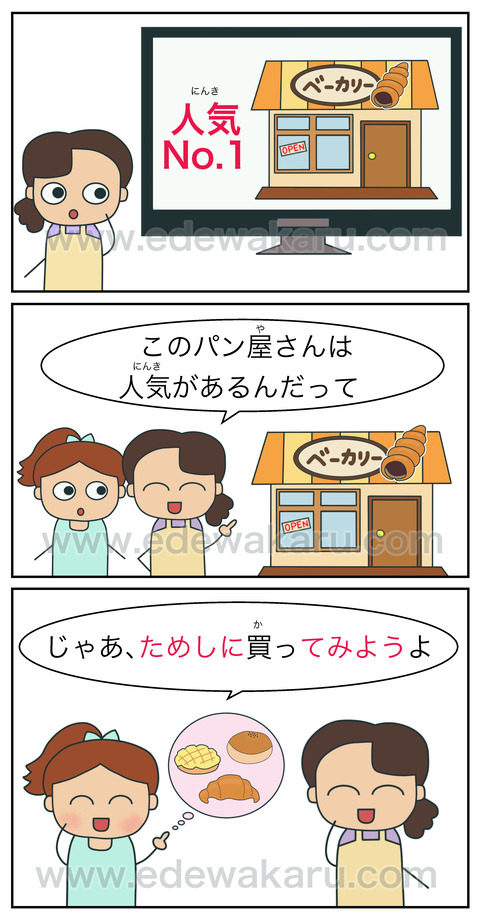
A:このパン屋さんは人気があるんだって!B:じゃあ、ためしに買ってみようよ
→おいしいかどうか判断するために買おうよ(復習:〜って(伝聞))A: I hear this bakery is popular! B: Then let’s try buying something. → Let’s buy some to see if it’s tasty. (Review: 〜って (hearsay))
今年は、ためしに日本語能力試験(にほんごのうりょくしけん)を受けてみよう
→今年は、能力試験に合格するかどうかためしてみよう(復習:テストをする・テストを受ける)This year, let’s try taking the Japanese-Language Proficiency Test. → This year, let’s see whether I can pass the proficiency test. (Review: taking a test vs sitting for a test)
クッキーを焼いたから、ためしに食べてみて
→クッキーを焼いたから、おいしいかどうかためしてI baked cookies, so try one. → I baked cookies, so try them to see if they’re tasty.
Read the original source text
Meaning
〜かどうか試す
いいか悪いか判断するために〜する
How to use it
ためしに+動詞[て形]+てみる
Explanation
「ためしに〜てみる」は「〜かどうかをためす」という意味を表す文型です。「いいか悪いかなどを判断するために〜する」と言いたい時に使います😊
[例]
あそこのパンを
ためしに
買っ
てみた
→あそこのパンは「おいしい」
か
「おいしくない」
かを判断するために
買った
また、「ためしに〜てみる」は漢字で書くと
「試しに〜てみる」
と書くと覚えておきましょう😀
【余裕のある人へ】
「〜てみる」の命令形は「〜てみなさい」です。
「ためしに〜てみる」以外に「ためしに〜てみなさい」「ためしに〜てごらん」もよく使われます
ので、一緒に覚えておくといいと思います😉
(復習:〜てごらん)
[例]
日本語能力試験をためしに受けてみなさい
日本語能力試験をためしに受けてごらん
【中級〜上級レベルの人へ】
「ためしに〜てみる」は上の例文でもあげたように「ためしに〜てみよう」の形がよく使われます。「ためしに〜てみよう」が上手に使えるようになった人は、
「ためしに+ようかな」
の形も使ってみましょう😀
(復習:〜ようか・〜ようかな・〜ようかしら)
[例]
ためしに日本語能力試験を受けてみよう
ためしに日本語能力試験を受けてみようかな
N4の文型は、会話でもよく使われますので復習しておきましょう😊
日本語文型辞典
Meaning
Indicates actually performing an action in order to find out what something is like or what a place is like. It is not used if one intended to try but did not actually perform the action. For example, “I tried to meet them, but couldn’t” would be incorrect; say “I tried to meet them, but couldn’t” using a form such as “会おうとしたが会えなかった.”
Means “only after reaching that state.” Here “みて” does not mean intentionally “try it out,” but rather “a certain state arises.”
Expresses a cue for discovery. The cue may be intentional or unintentional. When intentional, it means “I tried it, and as a result, found this out.” As in ⑦ and ⑧, when unintentional, it means “I found out upon reaching that situation.” Omitting “みる” leaves roughly the same meaning, but forms such as “読んでみると” and “振り返ってみると” are commonly used idiomatically.
a. V-てみたら
Expresses a cue for discovery.
b. V-てみたらどう
Expresses a recommendation to try something.
Usually used in the form “てもみなかった” to emphasize that someone did not do something. The verbs used are limited. “思ってもみなかった” is a common idiomatic expression meaning “I never expected it at all,” used after a situation has actually occurred.
A somewhat emphatic form of “V-ないで.” It is often used in expressions of criticism.
⇾にしてみれば
How to use it
V-てみる
V-てみてはじめて
V-てみると
V-てみたら
V-てもみない
V-てもみないで
Nにしてみれば
In context 32 examples
一度そのめずらしい料理が食べてみたい。
I’d like to try that unusual dish sometime.
先日最近話題になっている店へ行ってみました。
The other day, I went to a shop that has been in the news recently.
ズボンのすそを直したので、ちょっとはいてみてください。
I had the hems of my trousers altered, so please try them on.
電話番号は電話局へ問い合わせてみたのですが、わかりませんでした。
I tried inquiring with the telephone company about the phone number, but they couldn’t tell me.
パンダはまだ見たことがない。一度見てみたいと思っている。
I’ve never seen a panda. I’d like to see one sometime.
電車をやめて、自転車通勤をしてみることにした。
I decided to stop taking the train and try commuting by bicycle.
どの車を買うか決める前に、車に詳しい人の意見を聞いてみようと思っています。
Before deciding which car to buy, I’m thinking of asking someone who knows a lot about cars.
病気になってみてはじめて健康の大切さが身にしみた。
Only after I got sick did I truly appreciate the importance of good health.
親に死なれてみてはじめてありがたさがわかった。
Only after my parent died did I realize how grateful I was to them.
彼がやめてみてはじめて、この会社にとって重要な人物だったということがわかった。
Only after he quit did I realize that he had been an important person to this company.
表にして比べてみると、両者は実際にはあまり違いがないということがわかる。
When you put them in a table and compare them, you can see that the two are not actually very different.
そのルポルタージュをよく読んでみると、作者はその場所へは実際に行ったことがないとわかった。
When I read the report carefully, I learned that the author had never actually been to that place.
今振り返ってみると、5年前の会社設立当時が自分の人生の中で最も大変だったと思う。
Looking back now, I think the time when we founded the company five years ago was the hardest period of my life.
もう一度考えてみると、この批評はある程度当たっていないこともない。
Thinking about it once more, this criticism is not entirely off the mark.
仕事をやめてみると、急に生活の空間が広がったような気がした。
When I quit my job, I suddenly felt as if my life had opened up.
生のイカなんて、みかけは気持ちが悪かったが、食べてみると、意外においしかった。
Raw squid looked disgusting, but when I tried it, it was surprisingly delicious.
A:意地悪に見えるけど、彼は本当は好意でそう言ったんじゃないんですか。
B:そう言われてみると、そんな気もします。A: He seems mean, but don’t you think he said that out of kindness? B: Now that you mention it, I think you may be right.
一夜明けてみると、大木がなぎ倒されていた。
When morning came, I saw that a large tree had been knocked down.
電話でたずねてみたら、もう切符は売り切れたと言われた。
When I called to ask, I was told that the tickets had already sold out.
きらいなうなぎを思い切って食べてみたら、おいしいので驚いた。
I worked up the courage to try eating eel, which I dislike, and was surprised that it was delicious.
新聞に広告を出してみたら、予想以上の反響があった。
When I tried placing an ad in the newspaper, the response was greater than expected.
A:山下さんは全然わかってくれません。
B:もう一度会って話してみたらどうですか。A: Mr. Yamashita never understands me at all. B: Why don’t you meet him and try talking to him one more time?
結果をまとめる前にもうすこしデータを増やしてみたらどうですか。
Why don’t you try increasing the data a little more before compiling the results?
ひとりで考えていないで、専門家に相談してみたらどうですか。
Instead of thinking it over by yourself, why don’t you try consulting a specialist?
この作品がコンクールに入選するなんて考えてもみなかった。
I never even imagined that this work would be selected for the competition.
できないと思い込んでいたので、試してもみなかった。
I was convinced I couldn’t do it, so I never even tried.
はじめから断られると思っていたので、言ってもみなかった。
I thought they would turn me down from the start, so I never even asked.
彼女と結婚することになるとは思ってもみなかった。
I never even imagined that I would end up marrying her.
あの人にもう一度会えるなんて思ってもみなかった。
I never even imagined I’d be able to see that person again.
始める前は、こんなに大変な仕事だとは思ってもみなかった。
Before I started, I never imagined this job would be so demanding.
本を読んでもみないで、何が書いてあったかどうしてわかるだろう。
How could you possibly know what was written in the book without even reading it?
食べてもみないで、文句を言うのはやめてください。
Please stop complaining without even trying it.
Read the original source text
Meaning
どんなものか、どんな所かといったことを知るために、実際に行為をすることを示す。試みる意志があっても実際に行為をしていない場合は、使わない。たとえば、「会ってみたが会えなかった」のような使い方は誤用となる。この場合は、「会おうとしたが会えなかった」のようにする。
「そういう状態になってはじめて」の意味。この「みて」は、意志的な「ためしにする」という意味ではなく、「ある状態が生じる」という意味。
発見のきっかけを表す。きっかけには意志的なものとそうでないものがある。意志のある場合は、「試行して、その結果、こういうことがわかる」の意味。また、⑦⑧のように、意志がない場合は、「そのような状況になって、発見した」という意味。「みる」をつけなくても、だいたい同じ意味になるが、「読んでみると」「振り返ってみると」などは慣用的によく使う。
a. V-てみたら
発見のきっかけを表す。
b. V-てみたらどう
ためしにするように薦めることを表す。
多くは、「てもみなかった」の形で、そうしなかったということを強めるのに用いる。使う動詞は限られている。「思ってもみなかった」は慣用的によく使う表現で、実際にある状態になってから、「全く予想しなかった」という意味で用いる。
「V-ないで」のやや強調した表現。非難の表現に使うことが多い。
⇾にしてみれば
How to use it
V-てみる
V-てみてはじめて
V-てみると
V-てみたら
V-てもみない
V-てもみないで
Nにしてみれば
日本語文型辞典 英語版
Meaning
Indicates taking concrete action in order to find out more about a certain thing, place, etc. Not used when someone has the intention to try doing something but doesn’t actually carry out the action. For example, the sentence 会ってみたが会えなかった (I tried to meet her but couldn’t) would be a mistake. The correct statement in such a case would be 会おうとしたが会えなかった.
Means “for the first time after a certain situation came about.” みて in this expression does not mean “give something a try” but “a certain situation arises.”
B:そう言われてみると、そんな気もします。
When you put it that way, I think that might be true.
Expresses the triggering of a discovery. The trigger may or may not be an intentional action. When it is intentional, the meaning is “I attempted such-and-such, and as a result, this is what I learned.” As in
(7)
and
(8)
, when there is no intention, the meaning is “when a certain condition arose, something was discovered.” Even if the word みる is omitted, the meaning remains essentially the same, but expressions like 読んでみると and 振り返ってみると are commonly-used idiomatic expressions.
Expresses the triggering of a discovery.
b. V-てみたらどう
B:もう一度会って話してみたらどうですか。
What if you try to meet with him and talk it over one more time?
Used to recommend that someone try to do something.
Often used in the form てもみなかった to emphasize that something was not done. There is a limited set of verbs that can be used with this form. 思ってもみなかった is an idiomatic expression that is commonly used after a certain situation has actually arisen to convey the meaning “this was completely unexpected.”
A slightly more emphatic way to say V-ないで. Often used to express criticism.
How to use it
1. V-てみる
2. V-てみてはじめて
3. V-てみると
4. V-てみたらa. V-てみたら
5. V-てもみない
6. V-てもみないで
7. Nにしてみれば→
In context 32 examples
一度そのめずらしい料理が食べてみたい。
I’d like to try that unusual dish just once.
先日最近話題になっている店へ行ってみました。
The other day, I went to see that shop everyone’s been talking about.
ズボンのすそを直したので、ちょっとはいてみてください。
I’ve adjusted the hem of these pants, so please just try them on.
電話番号は電話局へ問い合わせてみたのですが、わかりませんでした。
I tried contacting the telephone company to ask for the number, but they couldn’t tell me.
パンダはまだ見たことがない。一度見てみたいと思っている。
I’ve never seen a panda. It would be nice to see one someday.
電車をやめて、自転車通勤をしてみることにした。
I decided to stop taking the train and try commuting by bicycle.
どの車を買うか決める前に、車に詳しい人の意見を聞いてみようと思っています。
Before I decide what kind of car to buy, I’m thinking of asking the opinion of someone who knows a lot about cars.
病気になってみてはじめて健康の大切さが身にしみた。
It wasn’t until I became ill that I keenly felt the importance of good health.
親に死なれてみてはじめてありがたさがわかった。
I never knew what my parents meant to me until I lost them.
彼がやめてみてはじめて、この会社にとって重要な人物だったということがわかった。
It was only after he quit that we realized how important he had been to this company.
表にして比べてみると、両者は実際にはあまり違いがないということがわかる。
If you make a table and compare them, you can see that there actually isn’t much difference between the two.
そのルポルタージュをよく読んでみると、作者はその場所へは実際に行ったことがないとわかった。
When I read that reportage carefully, I realized that the author has never actually been to that location.
今振り返ってみると、5年前の会社設立当時が自分の人生の中で最も大変だったと思う。
Now that I look back, I think the hardest time of my life was when I first established this company five years ago.
もう一度考えてみると、この批評はある程度当たっていないこともない。
If I think about it again, this criticism isn’t completely groundless.
仕事をやめてみると、急に生活の空間が広がったような気がした。
When I quit my job, I felt as if my whole life had suddenly broadened.
生のイカなんて、みかけは気持ちが悪かったが、食べてみると、意外においしかった。
You know raw squid—well, it looked revolting, but when I tried eating it, it was surprisingly good.
A:意地悪に見えるけど、彼は本当は好意でそう言ったんじゃないんですか。
It seems like he was being mean, but didn’t he really say that with good intentions?
一夜明けてみると、大木がなぎ倒されていた。
The next morning, the huge tree had been toppled.
電話でたずねてみたら、もう切符は売り切れたと言われた。
When I called and asked, I found that the tickets had already been sold out.
きらいなうなぎを思い切って食べてみたらおいしいので驚いた。
When I took the plunge and tried eating eel, which I didn’t like, I was surprised at how good it was.
新聞に広告を出してみたら、予想以上の反響があった。
There was a much greater response than expected when they tried advertising in the newspaper.
A:山下さんは全然わかってくれません。
Yamashita-san doesn’t understand at all.
結果をまとめる前にもうすこしデータを増やしてみたらどうですか。
Before you summarize your results, why don’t you try to gather a little more data?
ひとりで考えていないで、専門家に相談してみたらどうですか。
Don’t just mull it over all by yourself—how about consulting a specialist?
この作品がコンクールに入選するなんて考えてもみなかった。
I never thought this piece would be selected for the contest.
できないと思い込んでいたので、試してもみなかった。
I was sure I couldn’t do it, so I didn’t even try.
はじめから断られると思っていたので、言ってもみなかった。
From the outset I thought I would get turned down, so I never said anything.
彼女と結婚することになるとは思ってもみなかった。
I never imagined that I would end up marrying her.
あの人にもう一度会えるなんて思ってもみなかった。
I never thought I would get to see that person once more.
始める前は、こんなに大変な仕事だとは思ってもみなかった。
Before I started, I never believed this would be such hard work.
本を読んでもみないで、何が書いてあったかどうしてわかるだろう。
If you don’t even try reading the book, how can you know what it said?
食べてもみないで、文句を言うのはやめてください。
Please stop complaining, when you haven’t even tried eating it.
Read the original source text
Meaning
Indicates taking concrete action in order to find out more about a certain thing, place, etc. Not used when someone has the intention to try doing something but doesn’t actually carry out the action. For example, the sentence 会ってみたが会えなかった (I tried to meet her but couldn’t) would be a mistake. The correct statement in such a case would be 会おうとしたが会えなかった.
Means “for the first time after a certain situation came about.” みて in this expression does not mean “give something a try” but “a certain situation arises.”
B:そう言われてみると、そんな気もします。
When you put it that way, I think that might be true.
Expresses the triggering of a discovery. The trigger may or may not be an intentional action. When it is intentional, the meaning is “I attempted such-and-such, and as a result, this is what I learned.” As in
(7)
and
(8)
, when there is no intention, the meaning is “when a certain condition arose, something was discovered.” Even if the word みる is omitted, the meaning remains essentially the same, but expressions like 読んでみると and 振り返ってみると are commonly-used idiomatic expressions.
Expresses the triggering of a discovery.
b. V-てみたらどう
B:もう一度会って話してみたらどうですか。
What if you try to meet with him and talk it over one more time?
Used to recommend that someone try to do something.
Often used in the form てもみなかった to emphasize that something was not done. There is a limited set of verbs that can be used with this form. 思ってもみなかった is an idiomatic expression that is commonly used after a certain situation has actually arisen to convey the meaning “this was completely unexpected.”
A slightly more emphatic way to say V-ないで. Often used to express criticism.
How to use it
1. V-てみる
2. V-てみてはじめて
3. V-てみると
4. V-てみたらa. V-てみたら
5. V-てもみない
6. V-てもみないで
7. Nにしてみれば→
日本語NET JLPT文法解説まとめ
Meaning
To try something in practice and check by doing it, because you don't know whether it's good or not.
How to use it
V (て-form) + みる
Connects to volitional verbs.
Explanation
try doing something
In context 8 examples
似合うかどうかわからないので、履いてみます。
I don't know if it will suit me, so I'll try it on.
サイズが合うかどうかわからないので、着てみます。
I don't know if the size will fit, so I'll try it on.
美味しいかどうかわからないので、試しに食べてみます。
I don't know if it's tasty, so I'll try some.
もしお金がたくさんあったら、何をしてみたいですか。
If you had a lot of money, what would you like to try doing?
日本に行ったら、相撲を見てみたいです。
If I go to Japan, I'd like to try watching sumo.
一度でいいから海が綺麗な南の島でのんびり過ごしてみたいなぁ。
Just once would be enough; I'd love to relax on a beautiful southern island.
京都に行ったら、着物を着てみたいです。
If I go to Kyoto, I'd like to try wearing a kimono.
大人になったら、世界一周旅行をしてみたいです。
When I grow up, I'd like to try traveling around the world.
Read the original source text
Meaning
いいかどうかわからないので実際に行動して確かめる
How to use it
V(て形)+ みる
意志動詞と接続する。
Explanation
try doing something
毎日のんびり日本語教師
How to use it
Verb in て-form + みる
Explanation
Expresses trying something out in order to understand or check something.
Notes
The “~てみる” series
In context 8 examples
死ぬまでに一度は本場の中華料理を食べてみたい。(在死之前我都想尝一次地道的中国菜。)
Before I die, I’d like to try authentic Chinese cuisine at least once.
一度やってみたらどうですか?
Why don’t you try doing it once?
この服着てみてもいいですか。
May I try on these clothes?
今日は満月らしいから外を見てみよう。
Apparently there’s a full moon tonight, so let’s take a look outside.
新学期始まるから髪を染めてみた。
Since the new term is starting, I tried dyeing my hair.
時間があれば見てみてください。
If you have time, please take a look.
とりあえず様子を見てみて、それから決めようと思う。
For now, I think I’ll see how things go and then decide.
いつも近くを散歩してる野良猫にご飯をあげてみた。
I tried giving food to the stray cat I often see around here.
Read the original source text
How to use it
動て形+みる
Explanation
ある物事のことを理解・確認するため、試しに行うことを表します。
Notes
「~てみる」シリーズ
NINJAL 日本語文型データベース
Meaning
Used when saying that one will try doing ~ as an experiment. Used when doing something one has never experienced before, or when wanting to check the actual state or result of something.
It is often used together with expressions such as “~かどうか” and “(question word)~か.”
How to use it
Vてみる
Notes
“~” takes a verb expressing a volitional action, such as “作る・食べる・する.”
In context 6 examples
「駅前にある『さくら井』っていうラーメン屋、知ってますか。おいしいですよ」「そうですか。今度行ってみます」
“Do you know the ramen shop called Sakurai in front of the station? It’s delicious.” “Oh, really? I’ll try going there next time.”
「この靴、サイズが合うかどうか、ちょっと履いてみてもいいですか」
“Could I try these shoes on to see whether they fit?”
今と昔で、日本の食生活がどのように変わってきたか、調べてみよう。
Let’s look into how Japan’s eating habits have changed from the past to the present.
「先生、うちの犬、おとといから何も食べないんです」「そうですか。ちょっと診てみましょう」
“Doctor, my dog hasn’t eaten anything since the day before yesterday.” “I see. Let me examine it.”
「同じ日本酒なのにそんなに味が違うんですか」「ええ、ぜひ飲み比べてみてください。味の違いがわかりますよ」
“The flavors are that different even though it’s the same sake?” “Yes, please do try comparing them. You’ll notice the difference in taste.”
「部長、企画書を書いてみましたので、ご覧いただけますか」
“Department manager, I’ve tried drafting the proposal. Could you take a look?”
Read the original source text
Meaning
試みとして~の行為を行うと言いたいときに使います。それまで経験がないことをするときや、何かの実態や結果を確かめたいときなどに使います。
「~かどうか」「(疑問詞)~か」などの表現をよく一緒に使います。
How to use it
Vてみる
Notes
「~」には、「作る・食べる・する」など、意志的な行為を表す動詞がきます。
Yokubi — The Common Grammar Guide (https://yoku.bi)
Explanation
The てみる auxiliary originates from the verb 見る, and can provide some insight on how to remember what it means. It roughly means "try to do something (and see how it goes)". However, when it is used with this meaning, it should never be written in kanji.
てみる indicates that the action is "tried" or being done with the intent to see what the outcome of doing so will be.
In the previous lesson, we saw another grammar point that can be translated as "to try to do": ようとする.
In Japanese, these two grammar points are very different, but when translated into English they are often a source of confusion. てみる assumes that the action is going to be done and that what matters is the outcome, while ようとする implies that the hard part (the "attempt") is the action itself. It is often used with the assumption that the subject will not be able to "do" the action in the first place.
Consider the difference between these two sentences:
The first sentence focuses on the fact that the speaker doesn't know how their escape attempt will go, but they want to try and see. The second sentence stops the girl from escaping before she even begins to do so. It implies that she attempted to initiate the act of "escaping" but she was unable to follow through with it.
In context 1 examples
食べてみる
I'll try to eat it (and see how it goes/see if I like it/see if it's poisoned, etc)
IMABI
Trying
Read this IMABI lesson ↗Explanation
Try I: ~てみる・みたい・みせる
The word “try” has a lot of different meanings. When it is translated into Japanese, there are many phrases to consider. The phrases themselves are not difficult to use or understand, but because they all have the same English translation, it may become troublesome to differentiate between them. So, in the next two lessons, we will go through each applicable phrase in great detail so that you properly learn how to express the many “try” phrases of Japanese.
~てみる/~てみたい
As you know already, 見る means “to see.” When it is after the particle て, it means “to try to…” in the sense of doing something for the sake of seeing what happens. There isn’t any negative consequences necessarily implied by using it.
1. 新しいコートを着てみる。
I’ll try a new coat on.
2. よく考えてみる(よ)。
I’ll think it over.
3. カレーライスを食べてみる。
To try to eat curry rice.4. みんなに聞いてみたけど。
I’ve tried asking everyone, but…
5. 一か八かやってみる。
To take a chance/sink or swim.
Reading Note: 八 is read as ばち in the phrase above. Other readings of the entire phrase other than いちかばちか is wrong.
6. たまった宿題を一遍いっぺんに片付けてみよう。
I’m going to try to finish up this piled homework at once.
Grammar Note: In this sentence, ~よう is used to emphasize one’s volition to finish the homework.
~てみたい
~てみたい means “to want to try to…” Again, this “try” is the same “try” as in “trial and error” (試行錯誤). These patterns are not intended to describe “trials” that last longer than an occurrence.
7. 本当に(お)すしを食べてみたいです。
I really want to try sushi.
漢字 Note: Sushi may also be spelled as 寿司, 鮨, or rarely as 鮓.
8. やってみたい。
I want to try.
9. 月見バーガーを食べてみたい。
I want to try a tsukimi burger.
Word Note: It might as well be called egg burger.
10. 誰か一度会ってみたい 人がいますか。
Is there someone you would like to meet once?
11. みんなを笑いの渦うずに巻き込んでみたい。 (Idiomatic)
I want to put a smile on everyone’s faces.
Orthography Note: In Modern Japanese spelling, helper verbs like みる in ~てみる are written as such in ひらがな. Writing the verbs in 漢字 would not be wrong, but the verb may be interpreted literally.
Colloquialism Note: In casual speech, you can tell someone to try to do something by using ~てみい.
~てごらん
This is used to entice someone to try to do something. ごらん is from the honorific form of みる, ご覧になる. This pattern comes from the abbreviation of the command form of this expression, ご覧なさい.
12. おいしいから食べてごらん。
Try it. It’s delicious.
13. そのサボテンを跳とび越こえてごらん!
Try jumping over the cactus!
漢字 Note: The 漢字 for サボテン is 仙人掌. You don’t need to remember this.
Honorifics Note: Some speakers do not like ~てご覧なさい and feel that it lacks etiquette. However, as is found in dictionaries and is the case for most speakers, it is completely fine and the correct way of making ~てみる honorific.
14. 来てごらんなさい。
Please come [forth].
15. 耳を澄すませてご覧なさい。
Please try to listen carefully.
16. 目を閉じてご覧なさい。
Try closing your eyes.
However, those who feel ~てご覧なさい lacks respect replace it with ~てみてください with an already honorific verb. So, the difference lies in where the honorific element of the verb phrase is.
17a. 訂正されてみてください。△
17b. 訂正なさってみてください。〇
Please try to revise/edit it.
This shows that lowering honorific standards causes problems. The first sentence may make someone sound uneducated. The second sentence comes from fears of being too pushy, which ~なさい in other contexts gives.
To complicate things more, ~てご覧なさい may not always be appropriate. However, ~てみる is typically not used in other conjugations in honorific fashion as mentioning superiors trying things is not formal. Rather, things like ~ていただく “receiving the act of…(by/from….)” would be used. So, “I received the boss eating X” rather than “X tried eating X”.
試す
This verb means “to try out” and is used a lot with ~てみる.
18. 自分の力を試してみる。
To try one’s strength.
19. もう一度試してみて。
Have another try.
試す VS 試みる
試す is used to mean “to test” in the sense of investigating means.
試みる is used to mean “to test” in the sense of ascertaining an end result. In other words, you’re taking a go at it.
The best way to see how these two verbs differ, it’s important to see what sorts of phrases they are used in. Trying to escape from jail? 試みる will be your best choice. Simply trying to test your Japanese skills? 試す will be what you want.
20. 脱走だっそうを試みる。
To test/have a got at an escape.
21. 能力を試す。
To test ability.
22. 日本語能力試験をして実力を試してみたらどうですか。
How about testing your true skills by taking the Japanese Proficiency Test?
23. 新車の乗り心地ごこちを試す。
To test the feel of a new car.
24. 別の方法を試みる。
To try another method.
Other Miscellaneous “Try” Verbs
There are plenty of other phrases in Japanese that are translated into English as “try”. However, they all correspond to specific usages. Meanings like in “trying one’s utmost” or “test new products” are all expressed differently in Japanese.
25. 彼は全力を尽くした。
He tried his hardest.
26. ラーメンを試食ししょくする。
To taste-test ramen.
27. 新製品を試用する。
To test new products.
28. あらゆる努力どりょくをする。
To make every effort.
29. 誰がこの事件を{裁さばく・審理しんりする}のでしょうか。
Who is going to try this case?
30. 彼は脱税だつぜい容疑ようぎで裁判を受けた。
He was tried for tax evasion.
~てみせる
見せる means “to show”. After the particle て, it usually isn’t written in 漢字. In this sense, it shows the showing of an action to someone.
31. 手品てじなをしてみせましょう。
I will show you a trick!
32. 微笑んでみせる。
To show a smile.
33. 何としても勝ってみせるぞ。
No matter what it takes, I’ll show you that I’ll win.
34. 彼はグラフをコンピュータ画面に{表示して・出して}みせた。
He displayed the graph on the computer screen.
35. 彼は素晴らしい勇敢さを見せた。
He showed great courage.
36. 私の名前を漢字で書いてみせた。
I showed them how to write my name in Kanji.
37. 将来必ず日本語の通訳つうやくになってみせるよ。
As for the future, I will certainly show that I will become a Japanese interpreter.
In context 37 examples
新しいコートを着てみる。
I’ll try a new coat on.
よく考えてみる(よ)。
I’ll think it over.
カレーライスを食べてみる。
Try eating curry rice.
一か八かやってみる。
To take a chance/sink or swim.
たまった宿題を一遍いっぺんに片付けてみよう。
I’m going to try to finish up this piled homework at once.
本当に(お)すしを食べてみたいです。
I really want to try sushi.
やってみたい。
I want to try.
月見バーガーを食べてみたい。
I want to try a tsukimi burger.
誰か一度会ってみたい 人がいますか。
Is there someone you would like to meet once?
みんなを笑いの渦うずに巻き込んでみたい。 (Idiomatic)
I want to put a smile on everyone’s faces.
おいしいから食べてごらん。
Try it. It’s delicious.
そのサボテンを跳とび越こえてごらん!
Try jumping over the cactus!
来てごらんなさい。
Please come [forth].
耳を澄すませてご覧なさい。
Please try to listen carefully.
目を閉じてご覧なさい。
Try closing your eyes.
訂正されてみてください。△
Please try to revise/edit it.
訂正なさってみてください。〇
Please try to revise/edit it.
自分の力を試してみる。
To try one’s strength.
もう一度試してみて。
Have another try.
脱走だっそうを試みる。
To test/have a got at an escape.
能力を試す。
To test ability.
日本語能力試験をして実力を試してみたらどうですか。
How about testing your true skills by taking the Japanese Proficiency Test?
新車の乗り心地ごこちを試す。
To test the feel of a new car.
別の方法を試みる。
To try another method.
彼は全力を尽くした。
He tried his hardest.
ラーメンを試食ししょくする。
To taste-test ramen.
新製品を試用する。
To test new products.
あらゆる努力どりょくをする。
To make every effort.
誰がこの事件を{裁さばく・審理しんりする}のでしょうか。
Who is going to try this case?
彼は脱税だつぜい容疑ようぎで裁判を受けた。
He was tried for tax evasion.
手品てじなをしてみせましょう。
I will show you a trick!
微笑んでみせる。
To show a smile.
何としても勝ってみせるぞ。
No matter what it takes, I’ll show you that I’ll win.
彼はグラフをコンピュータ画面に{表示して・出して}みせた。
He displayed the graph on the computer screen.
彼は素晴らしい勇敢さを見せた。
He showed great courage.
私の名前を漢字で書いてみせた。
I showed them how to write my name in Kanji.
将来必ず日本語の通訳つうやくになってみせるよ。
As for the future, I will certainly show that I will become a Japanese interpreter.
Read the original source text
Explanation
Try I: ~てみる・みたい・みせる
The word “try” has a lot of different meanings. When it is translated into Japanese, there are many phrases to consider. The phrases themselves are not difficult to use or understand, but because they all have the same English translation, it may become troublesome to differentiate between them. So, in the next two lessons, we will go through each applicable phrase in great detail so that you properly learn how to express the many “try” phrases of Japanese.
~てみる/~てみたい
As you know already, 見る means “to see.” When it is after the particle て, it means “to try to…” in the sense of doing something for the sake of seeing what happens. There isn’t any negative consequences necessarily implied by using it.
1. 新しいコートを着てみる。
I’ll try a new coat on.
2. よく考えてみる(よ)。
I’ll think it over.
3. カレーライスを食べてみる。
To try to eat curry rice.4. みんなに聞いてみたけど。
I’ve tried asking everyone, but…
5. 一か八かやってみる。
To take a chance/sink or swim.
Reading Note: 八 is read as ばち in the phrase above. Other readings of the entire phrase other than いちかばちか is wrong.
6. たまった宿題を一遍いっぺんに片付けてみよう。
I’m going to try to finish up this piled homework at once.
Grammar Note: In this sentence, ~よう is used to emphasize one’s volition to finish the homework.
~てみたい
~てみたい means “to want to try to…” Again, this “try” is the same “try” as in “trial and error” (試行錯誤). These patterns are not intended to describe “trials” that last longer than an occurrence.
7. 本当に(お)すしを食べてみたいです。
I really want to try sushi.
漢字 Note: Sushi may also be spelled as 寿司, 鮨, or rarely as 鮓.
8. やってみたい。
I want to try.
9. 月見バーガーを食べてみたい。
I want to try a tsukimi burger.
Word Note: It might as well be called egg burger.
10. 誰か一度会ってみたい 人がいますか。
Is there someone you would like to meet once?
11. みんなを笑いの渦うずに巻き込んでみたい。 (Idiomatic)
I want to put a smile on everyone’s faces.
Orthography Note: In Modern Japanese spelling, helper verbs like みる in ~てみる are written as such in ひらがな. Writing the verbs in 漢字 would not be wrong, but the verb may be interpreted literally.
Colloquialism Note: In casual speech, you can tell someone to try to do something by using ~てみい.
~てごらん
This is used to entice someone to try to do something. ごらん is from the honorific form of みる, ご覧になる. This pattern comes from the abbreviation of the command form of this expression, ご覧なさい.
12. おいしいから食べてごらん。
Try it. It’s delicious.
13. そのサボテンを跳とび越こえてごらん!
Try jumping over the cactus!
漢字 Note: The 漢字 for サボテン is 仙人掌. You don’t need to remember this.
Honorifics Note: Some speakers do not like ~てご覧なさい and feel that it lacks etiquette. However, as is found in dictionaries and is the case for most speakers, it is completely fine and the correct way of making ~てみる honorific.
14. 来てごらんなさい。
Please come [forth].
15. 耳を澄すませてご覧なさい。
Please try to listen carefully.
16. 目を閉じてご覧なさい。
Try closing your eyes.
However, those who feel ~てご覧なさい lacks respect replace it with ~てみてください with an already honorific verb. So, the difference lies in where the honorific element of the verb phrase is.
17a. 訂正されてみてください。△
17b. 訂正なさってみてください。〇
Please try to revise/edit it.
This shows that lowering honorific standards causes problems. The first sentence may make someone sound uneducated. The second sentence comes from fears of being too pushy, which ~なさい in other contexts gives.
To complicate things more, ~てご覧なさい may not always be appropriate. However, ~てみる is typically not used in other conjugations in honorific fashion as mentioning superiors trying things is not formal. Rather, things like ~ていただく “receiving the act of…(by/from….)” would be used. So, “I received the boss eating X” rather than “X tried eating X”.
試す
This verb means “to try out” and is used a lot with ~てみる.
18. 自分の力を試してみる。
To try one’s strength.
19. もう一度試してみて。
Have another try.
試す VS 試みる
試す is used to mean “to test” in the sense of investigating means.
試みる is used to mean “to test” in the sense of ascertaining an end result. In other words, you’re taking a go at it.
The best way to see how these two verbs differ, it’s important to see what sorts of phrases they are used in. Trying to escape from jail? 試みる will be your best choice. Simply trying to test your Japanese skills? 試す will be what you want.
20. 脱走だっそうを試みる。
To test/have a got at an escape.
21. 能力を試す。
To test ability.
22. 日本語能力試験をして実力を試してみたらどうですか。
How about testing your true skills by taking the Japanese Proficiency Test?
23. 新車の乗り心地ごこちを試す。
To test the feel of a new car.
24. 別の方法を試みる。
To try another method.
Other Miscellaneous “Try” Verbs
There are plenty of other phrases in Japanese that are translated into English as “try”. However, they all correspond to specific usages. Meanings like in “trying one’s utmost” or “test new products” are all expressed differently in Japanese.
25. 彼は全力を尽くした。
He tried his hardest.
26. ラーメンを試食ししょくする。
To taste-test ramen.
27. 新製品を試用する。
To test new products.
28. あらゆる努力どりょくをする。
To make every effort.
29. 誰がこの事件を{裁さばく・審理しんりする}のでしょうか。
Who is going to try this case?
30. 彼は脱税だつぜい容疑ようぎで裁判を受けた。
He was tried for tax evasion.
~てみせる
見せる means “to show”. After the particle て, it usually isn’t written in 漢字. In this sense, it shows the showing of an action to someone.
31. 手品てじなをしてみせましょう。
I will show you a trick!
32. 微笑んでみせる。
To show a smile.
33. 何としても勝ってみせるぞ。
No matter what it takes, I’ll show you that I’ll win.
34. 彼はグラフをコンピュータ画面に{表示して・出して}みせた。
He displayed the graph on the computer screen.
35. 彼は素晴らしい勇敢さを見せた。
He showed great courage.
36. 私の名前を漢字で書いてみせた。
I showed them how to write my name in Kanji.
37. 将来必ず日本語の通訳つうやくになってみせるよ。
As for the future, I will certainly show that I will become a Japanese interpreter.