AIUEO JLPT Grammar
Meaning
This sentence pattern is used to specify the source of information. It is used when the speaker wants to make clear where the information came from, such as in news, reports, or rumors.
How to use it
Noun + に + よると; noun + に + よれば
In context 5 examples
友達の話によると、その映画はとても面白いそうです。
According to my friend, that movie is very interesting.
報告によれば、このプロジェクトは来月から始まる予定です。
According to the report, this project is scheduled to start next month.
先生の話によると、試験は延期されるそうです。
According to the teacher, the exam will be postponed.
ニュースによれば、この地域には避難勧告が出されています。
According to the news, an evacuation advisory has been issued for this area.
経済アナリストによりますと、来年の経済成長率は上昇するそうです。
According to the economic analyst, next year’s economic growth rate will rise.
Read the original source text
Meaning
This sentence pattern is used to specify the source of information. It is used when the speaker wants to make clear where the information came from, such as in news, reports, or rumors.
How to use it
名詞に+よると名詞に+よれば
Explanation · 日本語
この文型は、情報源を示すときに使われる表現です。話者が情報を引用するときに、情報がどこから来たかを明確にするために使用されます。これらの表現は、ニュース、報告、噂などの出所を示すのに適しています。
文法
Meaning
“According to …”
Indicates a source of information or the basis for a judgment.
How to use it
N + によると / によれば
Notes
・Often used together with expressions of hearsay.
・「〜によると」 and 「〜によれば」 have the same meaning.
・The expressions 「(Vタ)ところによると」 and 「(Vタ)ところによれば」 are also used.
・「〜らしい」 or 「〜そうだ」 often comes at the end of the sentence.
In context 12 examples
天気予報によると、明日は雨だそうです。
According to the weather forecast, it’s supposed to rain tomorrow.
田中さんによると、もうすぐあの二人は結婚するそうです。
According to Mr. Tanaka, those two are supposedly getting married soon.
この資料によれば、経営状況は毎年悪化傾向にあることがわかる。
According to these materials, the business situation has been deteriorating every year.
ニュース速報によると、指名手配されていた犯人が捕まったそうです。
According to breaking news, the wanted criminal has been caught.
専門家の話によると、今度も高齢化や年金問題といった社会問題はひどくなっていくということです。
According to experts, social problems such as population aging and pension issues will continue to worsen.
私の記憶によると、この辺りに昔住んでいたマンションがあるはずなんだけど。
If I remember correctly, there should be an apartment building around here where I used to live.
噂によると、あの二人は付き合っているそうだ。
Rumor has it that those two are dating.
ニュースによると、来年のセンター試験の形式が大きく変わるそうです。
According to the news, the format of next year’s Center Test is going to change significantly.
先生の話によると、この文型はJLPTのテストに出る可能性は低いとのことだ。
According to the teacher, this sentence pattern is unlikely to appear on the JLPT.
医者によると、1日3回、食後にこの薬を飲んでおけば大丈夫とのことだ。
According to the doctor, it will be fine if I take this medicine three times a day after meals.
聞いた話によると、鈴木先生が今学期でこの学校を辞めるそうだ。
I heard that Mr. Suzuki is leaving this school at the end of this term.
マレーシア人のプテラさんによると、日本のコンビニはとても便利らしい。
According to Putera, who is Malaysian, convenience stores in Japan are very convenient.
Read the original source text
Meaning
"〜では"
情報源や判断の元を表す
How to use it
N + によると / によれば
Notes
・伝聞表現とともに使われることが多い。
・「〜によると」も「〜によれば」も意味は同じ。
・「(Vタ)ところによると」、「(Vタ)ところによれば」という表現もある。
・文末には「〜らしい」や「〜そうだ」が来ることが多い。
Bunpro Grammar Reference
Meaning
According to
How to use it
Noun + によると(1)
Verb + ところ + によると(1)
(1) によれば
Nuance
A semi-formal expression that highlights information that is according to (A), or stems from (A).
Explanation
によると, a combination of the case marking particle に, the う - Verb よる, and the conjunction particle と, is a phrase that is used to express that something is 'according to (A)', or 'going off (A)'. In these cases, (A) is considered to be the source of some form of information which will be conveyed in the (B) part of the sentence.
This expression will be used after nouns, or with verbs that have been paired with ところ (to indicate the 'place' where the information came from).
今朝の天気予報によると、今夜から雪が降るらしいですよ。
According to the forecast, it is apparently going to start snowing from tonight.
先生に聞いたところによると、来週からオンライン授業になるらしいよ。
Going off of what I heard from the teacher, we are going to be taking online classes from next week.
In newspapers and in articles, the more formal によりますと variant can also regularly be seen.
愛知県警によりますと、犯人は四十代の男性だと言う事です。
According to the Aichi Prefectural Police, the criminal is a 40 year old male.
However, this structure is not limited to using と, and the same meaning can be conveyed with によれば. This is just よる in its conjunctive form that pairs with the conjunction particle ば.
今朝のニュースによれば、来月末から海外旅行が出来るようになる。
According to this morning's news, we are going to be able to travel abroad starting from the end of next month.
私が聞くところによると、部長が転職するそうだ。
Going off of what I heard, the manager is going to be switching jobs.
Caution
Although によると and によれば are largely interchangeable, によると will convey a higher level of 'certainty', or 'reliability' in regard to the source of information. Due to this, によると is more likely to be used when referring to legitimate sources (police, news, etc).
警視庁によると、イマダ容疑者は寝ている母親を包丁で刺していたという事です。
According to the Tokyo Metropolitan Police department, Imada, the suspect, stabbed his mother who was sleeping, with a knife.
Fun Fact
よる is almost always written in hiragana alone. However, there are several different kanji that can be used to represent this verb. Each of these kanji have slightly different nuances, but they generally all represent the same 'base' meaning. This meaning is that '(B)'s foundation is (A)'. The most common kanji used for よる are as follows:
依る - (B) depends on (A).
拠る - (B) extends from (A).
因る - (B) results from (A).
由る - (B) is due to (A).
In context 18 examples
- 天気予報によると、明日は晴れです。
According to the weather forecast, tomorrow will be sunny.
- 今朝のニュースによれば、来月末から海外旅行が出来るようになる。
According to this morning's news, we are going to be able to travel abroad starting from the end of next month.
- 愛知県警によりますと、犯人は四十代の男性だと言う事です。
According to the Aichi Prefectural Police, the criminal is a 40 year old male.
- 今朝の天気予報によると、今夜から雪が降るらしいですよ。
According to the forecast, it is apparently going to start snowing from tonight.
- 先生に聞いたところによると、来週からオンライン授業になるらしいよ。
Going off of what I heard from the teacher, we are going to be taking online classes from next week.
- 私が聞くところによると、部長が転職するそうだ。
Going off of what I heard, the manager is going to be switching jobs.
- 警察によると、犯人が逃げたそうです。
According to the police, the criminal escaped.
- 先輩の話によると、あの会社はブラック企業らしい。
According to what my senior said, that company is one of those 'black companies'.
- 目撃者によれば、犯人は20代男性だ。
According to the witness, the criminal is a man in his 20s.
- 聞くところによれば、彼はあの子が好きみたいだ。
According to what I hear, it seems as though he likes that girl.
- 統計によれば、明日は雨が降る確率が高い。
According to statistics, there is a high probability it will rain tomorrow.
- 地震速報によると、この地域は震度3だ。
According to the Earthquake Early Warning System, this area is having an earthquake with an intensity of three.
- 医者によれば、二、三日ゆっくりすればよくなるらしい。
According to the doctor, I will get better if I take it easy for 2 or 3 days.
- 専門家によれば、あの歌い方だと喉に悪いらしい。
According to an expert, that style of singing is bad for your throat.
- この地図によるともうすぐ着くはずなのに、家が全然見えてこない。
According to the map here, I should be arriving soon, but I don't see the house at all.
- 私の母によると、毎日野菜を食べる必要があるらしいです。
According to my mother, it is necessary to eat vegetables every day.
- 今朝の新聞によると、あの犯人はまだ逃走しているようだ。
According to the newspaper issued this morning, that criminal is still on the run.
- 警視庁によると、イマダ容疑者は寝ている母親を包丁で刺していたという事です。
According to the Tokyo Metropolitan Police department, Imada, the suspect, stabbed his mother who was sleeping, with a knife.
Read the original source text
Meaning
According to
How to use it
Noun + によると(1)
Verb + ところ + によると(1)
(1) によれば
Nuance
A semi-formal expression that highlights information that is according to (A), or stems from (A).
Explanation
によると, a combination of the case marking particle に, the う - Verb よる, and the conjunction particle と, is a phrase that is used to express that something is 'according to (A)', or 'going off (A)'. In these cases, (A) is considered to be the source of some form of information which will be conveyed in the (B) part of the sentence.
This expression will be used after nouns, or with verbs that have been paired with ところ (to indicate the 'place' where the information came from).
今朝の天気予報によると、今夜から雪が降るらしいですよ。
According to the forecast, it is apparently going to start snowing from tonight.
先生に聞いたところによると、来週からオンライン授業になるらしいよ。
Going off of what I heard from the teacher, we are going to be taking online classes from next week.
In newspapers and in articles, the more formal によりますと variant can also regularly be seen.
愛知県警によりますと、犯人は四十代の男性だと言う事です。
According to the Aichi Prefectural Police, the criminal is a 40 year old male.
However, this structure is not limited to using と, and the same meaning can be conveyed with によれば. This is just よる in its conjunctive form that pairs with the conjunction particle ば.
今朝のニュースによれば、来月末から海外旅行が出来るようになる。
According to this morning's news, we are going to be able to travel abroad starting from the end of next month.
私が聞くところによると、部長が転職するそうだ。
Going off of what I heard, the manager is going to be switching jobs.
Caution
Although によると and によれば are largely interchangeable, によると will convey a higher level of 'certainty', or 'reliability' in regard to the source of information. Due to this, によると is more likely to be used when referring to legitimate sources (police, news, etc).
警視庁によると、イマダ容疑者は寝ている母親を包丁で刺していたという事です。
According to the Tokyo Metropolitan Police department, Imada, the suspect, stabbed his mother who was sleeping, with a knife.
Fun Fact
よる is almost always written in hiragana alone. However, there are several different kanji that can be used to represent this verb. Each of these kanji have slightly different nuances, but they generally all represent the same 'base' meaning. This meaning is that '(B)'s foundation is (A)'. The most common kanji used for よる are as follows:
依る - (B) depends on (A).
拠る - (B) extends from (A).
因る - (B) results from (A).
由る - (B) is due to (A).
Nuance · 日本語
(A)から聞いた、又は(A)から来た話だということを少し丁寧に表す表現。
Explanation · 日本語
「によると」は、格助詞「に」と五段動詞「よる」、そして接続助詞「と」を合わせた表現です。「(A) から聞いた話では」のような意味を表します。(A) にはその情報をくれた人や組織、資料などが入り(はいり)、(B) にはその内容が入ります。
この文法は、名詞のあとや、その情報がどこから来たのかを表す「ところ」が付いた動詞のあとに置かれます。
今朝の天気予報によると、今夜から雪が降るらしいですよ。
According to the forecast, it is apparently going to start snowing from tonight.
先生に聞いたところによると、来週からオンライン授業になるらしいよ。
Going off of what I heard from the teacher, we are going to be taking online classes from next week.
新聞やニュースなど、よりフォーマルな場面では「によりますと」の形がよく使われます。
愛知県警によりますと、犯人は四十代の男性だと言う事です。
According to the Aichi Prefectural Police, the criminal is a 40 year old male.
また、「によると」と同じ意味で、「によれば」を使うこともできます。これは、「よる」が接続助詞「ば」と合わさった形です。
今朝のニュースによれば、来月末から海外旅行が出来るようになる。
According to this morning's news, we are going to be able to travel abroad starting from the end of next month.
私が聞くところによると、部長が転職するそうだ。
Going off of what I heard, the manager is going to be switching jobs.
注意点
「によると」と「によれば」はほとんど同じように使われます。ただし、「によると」の方が、情報の確かさをより強く感じさせる表現です。警察の発表やニュースなど、信頼性の高い情報を伝える組織などでよく使われます。
警視庁によると、イマダ容疑者は寝ている母親を包丁で刺していたという事です。
According to the Tokyo Metropolitan Police department, Imada, the suspect, stabbed his mother who was sleeping, with a knife.
豆知識
ほとんどの場合、「よる」という言葉はひらがなで書かれますが、漢字で書くこともできます。この場合、使われる漢字がいくつかあります。どれも「(B) のもとは (A) 」のように、だいたい同じ意味を表していますが、ニュアンスが少しだけ違います。
依る - (A) を頼って (B).
拠る - (A) を基準に (B).
因る - (A) の結果、(B).
由る - (A) が原因で (B).
DoJG 日本語文法辞典(全集)
Meaning
According to; based on
How to use it
Noun | によると | |
| {新聞/法律 /規則/辞書}によると | According to the newspaper/law/rule/dictionary |
Explanation
A compound particle that is used to identify the source of information provided in the sentence.
In context 12 examples
その温泉は旅行雑誌によると神経痛にいいそうだ。
One of the travel magazines said that hot springs are good for arthritis.
日本の法律によるとおおむね12歳未満の者は逮捕の対象にならない。
According to Japanese law, generally, youths under 12 are not subject to arrest.
聞いたところによると来年は授業料が上がるらしい。
Based on what I heard, (it appears that) tuition will go up next year.
新聞の世論調査によると、内閣支持率は22%にまで急落したそうだ。
According to a newspaper poll, the approval rating for the Cabinet dropped sharply to 22 percent.
友達に聞いたところによると、フィンランドのメーデーは学生も集まって春を祝う祭りの日だそうだ。
According to my friend, May Day in Finland is a day when everyone, including students, joins in a festival to celebrate spring.
H博士によると、犬は人間が歩く際に発する弱い電磁波を感じ取っている可能性があるという。
According to Dr. H, dogs may be able to feel the faint electromagnetic waves that people generate when they walk.
政府筋によると、政府はバイオテロリズムへの対策を研究する審議会を設置する予定であるという。
According to government sources, the government plans to establish a panel that will study measures to cope with bioterrorism.
法律によると、介護保険は適切な医療および福祉サービスが受けられるようにすることを目的としています。
According to the law, the purpose of insurance for care of the elderly is to make appropriate medical and welfare services accessible.
辞書によると、「さびしい」には「寂しい」と「淋しい」の二つの漢字が使われている。
According to the dictionary, two characters are used for sabishii, ""寂"", ""淋"".
調査によると、高齢者に対する暴力と虐待の加害者は、家族、友人あるいは知人であることが最も多い。
According to the survey, those who inflict violence and abuse upon the elderly are most often the victim's family, friends or acquaintances.
懲戒処分基準によると、教職員が酒酔い運転で死亡・重傷事故を起こした場合は免職になる。
According to the standards for disciplinary action, if a faculty or staff member driving under the influence (of alcohol) causes an accident resulting in serious injury or death, he or she will be dismissed.
韓国人の友人によると、中国では韓国語学習者が増えているらしい。
According to my Korean friend, the number of the learners of Korean is increasing.
どんなときどう使う 日本語表現文型辞典
Meaning
according to
How to use it
N + によると
Explanation
~では
1)伝聞の文において、その内容をもたらした情報源を表す。
2)「によると」は「によれば」と言うこともできる。
2)Pattern によると is interchangeable with によれば.
1)Source of information of hearsay.
In context 3 examples
テレビの長期予報によると、今年の夏は特に東北地方において冷夏が予想されるそうです。
According to the long-range forecast on TV, a particularly cool summer is expected in the Tohoku region this year.
経済専門家の予想によると、円高は今後も続くということだ。
According to economic experts’ predictions, the yen will continue to strengthen.
妹からの手紙によれば、弟は今年、オーストラリアの自転車旅行を計画しているそうだ。
According to a letter from my younger sister, my younger brother is planning a bicycle trip around Australia this year.
Read the original source text
Meaning
according to
How to use it
N+によると
Explanation
~では
1)伝聞の文において、その内容をもたらした情報源を表す。
2)「によると」は「によれば」と言うこともできる。
2)Pattern によると is interchangeable with によれば.
1)Source of information of hearsay.
絵でわかる日本語
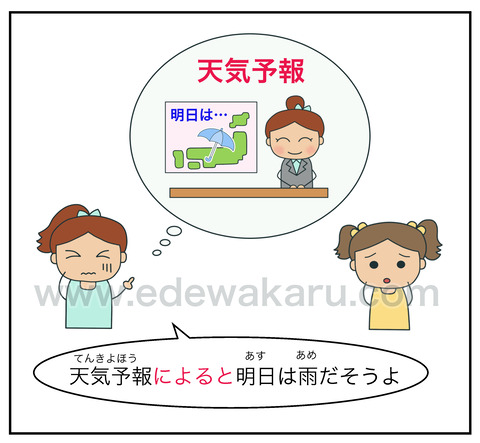
Meaning
Indicates the source of information
How to use it
Noun [dictionary form] + によると
Explanation
“〜によると” is a sentence pattern indicating the source of information, such as what one heard it from or whom one heard it from. It is followed by an expression of hearsay or conjecture. 😊 “〜によれば” has the same meaning.
[Expressions often used with “〜によると”]
〜そうだ
〜らしい
〜ということだ (Review: 〜ということだ)
〜とのことだ
〜って・〜んだって (Review: 〜って・〜んだって)
[For those who want to learn more]
There is also the expression “〜ところによると” with “〜によると.” 😮 It is used in the form “verb [dictionary form, た-form, or ている-form] + ところによると.”
[Examples]
According to what I heard on the weather forecast, it will apparently rain tomorrow.
According to what the teacher says, he has passed the Japanese Language Proficiency Test.
According to what I heard on the radio, there was apparently an earthquake in Tokyo.
“〜ところによれば” is used with the same meaning as “〜ところによると.” 😊
In context 3 examples
天気予報によると明日は雨だそうだ
→[情報源]天気予報(を見て…):明日は雨だそうだAccording to the weather forecast, it will apparently rain tomorrow. → [Source of information] The weather forecast (having seen it...): apparently, it will rain tomorrow.
先生によると、彼は日本語能力試験に合格したということだ(復習:〜ということだ)
→[情報源]先生(から聞いて…):彼は日本語能力試験に合格したそうだAccording to the teacher, he has passed the Japanese Language Proficiency Test. (Review: 〜ということだ) → [Source of information] The teacher (having heard it from them...): apparently, he has passed the Japanese Language Proficiency Test.
ラジオによると東京で地震があったらしい
→[情報源]ラジオ(を聞いて…):東京で地震があったらしいAccording to the radio, there was apparently an earthquake in Tokyo. → [Source of information] The radio (having heard it...): apparently, there was an earthquake in Tokyo.
Read the original source text
Meaning
情報源(じょうほうげん)を表す
How to use it
名詞[辞書形]+によると
Explanation
「〜によると」は何で聞いたか、または誰から聞いたかなど【情報源】を表す文型です。後ろには伝聞表現や推測を表す表現がきます😊「〜によれば」は同じ意味です。
[「〜によると」とよく使われる表現]
〜そうだ
〜らしい
〜ということだ(復習:〜ということだ)
〜とのことだ
〜って・〜んだって(復習:〜って・〜んだって)
【余裕がある人へ】
「〜によると」には「〜ところによると」という表現もあります😮【動詞[辞書形・た形・ている形]+ところによると】の形で使われます。
[例]
天気予報で聞いた
ところによると、明日は雨だそうだ
先生が言う
ところによると、彼は日本語能力試験に合格したということだ
ラジオを聞いた
ところによると
東京で地震があったらしい
「〜ところによれば」は「〜ところによると」と同じ意味で使われます
😊
日本語文型辞典
Meaning
a. Nによると
Indicates the source of something heard from another person or the basis for an inference. It is followed by expressions of hearsay such as 「…そうだ」 and 「…ということだ」, or expressions of inference such as 「…だろう」 and 「…らしい」. In ① and ②, 「…によれば」 can also be used.
b. ことによると / ばあいによると
Fixed idiomatic expressions meaning “perhaps” or “under certain conditions.” They are followed by expressions of inference. The forms 「ことによったら」 and 「場合によったら」 are also used.
Indicates the source of something heard from another person or the basis for a judgment. It is followed by expressions of hearsay such as 「…そうだ」 and 「-ということだ」, or expressions that state a judgment, such as inference or assertion. The form 「…ところによれば」 is also used.
How to use it
Nによると
Vところによると
In context 8 examples
天気予報によると、明日は晴れるそうです。
According to the weather forecast, it will apparently be sunny tomorrow.
彼の説明によると、この機械は廃棄物を処理するためのものだということです。
According to his explanation, this machine is for processing waste.
あの雲の様子によると、明日は多分晴れるだろう。
Judging from those clouds, it will probably be sunny tomorrow.
ことによると今回の旅行はキャンセルしなければならないかもしれない。
We may perhaps have to cancel this trip.
場合によると彼らも応援に来てくれるかもしれない。
Under some circumstances, they might come to support us, too.
聞いたところによると、最近は飛行磯でいく方が電車より安い場合もあるそうですね。
From what I hear, these days there are cases when flying is cheaper than taking the train.
彼の主張するところによると、彼は事件とは関係ないということだ。
According to his claim, he has nothing to do with the incident.
祖父の語ったところによると、このあたりには昔古い農家があったということだ。
According to what my grandfather said, there used to be old farmhouses around here.
Read the original source text
Meaning
a. Nによると
ほかから聞いたことの出どころや推測のよりどころを表す。後ろには「…そうだ」「…ということだ」などの伝聞を表す表現や「…だろう」「…らしい」などの推測を表す表現が続く。①②は「…によれば」を用いることもできる。
b. ことによると/ばあいによると
慣用句的に固定した表現で「もしかしたら」「ある条件のもとでは」という意味を表す。後ろには推測を表す表現が続く。「ことによったら」「場合によったら」の形も用いられる。
はかから聞いたことの出どころや判断のよりどころを表す。後ろには「…そうだ」「-ということだ」などの伝聞を表す表現や推測・断定などの判断を表す表現が続く。「…ところによれば」の形も用いられる。
How to use it
Nによると
Vところによると
日本語文型辞典 英語版
Meaning
Indicates a source from which the speaker has heard something, or a basis from which the speaker infers something. Followed by an expression of hearsay such as ...そうだ (I hear/they say) or ...ということだ (they say), or a suppositional expression such as ...だろう (probably), ...らしい (apparently), etc. In
(1)
and
(2)
, it would also be possible to use ...によれば.
b. ことによると/ばあいによると
Fixed, idiomatic expressions with the meaning of “maybe, perhaps” or “under certain conditions.” Followed by a suppositional expression. Also used in the forms ことによったら and 場合によったら.
Indicates a source from which the speaker has heard something, or the basis for a judgment. Followed by an expression of hearsay, such as ...そうだ (I hear/they say) or ...ということだ (they say), or an expression of judgment, such as a supposition or assertion. Also used in the form ...ところによれば.
How to use it
1. Nによるとa. Nによると
2. Vところによると
In context 8 examples
天気予報によると、明日は晴れるそうです。
According to the weather forecast, it will be sunny tomorrow.
彼の説明によると、この機械は廃棄物を処理するためのものだということです。
According to his explanation, this machine is for the disposal of waste.
あの雲の様子によると、明日は多分晴れるだろう。
Judging from those clouds, I think it will probably be sunny tomorrow.
ことによると今回の旅行はキャンセルしなければならないかもしれない。
It may turn out that I’ll have to cancel the upcoming trip.
場合によると彼らも応援に来てくれるかもしれない。
Depending on the situation, they might come to help us.
聞いたところによると、最近は飛行機でいく方が電車より安い場合もあるそうですね。
From what I’ve heard, you know, these days flying can sometimes be cheaper than going by train.
彼の主張するところによると、彼は事件とは関係ないということだ。
Based on what he claims, he has nothing to do with the incident.
祖父の語ったところによると、このあたりには昔古い農家があったということだ。
According to what my grandfather told me, there used to be old farmhouses around here a long time ago.
Read the original source text
Meaning
Indicates a source from which the speaker has heard something, or a basis from which the speaker infers something. Followed by an expression of hearsay such as ...そうだ (I hear/they say) or ...ということだ (they say), or a suppositional expression such as ...だろう (probably), ...らしい (apparently), etc. In
(1)
and
(2)
, it would also be possible to use ...によれば.
b. ことによると/ばあいによると
Fixed, idiomatic expressions with the meaning of “maybe, perhaps” or “under certain conditions.” Followed by a suppositional expression. Also used in the forms ことによったら and 場合によったら.
Indicates a source from which the speaker has heard something, or the basis for a judgment. Followed by an expression of hearsay, such as ...そうだ (I hear/they say) or ...ということだ (they say), or an expression of judgment, such as a supposition or assertion. Also used in the form ...ところによれば.
How to use it
1. Nによるとa. Nによると
2. Vところによると
日本語NET JLPT文法解説まとめ
Meaning
“According to …”
Indicates a source of information or the basis for a judgment.
How to use it
N + によると / によれば
Explanation
according to
・It is often used together with expressions of hearsay.
・「〜によると」 and 「〜によれば」 have the same meaning.
・The expressions 「(Vた)ところによると」 and 「(Vた)ところによれば」 are also used.
・The sentence often ends with 「〜らしい」 or 「〜そうだ」.
In context 12 examples
天気予報によると、明日は雨だそうです。
According to the weather forecast, it’s supposed to rain tomorrow.
田中さんによると、もうすぐあの二人は結婚するそうです。
According to Mr. Tanaka, those two are supposedly getting married soon.
この資料によれば、経営状況は毎年悪化傾向にあることがわかる。
According to these materials, the business situation has been deteriorating every year.
ニュース速報によると、指名手配されていた犯人が捕まったそうです。
According to breaking news, the wanted criminal has been caught.
専門家の話によると、今度も高齢化や年金問題といった社会問題はひどくなっていくということです。
According to experts, social problems such as population aging and pension issues will continue to worsen.
私の記憶によると、この辺りに昔住んでいたマンションがあるはずなんだけど。
If I remember correctly, there should be an apartment building around here where I used to live.
噂によると、あの二人は付き合っているそうだ。
Rumor has it that those two are dating.
ニュースによると、来年のセンター試験の形式が大きく変わるそうです。
According to the news, the format of next year’s Center Test is going to change significantly.
先生の話によると、この文型はJLPTのテストに出る可能性は低いとのことだ。
According to the teacher, this sentence pattern is unlikely to appear on the JLPT.
医者によると、1日3回、食後にこの薬を飲んでおけば大丈夫とのことだ。
According to the doctor, it will be fine if I take this medicine three times a day after meals.
聞いた話によると、鈴木先生が今学期でこの学校を辞めるそうだ。
I heard that Mr. Suzuki is leaving this school at the end of this term.
マレーシア人のプテラさんによると、日本のコンビニはとても便利らしい。
According to Putera, who is Malaysian, convenience stores in Japan are very convenient.
Read the original source text
Meaning
"〜では"
情報源や判断の元を表す
How to use it
N + によると / によれば
Explanation
according to
・伝聞表現とともに使われることが多い。
・「〜によると」も「〜によれば」も意味は同じ。
・「(Vタ)ところによると」、「(Vタ)ところによれば」という表現もある。
・文末には「〜らしい」や「〜そうだ」が来ることが多い。
毎日のんびり日本語教師
How to use it
Noun+によると
Noun+によれば
Nounの話では/の話によると/の話によれば
Verb dictionary form+ところによると/ところによれば
Verb た-form+ところによると/ところによれば
Explanation
This sentence pattern expresses hearsay or conjecture. The second part often pairs with modal expressions that indicate hearsay or conjecture, such as 「~そうだ」, 「~らしい」, or 「~だろう」.
「場合によると」 (depending on the circumstances) is used idiomatically.
Notes
The 「よる」 series
【N3 Grammar】~によって/によっては/により/による
【N3 Grammar】~によらず
【N3 Grammar】~によると/によれば/の話では
In context 10 examples
一説によると、薄毛には運動不足が関係しているらしい。
According to one theory, lack of exercise is apparently related to hair loss.
噂によると、あの二人は別れたようだ。
According to rumors, it seems those two have broken up.
厚生労働省の調査によると、日本人女性の平均寿命は世界一といわれている。
According to a survey by the Ministry of Health, Labour and Welfare, Japanese women are said to have the highest life expectancy in the world.
噂によれば、この学校には幽霊が出るらしい。
According to rumors, ghosts apparently appear at this school.
知り合いから聞いたところによると、あそこのコンビニの向かいにラーメン屋ができるらしい。
From what I heard from an acquaintance, it seems a ramen shop is going to open across from that convenience store.
天気予報によれば午後には風速が30メートルを超えるとのことだ。
According to the weather forecast, wind speeds are expected to exceed 30 meters per second this afternoon.
聞くところによると、消費税増税で飲食店は大打撃を受けているようだ。
From what I hear, the consumption tax hike seems to be hitting restaurants hard.
解剖記録によると、死因は失血死だったそうだ。
According to the autopsy report, the cause of death was apparently blood loss.
嘘をつくことはいけないが、それは時と場合による。
Lying is wrong, but it depends on the time and circumstances.
飲み会は基本行かないが、場合による。
I generally don't go to drinking parties, but it depends.
Read the original source text
How to use it
名詞+によると
名詞+によれば
名詞+の話では/の話によると/の話によれば
動辞形+ところによると/ところによれば
動た形+ところによると/ところによれば
Explanation
伝聞や推測を表す文型です。後件には「~そうだ」「~らしい」「~だろう」などの伝聞、推測を表すモダリティ表現が呼応しやすいです。
「場合によると(根据情況)」は慣用的に用いられます。
Notes
「よる」シリーズ
【N3文法】~によって/によっては/により/による
【N3文法】~によらず
【N3文法】~によると/によれば/の話では
NINJAL 日本語文型データベース
Meaning
Indicates the source of information.
How to use it
Nによると
Notes
A sentence stating the content of the information follows 「〜によると」. Expressions such as 「~そうだ・~らしい・~という・~ということだ・~とのことだ」 are used.
In context 5 examples
天気予報によると、大型の台風が近づいているそうだ。
According to the weather forecast, a large typhoon is approaching.
先輩によると、夏休みの合宿の日程が変更になるらしい。
According to my senior colleague, it seems the dates for the summer camp have changed.
経済評論家の松田氏の解説によると、景気の回復はしばらく期待できないということだ。
According to economist Matsuda’s analysis, an economic recovery cannot be expected for some time.
新聞によると、昨日の貨物船の事故で8人が負傷したそうだ。
According to the newspaper, eight people were injured in yesterday’s cargo ship accident.
木村(2020)によると、多くの人が潜在的にストレス性の疾患にかかっているという。
According to Kimura (2020), many people have latent stress-related illnesses.
Read the original source text
Meaning
情報源を表します。
How to use it
Nによると
Notes
「〜によると」の後には、情報の内容を表す文がきます。「~そうだ・~らしい・~という・~ということだ・~とのことだ」のような表現を使います。
IMABI
~によって
Read this IMABI lesson ↗Explanation
~によって
When we learned about the agent marker に, we learned how several functions of に are interrelated. From its basic definition of showing where something exists, に by extension marks the existence of an agent. As we learned in that lesson and the lessons that followed, に marks the agent of stative-transitive, passive sentences, and causative predicates.
At the conclusion of our discussion on how に functions as an agent, we learned that に can in fact follow verbal expressions. By doing so, the verb becomes grammatically nominalized, but because the resultant noun is still verbal in nature, the “agent” becomes interpreted as a reason/purpose/cause for the main predicate of the sentence. Thus, the purpose-marker is born.
In Lesson 115, we briefly discussed how ~によって can be used to mark the agent. This is the combination of the agent-marker に and よる, which has various nuances including “to be caused by/to depend on/to be based on.” At its basic understanding, it helps fully establish that something is an agent, especially when other usages of に are present.
~によって・により
1. 原因 (Cause)・理由 (Reason): The first usage of ~によって is to objectively and indifferently present cause/reason. This speech pattern, thus, is not used so much in general conversation due to its lack of emotion. It is, however, perfectly appropriate for speaking in a technical manner.
In English, this usage translates as “due to.” Whenever it is used to directly modify a noun, you use ~による (Exs. 3-6).
Spelling Note: The Kanji spelling for this nuance is に因って.
1. 踏切ふみきりでの大おおきな衝突事故しょうとつじこによって、運行うんこうに20にじゅう時間じかんの遅おくれが出でた。
Due to a large collision at the railroad crossing, a 20-hour delay came out in operations.
2. このビルは大地震おおじしん{によって・で}ばらばらに破壊はかいされた。
This building was destroyed to pieces [by/in] the big earthquake.
3. 過失かしつによる人身事故じんしんじこ
Traffic accident caused by a blunder
4. 大地震おおじしんによる家屋倒壊かおくとうかいは、すでに一万戸いちまんこを超こえているといわれる。
It’s said that the number of homes that collapsed due to the big earthquake has already surpassed 10,000 homes.
5. 福島原発事故ふくしまげんぱつじこによる放射能環境汚染ほうしゃのうかんきょうおせん
Environmental radioactivity pollution caused by the Fukushima Nuclear Accident
6. 牛うしインフルエンザによる死亡者しぼうしゃが続出ぞくしゅつしています。
Deaths are occurring one after another due to cow influenza.
2. 手段 (Method): によって can also be used in the sense of “by” to express method. This usage has considerable overlap with the particle で, but because によって deals heavily in showing agents of happenstance, when method is being used in a way that is not a speaker literally using a tool/method, then only によって would be appropriate.
When modifying nouns directly with this meaning, ~によって takes either the form ~による or ~によっての.
7. インターネットにより世界せかいのニュースを知しる。
To know the world news by the Internet.
8. インターネット{によって・で}、人間にんげんは居いながらにして、世界せかいを概観がいかんできる。
Through/with the internet, people can stay seated as they can survey the world.
9. 投票とうひょう{によって・で}決きめよう。
Let’s decide by vote.
10. 大抵たいていの成功せいこうは不断ふだんの努力どりょくによって得えられる。
Most success is gained by ceaseless effort.
~によって VS ~を通じて・通して
There is some interchangeability between ~によって, ~を通じて, and ~を通して with Usage 2. ~によって places emphasis on the connection between the method and effect/result, which is in line with how the agent-maker に behaves. The latter two phrases, on the other hand, place emphasis on the process.
12. インターネット{によって・を通つうじて・を通とおして}、アルバムを販売はんばいする。
To sell albums by/via/through the Internet.
13. 選挙せんきょ{〇 によって・X を通つうじて・X を通とおして}委員長いいんちょうになる。
To become the committee chairman by election.
3. 受身の動作主 (Agent of a Passive Structure): As we have already learned about, ~によって can be used with the passive form of a verb to show the agent (doer). If a sentence with a receiver (indirect object) is passivized, the agent must be marked by ~によって. Additionally, ~による is the only acceptable attribute form for this usage.
14. 田中たなかさん{〇 によって・X に}岡田おかださんに手紙てがみが送られました。
A letter was sent to Mr. Okada by Mr. Tanaka.
15. その仕事しごとは加藤かとうさんによってなされました。
The work was done by Mr. Kato.
16. ライトアップ{によって・で}夢幻的むげんてきな光景こうけいが生うみ出だされた。
A dreamy scenery was created by/with a light-up.
17. 松本清張まつもとせいちょうによる小説しょうせつ
A novel by Matsumoto Seichō
4. 根拠 (Proof)・拠り所 (Basis): Following a rule/law/example/precedent/previous example/etc., it is used a lot to clearly show proof/basis. In this usage, ~による is the only acceptable attribute form. This should only be used when something clear is understood. It should not be used for mere hearsay.
18. 証言しょうげんによる真実しんじつ
Truth according to testimony
19. 前例ぜんれい{による・に基もとづく}判決はんけつが下くだされることになる。
A judgment is to be made based on precedent.
5. 場合 (Circumstance)・相応変化 (Reasonable Change): This usage is perhaps the most common in the spoken language, equating to “depending on…” Both ~による and ~によっての are correct attribute forms, although the latter is more common in the spoken language.
20. 天候てんこうによっては中止ちゅうしもありえるでしょう。
Depending on the weather conditions, (the match) may possibly be canceled.
21. 時ときと場合ばあいに{よっての・よる}対処たいしょ
Approach which depends on the time and circumstance
22. お金かねによって、人ひとは変かわるものです。
People change depending on money.
23. この仕事しごとは販売数はんばいすうによって給料きゅうりょうが変かわります。
As for this job, one’s salary changes depending on sales.
24. 板前長いたまえちょうの腕うでによって、寿司すしの味あじの良よし悪しが左右さゆうされます。
The quality of the flavor of sushi is dependent on the skill of the chef.
25. 含ふくまれる材料ざいりょうによって、いろいろな味あじのラーメンがあります。
There are many flavors of ramen based on the ingredients put in it.
26. 人ひとによって考かんがえが違ちがいます。
Opinions vary from person to person.
27. 挨拶言葉あいさつことばはその日ひの天気てんきによっていろいろ言いえばよい。
It’s best to say that there are various greetings based on the weather of the day.
28. 曜日ようびによって授業じゅぎょうが変かわります。
Classes change depending on the day of the week.
29. 人ひとによって好すきなものと嫌きらいなものは異ことなります。
One’s likes and dislikes differ from person to person.
30. 「でも、すごいのよ。二階にかいの人ひとが歩あるくと、天井てんじょうがみしみしって鳴なるの。窓枠まどわくも木きだし、風向かざむきによってはかたかた鳴なって、すきま風かぜが入はいってくるみたい。ドアなんか、鍵なんかなくても体当たりすれば開きそうよ」
“But, it’s dreadful! When the people on the second-floor walk, the ceiling creaks. The window frame is made of wood, which makes it clatter in the wind, and it’s like a draft is coming in. The door, it seems like it’ll open if you charge at it even if there wasn’t a lock.”From 冷たい誘惑 by 乃南アサ.
その仕事は加藤かとうさんによってなされました。
The work was done by Mr. Kato.
~によらず
~ず is an old negative auxiliary, and when it is paired with ~による, the resulting phrase gives a meaning of “in any situation everything/despite/regardless”.
31. 何事なにごとによらず注意ちゅういが肝心かんじんだ。
No matter what, attention is crucial.
32. 誰だれによらず人ひとの不始末ふしまつの尻拭しりぬぐいなどしたくはないよ。
No matter who it is, I don’t want to reap the harvests off other people’s misconduct.
~によると・によったら・によれば
~によると
Also seen as ~によりますと in extremely polite/formal speech, the most common usage of this is to mean “according to”.
33. 新聞しんぶんによると台風たいふうが接近中せっきんちゅうだった。
According to the newspaper, the typhoon was approaching.
34. (天気てんき)予報よほうによりますと、明日あしたは晴はれるそうです。
According to the weather report, it’ll clear up tomorrow.
35. ニュースによると、朝あさは晴はれだそうだ。
According to the news, morning will be clear skies.
36. 電灯でんとうの発明はつめいはエジソンによるとされている。
The invention of electric light is credited to Edison.
~によれば
A more direct and personal means of saying “according to” is ~によれば.
37.
お母かあさま方がたのために
古事記こじき、日本書紀にほんしょき(記紀きき)によれば、 伊弉諾尊いざなぎのみこと(男神だんしん)、伊弉冉尊いざなみみこと(女神めがみ)二柱ふたはしらの大神おおがみによる国生くにうみの神話しんわは、日本にほんの国土誕生物語こくどたんじょうものがたりです。私わたしたち日本人にほんじんの祖先そせんは、日本にほんの国土こくどは神様かみさまがお生うみになり、住すみやすく良よい国くにに作つくりあげられたものと信しんじていました。ですから、日本にほんの国土こくどに住すむ日本人にほんじんは、すべて神様かみさまの子ことしてかたく結むすばれている意識いしきが非常に強かったのです。
For Mothers
According to the Kojiki and Nihon Shoki (Kiki), the tale of the birth of our nation by the two-great kami Izanagi (male kami) and Izanami (female kami), is the creation story of Japan. Our Japanese ancestors that the kami created the Japanese land to make a great and easy to live country. That is why Japanese people living in the land of Japan felt a strong and tight binding connection to the land as all being children of the kami.
Citation Note: From かみさまのおはなし.
~によったら
~によったら would directly translate as “if it were according to.” It is most common in the set phrase ことによったら, meaning “perhaps.”
38. {ことによると・ことによったら}列車れっしゃが停止ていしするかもしれません。
Perhaps the train might halt.
In context 41 examples
原因 (Cause)・理由 (Reason): The first usage of ~によって is to objectively and indifferently present cause/reason. This speech pattern, thus, is not used so much in general conversation due to its lack of emotion. It is, however, perfectly appropriate for speaking in a technical manner.
原因 (cause)・理由 (reason): The first use of ~によって is to present a cause or reason objectively and impartially. Because this speech pattern lacks emotion, it is not used much in general conversation. It is, however, perfectly appropriate for speaking in a technical manner.
踏切ふみきりでの大おおきな衝突事故しょうとつじこによって、運行うんこうに20にじゅう時間じかんの遅おくれが出でた。
Due to a large collision at the railroad crossing, a 20-hour delay came out in operations.
このビルは大地震おおじしん{によって・で}ばらばらに破壊はかいされた。
This building was destroyed to pieces [by/in] the big earthquake.
過失かしつによる人身事故じんしんじこ
Traffic accident caused by a blunder
大地震おおじしんによる家屋倒壊かおくとうかいは、すでに一万戸いちまんこを超こえているといわれる。
It’s said that the number of homes that collapsed due to the big earthquake has already surpassed 10,000 homes.
福島原発事故ふくしまげんぱつじこによる放射能環境汚染ほうしゃのうかんきょうおせん
Environmental radioactivity pollution caused by the Fukushima Nuclear Accident
牛うしインフルエンザによる死亡者しぼうしゃが続出ぞくしゅつしています。
Deaths are occurring one after another due to cow influenza.
手段 (Method): によって can also be used in the sense of “by” to express method. This usage has considerable overlap with the particle で, but because によって deals heavily in showing agents of happenstance, when method is being used in a way that is not a speaker literally using a tool/method, then only によって would be appropriate.
手段 (method): によって can also mean “by” and express a method. This use overlaps considerably with the particle で, but because によって is often used to show agents of happenstance, only によって is appropriate when the method does not involve the speaker literally using a tool or method.
インターネットにより世界せかいのニュースを知しる。
To know the world news by the Internet.
インターネット{によって・で}、人間にんげんは居いながらにして、世界せかいを概観がいかんできる。
Through/with the internet, people can stay seated as they can survey the world.
投票とうひょう{によって・で}決きめよう。
Let’s decide by vote.
大抵たいていの成功せいこうは不断ふだんの努力どりょくによって得えられる。
Most success is gained by ceaseless effort.
インターネット{によって・を通つうじて・を通とおして}、アルバムを販売はんばいする。
To sell albums by/via/through the Internet.
選挙せんきょ{〇 によって・X を通つうじて・X を通とおして}委員長いいんちょうになる。
To become the committee chairman by election.
受身の動作主 (Agent of a Passive Structure): As we have already learned about, ~によって can be used with the passive form of a verb to show the agent (doer). If a sentence with a receiver (indirect object) is passivized, the agent must be marked by ~によって. Additionally, ~による is the only acceptable attribute form for this usage.
A letter was sent to Mr. Okada by Mr. Tanaka.
田中たなかさん{〇 によって・X に}岡田おかださんに手紙てがみが送られました。
A letter was sent to Mr. Okada by Mr. Tanaka.
その仕事しごとは加藤かとうさんによってなされました。
The work was done by Mr. Kato.
ライトアップ{によって・で}夢幻的むげんてきな光景こうけいが生うみ出だされた。
A dreamy scenery was created by/with a light-up.
松本清張まつもとせいちょうによる小説しょうせつ
A novel by Matsumoto Seichō
根拠 (Proof)・拠り所 (Basis): Following a rule/law/example/precedent/previous example/etc., it is used a lot to clearly show proof/basis. In this usage, ~による is the only acceptable attribute form. This should only be used when something clear is understood. It should not be used for mere hearsay.
Truth according to testimony
証言しょうげんによる真実しんじつ
Truth according to testimony
前例ぜんれい{による・に基もとづく}判決はんけつが下くだされることになる。
A judgment is to be made based on precedent.
場合 (Circumstance)・相応変化 (Reasonable Change): This usage is perhaps the most common in the spoken language, equating to “depending on…” Both ~による and ~によっての are correct attribute forms, although the latter is more common in the spoken language.
Depending on the weather conditions, (the match) may possibly be canceled.
天候てんこうによっては中止ちゅうしもありえるでしょう。
Depending on the weather conditions, (the match) may possibly be canceled.
時ときと場合ばあいに{よっての・よる}対処たいしょ
Approach which depends on the time and circumstance
お金かねによって、人ひとは変かわるものです。
People change depending on money.
この仕事しごとは販売数はんばいすうによって給料きゅうりょうが変かわります。
As for this job, one’s salary changes depending on sales.
板前長いたまえちょうの腕うでによって、寿司すしの味あじの良よし悪しが左右さゆうされます。
The quality of the flavor of sushi is dependent on the skill of the chef.
含ふくまれる材料ざいりょうによって、いろいろな味あじのラーメンがあります。
There are many flavors of ramen based on the ingredients put in it.
人ひとによって考かんがえが違ちがいます。
Opinions vary from person to person.
挨拶言葉あいさつことばはその日ひの天気てんきによっていろいろ言いえばよい。
It’s best to say that there are various greetings based on the weather of the day.
曜日ようびによって授業じゅぎょうが変かわります。
Classes change depending on the day of the week.
人ひとによって好すきなものと嫌きらいなものは異ことなります。
One’s likes and dislikes differ from person to person.
「でも、すごいのよ。二階にかいの人ひとが歩あるくと、天井てんじょうがみしみしって鳴なるの。窓枠まどわくも木きだし、風向かざむきによってはかたかた鳴なって、すきま風かぜが入はいってくるみたい。ドアなんか、鍵なんかなくても体当たりすれば開きそうよ」
“But it’s amazing. When someone walks around upstairs, the ceiling creaks. The window frames are wooden, too, and depending on the wind direction they rattle; it seems like drafts come in through the gaps. Even the doors look like they’d open if you charged into them, even without a lock.”
何事なにごとによらず注意ちゅういが肝心かんじんだ。
No matter what, attention is crucial.
誰だれによらず人ひとの不始末ふしまつの尻拭しりぬぐいなどしたくはないよ。
No matter who it is, I don’t want to reap the harvests off other people’s misconduct.
新聞しんぶんによると台風たいふうが接近中せっきんちゅうだった。
According to the newspaper, the typhoon was approaching.
(天気てんき)予報よほうによりますと、明日あしたは晴はれるそうです。
According to the weather report, it’ll clear up tomorrow.
ニュースによると、朝あさは晴はれだそうだ。
According to the news, morning will be clear skies.
電灯でんとうの発明はつめいはエジソンによるとされている。
The invention of electric light is credited to Edison.
{ことによると・ことによったら}列車れっしゃが停止ていしするかもしれません。
Perhaps the train might halt.
Read the original source text
Explanation
~によって
When we learned about the agent marker に, we learned how several functions of に are interrelated. From its basic definition of showing where something exists, に by extension marks the existence of an agent. As we learned in that lesson and the lessons that followed, に marks the agent of stative-transitive, passive sentences, and causative predicates.
At the conclusion of our discussion on how に functions as an agent, we learned that に can in fact follow verbal expressions. By doing so, the verb becomes grammatically nominalized, but because the resultant noun is still verbal in nature, the “agent” becomes interpreted as a reason/purpose/cause for the main predicate of the sentence. Thus, the purpose-marker is born.
In Lesson 115, we briefly discussed how ~によって can be used to mark the agent. This is the combination of the agent-marker に and よる, which has various nuances including “to be caused by/to depend on/to be based on.” At its basic understanding, it helps fully establish that something is an agent, especially when other usages of に are present.
~によって・により
1. 原因 (Cause)・理由 (Reason): The first usage of ~によって is to objectively and indifferently present cause/reason. This speech pattern, thus, is not used so much in general conversation due to its lack of emotion. It is, however, perfectly appropriate for speaking in a technical manner.
In English, this usage translates as “due to.” Whenever it is used to directly modify a noun, you use ~による (Exs. 3-6).
Spelling Note: The Kanji spelling for this nuance is に因って.
1. 踏切ふみきりでの大おおきな衝突事故しょうとつじこによって、運行うんこうに20にじゅう時間じかんの遅おくれが出でた。
Due to a large collision at the railroad crossing, a 20-hour delay came out in operations.
2. このビルは大地震おおじしん{によって・で}ばらばらに破壊はかいされた。
This building was destroyed to pieces [by/in] the big earthquake.
3. 過失かしつによる人身事故じんしんじこ
Traffic accident caused by a blunder
4. 大地震おおじしんによる家屋倒壊かおくとうかいは、すでに一万戸いちまんこを超こえているといわれる。
It’s said that the number of homes that collapsed due to the big earthquake has already surpassed 10,000 homes.
5. 福島原発事故ふくしまげんぱつじこによる放射能環境汚染ほうしゃのうかんきょうおせん
Environmental radioactivity pollution caused by the Fukushima Nuclear Accident
6. 牛うしインフルエンザによる死亡者しぼうしゃが続出ぞくしゅつしています。
Deaths are occurring one after another due to cow influenza.
2. 手段 (Method): によって can also be used in the sense of “by” to express method. This usage has considerable overlap with the particle で, but because によって deals heavily in showing agents of happenstance, when method is being used in a way that is not a speaker literally using a tool/method, then only によって would be appropriate.
When modifying nouns directly with this meaning, ~によって takes either the form ~による or ~によっての.
7. インターネットにより世界せかいのニュースを知しる。
To know the world news by the Internet.
8. インターネット{によって・で}、人間にんげんは居いながらにして、世界せかいを概観がいかんできる。
Through/with the internet, people can stay seated as they can survey the world.
9. 投票とうひょう{によって・で}決きめよう。
Let’s decide by vote.
10. 大抵たいていの成功せいこうは不断ふだんの努力どりょくによって得えられる。
Most success is gained by ceaseless effort.
~によって VS ~を通じて・通して
There is some interchangeability between ~によって, ~を通じて, and ~を通して with Usage 2. ~によって places emphasis on the connection between the method and effect/result, which is in line with how the agent-maker に behaves. The latter two phrases, on the other hand, place emphasis on the process.
12. インターネット{によって・を通つうじて・を通とおして}、アルバムを販売はんばいする。
To sell albums by/via/through the Internet.
13. 選挙せんきょ{〇 によって・X を通つうじて・X を通とおして}委員長いいんちょうになる。
To become the committee chairman by election.
3. 受身の動作主 (Agent of a Passive Structure): As we have already learned about, ~によって can be used with the passive form of a verb to show the agent (doer). If a sentence with a receiver (indirect object) is passivized, the agent must be marked by ~によって. Additionally, ~による is the only acceptable attribute form for this usage.
14. 田中たなかさん{〇 によって・X に}岡田おかださんに手紙てがみが送られました。
A letter was sent to Mr. Okada by Mr. Tanaka.
15. その仕事しごとは加藤かとうさんによってなされました。
The work was done by Mr. Kato.
16. ライトアップ{によって・で}夢幻的むげんてきな光景こうけいが生うみ出だされた。
A dreamy scenery was created by/with a light-up.
17. 松本清張まつもとせいちょうによる小説しょうせつ
A novel by Matsumoto Seichō
4. 根拠 (Proof)・拠り所 (Basis): Following a rule/law/example/precedent/previous example/etc., it is used a lot to clearly show proof/basis. In this usage, ~による is the only acceptable attribute form. This should only be used when something clear is understood. It should not be used for mere hearsay.
18. 証言しょうげんによる真実しんじつ
Truth according to testimony
19. 前例ぜんれい{による・に基もとづく}判決はんけつが下くだされることになる。
A judgment is to be made based on precedent.
5. 場合 (Circumstance)・相応変化 (Reasonable Change): This usage is perhaps the most common in the spoken language, equating to “depending on…” Both ~による and ~によっての are correct attribute forms, although the latter is more common in the spoken language.
20. 天候てんこうによっては中止ちゅうしもありえるでしょう。
Depending on the weather conditions, (the match) may possibly be canceled.
21. 時ときと場合ばあいに{よっての・よる}対処たいしょ
Approach which depends on the time and circumstance
22. お金かねによって、人ひとは変かわるものです。
People change depending on money.
23. この仕事しごとは販売数はんばいすうによって給料きゅうりょうが変かわります。
As for this job, one’s salary changes depending on sales.
24. 板前長いたまえちょうの腕うでによって、寿司すしの味あじの良よし悪しが左右さゆうされます。
The quality of the flavor of sushi is dependent on the skill of the chef.
25. 含ふくまれる材料ざいりょうによって、いろいろな味あじのラーメンがあります。
There are many flavors of ramen based on the ingredients put in it.
26. 人ひとによって考かんがえが違ちがいます。
Opinions vary from person to person.
27. 挨拶言葉あいさつことばはその日ひの天気てんきによっていろいろ言いえばよい。
It’s best to say that there are various greetings based on the weather of the day.
28. 曜日ようびによって授業じゅぎょうが変かわります。
Classes change depending on the day of the week.
29. 人ひとによって好すきなものと嫌きらいなものは異ことなります。
One’s likes and dislikes differ from person to person.
30. 「でも、すごいのよ。二階にかいの人ひとが歩あるくと、天井てんじょうがみしみしって鳴なるの。窓枠まどわくも木きだし、風向かざむきによってはかたかた鳴なって、すきま風かぜが入はいってくるみたい。ドアなんか、鍵なんかなくても体当たりすれば開きそうよ」
“But, it’s dreadful! When the people on the second-floor walk, the ceiling creaks. The window frame is made of wood, which makes it clatter in the wind, and it’s like a draft is coming in. The door, it seems like it’ll open if you charge at it even if there wasn’t a lock.”From 冷たい誘惑 by 乃南アサ.
その仕事は加藤かとうさんによってなされました。
The work was done by Mr. Kato.
~によらず
~ず is an old negative auxiliary, and when it is paired with ~による, the resulting phrase gives a meaning of “in any situation everything/despite/regardless”.
31. 何事なにごとによらず注意ちゅういが肝心かんじんだ。
No matter what, attention is crucial.
32. 誰だれによらず人ひとの不始末ふしまつの尻拭しりぬぐいなどしたくはないよ。
No matter who it is, I don’t want to reap the harvests off other people’s misconduct.
~によると・によったら・によれば
~によると
Also seen as ~によりますと in extremely polite/formal speech, the most common usage of this is to mean “according to”.
33. 新聞しんぶんによると台風たいふうが接近中せっきんちゅうだった。
According to the newspaper, the typhoon was approaching.
34. (天気てんき)予報よほうによりますと、明日あしたは晴はれるそうです。
According to the weather report, it’ll clear up tomorrow.
35. ニュースによると、朝あさは晴はれだそうだ。
According to the news, morning will be clear skies.
36. 電灯でんとうの発明はつめいはエジソンによるとされている。
The invention of electric light is credited to Edison.
~によれば
A more direct and personal means of saying “according to” is ~によれば.
37.
お母かあさま方がたのために
古事記こじき、日本書紀にほんしょき(記紀きき)によれば、 伊弉諾尊いざなぎのみこと(男神だんしん)、伊弉冉尊いざなみみこと(女神めがみ)二柱ふたはしらの大神おおがみによる国生くにうみの神話しんわは、日本にほんの国土誕生物語こくどたんじょうものがたりです。私わたしたち日本人にほんじんの祖先そせんは、日本にほんの国土こくどは神様かみさまがお生うみになり、住すみやすく良よい国くにに作つくりあげられたものと信しんじていました。ですから、日本にほんの国土こくどに住すむ日本人にほんじんは、すべて神様かみさまの子ことしてかたく結むすばれている意識いしきが非常に強かったのです。
For Mothers
According to the Kojiki and Nihon Shoki (Kiki), the tale of the birth of our nation by the two-great kami Izanagi (male kami) and Izanami (female kami), is the creation story of Japan. Our Japanese ancestors that the kami created the Japanese land to make a great and easy to live country. That is why Japanese people living in the land of Japan felt a strong and tight binding connection to the land as all being children of the kami.
Citation Note: From かみさまのおはなし.
~によったら
~によったら would directly translate as “if it were according to.” It is most common in the set phrase ことによったら, meaning “perhaps.”
38. {ことによると・ことによったら}列車れっしゃが停止ていしするかもしれません。
Perhaps the train might halt.