文法
Meaning
You should have 〜 / It would have been better to 〜. An expression used to say that something should have been done, but in fact was not.
How to use it
V (dictionary form) + べきだ
※「する」can also take the form 「すべきだたった」.
Notes
・Includes the speaker’s feelings of reflection or regret.
・The negative form is 「〜べきではなかった」.
In context 12 examples
こんな結果になるなら、もっと勉強しておくべきだった。
If I'd known it would turn out like this, I should have studied more.
あとでバレて叱られるくらいなら、もっと早く上司に報告しておくべきだった。
Rather than getting found out later and scolded, I should have reported it to my boss earlier.
あの時、「好き」って言っておくべきだった。
I should have told them “I like you” back then.
留学前に、もっと勉強しておくべきだった。授業が難しくてついていけない。
I should have studied more before studying abroad. The classes are so difficult I can't keep up.
あの時、迷わず買っておくべきだったなあ。
I should have bought it without hesitating back then.
旅行前にちゃんと計画を立てておくべきだった。
I should have made proper plans before the trip.
あ〜、今日は傘を持ってくるべきだったなあ。まさか、こんな大雨になるとは。
Ah, I should have brought an umbrella today. I never expected it to rain this hard.
契約内容をきちんと確認すべきだったのに、確認せずにサインをしたので、今とても後悔している。
I should have carefully checked the terms of the contract, but I signed without checking, so I deeply regret it now.
彼のせいでパーティーが台無しになったので、誘うべきではなかったと後悔している。
Because of him, the party was ruined, so I regret having invited him.
こんな嫌な思いをするくらいなら、パーティーに参加するべきではなかった。
If it meant having such an unpleasant experience, I shouldn't have gone to the party.
海外で夜中に外出すべきでなかった。財布を盗まれるなんて・・・。
I shouldn't have gone out in the middle of the night while abroad. I can't believe my wallet got stolen...
夜にコーヒーを飲むべきではなかった。全然寝られない。
I shouldn't have drunk coffee at night. I can't sleep at all.
Read the original source text
Meaning
〜すればよかった / 〜したほうがよかった〜するのが当然だったが、実際にはしなかったと言う時に使う表現。
How to use it
V(辞書形)+ べきだ
※「する」は「すべきだたった」の形もある。
Notes
・話し手の反省の気持ちや後悔の気持ちが含まれる。
・否定形は「〜べきではなかった」
絵でわかる日本語
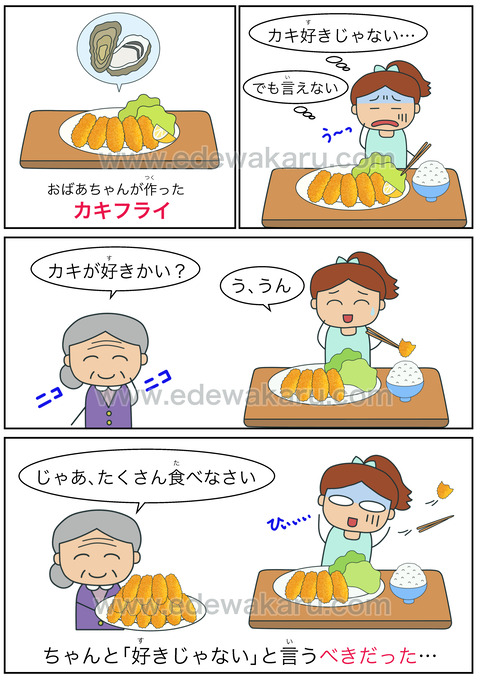
Meaning
I should have done…
I shouldn’t have done…
How to use it
Verb [dictionary form] + べきだった
Verb [dictionary form] + べきではなかった
Explanation
“〜べきだった” and “〜べきではなかった” mean “I should have done…” and “I shouldn’t have done…”. These patterns convey feelings of [regret] and [reflection]. They are used when you want to say, “I should have done it, but didn’t” or “I did something I shouldn’t have / did something I would have been better off not doing.”
(Review: 〜ておく)
(Review: 〜ばよかった・〜たらよかった)
(Review: 〜ほうがいい)
[Examples]
① I should have said clearly, “I don’t like you.”
→ I should have said clearly, “I don’t like you,” but I didn’t.
② I should have bought it yesterday.
→ I should have bought it yesterday, but I didn’t.
③ When I was a student, I should have studied properly.
→ I should have studied properly, but I didn’t.
* With “〜する,” both “〜するべきだった” and “〜すべきだった” can be used.
④ I shouldn’t have drunk coffee before bed.
→ I would have been better off not drinking coffee, but I drank it.
⑤ I shouldn’t have lent her money.
→ I would have been better off not lending her money, but I lent it.
(Review: 貸す・借りる)
⑥ I shouldn’t have said something like “I hate you!” to Mom.
→ I shouldn’t have said “I hate you!” even though I shouldn’t have said it.
(Review: 〜てしまう (disappointment/regret))
“〜べきだった” and “〜べきではなかった” are very commonly used in conversation. There are also several sentence patterns containing “〜べき,” so learn them together. 😉
[Sentence patterns containing “べき”]
〜べからず・〜べからざる
〜べきだ
〜べきだった・〜べきではなかった
〜べく
〜べくして
〜べくもない
〜べし
In context 6 examples
ちゃんと「好きじゃない」と言うべきだった
→ちゃんと「好きじゃない」と言えばよかったI should have said clearly, “I don’t like you.” → I should have said clearly, “I don’t like you.”
昨日買っておくべきだった
→昨日買っておけばよかったI should have bought it yesterday. → I should have bought it yesterday.
学生の時に、ちゃんと勉強するべきだった
→学生の時に、ちゃんと勉強しておけばよかったWhen I was a student, I should have studied properly. → I should have made sure to study properly when I was a student.
寝る前にコーヒーを飲むべきではなかった
→寝る前にコーヒーを飲まなければよかったI shouldn’t have drunk coffee before bed. → I shouldn’t have drunk coffee before bed.
彼女にお金を貸すべきではなかった
→彼女にお金を貸さなければよかった(復習:貸す・借りる)I shouldn’t have lent her money. → I shouldn’t have lent her money. (Review: 貸す・借りる)
お母さんに、「大嫌い!」なんて言うべきではなかった
→お母さんに、「大嫌い」なんて言わなければよかった(復習:〜など・〜なんか・〜なんて)I shouldn’t have said something like “I hate you!” to Mom. → I shouldn’t have said something like “I hate you!” to Mom. (Review: 〜など・〜なんか・〜なんて)
Read the original source text
Meaning
〜しておけばよかった
〜しなければよかった
How to use it
動詞[辞書形]+べきだった
動詞[辞書形]+べきではなかった
Explanation
「〜べきだった」「〜べきではなかった」は「〜しておけばよかった」「〜しなければよかった」という意味を表す文型です。この文型は
【後悔】【反省】
の気持ちが入ります。
「〜しなければいけなかったのにしなかった・〜したほうがよかったのにしなかった」「〜してはいけないことをしてしまった・〜しないほうがよかったことをしてしまった」
と言いたい時に使います。
(復習:〜ておく)
(復習:〜ばよかった・〜たらよかった)
(復習:〜ほうがいい)
[例]
①ちゃんと「好きじゃない」という
べきだった
→ちゃんと「好きじゃない」と言えばよかったが、
言わなかった
②昨日買っておく
べきだった
→昨日買っておけばよかったが、買わなかった
③学生の時に、ちゃんと勉強する
べきだった
→ちゃんと勉強したほうがよかったが、しなかった
*「〜する」の場合は「〜するべきだった」「〜すべきだった」の両方が使えます
④寝る前にコーヒーを飲む
べきではなかった
→コーヒーを飲まないほうがよかったが、飲んだ
⑤彼女にお金を貸す
べきではなかった
→お金を貸さないほうがよかったが、貸した
(復習:貸す・借りる)
⑥お母さんに、「大嫌い!」なんて言う
べきではなかった
→「大嫌い!」と言ってはいけないのに、言ってしまった
(復習:〜てしまう(残念・後悔))
「〜べきだった」「〜べきではなかった」は会話でもとてもよく使われる文型です。
また「〜べき」がつく文型はいくつかありますので、一緒に覚えておきましょう😉
【「べき」がつく文型】
〜べからず・〜べからざる
〜べきだ
〜べきだった・〜べきではなかった
〜べく
〜べくして
〜べくもない
〜べし
日本語NET JLPT文法解説まとめ
Meaning
“should have ~ / it would have been better to ~”
An expression used to say that one ought to have done something, but actually did not.
How to use it
V (dictionary form) + べきだ
※「する」can also take the form 「すべきだたった」.
Explanation
"should have... / It would have been better if..."
An expression used to say that something should have been done but actually wasn't.
① It includes the speaker's feelings of reflection or regret.
② The negative form is "〜べきではなかった"
① It includes the speaker's feelings of reflection or regret.
② The negative form is "〜べきではなかった"
In context 12 examples
こんな結果になるなら、もっと勉強しておくべきだった。
If I'd known it would turn out like this, I should have studied more.
あとでバレて叱られるくらいなら、もっと早く上司に報告しておくべきだった。
Rather than getting found out later and scolded, I should have reported it to my boss earlier.
あの時、「好き」って言っておくべきだった。
I should have told them “I like you” back then.
留学前に、もっと勉強しておくべきだった。授業が難しくてついていけない。
I should have studied more before studying abroad. The classes are so difficult I can't keep up.
あの時、迷わず買っておくべきだったなあ。
I should have bought it without hesitating back then.
旅行前にちゃんと計画を立てておくべきだった。
I should have made proper plans before the trip.
あ〜、今日は傘を持ってくるべきだったなあ。まさか、こんな大雨になるとは。
Ah, I should have brought an umbrella today. I never expected it to rain this hard.
契約内容をきちんと確認すべきだったのに、確認せずにサインをしたので、今とても後悔している。
I should have carefully checked the terms of the contract, but I signed without checking, so I deeply regret it now.
彼のせいでパーティーが台無しになったので、誘うべきではなかったと後悔している。
Because of him, the party was ruined, so I regret having invited him.
こんな嫌な思いをするくらいなら、パーティーに参加するべきではなかった。
If it meant having such an unpleasant experience, I shouldn't have gone to the party.
海外で夜中に外出すべきでなかった。財布を盗まれるなんて・・・。
I shouldn't have gone out in the middle of the night while abroad. I can't believe my wallet got stolen...
夜にコーヒーを飲むべきではなかった。全然寝られない。
I shouldn't have drunk coffee at night. I can't sleep at all.
Read the original source text
Meaning
"〜すればよかった / 〜したほうがよかった"
〜するのが当然だったが、実際にはしなかったと言う時に使う表現。
How to use it
V(辞書形)+ べきだ
※「する」は「すべきだたった」の形もある。
Explanation
"should have... / It would have been better if..."
An expression used to say that something should have been done but actually wasn't.
① 話し手の反省の気持ちや後悔の気持ちが含まれる。
② 否定形は「〜べきではなかった」
① It includes the speaker's feelings of reflection or regret.
② The negative form is "〜べきではなかった"
毎日のんびり日本語教師
Meaning
Should have… (べきだった)
Should not have… (べきではなかった)
How to use it
動辞形+べきだった/べきではなかった
Explanation
This grammar expresses regret or reflection about something that happened in the past.
It is often used in the forms 「~ておくべきだった」 and 「~ておくべきではなかった」.
Notes
Related grammar: 「~べき/べきだ/べきではない」
Related grammar: 「~べからず」
Related grammar: 「~べからざる」
In context 8 examples
怪我をした時点で出場するべきではなかった。(受伤的时候不应该出场。)
They should not have competed after getting injured. (They shouldn't have competed when they were injured.)
大学時代もっと真剣に取り組んで、ちゃんと学んどくべきだった。
I should have worked much harder and properly learned things when I was in university.
転職する前に資格を取得しておくべきだった。(跳槽前应该取得资格证。)
I should have gotten a qualification before changing jobs. (I should have gotten a certification before changing jobs.)
寝れないからってこんな時間に外に出るべきではなかった。
I shouldn't have gone outside at this hour just because I couldn't sleep.
昨日の謝罪会見はやるべきではなかったと思う。
I don't think they should have held yesterday's apology press conference.
今考えると、私たちがもっと頑張るべきだった。
Looking back now, we should have tried harder.
もっと早くセミナーに参加をしておくべきだったと後悔している。(后悔应该早点参加研讨会)
I regret not attending the seminar much earlier. (I regret that I should have attended the seminar earlier.)
先にお伝えすべきだったのに、遅くなってしまい申し訳ございません。
I should have told you sooner, and I apologize for the delay.
Read the original source text
Meaning
当时应该…(べきだった)
当时不应该…(べきではなかった)
How to use it
動辞形+べきだった/べきではなかった
Explanation
過去に発生したことに対する後悔や反省の気持ちを表す文法です。
「~ておくべきだった」「~ておくべきではなかった」の形でよく使われます。
Notes
関連文法「~べき/べきだ/べきではない」
関連文法「~べからず」
関連文法「~べからざる」
NINJAL 日本語文型データベース
Meaning
Used when regretting or reflecting on not having done what is generally right or proper, or when making a reproachful comment.
How to use it
In context 18 examples
若いうちに仕事のことをもっとしっかり考えるべきだった。私の年で転職は難しい。
I should have thought more seriously about work while I was young. It’s difficult to change jobs at my age.
あの日、もっと早く家を出るべきだった。途中、渋滞にあって、大事な会議に遅刻してしまった。
I should have left home earlier that day. I got caught in traffic on the way and ended up late for an important meeting.
食事会が延期になったこと、私のほうから連絡すべきでした。すみませんでした。
I should have contacted you myself about the postponement of the dinner gathering. I’m sorry.
ああ、今日のハイキングは取りやめるべきだったかなあ。空が暗くなってきた。
Oh, maybe we should have called off today’s hike. The sky is getting dark.
「山田さん、もっと早く来るべきでしたよ。いい物はほとんど売れてしまいました」
“Mr. Yamada, you should have come earlier. Almost all the good things have been sold.”
親が生きているうちに親孝行すべきだったと、多くの人が後悔するが……。
Many people regret that they should have shown filial devotion while their parents were still alive, but…
子どもの心が傷ついていることに気づかなかった。親として注意深くあるべきだった。
I didn’t realize that my child’s feelings were hurt. I should have been more attentive as a parent.
大勢が集まるミーティングで、大声でいろいろ余計な発言をしてしまった。ああいう場での振る舞いは賢くあるべきだったと反省している。
At a meeting attended by a lot of people, I ended up making all sorts of unnecessary remarks loudly. I regret that I should have behaved more sensibly in a setting like that.
早く転職すればよかった。もっと潔くあるべきだった。
I should have changed jobs sooner. I should have been more decisive.
亡母には優しくあるべきだったなあ。今さら言っても仕方ないが。
I should have been kinder to my late mother. There’s no point saying it now, though.
役者になりたいという夢の実現のために、もっと積極的であるべきだった。
I should have been more proactive to make my dream of becoming an actor come true.
部下には寛容であるべきだったと、退職した今になって悔いている。
Now that I’ve retired, I regret that I should have been more tolerant of my subordinates.
今さらながら思う。若いとき、もっと謙虚であるべきだった。
I realize it only now: when I was young, I should have been more humble.
部屋探しには慎重であるべきだったかな。決めるのを少し急ぎすぎたかな。
Maybe I should have been more careful when looking for a room. Maybe I rushed a little too much into deciding.
「僕はもっといい夫であるべきだった。すまない」
“I should have been a better husband. I’m sorry.”
私は親によく反抗した。でも、素直な子であるべきだったとは今でも思っていない。
I often defied my parents. But even now, I don’t think I should have been an obedient child.
自由な生き方をしているAさんに憧れる。そんなときは自分もずっと独身であるべきだったかなあと思う。
I admire Mr. A, who lives freely. At times like that, I wonder if I should have stayed single all along too.
在任中、もっと優しい教師であるべきだった。私は生徒に厳しすぎた。
While I was in office, I should have been a kinder teacher. I was too strict with my students.
Read the original source text
Meaning
一般的に見て正しいこと、当然なことをしなかったと後悔・反省するときや、苦言を言うときに使います。
How to use it
IMABI
Obligation: ~べきだ
Read this IMABI lesson ↗Explanation
Obligation: ~べきだ
In this lesson, we will learn about the auxiliary verb1 ~べきだ, which often translates into English as “ought to/should.” While similar in meaning to the modal ~はずだ, ~べきだ possesses a far stronger tone, making it not as common in everyday speech but a powerful, useful auxiliary to have in one’s repertoire nonetheless.
Curriculum Note: While there are several more forms derived from ~べきだ’s predecessor ~べし, the content of this lesson will largely focus on ~べきだ, saving the rest of the discussion for a later advanced lesson.
Conjugating w/ ~べきだ
The auxiliary verb ~べきだ principally follows the 終止形 of verbs, but it does not attach to other auxiliary verbs or adjectives.
一段動詞食べるべきだ (ought to eat)
五段動詞死ぬべきだ (ought to die)
サ変(する)するべきだ (ought to do)
すべきだ
カ変(来る)来るべきだ (ought to come)
While it may be tempting to view ~べきだ as following the 連体形 of verbs, this is not the case2. From the chart above, you may notice how する appears irregular for allowing both すべきだ and するべきだ. The reason for this pertains to the collapse of the 終止形 and 連体形 in appearance (though never function) being incomplete in this environment.
The original 終止形 of the verb する (to do) was す and する was originally the verb’s 連体形. Now that the 連体形 is identical in appearance to the 終止形 for all verbs in Modern Japanese, it is convention which has allowed the original 終止形 to hang on with this structure. In fact, the majority of speakers prefer すべきだ over するべきだ. However, both forms are considered correct, and using one form over the other does not affect the tone or nuance of one’s statement.
This fluctuation in form does beg the question what happens to the various typological subsets of する verbs that exist: those which end in /-jiru~zuru/ and those which end in /-suru/ but cause 促音化 to occur to final mora of the root morpheme.
CategoryNeo-ClassicalTransitional FormModern
①感ずべきだ感ずるべきだ感じるべきだ
②重んずべきだ重んずるべきだ重んじるべきだ
③達すべきだ達するべきだ達するべきだ
Category ① involves する verbs made by attaching す (its original 終止形) to Sino-Japanese morphemes ending in /ɴ/, which resulted in す → ず. For these verbs, the variety of forms demonstrated above are all in use, with the modern usage of ~じるべきだ being most predominant and ~ずべきだ being most notably anachronistic yet representative of Early Modern Japanese-like speech.
Category ② involves する verbs which all result from the condensing of various morphemic information into ん upon す attaching, which itself triggered the voicing of す on top of it all. Verbs in this category include 重んじる (from 重見する meaning “to esteem”), 先んじる (from 先にする meaning “to forestall/anticipate”), and 軽んじる (from 軽見する meaning “to look down on”).
Category ③ involves する verbs attaching to Sino-Japanese morphemes ending in つ, which then triggers 促音化. These verbs exhibit the opposite trend of “す” over “する” in relation to ~べきだ, but it is not to say that ~すべきだ would be incorrect.
There are also verbs ending in ~じる in Modern Japanese which do not derive from combinations with する that maintain their older 終止形 when used with the auxiliary verb ~べきだ. The most notable example of this is 恥ずべき (disgraceful/shameful/dishonorable), which is the combination of the classical form of the verb 恥じる (to feel ashamed)—恥づ—and its 終止形 to the auxiliary ~べし. While 恥じるべきだ is not incorrect, the set phrase-like ring that 恥ずべき has prevents this more modern from being used as frequently.
Lastly, as ~べきだ utilizes the copula in its own conjugations, those forms are as follows:
Plain SpeechPolite Speech
Non-Past~べきだ~べきです
Past~べきだった~べきでした
Negative~べきではない
~べきじゃない~べきではありません
~べきじゃありません
~べきではないです
~べきじゃないです
Negative Past~べきではなかった
~べきじゃなかった~べきではありませんでした
~べきじゃありませんでした
~べきではなかったです
~べきじゃなかったです
※Not all forms of the copula are shown in this chart, but it is understood that those other forms not listed may be invoked when appropriate.
Obligation: ~べきだ
When something is naturally what one “ought to do,” ~べきだ is the most direct, assertive means of expressing this notion. While other patterns such as ~はずだ are similar in meaning, ~べきだ is the most rigid, stern, and direct wording.
1a. 野菜は、毎日食べるべきだ。
1b. 野菜は、毎日食べたほうがいい。
1c. 野菜は、毎日食べなければならない。
1d. 野菜を毎日食べるのは当然のことだ。
1a. One ought to eat vegetables every day.
1b. It is best to eat vegetables every day.
1c. You must eat vegetables every day.
1d. Eating vegetables every day is the natural thing to do.
2. 職場ではきちんと敬語を使うべきです。
One should use honorific speech properly in the workplace.
3. みんなオレの家族になるべきだ!
Everyone should become a part of my family!
4. 私は、若者言葉は話す相手によって使って良いかどうかをよく考えるべきだと思います。
I think one should carefully consider whether it is appropriate to use youth slang based on who one is speaking to.
5. 空き家は、売るべきでしょうか、それとも壊すべきでしょうか。
As far as abandoned houses go, should one sell or demolish it?
6. 借りたものは必ず返すべきだ。
One must always return what one has borrowed.
7. すべての道を試してから、最後の最後に降伏す(る)べきだよ。
You should only give up after having tried every avenue.
8. 取り扱い方は、もうちょっと慎重にす(る)べきだろうね。
I suppose you should be a little more careful in how you handle things.
9. 事故の時や予定より遅れそうな場合は、早めに連絡すべきだ。
You should contact (them/us) ahead of time in case of an accident or if it looks like you are running behind.
10. 英語力を向上させたいのなら、英語のクラスを受講するべきです。
If you want to improve your English, you should take English classes.
This also means that ~べきだ is not as commonly heard in speech, as people are not constantly at each other’s throats about their obvious responsibilities. However, it is not to say that ~べきだ is limited to formal, written language either. Even so, overuse of this pattern would make your speech sound bombastic at best.
11. 妊娠してる人とか、体の不自由な女性には席を譲るべきだし、若い女の子だってそうするべき。
People should give up their seats to pregnant women and women with disabilities, and it’s only right for young ladies to do so.
As Ex. 11 shows, when ~べきだ is employed in the spoken language, it may be affected by colloquial adaptations no differently than anything else, including but excluded to copula ellipsis. Of course, every grammatical phenomenon functions within its own constrains and dynamics. Meaning, copula ellipsis is not inherently colloquial and may occur out of grammatical necessity due to modality constraints (Ex. 12).
12. 日本の新幹線や特急列車に、優先席は設定されていません。つまり、日本の社会的ルール上、新幹線や特急列車で「席を譲るべき3」とはされていない、と考えるのが妥当でしょう。
There are no priority seats on the bullet train or limited express train lines in Japan. In other words, it is reasonable to assume that Japanese social rules do not require people to “give up their seats” on bullet trains or limited express trains.
While easily translated into English as “ought to” or “should,” it is important to limit the scope of these words to the notion of what “one must do,” as opposed to “should/ought to be the case.” Although this nuance is built into ~べきだ’s predecessor, its modern application is limited almost entirely to verbs with willful agents.
Of course, the speaker often projects what ought to happen with said execution of will onto others. In actuality, this is usually the case. Nonetheless, there is still a range of entities that can fill the roll of agent for this pattern.
13. 生きるべきか死ぬべきか、それが問題だ。(No Overt Agent in Mind)
Literally: To live or die, that is the question.
To be, or not to be, that is the question.
14. 政府は失業者の税負担を免除すべきだと思う。(Third-Person Entity as Agent)
I think that the government ought to exempt unemployed individuals from paying taxes.
15.我々はご主人様のお目覚めを願うべきであります。 (First Person Plural)
We should pray for our master’s awakening.
16. 言うべきことは強く言うべきだ 。(Second Person)
You should firmly say what needs to be said.
At times, it may not seem like there would even be a willful agent, but in the underlining structure of the phrase, one would have to be there to facilitate the obligation inherent of ~べきだ.
17. さすがはエンジニアの端くれとでもいうべきだろうか。(General Statement in Third Person ≈ No Overt Agent)
Perhaps this is to be expected of a humble engineer.
You may also see ~べきだ paired with the passive voice, which also excludes overt agents, they such statements function under the presumption that an agent exists.
18. トランプ氏は、「今すぐにでも利下げすべきだ。パウエルは一刻も早く解任されるべきだ」と投稿した。
Trump posted, “(They) need to lower interest rates now! Powell needs to be fired ASAP!”
Even when ~べきだ is paired with intransitive verbs with no apparent agent, a condition is being stated as being obligatory, and the speaker is asserting that the agent/subject of said state be (made) compliant. These situations also allow for the subject to be non-sentient and even lack willpower to execute an action, but the speaker remains resolute in their opinion on the state needing to be the case.
19. 男とは本来ならこうあるべきだ。
This is how men ought to be.
20. 世界は終わるべきだ。
The world should end.
21. マスコミの責任は重いし、抜本的に変わるべきだと思います。
The media bears a great deal of responsibility and needs to change at a fundamental level.
22. そういう社会は破壊されるべきだ。
Such a society ought to be destroyed.
One must not overlook how ~べきだ, no differently than any other auxiliary verb, can interact with other structures. For instance, it can find itself in subordinate clauses such as imbedded questions or be used in the て form.
23. 何を与えるべき4かは、お子さまを観察していれば見えてきます。
Observing your child will help you decided what you ought to give them.
24.「落とした人はきっと困っているはず」と拾ったものの、警察に届けるべきか、それとも持ち主が戻ってくるかもしれないのでその場に置いておくべきか、迷ってしまうこともあるでしょう。
You may find yourself picking up something, thinking, “the person who dropped this must be in a world of trouble over it,” but then wonder whether you should take it to the police or leave it there in case the owner returns.
25. 総理の指示を聞けないのなら、辞任すべきで、それを居直って、罷免され、英雄気取りでいる心理は、どうしても分からない。
If (someone) can’t follow the Prime Minister’s directives, (that person) should resign. I just can’t understand the mindset of someone who, despite being dismissed, still feigns to be a hero.
W/ Negation: ~べきではない
As mentioned, the conjugation powers of ~べきだ are held by the copula verb ~だ built into it. When conjugated into the negative, the obligation at hand is in the negative, naturally, as opposed to being in the affirmative.
26. お金がないなら遊びに行くべきではありません。
If you have no money, they you shouldn’t go out.
27. 人を見た目で判断すべきではない。
Literally: You shouldn’t judge people by their appearance.
You ought not judge a book by its cover.
28. 肉に甲乙をつけるべきではない。
We shouldn’t discriminate between meats.
29. 勝てるはずがない戦争はすべきではない。
One shouldn’t fight wars that one can’t win.
30. 嘘はつくべきではないと思う。
I don’t think we should lie.
There are times, of course, in which ~ない is not meant to be taken literally, most notably when used in rhetorical questions, no differently than “isn’t it?” in English. Such questions can be formed with ~べきではない.
31. どの会社もテレワークを推進すべきじゃないですか?
Shouldn’t all companies be promoting teleworking?
32. 研究者になりたいと思うなら大学院に行くべきではありませんか?
If you wish to be a researcher, shouldn’t you go to graduate school?
It just so happens that with the predecessor of ~べきだ, the original iteration of this obligatory marker, ~べし, allowed for negation to occur before and after it, capitalizing on an array of nuancing based on the implication of hierarchy between the notions of “negation” and “obligation.” Is the obligation such that one must make sure not to do something as a command (~べからず), or is something clearly not the case (~ざるべし)? In the latter case, the sense of “obligation” is more akin to “certainty of something being the case.”
33. この人々の深き志は、この海にも劣らざるべし。
The deep kindness of those here surely outmatches that of this sea (in its depth).
From the 『土佐日記』.
34. 財多しとて頼むべからず。
One mustn’t rely on one’s wealth even if it is in abundance.
From the 『徒然草』.
The Grammaticality of ~ないべきだ
While these two patterns, ~べからず and ~ざるべし are archaic, they create a basis for the grammaticality of ~ないべきだ, although from a standpoint based purely on whether it is possible for these morphemes to be combined in the order of [negation + obligation]. When one encounters instances of ~ないべきだ in modern speech, the speaker is implying very strongly that an inaction ought to be the case. A great example of this can be easily heard in gaming streams where player movements are crucial to get right.
35. 出撃したばかりのユニットはまあ、今のところ、【動かないべきだ △・動くべきではない ◎】。
You should NOT, um, move the units you’ve just sent out for right now.
Even though examples can be readily found, statistically, very few speakers utilize ~ないべきだ in their own speech. This may be influenced both by how ~べきではない is taught to be the standard form of negation for it as well as by the disconnect ~ないべきだ has in meaning with ~ざるべし. Despite being its natural predecessor, ~ざるべし does not pertain to obligation, but rather certainty that something will not or is not happening. As such, the modality of theses structures are not synonymous, as obligation implies an agent who would need to willingly carry out the action at hand, whereas certainty needs only a subject to be anchored in the situation that is most likely the case. While parallels can be made between these scenarios, they are certainly and ought not be viewed as one and the same.
Regret: ~べきだった・べきではなかった
When ~べきだ or its negative iterations are used in the past tense, the pattern indicates regret/criticism depending on what the speaker implies ought to have been the case. Naturally, this environment is also a perfect setting for the auxiliary to be used in first person contexts directed at oneself.
36. 若いときに、もうちょっと韓国語を勉強するべきだったな。
Man, I should’ve learned Korean a little bit more (than I did) when I was young.
37. 彼らは、どちらにしろ、喧嘩すべきじゃなかった。
They shouldn’t have fought, either way.
38. 一言言っておくべきだったな。
Man, I should’ve said something.
39. 早めに連絡すべきでした。
I should have contacted (them) sooner.
W/ Adjectives?
While exceedingly rare in modern Japanese, you may still find examples of ~べきだ occurring with adjectives and adjectival nouns. To match the slightly outdated tone associated with ~べきだ , however, it must attach to these parts of speech as follows:
Adjectives連用形+ある(連体形)+べきだ~くあるべきだ
Adjectival Nouns連体形(である)~であるべきだ
Although ~べきだ is almost entirely limited to verbs with willful agents in modern speech, when it is invoked with adjectival expressions, then the sense of “ought to be the case” is, in fact, implied—making it more similar to its predecessor ~べし.
40. 人はあらゆる面で美しくあるべきだ。
People should be beautiful in every aspect.
41. 刑務所は死刑より厳しくあるべきだと思う。
I think prisons should be harsher than the death penalty.
~べき Used Adjectivally
A function inherent of the 連体形 is allowing verbal constructions to modify a noun. As the ~べき in ~べきだ is, itself the 連体形 of its predecessor ~べし, that means that ~べき ought to still hold this function in modern speech. Lo and behold, it most certainly does.
42. 一人暮らしで重視すべき条件は?
What are important conditions one ought to heavily consider when living alone?
43. 恥ずべき行為だ。
It’s a shameless act.
44. 今後10年間かけて達成するべき5つの目標を設定しました。
I have set five goals that I ought to achieve over the next ten years.
Of course, ~べきだという may also be seen in appropriate environments when it is an embedded quote that is being used as a modifier.
45. できるからといってやるべきだということにはならない。
Just because you can doesn’t mean you should.
~べきだ ought to be more accurately viewed as a corrupted “auxiliary adjective,” as its morphology is still indicative of it having derived from an adjective. ↩︎
Historically, the predecessor of ~べきだ—~べし—did irregularly attach to the 連体形 of ラ変 verbs. However, since ~べし’s inception well before Old Japanese, it is clear from the wealth of examples found in early writings that the ending has principally followed the 終止形. ↩︎
The argument can be made that copula ellipsis is inappropriate in this example, and that ~べき ought to be replaced with ~べきだ or ~べし to properly complete the embedded quote. ↩︎
The ellipsis of ~だ is obligatory when ~べきだ is followed by か in an embedded question. ↩︎
In context 48 examples
野菜は、毎日食べるべきだ。
1a. One ought to eat vegetables every day.
野菜は、毎日食べたほうがいい。
1a. One ought to eat vegetables every day.
野菜は、毎日食べなければならない。
1a. One ought to eat vegetables every day.
野菜を毎日食べるのは当然のことだ。
1a. One ought to eat vegetables every day.
職場ではきちんと敬語を使うべきです。
One should use honorific speech properly in the workplace.
みんなオレの家族になるべきだ!
Everyone should become a part of my family!
私は、若者言葉は話す相手によって使って良いかどうかをよく考えるべきだと思います。
I think one should carefully consider whether it is appropriate to use youth slang based on who one is speaking to.
空き家は、売るべきでしょうか、それとも壊すべきでしょうか。
As far as abandoned houses go, should one sell or demolish it?
借りたものは必ず返すべきだ。
One must always return what one has borrowed.
すべての道を試してから、最後の最後に降伏す(る)べきだよ。
You should only give up after having tried every avenue.
取り扱い方は、もうちょっと慎重にす(る)べきだろうね。
I suppose you should be a little more careful in how you handle things.
事故の時や予定より遅れそうな場合は、早めに連絡すべきだ。
You should contact (them/us) ahead of time in case of an accident or if it looks like you are running behind.
英語力を向上させたいのなら、英語のクラスを受講するべきです。
If you want to improve your English, you should take English classes.
妊娠してる人とか、体の不自由な女性には席を譲るべきだし、若い女の子だってそうするべき。
People should give up their seats to pregnant women and women with disabilities, and it’s only right for young ladies to do so.
日本の新幹線や特急列車に、優先席は設定されていません。つまり、日本の社会的ルール上、新幹線や特急列車で「席を譲るべき3」とはされていない、と考えるのが妥当でしょう。
There are no priority seats on the bullet train or limited express train lines in Japan. In other words, it is reasonable to assume that Japanese social rules do not require people to “give up their seats” on bullet trains or limited express trains.
生きるべきか死ぬべきか、それが問題だ。(No Overt Agent in Mind)
Literally: To live or die, that is the question.
政府は失業者の税負担を免除すべきだと思う。(Third-Person Entity as Agent)
I think that the government ought to exempt unemployed individuals from paying taxes.
我々はご主人様のお目覚めを願うべきであります。 (First Person Plural)
We should pray for our master’s awakening.
言うべきことは強く言うべきだ 。(Second Person)
You should firmly say what needs to be said.
さすがはエンジニアの端くれとでもいうべきだろうか。(General Statement in Third Person ≈ No Overt Agent)
Perhaps this is to be expected of a humble engineer.
トランプ氏は、「今すぐにでも利下げすべきだ。パウエルは一刻も早く解任されるべきだ」と投稿した。
Trump posted, “(They) need to lower interest rates now! Powell needs to be fired ASAP!”
男とは本来ならこうあるべきだ。
This is how men ought to be.
世界は終わるべきだ。
The world should end.
マスコミの責任は重いし、抜本的に変わるべきだと思います。
The media bears a great deal of responsibility and needs to change at a fundamental level.
そういう社会は破壊されるべきだ。
Such a society ought to be destroyed.
何を与えるべき4かは、お子さまを観察していれば見えてきます。
Observing your child will help you decided what you ought to give them.
「落とした人はきっと困っているはず」と拾ったものの、警察に届けるべきか、それとも持ち主が戻ってくるかもしれないのでその場に置いておくべきか、迷ってしまうこともあるでしょう。
You may find yourself picking up something, thinking, “the person who dropped this must be in a world of trouble over it,” but then wonder whether you should take it to the police or leave it there in case the owner returns.
総理の指示を聞けないのなら、辞任すべきで、それを居直って、罷免され、英雄気取りでいる心理は、どうしても分からない。
If (someone) can’t follow the Prime Minister’s directives, (that person) should resign. I just can’t understand the mindset of someone who, despite being dismissed, still feigns to be a hero.
お金がないなら遊びに行くべきではありません。
If you have no money, they you shouldn’t go out.
人を見た目で判断すべきではない。
Literally: You shouldn’t judge people by their appearance.
肉に甲乙をつけるべきではない。
We shouldn’t discriminate between meats.
勝てるはずがない戦争はすべきではない。
One shouldn’t fight wars that one can’t win.
嘘はつくべきではないと思う。
I don’t think we should lie.
どの会社もテレワークを推進すべきじゃないですか?
Shouldn’t all companies be promoting teleworking?
研究者になりたいと思うなら大学院に行くべきではありませんか?
If you wish to be a researcher, shouldn’t you go to graduate school?
この人々の深き志は、この海にも劣らざるべし。
The deep kindness of those here surely outmatches that of this sea (in its depth).
財多しとて頼むべからず。
One mustn’t rely on one’s wealth even if it is in abundance.
出撃したばかりのユニットはまあ、今のところ、【動かないべきだ △・動くべきではない ◎】。
You should NOT, um, move the units you’ve just sent out for right now.
若いときに、もうちょっと韓国語を勉強するべきだったな。
Man, I should’ve learned Korean a little bit more (than I did) when I was young.
彼らは、どちらにしろ、喧嘩すべきじゃなかった。
They shouldn’t have fought, either way.
一言言っておくべきだったな。
Man, I should’ve said something.
早めに連絡すべきでした。
I should have contacted (them) sooner.
人はあらゆる面で美しくあるべきだ。
People should be beautiful in every aspect.
刑務所は死刑より厳しくあるべきだと思う。
I think prisons should be harsher than the death penalty.
一人暮らしで重視すべき条件は?
What are important conditions one ought to heavily consider when living alone?
恥ずべき行為だ。
It’s a shameless act.
今後10年間かけて達成するべき5つの目標を設定しました。
I have set five goals that I ought to achieve over the next ten years.
できるからといってやるべきだということにはならない。
Just because you can doesn’t mean you should.