日本語文型辞典
Usage 1
Meaning
Used with an expression after it that negates X, such as “Xかというとそうではない” or “Xかというとそうとは限らない,” to raise the conclusion X that would naturally follow from the preceding sentence and then deny that it is actually so. For example, ① means that although one might expect from “she likes that job” that she would devote herself to it even at the expense of her personal time, in fact she does not. “かといえば” is also used.
Used after a question containing an interrogative to indicate the question at issue. What follows gives the answer. When giving a reason, as in ①, it is often followed by “からだ/ためだ/のだ.” “どうしてかというと/なぜかというと” are idiomatic expressions. Used when explaining something in a form resembling asking and answering oneself. “かといえば” is also used.
How to use it
…かというと
N/Na(なの)かというと
A/V(の)かというと
question word + かというと
In context 10 examples
彼女はその仕事が気に入っているそうだ。しかし自分の時間を犠牲にしてでも打ち込んでいるかというと、そこまでは行かないらしい。
Apparently, she likes that job. But as for whether she devotes herself to it even at the expense of her own time, apparently she doesn't go that far.
私はこの国に失望させられた。しかし、まったく見捨ててしまったのかというと、そうでもない。
I have been disappointed by this country. But it's not as though I have completely given up on it.
彼女はケーキ作りがとても上手なのだが、甘いものが好きなのかといえば、そうでもない。
She's very good at making cakes, but as for whether she likes sweets, not really.
彼は入社して3ヶ月で会社を辞めてしまった。仕事や給料が不満だったのかというとそういうわけではなくて、もともと大学院に行きたかったので就職する気はなかったのだということだった。
He quit the company just three months after joining. It wasn't that he was dissatisfied with the work or salary; apparently, he had wanted to go to graduate school all along and had no intention of getting a job.
私は彼がきらいだ。どうしてかというと、いつも人の悪口ばかり言っているからだ。
I dislike him. The reason is that he is always saying bad things about other people.
私は一度も海外に行ったことがない。どうしてかというと、飛行機に乗るのが恐いからだ。
I've never been abroad. The reason is that I'm afraid of flying.
祖父がいつごろこの家を建てたかというと、戦争が終わってすぐの頃、食べるものも満足に手に入らないような苦労の時代だ。
As for when my grandfather built this house, it was right after the war ended, during a difficult time when people couldn't even get enough food.
彼は入社して3ヶ月で一流企業を退職してしまった。やめて何をするかというと、インドへ行って仏教の修行をするらしい。
He quit a top company just three months after joining. As for what he plans to do after quitting, apparently he's going to India to train in Buddhism.
機械の苦手な私がどうやってパソコンに慣れたかというと、友達とパソコンでゲームをして遊んでいるうちに、だんだん恐くなくなってきたのだ。
As for how I, someone who's bad with machines, got used to computers, it was by playing computer games with friends until little by little they no longer seemed scary.
A:なんで引っ越すの。今のアパート、家賃も安いし広いのに。
B:なんでかっていうとね、大家さんがうるさくて、友達を呼ぶと文句を言われるし、おまけに壊れたところも直してくれないのよね。A: Why are you moving? Your current apartment has cheap rent and is spacious. B: Well, the landlord is so fussy: whenever I invite friends over, he complains, and on top of that, he won't fix anything that's broken.
Read the original source text
Meaning
「Xかというとそうではない」「Xかというとそうとは限らない」など、後ろにXを否定する表現を伴って、それ以前の文から当然出てくるはずの結論Xを取り上げて、実はそうではないと否定するのに用いる。たとえば①では、「彼女はその仕事が気に入っている」から「自分の時間を犠牲にしてでも打ち込む」ことが予想されるが、実際にはそうではないという意味。「かといえば」も使う。
疑問詞を含む疑問文を受けて疑問点を示すのに用いる。後ろにはその答を述べる表現が続く。①のように理由を述べる場合は、後に「からだ/ためだ/のだ」がくることが多い。「どうしてかというと/なぜかというと」は慣用句。何かについて自問自答のような形で説明する場合に用いる。「かといえば」も使う。
How to use it
…かというと
N/Na(なの)かというと
A/V(の)かというと
疑問詞+かというと
Usage 2
Meaning
Basic information
In the form 「なぜ…かというと/かといえば」, a phrase expressing a result or current situation follows 「なぜ」, and the construction is used to ask for the reason. The reason is given in the following clause. The sentence usually ends with 「からだ」, but 「のだ」 is also used, as in ④.
Examples
① The reason I was late is that I got a phone call before I left.
② The reason the westerlies blow is that the Earth rotates.
③ The reason I studied in the United States was that I have relatives there.
④ The reason he is studying so hard is that he intends to qualify as a lawyer.
Read the original source text
Meaning
基本情報説明「なぜ…かというと/かといえば」の形で、「なぜ」の後に結果や現状を表す表現が来て、その理由を求めるのに使う。後ろの節で理由が述べられる。文末にはたいてい「からだ」を伴うが、④のように「のだ」が用いられることもある。例文① なぜ遅刻したかというと、出かける前に電話がかかったからです。② なぜ偏西風が吹くのかというと、地球が自転しているからだ。③ なぜアメリカに留学したかといえば、親戚がいるからです。④ なぜあんなに勉強しているのかといえば、彼は弁護士資格をとるつもりなのです。
絵でわかる日本語
Usage 1
Read this source entry ↗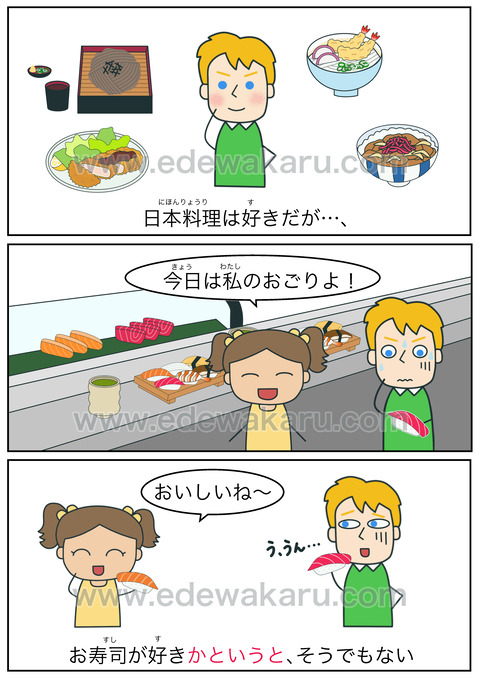
Meaning
In reality, ~ is not the case
Actually, ~ is not the case
How to use it
Verb, adjective, or noun [plain form] + かというと〜ない
Verb, adjective, or noun [plain form] + かといえば〜ない
Explanation
「Aかというと〜ない」 is a sentence pattern meaning “In reality, A is not the case” or “Actually, A is not the case.” It is used to say, “You might naturally think A because of ~, but in reality A is not the case,” or “People tend to think A, but actually it isn’t so.”
[Examples]
① I like Japanese food, but it’s not as if I like sushi.
→ It would be natural to think that I like sushi too because I like Japanese food, but I don’t like sushi.
② If you give your girlfriend an expensive present, it doesn’t necessarily mean she’ll be happy.
→ You might normally think she’d be happy if you gave her an expensive gift, but that isn’t always the case.
③ It doesn’t necessarily seem that rich people are happy.
→ People tend to think rich people are happy, but in reality that doesn’t seem to be the case.
④ It’s not necessarily true that anyone can become a singer if they sing well.
→ People normally think that if you sing well, you can become a singer, but that is not necessarily the case.
⑤ Work is very demanding, but it’s not that I want to quit.
→ People tend to think that when work is demanding, you want to quit, but that’s not the case.
「〜かというと〜ない」 is often used with 「〜とは限らない」, 「〜わけではない」, and 「〜というものではない」, so learn them together 😉
【Related patterns】
In context 5 examples
日本料理は好きだが、寿司が好きかというと、そうでもない
I like Japanese food, but it’s not as if I like sushi.
高いものをプレゼントしたら彼女が喜ぶかというと、そうではないこともある
If you give your girlfriend an expensive present, it doesn’t necessarily mean she’ll be happy.
お金持ちが幸せかというと、そういうわけでもなさそうだ
It doesn’t necessarily seem that rich people are happy.
歌がうまければ誰でも歌手になれるかというと、そうとは限らない
It’s not necessarily true that anyone can become a singer if they sing well.
仕事はとても大変だが、辞めたいかというと、そんなことはない
Work is very demanding, but it’s not that I want to quit.
Read the original source text
Meaning
実際は〜ではない
実は〜ではない
How to use it
動詞・形容詞・名詞[普通形]+かというと〜ない
動詞・形容詞・名詞[普通形]+かといえば〜ない
Explanation
「Aかというと〜ない」は「実際はAではない」「実はAではない」という意味の文型です。「〜だからAだと思うのが当然だが、実際はAではない」「普通に考えるとAだと思われがちだが、実はAではない」と言いたい時に使われます。
[例]
①日本料理が好きだが、寿司が好き
かというと、そうでもない
→日本料理が好きだから、お寿司も好きだと思われるのが当然だが、お寿司は好きではない
②高いものをプレゼントしたら彼女が喜ぶ
かというと、そうではないこともある
→高いものをプレゼントしたら彼女が喜ぶと思うのが普通だが、そうではないこともある
③お金持ちが幸せ
かというと、そういうわけでもなさそうだ
→普通に考えるとお金持ちは幸せだと思われがちだが、実際はそうではない
④歌がうまければ誰でも歌手になれる
かというと、そうとは限らない
→歌がうまければ歌手になれると思うのが普通だが、そうとは限らない
⑤仕事はとても大変だが、辞めたい
かというと、そんなことはない
→仕事が大変だと辞めたいと思っていると思われがちだが、そんなことはない
「〜かというと〜ない」は「〜とは限らない」「〜わけではない」「〜というものではない」などとよく使われますので、一緒に覚えておきましょう😉
【関連文型】
Usage 2
Read this source entry ↗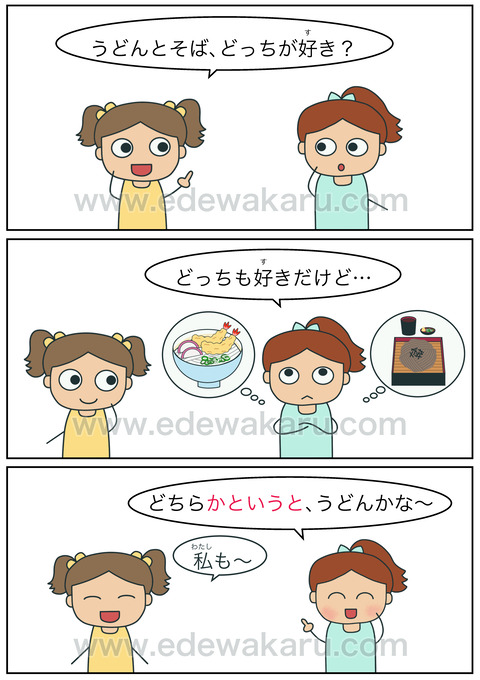
Meaning
To explain why ~
How to use it
Question word + かというと
Question word + かといえば
Explanation
「Aかというと」 is a sentence pattern meaning “to explain why A” or “to explain A.” A contains a question word. When giving a reason with expressions such as 「なぜかというと」 or 「どうしてかというと」, patterns such as 「〜からだ」 and 「〜ためだ」 are often used.
[Examples]
① A: Which do you like better, udon or soba?
B: I like both, but if I had to say which, I guess udon.
→ If I explain which one I like better, I’d say udon.
② She speaks English fluently. The reason is that she studied abroad in the United States.
→ To explain why, it’s because she studied abroad in the United States.
③ I don’t really like Yamada. The reason is that he’s very stingy.
→ To explain why, it’s because he’s very stingy.
④ I didn’t like studying when I was in elementary school. As for when I started liking it, that was when I became a high school student.
→ To explain when I started liking it, it was when I became a high school student.
⑤ I can’t stand natto. The reason is that it smells really bad.
→ To explain why, it’s because it smells really bad.
⑥ Teacher: Why are you studying Japanese?
Student: The reason is that I love Japanese anime.
→ To explain why, it’s because I love Japanese anime.
There is also the pattern 「〜かというと〜ない」, so learn it at the same time 😉
【Related patterns】
In context 6 examples
A: うどんとそば、どっちが好き?B:どっちも好きだけど、どちらかというと、うどんかな
A: Which do you like better, udon or soba? B: I like both, but if I had to say which, I guess udon.
彼女は英語がペラペラだ。どうしてかというと、アメリカに留学していたからだ
She speaks English fluently. The reason is that she studied abroad in the United States.
私はあまり山田くんが好きではない。なぜかというと、とてもケチだからだ
I don’t really like Yamada. The reason is that he’s very stingy.
小学生の頃は勉強が嫌いだった。いつ好きになったかというと、高校生になった時だ
I didn’t like studying when I was in elementary school. As for when I started liking it, that was when I became a high school student.
納豆が苦手だ。なぜかというと、とてもくさいからだ
I can’t stand natto. The reason is that it smells really bad.
先生:なぜ日本語を勉強していますか?学生:なぜかというと、日本のアニメが大好きだからです
Teacher: Why are you studying Japanese? Student: The reason is that I love Japanese anime.
Read the original source text
Meaning
〜かを説明すると
How to use it
疑問詞+かというと
疑問詞+かといえば
Explanation
「Aかというと」は「Aかを説明すると」「Aについて説明すると」という意味の文型です。「A」には疑問詞が入ります。「なぜかというと」「どうしてかというと」のように理由を言う場合は、「〜からだ」「〜ためだ」などの文型がよく使われます。
[例]
①A: うどんとそば、どっちが好き?
B:どっちも好きだけど、どちら
かというと、うどんかな
→どちらが好きかを説明すると、うどんだと思う
②彼女は英語がペラペラだ。どうして
かというと、アメリカに留学していたからだ
→どうしてかを説明すると、アメリカに留学していたからだ
③私はあまり山田くんが好きではない。なぜ
かというと、とてもケチだからだ
→なぜかを説明すると、とてもケチだからだ
④小学生の頃は勉強が嫌いだった。いつ好きになった
かというと、高校生になった時だ
→いつ好きになったかを説明すると、高校生になった時だ
⑤納豆が苦手だ。なぜ
かというと、とてもくさいからだ
→なぜかを説明すると、とてもくさいからだ
⑥先生:なぜ日本語を勉強していますか?
学生:なぜ
かというと、日本のアニメが大好きだからです
→なぜかを説明すると、日本のアニメが好きだからです
「〜かというと〜ない」という文型もありますので、一緒に覚えておきましょう😉
【関連文型】
日本語文型辞典 英語版
Usage 1
Meaning
When かというと is used with a negative expression in phrases such as Xかというとそうではない or Xかというとそうとは限らない, X is negated, even though X would have been the obvious outcome judging from the context of the preceding sentence. For example, in
(1)
, because “she likes her job so much,” one might expect that “she would devote herself to her job even at the expense of her personal time,” but in reality, this is not the case. かといえば is also used.
B:なんでかっていうとね、大家さんがうるさくて、友達を呼ぶと文句を言われるし、おまけに壊れたところも直してくれないのよね。
Well, to tell you the truth, the landlord is in my face all the time, complaining when I invite friends over, and—what’s more—he won’t repair anything that breaks down.
Attaches to a question with a question word in it and is used to indicate the point of the question. The answer to the question follows. When a reason is expressed, as in
(1)
, the sentence often ends with からだ, ためだ, or のだ. どうしてかというと and なぜかというと (both meaning “the reason being”) are idiomatic expressions. Used to explain something by asking oneself to come up with an answer. かといえば can also be used.
How to use it
1. ...かというと[N/Na (なの)かというと][A/V (の)かというと]
2. question word + かというと
In context 10 examples
彼女はその仕事が気に入っているそうだ。しかし自分の時間を犠牲にしてでも打ち込んでいるかというと、そこまでは行かないらしい。
I hear she likes her job very much. Having said that, she doesn’t seem to like it enough to sacrifice her own free time for it.
私はこの国に失望させられた。しかし、まったく見捨ててしまったのかというと、そうでもない。
I have been disappointed by this country. However, if you asked me whether or not I’ve abandoned it completely, I would say no.
彼女はケーキ作りがとても上手なのだが、甘いものが好きなのかといえば、そうでもない。
She is very good at making cakes, but whether she likes sweet things or not is another matter.
彼は入社して3ヶ月で会社を辞めてしまった。仕事や給料が不満だったのかというとそういうわけではなくて、もともと大学院に行きたかったので就職する気はなかったのだということだった。
He quit his job within three months. It wasn’t that he was dissatisfied with the work or the salary, but rather that he wanted to go to graduate school and really had no intention of starting a career in the first place.
私は彼がきらいだ。どうしてかというと、いつも人の悪口ばかり言っているからだ。
I don’t like him, and if you want to know why, it’s because he’s always badmouthing people.
私は一度も海外に行ったことがない。どうしてかというと、飛行機に乗るのが恐いからだ。
I have never been abroad. The reason I haven’t is that I’m scared of flying.
祖父がいつごろこの家を建てたかというと、戦争が終わってすぐの頃、食べるものも満足に手に入らないような苦労の時代だ。
To tell you about the time when my grandfather built this house—it was just after the war ended, and things were so bad that people couldn’t even get enough food.
彼は入社して3ヶ月で一流企業を退職してしまった。やめて何をするかというと、インドへ行って仏教の修行をするらしい。
He’s left a leading company after three months. What he’ll do after quitting his job is to go to India and devote himself to Buddhist training.
機械の苦手な私がどうやってパソコンに慣れたかというと、友達とパソコンでゲームをして遊んでいるうちに、だんだん恐くなくなってきたのだ。
If you want to know how someone as technically challenged as I am learned how to use a PC, it’s that I gradually got over my fear by playing computer games with friends.
A:なんで引っ越すの。今のアパート、家賃も安いし広いのに。
Why are you moving? The apartment you live in now is reasonable and roomy.
Read the original source text
Meaning
When かというと is used with a negative expression in phrases such as Xかというとそうではない or Xかというとそうとは限らない, X is negated, even though X would have been the obvious outcome judging from the context of the preceding sentence. For example, in
(1)
, because “she likes her job so much,” one might expect that “she would devote herself to her job even at the expense of her personal time,” but in reality, this is not the case. かといえば is also used.
B:なんでかっていうとね、大家さんがうるさくて、友達を呼ぶと文句を言われるし、おまけに壊れたところも直してくれないのよね。
Well, to tell you the truth, the landlord is in my face all the time, complaining when I invite friends over, and—what’s more—he won’t repair anything that breaks down.
Attaches to a question with a question word in it and is used to indicate the point of the question. The answer to the question follows. When a reason is expressed, as in
(1)
, the sentence often ends with からだ, ためだ, or のだ. どうしてかというと and なぜかというと (both meaning “the reason being”) are idiomatic expressions. Used to explain something by asking oneself to come up with an answer. かといえば can also be used.
How to use it
1. ...かというと[N/Na (なの)かというと][A/V (の)かというと]
2. 疑問詞+かというと
Usage 2
Meaning
This pattern takes the form なぜ...かというと or なぜ...かといえば and is used to explain the reason for a certain result or a current situation. なぜ is followed by a description of the result or situation, and the reason is stated in the subsequent clause.
This pattern is usually accompanied by the use of からだ (because/since) at the end of the sentence のだ (since/because) can also be used, as shown in
(4)
.
In context 4 examples
なぜ遅刻したかというと、出かける前に電話がかかったからです。
The reason I was late is that I got a phone call right before I left home.
なぜ偏西風が吹くのかというと、地球が自転しているからだ。
The reason the westerlies blow is that the earth is rotating on its axis.
なぜアメリカに留学したかといえば、親戚がいるからです。
The reason I studied in the United States is that I have relatives there.
なぜあんなに勉強しているのかといえば、彼は弁護士資格をとるつもりなのです。
The reason he’s studying so hard is that he’s planning to get the qualifications he needs to become a lawyer.
AIUEO JLPT Grammar
Usage 1
Meaning
This sentence pattern is used to indicate that the answer or result is negative, contrary to general expectations or assumptions. It is used when the speaker expresses that something is not necessarily true from their perspective.
How to use it
Plain sentence か + と + いうと + negative sentence; Plain sentence か + と + いえば + negative sentence
In context 5 examples
日本料理が好きかと言いますと、実はそうでもないです。
To tell you the truth, I don't really like Japanese food.
この問題は簡単そうに見えるが、簡単かというと意外に難しい。
This problem looks simple, but if you ask whether it’s really simple, it’s surprisingly difficult.
努力すれば成功するかというと、必ずしもそうではない。
If you ask whether effort guarantees success, that’s not always the case.
彼は親切だが、頼りになるかといえば、そうでもない。
He’s kind, but if you ask whether he’s reliable, not really.
有名なレストランだったが、美味しかったかといえば、普通だった。
It was a famous restaurant, but if you ask whether the food was delicious, it was just average.
Read the original source text
Meaning
This sentence pattern is used to indicate that the answer or result is negative, contrary to general expectations or assumptions. It is used when the speaker expresses that something is not necessarily true from their perspective.
How to use it
普通文か+と+いうと+否定文普通文か+と+いえば+否定文
Explanation · 日本語
この文型は、一般的な期待や考えに反して、その答えが否定的であることを表す表現です。話し手の視点から、必ずしもそうではないと述べるときに使われます。
Usage 2
Meaning
This sentence pattern is used when providing an answer or reason for a question or matter. It is used when the speaker gives an explanation based on their subjective opinion or situation.
How to use it
Interrogative word か + と + いうと; Interrogative word か + と + いえば
In context 5 examples
なぜ彼が辞めたかというと、家庭の事情があったからです。
If you ask why he quit, it’s because he had family issues.
どうして彼女が怒ったかといえば、私が約束を破ったからです。
If you ask why she got angry, it’s because I broke my promise.
何が問題かというと、資金が足りないことです。
If you ask what the problem is, it’s that we don’t have enough funds.
どうやって解決するかというと、まず話し合いが必要です。
If you ask how to solve it, the first step is to have a discussion.
どちらかと言えば、私は家でゆっくりするのが好きです。
If I had to choose, I prefer relaxing at home.
Read the original source text
Meaning
This sentence pattern is used when providing an answer or reason for a question or matter. It is used when the speaker gives an explanation based on their subjective opinion or situation.
How to use it
疑問詞か+と+いうと疑問詞か+と+いえば
Explanation · 日本語
この文型は、ある疑問や事柄に対する答えや理由を提示するときに使われる表現です。この文型は、話し手の主観や状況に応じた説明を述べるときに用いられます。
Bunpro Grammar Reference
Usage 1
Meaning
Why? Well..., Why? Because..., If you ask me why..., The reason why is..., It is because...
How to use it
どうして(1) + Phrase (A) + かというと(2) + Phrase (B) + からだ(3)
Phrase (A)。どうして(1) + かというと(2) + Phrase (B) + からだ(3)
どうして(1) + Verb + (の) + かというと(2)
(1) なぜ
(2) かといえば
(3) のだ、ためだ
どうして(1) + Phrase (A) + かというと(2) + Phrase (B) + からです(3)
Phrase (A)。どうして(1) + かというと(2) + Phrase (B) + からです(3)
どうして(1) + Verb + (の) + かというと(2)
(1) なぜ
(2) かといえば
(3) のです、ためです
Nuance
A hypothetical structure indicating that if someone were to ask the question of (A), (B). Used for giving reasons.
Explanation
~かというと is a phrase that has two primary functions. The first is used in conjunction with 'why' and 'how' words, like どうして or なぜ, while the other is used with 'who', 'when', 'where', and 'what'. We will focus on the former in this lesson. かというと is a combination of the case marking particle か in its use as a question marker, the case marking particleと in its citation use, the う - Verb 言う 'to say', and the case marking particle と in its result use.
This is quite a few particles combined together, but the literal meaning is more simply 'if (A) were to be asked', before the speaker will go on to highlight their reasoning in (B).
どうして明日のパーティーに行きたくないかというと、元カレが来ると聞いたからです。
The reason why I don't want to go to tomorrow's party is because I heard that my ex-boyfriend is coming.
なぜこの計画で進めようと思ったかというと、以前この計画に似たプランが成功したからです。
The reason why we have decided to continue with this plan is because a similar plan succeeded last time.
As ~かというと will come before some sort of explanation, から will also regularly be used at the end of the sentence as 'because', emphasizing the speaker's reasoning.
Caution
Like other grammar points that utilize the 'if' nuance of と, ば, and sometimes even たら may be used. However, たら will appear far less frequently than と or ば.
どうして冬でも冷房をかけているかと言えば、お客さんに汗をかかずに買い物をさせる為です。
If you ask me why we keep the air conditioning on even in the winter, it is because we want the customers to shop without sweating.
なぜ安い方を選んだかといったら、安いやつも、高いやつもついている機能が同じだからです。
If you ask me why I picked the cheaper one, it is because both the cheaper one and the expensive one have the same functionality.
In context 16 examples
- なぜ彼はそれをしたのかというといまだに私自身もわからない。
If you ask me why he did that, well, even now I don't know.
- どうして明日のパーティーに行きたくないかというと、元カレが来ると聞いたからです。
The reason why I don't want to go to tomorrow's party is because I heard that my ex-boyfriend is coming.
- なぜこの計画で進めようと思ったかというと、以前この計画に似たプランが成功したからです。
The reason why we have decided to continue with this plan is because a similar plan succeeded last time.
- どうしてそのブランドのスマホは買いたくないかっていうと、前に一回買ったけど二週間で壊れたんだよね.
If you ask me why I don't want to buy that brand of smartphone, it is because I bought one before and it broke in (just) two weeks.
- キリンには長い首がある。なぜかというと、その長い首を使って高い木の上にある葉を食べるためだ。
Giraffes have long necks. The reason why is because by using their long necks they can eat leaves on the top of trees.
- どうしてバスを使うよりは自転車を使うようにしているかというと、自転車はより安いばかりではなくて交通渋滞の中でもより速いからです。
If you ask me why I do my best to bike (to work) rather than take a bus, it is because bicycles are not only cheaper but also faster in traffic.
- 法律によって犬や猫にチップをつけることが要求されています。なぜかというとペットが捨てられた場合にすぐにオーナーがわかるようにするためです。
The law requires that dogs and cats be microchipped. Why? Because in the event that the pet is abandoned, the microchip will allow the owner to be quickly identified.
- A(エー):「どうしてそんなことを言うの?」
B(ビー):「どうしてかというと、あーの、えーと、A(エー)さんのことが心配だからです。」A: 'Why are you saying this?' B: 'If you ask me why, hmm...uhhh... It's because I am worried about you.'
- なぜアイスクリームトラックが音楽を流しているのかといえば、それはお客さんにその地域でアイスクリームを売っていることを知らせるためです。
If you ask me why ice cream trucks are playing music, it is because it lets customers know they are selling in the area.
- どうしてそれはグラファイトからできているかというと、答えは単に値段がかなり安いからです。
If you ask me why it is made from graphite, well the answer is simple, because it is quite cheap.
- ニューヨークは驚きだらけの街だ。なぜかというと毎日地下鉄で有名人に会う可能性が高いからです。
New York is a city full of surprises. If you ask me why, it is because there is a high chance of meeting famous people on the metro every day.
- なぜこれほど両親に感謝しているのかというと食べ方を始めとして知っていることすべて教えてくれたからだ。
If you ask me why I am so grateful to my parents, it is because they taught me everything I know, starting with how to eat.
- なぜそのようにするべきかというと、それが効果的だから、それだけの話です。
If you ask me why we have to do it like that, it is because it is effective, and that's all.
- 新しいノートパソコンを買うべきかどうか迷っている。どうしてかというと、今持ってるのもまだきちんと動くけど新しいのがより速いから。
I am not sure if I should buy a new laptop or not. Why? Because, while the one I have now still works fine, the new one would be faster.
- どうして冬でも冷房をかけているかと言えば、お客さんに汗をかかずに買い物をさせる為です。
If you ask me why we keep the air conditioning on even in the winter, it is because we want the customers to shop without sweating.
- なぜ安い方を選んだかといったら、安いやつも、高いやつもついている機能が同じだからです。
If you ask me why I picked the cheaper one, it is because both the cheaper one and the expensive one have the same functionality.
Usage 2
Meaning
If you ask me..., If I had to say, If I were to say, If I were to choose one, I'd rather
How to use it
Question Word + (の(1)) + かというと(2)
Question Word + Phrase + (の(1)) + かというと(2)
(1) ん
(2) かといえば
Nuance
A hypothetical expression, highlighting that if you were to ask or say (A) to the speaker, their reply would be (B).
Explanation
~かというと is a phrase that has two primary functions. The first is used in conjunction with 'why' and 'how' words, while the other is used with 'who', 'when', 'where', 'which' or 'what'. We will focus on the latter in this lesson. かというと is a combination of the case marking particle か in its use as a question marker, the case marking particle と in its citation use, the う - Verb 言う 'to say', and the case marking particle と in its result use.
This is quite a few particles combined together, but the literal meaning is more simply 'if (A) were to be asked', before the speaker will go on to highlight their reasoning in (B). 何で, 何, どちら, 誰, どの, and similar words often appear as the 'who', 'where', or 'which' words in these sentences.
何で日本に引っ越して来たかというと 、私の家族が日本に住んでいるからです。
If I were to say why I moved to Japan, it is because my family lives here.
誰と旅行に行きたいかというと 、大親友と行きたい。
If I were to say who I wanted to travel with, it would be my best friend.
どの街に住みたいかというと 、両親が住んでいる街に住みたいと思っています。
If I were to say which city I wanted to live in, I think it would be the city that my parents do.
As ~かというと will come before some sort of explanation, から will also regularly be used at the end of the sentence as 'because', emphasizing the speaker's reasoning.
Caution
Like other grammar points that utilize the 'if' nuance of と, ば, and sometimes even たら may be used. However, たら will appear far less frequently than と or ば.
何でこんな事になったかといえば、私がきちんと確認をしなかったからです。
If I were to say why something like this happened, well, it is because I did not check properly.
誰が一番上手かといったらB(ビー)組のタカハシさんです。
If I were to say who was the best, it would be Takahashi-san from class B.
In context 17 examples
- 一方、自分にとってどちらかというと丈夫な車のほうが優れていると思う。
On the other hand, if you ask me, I think that sturdy cars are superior.
- どの街に住みたいかというと 、両親が住んでいる街に住みたいと思っています。
If I were to say which city I wanted to live in, I think it would be the city that my parents do.
- 何で日本に引っ越して来たかというと 、私の家族が日本に住んでいるからです。
If I were to say why I moved to Japan, it is because my family lives here.
- 誰と旅行に行きたいかというと 、大親友と行きたい。
If I were to say who I wanted to travel with, it would be my best friend.
- イオさん:「どっちのほうがいいの?」
ツミキさん:「どどどっちかっていうと、こっちのほう...」Io: 'Which do you like more?' Tsumiki: 'If, if, if I were to say, I like this more...'
- イチカさん:「ミクちゃんは好きな人がいるみたいに見えるよ。」
イツキさん:「誰が好きかっていうときっとフウタロウくんでしょう。」Ichika: 'It looks like Miku has a crush on someone.' Itsuki: 'If I were to say on who, then it would be Futaro.'
- ヨツバさん:「その犬はどのくらい大きいの?」
フウカさん:「どのくらい大きいかというと....えーと....こんなに大きいくらいでしょう。」Yotsuba: 'How big was that dog?' Fuuka: 'If you ask me how big, hmmm, I think about this big?'
- 何でこんなことになったかというと、すべてが始まったのは一週間ほど前に学校から帰っていた時...
If I were to say why it turned out like this, well, it all started around 1 week ago when I was coming back from school...
- オティス:「人生で最も大切にしているのは何かというと、それは人でしょう。私が一人ぼっちだった時助けてくれた人たちのことです。」
Otis: 'If I were to say what do I value in life the most, that would be: people. (Specifically) the people who helped me when I was all alone.'
- コウさん:「明日、用事ある?一緒にどこかに行く?」
ニノさん:「用事があるわけではないけど、どちらかっていうと家でゆっくりしたい。」Kou: 'Do you have plans for tomorrow? Do you want to go somewhere together?' Nino: 'It is not like I have plans, but if I were to choose one, I'd rather take it easy at home.'
- 何を晩ご飯に食べたいかっていうと...よく分からない...焼きそばかもしれん...
If I were to say what I want for dinner... I don't know... yakisoba, maybe...
- 3ヶ月後に日本語能力試験を受ける予定です。合格したら何をするかといえば、日本に旅行に行くかもしれません。
I plan to take the JLPT in three months. If I were to say what I would do if I passed, perhaps I would take a trip to Japan.
- ブンポウちゃん:「いつあたしを好きになった?」
ユーザーくん:「いつかというと、窓を開けっぱなしにして君がすごく怒った日だろう。」Bunpou-chan: 'When did you fall in love with me?' User-kun: 'If I were to say when it would probably be the day when I left the window open and you got really angry.'
- どんな人なのかというと一見怖そうなのに実は天使のように優しい人です。
If I were to say what kind of person he is, it would be a person that looks scary at first glance, but in reality, is as kind as an angel.
- それがどのように起こったかというと、労働者が安全第一というルールに従わなかったためだ。
If I were to say how it happened, it was because workers didn't follow the safety-first rule.
- 何でこんな事になったかといえば、私がきちんと確認をしなかったからです。
If I were to say why something like this happened, well, it is because I did not check properly.
- 誰が一番上手かといったらB(ビー)組のタカハシさんです。
If I were to say who was the best, it would be Takahashi-san from class B.
DoJG 日本語文法辞典(全集)
Meaning
You would think that ~ but (that is not right)
How to use it
(i) ~{V/Adjective い} informal | かと言うと、S | |
| {話す /話した} かと言うと | You would think that someone talks/talked but ~ |
| {高い /高かった} かと言うと | You would think that something is/was expensive but ~ |
(ii) {Adjective な stem/ Noun} | {Ø/だった} かと言うと、S | |
| {静か /静かだった} かと言うと | You would think that something is/was quiet but ~ |
| {先生/先生だった} かと言うと | You would think that someone is/was a teacher but ~ |
Explanation
A conjunction to indicate the speaker's assertion that a popular belief is not right.
In context 7 examples
日本人はみんな寿司が好きかと言うと、そうではない。嫌いな人もいる。
You would think that all the Japanese like sushi, but that is not true. Some Japanese don't like it.
がんは治らない病気かと言うと、そうではない。早期発見をすれば治ると言われている。
You would think that cancer is not curable, but that is not true. If it is detected early it is said to be curable.
日本に行って、二、三年住めば日本語が上手になるかと言うと、そうでもないようだ。かえって下手になることもある。
You'd think that if you went to Japan and lived there for a few years, your Japanese would become good, but that doesn't seem to be true. On the contrary, your Japanese may become worse than before.
大学の時にいい成績の学生が社会で成功するかと言うと、必ずしもそうではないようだ。
You'd think that a college student with good grades would be successful in society, but that doesn't always seem to be the case.
毎日運動をすれば長生きをするかと言うと、そうでもなさそうだ。
You'd think that if you did exercise every day, you would live long, but that does not seem to be true.
日本語は難しいかと言うと、話したり聞いたりすることはそんなに難しくない。
You'd think that Japanese would be hard, but speaking and listening are not that hard.
ボストンでの車なしの生活が不便だったかと言うと、全然そうではなかったんです。
You'd think that my life without a car in Boston must have been inconvenient, but it wasn't at all.
毎日のんびり日本語教師
How to use it
① Verb in plain form + (の)かと言うと
い-adjective in plain form + (の)かと言うと
な-adjective stem + (なの)かと言うと
Noun + (なの/であるの)かと言うと
② Question phrase + かと言うと
Explanation
There are two uses.
① In fact, that is not the case
First, the preceding clause states an assumed fact, and the following clause denies a result that would necessarily follow from that fact. The preceding clause may occur together with 「【N2文法】~からといって/からって/からとて」, and the following clause denies it using expressions such as 「~ではない」 or 「必ずしも~とは限らない」.
【A】。しかし【B】かと言うと【そうではない】
【A】からと言って【B】かと言うと【そうではない】
② Circumstances
This use raises a question about a phrase containing an interrogative, answers that question oneself, and adds an explanation. This pattern serves to focus attention on that question.
「どちらかと言うと」 is used idiomatically to mean “if anything” or “generally speaking.”
Notes
Nothing in particular.
In context 15 examples
絵が上手であれば誰でも漫画家になれるかと言えば、そうとは限らない。
Does being good at drawing mean that anyone can become a manga artist? Not necessarily.
付き合っているからと言って二人の関係が必ずしも良いかというとそういうわけでもない。
Just because they are dating doesn’t necessarily mean their relationship is good.
資格を取ったからと言って、すぐ希望の仕事に就けるかというとそうではない。
Just because you get a qualification doesn’t mean you can immediately get the job you want.
長く付き合ったからと言って結婚後幸せになれるかと言うとそうではないし、短いお付き合いで結婚してすぐ別れることになるかというとそういうわけでもない。
Just because you dated for a long time doesn’t mean you’ll be happy after getting married, and just because you marry after a short courtship doesn’t necessarily mean you’ll soon break up.
努力したからと言ってみんなが成功するかと言うと、そうとは限らない。
Just because you make an effort doesn’t mean everyone will succeed.
1か月も経たずに仕事を辞めた。会社に不満があったかと言うとそういうわけでもないが、何だか自分には合わない気がした。
I quit my job before even a month had passed. It wasn’t that I was dissatisfied with the company, but somehow I felt it wasn’t right for me.
私はどっちかと言うと前向き思考な人間。
If I had to say, I’m a positive thinker.
どっちかといえば子供は苦手。
If I had to say, I’m not very good with children.
うどん派かそば派かといえばうどん派。
If I had to choose between udon and soba, I’d choose udon.
自分がいつ変わったかといえば、新卒で入った会社を辞めた時です。
If I had to say when I changed, it was when I quit the company I joined as a new graduate.
見るだけだと分からないけど、彼女はどっちかというと日本人っぽい。
You can’t tell just by looking, but if I had to say, she looks Japanese.
成功を手にした人たちは何が違うのかというと「行動を起こしている」ということです。
What sets people who have achieved success apart is that they take action.
一度も海外に行った事がない。なぜかというと日本語しか話せないからだ。
I’ve never been abroad. The reason is that I can only speak Japanese.
Aさんは30歳で退職した。辞めて何をするかと言えば、自分で起業するらしい。
Mr. A retired at 30. As for what he’ll do after quitting, apparently he plans to start his own business.
雪を見たことがない。なぜかというと南国生まれだからだ。
I’ve never seen snow. The reason is that I was born in a tropical country.
Read the original source text
How to use it
①動詞普通形+(の)かと言うと
イ形容詞普通形+(の)かと言うと
ナ形容詞語幹+(なの)かと言うと
名詞+(なの/であるの)かと言うと
②疑問句+かと言うと
Explanation
2つの用法があります。
①実はそうではない
まず前件で前提となる事実を述べ、その事実から必然的に導き出される結果を否定します。前件では「【N2文法】~からといって/からって/からとて」が呼応することもあり、後件では「~ではない」「必ずしも~とは限らない」などの言い方で否定します。
【A】。しかし【B】かと言うと【そうではない】
【A】からと言って【B】かと言うと【そうではない】
②事情
疑問詞を伴った句について疑問を提示し、その疑問に自ら答え、解説を加える用法です。この文型はその疑問に対してフォーカスを当てる役割があります。
「どちらかと言うと(说起来/总的来说)」は慣用的に用います。
Notes
特になし