日本語文型辞典
Meaning
Indicates that something is one of X and Y. With adjectives and verbs, it can also be used paired with a negative form, as in ⑤ and the following example.
Also, as in ⑦, two or more things may be listed.
Used to give examples of the main items among a range of choices.
Lists two things with negative meanings and indicates that something is in one of those states. What follows describes trouble or some other undesirable consequence caused by that state. It may also take the form “XかYかしていて,” as in the following examples.
Expresses the meaning “…whether … or not” or “…or not.” Used to turn a choice question answered with “yes” or “no” into a noun-equivalent and embed it as part of a sentence. For example, in ①, the sentence “Is that person coming?” replaces the “that” in “Do you know that?” Words such as “not know,” “not understand,” “be doubtful,” “not be confident,” and “decide” often follow.
a. …か…ないか
⇾か1
b. …か…ない(か)
Repeats the affirmative and negative forms of the same verb to indicate an unclear, delicate point at which it is hard to tell whether someone is “…doing” or “…not doing” something. For past events, ① can also be phrased as “入ったか入らないか.”
Used to turn a question containing an interrogative into a noun-equivalent and embed it as part of another sentence. For example, in ①, the sentence “When did he die?” replaces the “that” in “Do you know that?” The predicate before “か” is in the plain form.
a. 疑問詞+か
Attached to interrogatives such as “なに・だれ・どこ・いつ,” it indicates something that is not known or decided specifically, or need not be stated.
b. 何+数量詞+か/いくつか
When “か” is attached to an indefinite quantity such as “何本” or “いくつ,” it indicates that the exact quantity cannot be given, but that it is not very large.
Used in forms such as “Xからか、Y” to conjecture that X may be the reason for Y. The emphasis is on Y. The “か” often appears in a reason-giving form such as “からか・せいか・ためか・のか.” For example, ① means “It feels cool today. Perhaps it is because there is a breeze.”
⇾ことか
⇾どころ
⇾ばかりか
⇾ものか
How to use it
…か…か
NかN(か)
NaかNaか
AかAか
VかVか
Nか + question word + か
…か…かで
NかN(か)で
NaかNaかで
AかAかで
VかVかで
…かどうか
N/Na/A/V かどうか
…か…ないか
V-dictionary formかVない(か)
V-たかV-ない(か)
question word…か
question word + か
…からか/…せいか/…のか
…ことか
10 …どころか
11 …ばかりか
12 …ものか
In context 44 examples
電車かバスで行くつもりだ。
I intend to go by train or bus.
水曜か金曜の夜なら都合がいいのですが。
Wednesday or Friday evening would work for me.
ネクタイはこれかそれかどっちがいいだろう。
Which tie would be better, this one or that one?
進学か就職かで悩んでいる。
I'm agonizing over whether to go on to further studies or get a job.
その映画がおもしろいかおもしろくないかは見てみなければわからない。
You won't know whether that movie is interesting or not unless you watch it.
二次会は、カラオケに行くかもう少し飲むか、どっちがいいでしょうか。
For the after-party, which would be better: going to karaoke or having a few more drinks?
夏休みは、香港か台湾かシンガポールに行きたい。
For summer vacation, I want to go to Hong Kong, Taiwan, or Singapore.
体が健康か不健康かは顔色で判断できることもある。
Sometimes you can tell from a person's complexion whether they are healthy or unhealthy.
(例) 行くか行かないか決めてください。
(Example) Please decide whether to go or not.
プレゼントはコーヒーカップか何かにしよう。
Let's get coffee cups or something as a present.
その仕事は内田さんか誰かに頼むつもりだ。
I plan to ask Uchida or someone else to do that job.
夏休みは、北欧かどこか、涼しいところに行きたい。
For summer vacation, I want to go somewhere cool, like Scandinavia or someplace.
また来週かいつかお電話しましょうか。
Shall I call you again next week or sometime?
あの人の話は、たいてい自分の自慢話か仕事の愚痴かで、聞いているとうんざりする。
That person usually talks either about how great they are or complains about work; listening to them is exhausting.
あの人は毎晩飲み屋で飲んでいるかカラオケバーに行っているかで、電話してもほとんどつかまらない。
That person is either drinking at a bar every night or going to a karaoke bar, so they're almost impossible to catch even when I call.
最近の学生はアルバイトで忙しいかクラブ活動で疲れているかで、あまり家で勉強していないようだ。
Students these days are either busy with part-time jobs or tired from club activities, and don't seem to study much at home.
家賃が安い家は交通が不便か部屋がきたないかで、どこか欠点があるような場合が多い。
Cheap houses often have some drawback, such as inconvenient transport or dirty rooms.
(例) 彼はパーティーでもずっと飲むか食べるかしていて、全然他の人としゃべろうとしない。
(Example) Even at parties, he just keeps eating or drinking and doesn't try to talk to anyone at all.
あの人が来るかどうか知っていますか。
Do you know whether that person is coming?
それが本物のパスポートかどうかはあやしい。
It's doubtful whether that's a genuine passport.
その映画がおもしろいかどうかは見てみなければ分からない。
We won't know whether that movie is interesting unless we watch it.
このようなアドバイスが適切かどうかわかりませんが、お役に立てれば幸いです。
I don't know whether this kind of advice is appropriate, but I hope it will be of help.
行くか行かないか決めて下さい。
Please decide whether to go or not.
面白いか面白くないか分からない。
I don't know whether it's interesting or not.
去年彼女に会ったのは、たしかゴールデンウイークに入るか入らないかの頃だったと思います。
I think I met her last year sometime around when Golden Week was just about to begin.
ベルが鳴り終わるか終わらないうちに、生徒達は外へ飛び出していった。
The students rushed outside almost as soon as the bell stopped ringing.
顔こえるか聞こえないかぐらいの程度だが、このレコードには変なノイズが入っている。
There's a strange noise on this record, though it's barely audible.
この銃は引き金に指が触れるか触れないかで弾が飛び出すので、慎重に扱う必要がある。
This gun fires as soon as your finger touches the trigger, so it must be handled carefully.
彼がいつ亡くなったか知っていますか。
Do you know when he died?
パーティーに誰を招待したか忘れてしまった。
I forgot whom I invited to the party.
人生において重要なのは、何をやったかではなく、いかに生きたかということであろう。
What matters in life is not what one has done, but how one has lived.
人類の将来は、地球環境をいかに守っていくかにかかっていると言っても過言ではない。
It is no exaggeration to say that humanity's future depends on how we protect the global environment.
彼はどうも何かを隠しているらしい。
He seems to be hiding something.
誰かに道を聞こう。
Let's ask someone for directions.
あの人にはいつか会ったことがある。
I've met that person before, sometime or other.
郊外のどこかに安くて広い土地はないだろうか。
I wonder if there's any cheap, spacious land somewhere in the suburbs.
ビールなら冷蔵庫に何本かある。
There's a few bottles of beer in the refrigerator.
鉢植えをいくつか買ってきてべランダに置こう。
Let's buy a few potted plants and put them on the balcony.
男子学生を何人か呼んできて手伝ってもらえば、これくらいの荷物はすぐ運べる。
If we call a few male students to come help, we can move this much luggage in no time.
いつかアフリカに何年か住んでみたい。それが私の夢だ。
Someday, I'd like to live in Africa for a few years. That's my dream.
彼女は自分も留学経験があるからか、留学生の悩みの相談によくのってあげている。
Perhaps because she has studied abroad herself, she often listens to international students' concerns and offers advice.
今日は風があるせいか、日差しが強いわりには涼しく感じられる。
Perhaps because there's a breeze today, it feels cool despite the strong sunshine.
彼はそれを知っていたのか、私の話を聞いても特に驚いた様子はなかった。
Perhaps he knew about it; even after hearing what I said, he didn't seem particularly surprised.
彼は家が本屋だからか、いろんな分野の本をよく読んでいるし、趣味で小説も書くらしい。
Perhaps because his family owns a bookstore, he reads books in all sorts of fields and apparently writes novels as a hobby, too.
Read the original source text
Meaning
XとYのうちのどちらかひとつであることを表す。形容詞や動詞の場合は⑤や次の例のように否定の形とペアで使うこともできる。
また⑦のように2つ以上のものが列挙されることもある。
選択肢の中の主なものとして例をあげるのに用いる。
マイナスの意味を持つことを二つあげ、そのどちらかの状態であることを表す。後にはそれによって困ったりまずいことが起こったりすることを述べる。次のように「XかYかしていて」となることもある。
「…するか…しないか」「…か…でないか」の意味を表す。「はい」「いいえ」で答える選択疑問文を名詞の資格に変えて文の一部に埋め込むのに用いる。例えば①で「あの人は来ますか」という文を「あなたはそれを知っていますか」の「それ」の部分に入れかえたもの。後に「知らない/分からない/あやしい/自信がない/決める」などの語が続く。
a. …か…ないか
⇾か1
b. …か…ない(か)
同じ動詞の肯定形と否定形を続け「…する」か「…しない」のどちらであるかよくわからないくらいの不明確で微妙な段階であることを表す。過去のことである場合は、①なら「入ったか入らないか」と言うこともできる。
疑問詞を伴う疑問文を名詞の資格に変えて、他の文の一部に埋め込むのに用いる。例えば①で、「彼はいつ亡くなりましたか」という文を「あなたはそれを知っていますか」の「それ」の部分と入れかえたもの。「か」の前は述語の普通体を用いる。
a. 疑問詞+か
「なに・だれ・どこ・いつ」などの凝問詞に付いて、具体的にはっきりとはわからない、決まっていない、または言う必要のないものを表すのに用いられる。
b. 何+数量詞+か/いくつか
「何本」「いくつ」などの不定の数量に「か」が付いて、はっきりした数量は言えないがあまり多くはないということを表す。
「Xからか、Y」などの形で、Yの理由をXだろうかと推量して述べるのに用いる。Yの方に重点がおかれている。「か」の部分は「からか・せいか・ためか・のか」などの理由を表す形になることが多い。例えば①では「今日は涼しく感じられる。おそらく風があるせいだろう」の意味。
⇾ことか
⇾どころ
⇾ばかりか
⇾ものか
How to use it
…か…か
NかN(か)
NaかNaか
AかAか
VかVか
Nか+疑問詞+か
…か…かで
NかN(か)で
NaかNaかで
AかAかで
VかVかで
…かとうか
N/Na/A/V かとうか
…か…ないか
V-るかV-ない(か)
V-たかV-ない(か)
疑問詞…か
疑問詞+か
…からか/…せいか/…のか
…ことか
10 …どころか
11 …ばかりか
12 …ものか
絵でわかる日本語
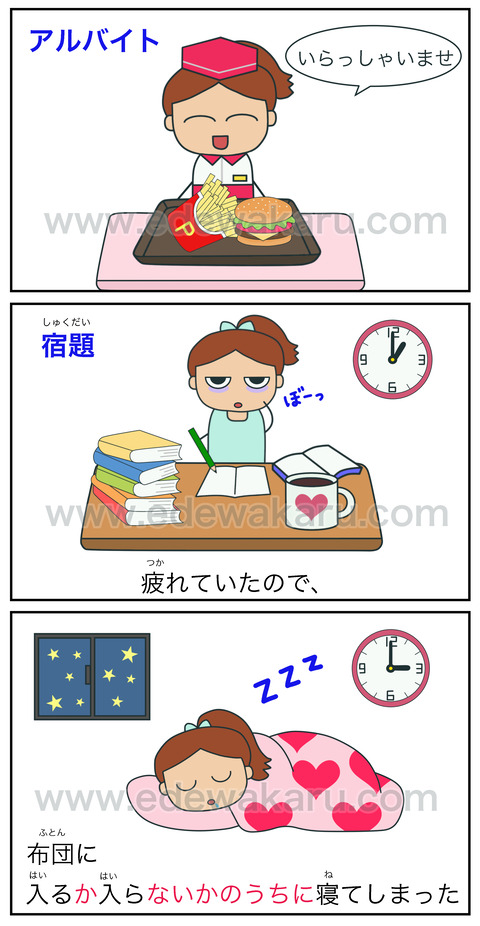
Meaning
As soon as …
As soon as … happens
How to use it
Verb [dictionary form] + か + Verb [ない-form] + かのうちに
Explanation
“〜か〜ないかのうちに” is a sentence pattern meaning “as soon as…”. It is used in the form “AかAないかのうちにB” when you want to emphasize “B happens shortly after A begins” or “B happens almost simultaneously with A.” 😊 This pattern is used for something that has already happened, so remember that it is usually followed by the た-form (other dictionaries also give examples in the non-past form). 😉
[Examples]
① I got into bed
か
before I knew it, I had
ないかのうちに
fallen asleep.
② The cakes had all sold out
か
before the shop had
ないかのうちに
opened.
③ The train came
か
as soon as I had
ないかのうちに
arrived at the station.
④ It started raining
か
as soon as the clouds had
ないかのうちに
started appearing.
There are many sentence patterns meaning “as soon as…,” so be sure to distinguish them and learn them carefully. 😀
[Related sentence patterns]
In context 4 examples
疲れていたので、布団に入るか入らないかのうちに寝てしまった
→疲れていたので、布団に入ったらすぐに寝てしまったBecause I was tired, I fell asleep as soon as I got into bed. → Because I was tired, I fell asleep as soon as I got into bed.
お店が開店するか開店しないかのうちに、ケーキは全部売れてしまった
→お店が開店したらすぐに、ケーキは全部売れてしまったThe cakes had all sold out as soon as the shop opened. → The cakes had all sold out as soon as the shop opened.
駅に着くか着かないかのうちに電車がきた
→駅に着いたらすぐに、電車がきたThe train came as soon as I arrived at the station. → The train came as soon as I arrived at the station.
雲が出てくるか出てこないかのうちに、雨が降り出した
→雲が出てくるとすぐに、雨が降り出した(復習:〜てくる(出現))As soon as clouds appeared, it started raining. (Review: 〜てくる (appearance))
Read the original source text
Meaning
〜するとすぐに〜
〜したらすぐに〜
How to use it
動詞[辞書形]+か+動詞[ない形]かのうちに
Explanation
「〜か〜ないかのうちに」は「〜するとすぐに〜」という意味を表す文型です。この文型は「AかAないかのうちにB」の形で
「Aを始めてから、あまり時間が経過しない時にB」「Aしたのと、ほとんど同時にB」
ということを強調したい時に使われます😊この文型は、
すでに発生したことに使いますので、後ろには多くの場合「た形」がくると覚えておきましょう(他の辞書は非過去の例も挙げています)
😉
[例]
①布団に入る
か
入ら
ないかのうちに
寝てしまっ
た
②お店が開店する
か
開店し
ないかのうちに、ケーキは全部売れてしまった
③駅に着く
か
着か
ないかのうちに
電車がきた
④雲が出てくる
か
出てこ
ないかのうちに、雨が降り出した
「〜するとすぐに〜」という意味の文型はたくさんありますので、しっかりと区別をして覚えておきましょう😀
【関連文型】
どんなときどう使う 日本語表現文型辞典
Meaning
just barely…when
How to use it
Vるか・Vたか+Vないか+のうちに
Explanation
か~ないかのうちに
~すると、同時に
1)「~か~ないかのうちに…」の形で、「~」が起こったすぐ直後に「…」が起こる、と言いたいときに使う。
2)「か~ないかのうちに」は現実のできごとを描写するのであるから、意志的な行為を表す文や「よう・つもり」などの意志の文、命令文、否定文などが後に来ることはない。
◆ × 空港に着くか着かないかのうちに会社に電話をかけるつもりです。
3)同様の意味・用法を持つ表現には次のものがある。
2)Phrase ~か~ないかのうちに describes actual event. Phrases expressing volitional action or words of volition, such as よう or つもり, commands, or negatives cannot follow.
◆ × 空港に着くか着かないかのうちに会社に電話をかけるつもりです。
1)One event happens shortly after another.
3)Patterns with similar meanings or usage are:
In context 3 examples
子どもは「おやすみなさい」と言ったか言わないかのうちに、もう眠ってしまった。
The child had barely said “Good night” when they had already fallen asleep.
彼はいつも終了のベルが鳴ったか鳴らないかのうちに、教室を飛び出していく。
He always dashes out of the classroom just as the end-of-class bell is about to ring.
このごろ、うちの会社では一つの問題が解決するかしないかのうちに、次々と新しい問題が起こってくる。
These days at our company, one problem after another crops up before one problem has even been resolved.
Read the original source text
Meaning
just barely…when
How to use it
Vるか・Vたか+Vないか+のうちに
Explanation
か~ないかのうちに
~すると、同時に
1)「~か~ないかのうちに…」の形で、「~」が起こったすぐ直後に「…」が起こる、と言いたいときに使う。
2)「か~ないかのうちに」は現実のできごとを描写するのであるから、意志的な行為を表す文や「よう・つもり」などの意志の文、命令文、否定文などが後に来ることはない。
◆ × 空港に着くか着かないかのうちに会社に電話をかけるつもりです。
3)同様の意味・用法を持つ表現には次のものがある。
2)Phrase ~か~ないかのうちに describes actual event. Phrases expressing volitional action or words of volition, such as よう or つもり, commands, or negatives cannot follow.
◆ × 空港に着くか着かないかのうちに会社に電話をかけるつもりです。
1)One event happens shortly after another.
3)Patterns with similar meanings or usage are:
日本語NET JLPT文法解説まとめ
Meaning
An indirect question.
An expression in which a question using an interrogative word is embedded within a sentence.
How to use it
Interrogative word + V (plain form) か, 〜
Interrogative word + い-adjective (plain form) か, 〜
Interrogative word + な-adjective (plain form) だか, 〜 ※な-adjective だ
Interrogative word + N (plain form) だか, 〜 ※N だ
In context 11 examples
漢字はいつ日本へ来たか知っていますか。
Do you know when kanji came to Japan?
トムさんってどんな人がタイプか知ってる?
Do you know what kind of person Tom likes?
誰がパーティーに来るか知ってる?
Do you know who's coming to the party?
何時に行けばいいか教えて。
Tell me what time I should go.
先生がどこにいるか知ってる?
Do you know where the teacher is?
初めてのデートでどこへ行ったか覚えていますか。
Do you remember where you went on your first date?
浅草へどうやって行くか知っていますか。
Do you know how to get to Asakusa?
おとといの晩、何を食べたか覚えていますか。
Do you remember what you ate the night before last?
卒業したら、どうするかまだ決めてません。
I haven't decided yet what I'll do after I graduate.
この映画が大好きで、もう何回見たか覚えていません。
I love this movie, and I've lost count of how many times I've watched it.
どうして私が怒っているかわかってる?
Do you know why I'm angry?
Read the original source text
Meaning
間接疑問文。
文の中に疑問語(疑問詞)を使った疑問文を埋め込んで使う表現。
How to use it
疑問詞 + V(普通形)か、〜
疑問詞 + イA(普通形)か、〜
疑問詞 + ナA(普通形)だか、〜 ※ナAだ
疑問詞 + N(普通形)だか、〜 ※Nだ
日本語文型辞典 英語版
Meaning
Expresses a choice between either X or Y. When X and Y are adjectives or verbs, かmay be used to pair the affirmative and negative forms, as in
(5)
above and the example below.
(例)行くか行かないか決めてください。
Please decide whether to go or not.
Also, sometimes more than two things are listed, as in
(7)
.
In this pattern, か is used to give a prime example from a set of several possible choices.
Indicates that something is either X or Y, both of which have negative evaluative meaning. Followed by the statement of some predicament or problem created as a result of X and/or Y. This pattern may also take the form XかYかしていて, as shown in the following example.
(例)彼はパーティーでもずっと飲むか食べるかしていて、全然他の人としゃべろうとしない。
Even at parties, he’s either eating or drinking the whole time and never makes any attempt to talk with other people.
Means “does or does not” or “is or is not.” Used to change a yes/no question into the equivalent of a noun phrase, which is then embedded into another sentence. For example, in
(1)
, the phrase あの人が来るかどうか (whether or not he’s going to come), which is derived from the question あの人は来ますか (Is he going to come?), replaces それ (that) in the sentence あなたはそれを知っていますか (Do you know that?). かどうか is followed by predicates such as 知らない (not know), 分からない (not know), あやしい (is doubtful), 自信がない (not be sure), and 決める (decide).
→
【か】1b. ...か...ない(か)[V-るかV-ない(か)][V-たかV-ない(か)]
Uses the affirmative and negative forms of the same verb. Means that an action or event is so indefinite or at such a delicate stage that it is hard to tell whether or not it is actually happening. If the event took place in the past, the verb before かmay take the ta-form. For example,
(1)
may be rephrased as 入ったか入らないか.
Used to change an interrogative sentence containing a question word (who, what, how, etc.) into the equivalent of a noun phrase; this phrase is then embedded into another sentence. For example, in
(1)
, the phrase 彼がいつ亡くなったか (when he died), derived from the sentence 彼はいつ亡くなりましたか (When did he die?), replaces それ (that) in the sentence あなたはそれを知っていますか (Do you know that?). The predicate preceding か takes the plain form.
When か is attached to interrogatives such as なに (what), だれ (who), どこ (where) and いつ (when), it expresses something that is not clearly or concretely known, is not yet decided, or does not need to be mentioned.
b. 何+数量詞 +か/いくつか
When attached to an indefinite quantity such as 何本 (a few (bottles)) or いくつ (several), か means that although the exact quantity can’t be stated, it is not very much.
Xからか、Y and other similar patterns are used to express a conjecture that the reason for Y might be X. The emphasis is placed on Y. The part of the sentence including か tends to take a form that expresses a reason, such as からか, せいか, ためか, のか. For example,
(2)
means “It feels cool today. This might be because of the wind.”
1
1
1
How to use it
1. ...か...か[NかN(か)][Na かNa か][AかAか][VかVか]
2. Nか + question word + か
3. ...か...かで[NかN(か)で][Na かNa かで][AかAかで][VかVかで]
4. ...かどうか[N/Na (なの)かどうか][A/V (の)かどうか]
5. ...か...ないか a. ...か...ないか
6. question word...か
7. question word + か a. question word + か
8. ...からか/...せいか/...のか
9. ...ことか→
0. ...どころか→
1. ...ばかりか→
2. ...ものか→
In context 42 examples
電車かバスで行くつもりだ。
I’m going to go by train or bus.
水曜か金曜の夜なら都合がいいのですが。
Either Wednesday or Friday night would be convenient for me.
ネクタイはこれかそれかどっちがいいだろう。
Which tie is better, this one or that one?
進学か就職かで悩んでいる。
I’m worried about whether I should continue my education or get a job.
その映画がおもしろいかおもしろくないかは見てみなければわからない。
I won’t know whether the movie is interesting or not unless I see it.
二次会は、カラオケに行くかもう少し飲むか、どっちがいいでしょうか。
Which is better for the after-party, going to karaoke or having a few more drinks?
夏休みは、香港か台湾かシンガポールに行きたい。
I want to go to Hong Kong or Taiwan or Singapore for the summer vacation.
体が健康か不健康かは顔色で判断できることもある。
Sometimes we can judge whether or not a person is healthy from his/her facial color.
プレゼントはコーヒーカップか何かにしよう。
I’ll buy a coffee cup or something as a present.
その仕事は内田さんか誰かに頼むつもりだ。
I’m planning to ask Uchida-san or someone else to do that task.
夏休みは、北欧かどこか、涼しいところに行きたい。
During summer vacation, I’d like to go someplace cool like Scandinavia (lit. Northern Europe).
また来週かいつかお電話しましょうか。
Shall I call you sometime, like next week or something?
あの人の話は、たいてい自分の自慢話か仕事の愚痴かで、聞いているとうんざりする。
Most of what he says is either boasting about himself or complaining about his job, so I get sick and tired of listening to him.
あの人は毎晩飲み屋で飲んでいるかカラオケバーに行っているかで、電話してもほとんどつかまらない。
Every night she’s either drinking at a tavern or out at a karaoke bar, so I can hardly ever reach her by phone.
最近の学生はアルバイトで忙しいかクラブ活動で疲れているかで、あまり家で勉強していないようだ。
It seems that students these days are either busy working part-time or tired from club activities, so they don’t study at home very much.
家賃が安い家は交通が不便か部屋がきたないかで、どこか欠点があるような場合が多い。
Whether it’s inconvenient location or shabby rooms, low-rent houses often have some kind of drawback.
あの人が来るかどうか知っていますか。
Do you know whether or not he’s going to come?
それが本物のパスポートかどうかはあやしい。
It is doubtful whether that passport is genuine.
その映画がおもしろいかどうかは見てみなければ分からない。
I won’t know whether the movie is interesting or not without seeing it.
このようなアドバイスが適切かどうかわかりませんが、お役に立てれば幸いです。
I don’t know whether this sort of advice is appropriate, but I’ll be happy if it helps you.
行くか行かないか決めて下さい。
Please decide whether you’re going to go or not.
面白いか面白くないか分からない。
I don’t know whether it’s interesting or not.
去年彼女に会ったのは、たしかゴールデンウィークに入るか入らないかの頃だったと思います。
I’m fairly sure it was either just before or at the very beginning of Golden Week that I met her last year.
ベルが鳴り終わるか終わらないうちに、生徒達は外へ飛び出していった。
The students had run out of the room even before the bell stopped ringing.
聞こえるか聞こえないかぐらいの程度だが、このレコードには変なノイズが入っている。
Even though they can barely be heard, there are strange noises on this record.
この銃は引き金に指が触れるか触れないかで弾が飛び出すので、慎重に扱う必要がある。
This gun needs to be handled carefully, because it can go off with just the faintest little touch of the trigger.
彼がいつ亡くなったか知っていますか。
Do you know when he died?
パーティーに誰を招待したか忘れてしまった。
I forgot who I invited to the party.
人生において重要なのは、何をやったかではなく、いかに生きたかということであろう。
The important thing in life is not what you have done, but how you have lived.
人類の将来は、地球環境をいかに守っていくかにかかっていると言っても過言ではない。
It is not too much to say that the future of mankind depends on how we protect the global environment.
彼はどうも何かを隠しているらしい。
He seems to be hiding something.
誰かに道を聞こう。
Let’s ask someone how to get there.
あの人にはいつか会ったことがある。
I’ve met that person before.
郊外のどこかに安くて広い土地はないだろうか。
I wonder if there isn’t a large, inexpensive piece of land somewhere in the suburbs.
ビールなら冷蔵庫に何本かある。
We have a few bottles of beer in the refrigerator, if that’s what you’re looking for.
鉢植えをいくつか買ってきてベランダに置こう。
I’ll buy some potted plants and put them on the porch.
男子学生を何人か呼んできて手伝ってもらえば、これくらいの荷物はすぐ運べる。
If I ask a few of the students to come and help me, a load of this size can be moved quickly.
いつかアフリカに何年か住んでみたい。それが私の夢だ。
Someday I’d like to live in Africa for a few years. That’s my dream.
彼女は自分も留学経験があるからか、留学生の悩みの相談によくのってあげている。
I’m not sure, but it might be because she herself has studied abroad that she often helps the international students with their problems.
今日は風があるせいか、日差しが強いわりには涼しく感じられる。
I’m not sure if it’s because of the wind, but today it feels cool even with the bright sunshine.
彼はそれを知っていたのか、私の話を聞いても特に驚いた様子はなかった。
It might be that he already knew about it, but he didn’t look surprised when he heard what I had to say.
彼は家が本屋だからか、いろんな分野の本をよく読んでいるし、趣味で小説も書くらしい。
I’m not sure whether it’s because his family runs a bookstore, but he reads all sorts of books, and it also seems that he writes novels as a hobby.
Read the original source text
Meaning
Expresses a choice between either X or Y. When X and Y are adjectives or verbs, かmay be used to pair the affirmative and negative forms, as in
(5)
above and the example below.
(例)行くか行かないか決めてください。
Please decide whether to go or not.
Also, sometimes more than two things are listed, as in
(7)
.
In this pattern, か is used to give a prime example from a set of several possible choices.
Indicates that something is either X or Y, both of which have negative evaluative meaning. Followed by the statement of some predicament or problem created as a result of X and/or Y. This pattern may also take the form XかYかしていて, as shown in the following example.
(例)彼はパーティーでもずっと飲むか食べるかしていて、全然他の人としゃべろうとしない。
Even at parties, he’s either eating or drinking the whole time and never makes any attempt to talk with other people.
Means “does or does not” or “is or is not.” Used to change a yes/no question into the equivalent of a noun phrase, which is then embedded into another sentence. For example, in
(1)
, the phrase あの人が来るかどうか (whether or not he’s going to come), which is derived from the question あの人は来ますか (Is he going to come?), replaces それ (that) in the sentence あなたはそれを知っていますか (Do you know that?). かどうか is followed by predicates such as 知らない (not know), 分からない (not know), あやしい (is doubtful), 自信がない (not be sure), and 決める (decide).
→
【か】1b. ...か...ない(か)[V-るかV-ない(か)][V-たかV-ない(か)]
Uses the affirmative and negative forms of the same verb. Means that an action or event is so indefinite or at such a delicate stage that it is hard to tell whether or not it is actually happening. If the event took place in the past, the verb before かmay take the ta-form. For example,
(1)
may be rephrased as 入ったか入らないか.
Used to change an interrogative sentence containing a question word (who, what, how, etc.) into the equivalent of a noun phrase; this phrase is then embedded into another sentence. For example, in
(1)
, the phrase 彼がいつ亡くなったか (when he died), derived from the sentence 彼はいつ亡くなりましたか (When did he die?), replaces それ (that) in the sentence あなたはそれを知っていますか (Do you know that?). The predicate preceding か takes the plain form.
When か is attached to interrogatives such as なに (what), だれ (who), どこ (where) and いつ (when), it expresses something that is not clearly or concretely known, is not yet decided, or does not need to be mentioned.
b. 何+数量詞 +か/いくつか
When attached to an indefinite quantity such as 何本 (a few (bottles)) or いくつ (several), か means that although the exact quantity can’t be stated, it is not very much.
Xからか、Y and other similar patterns are used to express a conjecture that the reason for Y might be X. The emphasis is placed on Y. The part of the sentence including か tends to take a form that expresses a reason, such as からか, せいか, ためか, のか. For example,
(2)
means “It feels cool today. This might be because of the wind.”
1
1
1
How to use it
1. ...か...か[NかN(か)][Na かNa か][AかAか][VかVか]
2. Nか+疑問詞+か
3. ...か...かで[NかN(か)で][Na かNa かで][AかAかで][VかVかで]
4. ...かどうか[N/Na/A/V かどうか]
5. ...か...ないかa. ...か...ないか
6. 疑問詞...か
7. 疑問詞+かa. 疑問詞+か
8. ...からか/...せいか/...のか
9. ...ことか→
0. ...どころか→
1. ...ばかりか→
2. ...ものか→
AIUEO JLPT Grammar
Usage 1
Meaning
「〜か」is a particle used to list nouns and indicate a selection of choices. It connects two or more nouns and shows that one of the options is selected. Similar to "… or ...” in English.
How to use it
Noun 1 か + Noun 2 (+ か)
In context 5 examples
朝ごはんは、パンかおにぎりを食べます。
For breakfast, I eat either bread or rice balls.
今日は電車かバスで行きます。
Today, I’ll go by either train or bus.
コーヒーか紅茶を飲みますか?
Will you drink coffee or tea?
昼ご飯はラーメンか寿司を食べます。
For lunch, I’ll eat either ramen or sushi.
赤か青か、迷っています。
I don't know whether red or blue is better.
Read the original source text
Meaning
「〜か」is a particle used to list nouns and indicate a selection of choices. It connects two or more nouns and shows that one of the options is selected. Similar to "… or ...” in English.
How to use it
名詞1か+名詞2 (+か)
Explanation · 日本語
「〜か」は、名詞を並列させて選択肢を示すために使われる助詞です。二つ以上の名詞をつなげて、そのうちの一つの選択肢を選ぶことを示します。
Usage 2
Meaning
「〜か」is an ending particle that indicates doubt or confirmation, used to ask questions or confirm one’s own thoughts. It can also be used in casual speech, resembling self-talk or reflection.
In context 5 examples
これは何ですか?
What is this?
明日は雨ですか?
Will it rain tomorrow?
この本を読んだことがありますか?
Have you read this book?
それは本当ですか?
Is that true?
ここに座ってもいいですか?
May I sit here?
Usage 3
Meaning
This sentence pattern expresses something uncertain or unspecified. By adding 「か」after an interrogative word, it indicates an unspecified person, thing, place, or time such as someone, something, somewhere, or anytime.
How to use it
Interrogative word + か
In context 5 examples
何か問題がありますか?
Is there any problem?
どこかに静かに勉強できる場所はありませんか?
Is there any place where I can study quietly?
誰かが私の名前を呼んでいます。
Someone is calling my name.
いつかヨーロッパに行きたいです。
I want to go to Europe sometime.
何かお探しですか?
Are you looking for something?
Read the original source text
Meaning
This sentence pattern expresses something uncertain or unspecified. By adding 「か」after an interrogative word, it indicates an unspecified person, thing, place, or time such as someone, something, somewhere, or anytime.
How to use it
疑問詞+か
Explanation · 日本語
この文型は、何か不明なことや不特定の事柄を表す表現です。疑問詞の後に「か」を付けることで、誰か、何か、どこか、いつかなど、不特定の人、物、場所、時間を示します。
Bunpro Grammar Reference
Usage 1
Meaning
Or
How to use it
Verb (A) + か + Verb (B) + か
[い]Adjective (A) + か + [い]Adjective (B) + か
[な]Adjective (A) + か + [な]Adjective (B) + か
Noun (A) + か + Noun (B) + か
Nuance
A particle which may express multiple possibilities between (A), (B), and (C).
Explanation
One of the common uses of the particle か is often translated to 'or' in English. While this translation is accurate, it is not actually any different from か's regular usage as a question marker.
それはお母さんの靴かお父さんの靴。
Are those mom's shoes, or dad's shoes?
それはお母さんの靴かお父さんの靴。
Are those mom's shoes, or dad's shoes?
From these examples, we can see that, in Japanese, か is performing the same role that a question mark would, or that a change in tone of voice would in spoken language.
'Would you like tea? coffee?' (said with a rising tone).
This nuance of か can be used after the dictionary form of almost any word in Japanese. However, using です or ます will change the nuance from 'presenting possibilities', to 'asking a formal question', so should be avoided.
今日か明日休むか。
Today or tomorrow, when will I take a break? (The speaker is thinking this to themselves)
今日か明日は休みますか。
Will you take a break today or tomorrow? (The speaker is asking another person)
In context 16 examples
- ここかそこ。
Here or there?
- 今日か明日休むか。
Today or tomorrow, when will I take a break? (The speaker is thinking this to themselves)
- それはお母さんの靴か。お父さんの靴か。
Are those mom's shoes? Dad's shoes?
- 今日か明日は休みますか。
Will you take a break today or tomorrow? (The speaker is asking another person)
- それはお母さんの靴かお父さんの靴。
Are those mom's shoes, or dad's shoes?
- 赤か青。
Red or blue.
- 寝るか遊ぶ。
To sleep or to play.
- 今日か明日。
Today or tomorrow.
- これは私のペンかあなたのペンですか。
Is this my pen or your pen?
- 暇か忙しい。
Free or busy.
- ひらがなか漢字で書く。
To write in hiragana or kanji.
- ここのレストランかあそこのレストランでいい。
This restaurant or that restaurant is good.
- 晩ごはんは魚か肉。
Dinner is fish or meat.
- 月曜日か火曜日に行く。
To go on Monday or Tuesday.
- 旅行に行くか休む。
To go on a trip or to take a break.
- 夏休みか冬休み。
Summer vacation or winter vacation.
Usage 2
Meaning
Question marking particle
How to use it
Phrase + か
Nuance
A grammar point used to express uncertainty or direct questions.
Explanation
か is a particle that frequently comes at the end of sentences in Japanese, and carries the same meaning as a question mark in English. (It is not limited to appearing at the end of sentences, however). In addition to questions, か can also express uncertainty about something, without strictly being a question.
これはコップですか。
Is this a cup? (Plain question)
あなたのアパートは大きいですか。
Is your apartment big? (Plain question)
美味しいか分からない。
I don't know if this is delicious or not. (Expressing uncertainty, but not a question)
これは何か分からない。
I don't know what this is. (Expressing uncertainty, but not a question)
か regularly comes after the polite form of words, such as ~ですか, ~ますか. However, in casual conversation, か can be used directly after the word that the speaker is showing uncertainty about.
大丈夫ですか?
Are you okay? (Standard pattern)
大丈夫か?
Are you okay? (Very casual pattern)
Both examples are grammatically correct, but the sentence without です may be considered rude by some people (as it sounds too familiar/direct).
In context 18 examples
- これは本ですか。
Is this a book?
- これはコップですか。
Is this a cup? (Plain question)
- あなたのアパートは大きいですか。
Is your apartment big? (Plain question)
- 大丈夫か?
Are you okay? (Very casual pattern)
- 大丈夫ですか?
Are you okay? (Standard pattern)
- 美味しいか分からない。
I don't know if this is delicious or not. (Expressing uncertainty, but not a question)
- これは何か分からない。
I don't know what this is. (Expressing uncertainty, but not a question)
- これはあなたの本ですか。
Is this your book?
- これもあなたの本ですか。
Is this also your book?
- これはペンですか。
Is this a pen?
- これはいいですか。
Is this good?
- 明日もいいですか。
Is tomorrow also good?
- これは、ユウキさんのお母さんですか。
Is this Yuki's mother?
- これはゾンビですか。
Is this a zombie?
- お元気ですか。
How are you?
- 映画はいいですか。
Is the movie good?
- これはよくないですか。
Is this not good?
- これは、必要ですか。
Is this necessary?
Read the original source text
Meaning
Question marking particle
How to use it
Phrase + か
Nuance
A grammar point used to express uncertainty or direct questions.
Explanation
か is a particle that frequently comes at the end of sentences in Japanese, and carries the same meaning as a question mark in English. (It is not limited to appearing at the end of sentences, however). In addition to questions, か can also express uncertainty about something, without strictly being a question.
これはコップですか。
Is this a cup? (Plain question)
あなたのアパートは大きいですか。
Is your apartment big? (Plain question)
美味しいか分からない。
I don't know if this is delicious or not. (Expressing uncertainty, but not a question)
これは何か分からない。
I don't know what this is. (Expressing uncertainty, but not a question)
か regularly comes after the polite form of words, such as ~ですか, ~ますか. However, in casual conversation, か can be used directly after the word that the speaker is showing uncertainty about.
大丈夫ですか?
Are you okay? (Standard pattern)
大丈夫か?
Are you okay? (Very casual pattern)
Both examples are grammatically correct, but the sentence without です may be considered rude by some people (as it sounds too familiar/direct).
Nuance · 日本語
不明な点がある時や質問をするときに使われる文法。
Usage 3
Meaning
Including questions within sentences
How to use it
Question Word + か + わかる(1)
(1) 覚える、決める、知っている and so on
Nuance
A particle used to highlight questions or statements of uncertainty within longer sentences.
Explanation
Often, the adverbial particle か is used in the middle of a sentence, in the same way that it is as a sentence ending particle. The main differences are as follows:
Adverbial Particle: 副助詞 - Highlights uncertain things '不確かであること'. This is the same か as in どこか 'somewhere'.
Sentence Ending Particle: 終助詞 - Highlights doubts and questions '疑問や質問'. This is a direct question.
In the case of the adverbial particle か and 'uncertain things', this will almost always be followed by a word that is seeking information about the uncertain thing.
忘年会に社長が来るか分かりますか?
Do you know if the CEO is coming to the end of year party? (Literally, 'If the CEO is coming, do you know?')
これで足りるか分かる?
Do you know if this is enough? (Literally, 'If this is enough, do you know?')
何でこのビルを壊すか知っていますか。
Do you know why they are destroying this building? (Literally, 'Why they are destroying it, do you know?')
お祭りは何時に終わるか知ってる?
Do you know what time the festival is going to end? (Literally, 'What time it will end, do you know?')
As can be seen in these examples, sometimes the adverbial particle will appear by itself, and sometimes it will appear together with the sentence ending particle in the same sentence. However, due to the 'uncertainty' being displayed by the adverbial particle, the question marker at the end of the sentence is not required.
Caution
This か should not be preceded by だ (or です), this is why words like どこか and 誰か are not どこだか and 誰だか.
In context 16 examples
- 僕がどこにいるかわかる?
Do you know where I am? (question within a larger sentence)
- これで足りるか分かる?
Do you know if this is enough? (Literally, 'If this is enough, do you know?')
- お祭りは何時に終わるか知ってる?
Do you know what time the festival is going to end? (Literally, 'What time it will end, do you know?')
- 何でこのビルを壊すか知っていますか。
Do you know why they are destroying this building? (Literally, 'Why they are destroying it, do you know?')
- 忘年会に社長が来るか分かりますか?
Do you know if the CEO is coming to the end of year party? (Literally, 'If the CEO is coming, do you know?')
- いつ美術館に行くか決めましたか?
Have you decided when you are going to the art museum? (question within a larger sentence)
- 彼の好みの味が何かわかる?
Do you know what kind of flavor(s) he likes? (question within a larger sentence)
- 彼が誰のことを好きかわかりません。
I do not know who he likes. (question within a larger sentence)
- 何を消したか知っている?
Do you know what was erased? (question within a larger sentence)
- ん?先生はどこに行ったかわかる?
Huh? Do you know where the teacher went? (question within a larger sentence)
- 彼女がどんなセーターを着ていたか覚えていませんか?
Do you remember what kind of sweater she was wearing? (question within a larger sentence)
- 明日どこで集まるかも決めてください。
Please decide where we will gather tomorrow as well. (question within a larger sentence)
- 彼女の嫌いなレストランがどこか確認してください。
Please confirm what restaurants she is not fond of. (question within a larger sentence)
- 誰が道具を持ってきたか彼に聞いてみてくれる?
Would you mind asking him who brought tools (and who didn't)? (question within a larger sentence)
- 誰が一番上手に漢字を書けるかわかるかな。
I wonder if you know who is the best at writing kanji. (question within a larger sentence)
- 誰が一番上手かわからないけど、誰が一番下手かわかるよ。
I don't know who is the best, but I know who is the worst. (question within a larger sentence)
文法
Meaning
An indirect question.
An expression in which a question using an interrogative word is embedded within a sentence.
How to use it
Interrogative word + V (plain form) か, 〜
Interrogative word + い-adjective (plain form) か, 〜
Interrogative word + な-adjective (plain form) だか, 〜 ※な-adjective だ
Interrogative word + N (plain form) だか, 〜 ※N だ
In context 11 examples
漢字はいつ日本へ来たか知っていますか。
Do you know when kanji came to Japan?
トムさんってどんな人がタイプか知ってる?
Do you know what kind of person Tom likes?
誰がパーティーに来るか知ってる?
Do you know who's coming to the party?
何時に行けばいいか教えて。
Tell me what time I should go.
先生がどこにいるか知ってる?
Do you know where the teacher is?
初めてのデートでどこへ行ったか覚えていますか。
Do you remember where you went on your first date?
浅草へどうやって行くか知っていますか。
Do you know how to get to Asakusa?
おとといの晩、何を食べたか覚えていますか。
Do you remember what you ate the night before last?
卒業したら、どうするかまだ決めてません。
I haven't decided yet what I'll do after I graduate.
この映画が大好きで、もう何回見たか覚えていません。
I love this movie, and I've lost count of how many times I've watched it.
どうして私が怒っているかわかってる?
Do you know why I'm angry?
Read the original source text
Meaning
間接疑問文。
文の中に疑問語(疑問詞)を使った疑問文を埋め込んで使う表現。
How to use it
疑問詞 + V(普通形)か、〜
疑問詞 + イA(普通形)か、〜
疑問詞 + ナA(普通形)だか、〜 ※ナAだ
疑問詞 + N(普通形)だか、〜 ※Nだ
Yokubi — The Common Grammar Guide (https://yoku.bi)
Usage 1
Explanation
Questions in Japanese are formed with tone of voice, and they sometimes end with か or の also depending on the politeness level.
This lesson will cover yes/no questions with か. We'll cover "wh"-questions and の questions later.
When reading written language, where tone does not come across, writers often indicate the presence of a question with a question mark ? just like in English. However, be aware that this is not required as questions can also end with just か (or even の) and a period 。 without the question mark. Japanese does not have the same punctuation rules as English.
When a question is formed with か, the か just goes at the end of the sentence. However, か to ask questions is normally reserved for the polite form (ですか? and ますか?). In casual form you don't usually ask questions ending with か as it can sound very stark and too direct. People just use a rising tone of voice like in the example above.
There are situations where か can be used in casual form too, but they are usually rhetorical questions, or have a specific type of nuance that is hard to explain in a beginner guide. Just don't fall for the trap of asking every question by just slapping か at the end, at least until you really know what you're doing.
This last piece of advice however does not apply to fictional language used in media and is one of the most common sources of disconnect between real life Japanese and fictional Japanese (anime, manga, books, etc).
As shown above, to ask a か question in polite language, just add か after です/ます
There are some set phrases and expressions that may use か to ask what seems to be rhetorical questions, but they aren't actually questions. For example:
そっか is a casual slurring of そうか, literally "Is that so?"
In context 6 examples
暑いですか。
Is it hot? (polite)
お前は警察か
Are you with the police? (sounds aggressive, fictional language)
彼は学生ですか。
Is he a student?
古いですか
Is it old?
食べますか
Will you eat?
あ、そっか。
Ah, I see.
Usage 2
Explanation
Besides marking questions, か can also be used to turn question words into generic nouns.
| | |
|------------|---------------|
| なに | what |
| なに**か** | **some**thing |
| | |
|------------|-------------|
| だれ | who |
| だれ**か** | **some**one |
| | |
|------------|---------------|
| どこ | where |
| どこ**か** | **some**where |
| | |
|------------|---------------------------|
| いつ | when |
| いつ**か** | **some**time ("somewhen") |
Often なにか is slurred as なんか:
Make sure to not confuse the following two usages:
Note how with question words + か it is common to drop the が particle after them (何かが -> 何か), possibly because it is easier to pronounce.
In a similar manner, we can also use も to turn question words into "inclusive/exclusive" nouns. Think about words like "anything" or "nothing" in English.
| | |
|--------|--------------------------|
| なにも | anything/nothing |
| だれも | everyone/anyone/no one |
| どれも | any of them/none of them |
| いつも | anytime/never/always |
Note: In case of 誰も used as subject in a non-negative statement, the が cannot be dropped so it becomes 誰もが
There's a logical distinction between "every particular thing" and "any one particular thing". By attaching でも to some of these words, you can give them the "any" sense of "any one particular thing".
In context 2 examples
なんか飲む?
Do you want something to drink?
何かあった?
Did something happen? (lit. Was something there?)
Usage 3
Explanation
List of items in Japanese are made by tagging each item with a specific "listing" particle that defines the nature of the list. There can be both exhaustive and non-exhaustive lists. An exhaustive list is just a list that states explicitly every element it is comprised of. A non-exhaustive list is a list that provides a few examples or a description of the nature of its elements, while leaving space for ambiguity and indirectness.
"I went to the mall with Paul and Frank" is an exhaustive list, while "I went to the mall with Paul, Frank, and the rest of the crew" on the other hand is a non-exhaustive list.
Depending on the nature of the list, the final element often has its listing particle dropped and replaced with the case particle that applies to the entire list.
や makes a **non-exhaustive** list providing a few examples of elements that correlate to a general common idea of them.
と was covered as a side-note before, but here we'll cover it explicitly and compare it to や. と makes a "generic" **exhaustive** list. It counts every element in the list.
As already mentioned, the last と is optional and usually dropped.
か can be used to provide alternatives. It is closer to "or" than "and" although the distinction is sometimes blurry.
とか makes a "vague" list. It's vague, and therefore **non-exhaustive**, but each item is its own. The items aren't necessarily considered to share a common property.
It can also be used to make things vague with just one element:
To the surprise of no one, とか is basically like と + か. It can also be used to list verbs, often to provide alternative choices. This is a distinctive feature that doesn't exist for the other listing particles in this lesson.
If the list is too long (more than 2-3 elements), it's common to use commas to separate the elements in the middle without using particles.
など is not technically a listing particle, but rather some filler particle that sounds like using "etc" or "and such" in English. It implies the notion of a list of elements open to more similar stuff. Its meaning is similar to using a single や or とか to state that more examples are implied but not directly stated.
These listing particles are also commonly used together, especially with など. The pattern Xや、Y、Zなど is incredibly common, like in the following sentence:
There is another listing particle that is sometimes overlooked: に. This particle is used to list things that come together in a set, or that the speaker is listing one-by-one as some form of chain of thought or active recollection.
In context 6 examples
スプーンかフォークで食べる。
To eat with a spoon or a fork.
スプーンとかフォークで食べること
To eat with a spoon or fork (or something).
例えばデスクトップパソコンとか。
For example, (something like a) desktop PC...
戦えるとか戦えないとか、そういう問題じゃないんだ。
The problem isn't whether you can fight or not.
もしかして、付き合ってるとか?
Are you perhaps dating? (or something like that)
剣や斧、槍、弓など、様々な武器が置かれている。
Swords, axes, spears, bows, and such a multitude of weapons were on display.
IMABI
The Particle か I: Basic Questions
Read this IMABI lesson ↗Explanation
The Particle か I
「か」を使った疑問文の作り方
Turning a sentence into a question is usually accomplished in English by a slight change in word order as is demonstrated by the following example:
i. Sam will go to the park.
ii. Will Sam go to the park?
As you can see, the words “Sam” and “will” flip when i. is turned into a question like in ii.
In Japanese no word order change is necessary to form a question, but the question is marked in some fashion as such. Typically, this is done by adding what is known as a final particle that marks the sentence as a question.
The most basic way to go about this is by using the particle か. This lesson will delve into the most important ways this particle is used in basic grammar.
The Basic Question
疑問文の基礎的な構造
The formula for a basic question in Japanese will be defined as a polite sentence with no deviation in tone from a simple, harmless question. Add anything to the mix and the resulting grammar may not be the same.
In creating the basic question in Japanese, we will learn about how the particle か is used. This particle is known as a “final particle” because it goes at the end of a sentence.
Part of Speech +か Example
NounN+ですか高校生ですか
Is…a high school student?
AdjectiveAdj.+ですかかわいいですか
Is it cute?
Adjectival NounAdj. N +ですか可能ですか
Is…possible?
VerbVerb 連用形+ -ますか変わりますか
Will…change?
1. 休憩を取りますか。
Will you take a break?
2. 山田さんはどこですか。
Where is Mr./Mr(s). Yamada?
3.(お)名前は何ですか。
What is your name?
4.(お)誕生日はいつですか。
When is your birthday?
5. 試験はいつですか。
When is the exam(ination)?
6. 結婚式はいつですか。
When is the wedding?
7. 行きます(か)?
Will you go?/Shall we go?
8. 趣味は何ですか。
What are your hobbies?
9. トイレはどこですか。
Where is the bathroom?
10. 分かりますか。
Do you follow/understand?
11. 分かりましたか。
Have you got it?/Do you understand?
12. 違いますか。
[Is it/Am I] wrong?
13. これは何ですか。
What is this?
14. サラダが嫌いですか?
Do you hate salad?
15. あの人は山下さんですか。
Is that person over there Mr./Mr(s). Yamashita?
16. 「お元気ですか」「はい、元気です」
“How are you?” “I’m doing well.”
Literally: “Are you doing well?” “Yes, I’m doing well.”
Question Words
疑問詞
The majority of questions we ask on a daily basis revolve around the words “who,” “what,” “when,” “where,” “why,” and “how.” Japanese is similar in this regard, but because a lot more complexity is placed on things like politeness, tone, and purpose of the question, things can get tricky very quickly. Putting all that aside, the basic means of expressing these questions in Japanese are as follows:
だれですか ー Who is it?
なんですか ー What is it?
いつですか ー When is it?
どこですか ー Where is it?
どうしてですか ー Why is it?※
どうですか ー How is it?
In English, these question words can be used more than just to literally create a question. For instance, they may denote a subordinate clause like in “I forgot what I did yesterday.” They may also deviate further such as in “when I go to school” or “use this when you need help.’ These unique circumstances call for particular grammar to be used in Japanese, some of which involves more than the basics we are going over now. You must first understand what exactly the Japanese words refer to in order to build upon them.
誰 ー “Who” as in an unknown someone.
何 ー “What” as in an unknown something.
いつ ー “When” as in an unknown time.
どこ ー “Where” as in an unknown location.
どうして1 ー “Why” as in an unknown reason.
どう ー “How” as in an unknown situation/means.
Form Note: In isolation, 何 is reading as なに, but when it is followed by です, it is read as なん.
Languages do not always exactly match in how question words are used figuratively. For instance, if you were to ask someone what part of your partner’s body do you find attractive, なに would not be used. Instead, どこ would be used because you are talking about a location on the body. Other instances of “what” overreach include the following two examples.
17. 住所はどこですか。
What is your address?
18. どう思いますか。
What do you think (of it)?
Another important difference is that these words are “question words.” Meaning, the word いつ cannot be used to mean “when” as in “when I go to school.” In English, “when” happens to be used both as a regular time phrase and as a question word, but this is not the case in Japanese.
「X+は+Y(Question Word)+が+ Z」
When question words are not used as the predicate of the sentence, the differences between は and が become most apparent. Instead of seeing the question word at the end of the sentence preceded by は, you see that the question word is now marked by が and that the question word is pinpointing information about the topic. Thus, it is no longer a general question.
iii. What is a pet? → Question word at the end
iv. What would be good for a pet? → XはY (question word)がZ
iii. and iv. illustrate how this grammatical difference works in English. iii. follows the same line of questioning seen in the previous section whereas iv. is indicative of the sorts of questions that will soon follow.
All the question words discussed can be used as either nouns or adverbs except どう (how), which can only be used as an adverb.
19. 座席はどこがいいですか。
What seat(s) is/are good?
Literally: As for seat(s), where at is good?
20. いつ(が)都合がいいですか。
When will be convenient for you?
Literally: As for you, when is convenient?
Particle Note: Although いつ can be used as a noun, this is not nearly as common, so が is always optional after it. In this example sentence, 都合がいい is a set phrase meaning “convenient,” and because it is grammatically treated as a single adjective, two が may be in the same clause.
21. 日本のどこが好きですか?
What part of Japan do you like?
Literally: Where of Japan do you like?
22. 足のどこが痛いですか。
What part of your leg hurts?
Literally: Where on your leg is it that hurts?
23. お土産は何がいいですか。
What would be good for souvenirs?
Literally: As for souvenirs, what is good?
24.お飲み物は何がいいですか。
What would you like to drink?
As you can see, the very fundamental pattern “X + は + Y + が + Z” affects question words the same way as any other words, but this also means you’ll have to pay some attention to nuance. Consider the difference between the two following sentences.
25. 社長は誰ですか。
Who is the company president?
The topic of conversation here is clearly the company president. The question is “who is he/she”? This sentence would be used when you are asking someone to identify who someone is, and the person doesn’t have to be there.
26. 誰が社長ですか?
Who is the company president?
As a standalone statement, 26. would catch a speaker off-guard as an odd question as more context is needed to justify why the questioner feels it’s necessary to pinpoint who the boss is.
27. 問題は何ですか。
What’s the matter?
28. 何が問題ですか?
What is the problem?
Just as in English, the same sternness that this question possesses comes across in Ex. 28. Although both sentences could be translated as “what is the problem,” Ex. 27 is not as direct and is merely innocently asking the question at hand.
Basic Questions in Plain Speech
常体語における疑問文の作り方
The lack of です or ~ます in forming questions in plain speech makes using か a little bit more tricky, largely because it’s not used at all. Rather, a phrase usually becomes a question in plain speech by the use of raised intonation.
29. 大丈夫?
Are you okay?
30. それは何?
What is that?
31. あれはクモ?
Is that a spider over there?
32. 上野公園はどこ?
Where’s Ueno Park?
When か is used in plain speech, there are both grammatical and sociolinguistic factors that must be taken into account.
か does not attach to だ like it does with です when the copula serves as the predicate2. Instead, the copula だ is dropped, leaving only か. This means か attaches directly to nouns and adjectival nouns without copula intervention. Incidentally, not using か altogether as we just saw is more common. The reason for this brings us to the sociolinguistic aspects.
Marking questions in plain speech with か is done so largely by male speakers. Specific sociolinguistic implications are contingent on both tone and the relationship between the speaker and listener(s). When directed at friends of equal or lower status, or towards outsiders of lower status3, the question is made without reservations over marking politeness. Especially when directed at outsiders, the question may show no modesty towards the listener at all and may even be used with an interrogative, brutish tone. In totality, these effects are what prompts men to use か in informal situations.
33. 大丈夫か?
You alright?
34. 君はあほか?
Are you stupid or something?
35. あんた、行くか?
You coming?
Tone Note: The use of Ex. 35 is largely restricted to men in coarse conversation.
Say if the question is not directed at anyone, but instead, you are talking to oneself or reacting to something and make a rhetorical question to that effect, then か loses its potency. As the following examples demonstrate, this applies to polite speech as well.
36. もう時間(です)か。
It’s already time, huh…
37. さ、行くか。
Well, time to go.
38. では、行きますか。
Alright, time to go.
39. 雨、降ったか。
It rained, huh?
40. ああ、そうか。
Ah, really?/I see.
Question Word + だ
In plain speech, when a question word is used as the predicate, the predicate/question word cannot be followed by the particle か in most sentences. The reason for this is because adding か directly to a question word usually creates phrases involving “some…” To get around this, a speaker has two options.
1. Attach nothing to the question word and use a rising intonation to indicate that it is a question.
2. Follow the question word with the copula verb だ.
Option 2 is preferred by men, especially in casual conversation. It must be noted, though, that the tone created is meant to be stern, and an angry tone can easily make the question sound rude and demanding.
For both options, speakers often add the particle よ to make the tone of the question more emphatic. As it is not what marks the sentence as a question, you can simply visualize it as a tack-on to the sentence. In the case of Option 1, the construction becomes feminized by the addition of よ as the sentence looks as if the more masculine だ is omitted.
41. 何だ、これ?
What the heck is this?
Sentence Note: This sentence is inverted, but reversing the predicate and subject like this is common in casual speech, especially with simple questions.
42. えっ、何よ!(Feminine)
Wh-what the heck?
43. 鍵はどこだ。
Where [is/are] the key(s)?
44. 鍵はどこだよ!
Where [is/are] the dang key(s)!?
45. 君、どうしてだよ!
You…why!?
There are highly specific scenarios in which you may find a question word as the predicate followed by か, but as the following example illustrates, they are always very philosophical and rhetorical and not intended to necessarily be answered directly by the listener.
46. 人生とは何か。
What exactly is life as a human?
Previous Lesson
Next Lesson
Another common word for “why?” is なぜ. Though very formal in polite speech, it can have a very stern tone in plain speech. It is best to stick to どうして until you are more familiar with nuancing your speech. ↩︎
The combination だか does appear in subordinate clauses. ↩︎
In Japanese society, certain relationships may warrant plain speech by the speaker for maintaining rank distinction; this may be done in a cordial manner in tandem. A classic example would be a sempai-kо̄hai relationship. Both parties could very well be friends, but the sempai’s rank allows for unilateral use of coarser speech. Meanwhile, the kо̄hai, depending on other social dynamics, may feel inclined to use politer speech registers. ↩︎
In context 47 examples
休憩を取りますか。
Will you take a break?
山田さんはどこですか。
Where is Mr./Mr(s). Yamada?
(お)名前は何ですか。
What is your name?
(お)誕生日はいつですか。
When is your birthday?
試験はいつですか。
When is the exam(ination)?
結婚式はいつですか。
When is the wedding?
行きます(か)?
Will you go?/Shall we go?
趣味は何ですか。
What are your hobbies?
トイレはどこですか。
Where is the bathroom?
分かりますか。
Do you follow/understand?
分かりましたか。
Have you got it?/Do you understand?
違いますか。
[Is it/Am I] wrong?
これは何ですか。
What is this?
サラダが嫌いですか?
Do you hate salad?
あの人は山下さんですか。
Is that person over there Mr./Mr(s). Yamashita?
「お元気ですか」「はい、元気です」
“How are you?” “I’m doing well.”
住所はどこですか。
What is your address?
どう思いますか。
What do you think (of it)?
座席はどこがいいですか。
What seat(s) is/are good?
いつ(が)都合がいいですか。
When will be convenient for you?
日本のどこが好きですか?
What part of Japan do you like?
足のどこが痛いですか。
What part of your leg hurts?
お土産は何がいいですか。
What would be good for souvenirs?
お飲み物は何がいいですか。
What would you like to drink?
社長は誰ですか。
Who is the company president?
誰が社長ですか?
Who is the company president?
問題は何ですか。
What’s the matter?
何が問題ですか?
What is the problem?
大丈夫?
Are you okay?
それは何?
What is that?
あれはクモ?
Is that a spider over there?
上野公園はどこ?
Where’s Ueno Park?
大丈夫か?
You alright?
君はあほか?
Are you stupid or something?
あんた、行くか?
You coming?
もう時間(です)か。
It’s already time, huh…
さ、行くか。
Well, time to go.
では、行きますか。
Alright, time to go.
雨、降ったか。
It rained, huh?
ああ、そうか。
Ah, really?/I see.
Follow the question word with the copula verb だ.
Option 2 is preferred by men, especially in casual conversation. It must be noted, though, that the tone created is meant to be stern, and an angry tone can easily make the question sound rude and demanding.
何だ、これ?
What the heck is this?
えっ、何よ!(Feminine)
Wh-what the heck?
鍵はどこだ。
Where [is/are] the key(s)?
鍵はどこだよ!
Where [is/are] the dang key(s)!?
君、どうしてだよ!
You…why!?
人生とは何か。
What exactly is life as a human?
The Particle か W/ The Negative
Read this IMABI lesson ↗Explanation
The Particle か W/ The Negative
Just as the particle か is used in affirmative questions, it is also used in negative questions. More broadly, we are going to be investigating in this lesson on how to interpret ~ないか and ~ませんか in various contexts.
Creating questions with “negative” elements is not too dissimilar between English and Japanese, but how questions are responded to can be quite different. Why not continue reading to find out more?
Intonation Note: English dialects vary in intonation when forming questions, but Japanese questions generally have a rising intonation towards the end of the sentence.
~ない(の)ですか?
When a speaker is rather certain but asks the question anyway in the negative with ~ないですか, the resultant question translates to “is it not…?” Meaning, although a negative construction is being used, the speaker is still trying to gain positive reaffirmation.
If, however, more doubt or general concern is placed on the question, the particle の is added to get ~ないのですか or ~ないんですか, the latter being more common in the spoken language. These questions seek to confirm whether the negative status is true or not.
1. 彼女は忙しくないのですか。
Is she not busy?
2. 京子は年下じゃないんですか。
Is Mrs./Ms. Kyoko not younger?
3. 夕食を食べないのですか。
Are you not going to have dinner?
4. 一人暮らしは寂しくないですか。
Isn’t living by oneself lonely?
5. その事実は悲しくないですか。
Is that fact not sad?
6. この車は新しくないですか。
Isn’t this car new?
The use of の・ん provides emphasis on the question element and adds weight to the overall statement. When you are asking about intention and you do not use の・ん, then your question sounds more like a solicitation because you are in effect telling the person that you are certain that he/she is doing so.
7. パーティに行かないんですか。
Are you not going to the party?
8. コンサートに行かないですか。
Why not go to the concert?
Particle Note: In the example sentences here, the particle に is used to mark where at one is going.
の・ん does not simply add doubt to a question, but it also demonstrates the speaker’s interest/concern towards the answer. This is also true when ~の・んですか is used with the affirmative.
9. 彼氏は行くんですか。
Will your boyfriend go?
10. 醤油を使うんですか。
Will you be using soy sauce?
11. 毎日祈るんですか。
Do you pray every day?
The Japanese “Yes” & “No”
「はい」か「いいえ」、どっち?
The basis as to whether you say “no” to a negative question is whether you agree with the statement or not. If you agree, the response is はい. If you disagree, the response is いいえ.
12a. 「そう思わないですか?」「いえ1、そう思いません。」
“Don’t you think so?” “No, I don’t think so.”
The difference between “don’t you think?” and “do you not think” is important. The former suggests agreement from the listener even though a negative structure is used, whereas the latter phrase could either be a less direct way of going about that same means or more literally ask whether someone does in fact not think so.
12b. 「そう思わないんですか?」「はい、思いませんね。」
“Do you not think so?” “No, I don’t.”
In English, the use of “no” in a response may be because the speaker is emphasizing their disapproval, but in the Japanese mind, affirming the validity of the statement is more important. If you do not approve, you should say, “Yes, I’m not for that.”
13. 「動物が好きじゃないのですか?」「はい、好きじゃありません。」
“Do you not like any animals?” “Right/No, I don’t like them.”
Even if “no” can still throw you from making the right word choice in Japanese, by rethinking your response with “right” instead, you can guide yourself to correctly choosing はい.
~ませんか
At least for verbs, ~ませんか is the more polite/formal way of saying ~ないですか. This means that it can also create “don’t you…” questions.
12c. 「そう思いませんか?」「いいえ、そう思いません。」
“Don’t you think so?” “No, I don’t think so.”
When used with action verbs, however, it is most often used to politely invite someone to do something.
14. パイナップルを漬けませんか。
Why not pickle pineapple?
15. ちょっと遊びませんか。
Why not have some fun?
16. 海で泳ぎませんか。
Why not swim in the ocean?
17. タバコをやめませんか。
How about quitting smoking?
18. 糖質を減らしませんか。
How about decreasing carbohydrates?
19.知りませんか。
Do you happen to know?
~ない(か)?
In plain speech, you can solicit someone with ない(か). The use of か indicates that you are very familiar with the speaker, but it also has a masculine tone to it2. If the listener is neither equal nor lower in status than oneself, the invite could be taken badly for using the wrong speech register.
20. 折り紙を作らないか?
Why not make some origami?
21. 一緒に飲まない?
How about we drink together?
22. いい加減3にしないか。(Idiom)
Can’t you give me a break?
23. キャンディー、食べない?
Why not eat some candy?
Particle Note: Ex. 23 shows how the particle を can be dropped in casual conversation.
~ないのか
~ないのか is used in plain speech to seriously and/or harshly ask a question about whether something is not so. This is used frequently especially when emotions are flaring, as depending on the tone, it can also sound sarcastic or rhetorical. Thus, caution is needed when using it.
24. 見ないのか。
You’re not going to watch!?
25. すぐにやめないのか。
You’re not going to stop immediately!?
26. 昨日、宿題(を)やらなかったのか。
You didn’t do your homework yesterday!?
~ないの?
When the particle か is dropped and you are left with ~ないの?, the question becomes a lot softer, but you are still seriously asking the question. The same goes for when this is used with the affirmative.
27. ピアノ弾かないの?
You’re not going to/won’t play the piano?
28. 終わらないの?
Is it not going to end/are you ever going to finish?
29. 何を選ぶの?
What’ll you choose?
30. 明日行くの?
Are you going tomorrow?
31. ピザを食べたの?
Did you eat pizza?
~(ん)じゃないですか・~んじゃありませんか?
When ~じゃないですか・じゃありませんか follows a verb/adjective/copula in the 連体形, the expression means “isn’t it (the case that…)?” The lack of ん indicates greater confidence in one’s statement being right in the first place.
Contracting では to じゃ and の to ん are aspects of the spoken language, but it does not mean that they will always be contracted like this. A speaker may wish to opt for uncontracted forms to sound more serious. Contracted forms are also typically avoided in the written language.
32. あ、木下さんではないですか。
My, if it isn’t Mr./M(r)s. Kinoshita!
33. 明日買うじゃない?
Aren’t you buying it tomorrow?
As is the case in Ex. 32, calling it a question may be a bit of stretch. Rather, calling it an emphatic way of stating what you feel to be the obvious is more fitting. If it is meant to be understood more as a question like in Ex. 33, the intonation will also match this when spoken.
When の・ん gets added, though, you are seeking affirmation from the listener as well as showing a certain degree of uncertainty that you want to have cleared up. When used with nouns in a non-past sentence, be sure to insert the attributive form な of the copula in between.
34. この洋服、新しいんじゃありませんか。
Aren’t these clothes new?
35. いいんじゃないですか4。
Literally: Isn’t it fine?
I don’t see why not.
36. いいんじゃない!5
Might as well!
37. あれはカメな6んじゃないですか?
Isn’t that over there a turtle?
38. 写真がテーマなのではないか。
Isn’t the picture the theme?
The forms taught thus far in this lesson have all been examples of double-negatives. This means that, literally, you are still asking if the negative state is true or not but in a way that makes it sound like you already think the statement is true. It is just that you are asking to have that confirmed.
39. おやつ食べないんじゃない?
Aren’t you not going to eat the snacks?
The consequence of dropping の・ん is that with the increased confidence the speaker has with their question, the question is most likely going to be interpreted as calling out the listener/person in question, as the speaker is implying that both sides knows the answer to the dilemma.
40. 何もやらないじゃない?
(He/She) won’t do anything, you know?
Confusingly, you could also see the particle の in casual speech tacked at the end of a negative question, even when there is a preceding の in the double-negative question construct. The reason for this is to use の as a final particle7 with the purpose of adding a final hook to the seriousness of the question.
41. さっき買ったんじゃない(の)?
Didn’t you buy (that) just now?
Lastly, also in casual speech, the entire phrase ~じゃないか can be simplified to ~じゃん(か). This is rather dialectal8, being representative of Eastern Japanese dialects including Tokyo Dialect. Without the particle か, ~じゃん is hardly heard as a real question but as a means of the speaker making an affirmative statement with a tone softener.
For the examples shown below, this concept of tone softener is reflected in how the English is rendered. Rather than trying to mechanically view ~じゃん as just “isn’t it?” its casual yet rather affirmative tone is captured more naturally by how English would go about wording statements in that manner.
42. いいじゃん!
That’s awesome!/Fine with me!
43. 行くんじゃんか。
Weren’t you going (if I’m right)?
44. あれはタヌキじゃん!
Well is that not a tanuki (if I did see one)!
Previous Lesson
Next Lesson
いいえ may also be rendered as いえ, which is more common in the spoken language. For more information, see this lesson. ↩︎
Female speakers tend to avoid coarser speech patterns. In this scenario, a female speaker is more likely to not use か at all. ↩︎
加減 literally means “degree/extent,” and the set phrase いい加減にする indicates “quitting something one has been engaged in too long or too excessively.” ↩︎
This sentence has a very carefree tone to it, and much like the English equivalent, it is rather rhetorical. ↩︎
The casual iteration of Ex. 35, this sentence is entirely rhetorical and accompanied with a positive, affirming tone. ↩︎
As カメ (turtle) is a noun, the clause that contains it must end with the attributive form, which produces [あれはカメな], which is then followed by の・ん, effectively nominalizing the clause. ↩︎
Final particles, with か and じゃん also being examples, are tone/emotion adjusters, with each having its own flare. ↩︎
In Western Japanese dialects, ~じゃん(か) manifests as ~やん(か). ↩︎
In context 46 examples
彼女は忙しくないのですか。
Is she not busy?
京子は年下じゃないんですか。
Is Mrs./Ms. Kyoko not younger?
夕食を食べないのですか。
Are you not going to have dinner?
一人暮らしは寂しくないですか。
Isn’t living by oneself lonely?
その事実は悲しくないですか。
Is that fact not sad?
この車は新しくないですか。
Isn’t this car new?
パーティに行かないんですか。
Are you not going to the party?
コンサートに行かないですか。
Why not go to the concert?
彼氏は行くんですか。
Will your boyfriend go?
醤油を使うんですか。
Will you be using soy sauce?
毎日祈るんですか。
Do you pray every day?
「そう思わないですか?」「いえ1、そう思いません。」
“Don’t you think so?” “No, I don’t think so.”
「そう思わないんですか?」「はい、思いませんね。」
“Do you not think so?” “No, I don’t.”
「動物が好きじゃないのですか?」「はい、好きじゃありません。」
“Do you not like any animals?” “Right/No, I don’t like them.”
「そう思いませんか?」「いいえ、そう思いません。」
“Don’t you think so?” “No, I don’t think so.”
パイナップルを漬けませんか。
Why not pickle pineapple?
ちょっと遊びませんか。
Why not have some fun?
海で泳ぎませんか。
Why not swim in the ocean?
タバコをやめませんか。
How about quitting smoking?
糖質を減らしませんか。
How about decreasing carbohydrates?
知りませんか。
Do you happen to know?
折り紙を作らないか?
Why not make some origami?
一緒に飲まない?
How about we drink together?
いい加減3にしないか。(Idiom)
Can’t you give me a break?
キャンディー、食べない?
Why not eat some candy?
見ないのか。
You’re not going to watch!?
すぐにやめないのか。
You’re not going to stop immediately!?
昨日、宿題(を)やらなかったのか。
You didn’t do your homework yesterday!?
ピアノ弾かないの?
You’re not going to/won’t play the piano?
終わらないの?
Is it not going to end/are you ever going to finish?
何を選ぶの?
What’ll you choose?
明日行くの?
Are you going tomorrow?
ピザを食べたの?
Did you eat pizza?
あ、木下さんではないですか。
My, if it isn’t Mr./M(r)s. Kinoshita!
明日買うじゃない?
Aren’t you buying it tomorrow?
この洋服、新しいんじゃありませんか。
Aren’t these clothes new?
いいんじゃないですか4。
Literally: Isn’t it fine?
いいんじゃない!5
Might as well!
あれはカメな6んじゃないですか?
Isn’t that over there a turtle?
写真がテーマなのではないか。
Isn’t the picture the theme?
おやつ食べないんじゃない?
Aren’t you not going to eat the snacks?
何もやらないじゃない?
(He/She) won’t do anything, you know?
さっき買ったんじゃない(の)?
Didn’t you buy (that) just now?
いいじゃん!
That’s awesome!/Fine with me!
行くんじゃんか。
Weren’t you going (if I’m right)?
あれはタヌキじゃん!
Well is that not a tanuki (if I did see one)!
The Particle か III: Indirect Question
Read this IMABI lesson ↗Explanation
The Particle か III: Indirect Question
Subordinate clauses (従属節) are the opposite of independent clauses (独立節). In English, independent clauses stand alone as sentences with at least a subject and a verb, and dependent clauses are composed of a subject and verb but do not form a complete thought. Thus, the former is used as a sentence and may also be called the “main clause (主節)” but the latter is not. In the English sentences, below, the clause put in [] is labeled as either being an independent or a dependent clause.
i. [I went to the park.] (Independent Clause)
ii. The one [who went to the park]… (Dependent Clause)
iii. [That song is amazing.] (Independent Clause)
iv. Which song was it [(that) I thought was amazing]? (Dependent Clause)
v. I forgot [what we did the other day.] (Dependent Clause)
vi. I know [what you did the other day.] (Dependent Clause)
In English, dependent clauses are usually marked with the words “what,” “which,” “whose,” “where,” “who,” “whom,” and “that.” English does not particularly distinguish between using these words based on whether a question is being embedded or not. In other words, “what” does not look different in v. or vi. despite that the meaning is not the same.
Subordinate Clause: When Not a Question
When you are creating a subordinate clause, but not to embed a question, you simply place the verbal phrase like you would an adjectival phrase directly before the noun you wish to modify. The opposite is true in English, which depending on the length of the phrase, places complex verbal qualifiers after the noun in question.
1. 健太君けんたくんはきのう、山やまを登のぼりました。
Yesterday, Kenta climbed a mountain.
2. きのう山やまを登のぼったのは、健太君けんたくんでした。
The one who climbed the mountain yesterday was Kenta.
In Ex. 2, the particle の is used to change きのう山を登った into a nominal phrase1, and it is essentially the “one” in the sentence with no intervening “who” being necessary thanks to the 連体形 of 登った. This should not be new information at this point, as we have seen plenty of sentences in which whole phrases, whether they end in adjectives or verbs, modify nouns.
3. 巨大きょだいな魚さかながあのサメを飲のみ込こんだ。
An enormous fish swallowed that shark.
4. あのサメを飲のみ込こんだ、この魚さかなはやはり大おおきいですね。
This fish, which swallowed that shark, is as big as expected, isn’t it.
Embedded/Indirect Questions
When a subordinate clause is an embedded question, the particle か intervenes. Embedded sentences, as a rule, do not include the topic of the sentence. This is because the topic should be outside, in the main clause. As such, you will expect to see が in dependent clauses. If for some reason you do see は, that is a clue that you are not actually in the embedded clause, and if you are, it is not being used to simply mark a topic.
5. カイロは(、)どこの国くににあるか知しっていますか。
Do you know which country Cairo is in?
6. どの宿題しゅくだいが難むずかしかったか教おしえてください。
Please tell me which homework was difficult.
7. どれがおいしいかまずいかさっぱりわかりません。
I have no idea which is delicious and which is nasty.
~かどうか
To express “whether (…)or not,” you may follow a predicate with ~かどうか, with the どう standing place for the opposite rendition of the predicate (whether it be the same verb in the negative or its antonym). Of course, sentences like Ex. 8 are parallel in structure with どう being absent but rendered as what it would otherwise take the place of.
8. 妻つまが寝ねているか起おきているか分わからない。
I don’t know whether my wife is asleep or awake?
9. 妻が寝ているかどうか分わからない。
I don’t know whether or not my wife is asleep.
10. (私わたしは、)彼女かのじょが虫むしが嫌きらいかどうかわかりません。
I don’t know whether or not she hates bugs.
11. 夫おっとが本当ほんとうに幸しあわせかどうか分わかりません。
I really don’t know whether or not my husband is really happy.
Without the ~どうか, you create a sentence that asks “if/whether” something is so, which in all practicality is no different than “whether or not.”
12. お風呂ふろが十分じゅうぶんに熱あついかどうか確たしかめてください。
Please check whether or not the bath is hot enough.
13. お風呂ふろが十分じゅうぶんに熱あついか確たしかめてください。
Please check if the bath is hot enough.
14. きょうは、あの店みせの素麺そうめんが本当ほんとうにまずいか調査ちょうさします。
Today, I will investigate if that place’s somen really is disgusting.
Subordinate/Embedded Question Clauses = Noun-Like?
Embedded questions marked by か, though subordinate clauses, may take on noun-like properties, being modifiable by both other adverbial quantifiers (Exs. 15-16) or case particles (Exs. 17-20).
15. 山やま口ぐちさんは誰だれが歌うたったか大だい体たい知しっているでしょう。
Mr/M(r)s. Yamaguchi probably knows for the most part who sang.
Grammar Note: 大体 corresponds to the quantity of people 誰 refers to.
16. 私わたしは何なにが届とどいたか全部知ぜんぶしっています。
I know all of what has arrived.
Grammar Note: 全部 corresponds to the quantity of things 何 refers to.
This demonstrates that embedded questions end up functioning like nouns thanks to か. This can be further demonstrated by how other particles can follow it.
17. 警察けいさつは誰だれが犯行現場はんこうげんばにいたか(を)調しらべています。
The police are investigating who was at the crime scene.
18. どんな状態じょうたいになるかに注目ちゅうもくしてください。
Pay attention to what sort of situation it becomes.
19. 古ふるいかどうかを調しらべる方法ほうほう
Method of investigating whether or not it’s old
20. ないものはしょうがないですが、明日あすの時点じてんで発送はっそうする端末たんまつは来週水曜らいしゅうすいようまでに札幌さっぽろに到着とうちゃくするかが知しりたいです。
The ones you don’t have can’t be helped, but I want to know if the devices that you will ship as of tomorrow will make it by Wednesday next week to Sapporo.
~のか
The の in のか establishes that the speaker’s concern is serious and directly related to the discourse at hand. What determines the overall civility of your question is all based on what else is added to the sentence, but putting that aside, this same principle applies to embedded questions as well.
21. 存在意義そんざいいぎは何なんなのか教おしえてください。
Please tell me what exactly the meaning of life is.
22. 何なにが何なにかはほとんどわかりません。
I hardly understand what is what.
23. 何なにを言いっているのかわからない。
I don’t understand what you’re saying.
When you use か all on its own, the level of uncertainty you are portraying is more or less at about 20%. You are not sure; thus, you are asking a question, but your level of uncertainty is neither pressing nor significant in the least. This helps explain the tone of all the examples of it thus far in this lesson.
24. 次つぎの相手あいては誰だれかわかりません。
I don’t know who my next opponent is.
25. 次つぎの相手あいては誰だれなのかわかりません。
I really don’t know who my next opponent is.
The use of のか raises the level of one’s uncertainty to 50%. When the particle か is directly after a question word, it first and foremost shows that something is uncertain. As such, in Ex. 24, the fact that one has an opponent is just what is uncertain about the situation. With the change to のか, your attention is shifting toward suspicion as to who will really be one’s opponent.
26. 誰だれが盗ぬすんだのか知しりませんか。
Would you happen to know who stole it?
27. ここは生鮮食料品せいせんしょくりょうひんが安やすいのか、すごく混こんでいます。
Whether it’s because fresh produce is cheap, but it is really crowded here.
28. 運用うんようしている人ひとが少すくないのか、インターネットに情報じょうほうがほとんどありません。
Whether it’s because there are few people running it, there is hardly any information online.
Interrogative + か
The combining of [interrogative + か] can be interpreted in two ways depending on the grammatical context. The first of which is when か marks an embedded question and the interrogative is the predicate of that subordinate clause.
29. この生物せいぶつは何なにか教おしえてください。
Please tell me what creature this is.
30. 七夕たなばた2はいつか知しっていますか。
Do you know when Tanabata is?
Or, the combination may create adverbial (nouns) equivalent to the “some…” pronouns in English: 誰か (someone), 何か (something), いつか (sometime), どこか (somewhere), どうか (somehow), etc. As nouns, they may be marked by case particles (Exs. 32, 34), but some like どうか are exclusively used as adverbs, which is how these words are typically used due to still being formed by the adverbial particle か.
31. いつかきっと、世界せかいが一ひとつになる日ひが来くる。
Someday surely, the day in which the world becomes one will arrive.
32. あの子こは粘土ねんどで何なにか(を)作つくった。
That child made something with clay.
33. 今週こんしゅうは、旦那だんながある本ほんを買かいにどこかへ行いった。
This week, my husband went somewhere to buy a certain book.
34. どうか許ゆるしてください。
Please forgive me.
~だか
Say you are even more doubtful and or suspicious about the situation. In which case, rather than using ~か or ~のか, you can use ~だか. Thanks to か being in sentence-medial position, だ is spared from being ellipsed. The level of one’s uncertainty expressed is 80%.
~だか attaches to nouns and adjectival nouns with no modification done to either side, as ~だ itself establishes the 終止形. With adjectives or verbs, however, you will need to insert ん・の, giving ~んだか・のだか, as だ must follow a nominal(ized) phrase.
35. 次つぎの相手あいては誰だれだかわかりません。
I have no clue who my next opponent is.
36. 僕ぼくは、あいつが本当ほんとうに女おんなだかわからないんですよ。
I really have no clue if that guy is a woman.
37. 相手あいてがゲイだかわからない。
I sure don’t know if my partner/the person (I’m dealing with) is gay.
80% uncertainty is not a guarantee. In the example below, the question posed is simply drawing the listener in to elicit a response for the speaker to then say yea or nay.
38. この世よで最高さいこうに綺麗きれいなものは何なんだか知しってます?
Do you what the prettiest thing in the world is?
何だか can also be used as an adverb meaning “a little/somewhat/rather.”
39. この辺へんは何なんだか静しずかですね。
This area is rather quiet, isn’t it?
40. 何なんだか眠ねむい。
I’m a little tired.
~んだか
Showing 80-100% indecisiveness/uncertainty is possible with ~んだか, especially in the pattern A…んだか+B…んだか. The “A” and “B” can be a noun, adjective, adjectival noun, or verb. If using a noun or adjectival noun, you will need to place な before ~んだか so that you are still utilizing the 連体形. For adjectives and verbs, this pattern becomes indistinguishable from the previous one, which is why it may or may not show absolute indecisiveness.
41. 安やすいんだか、高たかいんだか、もうわからないんですよ。
I have no idea whether it’s cheap or expensive.
42. 主人公しゅじんこうは一体誰いったいだれなんだかわからない。
I have no earthly idea who the protagonist is.
43. 少すくないんだか、多おおいんだか分わからなくなるよな3。
You end up not having a clue if there’s little or a lot of it, you know.
~んだか = Or
~んだか may also indicate desperation/complete indecisiveness, translating as “whether…or…” This, though, is used in the sense of making heads or tails of a situation, not as in presenting indecisiveness on a benign decision.
In the same light, all the other patterns shown in this lesson can be used the same way with various degrees of uncertainty implied.
PatternUncertaintyExplanation
~か~か0~20%Simply lists options.
~のか~のか50%A rather confident yet uncertain “or.”
~だか~だか80%Very uncertain and suspicious “or.”
~んだか~んだか100%Completely indecisive “or.”
As for ~か~か, the final か is not there if you are just listing options of an action/situation unless you are actually questioning something. It is when you list situations/actions that both か are needed.
44. 生なまの水道水すいどうすいか沸騰ふっとうした水道水すいどうすいかお茶ちゃか、どれが一番健康いちばんけんこうにいいんですか。
Which is the healthiest, plain tap water, boiled tap water, or tea?
45. 水みずかミルクを飲のんでください。
Drink water or milk.
46. すしか刺さし身みを注文ちゅうもんしてください。
Order either sushi or sashimi.
47. 公園こうえんに行いくか、デパートに行いくかですね。
Either go to the park or go to the department store, right?
48. 東京とうきょうでは男おとこだか女おんなだか分わからない人ひとが多おおいの?
Are there are lot of people in Tokyo you can’t tell whether they’re a man or a woman?
49. 寒さむいのか暑あついのか分わからないんじゃないの?
You don’t know whether it’s cold or hot (outside)?
50. もう誰だれが死しぬんだか、みんな死しぬんだかわからない。
I have no idea anymore who’s going to die or if everyone’s going to die.
The particle の in this nominalizing capacity is often referred to in Japanese as a 準体助詞. ↩︎
七夕, also known as the Star Festival, is a Japanese festival that celebrates the meeting of the deities 織姫 and 彦星 represented by the stars Vega and Altair respectively. ↩︎
The final particle な at the end of this sentence is used similarly to ending a sentence with “you know” in English, and its use over ね suggests that the speaker is likely male. ↩︎
In context 50 examples
健太君けんたくんはきのう、山やまを登のぼりました。
Yesterday, Kenta climbed a mountain.
きのう山やまを登のぼったのは、健太君けんたくんでした。
The one who climbed the mountain yesterday was Kenta.
巨大きょだいな魚さかながあのサメを飲のみ込こんだ。
An enormous fish swallowed that shark.
あのサメを飲のみ込こんだ、この魚さかなはやはり大おおきいですね。
This fish, which swallowed that shark, is as big as expected, isn’t it.
カイロは(、)どこの国くににあるか知しっていますか。
Do you know which country Cairo is in?
どの宿題しゅくだいが難むずかしかったか教おしえてください。
Please tell me which homework was difficult.
どれがおいしいかまずいかさっぱりわかりません。
I have no idea which is delicious and which is nasty.
妻つまが寝ねているか起おきているか分わからない。
I don’t know whether my wife is asleep or awake?
妻が寝ているかどうか分わからない。
I don’t know whether or not my wife is asleep.
(私わたしは、)彼女かのじょが虫むしが嫌きらいかどうかわかりません。
I don’t know whether or not she hates bugs.
夫おっとが本当ほんとうに幸しあわせかどうか分わかりません。
I really don’t know whether or not my husband is really happy.
お風呂ふろが十分じゅうぶんに熱あついかどうか確たしかめてください。
Please check whether or not the bath is hot enough.
お風呂ふろが十分じゅうぶんに熱あついか確たしかめてください。
Please check if the bath is hot enough.
きょうは、あの店みせの素麺そうめんが本当ほんとうにまずいか調査ちょうさします。
Today, I will investigate if that place’s somen really is disgusting.
山やま口ぐちさんは誰だれが歌うたったか大だい体たい知しっているでしょう。
Mr/M(r)s. Yamaguchi probably knows for the most part who sang.
私わたしは何なにが届とどいたか全部知ぜんぶしっています。
I know all of what has arrived.
警察けいさつは誰だれが犯行現場はんこうげんばにいたか(を)調しらべています。
The police are investigating who was at the crime scene.
どんな状態じょうたいになるかに注目ちゅうもくしてください。
Pay attention to what sort of situation it becomes.
古ふるいかどうかを調しらべる方法ほうほう
Method of investigating whether or not it’s old
ないものはしょうがないですが、明日あすの時点じてんで発送はっそうする端末たんまつは来週水曜らいしゅうすいようまでに札幌さっぽろに到着とうちゃくするかが知しりたいです。
The ones you don’t have can’t be helped, but I want to know if the devices that you will ship as of tomorrow will make it by Wednesday next week to Sapporo.
存在意義そんざいいぎは何なんなのか教おしえてください。
Please tell me what exactly the meaning of life is.
何なにが何なにかはほとんどわかりません。
I hardly understand what is what.
何なにを言いっているのかわからない。
I don’t understand what you’re saying.
次つぎの相手あいては誰だれかわかりません。
I don’t know who my next opponent is.
次つぎの相手あいては誰だれなのかわかりません。
I really don’t know who my next opponent is.
誰だれが盗ぬすんだのか知しりませんか。
Would you happen to know who stole it?
ここは生鮮食料品せいせんしょくりょうひんが安やすいのか、すごく混こんでいます。
Whether it’s because fresh produce is cheap, but it is really crowded here.
運用うんようしている人ひとが少すくないのか、インターネットに情報じょうほうがほとんどありません。
Whether it’s because there are few people running it, there is hardly any information online.
この生物せいぶつは何なにか教おしえてください。
Please tell me what creature this is.
七夕たなばた2はいつか知しっていますか。
Do you know when Tanabata is?
いつかきっと、世界せかいが一ひとつになる日ひが来くる。
Someday surely, the day in which the world becomes one will arrive.
あの子こは粘土ねんどで何なにか(を)作つくった。
That child made something with clay.
今週こんしゅうは、旦那だんながある本ほんを買かいにどこかへ行いった。
This week, my husband went somewhere to buy a certain book.
どうか許ゆるしてください。
Please forgive me.
次つぎの相手あいては誰だれだかわかりません。
I have no clue who my next opponent is.
僕ぼくは、あいつが本当ほんとうに女おんなだかわからないんですよ。
I really have no clue if that guy is a woman.
相手あいてがゲイだかわからない。
I sure don’t know if my partner/the person (I’m dealing with) is gay.
この世よで最高さいこうに綺麗きれいなものは何なんだか知しってます?
Do you what the prettiest thing in the world is?
この辺へんは何なんだか静しずかですね。
This area is rather quiet, isn’t it?
何なんだか眠ねむい。
I’m a little tired.
安やすいんだか、高たかいんだか、もうわからないんですよ。
I have no idea whether it’s cheap or expensive.
主人公しゅじんこうは一体誰いったいだれなんだかわからない。
I have no earthly idea who the protagonist is.
少すくないんだか、多おおいんだか分わからなくなるよな3。
You end up not having a clue if there’s little or a lot of it, you know.
生なまの水道水すいどうすいか沸騰ふっとうした水道水すいどうすいかお茶ちゃか、どれが一番健康いちばんけんこうにいいんですか。
Which is the healthiest, plain tap water, boiled tap water, or tea?
水みずかミルクを飲のんでください。
Drink water or milk.
すしか刺さし身みを注文ちゅうもんしてください。
Order either sushi or sashimi.
公園こうえんに行いくか、デパートに行いくかですね。
Either go to the park or go to the department store, right?
東京とうきょうでは男おとこだか女おんなだか分わからない人ひとが多おおいの?
Are there are lot of people in Tokyo you can’t tell whether they’re a man or a woman?
寒さむいのか暑あついのか分わからないんじゃないの?
You don’t know whether it’s cold or hot (outside)?
もう誰だれが死しぬんだか、みんな死しぬんだかわからない。
I have no idea anymore who’s going to die or if everyone’s going to die.
Interrogatives III: With Particles
Read this IMABI lesson ↗Explanation
Interrogatives III: With Particles
In this lesson, we will investigate how the meaning of the basic interrogatives of Japanese change when used in conjunction with certain particles, most notably with か, も, and でも.
Interrogative + か/も
The chart below illustrates how the basic interrogatives in Japanese are interpreted when the adverbial particles か・も are attached. Note that, for も, the English translation will differ depending on whether the sentence is in the affirmative or negative.
+ か + も
誰・どなたSomeoneAffirmative: Either/Everyone
Negative: Neither/Nobody
なにSomethingAffirmative: Everything
Negative: Nothing1
なぜSomehowX
どうしてXBy any means
いつSometimeAlways
どこ・どちらSomewhereAffirmative: Everywhere
Negative: Nowhere
どれEvery (one/thing)Affirmative: Anything
Negative: None
どうSomehow or anotherMuch
These expressions, just like their base interrogatives, behave grammatically as adverbial nouns. Meaning, depending on the surrounding grammatical context they may either behave as a noun or as an adverb.
1. 仕事も何もかも忘れて、休暇きゅうかを楽たのしんだ。
I forgot about work and everything, and I enjoyed a vacation.
2. 誰かがおいしいクッキーを全部食べた。
Somebody ate all of the delicious cookies!
3. いつも何を考えているのですか。
What are you always thinking about?
4. 彼は本当にいつも親切しんせつです。
He is really always kind.
5. あいつはいつも愚痴ぐちを零こぼしてる。
That guy is always complaining.
6. 犯人はんにんをどこかで見たか。
Did you see the criminal somewhere?
7. いつか日本の大学に留学りゅうがくしたいと思っています。
I want to some day study abroad at a Japanese university.
8. 誰もが彼の商才しょうさいを認みとめている。
Everyone recognizes his business ability.
9. 私の英語の講座こうざはどれも文法ぶんぽうを扱あつかった。
Every one of my English courses dealt with grammar.
10. あなたのコンピューターはどこも悪くありません。
There’s nothing wrong anywhere with your computer.
11. 食べ物が何もない。
I have nothing to eat.
12. 彼女は何も答こたえませんでした。
She answered nothing.
13. アクセルに何かおかしいところがあります。
There’s something wrong with the accelerator.
14. 今日の彼はどうかしている。
He’s not himself today.
15. 色々いろいろどうもありがとうございます。
Thank you very much for everything.
16. 昨日きのうはどうも。
Thanks for yesterday.
17. 今日は魚がどうも食くわない。
The fish won’t bite for some reason today.
18. 何かの拍子ひょうしでケイタイを落としたんです。
By some chance, I dropped my cellphone.
19. 何か趣味しゅみはありますか。
Do you have any hobbies?
20. 彼らはワープロにいつも手を焼やいている。
They’re always having trouble with their processor.
While particles such as が・の・で・に clearly follow after [interrogative + か], the relationship between particles and [interrogative + も] appears somewhat more complicated. Consider the following:
21. 誰の車でもない。
That isn’t even anybody’s car.
22. 誰の車も盗んでいません。
I have not stolen anyone’s car.
23. 現時点では何の証拠もない。
At this point in time, there is no proof of (it) whatsoever.
24. 誰にも車を使わせていません。
I have not been letting anyone use my car.
25. 健康に日常生活を送るということは誰もの願いです。
It’s everyone’s desire to live out every day life in good health.
Interrogative + でも
When an interrogative is followed by でも, it creates an “any” indefinite pronoun. These phrases are only used as adverbs. So, you cannot follow them with particles like が.
なん+ でもAnything
誰・どなた+ でもAnybody/anyone
いつ+ でもAnytime
どこ・どちら+ でもAnywhere
どれ+ でもAnything (out of many)
26. いつでもいい。
Anytime is OK.
27. この棚たなの商品しょうひんはどれでも千円です。
Whichever item on this shelf is 1,000 yen.
28. どこでも好きなところへ行く。
I will go anywhere I like.
29. 論評ろんぴょうの結果けっかはいつでも悪いことだ。
The effect of criticism is always a bad thing.
30. 彼は何なんでも高価こうかな物ものを好このむ。
He favors anything expensive.
Interrogative + V1 ~ても
When an interrogative is used in conjugation with ~ても, you get “no matter…”
31. 阿蘇山あそさんはいつ見てもきれいですね。
Mt. Aso is beautiful no matter when you see it, huh.
32. 僕は何を食べても、太らない。
No matter what I eat, I don’t get fat.
33. どこに行っても僕は君の側そばにいるよ。
No matter where you go, I will be by your side.
34. 誰の鍵かぎがドアを開けても、僕がいるから君はこの部屋に安全あんぜんだよ。
No matter whose key opens the door, you are safe in this room because I’m here.
35. 何度見ても面白いです。
No matter how many times I see it, it’s funny.
何も may be used in the affirmative to mean “anything and everything” in the phrases 何もかも and 何も全すべて. The か in かも is written in Kanji as 彼, which means it is, in fact, etymologically related to the word 彼 with a literal meaning of “that.” ↩︎
In context 35 examples
仕事も何もかも忘れて、休暇きゅうかを楽たのしんだ。
I forgot about work and everything, and I enjoyed a vacation.
誰かがおいしいクッキーを全部食べた。
Somebody ate all of the delicious cookies!
いつも何を考えているのですか。
What are you always thinking about?
彼は本当にいつも親切しんせつです。
He is really always kind.
あいつはいつも愚痴ぐちを零こぼしてる。
That guy is always complaining.
犯人はんにんをどこかで見たか。
Did you see the criminal somewhere?
いつか日本の大学に留学りゅうがくしたいと思っています。
I want to some day study abroad at a Japanese university.
誰もが彼の商才しょうさいを認みとめている。
Everyone recognizes his business ability.
私の英語の講座こうざはどれも文法ぶんぽうを扱あつかった。
Every one of my English courses dealt with grammar.
あなたのコンピューターはどこも悪くありません。
There’s nothing wrong anywhere with your computer.
食べ物が何もない。
I have nothing to eat.
彼女は何も答こたえませんでした。
She answered nothing.
アクセルに何かおかしいところがあります。
There’s something wrong with the accelerator.
今日の彼はどうかしている。
He’s not himself today.
色々いろいろどうもありがとうございます。
Thank you very much for everything.
昨日きのうはどうも。
Thanks for yesterday.
今日は魚がどうも食くわない。
The fish won’t bite for some reason today.
何かの拍子ひょうしでケイタイを落としたんです。
By some chance, I dropped my cellphone.
何か趣味しゅみはありますか。
Do you have any hobbies?
彼らはワープロにいつも手を焼やいている。
They’re always having trouble with their processor.
誰の車でもない。
That isn’t even anybody’s car.
誰の車も盗んでいません。
I have not stolen anyone’s car.
現時点では何の証拠もない。
At this point in time, there is no proof of (it) whatsoever.
誰にも車を使わせていません。
I have not been letting anyone use my car.
健康に日常生活を送るということは誰もの願いです。
It’s everyone’s desire to live out every day life in good health.
いつでもいい。
Anytime is OK.
この棚たなの商品しょうひんはどれでも千円です。
Whichever item on this shelf is 1,000 yen.
どこでも好きなところへ行く。
I will go anywhere I like.
論評ろんぴょうの結果けっかはいつでも悪いことだ。
The effect of criticism is always a bad thing.
彼は何なんでも高価こうかな物ものを好このむ。
He favors anything expensive.
阿蘇山あそさんはいつ見てもきれいですね。
Mt. Aso is beautiful no matter when you see it, huh.
僕は何を食べても、太らない。
No matter what I eat, I don’t get fat.
どこに行っても僕は君の側そばにいるよ。
No matter where you go, I will be by your side.
誰の鍵かぎがドアを開けても、僕がいるから君はこの部屋に安全あんぜんだよ。
No matter whose key opens the door, you are safe in this room because I’m here.
何度見ても面白いです。
No matter how many times I see it, it’s funny.
The Adjectival Affix ~か
Read this IMABI lesson ↗Explanation
The Adjectival Affix「か」: か~・~か・~らか・~やか
The grammar term 接辞 refers to both prefixes and suffixes in Japanese grammar. Typically, we don’t associate words as being both. However, it is possible for the same word/morpheme to appear in various parts of a sentence. The exact nuancing and syntax may differ, but a clear example of this scenario in English can be found with the word “like.”
The one like my dog, like, is the cutest of them all.
The cat-like animal is, in fact, more closely related to canines than felines.
The likely outcome will show that the dog is only partially wolfdog.
As seen in i., “like” usually goes after what it modifies. However, the filler-word function of “like” seen immediately after stems from this sense in which it appears at the front of a phrase. In ii. and iii., we see the word “like” used as a suffix with two distinct forms “-like” and “-ly.” This is a testament to how a single “word” may exhibit different syntax and morphological changes to match.
The concept of varying syntax based on placement is one theme of this discussion. The morphemes to be discussed all appear as /ka/. In addition to bearing the same appearance, each of them is used exclusively in adjectival phrases. These morphemes are as follows:
The Prefix か
The Suffix か seen in ~か・~らか・~やか
The か ending for adjectives in Kyushu Dialects
Our first objective is to study each morpheme and then conclude with whether they are truly one of the same.
To properly delve into these topics, many excerpts are taken from non-Modern Japanese works, ranging from Old Japanese to Early Modern Japanese. For those unfamiliar with Classical Japanese grammar, simply focus on the grammar being discussed.
The Prefix か~
接頭辞の「か」
か- is a nonproductive emphatic prefix with the general meaning of “very.” Although it isn’t possible to know how many adjectives it would have been used with in Old Japanese, or to what degree it even emphasized the adjectival phrase it created, not enough texts remain to determine whether it was used with any other words other than the ones seen in the examples below.
1. 蜷(みな)の腸(わた)か黒き※髪にいつの間か霜の降りけむ
Before one knows it, grey hair has befallen on one’s black hair, once dark as the innards of a nina.
From『万葉集巻五・八〇四』
※か+黒し
Word Note: 蜷 /nina/or /mina/ in Old Japanese refers to mollusks with a spiral shell. The modern iteration of this is カワニナ or ニナ貝.
2. 柔田津の荒礒(ありそ)の上にか青く※玉藻
The very green seaweed atop the beaten shore of Nikitazu (Nikita Harbor)…
From『万葉集巻二・一三一』
※か+青し
3. 手放れもをちもかやすきこれをおきてまたはありがたし
It’s so easy to have (the hawk) release from your hand and return; with all this, it would be difficult to (find such a hawk) have ever again.
From 『万葉集巻十七・四〇一一』より
※か+易し
In addition to these adjectives, か- could be seen with 弱し and 細し—producing か弱し and か細(ぼそ)し respectively. Interestingly, it’s only these two words※ that have survived into Modern Japanese as か弱い (frail/weak) and か細い (feeble/delicate). From these examples, we can see that it has taken on a more negative nuancing that didn’t necessarily exist in Old Japanese.
4. ただ守られるだけのか弱い存在じゃないよ。
I’m not some weak existence just worth protecting.
5. か細い声で囁く。
To murmur in a feeble voice.
※か黒(ぐろ)い does exist in Modern Japanese, translating as, “deep black,” notably relating to the original nuancing of か-. However, it is considered archaic.
※It is possible that かやすし survives in Modern Japanese as たやすい, given that the form たやすし appears in Middle Japanese. The affix た- is alternatively possibly linked to the た found in verbs such as 謀(たばか)る (to think up a plan) and 企(たくら)む (to scheme), but the closeness in meaning of these verbs indicates that this た- is separate from the one found in たやすい. However, there is one other example that doesn’t survive in Modern Japanese, た忘る, which was likely used in an emphatic sense of “to completely forget.” In any event, we see that た- attached itself to verbs whereas か- attached to adjectives, so it is likely safe to assume that there was a simple change from /k/ to /t/ in the case of かやすし → たやすし.
※Some scholars believe か青く in Ex. 2 actually read as か青に in the original Man’yogana script. However, if this were true, it would be the only extant example of the prefix か- in the formation of an adjectival noun. On the other hand, it would serve as a bridging context for the formation of the suffix -か, which is to be discussed next.
The Suffix ~か
接尾辞の「か」:~ら・らか・やか
The suffix -か is an affix which describes the nature/state of things, creating the stem of the majority of the native adjectival nouns (形容動詞). Some grammarians shun away from accepting 形容動詞 as a natural class of words. However, even before the introduction of Sino-Japanese adjectival nouns, the suffix -か had already been employed to create 形容動詞 centuries before the influx of Sino-Japanese examples.
Usually, the suffix -か is either seen directly after an adjectival root or more frequently seen after the intermediary affix -ら (also seen as -や※). This produces three combinations: “root + -か/-らか/-やか.”
語幹+か 語幹+らか 語幹+やか
静か(な)(quiet) 柔らか(な)(soft) 穏やか(な)(tranquil)
仄か(な)(faint) 清らか(な)(pure) 鮮やか(な)(vibrant)
定か(な)(certain) 麗らか(な)(bright) 爽やか(な)(refreshing)
長閑(な)(calm) 明らか(な)(evident) 軽やか(な)(minor)
愚か(な)(foolish) 高らか(な)(sonorous) ささやか(な)(meager)
※Rare examples of ろか can be found in classical literature, but these are thought to be errors on the part of the writer largely written off as being due to the preceding vowel (ex. 軽(かろ)ろか).
※A number of examples of these endings attaching to things other than adjectival roots can be found. For instance, はやりか meaning, “fast-acting/scatterbrain/rushing” is the result of -か attaching to the 連用形 of a verb, albeit one created from an adjectival root. Another example of -か not directly following an adjectival root is 煌びやか (dazzling). Although /kira/ is an adjectival root, the /bi/ is thought to be the noun “fire” seen voiced because it is in a compound. We’ll look at more examples towards the end of this lesson.
※Usually, if an adjectival noun is formed by either ~らか, ~やか, or both, there won’t be an alternative form without the /-ra~ya/ morpheme. However, an exception to this is 細か(な) as both it and 細やか(な) are possible although with rather different meanings as can be gleamed from the examples below.
6. 紅は、その色彩の鮮やかさで人々を魅了し、古(いにしえ)より染料として用いられてきた。
‘Kurenai’ has mesmerized people for the vividness of its hues and has been used as a dye since ancient times.
Word Note: /kurenai/ is a contraction of 呉(くれ)の藍. In Old Japanese, the word 藍 was used to mean “dye” in the most broad sense, and the color associated with 紅 was thought to have originated from Wu China, thus 呉. The dye is extracted from the sap (汁) of the safflower (紅花) plant originally native to Ethiopia which had spread to Japan as early as the 5th century.
7. 全く同じかどうかは定かではないが似ていることは確かだ。
It isn’t certain whether they are completely the same, but their similarity is definite.
8. 利口な者は自分の知恵で自分の道をわきまえ、愚かな者は自分の愚かさで自分を欺く。
The wise will discern their own path with their own wisdom, but the foolish deceive themselves with their own foolishness.
9. 毎朝走った後は、爽やかな気持ちになる。
Every morning after I’ve run, I feel refreshed.
10. 麗らかな春の日を浴びよう。
I shall bask in the glorious spring sun.
11. ほのかに承れば世間には猫の恋とか称する俳諧趣味の現象があって、春先は町内の同族共の夢安からぬまで浮かれ歩く夜もあるとか云うが、吾輩はまだかかる心的変化に遭逢(そうほう)した事はない。
Ask around and you’ll hear of the haikai-esque phenomenon known as “cat love”: the start of spring is full of nights where pairs of all creeds kick up walk gallantly about the town to the point it’s completely unsettling; however, I have yet to experience such a psychological change.
From 『吾輩は猫である』 by 夏目漱石.
Root + /-shi/ (Adjectives) & [-ka/-raka/-yaka] (Adjectival Nouns)
語幹+~し(形容詞)/~か・らか・やか(形容動詞)
In Classical Japanese, two primary affixes created most of the adjectives: ~し which produced 形容詞 and ~か which produced 形容動詞. Some adjectival roots could take both endings, but the exact number of such roots is small. In Lesson 14, we learned about some of the resulting adjective/adjectival noun pairs made this way.
In Classical Japanese, there were two classes of 形容詞: those whose conjunctive form (連用形) ended in /-ku/ and those whose conjunctive form ended in /-shiku/. All examples of the latter kind relate to abstract concepts, which if you remember from Lesson 14 was a contingency in the nuances of native 形容動詞. Thus, for a pair to be more likely to exist, the 形容詞 would have to be of the “tangible” kind (具体的なモノ・ク活用) and the 形容動詞 ending in ~か・らか・やか would naturally be “intangible.” Note that there are some pairs in which the 形容詞 is シク活用, but this is quite rare.
Because of this general limitation, the existence of variety in adjectival forms has always been the exception and not the rule. Upon further inspection, there are a little over twenty adjectival roots affected. Let’s look at these roots which take both ~し and ~か・らか・やか to see if we can figure out the true usage of the latter.
Word Pairs
「~し」対「~か・らか・やか」単語ペア一覧
①新しい vs 新た(な)
Root: /ara-/
First, let’s put aside the fact that 新ただ is not used in the spoken language as this can be written off as exceptional. Instead, let’s focus on how semantically these two adjectival forms differ. If you look up these words in Japanese dictionaries, you will discover that they are, in fact, not defined identically.
あたらしい:
First time
Not too long since being made/used
Different from before
Modern/progressive
Fresh (food)
Lively
あらたな:
New fashion/state.
In あらたに, to do “anew.”
新しい has a strong colloquial feel, but it also boasts a much larger semantic territory than 新た(な). 新た(な) has a refined tone to it, making it very suitable for the written language as well as contexts in which emphasis needs to be placed on the ‘new’ state of condition the thing described is (especially see Ex. ).
12. 新しいスポットが次々と誕生しています。
New places are being made one after another.
13. アクアリウムが安定してきたら、新しい魚を導入したくなるよね。
You wanna introduce new fish whenever your aquarium has stabilized, you know.
14. 6月から新しい魚が多く釣れる。
You can catch lots of new fish starting in June.
15. 新たな魚病が蔓延している。
A new fish disease is spreading.
16. 当時の開発計画は、幅25メートルの道路を新たに建設するというものでした。
The development plan at the time was the new construction of a road with the width of 25 meters.
17. 新たな冒険が始まる!
A new adventure begins!
18. ベトナムで、新型コロナウイルスのインド型と英国型の変異が交じった新たな株が確認されたそうだ。
It is said that a new strain mixed with mutations of the India and England strains of the novel coronavirus has been confirmed in Vietnam.
19. 冷水に浸った母と姉の脛が真紅に凍てた色は、まだ記憶に新ただ。
The color of my mother’s and younger sister’s shin frozen crimson submerged in the cold waters is still new to memory.
From『利根の尺鮎』by 佐藤垢石
If 新たな adds emphasis to the “new” state described, it would seem fitting if ~か were used to produce あらたかな to further emphasize that state. In fact, this is also a word. Spelled in Kanji as 灼たか, it has the meaning of, “spiritual effects being clearly apparent.” It may also be seen without, か, though, which implies that it has the same etymology as 新た.
20. 霊験あらたかな神
A wonder-working god
新しい is read as /atarashii/ instead of /aratashii/ due to a sound change called metathesis in which the second and third syllables flip. This means that /-shi/ and /-ka/ both attached to an intermediary /-TA/, which appears to function the same way as /-ra/ and/-ya/ but is oddly limited to the root /ara-/.
②高い vs 高らか(な)
Although both adjectives share the root /taka-/, they are very different in meaning. 高い has an array of meanings including “tall, “expensive,” and “loud.” Contrarily, 高らかだ only refers to the state of being “very loud.” Here, we’re getting a clear image of how -か marks certain states. The states aren’t tangible, though, which is why both 高い and 高らかだ exist because the former is “tangible” in nature, following under the Classical Japanese class of adjectives whose conjunctive form ended in /-ku/.
21. 兵士たちは声高らかに叫んだ。
The soldiers shouted at the top of their lungs.
22. ニュースレポートをする際は、声をもう少し高く出すようにしている。
I tried to make my voice a little louder when I do news reporting.
③安い vs 安らか(な)
Root: /yasu-/
Although they share the same root and Kanji, it would seem that there is little in common between 安い and 安らか. The former means “cheap” whereas the latter means “to be in tranquil/peaceful state.” However, 安い does, in fact, have an outdated meaning of “to be calm.” Thus, 安らか would be the emphatic version of that usage. It just so happens that in this case, the emphatic version became the sole version of that meaning in modern speech.
23. 西からの戦報を手にするたびに安い心はなかった。
I never had a calm mind whenever I received a war status report from the west.
From『夜明け前』 by 島崎藤村.
24. 安らかに眠れ。
Rest in peace.
④緩い vs 緩やか(な)
Root: /yuru-/
The adjective 緩い refers to both being “lax” in one’s actions as well as “gentle” curves/slopes. It can also refer to “not having much force” as in “slow/weak” current as well as “loose” screws/parts/items. When used to refer to someone’s behavior, it often has a negative connotation.
On the other hand, the adjectival-noun 緩やか refers to “lenient” behavior as well as “gentle” slopes/speed. However, when used in reference to behavior, it isn’t necessarily used in a negative sense.
When the two overlap in meaning, 緩い has a more direct tone whereas 緩やか has a gentler tone.
25. 20度の緩い斜面でも崩落のリスクがある。
Even a gentle slope of 20 degrees has the risk of collapsing.
26. 傾斜が緩やかになったと思ったら、複数の倒木が道を塞いでいた。
Just when I thought the slope had become gentler, several fallen trees were blocking the road.
27. 個人情報の不法流通による被害を考えれば、あまりにも緩すぎる罰則だ。
When you think of the damages caused by the illegal distribution of personal information, it’s far too lax of a penalty.
28. 受験生なのにその緩い生活は何?!
What’s it with that lax lifestyle even though you’re (supposed to be) a student preparing for his exams.
29. 同じ目的が達成できる緩やかな規制が他にあるかどうかを審査すべきだ。
We should thoroughly investigate whether there are other loose regulations that can achieve the same goal.
※The outdated form 緩らか coexisted with 緩やか in Classical Japanese.
⑤軽(かる)い vs 軽(かろ)やか(な)
Root: /karu~karo-/
Of these two words 軽い, has the larger semantic scope. It bears the literally meaning of “light” as in weight, and it also has the meaning of “light” as in “nimble.” It can also mean “non-serious/minor/unimportant, but the meaning it shares with 軽やか is “nimble.” Of the two, 軽い is more direct whereas 軽やか is more figurative and doesn’t have any potentially negative connotations, which cannot be said about 軽い.
30. あの男は軽やかな足取りで歩き去った。
That man walked off with an elastic gait.
31. 口が軽い人だと分かれば、公に言えない事や他人の悪口を言うのは控えた方が身のためだ。
When you find out the person has a loose tongue, holding back talking about things you can’t see in public in addition to bad mouthing is simply for one’s own protection.
32. ギャルだからって軽くないよ。
I’m not that easy just because I’m a gyaru.
Phrase Note: ギャル refers to young women who adhere to fashion trends such as markedly blond/brunette hair as well as gaudy clothing.
33. 彼女の軽やかな身のこなしに魅了されてしまった。
I was taken aback by her easy demeanor.
⑥穏し vs 穏やか(な)
Root: /oda-/
Both of these forms mean “tranquil/calm” but only the latter form exists today. This may be because there is no true difference in meaning. 穏し falls into the シク活用 class. All of these adjectives refer to abstract, nontangible attributes, which is the same function as -か ending 形容動詞. Since the root of these forms, /oda-/, 穏やか likely survived because of its cadence as well as because -か highlights the state of “tranquility.”
34. この人の直しなだめられつればこそ、世もおだしかりつれ。
The world was tranquil because of the fact that he had calmed it through his arbitration…
From the 『平家物語』.
35. 来週にかけては広い範囲で穏やかな天気が続きそうだ。
Up into next week over a large area, it seems that tranquil weather will continue.
36. 進行役でない場合(に)は、「恐れ入りますが、〇〇の件についてお伺いしたいのですが…」と、穏やかな物言いで相手を傷つけずに雑談をスムーズに切り上げられる 。
In the event you aren’t the facilitator, you can smoothly cut small talk short without offending the other party with a calm manner of speaking by saying, “Apologies for interrupting, but I’d still like to discuss xx.”
⑦和し vs 和やか(な)
Root: /nago-/
和(なご)し is a word form that does not exist in Modern Japanese; however, the root /nago-/ bears the meaning of “to be tranquil” and is synonymous in this sense with 穏やか as well as its alternative form 和やか, which does happen to survive in Modern Japanese. A secondary meaning of 和し which is not shared by the modern 和やか is the meaning “to be soft.”
37. さばかりなごかりつる海とも見えずかし
It does not look like a sea that was so tranquil at all.
From the『枕草子』.
38. 高麗(こま)の紙の膚こまかになごうなつかしきが」〈源・梅枝〉
It’s paper from Goryeo (Korea) which is very fine and soft with such a familiar feeling…
From the『源氏物語・梅枝』.
39. 和やかな雰囲気の溢れるお店です。
It’s a store overflowing with a tranquil atmosphere.
⑧にこし vs にこやか
Root: /niko-/
The Kanji for either of these adjectives 和 or 柔. The root /niko-/ is an ancient one and it shares the same two meanings as /nago-/, making it seem likely that they are actually the same word. In Modern Japanese, the 形容詞 form didn’t survive, but other word forms such as にこにこ(と)and にこやか did, and you may recognize both of these forms as having the meaning of “in a smiling manner.” The meaning of “soft” has been lost in modern speech, so we see that over time, 和やか and にこやか respectively became specialized for just one of the two original meanings they had shared. As for how にこし and にこやか would have differed, the former would have been more direct whereas the latter could be used in more figurative contexts.
40. 御酒(みき)は、 瓮の上高知り、瓮の腹満て雙べて、和稲(にきしね)荒稲(あらしね)に、山に住む物は毛の和(にこ)き物、毛の荒き物
The sacred sake urns are outstanding, their insides full, and to match, there is both hulled and unhulled rice; things inhabiting the mountains, both soft and rough haired…
From『延喜式・祝詞』.
Etymology Note: The archaism 和稲 shows the form /niki/, which is the same root as /niko-/ with the literal meaning of “soft.” Some transcriptions will show /nigi/, but it is unclear whether the medial syllable was voiced or not. Either way, voiced consonants didn’t become phonemic until Middle Japanese while Ex. 40 is from Old Japanese. We can also see from this example that /niki~niko/ was the antonym of /ara-/ meaning “rough,” which survives as is in Modern Japanese as 【荒・粗】い.
41. にこやかな笑顔がいつも印象的でした。
(The person’s) radiant smile was always memorable.
⑨荒い vs 荒らか
Root: /ara-/
Surviving into Early Modern Japanese, 荒らか, also potentially written as 粗らか depending on the exact nuancing, is entirely synonymous with 荒々しい. The latter survives in Japanese as a highly emphatic form of 荒い meaning “rough/wild.” When spelled as 粗らか, it has the meaning of “rough” as in “crude” or “not exact.”
Of course, both 荒い and 粗い exist in Modern Japanese with parallel meanings, albeit in a more direct but not so emphatic way.
42. 人前に出るのが苦手な人が演説をするようなとき、あまりに緊張しすげて呼吸が荒くなることがある。
When people who aren’t good at going out in front of people perform speeches or the like, sometimes their breathing gets rough out of sheer anxiety.
43. 基準が粗すぎる。
The standard is too rough/general.
44. 守、少将の扱ひを、いかばかりめでたきことをせむと思ふに、そのきらきらしかるべきことも知らぬ心にはただ粗らかなる東絹どもを押しまろがして投げ出でつ。
The director wanted to treat the general (for his marriage) in an extravagant way to mark the auspicious occasion, but since he didn’t even know how to even make it outlandish, he threw out some coarse silk goods from the eastern provinces and the like (for them).
From the『源氏物語・東屋』.
45. 並々の人ならばこそ、荒らかにも引きかなぐらめ、それだに人のあまた知らむは、いかがあらむ。
If he were an average man, you would have pulled (him) apart violently and forcefully, but if many people were to learn of just that, what then?
From the『源氏物語・帚木』.
46. 声も荒らかに呼ばわりました。
Even their voice called out wildly.
From『邪宗門』by 芥川龍之介.
⑩柔い vs 柔らかい vs 柔らか(な)
Root: /yawa-/
Many of you may not even be aware that 柔い is a word, but it is actually synonymous with 柔らかい. Both words primarily mean “soft,” but the latter can be used in both tangibly and intangibly whereas the former is limited to the literal interpretation of “soft.” This is because 柔らかい is an amalgamation of the traditional 形容詞 and 形容動詞 forms. Thus, 柔らかだ is the traditional 形容動詞 form that you would expect to express the abstract states of being “soft/calm/gentle.”
47a. 柔らかな餅
47b. 柔らかい餅
47c. 柔い餅
Soft mochi
Each of these expressions essentially mean the same with only the first potentially differing in the sense that the mochi may not inherently be soft by default but is in that state, whereas the second and third iterations imply that the mochi is soft by nature.
48a. 柔らかいご飯
48b. 柔らかなご飯
48c. 柔らか目のご飯
48a. refers to soft, fluffy cooked rice. 39b. is also soft rice, but you can almost taste the flavor from the word alone. To contrast both expressions, we have 柔らか目(の) which means “comparatively soft.” This would be suitable in conversations centered around different kinds of rice.
In conversation, the predicative form 柔らかだ is seldom used, but it is not grammatically incorrect to use it, nor is it incorrect to use other conjugations of it. Nuance-wise, it really isn’t all that different from 柔らかい, but it does generally have a more refined tone to it, used similarly to phrases like 小さな・大きな.
49. あそこの団子は柔らかくて安いです。
The dango there is so soft and cheap.
50. 柔らかな日差し
Gentle sunrays
51. 柔らかでおいしい宗谷牛のステーキを食べてみた。
I tried steak made with soft, delicious Soya-beef.
52. イカの身が柔らかではないぶん、旨みが濃い。
The flavor is deep in proportion to the meat of the squid not being soft.
In place of 柔, you may see the Kanji 軟 used instead. 軟 refers to physical softness or softness in tone. In all other situations, 柔 is preferred. Even in situations where 軟 would be more fitting, 柔 may still be seen.
53. 大根を軟らかく煮る。
To simmer daikon soft.
54. 硬いニュースを軟らかく伝える。
To give stiff news in an informal/soft manner.
55. 地盤が軟らかいと、液状化現象が起きる恐れがある。
When the bedground is soft, there is the fear of liquification occurring.
56. 硬いマットレスと【柔・軟 △】らかいマットレスのどちらを選ぶべきか悩んでいる。
I’m torn between which to choose, a hard mattress or a soft mattress.
Spelling Note: Normally, a soft mattress doesn’t become permanently disfigured just by lying on it. And so, the use of 軟 is unnatural.
It is worth noting that although 柔い is listed in dictionaries, it is deemed dialectal by most speakers due it not existing in East Japanese dialects. In the dialects of West and South Japan where it is used, it may have the additional meanings of “easily broken” as well as “easy.”
57. やお(う)ねえ。(大分弁)
It’s not easy.
Etymology Note: When the /k/ is dropped from the 連用形 of /yawai/, the juxtaposed vowels /a/ and /u/ fuse to become /o:/, which is then shortened to /o/ based on locality.
⑪細い vs 細かい vs 細か(な) vs 細やか(な) vs 細かしい
Root: /koma-/
This group of words is quite similar to the previous group with it being more convoluted. Here, we start off with the adjectival root /koma-/. It is then followed either by the affix /-shi (Old Japanese)/ → /-i (Modern Japanese) or /-ka/ to produce 細(こま)い and 細かだ.
As a learner/speaker of Modern Japanese, we’ve already come to our first problem. Neither of these forms are recognizable as standard phrases in the predicative form for most speakers. This issue is a fluke in both counts as 細い is still used in West Japan and 細かだ can be found in the written language.
To conceptualize the differences between these forms, let’s look at how each of them may be defined.
細い:
①To be small (shape/amount/number). [Dialectal]
細かい:
①To be small/fine.
②To be in small amount (money).
③To be small (movement).
④To be detailed.
⑤To be sensitive/attentive.
⑥To be trivial.
⑦To be stingy.
58. 細かい砂埃がパソコンに被ってしまった。
A fine cloud of dust covered (the/my) computer.
59. 玉葱を細かく微塵切りにしてください。
Please cut the onions small and fine.
60. 硬貨対応のATMで細かいお金が下ろせる。
You can withdraw “small money = change” at ATMs capable of handling coin.
61. 彼女は怖さで肩を細かく震わせていた。
Her shoulders shook faintly out of fear.
62. 細かいことを気にしすぎる人は、気にし始めると止まらず、無限ループに陥る。
People who mind too much about every little thing fall into an infinite loop when they start minding about something as they just don’t stop.
63. 彼氏が物凄くお金に細かいです。
My boyfriend is incredibly stingy with money.
64. 客室乗務員がアナウンスで細かい注意を与えた。
The cabinet crew gave detailed advice in the announcement.
65. その女優は芸が細かい。
That actress’ art is so meticulous.
66. 賃仕事がなさせられう、細かい奥様でないかいな。
She mustn’t be a stingy wife with her being made to do piecework.
From『日本武尊吾妻鑑』by 近松世話浄瑠璃.
Grammar Note: ~られう = ~られよう.
細か(な):
①The state of being very small/fine.
②The state of being detailed.
③The state of being sensitive/attentive.
④The state of being stingy.
67. 黄砂とは、中国大陸の奥地から飛んでくる細かな砂の粒子だ。
Yellow dust is fine sand particles that blow in from the interior from the Chinese mainland.
68. 警察はこの事件を細かに調べた。
The police meticulously investigated this incident.
69. 細かな気遣いありがとうございます。
Thank you for the attentive consideration.
70. 彼はお金に細かな自称税理士です
He is a self-claimed, penny-pinching tax advisor.
細やか(な)※:
①The state of being deep (color/dog).
②The state of being tender (emotion). Also spelled as 濃やか.
③The state of being meticulous.
※Upon looking up this word in dictionaries such as the 広辞苑, you’ll notice that 細やか is historically completely synonymous with 細か in all senses regarding meticulousness, detail, and emotion. However, it is notably not used in the sense of “money” or any physical sense of being “small/fine.” It must be noted that 細やか has a rather subtler, more subjective nuance than 細か.
71. 人情に細やかな芸術
Art deep with human emotion
72. 細やかなる御調度は、いとしも調へ給はぬを… (Middle Japanese)
(She) has yet to really arrange detailed furnishings…
From the『源氏物語・初音』.
73. 鳳凰の様な柄が細やかに染められた。
A phoenix-like design was dyed with a subtle depth in color.
細かしい:
① An emphatic, outdated version of 細かい with a sense of irritation.
74. 細かしいところに細工をする。
To do handiwork into the minutiae.
Summary of Forms
細(こま)い is a “tangible” adjective, which is why it didn’t evolve to have a wider range of use. From there, we can see that 細かい is used in both tangible and nontangible connotations because it absorbed 細い’s meaning, but it’s important to note that 細かい also existed in Classical Japanese exhibiting シク活用. It just so happens that 細か, with the predicative form 細かなり, would have been coined first.
In Modern Japanese, the modern predicative form 細かだ is becoming exceedingly rare. However, because it has been used as a standalone 形容動詞 for centuries, it is not ungrammatical to use it as such. Its other conjugations are still occasionally used, especially its adverbial form 細かに.
細かしい is etymologically identical to 細かい, but it is worth noting that it is falling out of use entirely in modern speech. Similarly, 細やか is almost etymologically identical to 細か, which is why they share much in common, at least historically.
More Examples
75. まあ、綺麗だわね。大変目が細かくて柔らかいんですね。
My, how pretty. It’s so fine and soft, isn’t it?
76. 鮮度の高い牛肉は、赤身のキメが細かく、色は明るく鮮やかだ。
As for beef with a high degree of freshness, the texture of the red meat is fine, and the color is bright and vivid.
77. それじゃ、月賦でいただきましょう、月賦も細く、長く、どうせこれから御贔屓になるんですから。
Well then, let’s have it so I receive monthly installments; the monthly installments will be small yet long in duration, and in any case, then it’ll be a favor moving forward.
From『吾輩は猫である』by 夏目漱石.
78. データを、日記ほど細かではない質問によるべきか検討している。
(We) are examining whether to base the data on questions that aren’t as detailed as a diary.
79. 【細・濃】やかな霧が市街を包み始めた。
A deep fog began to envelope the streets.
80. 明るい緑色の細やかな葉が特徴的だ。
The deep, bright green leaves are characteristic.
81. 細やかな愛情を注(そそ)ぐ。
To pour tender affection.
82. 細かしい問題が山積している。
Trivial problems are accumulating.
83. 細かすぎて面倒くさい。
It’s so trivial, it’s annoying.
Grammar Note: In this example, 細かすぎる could be seen as a conjugated form of either 細かい or 細か.
84. 事件の詳細を事細かに描く。
To paint the facts of the case in great detail.
Grammar Note: The adverbial form 細かに is used heavily in the compound 事細かに meaning “minutely/in (great) detail.”
きめ細か・きめ細かい・きめ細やか
All three of these phrases mean “smooth/meticulous” depending on the interpretation of きめ. In Kanji it can be spelled as 木目 or 肌理. 木目 refers to texture (of skin/fabric) or grain as in wood, and 肌理 means “detail.”
As we have learned, 細か, 細かい, and 細やか all share the meaning of “detailed.” Due to this meaning being antiquated for 細やか, some speakers as well as all media outlets shun on using the form きめ細やか. Either way, there is no true difference in meaning between the forms.
85. さらさらとした長い髪を梳いて、きめの細やかな肌をなぞり、幾度も深く口づけた。
(I/he/she/they) brushed through (his/her/their) silky, long hair, touched down (his/her/their) smooth skin, and deeply kissed (him/her/them) time and time again.
86. きめ細かな指導の下で、専門分野の基礎の教育を行います。
Under closely supervised instruction, we administer education of the basics of specialist fields.
※The adjective form 細々しい also exists, created by doubling the adjectival root with the emphatic meaning of “minute/annoyingly complicated.” It is used more than 細かしい in modern speech.
⑫憎い vs 憎らしい vs 憎らか vs 憎たらしい
Root: niku-/
憎い means “to detest” and may translate both as a verb and as an adjective into English. To the Japanese mind, it is a pure “tangible” emotion described as an adjective, which it why it conjugates with ク活用. Next, we have 憎らしい, exhibiting シク活用 with the meaning of “detestable/odious.” As for 憎らか, it is best to really think of /-ra/ as nominalizing affix on the adjectival root; the use of /-shi/ is more colloquial than /-ka/, but they both highlight a detestable state. As both are essentially synonymous, 憎らか is no longer used today, being overshadowed by 憎らしい. As for 憎(っ)たらしい, the degree of “odiousness” is even greater than situations described by 憎らしい. As to where the additional /-ta/ comes from, it doesn’t likely share same origin as the /-ta/ in /arata/.
87. 不正を許す社会が憎い。
Our society which allows injustice is abominable.
88. こういうところが憎らしいけど好きだ。
I hate this (about the thing/person), but I love (it/them).
89. ホント憎たらしい奴だなぁ。
He’s really such a despicable guy.
90. さるべき方には卑下して、憎らかにもうけばらぬなどを、ほめぬ人なし。
There isn’t a person who would not praise her humbling herself to the correct people, not detestably flaunting about, and the like.
From the『源氏物語・若菜』.
⑬温い vs 温らか
Root: /nuru-/
温い has the primary meaning of “lukewarm,” but it may also refer to one’s behavior being “at ease/lax.” Naturally, this would prompt the existence for a -か ending 形容動詞 to mark such a state. That form is none other than 温らか. Unfortunately, this word only survives into Early Modern Japanese. At which point, it was replaced entirely by other words such as 寛容な and ゆったりした.
91. お風呂が温くなった。
The bath has become lukewarm.
92. 自分の温い態度を反省する。
To reflect on one’s lax attitude.
93. たどたどしくおぼめくこともあらじと温らかにこそ掟て給ふなれ。
It sounds like (she) hasn’t faltered or been aimless and that she is open-minded.
From the『源氏物語・常夏』.
⑭珍しい vs 珍か(なる)
Root: /medu-/
During orthography reform, debate was had whether to spell 珍しい as 珍らしい to reflect its true etymological breakdown as /-ra/. This /-ra/ has a nominalizing effect. After which, the affix /-shi/ or /-ka/ is attached. In Modern Japanese, only the form 珍しい exists. This is likely because both forms are ‘intangible’ in nature.
94. 珍しい宝石ですね。
What a rare gem, huh.
95. いそぎまゐらせて御覧ずるに、めづらかなる、児(ちご)の御かたちなり。
When he quickly had the child visit the palace, the child’s figure was quite extraordinary.
From the 『源氏物語・桐壺』.
⑮清い vs 清らか(な)
Root: /kiyo-/
清い translates as “clear/pure” and is deeply tied to the concept of pure beauty. It can be used in relation to physical entities such as the “air” which often become polluted as well as people, but for it to refer to “pure” feeling, the form 清らか must be used 清らか is used in both tangible and intangible situations. 清らか may also be viewed as being more emphatic. Here, we can see how ~らか highlights the sense/appearance of purity.
96. 選挙法を順守し、清い選挙をしなければならない。
We must strictly follow election laws and have a clean election.
97. 清き一票をお願いします!
I ask for your vote of pure (intent).
Phrase Note: This is a set phrase that politicians and local officials will use to encourage voters to vote how they feel rather than be bribed or coerced into voting for another candidate.
98. 水清ければ魚棲まず。
If the water is pure, fish won’t live there.
99. 清らかな感じのする人
A person who has a pure feeling to them
100. 清らかな瞳に魅せられる。
I am mesmerized by those pure eyes.
101. 清らかな森に入る。
To entire a forest with a pure aura.
⑯⑰白い・黒い vs 白らか(なる)・黒らか(なる)
Roots: /shiro-/ & /kuro-/
All color adjectives are examples of tangible adjectives. What, then, does 白らか mean? Read as either しろらか or しららか (with the latter form being predominant), it refers to the state of being extremely white/bright. In this sense, ~らか clearly functions as an emphasis marker.
We see the same thing for 黒い with the alternative form くろらか, meaning “incredibly black/dark-colored.”
Interestingly, in both cases, it is possible to see -やか used instead, giving しらやか and くろやか respectively.
Neither word has survived into Modern Japanese, but of course, examples can be found in older texts.
102. 其れに差去て、色白らかなる男の小さやかなる※立てり。
To the side of them stood a rather light-skinned man of very short stature.
From the『今昔物語』.
103. 三の宮、黒らかなる搔練一襲、縹(はなだ)の綺(き)の指貫
San-no-miya, a very dark crimson pair; a sashinuki of light indigo, thin, twilled silk
From the『宇津保物語・蔵開上 』.
※Additional adjectives with an emphatic form of this kind that did not survive into Modern Japanese include:
⑱赤い→ 赤らか
⑲細い → 細(ほそ)やか
⑳小さい → 小さやか
㉑遠い → 遠らか
㉒厚い → 厚らか
㉓薄い → 薄らか
㉔広い → 広らか・広やか
㉕強(こわ)い → 強らか
㉖早い → 早らか
㉗長い → 長やか
104. 紅といふものいと赤らかにかいつけて、髪けづりつくろひ給へる、さるかたに賑はしく、愛敬づきたり。
Her applying lipstick bright red and brushing her hair was in itself festive and charming.
From the『源氏物語・常夏』.
105. 容体細(ほそ)やかになまめかしう、あな清らの人やと見えたり。
Her figure was so slim and captivating; my, what a beautiful person she was.
From the『宇津保物語・楼上下』.
106. とをらかなるよそ目こそときどきもみれ
At times, I gaze at the far distant eyes of others.
From the『前田本夜の寝覚・上』.
㉘まことし vs まことしやか
Root: /makoto-/
The noun 誠(まこと)means “truth/sincerity.” Its adjectival form is まことし (シク活用), and the Kanji used to spell it include 真, 実, and 誠. In Classical Japanese, this adjectival form could either mean “true,” “serious,” or “formal.” Then, the derived form まことしやか, written with the same Kanji, has the special meaning of “plausible but false.” Some native speakers mistake this word for meaning “more believable,” but the word actually implies that the situation is, in fact, false. Thus, out of all the word pairs we have seen, this is the most divergent difference in meaning created with ~らか・やか.
107. 大方はまことしくあしらひて、偏に信ぜず、また疑ひ嘲るべからず。
Treat it as mostly true but do not wholeheartedly believe, but also neither doubt nor scoff at it.
From the『徒然草』.
108. まことしき方ざまの御心おきてなどこそは、めやすくものしたまひけめ。
(Kaoru’s) orthodox readiness and the like were surely a great sight to see.
From the『源氏物語・宿木』.
109. 実しやかな噓をついていた。
(That person) had been making a really believable lie.
110. 巨大地震が今月にも起こるという噂が実しやかに囁かれていた。
Seemingly plausible rumors were being made that said a major earthquake would occur any time this month.
㉙遥けし vs 遥か & ㉚ 静けし vs 静か & 静やか
Root: /haru-/
These pairs require us to return to Classical Japanese once again. This time, we see an intrusive /-ke/ affix in between the root and /-shi/ that is not present before the /-ka/ forms, but it could be that the /-ke/ is inserted to make the forms sound more similar to their /-ka/ forms. Although this form dynamic doesn’t look 100% like what we’ve seen so far, the same semantic dynamics still play out for these pairs.
遥けし and 静けし are both ク活用, and they mean “to be spatial/temporal/emotional distant” and “to be quite/calm” respectively.” These meanings have been completely inherited by their /-ka/ ending 形容動詞 forms, but it appears that in Old Japanese, at least, that the 形容詞 forms were more prevalent. However, by Middle Japanese, the opposite became true, and for a short period, 静か also had the emphatic form 静やか.
111. ぬばたまの月に向かひてほととぎす鳴く音遥けし里遠みかも。
Aimed towards the moon crossing the night sky, the chirping of the cuckoo can be heard from afar; alas, it is still a ways off from the village.
From the『万葉集・三九八八』.
112. しづけくも岸には波は寄せけるかこれの屋通し聞きつつ居れば。
Perhaps the waves are breaking ashore peacefully now, I wonder as I listen through the walls of this inn.
From the『万葉集・一二三七』.
113. しづやかに心にくきけはひ見えたまはぬわたりぞや。
He was someone who you couldn’t see his calm, refined state.
From the『源氏物語・若菜下』.
Grammar Note: One grammatical difference that 遥か has developed independently is its ability to be used as an adverb as is without being conjugated into its 連用形 as 遥かに. This is especially common in the phrase 遥か彼方 meaning “far away.”
㉛大きい vs 大らか(な)
Root:/ō-/
The word 大きい actually shares the same origin as 多い. In Old Japanese, the base adjective おほし, the combination of its root and /-shi/, both meant “large” and “many.” The form 大きい developed from its attributive form おほき through an irregular process. It wasn’t until the Muromachi Period (室町時代, circa 1336-1573) that 大きい had actually developed from 大きなり, which in turn became 大きな in Modern Japanese.
大らか, in turn, is more regular in composition, but it is very limited in meaning. In modern speech, it only means “magnanimous/placid/composed,” all in reference to behavior. In Classical Japanese, it could also be seen with the emphatic meaning of “a lot,” in which case it could also be seen spelled as 多らか, demonstrating further how 大きい and 多い are two forms of the same thing.
114. 質量の大きい物体ほど、より強い引力で引かれるので、より重くなる。
The greater the mass an object is, the stronger attraction it is pulled, which makers it heavier.
115. 近年結構大きい台風でも950ヘクトパスカルくらいなので、これは相当大きいです。
Even the relatively large typhoons in the past few years have been around 950 hectopascals, so this is considerably large.
116. 水族館での水槽を泳ぐ魚たちを眺めているだけで気持ちが大らかになっていく。
Just by looking at the fishes swimming in the aquarium’s tanks, my feelings gradually become composed.
117. 打ち蒔きの米 (よね) を多らかにかきつかみて
…gathered a large amount of sacred rice…
『今昔物語』より
Phrase Note: 打ち蒔きの米 refers to sacred rice that is used to ward off evil spirits.
※The outdated form 大様(おおよう)らか can also be seen in archaic texts.
㉜明るい vs 明らか(な)
Root: /ak-/
The relation between these two words is apparent from the same root, but how they both formed differs considerably from the other word pairs we’ve seen thus far.
The root /ak-/ creates the word 明く (Modern 明ける) meaning “to dawn/grow light.” This root is also responsible for the formation of 赤い meaning “red,” which would have been 赤し in Classical Japanese. In fact, “red” and “bright” were represented by this same word for centuries. Eventually, the verb form 明かる was formed meaning “to become bright/clear,” and this is where the words 明るい and 明らか come into play.
明るい was coined as 明るし during Middle Japanese to mean “bright,” once and for all being separated from the form 赤し. As for 明らか, it is thought to originate from the verb form 明きらむ meaning “to make bright(er).” This means, we’re actually looking at the affix /-ka/ and not /-raka/. In the case of 明らか, it too had already appeared by Middle Japanese.
These two forms, 明るい and 明らか inherit the traits of their conjugation classifications. 明るい directly refers to “brightness” in both literal and figurative settings, and 明らか is limited to intangible contexts regarding the “obvious/clear” state of things. However, in older language, it could also be seen as an emphatic way of saying “bright,” indicating its relation to 明るい.
118. 明るい太陽の下(もと)で元気に遊ぶ。
To play full of energy under the bright sun.
119. 彼は明らかに間違いと分かっても、あくまでも自分の間違いと認めようとしない。
Even though he knows it’s clearly a mistake, he persistently attempts to not recognize it as his own mistake.
120. 夜深き月の明らかにさし出でて
The moon deep in the night shines brightly…
From the『源氏物語・椎本』.
㉝ひゃっこい vs 冷ややか(な)
Root: /hiya-/
The relationship between these words isn’t that direct. The root /hiya-/ is seen in various forms such as the verbal form 冷やす (to cool down) as well as 冷ややか(な)”to be cold,” with the latter word most often referring to “indifferent/cold” attitude. Its literal meaning of “cool” in reference to temperature is overshadowed by this figurative interpretation at least in the spoken language.
Perhaps as a counter to this, the form 冷やっこい also exists, sometimes pronounced as ひゃっこい depending on the speaker. This form doesn’t directly have /-shi/ attach to the root as is the case with most other adjectives. Instead, /-koi/ is viewed as a separate emphatic ending to highlight the state/nature of something.
Nonetheless, both words act accordingly to what we’ve seen thus far. It must be noted, though, that 冷やっこい is considered dialectal even though it is attested in Classical Japanese as ひやこし. If we look at other dialects, we see that there are places in Japan that do, in fact, use 冷やい, indicating that it must have existed as long as 冷ややか.
121. 冷ややかな侮蔑を感じる。
To feel indifferent contempt.
122. この水、ひゃっこいなあ。
This water’s so cold.
123. 暁の冷ややかな雲流れけり。
The cold clouds of daybreak have passed.
Written by 子規.
㉞鮮々し vs 鮮やか(な)
Root: /aza-/
鮮々し is another example of a シク活用 adjective which has a 形容動詞 equivalent. The reason for why it doesn’t exist but its 形容動詞 form 鮮やか survives is the same as for the other examples seen: they are identical in meaning. Double the root of adjectives is a whole other process to create emphatic forms, most often in adverbial phrases in Modern Japanese. Ultimately in this case, 鮮やか sounds more elegant and it was likely the cadence of ~やか that caused the demise of the シク活用 form.
124. 総じて神の御事をあざあざしくは申さねども、粗々一義を顕すべし。
Although I won’t plainly speak of the works of the gods all in all, I intend to make their truth roughly known.
From『謡・賀茂』.
125. 寿司職人は鮮やかな包丁捌きで大きなマグロを捌いてみせた。
The sushi artisan showed off fileted a large tuna with deft movements of the knife.
※The form 鮮らか can be seen in archaic speech.
㉟若い vs 若やか vs 若々しい
Root: /waka-/
We know 若い as a basic adjective meaning “young,” but it has two emphatic forms which mean “youthful.” These forms are 若やか and 若々しい. These emphatics are completely synonymous, and similarly to the last pair of words we just saw, only one form survived into Modern Japanese. This time, it is the form produced by doubling the root that survived rather than the ~やか form. It would seem that cadence was not enough for 若やか to survive.
126. いと若やかなる心地もするかな。
Alas, how you behave like a young person.
From the『源氏物語・若菜上』.
127. 若さの秘訣は、若々しい気持ちでいることだ。
The secret to youth is staying in a youthful mood.
128. まだ若いから大丈夫
(You/they)’re still young, so it’s fine.
㊱丸い vs 円やか vs まど(や)か
Roots: /maru-maro/ & /mado-/
The adjective 【丸・円】い means “round/circular,” but it may also have the abstract meaning of “amicable/harmonious.” The form 円(まろ)やか either means “spherical” or “mellow (to the palate).” Interestingly, somewhat older yet still occasionally seen forms include 円(まど)か and 円(まど)やか. These forms are identical in meaning and usage, both having a rather romanticizing tone and literary flare. Unlike 円(まろ)やか, however, they are not used in the sense of “mellow,” but they can, however, be used in the sense of “harmonious,” although this usage has been taken over by 丸い and other adjectives in modern speech.
Kanji Note: Regarding shape, the Kanji 丸 is only appropriate for “ball-shaped” items. Additionally, older, less commonly used forms like 円か, when written in Kanji, utilize 円. As for まろやか, although the Kanji is 円, it is usually written in Hiragana.
129. 地球は丸い。
The Earth is round.
130. 友達がその場を丸く収めた。
My friend calmed down the situation.
131. 円(まど)かな月を見ながらふと思った。
I thought of it as I looked at the round (~tranquil) moon.
132. 円(まど)やかな幸多き夢は破れた。
My smooth dreams of great fortune have been ruined.
From 『金』by 宮嶋資夫.
133. 魚のクセを抑えたまろやかな味がしますよ。
It has such a mellow taste that holds back on the fish’s stringency.
Using /-ra/ & /-ya/ Without /-ka/
独立用法の「~ら・~や」
Having looked closely at many words ending in /-ka/, we clearly see its role in marking appearance. What is more intriguing, though, is that the affix /-ra/~/-ya/ seen before /-ka/ is actually a separate affix that can be used independently of /-ka/.
From a glance, this intermediary affix /-ra/~/-ya/ essentially nominalizes the adjectival root it follows, producing an adjectival noun. We’ve actually just seen an example of this in Ex. 96 with the word 清ら, which is used to mean, “to be purely beautiful,” and was the signature word for beauty in the classical eras.
Although these independent forms are easier to find in archaic speech, few examples have made it into the modern language. One exception to this norm is the adjective 平ら, which is actually more common than its still extant alternative form 平らか exhibiting /-ka/.
平ら:
①The state of lacking ups-and-downs (flat).
②The state of being calm/stable.
平らか:
①The state of lacking ups-and-downs (flat).
②The state of being calm/stable.
※The word form 平らけし, similar to 静けし, also existed in Classical Japanese, demonstrating ク活用. ~けし constitutes yet another ending which creates adjectives, but they have all since been replaced with their ~か ending equivalents. Nonetheless, this creates yet another word pair between 平らか and 平らけし.
133. 平ら(か)な地形
Flat terrain
134. 平らかな道に導いてください。
Lead me down level ground.
135. 天下を平ら(か)にする。
To stabilize the world.
Here, we see that 平らか is used more figuratively, which is likely due to the presence of /-ka/, but it is not limited to this capacity as illustrated in Ex. 125.
Semantically and etymologically, it would seem that /-ra/~/-ya/※ plays a similar role in marking state.
※Out of brevity, moving forward, this intermediary affix will be referred to as /-ra/ as /-ya/ is simply a variation of it. It is not really predictable to determine which form a word may take as the decision was probably dialectal and/or personal preference when it was most productive.
Finding examples other than 平ら in Modern Japanese is excessively difficult but not possible. For instance, the common phrase 赤ら顔 used to describe “red face” upon blushing (due to alcohol) comes from 赤ら + 顔. 赤ら can be analyzed as an adjectival noun meaning “being very red,” which is very fitting to describe someone who is plastered.
This association with “red face” being a symptom of drinking alcohol actually led to the use of あから being used as a euphemism for alcohol.
136. あから呑め。
Drink liquor!
Now, although this sense of the word is no longer used, it is an example of how this affix did, in fact, create independent words. Another well-known example is うらら.
137. 春の うららの 隅田川~
The bright (weather) of spring: Sumitagawa♪
Here,うらら is used to refer to “bright weather.” You may be more familiar with its /-raka/ form 麗らか. This word is frequently translated as “beautiful,” but its primary meaning actually refers to pleasant, bright weather in addition to “cheerful” and “splendid.” It is believed that うらら is a contraction of うらうら, which is used in うらうらとした with the meaning of “to be shining brightly.”
Perhaps the most intriguing examples of these /-ra/ forms are in toponyms. For instance, 名古屋 is merely 当て字, obscuring its real origin and meaning: /nago/ + /ya/ = “tranquility.” Although /nagoya/ doesn’t exist as an adjectival noun in modern speech, the form 和やか still does.
Other examples of these toponyms can be found throughout Japan, but you have to look closely. In today’s speech, we associate 屋, also pronounced as /ya/ as a store title. However, this affix attaches strictly to nouns, so if we see や・屋・家 at the end of an adjective, it may actually be the affix /-ya/.
Let’s say there is a cafeteria named おだや食堂. Grammatically, we would have to analyze it is a compound word utilizing an adjective + the affix /-ya/ followed by the next noun. What say then about 黒家? Say this store specializes in 黒豚, then it would appear that 家・屋 should be interpreted literally as the store title suffix and that 黒 is being used as a noun in reference to the kind of meat it serves. However, the etymology of another store named くろや may in fact come from the adjectival noun, especially if in reference to textiles. We saw in Ex. 82 that 黒らか・黒やか could be used in the sense of “dark,” so it is perceivable for its /-ra/ form to be used as a noun in reference to such depth.
Unfortunately, the road stops here if our hopes are to find extant examples. To conclude, let’s just look at a few more examples from Classical Japanese.
138. 桜花みぎはしららに散つもりあまもひろはぬ貝かとぞ見る。
The cherry blossoms have piled up in a dazzlingly white on the shoreline; it would seem as if they’re like shells not picked up by divers.
From the『源賢集 』.
139. 蒸衾(むしぶすま)なごやが下に臥(ふ)せれども妹(いも)とし寝(ね)ねば肌し寒しも
Though I sleep under the soft bedding of ramie, my skin is still cold because you are not here by my side.
From the『万葉集・五二四』.
※There is also a very unique example in which -ら is found attach to the root of an adjective but does not take /-ka/. This word is 賢(さか)しら, which means “to pretend to know.” The adjective 賢し was a シク活用 adjective meaning “wise.” 賢しら exists in Modern Japanese as a set phrase. It is either seen adverbially as 賢しらに or as a noun in 賢しらをする.
140. あなみにくさかしらをすと酒飲まぬ人をよく見れば猿にかも似る
Oh, how unseemly; upon good look at those who don’t drink and act all wise, they really resemble monkeys.
From the『万葉集・三四四』.
141. 門外漢が賢しらに口を出すのを見て哀れに思う。
I feel sorry watching amateurs talk about things knowingly.
※はらら is an ancient onomatopoeia for “scattered” that also utilizes the affix -ら. It can be seen as is or with /-ka/ as はららか. Interestingly, はららか gave rise to the verb form はららかす for “to scatter,” but this eventually became replaced with 散らかす.
142. 浜に出でて海原見れば白波の八重折るが上に海人小船はららに浮きて大御食に仕へまつるとをちこちに漁り釣りけり
Upon heading to the shore and looking out at the sea, small fishing boats can be seen scattered atop the crisscrossing white-crested waves, fishing here and there so that they may present offerings to the king for his feast.
From the『万葉集・四三六〇』.
Lone Instances of ~か・らか・やか
Earlier we saw a few examples of ~か・らか・やか which ultimately do not have a 形容詞 pair※. These examples are not the only ones, but it would seem that they are the minority. When to use ~か・らか・やか is a matter of memorization as they are all offshoots of each other. Variation that once may have existed has all been eliminated as a result of language standardization.
※If we were to include 形容詞 created by doubling the root, the number of pairs wouldn’t expand beyond the examples we’ve already covered as most such forms result in adverbial forms often followed by と(した).
語幹+か 語幹+らか 語幹+やか
僅か(な)(slight/meager)朗らか(な)(cheerful/melodious) 速やか(な)(speedy/prompt)
詳らか(な)(detailed)滑らか(な)(smooth/glassy) 健やか(な)(vigorous/healthy)
確か(な)(certain) 爽やか(な)(refreshing/eloquent)
微か(な)(dim/scanty) 華やか(な)(brilliant/florid)
豊か(な)(abundant) 密やか(な)(quiet/surreptitious)
俄か(な)(sudden/abrupt)
※詳らか has a complicated etymology as it is most like a portmanteau of the archaic form of 粒 /tumbi/ combined with 開(ひら)く.
※華やか is, in fact, ~やか attached to the noun 花 meaning “flower,” and until the standardization of spelling, the spelling 花やか was also quite common.
※You may be wondering if 何らか meaning “some sort” is an example of ~らか. However, this derived from a separate /-ra/ affix which attaches to demonstratives and the particle か.
143. 僅かな注意を払えば、火災の発生を十分に予見できた。
By even giving the slightest attention, the fire would have easily been foreseen.
144. 丁寧かつ速やかに対応して頂き、とても助かりました。
It would so helpful that we were able to have it so politely and quickly handled.
145. 私は温かい家庭ですくすくと健やかに育ちました。
I was raised healthy swiftly in a warm home.
146. 朗らかな性格を目指すのであれば、否定的な言葉は出来るだけ使わないようにしましょう。
If you are really aiming for a cheerful personality, try to avoid using negative words as much as possible.
147. 彼らは特別なスキンケアをしなくとも、滑らかな肌が維持できている。
They are continuously able to maintain smooth skin without having to any particular skin care regiment.
Verb/Onomatopoeia + ~か・らか
It would be inaccurate to state that ~か or its offshoots ~らか and ~やか exclusively follow adjectival roots. A decent number, including some shown the previous chart, are actually formed by attaching to verbal and/or onomatopoeic roots.
Earlier in this lesson, we learned of the word はやりか, which is a combination of the verb 逸る meaning “to be eager/excited” and ~か.
148. 十九になりたまふ年、三位の宰相にて、なほ中将も離れず。帝、后の御もてなしに、ただ人にては、憚りなきめでたき人のおぼえにてものしたまへど、心のうちには身を思ひ知るかたありて、ものあはれになどもありければ、心にまかせて、はやりかなる好きごと、をさをさ好まず、よろづのこともてしづめつつ、おのづからおよすけたる心ざまを、人にも知られたまへり。
At 19, he became Third Chancellor while not quitting his role as lieutenant general. Through the service of the Emperor and Empress, this was quite respectable for a vassal with such unreserved, auspicious reputation. However, internally, there was something about himself that he was aware of, which brought with it a sense of sadness, and with that, he disdained unrestrained sensuality of his own volition, always being reserved with everything, which naturally matured his personality, this too being well known to others.
From the『源氏物語・ 匂宮』.
Another very similar example is the word 重りか, the combination of 重る (to become heavier/for a disease to become worse) ~か. The resulting form 重りか has the meaning of “to seem incredibly heavy” or “to be profound/solemn.”
149. 心得ずうちかたぶきたまへるに、包みに、衣筥の重りかに古代なるうち置きて、おし出でたり。
As he tilted his head puzzled, she placed forth a wrapped clothes chest which seemed heavy and old.
From the『源氏物語・末摘花』.
Interestingly, this word was often seen as 重らか, which would make it yet another word pair with 重い. However, 重らか is thought to be a corruption of 重りか, so it may be possible that its form changed due to association with ~らか. Or, both etymologies could hold true depending on how the individual speaker lexicalized it.
150. 小さき唐櫃の、金物したるが、いと重らかなるを、参らせられたり。
[He] presented the small Chinese-style chest, quite heavy with money.
From『増鏡・おどろの下』.
A large number of other examples with ~か・らか・やか appear to fuse irregularly with the roots of verbs. Examples of this include 揺ららか (in the state of swaying) , 笑らか (in the state of smiling), 肥えらか (in the state of being overweight) , 群(むら)らか (in the state of being gathered together). However, because these verb roots can be doubled to create onomatopoeia (ex. ゆらゆら), they could all have alternatively formed in the same was 麗らか with the repeated element’s first syllable being deleted.
151. 眉目のほどいと笑らかにて、らうたげなる
Such cheerful features, and so adorable.
From the『狭衣物語・三』.
152. 肥えらかに、高く、太く、色白く…
Hefty, tall, thick, light-skinned…
From『とはずがたり』.
This irregular process of fusing to the root of a verb is also responsible for the formation of 誇らか, which presumably fuses 誇る (to be proud of ) with か in a way that makes it look indistinguishable to ~らか. This, in turn, also created a シク活用 synonym in the form of 誇らしい.
153. 目の前にいる男は誇らかな顔をして僕に問いかけた。
The man in front of me began asking a question to me with a prideful face.
154. 私は同じ日本人として誇らしく思います。
I feel pride in (him) as a fellow Japanese.
Then, we have more clear examples of ~らか・やか regularly attaching to the verb root such as in 群(むれ)らか (in the state of being gathered together), 晴れやか (to be bright/beaming ), 忍びやか (to be stealthy), and 秘めやか (to be secretive).
155. 物はむれらかに得たるこそよけれ。
It’s even better to obtain things when brought together.
From the『宇治拾遺物語』.
156. 人生の大切な節目となる二十歳の晴れやかな姿を記憶に残してほしい。
I want that beaming appearance of you at twenty, which is such an important turning point in one’s life, to leave an impression in your memory.
157. 忍びやかに敵の陣所を通り抜ける。
To stealthily pass through the enemy’s quarters.
A common onomatopoeic example that may not bear too much resemblance to all other examples is ふくよか, which has the meaning of “plump” or “pleasant (fragrance).” However, this phrase is a corruption of its original form 膨(ふく)らか. Interestingly, ふっくら exists as an adverbial onomatopoeia, which is the independent version of the root /fuku/ + the affix /-ra/.
158. 四十余ばかりにて、いと白うあてにやせたれど、面つきふくらかに・・・
She is roughly in her forties, fair-skinned and rather slim, but her face is rather chubby…
From the『源氏物語・若紫』.
159. デブ専男性とは文字通り、太っているふくよかな女性が好きな男性のことを指す。
“Chub-only guy” is, word-for-word, a guy who likes chubby, plump women.
We have already seen other examples such as 健やか is directly related to the onomatopoeia すくすく(と)which describes “growing quickly (development),” but there are some words that are simply both. The root is onomatopoeic by nature and it results in the formation of various word forms, roots that produce verbs as well as ~か・らか・やか forms. An example of this is 滑(すべ)る meaning “to slip” as both すべすべ(と)”smoothly/sleekly” and 滑(すべ)らか “in the state of being smooth/sleek” exist.
The ~か Ending in Kyushu Dialects
九州方言におけるカ語尾
As an advanced learner or native speaker, you should be aware that in large areas of Kyushu, the predicative (終止形) and attributive (連体形) forms of adjectives end in か.This practice is referred to as カ語尾 in Japanese grammar. In some regions of Kyushu, only the adjective よい (good) is affected (→ よか). However, traditionally, all adjectives as well as adjectival supplementary endings are affected. In some regions, the adjectival-noun 綺麗 (pretty) is transformed into a /-ka/ ending 形容詞, resulting in きれ(い)か.
Etymologically speaking, this ~か derives from the 連体形 form ~かる, which was traditionally used when followed by auxiliary endings in Classical Japanese grammar (ex. ~かるべし = ought to be). Upon the 連体形 and 終止形 collapsing into one ending by late Middle Japanese, in southern Japan, the ~かる form (カリ活用) was kept instead of the base 終止形 form ending in /-shi/ as was the case in the rest of Japan.
160. こん花は、ほんなこつ綺麗かですね。
This flower is really pretty, huh.
161. こりゃ、臭か。
Wow, this stinks.
162. 行きたかー。
Man, I wanna go.
163. ほんに気持ちんよからしか。
It sounds like it’s really pleasant.
Note that while the swapping of /-shi/ to /-ka/ would seemingly make 形容詞 look identical to /-ka/ ending 形容動詞, the resemblance is superficial as the predicative (終止形) forms of the latter would still end in the appropriate form of the copula for the regional dialect, which in the case of Kyushu dialects would most likely either be じゃ or や.
In Conclusion…
最後に…
Having looked at these three /ka/ morphemes in great detail without even giving any mention to other /ka/ morphemes such as the particle か, how to exactly interpret /ka/ in Japanese is by no means a simple matter.
At the beginning of this discussion, we learned how even in Old Japanese, the prefix /ka-/ appeared to have been leaving the language. It is impossible to know to what degree it was used with adjectives before that time, but if it is the ancestor of the suffix /-ka/, their seemingly synonymous role of emphasizing state/condition would be sufficient evidence to support its transformation from a prefix to a suffix. Ex. 2 serves as potentially the only bridging context to support this hypothesis, but if the hypothesis were true, then we could also say with some definitiveness that the emerging /-ka/ morpheme was partially responsible for the emergence and subsequent growth of the native adjectival-noun class even as it was still a prefix in growingly limited contexts, of which Ex. 2 would truly be a relic.
The greatest finding this study has provided is how exactly the suffix /-ka/ marks the state/appearance of things, often in figurative, intangible, and indirect contexts. This is in contrast to the basic, ‘tangible’ adjectival forms created with the affix /-shi/. This knowledge can help us distinguish between adjectival pairs that only differ by these affixes when they otherwise appear completely synonymous.
Lastly, the affix /-ka/ seen in Kyushu dialects can be completely distinguished from the affix /-ka/ seen creating adjectival nouns out of adjectival roots from simply the fact that the resultant adjectives are not adjectival nouns. Furthermore, how exactly it formed and then spread is well documented. It is simply the Kyushu version of /-shi/ which came about from a complicated insertion and subsequent contraction of the existential verb /ari/ still seen in other adjectival conjugations in Modern Japanese (think the past tense –katta).
The affix /-ra~ya/ was another interesting grammar point touched on in this lesson. Although it is deeply tied with the affix /-ka/, it still retains a degree of autonomy. In fact, it’s also directly tied to the verbal forms ~らぐ・やぐ which can be seen with almost all examples of ~らか・やか. We’ll return to this topic specifically in a future installment.
In context 169 examples
蜷(みな)の腸(わた)か黒き※髪にいつの間か霜の降りけむ
Before one knows it, grey hair has befallen on one’s black hair, once dark as the innards of a nina.
柔田津の荒礒(ありそ)の上にか青く※玉藻
The very green seaweed atop the beaten shore of Nikitazu (Nikita Harbor)…
手放れもをちもかやすきこれをおきてまたはありがたし
It’s so easy to have (the hawk) release from your hand and return; with all this, it would be difficult to (find such a hawk) have ever again.
ただ守られるだけのか弱い存在じゃないよ。
I’m not some weak existence just worth protecting.
か細い声で囁く。
To murmur in a feeble voice.
紅は、その色彩の鮮やかさで人々を魅了し、古(いにしえ)より染料として用いられてきた。
‘Kurenai’ has mesmerized people for the vividness of its hues and has been used as a dye since ancient times.
全く同じかどうかは定かではないが似ていることは確かだ。
It isn’t certain whether they are completely the same, but their similarity is definite.
利口な者は自分の知恵で自分の道をわきまえ、愚かな者は自分の愚かさで自分を欺く。
The wise will discern their own path with their own wisdom, but the foolish deceive themselves with their own foolishness.
毎朝走った後は、爽やかな気持ちになる。
Every morning after I’ve run, I feel refreshed.
麗らかな春の日を浴びよう。
I shall bask in the glorious spring sun.
ほのかに承れば世間には猫の恋とか称する俳諧趣味の現象があって、春先は町内の同族共の夢安からぬまで浮かれ歩く夜もあるとか云うが、吾輩はまだかかる心的変化に遭逢(そうほう)した事はない。
Ask around and you’ll hear of the haikai-esque phenomenon known as “cat love”: the start of spring is full of nights where pairs of all creeds kick up walk gallantly about the town to the point it’s completely unsettling; however, I have yet to experience such a psychological change.
新しいスポットが次々と誕生しています。
New places are being made one after another.
アクアリウムが安定してきたら、新しい魚を導入したくなるよね。
You wanna introduce new fish whenever your aquarium has stabilized, you know.
6月から新しい魚が多く釣れる。
You can catch lots of new fish starting in June.
新たな魚病が蔓延している。
A new fish disease is spreading.
当時の開発計画は、幅25メートルの道路を新たに建設するというものでした。
The development plan at the time was the new construction of a road with the width of 25 meters.
新たな冒険が始まる!
A new adventure begins!
ベトナムで、新型コロナウイルスのインド型と英国型の変異が交じった新たな株が確認されたそうだ。
It is said that a new strain mixed with mutations of the India and England strains of the novel coronavirus has been confirmed in Vietnam.
冷水に浸った母と姉の脛が真紅に凍てた色は、まだ記憶に新ただ。
The color of my mother’s and younger sister’s shin frozen crimson submerged in the cold waters is still new to memory.
霊験あらたかな神
A wonder-working god
兵士たちは声高らかに叫んだ。
The soldiers shouted at the top of their lungs.
ニュースレポートをする際は、声をもう少し高く出すようにしている。
I tried to make my voice a little louder when I do news reporting.
西からの戦報を手にするたびに安い心はなかった。
I never had a calm mind whenever I received a war status report from the west.
安らかに眠れ。
Rest in peace.
20度の緩い斜面でも崩落のリスクがある。
Even a gentle slope of 20 degrees has the risk of collapsing.
傾斜が緩やかになったと思ったら、複数の倒木が道を塞いでいた。
Just when I thought the slope had become gentler, several fallen trees were blocking the road.
個人情報の不法流通による被害を考えれば、あまりにも緩すぎる罰則だ。
When you think of the damages caused by the illegal distribution of personal information, it’s far too lax of a penalty.
受験生なのにその緩い生活は何?!
What’s it with that lax lifestyle even though you’re (supposed to be) a student preparing for his exams.
同じ目的が達成できる緩やかな規制が他にあるかどうかを審査すべきだ。
We should thoroughly investigate whether there are other loose regulations that can achieve the same goal.
あの男は軽やかな足取りで歩き去った。
That man walked off with an elastic gait.
口が軽い人だと分かれば、公に言えない事や他人の悪口を言うのは控えた方が身のためだ。
When you find out the person has a loose tongue, holding back talking about things you can’t see in public in addition to bad mouthing is simply for one’s own protection.
ギャルだからって軽くないよ。
I’m not that easy just because I’m a gyaru.
彼女の軽やかな身のこなしに魅了されてしまった。
I was taken aback by her easy demeanor.
この人の直しなだめられつればこそ、世もおだしかりつれ。
The world was tranquil because of the fact that he had calmed it through his arbitration…
来週にかけては広い範囲で穏やかな天気が続きそうだ。
Up into next week over a large area, it seems that tranquil weather will continue.
進行役でない場合(に)は、「恐れ入りますが、〇〇の件についてお伺いしたいのですが…」と、穏やかな物言いで相手を傷つけずに雑談をスムーズに切り上げられる 。
In the event you aren’t the facilitator, you can smoothly cut small talk short without offending the other party with a calm manner of speaking by saying, “Apologies for interrupting, but I’d still like to discuss xx.”
さばかりなごかりつる海とも見えずかし
It does not look like a sea that was so tranquil at all.
高麗(こま)の紙の膚こまかになごうなつかしきが」〈源・梅枝〉
It’s paper from Goryeo (Korea) which is very fine and soft with such a familiar feeling…
和やかな雰囲気の溢れるお店です。
It’s a store overflowing with a tranquil atmosphere.
御酒(みき)は、 瓮の上高知り、瓮の腹満て雙べて、和稲(にきしね)荒稲(あらしね)に、山に住む物は毛の和(にこ)き物、毛の荒き物
The sacred sake urns are outstanding, their insides full, and to match, there is both hulled and unhulled rice; things inhabiting the mountains, both soft and rough haired…
にこやかな笑顔がいつも印象的でした。
(The person’s) radiant smile was always memorable.
人前に出るのが苦手な人が演説をするようなとき、あまりに緊張しすげて呼吸が荒くなることがある。
When people who aren’t good at going out in front of people perform speeches or the like, sometimes their breathing gets rough out of sheer anxiety.
基準が粗すぎる。
The standard is too rough/general.
守、少将の扱ひを、いかばかりめでたきことをせむと思ふに、そのきらきらしかるべきことも知らぬ心にはただ粗らかなる東絹どもを押しまろがして投げ出でつ。
The director wanted to treat the general (for his marriage) in an extravagant way to mark the auspicious occasion, but since he didn’t even know how to even make it outlandish, he threw out some coarse silk goods from the eastern provinces and the like (for them).
並々の人ならばこそ、荒らかにも引きかなぐらめ、それだに人のあまた知らむは、いかがあらむ。
If he were an average man, you would have pulled (him) apart violently and forcefully, but if many people were to learn of just that, what then?
声も荒らかに呼ばわりました。
Even their voice called out wildly.
柔らかな餅
Soft mochi
柔らかい餅
Soft mochi
柔い餅
Soft mochi
柔らかいご飯
Soft rice
柔らかなご飯
Soft rice
柔らか目のご飯
Somewhat soft rice
refers to soft, fluffy cooked rice. 39b. is also soft rice, but you can almost taste the flavor from the word alone. To contrast both expressions, we have 柔らか目(の) which means “comparatively soft.” This would be suitable in conversations centered around different kinds of rice.
It refers to soft, fluffy cooked rice. 39b. also means soft rice, but the word alone almost lets you taste its flavor. To contrast the two expressions, 柔らか目(の) means “comparatively soft.” This would be suitable in conversations centered on different kinds of rice.
あそこの団子は柔らかくて安いです。
The dango there is so soft and cheap.
柔らかな日差し
Gentle sunrays
柔らかでおいしい宗谷牛のステーキを食べてみた。
I tried steak made with soft, delicious Soya-beef.
イカの身が柔らかではないぶん、旨みが濃い。
The flavor is deep in proportion to the meat of the squid not being soft.
大根を軟らかく煮る。
To simmer daikon soft.
硬いニュースを軟らかく伝える。
To give stiff news in an informal/soft manner.
地盤が軟らかいと、液状化現象が起きる恐れがある。
When the bedground is soft, there is the fear of liquification occurring.
硬いマットレスと【柔・軟 △】らかいマットレスのどちらを選ぶべきか悩んでいる。
I’m torn between which to choose, a hard mattress or a soft mattress.
やお(う)ねえ。(大分弁)
It’s not easy.
細かい砂埃がパソコンに被ってしまった。
A fine cloud of dust covered (the/my) computer.
玉葱を細かく微塵切りにしてください。
Please cut the onions small and fine.
硬貨対応のATMで細かいお金が下ろせる。
You can withdraw “small money = change” at ATMs capable of handling coin.
彼女は怖さで肩を細かく震わせていた。
Her shoulders shook faintly out of fear.
細かいことを気にしすぎる人は、気にし始めると止まらず、無限ループに陥る。
People who mind too much about every little thing fall into an infinite loop when they start minding about something as they just don’t stop.
彼氏が物凄くお金に細かいです。
My boyfriend is incredibly stingy with money.
客室乗務員がアナウンスで細かい注意を与えた。
The cabinet crew gave detailed advice in the announcement.
その女優は芸が細かい。
That actress’ art is so meticulous.
賃仕事がなさせられう、細かい奥様でないかいな。
She mustn’t be a stingy wife with her being made to do piecework.
黄砂とは、中国大陸の奥地から飛んでくる細かな砂の粒子だ。
Yellow dust is fine sand particles that blow in from the interior from the Chinese mainland.
警察はこの事件を細かに調べた。
The police meticulously investigated this incident.
細かな気遣いありがとうございます。
Thank you for the attentive consideration.
彼はお金に細かな自称税理士です
He is a self-claimed, penny-pinching tax advisor.
人情に細やかな芸術
Art deep with human emotion
細やかなる御調度は、いとしも調へ給はぬを… (Middle Japanese)
(She) has yet to really arrange detailed furnishings…
鳳凰の様な柄が細やかに染められた。
A phoenix-like design was dyed with a subtle depth in color.
細かしいところに細工をする。
To do handiwork into the minutiae.
まあ、綺麗だわね。大変目が細かくて柔らかいんですね。
My, how pretty. It’s so fine and soft, isn’t it?
鮮度の高い牛肉は、赤身のキメが細かく、色は明るく鮮やかだ。
As for beef with a high degree of freshness, the texture of the red meat is fine, and the color is bright and vivid.
それじゃ、月賦でいただきましょう、月賦も細く、長く、どうせこれから御贔屓になるんですから。
Well then, let’s have it so I receive monthly installments; the monthly installments will be small yet long in duration, and in any case, then it’ll be a favor moving forward.
データを、日記ほど細かではない質問によるべきか検討している。
(We) are examining whether to base the data on questions that aren’t as detailed as a diary.
【細・濃】やかな霧が市街を包み始めた。
A deep fog began to envelope the streets.
明るい緑色の細やかな葉が特徴的だ。
The deep, bright green leaves are characteristic.
細やかな愛情を注(そそ)ぐ。
To pour tender affection.
細かしい問題が山積している。
Trivial problems are accumulating.
細かすぎて面倒くさい。
It’s so trivial, it’s annoying.
事件の詳細を事細かに描く。
To paint the facts of the case in great detail.
さらさらとした長い髪を梳いて、きめの細やかな肌をなぞり、幾度も深く口づけた。
(I/he/she/they) brushed through (his/her/their) silky, long hair, touched down (his/her/their) smooth skin, and deeply kissed (him/her/them) time and time again.
きめ細かな指導の下で、専門分野の基礎の教育を行います。
Under closely supervised instruction, we administer education of the basics of specialist fields.
不正を許す社会が憎い。
Our society which allows injustice is abominable.
こういうところが憎らしいけど好きだ。
I hate this (about the thing/person), but I love (it/them).
ホント憎たらしい奴だなぁ。
He’s really such a despicable guy.
さるべき方には卑下して、憎らかにもうけばらぬなどを、ほめぬ人なし。
There isn’t a person who would not praise her humbling herself to the correct people, not detestably flaunting about, and the like.
お風呂が温くなった。
The bath has become lukewarm.
自分の温い態度を反省する。
To reflect on one’s lax attitude.
たどたどしくおぼめくこともあらじと温らかにこそ掟て給ふなれ。
It sounds like (she) hasn’t faltered or been aimless and that she is open-minded.
珍しい宝石ですね。
What a rare gem, huh.
いそぎまゐらせて御覧ずるに、めづらかなる、児(ちご)の御かたちなり。
When he quickly had the child visit the palace, the child’s figure was quite extraordinary.
選挙法を順守し、清い選挙をしなければならない。
We must strictly follow election laws and have a clean election.
清き一票をお願いします!
I ask for your vote of pure (intent).
水清ければ魚棲まず。
If the water is pure, fish won’t live there.
清らかな感じのする人
A person who has a pure feeling to them
清らかな瞳に魅せられる。
I am mesmerized by those pure eyes.
清らかな森に入る。
To entire a forest with a pure aura.
其れに差去て、色白らかなる男の小さやかなる※立てり。
To the side of them stood a rather light-skinned man of very short stature.
三の宮、黒らかなる搔練一襲、縹(はなだ)の綺(き)の指貫
San-no-miya, a very dark crimson pair; a sashinuki of light indigo, thin, twilled silk
紅といふものいと赤らかにかいつけて、髪けづりつくろひ給へる、さるかたに賑はしく、愛敬づきたり。
Her applying lipstick bright red and brushing her hair was in itself festive and charming.
容体細(ほそ)やかになまめかしう、あな清らの人やと見えたり。
Her figure was so slim and captivating; my, what a beautiful person she was.
とをらかなるよそ目こそときどきもみれ
At times, I gaze at the far distant eyes of others.
大方はまことしくあしらひて、偏に信ぜず、また疑ひ嘲るべからず。
Treat it as mostly true but do not wholeheartedly believe, but also neither doubt nor scoff at it.
まことしき方ざまの御心おきてなどこそは、めやすくものしたまひけめ。
(Kaoru’s) orthodox readiness and the like were surely a great sight to see.
実しやかな噓をついていた。
(That person) had been making a really believable lie.
巨大地震が今月にも起こるという噂が実しやかに囁かれていた。
Seemingly plausible rumors were being made that said a major earthquake would occur any time this month.
ぬばたまの月に向かひてほととぎす鳴く音遥けし里遠みかも。
Aimed towards the moon crossing the night sky, the chirping of the cuckoo can be heard from afar; alas, it is still a ways off from the village.
しづけくも岸には波は寄せけるかこれの屋通し聞きつつ居れば。
Perhaps the waves are breaking ashore peacefully now, I wonder as I listen through the walls of this inn.
しづやかに心にくきけはひ見えたまはぬわたりぞや。
He was someone who you couldn’t see his calm, refined state.
質量の大きい物体ほど、より強い引力で引かれるので、より重くなる。
The greater the mass an object is, the stronger attraction it is pulled, which makers it heavier.
近年結構大きい台風でも950ヘクトパスカルくらいなので、これは相当大きいです。
Even the relatively large typhoons in the past few years have been around 950 hectopascals, so this is considerably large.
水族館での水槽を泳ぐ魚たちを眺めているだけで気持ちが大らかになっていく。
Just by looking at the fishes swimming in the aquarium’s tanks, my feelings gradually become composed.
打ち蒔きの米 (よね) を多らかにかきつかみて
…gathered a large amount of sacred rice…
明るい太陽の下(もと)で元気に遊ぶ。
To play full of energy under the bright sun.
彼は明らかに間違いと分かっても、あくまでも自分の間違いと認めようとしない。
Even though he knows it’s clearly a mistake, he persistently attempts to not recognize it as his own mistake.
夜深き月の明らかにさし出でて
The moon deep in the night shines brightly…
冷ややかな侮蔑を感じる。
To feel indifferent contempt.
この水、ひゃっこいなあ。
This water’s so cold.
暁の冷ややかな雲流れけり。
The cold clouds of daybreak have passed.
総じて神の御事をあざあざしくは申さねども、粗々一義を顕すべし。
Although I won’t plainly speak of the works of the gods all in all, I intend to make their truth roughly known.
寿司職人は鮮やかな包丁捌きで大きなマグロを捌いてみせた。
The sushi artisan showed off fileted a large tuna with deft movements of the knife.
いと若やかなる心地もするかな。
Alas, how you behave like a young person.
若さの秘訣は、若々しい気持ちでいることだ。
The secret to youth is staying in a youthful mood.
まだ若いから大丈夫
(You/they)’re still young, so it’s fine.
地球は丸い。
The Earth is round.
友達がその場を丸く収めた。
My friend calmed down the situation.
円(まど)かな月を見ながらふと思った。
I thought of it as I looked at the round (~tranquil) moon.
円(まど)やかな幸多き夢は破れた。
My smooth dreams of great fortune have been ruined.
魚のクセを抑えたまろやかな味がしますよ。
It has such a mellow taste that holds back on the fish’s stringency.
平ら(か)な地形
Flat terrain
平らかな道に導いてください。
Lead me down level ground.
天下を平ら(か)にする。
To stabilize the world.
あから呑め。
Drink liquor!
春の うららの 隅田川~
The bright (weather) of spring: Sumitagawa♪
桜花みぎはしららに散つもりあまもひろはぬ貝かとぞ見る。
The cherry blossoms have piled up in a dazzlingly white on the shoreline; it would seem as if they’re like shells not picked up by divers.
蒸衾(むしぶすま)なごやが下に臥(ふ)せれども妹(いも)とし寝(ね)ねば肌し寒しも
Though I sleep under the soft bedding of ramie, my skin is still cold because you are not here by my side.
あなみにくさかしらをすと酒飲まぬ人をよく見れば猿にかも似る
Oh, how unseemly; upon good look at those who don’t drink and act all wise, they really resemble monkeys.
門外漢が賢しらに口を出すのを見て哀れに思う。
I feel sorry watching amateurs talk about things knowingly.
浜に出でて海原見れば白波の八重折るが上に海人小船はららに浮きて大御食に仕へまつるとをちこちに漁り釣りけり
Upon heading to the shore and looking out at the sea, small fishing boats can be seen scattered atop the crisscrossing white-crested waves, fishing here and there so that they may present offerings to the king for his feast.
僅かな注意を払えば、火災の発生を十分に予見できた。
By even giving the slightest attention, the fire would have easily been foreseen.
丁寧かつ速やかに対応して頂き、とても助かりました。
It would so helpful that we were able to have it so politely and quickly handled.
私は温かい家庭ですくすくと健やかに育ちました。
I was raised healthy swiftly in a warm home.
朗らかな性格を目指すのであれば、否定的な言葉は出来るだけ使わないようにしましょう。
If you are really aiming for a cheerful personality, try to avoid using negative words as much as possible.
彼らは特別なスキンケアをしなくとも、滑らかな肌が維持できている。
They are continuously able to maintain smooth skin without having to any particular skin care regiment.
十九になりたまふ年、三位の宰相にて、なほ中将も離れず。帝、后の御もてなしに、ただ人にては、憚りなきめでたき人のおぼえにてものしたまへど、心のうちには身を思ひ知るかたありて、ものあはれになどもありければ、心にまかせて、はやりかなる好きごと、をさをさ好まず、よろづのこともてしづめつつ、おのづからおよすけたる心ざまを、人にも知られたまへり。
At 19, he became Third Chancellor while not quitting his role as lieutenant general. Through the service of the Emperor and Empress, this was quite respectable for a vassal with such unreserved, auspicious reputation. However, internally, there was something about himself that he was aware of, which brought with it a sense of sadness, and with that, he disdained unrestrained sensuality of his own volition, always being reserved with everything, which naturally matured his personality, this too being well known to others.
心得ずうちかたぶきたまへるに、包みに、衣筥の重りかに古代なるうち置きて、おし出でたり。
As he tilted his head puzzled, she placed forth a wrapped clothes chest which seemed heavy and old.
小さき唐櫃の、金物したるが、いと重らかなるを、参らせられたり。
[He] presented the small Chinese-style chest, quite heavy with money.
眉目のほどいと笑らかにて、らうたげなる
Such cheerful features, and so adorable.
肥えらかに、高く、太く、色白く…
Hefty, tall, thick, light-skinned…
目の前にいる男は誇らかな顔をして僕に問いかけた。
The man in front of me began asking a question to me with a prideful face.
私は同じ日本人として誇らしく思います。
I feel pride in (him) as a fellow Japanese.
物はむれらかに得たるこそよけれ。
It’s even better to obtain things when brought together.
人生の大切な節目となる二十歳の晴れやかな姿を記憶に残してほしい。
I want that beaming appearance of you at twenty, which is such an important turning point in one’s life, to leave an impression in your memory.
忍びやかに敵の陣所を通り抜ける。
To stealthily pass through the enemy’s quarters.
四十余ばかりにて、いと白うあてにやせたれど、面つきふくらかに・・・
She is roughly in her forties, fair-skinned and rather slim, but her face is rather chubby…
デブ専男性とは文字通り、太っているふくよかな女性が好きな男性のことを指す。
“Chub-only guy” is, word-for-word, a guy who likes chubby, plump women.
こん花は、ほんなこつ綺麗かですね。
This flower is really pretty, huh.
こりゃ、臭か。
Wow, this stinks.
行きたかー。
Man, I wanna go.
ほんに気持ちんよからしか。
It sounds like it’s really pleasant.
Read the original source text
Explanation
The Adjectival Affix「か」: か~・~か・~らか・~やか
The grammar term 接辞 refers to both prefixes and suffixes in Japanese grammar. Typically, we don’t associate words as being both. However, it is possible for the same word/morpheme to appear in various parts of a sentence. The exact nuancing and syntax may differ, but a clear example of this scenario in English can be found with the word “like.”
The one like my dog, like, is the cutest of them all.
The cat-like animal is, in fact, more closely related to canines than felines.
The likely outcome will show that the dog is only partially wolfdog.
As seen in i., “like” usually goes after what it modifies. However, the filler-word function of “like” seen immediately after stems from this sense in which it appears at the front of a phrase. In ii. and iii., we see the word “like” used as a suffix with two distinct forms “-like” and “-ly.” This is a testament to how a single “word” may exhibit different syntax and morphological changes to match.
The concept of varying syntax based on placement is one theme of this discussion. The morphemes to be discussed all appear as /ka/. In addition to bearing the same appearance, each of them is used exclusively in adjectival phrases. These morphemes are as follows:
The Prefix か
The Suffix か seen in ~か・~らか・~やか
The か ending for adjectives in Kyushu Dialects
Our first objective is to study each morpheme and then conclude with whether they are truly one of the same.
To properly delve into these topics, many excerpts are taken from non-Modern Japanese works, ranging from Old Japanese to Early Modern Japanese. For those unfamiliar with Classical Japanese grammar, simply focus on the grammar being discussed.
The Prefix か~
接頭辞の「か」
か- is a nonproductive emphatic prefix with the general meaning of “very.” Although it isn’t possible to know how many adjectives it would have been used with in Old Japanese, or to what degree it even emphasized the adjectival phrase it created, not enough texts remain to determine whether it was used with any other words other than the ones seen in the examples below.
1. 蜷(みな)の腸(わた)か黒き※髪にいつの間か霜の降りけむ
Before one knows it, grey hair has befallen on one’s black hair, once dark as the innards of a nina.
From『万葉集巻五・八〇四』
※か+黒し
Word Note: 蜷 /nina/or /mina/ in Old Japanese refers to mollusks with a spiral shell. The modern iteration of this is カワニナ or ニナ貝.
2. 柔田津の荒礒(ありそ)の上にか青く※玉藻
The very green seaweed atop the beaten shore of Nikitazu (Nikita Harbor)…
From『万葉集巻二・一三一』
※か+青し
3. 手放れもをちもかやすきこれをおきてまたはありがたし
It’s so easy to have (the hawk) release from your hand and return; with all this, it would be difficult to (find such a hawk) have ever again.
From 『万葉集巻十七・四〇一一』より
※か+易し
In addition to these adjectives, か- could be seen with 弱し and 細し—producing か弱し and か細(ぼそ)し respectively. Interestingly, it’s only these two words※ that have survived into Modern Japanese as か弱い (frail/weak) and か細い (feeble/delicate). From these examples, we can see that it has taken on a more negative nuancing that didn’t necessarily exist in Old Japanese.
4. ただ守られるだけのか弱い存在じゃないよ。
I’m not some weak existence just worth protecting.
5. か細い声で囁く。
To murmur in a feeble voice.
※か黒(ぐろ)い does exist in Modern Japanese, translating as, “deep black,” notably relating to the original nuancing of か-. However, it is considered archaic.
※It is possible that かやすし survives in Modern Japanese as たやすい, given that the form たやすし appears in Middle Japanese. The affix た- is alternatively possibly linked to the た found in verbs such as 謀(たばか)る (to think up a plan) and 企(たくら)む (to scheme), but the closeness in meaning of these verbs indicates that this た- is separate from the one found in たやすい. However, there is one other example that doesn’t survive in Modern Japanese, た忘る, which was likely used in an emphatic sense of “to completely forget.” In any event, we see that た- attached itself to verbs whereas か- attached to adjectives, so it is likely safe to assume that there was a simple change from /k/ to /t/ in the case of かやすし → たやすし.
※Some scholars believe か青く in Ex. 2 actually read as か青に in the original Man’yogana script. However, if this were true, it would be the only extant example of the prefix か- in the formation of an adjectival noun. On the other hand, it would serve as a bridging context for the formation of the suffix -か, which is to be discussed next.
The Suffix ~か
接尾辞の「か」:~ら・らか・やか
The suffix -か is an affix which describes the nature/state of things, creating the stem of the majority of the native adjectival nouns (形容動詞). Some grammarians shun away from accepting 形容動詞 as a natural class of words. However, even before the introduction of Sino-Japanese adjectival nouns, the suffix -か had already been employed to create 形容動詞 centuries before the influx of Sino-Japanese examples.
Usually, the suffix -か is either seen directly after an adjectival root or more frequently seen after the intermediary affix -ら (also seen as -や※). This produces three combinations: “root + -か/-らか/-やか.”
語幹+か 語幹+らか 語幹+やか
静か(な)(quiet) 柔らか(な)(soft) 穏やか(な)(tranquil)
仄か(な)(faint) 清らか(な)(pure) 鮮やか(な)(vibrant)
定か(な)(certain) 麗らか(な)(bright) 爽やか(な)(refreshing)
長閑(な)(calm) 明らか(な)(evident) 軽やか(な)(minor)
愚か(な)(foolish) 高らか(な)(sonorous) ささやか(な)(meager)
※Rare examples of ろか can be found in classical literature, but these are thought to be errors on the part of the writer largely written off as being due to the preceding vowel (ex. 軽(かろ)ろか).
※A number of examples of these endings attaching to things other than adjectival roots can be found. For instance, はやりか meaning, “fast-acting/scatterbrain/rushing” is the result of -か attaching to the 連用形 of a verb, albeit one created from an adjectival root. Another example of -か not directly following an adjectival root is 煌びやか (dazzling). Although /kira/ is an adjectival root, the /bi/ is thought to be the noun “fire” seen voiced because it is in a compound. We’ll look at more examples towards the end of this lesson.
※Usually, if an adjectival noun is formed by either ~らか, ~やか, or both, there won’t be an alternative form without the /-ra~ya/ morpheme. However, an exception to this is 細か(な) as both it and 細やか(な) are possible although with rather different meanings as can be gleamed from the examples below.
6. 紅は、その色彩の鮮やかさで人々を魅了し、古(いにしえ)より染料として用いられてきた。
‘Kurenai’ has mesmerized people for the vividness of its hues and has been used as a dye since ancient times.
Word Note: /kurenai/ is a contraction of 呉(くれ)の藍. In Old Japanese, the word 藍 was used to mean “dye” in the most broad sense, and the color associated with 紅 was thought to have originated from Wu China, thus 呉. The dye is extracted from the sap (汁) of the safflower (紅花) plant originally native to Ethiopia which had spread to Japan as early as the 5th century.
7. 全く同じかどうかは定かではないが似ていることは確かだ。
It isn’t certain whether they are completely the same, but their similarity is definite.
8. 利口な者は自分の知恵で自分の道をわきまえ、愚かな者は自分の愚かさで自分を欺く。
The wise will discern their own path with their own wisdom, but the foolish deceive themselves with their own foolishness.
9. 毎朝走った後は、爽やかな気持ちになる。
Every morning after I’ve run, I feel refreshed.
10. 麗らかな春の日を浴びよう。
I shall bask in the glorious spring sun.
11. ほのかに承れば世間には猫の恋とか称する俳諧趣味の現象があって、春先は町内の同族共の夢安からぬまで浮かれ歩く夜もあるとか云うが、吾輩はまだかかる心的変化に遭逢(そうほう)した事はない。
Ask around and you’ll hear of the haikai-esque phenomenon known as “cat love”: the start of spring is full of nights where pairs of all creeds kick up walk gallantly about the town to the point it’s completely unsettling; however, I have yet to experience such a psychological change.
From 『吾輩は猫である』 by 夏目漱石.
Root + /-shi/ (Adjectives) & [-ka/-raka/-yaka] (Adjectival Nouns)
語幹+~し(形容詞)/~か・らか・やか(形容動詞)
In Classical Japanese, two primary affixes created most of the adjectives: ~し which produced 形容詞 and ~か which produced 形容動詞. Some adjectival roots could take both endings, but the exact number of such roots is small. In Lesson 14, we learned about some of the resulting adjective/adjectival noun pairs made this way.
In Classical Japanese, there were two classes of 形容詞: those whose conjunctive form (連用形) ended in /-ku/ and those whose conjunctive form ended in /-shiku/. All examples of the latter kind relate to abstract concepts, which if you remember from Lesson 14 was a contingency in the nuances of native 形容動詞. Thus, for a pair to be more likely to exist, the 形容詞 would have to be of the “tangible” kind (具体的なモノ・ク活用) and the 形容動詞 ending in ~か・らか・やか would naturally be “intangible.” Note that there are some pairs in which the 形容詞 is シク活用, but this is quite rare.
Because of this general limitation, the existence of variety in adjectival forms has always been the exception and not the rule. Upon further inspection, there are a little over twenty adjectival roots affected. Let’s look at these roots which take both ~し and ~か・らか・やか to see if we can figure out the true usage of the latter.
Word Pairs
「~し」対「~か・らか・やか」単語ペア一覧
①新しい vs 新た(な)
Root: /ara-/
First, let’s put aside the fact that 新ただ is not used in the spoken language as this can be written off as exceptional. Instead, let’s focus on how semantically these two adjectival forms differ. If you look up these words in Japanese dictionaries, you will discover that they are, in fact, not defined identically.
あたらしい:
First time
Not too long since being made/used
Different from before
Modern/progressive
Fresh (food)
Lively
あらたな:
New fashion/state.
In あらたに, to do “anew.”
新しい has a strong colloquial feel, but it also boasts a much larger semantic territory than 新た(な). 新た(な) has a refined tone to it, making it very suitable for the written language as well as contexts in which emphasis needs to be placed on the ‘new’ state of condition the thing described is (especially see Ex. ).
12. 新しいスポットが次々と誕生しています。
New places are being made one after another.
13. アクアリウムが安定してきたら、新しい魚を導入したくなるよね。
You wanna introduce new fish whenever your aquarium has stabilized, you know.
14. 6月から新しい魚が多く釣れる。
You can catch lots of new fish starting in June.
15. 新たな魚病が蔓延している。
A new fish disease is spreading.
16. 当時の開発計画は、幅25メートルの道路を新たに建設するというものでした。
The development plan at the time was the new construction of a road with the width of 25 meters.
17. 新たな冒険が始まる!
A new adventure begins!
18. ベトナムで、新型コロナウイルスのインド型と英国型の変異が交じった新たな株が確認されたそうだ。
It is said that a new strain mixed with mutations of the India and England strains of the novel coronavirus has been confirmed in Vietnam.
19. 冷水に浸った母と姉の脛が真紅に凍てた色は、まだ記憶に新ただ。
The color of my mother’s and younger sister’s shin frozen crimson submerged in the cold waters is still new to memory.
From『利根の尺鮎』by 佐藤垢石
If 新たな adds emphasis to the “new” state described, it would seem fitting if ~か were used to produce あらたかな to further emphasize that state. In fact, this is also a word. Spelled in Kanji as 灼たか, it has the meaning of, “spiritual effects being clearly apparent.” It may also be seen without, か, though, which implies that it has the same etymology as 新た.
20. 霊験あらたかな神
A wonder-working god
新しい is read as /atarashii/ instead of /aratashii/ due to a sound change called metathesis in which the second and third syllables flip. This means that /-shi/ and /-ka/ both attached to an intermediary /-TA/, which appears to function the same way as /-ra/ and/-ya/ but is oddly limited to the root /ara-/.
②高い vs 高らか(な)
Although both adjectives share the root /taka-/, they are very different in meaning. 高い has an array of meanings including “tall, “expensive,” and “loud.” Contrarily, 高らかだ only refers to the state of being “very loud.” Here, we’re getting a clear image of how -か marks certain states. The states aren’t tangible, though, which is why both 高い and 高らかだ exist because the former is “tangible” in nature, following under the Classical Japanese class of adjectives whose conjunctive form ended in /-ku/.
21. 兵士たちは声高らかに叫んだ。
The soldiers shouted at the top of their lungs.
22. ニュースレポートをする際は、声をもう少し高く出すようにしている。
I tried to make my voice a little louder when I do news reporting.
③安い vs 安らか(な)
Root: /yasu-/
Although they share the same root and Kanji, it would seem that there is little in common between 安い and 安らか. The former means “cheap” whereas the latter means “to be in tranquil/peaceful state.” However, 安い does, in fact, have an outdated meaning of “to be calm.” Thus, 安らか would be the emphatic version of that usage. It just so happens that in this case, the emphatic version became the sole version of that meaning in modern speech.
23. 西からの戦報を手にするたびに安い心はなかった。
I never had a calm mind whenever I received a war status report from the west.
From『夜明け前』 by 島崎藤村.
24. 安らかに眠れ。
Rest in peace.
④緩い vs 緩やか(な)
Root: /yuru-/
The adjective 緩い refers to both being “lax” in one’s actions as well as “gentle” curves/slopes. It can also refer to “not having much force” as in “slow/weak” current as well as “loose” screws/parts/items. When used to refer to someone’s behavior, it often has a negative connotation.
On the other hand, the adjectival-noun 緩やか refers to “lenient” behavior as well as “gentle” slopes/speed. However, when used in reference to behavior, it isn’t necessarily used in a negative sense.
When the two overlap in meaning, 緩い has a more direct tone whereas 緩やか has a gentler tone.
25. 20度の緩い斜面でも崩落のリスクがある。
Even a gentle slope of 20 degrees has the risk of collapsing.
26. 傾斜が緩やかになったと思ったら、複数の倒木が道を塞いでいた。
Just when I thought the slope had become gentler, several fallen trees were blocking the road.
27. 個人情報の不法流通による被害を考えれば、あまりにも緩すぎる罰則だ。
When you think of the damages caused by the illegal distribution of personal information, it’s far too lax of a penalty.
28. 受験生なのにその緩い生活は何?!
What’s it with that lax lifestyle even though you’re (supposed to be) a student preparing for his exams.
29. 同じ目的が達成できる緩やかな規制が他にあるかどうかを審査すべきだ。
We should thoroughly investigate whether there are other loose regulations that can achieve the same goal.
※The outdated form 緩らか coexisted with 緩やか in Classical Japanese.
⑤軽(かる)い vs 軽(かろ)やか(な)
Root: /karu~karo-/
Of these two words 軽い, has the larger semantic scope. It bears the literally meaning of “light” as in weight, and it also has the meaning of “light” as in “nimble.” It can also mean “non-serious/minor/unimportant, but the meaning it shares with 軽やか is “nimble.” Of the two, 軽い is more direct whereas 軽やか is more figurative and doesn’t have any potentially negative connotations, which cannot be said about 軽い.
30. あの男は軽やかな足取りで歩き去った。
That man walked off with an elastic gait.
31. 口が軽い人だと分かれば、公に言えない事や他人の悪口を言うのは控えた方が身のためだ。
When you find out the person has a loose tongue, holding back talking about things you can’t see in public in addition to bad mouthing is simply for one’s own protection.
32. ギャルだからって軽くないよ。
I’m not that easy just because I’m a gyaru.
Phrase Note: ギャル refers to young women who adhere to fashion trends such as markedly blond/brunette hair as well as gaudy clothing.
33. 彼女の軽やかな身のこなしに魅了されてしまった。
I was taken aback by her easy demeanor.
⑥穏し vs 穏やか(な)
Root: /oda-/
Both of these forms mean “tranquil/calm” but only the latter form exists today. This may be because there is no true difference in meaning. 穏し falls into the シク活用 class. All of these adjectives refer to abstract, nontangible attributes, which is the same function as -か ending 形容動詞. Since the root of these forms, /oda-/, 穏やか likely survived because of its cadence as well as because -か highlights the state of “tranquility.”
34. この人の直しなだめられつればこそ、世もおだしかりつれ。
The world was tranquil because of the fact that he had calmed it through his arbitration…
From the 『平家物語』.
35. 来週にかけては広い範囲で穏やかな天気が続きそうだ。
Up into next week over a large area, it seems that tranquil weather will continue.
36. 進行役でない場合(に)は、「恐れ入りますが、〇〇の件についてお伺いしたいのですが…」と、穏やかな物言いで相手を傷つけずに雑談をスムーズに切り上げられる 。
In the event you aren’t the facilitator, you can smoothly cut small talk short without offending the other party with a calm manner of speaking by saying, “Apologies for interrupting, but I’d still like to discuss xx.”
⑦和し vs 和やか(な)
Root: /nago-/
和(なご)し is a word form that does not exist in Modern Japanese; however, the root /nago-/ bears the meaning of “to be tranquil” and is synonymous in this sense with 穏やか as well as its alternative form 和やか, which does happen to survive in Modern Japanese. A secondary meaning of 和し which is not shared by the modern 和やか is the meaning “to be soft.”
37. さばかりなごかりつる海とも見えずかし
It does not look like a sea that was so tranquil at all.
From the『枕草子』.
38. 高麗(こま)の紙の膚こまかになごうなつかしきが」〈源・梅枝〉
It’s paper from Goryeo (Korea) which is very fine and soft with such a familiar feeling…
From the『源氏物語・梅枝』.
39. 和やかな雰囲気の溢れるお店です。
It’s a store overflowing with a tranquil atmosphere.
⑧にこし vs にこやか
Root: /niko-/
The Kanji for either of these adjectives 和 or 柔. The root /niko-/ is an ancient one and it shares the same two meanings as /nago-/, making it seem likely that they are actually the same word. In Modern Japanese, the 形容詞 form didn’t survive, but other word forms such as にこにこ(と)and にこやか did, and you may recognize both of these forms as having the meaning of “in a smiling manner.” The meaning of “soft” has been lost in modern speech, so we see that over time, 和やか and にこやか respectively became specialized for just one of the two original meanings they had shared. As for how にこし and にこやか would have differed, the former would have been more direct whereas the latter could be used in more figurative contexts.
40. 御酒(みき)は、 瓮の上高知り、瓮の腹満て雙べて、和稲(にきしね)荒稲(あらしね)に、山に住む物は毛の和(にこ)き物、毛の荒き物
The sacred sake urns are outstanding, their insides full, and to match, there is both hulled and unhulled rice; things inhabiting the mountains, both soft and rough haired…
From『延喜式・祝詞』.
Etymology Note: The archaism 和稲 shows the form /niki/, which is the same root as /niko-/ with the literal meaning of “soft.” Some transcriptions will show /nigi/, but it is unclear whether the medial syllable was voiced or not. Either way, voiced consonants didn’t become phonemic until Middle Japanese while Ex. 40 is from Old Japanese. We can also see from this example that /niki~niko/ was the antonym of /ara-/ meaning “rough,” which survives as is in Modern Japanese as 【荒・粗】い.
41. にこやかな笑顔がいつも印象的でした。
(The person’s) radiant smile was always memorable.
⑨荒い vs 荒らか
Root: /ara-/
Surviving into Early Modern Japanese, 荒らか, also potentially written as 粗らか depending on the exact nuancing, is entirely synonymous with 荒々しい. The latter survives in Japanese as a highly emphatic form of 荒い meaning “rough/wild.” When spelled as 粗らか, it has the meaning of “rough” as in “crude” or “not exact.”
Of course, both 荒い and 粗い exist in Modern Japanese with parallel meanings, albeit in a more direct but not so emphatic way.
42. 人前に出るのが苦手な人が演説をするようなとき、あまりに緊張しすげて呼吸が荒くなることがある。
When people who aren’t good at going out in front of people perform speeches or the like, sometimes their breathing gets rough out of sheer anxiety.
43. 基準が粗すぎる。
The standard is too rough/general.
44. 守、少将の扱ひを、いかばかりめでたきことをせむと思ふに、そのきらきらしかるべきことも知らぬ心にはただ粗らかなる東絹どもを押しまろがして投げ出でつ。
The director wanted to treat the general (for his marriage) in an extravagant way to mark the auspicious occasion, but since he didn’t even know how to even make it outlandish, he threw out some coarse silk goods from the eastern provinces and the like (for them).
From the『源氏物語・東屋』.
45. 並々の人ならばこそ、荒らかにも引きかなぐらめ、それだに人のあまた知らむは、いかがあらむ。
If he were an average man, you would have pulled (him) apart violently and forcefully, but if many people were to learn of just that, what then?
From the『源氏物語・帚木』.
46. 声も荒らかに呼ばわりました。
Even their voice called out wildly.
From『邪宗門』by 芥川龍之介.
⑩柔い vs 柔らかい vs 柔らか(な)
Root: /yawa-/
Many of you may not even be aware that 柔い is a word, but it is actually synonymous with 柔らかい. Both words primarily mean “soft,” but the latter can be used in both tangibly and intangibly whereas the former is limited to the literal interpretation of “soft.” This is because 柔らかい is an amalgamation of the traditional 形容詞 and 形容動詞 forms. Thus, 柔らかだ is the traditional 形容動詞 form that you would expect to express the abstract states of being “soft/calm/gentle.”
47a. 柔らかな餅
47b. 柔らかい餅
47c. 柔い餅
Soft mochi
Each of these expressions essentially mean the same with only the first potentially differing in the sense that the mochi may not inherently be soft by default but is in that state, whereas the second and third iterations imply that the mochi is soft by nature.
48a. 柔らかいご飯
48b. 柔らかなご飯
48c. 柔らか目のご飯
48a. refers to soft, fluffy cooked rice. 39b. is also soft rice, but you can almost taste the flavor from the word alone. To contrast both expressions, we have 柔らか目(の) which means “comparatively soft.” This would be suitable in conversations centered around different kinds of rice.
In conversation, the predicative form 柔らかだ is seldom used, but it is not grammatically incorrect to use it, nor is it incorrect to use other conjugations of it. Nuance-wise, it really isn’t all that different from 柔らかい, but it does generally have a more refined tone to it, used similarly to phrases like 小さな・大きな.
49. あそこの団子は柔らかくて安いです。
The dango there is so soft and cheap.
50. 柔らかな日差し
Gentle sunrays
51. 柔らかでおいしい宗谷牛のステーキを食べてみた。
I tried steak made with soft, delicious Soya-beef.
52. イカの身が柔らかではないぶん、旨みが濃い。
The flavor is deep in proportion to the meat of the squid not being soft.
In place of 柔, you may see the Kanji 軟 used instead. 軟 refers to physical softness or softness in tone. In all other situations, 柔 is preferred. Even in situations where 軟 would be more fitting, 柔 may still be seen.
53. 大根を軟らかく煮る。
To simmer daikon soft.
54. 硬いニュースを軟らかく伝える。
To give stiff news in an informal/soft manner.
55. 地盤が軟らかいと、液状化現象が起きる恐れがある。
When the bedground is soft, there is the fear of liquification occurring.
56. 硬いマットレスと【柔・軟 △】らかいマットレスのどちらを選ぶべきか悩んでいる。
I’m torn between which to choose, a hard mattress or a soft mattress.
Spelling Note: Normally, a soft mattress doesn’t become permanently disfigured just by lying on it. And so, the use of 軟 is unnatural.
It is worth noting that although 柔い is listed in dictionaries, it is deemed dialectal by most speakers due it not existing in East Japanese dialects. In the dialects of West and South Japan where it is used, it may have the additional meanings of “easily broken” as well as “easy.”
57. やお(う)ねえ。(大分弁)
It’s not easy.
Etymology Note: When the /k/ is dropped from the 連用形 of /yawai/, the juxtaposed vowels /a/ and /u/ fuse to become /o:/, which is then shortened to /o/ based on locality.
⑪細い vs 細かい vs 細か(な) vs 細やか(な) vs 細かしい
Root: /koma-/
This group of words is quite similar to the previous group with it being more convoluted. Here, we start off with the adjectival root /koma-/. It is then followed either by the affix /-shi (Old Japanese)/ → /-i (Modern Japanese) or /-ka/ to produce 細(こま)い and 細かだ.
As a learner/speaker of Modern Japanese, we’ve already come to our first problem. Neither of these forms are recognizable as standard phrases in the predicative form for most speakers. This issue is a fluke in both counts as 細い is still used in West Japan and 細かだ can be found in the written language.
To conceptualize the differences between these forms, let’s look at how each of them may be defined.
細い:
①To be small (shape/amount/number). [Dialectal]
細かい:
①To be small/fine.
②To be in small amount (money).
③To be small (movement).
④To be detailed.
⑤To be sensitive/attentive.
⑥To be trivial.
⑦To be stingy.
58. 細かい砂埃がパソコンに被ってしまった。
A fine cloud of dust covered (the/my) computer.
59. 玉葱を細かく微塵切りにしてください。
Please cut the onions small and fine.
60. 硬貨対応のATMで細かいお金が下ろせる。
You can withdraw “small money = change” at ATMs capable of handling coin.
61. 彼女は怖さで肩を細かく震わせていた。
Her shoulders shook faintly out of fear.
62. 細かいことを気にしすぎる人は、気にし始めると止まらず、無限ループに陥る。
People who mind too much about every little thing fall into an infinite loop when they start minding about something as they just don’t stop.
63. 彼氏が物凄くお金に細かいです。
My boyfriend is incredibly stingy with money.
64. 客室乗務員がアナウンスで細かい注意を与えた。
The cabinet crew gave detailed advice in the announcement.
65. その女優は芸が細かい。
That actress’ art is so meticulous.
66. 賃仕事がなさせられう、細かい奥様でないかいな。
She mustn’t be a stingy wife with her being made to do piecework.
From『日本武尊吾妻鑑』by 近松世話浄瑠璃.
Grammar Note: ~られう = ~られよう.
細か(な):
①The state of being very small/fine.
②The state of being detailed.
③The state of being sensitive/attentive.
④The state of being stingy.
67. 黄砂とは、中国大陸の奥地から飛んでくる細かな砂の粒子だ。
Yellow dust is fine sand particles that blow in from the interior from the Chinese mainland.
68. 警察はこの事件を細かに調べた。
The police meticulously investigated this incident.
69. 細かな気遣いありがとうございます。
Thank you for the attentive consideration.
70. 彼はお金に細かな自称税理士です
He is a self-claimed, penny-pinching tax advisor.
細やか(な)※:
①The state of being deep (color/dog).
②The state of being tender (emotion). Also spelled as 濃やか.
③The state of being meticulous.
※Upon looking up this word in dictionaries such as the 広辞苑, you’ll notice that 細やか is historically completely synonymous with 細か in all senses regarding meticulousness, detail, and emotion. However, it is notably not used in the sense of “money” or any physical sense of being “small/fine.” It must be noted that 細やか has a rather subtler, more subjective nuance than 細か.
71. 人情に細やかな芸術
Art deep with human emotion
72. 細やかなる御調度は、いとしも調へ給はぬを… (Middle Japanese)
(She) has yet to really arrange detailed furnishings…
From the『源氏物語・初音』.
73. 鳳凰の様な柄が細やかに染められた。
A phoenix-like design was dyed with a subtle depth in color.
細かしい:
① An emphatic, outdated version of 細かい with a sense of irritation.
74. 細かしいところに細工をする。
To do handiwork into the minutiae.
Summary of Forms
細(こま)い is a “tangible” adjective, which is why it didn’t evolve to have a wider range of use. From there, we can see that 細かい is used in both tangible and nontangible connotations because it absorbed 細い’s meaning, but it’s important to note that 細かい also existed in Classical Japanese exhibiting シク活用. It just so happens that 細か, with the predicative form 細かなり, would have been coined first.
In Modern Japanese, the modern predicative form 細かだ is becoming exceedingly rare. However, because it has been used as a standalone 形容動詞 for centuries, it is not ungrammatical to use it as such. Its other conjugations are still occasionally used, especially its adverbial form 細かに.
細かしい is etymologically identical to 細かい, but it is worth noting that it is falling out of use entirely in modern speech. Similarly, 細やか is almost etymologically identical to 細か, which is why they share much in common, at least historically.
More Examples
75. まあ、綺麗だわね。大変目が細かくて柔らかいんですね。
My, how pretty. It’s so fine and soft, isn’t it?
76. 鮮度の高い牛肉は、赤身のキメが細かく、色は明るく鮮やかだ。
As for beef with a high degree of freshness, the texture of the red meat is fine, and the color is bright and vivid.
77. それじゃ、月賦でいただきましょう、月賦も細く、長く、どうせこれから御贔屓になるんですから。
Well then, let’s have it so I receive monthly installments; the monthly installments will be small yet long in duration, and in any case, then it’ll be a favor moving forward.
From『吾輩は猫である』by 夏目漱石.
78. データを、日記ほど細かではない質問によるべきか検討している。
(We) are examining whether to base the data on questions that aren’t as detailed as a diary.
79. 【細・濃】やかな霧が市街を包み始めた。
A deep fog began to envelope the streets.
80. 明るい緑色の細やかな葉が特徴的だ。
The deep, bright green leaves are characteristic.
81. 細やかな愛情を注(そそ)ぐ。
To pour tender affection.
82. 細かしい問題が山積している。
Trivial problems are accumulating.
83. 細かすぎて面倒くさい。
It’s so trivial, it’s annoying.
Grammar Note: In this example, 細かすぎる could be seen as a conjugated form of either 細かい or 細か.
84. 事件の詳細を事細かに描く。
To paint the facts of the case in great detail.
Grammar Note: The adverbial form 細かに is used heavily in the compound 事細かに meaning “minutely/in (great) detail.”
きめ細か・きめ細かい・きめ細やか
All three of these phrases mean “smooth/meticulous” depending on the interpretation of きめ. In Kanji it can be spelled as 木目 or 肌理. 木目 refers to texture (of skin/fabric) or grain as in wood, and 肌理 means “detail.”
As we have learned, 細か, 細かい, and 細やか all share the meaning of “detailed.” Due to this meaning being antiquated for 細やか, some speakers as well as all media outlets shun on using the form きめ細やか. Either way, there is no true difference in meaning between the forms.
85. さらさらとした長い髪を梳いて、きめの細やかな肌をなぞり、幾度も深く口づけた。
(I/he/she/they) brushed through (his/her/their) silky, long hair, touched down (his/her/their) smooth skin, and deeply kissed (him/her/them) time and time again.
86. きめ細かな指導の下で、専門分野の基礎の教育を行います。
Under closely supervised instruction, we administer education of the basics of specialist fields.
※The adjective form 細々しい also exists, created by doubling the adjectival root with the emphatic meaning of “minute/annoyingly complicated.” It is used more than 細かしい in modern speech.
⑫憎い vs 憎らしい vs 憎らか vs 憎たらしい
Root: niku-/
憎い means “to detest” and may translate both as a verb and as an adjective into English. To the Japanese mind, it is a pure “tangible” emotion described as an adjective, which it why it conjugates with ク活用. Next, we have 憎らしい, exhibiting シク活用 with the meaning of “detestable/odious.” As for 憎らか, it is best to really think of /-ra/ as nominalizing affix on the adjectival root; the use of /-shi/ is more colloquial than /-ka/, but they both highlight a detestable state. As both are essentially synonymous, 憎らか is no longer used today, being overshadowed by 憎らしい. As for 憎(っ)たらしい, the degree of “odiousness” is even greater than situations described by 憎らしい. As to where the additional /-ta/ comes from, it doesn’t likely share same origin as the /-ta/ in /arata/.
87. 不正を許す社会が憎い。
Our society which allows injustice is abominable.
88. こういうところが憎らしいけど好きだ。
I hate this (about the thing/person), but I love (it/them).
89. ホント憎たらしい奴だなぁ。
He’s really such a despicable guy.
90. さるべき方には卑下して、憎らかにもうけばらぬなどを、ほめぬ人なし。
There isn’t a person who would not praise her humbling herself to the correct people, not detestably flaunting about, and the like.
From the『源氏物語・若菜』.
⑬温い vs 温らか
Root: /nuru-/
温い has the primary meaning of “lukewarm,” but it may also refer to one’s behavior being “at ease/lax.” Naturally, this would prompt the existence for a -か ending 形容動詞 to mark such a state. That form is none other than 温らか. Unfortunately, this word only survives into Early Modern Japanese. At which point, it was replaced entirely by other words such as 寛容な and ゆったりした.
91. お風呂が温くなった。
The bath has become lukewarm.
92. 自分の温い態度を反省する。
To reflect on one’s lax attitude.
93. たどたどしくおぼめくこともあらじと温らかにこそ掟て給ふなれ。
It sounds like (she) hasn’t faltered or been aimless and that she is open-minded.
From the『源氏物語・常夏』.
⑭珍しい vs 珍か(なる)
Root: /medu-/
During orthography reform, debate was had whether to spell 珍しい as 珍らしい to reflect its true etymological breakdown as /-ra/. This /-ra/ has a nominalizing effect. After which, the affix /-shi/ or /-ka/ is attached. In Modern Japanese, only the form 珍しい exists. This is likely because both forms are ‘intangible’ in nature.
94. 珍しい宝石ですね。
What a rare gem, huh.
95. いそぎまゐらせて御覧ずるに、めづらかなる、児(ちご)の御かたちなり。
When he quickly had the child visit the palace, the child’s figure was quite extraordinary.
From the 『源氏物語・桐壺』.
⑮清い vs 清らか(な)
Root: /kiyo-/
清い translates as “clear/pure” and is deeply tied to the concept of pure beauty. It can be used in relation to physical entities such as the “air” which often become polluted as well as people, but for it to refer to “pure” feeling, the form 清らか must be used 清らか is used in both tangible and intangible situations. 清らか may also be viewed as being more emphatic. Here, we can see how ~らか highlights the sense/appearance of purity.
96. 選挙法を順守し、清い選挙をしなければならない。
We must strictly follow election laws and have a clean election.
97. 清き一票をお願いします!
I ask for your vote of pure (intent).
Phrase Note: This is a set phrase that politicians and local officials will use to encourage voters to vote how they feel rather than be bribed or coerced into voting for another candidate.
98. 水清ければ魚棲まず。
If the water is pure, fish won’t live there.
99. 清らかな感じのする人
A person who has a pure feeling to them
100. 清らかな瞳に魅せられる。
I am mesmerized by those pure eyes.
101. 清らかな森に入る。
To entire a forest with a pure aura.
⑯⑰白い・黒い vs 白らか(なる)・黒らか(なる)
Roots: /shiro-/ & /kuro-/
All color adjectives are examples of tangible adjectives. What, then, does 白らか mean? Read as either しろらか or しららか (with the latter form being predominant), it refers to the state of being extremely white/bright. In this sense, ~らか clearly functions as an emphasis marker.
We see the same thing for 黒い with the alternative form くろらか, meaning “incredibly black/dark-colored.”
Interestingly, in both cases, it is possible to see -やか used instead, giving しらやか and くろやか respectively.
Neither word has survived into Modern Japanese, but of course, examples can be found in older texts.
102. 其れに差去て、色白らかなる男の小さやかなる※立てり。
To the side of them stood a rather light-skinned man of very short stature.
From the『今昔物語』.
103. 三の宮、黒らかなる搔練一襲、縹(はなだ)の綺(き)の指貫
San-no-miya, a very dark crimson pair; a sashinuki of light indigo, thin, twilled silk
From the『宇津保物語・蔵開上 』.
※Additional adjectives with an emphatic form of this kind that did not survive into Modern Japanese include:
⑱赤い→ 赤らか
⑲細い → 細(ほそ)やか
⑳小さい → 小さやか
㉑遠い → 遠らか
㉒厚い → 厚らか
㉓薄い → 薄らか
㉔広い → 広らか・広やか
㉕強(こわ)い → 強らか
㉖早い → 早らか
㉗長い → 長やか
104. 紅といふものいと赤らかにかいつけて、髪けづりつくろひ給へる、さるかたに賑はしく、愛敬づきたり。
Her applying lipstick bright red and brushing her hair was in itself festive and charming.
From the『源氏物語・常夏』.
105. 容体細(ほそ)やかになまめかしう、あな清らの人やと見えたり。
Her figure was so slim and captivating; my, what a beautiful person she was.
From the『宇津保物語・楼上下』.
106. とをらかなるよそ目こそときどきもみれ
At times, I gaze at the far distant eyes of others.
From the『前田本夜の寝覚・上』.
㉘まことし vs まことしやか
Root: /makoto-/
The noun 誠(まこと)means “truth/sincerity.” Its adjectival form is まことし (シク活用), and the Kanji used to spell it include 真, 実, and 誠. In Classical Japanese, this adjectival form could either mean “true,” “serious,” or “formal.” Then, the derived form まことしやか, written with the same Kanji, has the special meaning of “plausible but false.” Some native speakers mistake this word for meaning “more believable,” but the word actually implies that the situation is, in fact, false. Thus, out of all the word pairs we have seen, this is the most divergent difference in meaning created with ~らか・やか.
107. 大方はまことしくあしらひて、偏に信ぜず、また疑ひ嘲るべからず。
Treat it as mostly true but do not wholeheartedly believe, but also neither doubt nor scoff at it.
From the『徒然草』.
108. まことしき方ざまの御心おきてなどこそは、めやすくものしたまひけめ。
(Kaoru’s) orthodox readiness and the like were surely a great sight to see.
From the『源氏物語・宿木』.
109. 実しやかな噓をついていた。
(That person) had been making a really believable lie.
110. 巨大地震が今月にも起こるという噂が実しやかに囁かれていた。
Seemingly plausible rumors were being made that said a major earthquake would occur any time this month.
㉙遥けし vs 遥か & ㉚ 静けし vs 静か & 静やか
Root: /haru-/
These pairs require us to return to Classical Japanese once again. This time, we see an intrusive /-ke/ affix in between the root and /-shi/ that is not present before the /-ka/ forms, but it could be that the /-ke/ is inserted to make the forms sound more similar to their /-ka/ forms. Although this form dynamic doesn’t look 100% like what we’ve seen so far, the same semantic dynamics still play out for these pairs.
遥けし and 静けし are both ク活用, and they mean “to be spatial/temporal/emotional distant” and “to be quite/calm” respectively.” These meanings have been completely inherited by their /-ka/ ending 形容動詞 forms, but it appears that in Old Japanese, at least, that the 形容詞 forms were more prevalent. However, by Middle Japanese, the opposite became true, and for a short period, 静か also had the emphatic form 静やか.
111. ぬばたまの月に向かひてほととぎす鳴く音遥けし里遠みかも。
Aimed towards the moon crossing the night sky, the chirping of the cuckoo can be heard from afar; alas, it is still a ways off from the village.
From the『万葉集・三九八八』.
112. しづけくも岸には波は寄せけるかこれの屋通し聞きつつ居れば。
Perhaps the waves are breaking ashore peacefully now, I wonder as I listen through the walls of this inn.
From the『万葉集・一二三七』.
113. しづやかに心にくきけはひ見えたまはぬわたりぞや。
He was someone who you couldn’t see his calm, refined state.
From the『源氏物語・若菜下』.
Grammar Note: One grammatical difference that 遥か has developed independently is its ability to be used as an adverb as is without being conjugated into its 連用形 as 遥かに. This is especially common in the phrase 遥か彼方 meaning “far away.”
㉛大きい vs 大らか(な)
Root:/ō-/
The word 大きい actually shares the same origin as 多い. In Old Japanese, the base adjective おほし, the combination of its root and /-shi/, both meant “large” and “many.” The form 大きい developed from its attributive form おほき through an irregular process. It wasn’t until the Muromachi Period (室町時代, circa 1336-1573) that 大きい had actually developed from 大きなり, which in turn became 大きな in Modern Japanese.
大らか, in turn, is more regular in composition, but it is very limited in meaning. In modern speech, it only means “magnanimous/placid/composed,” all in reference to behavior. In Classical Japanese, it could also be seen with the emphatic meaning of “a lot,” in which case it could also be seen spelled as 多らか, demonstrating further how 大きい and 多い are two forms of the same thing.
114. 質量の大きい物体ほど、より強い引力で引かれるので、より重くなる。
The greater the mass an object is, the stronger attraction it is pulled, which makers it heavier.
115. 近年結構大きい台風でも950ヘクトパスカルくらいなので、これは相当大きいです。
Even the relatively large typhoons in the past few years have been around 950 hectopascals, so this is considerably large.
116. 水族館での水槽を泳ぐ魚たちを眺めているだけで気持ちが大らかになっていく。
Just by looking at the fishes swimming in the aquarium’s tanks, my feelings gradually become composed.
117. 打ち蒔きの米 (よね) を多らかにかきつかみて
…gathered a large amount of sacred rice…
『今昔物語』より
Phrase Note: 打ち蒔きの米 refers to sacred rice that is used to ward off evil spirits.
※The outdated form 大様(おおよう)らか can also be seen in archaic texts.
㉜明るい vs 明らか(な)
Root: /ak-/
The relation between these two words is apparent from the same root, but how they both formed differs considerably from the other word pairs we’ve seen thus far.
The root /ak-/ creates the word 明く (Modern 明ける) meaning “to dawn/grow light.” This root is also responsible for the formation of 赤い meaning “red,” which would have been 赤し in Classical Japanese. In fact, “red” and “bright” were represented by this same word for centuries. Eventually, the verb form 明かる was formed meaning “to become bright/clear,” and this is where the words 明るい and 明らか come into play.
明るい was coined as 明るし during Middle Japanese to mean “bright,” once and for all being separated from the form 赤し. As for 明らか, it is thought to originate from the verb form 明きらむ meaning “to make bright(er).” This means, we’re actually looking at the affix /-ka/ and not /-raka/. In the case of 明らか, it too had already appeared by Middle Japanese.
These two forms, 明るい and 明らか inherit the traits of their conjugation classifications. 明るい directly refers to “brightness” in both literal and figurative settings, and 明らか is limited to intangible contexts regarding the “obvious/clear” state of things. However, in older language, it could also be seen as an emphatic way of saying “bright,” indicating its relation to 明るい.
118. 明るい太陽の下(もと)で元気に遊ぶ。
To play full of energy under the bright sun.
119. 彼は明らかに間違いと分かっても、あくまでも自分の間違いと認めようとしない。
Even though he knows it’s clearly a mistake, he persistently attempts to not recognize it as his own mistake.
120. 夜深き月の明らかにさし出でて
The moon deep in the night shines brightly…
From the『源氏物語・椎本』.
㉝ひゃっこい vs 冷ややか(な)
Root: /hiya-/
The relationship between these words isn’t that direct. The root /hiya-/ is seen in various forms such as the verbal form 冷やす (to cool down) as well as 冷ややか(な)”to be cold,” with the latter word most often referring to “indifferent/cold” attitude. Its literal meaning of “cool” in reference to temperature is overshadowed by this figurative interpretation at least in the spoken language.
Perhaps as a counter to this, the form 冷やっこい also exists, sometimes pronounced as ひゃっこい depending on the speaker. This form doesn’t directly have /-shi/ attach to the root as is the case with most other adjectives. Instead, /-koi/ is viewed as a separate emphatic ending to highlight the state/nature of something.
Nonetheless, both words act accordingly to what we’ve seen thus far. It must be noted, though, that 冷やっこい is considered dialectal even though it is attested in Classical Japanese as ひやこし. If we look at other dialects, we see that there are places in Japan that do, in fact, use 冷やい, indicating that it must have existed as long as 冷ややか.
121. 冷ややかな侮蔑を感じる。
To feel indifferent contempt.
122. この水、ひゃっこいなあ。
This water’s so cold.
123. 暁の冷ややかな雲流れけり。
The cold clouds of daybreak have passed.
Written by 子規.
㉞鮮々し vs 鮮やか(な)
Root: /aza-/
鮮々し is another example of a シク活用 adjective which has a 形容動詞 equivalent. The reason for why it doesn’t exist but its 形容動詞 form 鮮やか survives is the same as for the other examples seen: they are identical in meaning. Double the root of adjectives is a whole other process to create emphatic forms, most often in adverbial phrases in Modern Japanese. Ultimately in this case, 鮮やか sounds more elegant and it was likely the cadence of ~やか that caused the demise of the シク活用 form.
124. 総じて神の御事をあざあざしくは申さねども、粗々一義を顕すべし。
Although I won’t plainly speak of the works of the gods all in all, I intend to make their truth roughly known.
From『謡・賀茂』.
125. 寿司職人は鮮やかな包丁捌きで大きなマグロを捌いてみせた。
The sushi artisan showed off fileted a large tuna with deft movements of the knife.
※The form 鮮らか can be seen in archaic speech.
㉟若い vs 若やか vs 若々しい
Root: /waka-/
We know 若い as a basic adjective meaning “young,” but it has two emphatic forms which mean “youthful.” These forms are 若やか and 若々しい. These emphatics are completely synonymous, and similarly to the last pair of words we just saw, only one form survived into Modern Japanese. This time, it is the form produced by doubling the root that survived rather than the ~やか form. It would seem that cadence was not enough for 若やか to survive.
126. いと若やかなる心地もするかな。
Alas, how you behave like a young person.
From the『源氏物語・若菜上』.
127. 若さの秘訣は、若々しい気持ちでいることだ。
The secret to youth is staying in a youthful mood.
128. まだ若いから大丈夫
(You/they)’re still young, so it’s fine.
㊱丸い vs 円やか vs まど(や)か
Roots: /maru-maro/ & /mado-/
The adjective 【丸・円】い means “round/circular,” but it may also have the abstract meaning of “amicable/harmonious.” The form 円(まろ)やか either means “spherical” or “mellow (to the palate).” Interestingly, somewhat older yet still occasionally seen forms include 円(まど)か and 円(まど)やか. These forms are identical in meaning and usage, both having a rather romanticizing tone and literary flare. Unlike 円(まろ)やか, however, they are not used in the sense of “mellow,” but they can, however, be used in the sense of “harmonious,” although this usage has been taken over by 丸い and other adjectives in modern speech.
Kanji Note: Regarding shape, the Kanji 丸 is only appropriate for “ball-shaped” items. Additionally, older, less commonly used forms like 円か, when written in Kanji, utilize 円. As for まろやか, although the Kanji is 円, it is usually written in Hiragana.
129. 地球は丸い。
The Earth is round.
130. 友達がその場を丸く収めた。
My friend calmed down the situation.
131. 円(まど)かな月を見ながらふと思った。
I thought of it as I looked at the round (~tranquil) moon.
132. 円(まど)やかな幸多き夢は破れた。
My smooth dreams of great fortune have been ruined.
From 『金』by 宮嶋資夫.
133. 魚のクセを抑えたまろやかな味がしますよ。
It has such a mellow taste that holds back on the fish’s stringency.
Using /-ra/ & /-ya/ Without /-ka/
独立用法の「~ら・~や」
Having looked closely at many words ending in /-ka/, we clearly see its role in marking appearance. What is more intriguing, though, is that the affix /-ra/~/-ya/ seen before /-ka/ is actually a separate affix that can be used independently of /-ka/.
From a glance, this intermediary affix /-ra/~/-ya/ essentially nominalizes the adjectival root it follows, producing an adjectival noun. We’ve actually just seen an example of this in Ex. 96 with the word 清ら, which is used to mean, “to be purely beautiful,” and was the signature word for beauty in the classical eras.
Although these independent forms are easier to find in archaic speech, few examples have made it into the modern language. One exception to this norm is the adjective 平ら, which is actually more common than its still extant alternative form 平らか exhibiting /-ka/.
平ら:
①The state of lacking ups-and-downs (flat).
②The state of being calm/stable.
平らか:
①The state of lacking ups-and-downs (flat).
②The state of being calm/stable.
※The word form 平らけし, similar to 静けし, also existed in Classical Japanese, demonstrating ク活用. ~けし constitutes yet another ending which creates adjectives, but they have all since been replaced with their ~か ending equivalents. Nonetheless, this creates yet another word pair between 平らか and 平らけし.
133. 平ら(か)な地形
Flat terrain
134. 平らかな道に導いてください。
Lead me down level ground.
135. 天下を平ら(か)にする。
To stabilize the world.
Here, we see that 平らか is used more figuratively, which is likely due to the presence of /-ka/, but it is not limited to this capacity as illustrated in Ex. 125.
Semantically and etymologically, it would seem that /-ra/~/-ya/※ plays a similar role in marking state.
※Out of brevity, moving forward, this intermediary affix will be referred to as /-ra/ as /-ya/ is simply a variation of it. It is not really predictable to determine which form a word may take as the decision was probably dialectal and/or personal preference when it was most productive.
Finding examples other than 平ら in Modern Japanese is excessively difficult but not possible. For instance, the common phrase 赤ら顔 used to describe “red face” upon blushing (due to alcohol) comes from 赤ら + 顔. 赤ら can be analyzed as an adjectival noun meaning “being very red,” which is very fitting to describe someone who is plastered.
This association with “red face” being a symptom of drinking alcohol actually led to the use of あから being used as a euphemism for alcohol.
136. あから呑め。
Drink liquor!
Now, although this sense of the word is no longer used, it is an example of how this affix did, in fact, create independent words. Another well-known example is うらら.
137. 春の うららの 隅田川~
The bright (weather) of spring: Sumitagawa♪
Here,うらら is used to refer to “bright weather.” You may be more familiar with its /-raka/ form 麗らか. This word is frequently translated as “beautiful,” but its primary meaning actually refers to pleasant, bright weather in addition to “cheerful” and “splendid.” It is believed that うらら is a contraction of うらうら, which is used in うらうらとした with the meaning of “to be shining brightly.”
Perhaps the most intriguing examples of these /-ra/ forms are in toponyms. For instance, 名古屋 is merely 当て字, obscuring its real origin and meaning: /nago/ + /ya/ = “tranquility.” Although /nagoya/ doesn’t exist as an adjectival noun in modern speech, the form 和やか still does.
Other examples of these toponyms can be found throughout Japan, but you have to look closely. In today’s speech, we associate 屋, also pronounced as /ya/ as a store title. However, this affix attaches strictly to nouns, so if we see や・屋・家 at the end of an adjective, it may actually be the affix /-ya/.
Let’s say there is a cafeteria named おだや食堂. Grammatically, we would have to analyze it is a compound word utilizing an adjective + the affix /-ya/ followed by the next noun. What say then about 黒家? Say this store specializes in 黒豚, then it would appear that 家・屋 should be interpreted literally as the store title suffix and that 黒 is being used as a noun in reference to the kind of meat it serves. However, the etymology of another store named くろや may in fact come from the adjectival noun, especially if in reference to textiles. We saw in Ex. 82 that 黒らか・黒やか could be used in the sense of “dark,” so it is perceivable for its /-ra/ form to be used as a noun in reference to such depth.
Unfortunately, the road stops here if our hopes are to find extant examples. To conclude, let’s just look at a few more examples from Classical Japanese.
138. 桜花みぎはしららに散つもりあまもひろはぬ貝かとぞ見る。
The cherry blossoms have piled up in a dazzlingly white on the shoreline; it would seem as if they’re like shells not picked up by divers.
From the『源賢集 』.
139. 蒸衾(むしぶすま)なごやが下に臥(ふ)せれども妹(いも)とし寝(ね)ねば肌し寒しも
Though I sleep under the soft bedding of ramie, my skin is still cold because you are not here by my side.
From the『万葉集・五二四』.
※There is also a very unique example in which -ら is found attach to the root of an adjective but does not take /-ka/. This word is 賢(さか)しら, which means “to pretend to know.” The adjective 賢し was a シク活用 adjective meaning “wise.” 賢しら exists in Modern Japanese as a set phrase. It is either seen adverbially as 賢しらに or as a noun in 賢しらをする.
140. あなみにくさかしらをすと酒飲まぬ人をよく見れば猿にかも似る
Oh, how unseemly; upon good look at those who don’t drink and act all wise, they really resemble monkeys.
From the『万葉集・三四四』.
141. 門外漢が賢しらに口を出すのを見て哀れに思う。
I feel sorry watching amateurs talk about things knowingly.
※はらら is an ancient onomatopoeia for “scattered” that also utilizes the affix -ら. It can be seen as is or with /-ka/ as はららか. Interestingly, はららか gave rise to the verb form はららかす for “to scatter,” but this eventually became replaced with 散らかす.
142. 浜に出でて海原見れば白波の八重折るが上に海人小船はららに浮きて大御食に仕へまつるとをちこちに漁り釣りけり
Upon heading to the shore and looking out at the sea, small fishing boats can be seen scattered atop the crisscrossing white-crested waves, fishing here and there so that they may present offerings to the king for his feast.
From the『万葉集・四三六〇』.
Lone Instances of ~か・らか・やか
Earlier we saw a few examples of ~か・らか・やか which ultimately do not have a 形容詞 pair※. These examples are not the only ones, but it would seem that they are the minority. When to use ~か・らか・やか is a matter of memorization as they are all offshoots of each other. Variation that once may have existed has all been eliminated as a result of language standardization.
※If we were to include 形容詞 created by doubling the root, the number of pairs wouldn’t expand beyond the examples we’ve already covered as most such forms result in adverbial forms often followed by と(した).
語幹+か 語幹+らか 語幹+やか
僅か(な)(slight/meager)朗らか(な)(cheerful/melodious) 速やか(な)(speedy/prompt)
詳らか(な)(detailed)滑らか(な)(smooth/glassy) 健やか(な)(vigorous/healthy)
確か(な)(certain) 爽やか(な)(refreshing/eloquent)
微か(な)(dim/scanty) 華やか(な)(brilliant/florid)
豊か(な)(abundant) 密やか(な)(quiet/surreptitious)
俄か(な)(sudden/abrupt)
※詳らか has a complicated etymology as it is most like a portmanteau of the archaic form of 粒 /tumbi/ combined with 開(ひら)く.
※華やか is, in fact, ~やか attached to the noun 花 meaning “flower,” and until the standardization of spelling, the spelling 花やか was also quite common.
※You may be wondering if 何らか meaning “some sort” is an example of ~らか. However, this derived from a separate /-ra/ affix which attaches to demonstratives and the particle か.
143. 僅かな注意を払えば、火災の発生を十分に予見できた。
By even giving the slightest attention, the fire would have easily been foreseen.
144. 丁寧かつ速やかに対応して頂き、とても助かりました。
It would so helpful that we were able to have it so politely and quickly handled.
145. 私は温かい家庭ですくすくと健やかに育ちました。
I was raised healthy swiftly in a warm home.
146. 朗らかな性格を目指すのであれば、否定的な言葉は出来るだけ使わないようにしましょう。
If you are really aiming for a cheerful personality, try to avoid using negative words as much as possible.
147. 彼らは特別なスキンケアをしなくとも、滑らかな肌が維持できている。
They are continuously able to maintain smooth skin without having to any particular skin care regiment.
Verb/Onomatopoeia + ~か・らか
It would be inaccurate to state that ~か or its offshoots ~らか and ~やか exclusively follow adjectival roots. A decent number, including some shown the previous chart, are actually formed by attaching to verbal and/or onomatopoeic roots.
Earlier in this lesson, we learned of the word はやりか, which is a combination of the verb 逸る meaning “to be eager/excited” and ~か.
148. 十九になりたまふ年、三位の宰相にて、なほ中将も離れず。帝、后の御もてなしに、ただ人にては、憚りなきめでたき人のおぼえにてものしたまへど、心のうちには身を思ひ知るかたありて、ものあはれになどもありければ、心にまかせて、はやりかなる好きごと、をさをさ好まず、よろづのこともてしづめつつ、おのづからおよすけたる心ざまを、人にも知られたまへり。
At 19, he became Third Chancellor while not quitting his role as lieutenant general. Through the service of the Emperor and Empress, this was quite respectable for a vassal with such unreserved, auspicious reputation. However, internally, there was something about himself that he was aware of, which brought with it a sense of sadness, and with that, he disdained unrestrained sensuality of his own volition, always being reserved with everything, which naturally matured his personality, this too being well known to others.
From the『源氏物語・ 匂宮』.
Another very similar example is the word 重りか, the combination of 重る (to become heavier/for a disease to become worse) ~か. The resulting form 重りか has the meaning of “to seem incredibly heavy” or “to be profound/solemn.”
149. 心得ずうちかたぶきたまへるに、包みに、衣筥の重りかに古代なるうち置きて、おし出でたり。
As he tilted his head puzzled, she placed forth a wrapped clothes chest which seemed heavy and old.
From the『源氏物語・末摘花』.
Interestingly, this word was often seen as 重らか, which would make it yet another word pair with 重い. However, 重らか is thought to be a corruption of 重りか, so it may be possible that its form changed due to association with ~らか. Or, both etymologies could hold true depending on how the individual speaker lexicalized it.
150. 小さき唐櫃の、金物したるが、いと重らかなるを、参らせられたり。
[He] presented the small Chinese-style chest, quite heavy with money.
From『増鏡・おどろの下』.
A large number of other examples with ~か・らか・やか appear to fuse irregularly with the roots of verbs. Examples of this include 揺ららか (in the state of swaying) , 笑らか (in the state of smiling), 肥えらか (in the state of being overweight) , 群(むら)らか (in the state of being gathered together). However, because these verb roots can be doubled to create onomatopoeia (ex. ゆらゆら), they could all have alternatively formed in the same was 麗らか with the repeated element’s first syllable being deleted.
151. 眉目のほどいと笑らかにて、らうたげなる
Such cheerful features, and so adorable.
From the『狭衣物語・三』.
152. 肥えらかに、高く、太く、色白く…
Hefty, tall, thick, light-skinned…
From『とはずがたり』.
This irregular process of fusing to the root of a verb is also responsible for the formation of 誇らか, which presumably fuses 誇る (to be proud of ) with か in a way that makes it look indistinguishable to ~らか. This, in turn, also created a シク活用 synonym in the form of 誇らしい.
153. 目の前にいる男は誇らかな顔をして僕に問いかけた。
The man in front of me began asking a question to me with a prideful face.
154. 私は同じ日本人として誇らしく思います。
I feel pride in (him) as a fellow Japanese.
Then, we have more clear examples of ~らか・やか regularly attaching to the verb root such as in 群(むれ)らか (in the state of being gathered together), 晴れやか (to be bright/beaming ), 忍びやか (to be stealthy), and 秘めやか (to be secretive).
155. 物はむれらかに得たるこそよけれ。
It’s even better to obtain things when brought together.
From the『宇治拾遺物語』.
156. 人生の大切な節目となる二十歳の晴れやかな姿を記憶に残してほしい。
I want that beaming appearance of you at twenty, which is such an important turning point in one’s life, to leave an impression in your memory.
157. 忍びやかに敵の陣所を通り抜ける。
To stealthily pass through the enemy’s quarters.
A common onomatopoeic example that may not bear too much resemblance to all other examples is ふくよか, which has the meaning of “plump” or “pleasant (fragrance).” However, this phrase is a corruption of its original form 膨(ふく)らか. Interestingly, ふっくら exists as an adverbial onomatopoeia, which is the independent version of the root /fuku/ + the affix /-ra/.
158. 四十余ばかりにて、いと白うあてにやせたれど、面つきふくらかに・・・
She is roughly in her forties, fair-skinned and rather slim, but her face is rather chubby…
From the『源氏物語・若紫』.
159. デブ専男性とは文字通り、太っているふくよかな女性が好きな男性のことを指す。
“Chub-only guy” is, word-for-word, a guy who likes chubby, plump women.
We have already seen other examples such as 健やか is directly related to the onomatopoeia すくすく(と)which describes “growing quickly (development),” but there are some words that are simply both. The root is onomatopoeic by nature and it results in the formation of various word forms, roots that produce verbs as well as ~か・らか・やか forms. An example of this is 滑(すべ)る meaning “to slip” as both すべすべ(と)”smoothly/sleekly” and 滑(すべ)らか “in the state of being smooth/sleek” exist.
The ~か Ending in Kyushu Dialects
九州方言におけるカ語尾
As an advanced learner or native speaker, you should be aware that in large areas of Kyushu, the predicative (終止形) and attributive (連体形) forms of adjectives end in か.This practice is referred to as カ語尾 in Japanese grammar. In some regions of Kyushu, only the adjective よい (good) is affected (→ よか). However, traditionally, all adjectives as well as adjectival supplementary endings are affected. In some regions, the adjectival-noun 綺麗 (pretty) is transformed into a /-ka/ ending 形容詞, resulting in きれ(い)か.
Etymologically speaking, this ~か derives from the 連体形 form ~かる, which was traditionally used when followed by auxiliary endings in Classical Japanese grammar (ex. ~かるべし = ought to be). Upon the 連体形 and 終止形 collapsing into one ending by late Middle Japanese, in southern Japan, the ~かる form (カリ活用) was kept instead of the base 終止形 form ending in /-shi/ as was the case in the rest of Japan.
160. こん花は、ほんなこつ綺麗かですね。
This flower is really pretty, huh.
161. こりゃ、臭か。
Wow, this stinks.
162. 行きたかー。
Man, I wanna go.
163. ほんに気持ちんよからしか。
It sounds like it’s really pleasant.
Note that while the swapping of /-shi/ to /-ka/ would seemingly make 形容詞 look identical to /-ka/ ending 形容動詞, the resemblance is superficial as the predicative (終止形) forms of the latter would still end in the appropriate form of the copula for the regional dialect, which in the case of Kyushu dialects would most likely either be じゃ or や.
In Conclusion…
最後に…
Having looked at these three /ka/ morphemes in great detail without even giving any mention to other /ka/ morphemes such as the particle か, how to exactly interpret /ka/ in Japanese is by no means a simple matter.
At the beginning of this discussion, we learned how even in Old Japanese, the prefix /ka-/ appeared to have been leaving the language. It is impossible to know to what degree it was used with adjectives before that time, but if it is the ancestor of the suffix /-ka/, their seemingly synonymous role of emphasizing state/condition would be sufficient evidence to support its transformation from a prefix to a suffix. Ex. 2 serves as potentially the only bridging context to support this hypothesis, but if the hypothesis were true, then we could also say with some definitiveness that the emerging /-ka/ morpheme was partially responsible for the emergence and subsequent growth of the native adjectival-noun class even as it was still a prefix in growingly limited contexts, of which Ex. 2 would truly be a relic.
The greatest finding this study has provided is how exactly the suffix /-ka/ marks the state/appearance of things, often in figurative, intangible, and indirect contexts. This is in contrast to the basic, ‘tangible’ adjectival forms created with the affix /-shi/. This knowledge can help us distinguish between adjectival pairs that only differ by these affixes when they otherwise appear completely synonymous.
Lastly, the affix /-ka/ seen in Kyushu dialects can be completely distinguished from the affix /-ka/ seen creating adjectival nouns out of adjectival roots from simply the fact that the resultant adjectives are not adjectival nouns. Furthermore, how exactly it formed and then spread is well documented. It is simply the Kyushu version of /-shi/ which came about from a complicated insertion and subsequent contraction of the existential verb /ari/ still seen in other adjectival conjugations in Modern Japanese (think the past tense –katta).
The affix /-ra~ya/ was another interesting grammar point touched on in this lesson. Although it is deeply tied with the affix /-ka/, it still retains a degree of autonomy. In fact, it’s also directly tied to the verbal forms ~らぐ・やぐ which can be seen with almost all examples of ~らか・やか. We’ll return to this topic specifically in a future installment.
Bound Particles
Read this IMABI lesson ↗Explanation
第031課: Bound Particles
Bound particles (係助詞) might as well be called emphatic particles. Most of them have become adverbial and or final particles. Their functions range from emphatic to interrogative usages, and this is often determined by careful attention to context.
Bound particles require that the final verb phrase in their clause to be in a particular form. Most require the final verb phrase to be in the 連体形 because, as we’ve seen, that can make verbs function as nominalized phrases in Classical Japanese.
Though the particles discussed in this lesson may not be exhaustive in accounting for all such particles in Classical Japanese, it will enable you to have a decent understanding of the some times very complex grammar rules that go with them.
The particles to be discussed are the following:
Particle The Fixed Base Function(s) Final Usages?
は 終止形 Topic Marker Yes
も 終止形 Parallel listing Yes
や(は) 連体形 Doubt/question Yes
か(は) 連体形 Doubt/question Yes
ぞ 連体形 Emphasis Yes
なむ・なん 連体形 Emphasis Yes
こそ 已然形 Strong emphasis Yes
Grammar Note: These particles have such a strong role in binding sentences in a certain form that even in their absence, when other elements that would be used in concert with them are showing doubt or a rhetorical question, as is an important usage for particles like ぞ, なむ, や, and か, the sentence may still be seen bound in the 連体形. No wonder the 終止形 and 連体形 merged.
は
The particle は is as you should certainly know is extremely important in Modern Japanese. However, there was a point in time where it was not used, and it has taken centuries for the がVSは rivalry to get to its present form. In fact, the thing that rivaled は, which shows known information, was も, which could present new information. Where did this particle come from? It likely has origin with the particle ば, but it is certain that by the 平安時代 its usages had become greatly varied and increasingly more complex.
So, we know that it marks the topic. This topic is emphasized and often made distinct from other things, which is why we still often translate it into English with “as for”. This topic is what the explanation/predicate is going to be about. It can be used with parallel items to show comparison and or contrast. Of course, it still has the role of highlighting the negative.
As you saw from above, it can also be used with other bound particles, and it can also be used as a final particle. That’s right. Although modern orthography changes doesn’t make this obvious, the adverbial は and final particle わ of Modern Japanese are from the same thing. When it comes at the end, the verb has to go to the 連体形,which is the common trait for bound particles.
Grammar Note: Remember from previous lessons that は can attach to an adjective 連用形 or -ず to create a hypothetical situation, and ず+は often makes ず(ん)ば. Also remember that を+は = をば.
Examples
1. 古京はすでに荒れて、新都はいまだ成らず。
The old capital has already been ravaged, and the new capital has still not been materialized.
From the 方丈記.
2. 人妻尓 言者誰事 酢衣乃 此紐解跡 言者孰言 (原文)
人妻に言ふは誰たが言ことさ衣のこの紐解けと言ふは誰が言
Who calls for me, a married woman? Who says I untie the cords of my cloth and sleep together?
From the 万葉集.
3. 其願空しかるべくは、道にて死ぬべし。
If such a request proves hopeless, I shall die en route!
From the 平家物語.
4. なにもなにも小さきものはみなうつくし。
Of everything small things are particularly adorable.
From the 枕草子.
5. まろ格子上かうしげずば道なくてげにえ入いり来ざらまし。
If I hadn’t raised the lattice, there would’ve been no path and I would have not been able to come.
From the 源氏物語.
6. 法師ばかり羨ましからぬものはあらじ。
There is probably no less enviable than a monk.
From the 徒然草.
7. 火に焼かむに焼けずはこそ真まことならめ
When we try to burn it by fire and it cannot burn, it’s definitely the real thing.
From the 竹取物語.
8. かの花は失せにけるは。
That flower has ended up disappearing!
From the 枕草子.
9. とまらしなよもの時雨のふるさとゝなりにしならの霜のくちはゝ (原文)
とまらじな四方の時雨の古郷となりにしならの霜の朽ち葉は
It won’t stop. In Nara the showers pour every which way, and the oak leaves fall and rot in the dew.
From the 院百首.
Word Note: [降る里 and 古里] and [奈良 and 楢] are overlapped together respectively.
10. 古里となりにし奈良の都にも色はかはらず花は咲きけり。
Even in the old capital Nara, without change in color, the flowers had bloomed.
From the 古今和歌集.
11. 悪所に落ちては死にたからず。
We don’t want to die falling into a bad spot.
From the 平家物語.
12. 居明而 君乎者将待 奴婆珠能吾黒髪尓 霜者零騰文 (原文)
居明かして君をば待たむ烏珠ぬばたまの吾が黒髪に霜は降るとも
I will wait as is till dawn, no matter if the dew falls into my black hair.
From the 万葉集.
Base Note: Although we say that it is paired with the 終止形, there are sentences with it that are in the 命令形, where it is cut off in the 連用形, or ends in a nominal (体言止め). This is all still the case in Modern Japanese.
も
The particle も is like “too/also” and can show listing of things that are new information. Or, it shows that what it follows is not limited in the situation to it alone. In being such, も can be seen in adverbial phrases showing an outer limit or minimal desire, which it still does today.
13. 山川 水陰生 山草 不止妹 所念鴨 (原文)
山河の水陰みかげに生ふる山菅やますげの止やまずも妹がおもほゆるかも
Like the mountain sedge growing on the waterside in the mountain, I think of you nonstop.
From the 万葉集.
14. 限りなく遠くも来にけるかな。
How far we have come endlessly!
From the 伊勢物語.
15. 熟田津尓 船乗世武登 月待者 潮毛可奈比沼 今者許藝乞菜 (原文)
熟田津に船乗りせむと月待てば潮もかなひぬ、今は漕ぎ出でな
The tide too has improved while I waited for the moon while boarding in Nikita Harbor. I now sail!
From the 万葉集.
16. 長き御世にもあらなん
May (she) have long life!
From the 源氏物語.
17. 月だにも雲のいづくに夏の夜のやみはあやなし曙の空。
Even the moon somewhere in the clouds colors the darkness of the summer night–daybreak.
From 順徳院.
18. 京極の屋の南むきに、今も二本侍るめり。
There are apparently two trees still on the south side of the Kyogoku residence.
From the 徒然草.
19. 花ちれる水のまにまにとめくれば山には春もなくなりにけり。
When the flowers scattered afloat the river, spring ended went away in the mountains.
From the 古今和歌集.
も can be very emotive, and it was used as a final particle in the 奈良時代.
20. 冨等登藝須 奈保毛奈賀那牟 母等都比等 可氣都々母等奈 安乎祢之奈久母 (原文)
霍公鳥 なほも鳴かなむ 本つ人 かけつつもとな 吾を音し泣くも
Oh cuckoo cry still; I think of the person passed away and in that vestige I cry and weep.
From the 万葉集.
21. 樂浪乃 國都美神乃 浦佐備而 荒有京 見者悲毛 (原文)
楽浪の 国つ御神の うらさびて 荒れたる都 見れば悲しも
The heart of the kami of Sasanami has withered, and the ravaged capital ruins are sad to behold.
From the 万葉集.
When in もぞ and もこそ, it can show that something can’t be–するといけない.
22. 烏などもこそ、見つくれ。
It must not be that something like a crow would find it.
From the 源氏物語.
23. 玉の緒よ 絶えなば絶えね ながらへば 忍ぶることの 弱りもぞする。
If this life shall cease, may it cease. If I live on like this, my secret love will be known to all.
From the 新古今和歌集.
や(は)
や(は) can show doubt and (rhetorical) question. When in the middle of a sentence it no doubts binds the final verb in the 連体形. However, as will be evident in the examples, the 終止形 can indeed be used when や is in the final position of a clause.
24. 龍田河もみぢみだれて流るめり渡らば錦なかや絶えなむ
The Tatsuda River seems to flow with colored leaves. If I cross, the brocade may be severed in half.
From the 古今和歌集.
25. 忘哉 語 意遣 雖過不過 猶戀
忘るやと物語りして心遣り過ぐせど過ぎずなほ恋ひにけり
Wondering if I would forget, I avert my mind with gossip, but I still can’t go by my love (for you).
From the 万葉集.
26. 冬ながら空より花の散りくるは雲のあなたは春にやあるらむ。
As for flowers falling from the sky while it’s winter, does that mean spring is beyond the clouds?
From the 古今和歌集.
27. 宵のまに身を投げはつる夏虫は燃えてや人に逢ふと聞きけむ。
I wonder if the summer bugs that burned in the night heard they could meet their loved ones by throwing themselves into the flames?
From the 伊勢物語.
28. 秋の田の穂の上を照らす稲妻の光の間にも我や忘るる。
I will not forget you even when lightning brightens the tops of the ears of rice in the autumn field.
From the 古今和歌集.
29. さくら花春くははれる年だにも人の心に飽かれやはせぬ。
Cherry blossom, even in years when spring is long, would you scatter without having satisfied man? Bloom to your heart’s desire!
From the 古今和歌集.
Grammar Note: やは…~ぬ = Why don’t you… (showing want of the speaker as well)
30. 光やあると見るに、蛍ばかりの光だになし。
When she looked wondering if there were light, there wasn’t even the light of a firefly.
From the 竹取物語.
31. 古 人尓和礼有哉 樂浪乃 故京乎 見者悲寸 (原文)
古の 人に我れあれや 楽浪の 古き都を 見れば悲しき
Aren’t I not a person of the old; when I look at the old capital of Sasanami, I’m sad without reason.
From the 万葉集.
Grammar Note: や can also be after 已然形 to show a rhetorical question directed at oneself.
32. うちはへて春はさばかりのどけきを花の心や何いそぐらむ
Although spring is calm like this every day, why do the hearts of the flowers hurry and try to scatter?
From the 後撰和歌集.
Word Note: うちはえて comes from a verb with the meaning of stringing along a rope and is used here adverbially to express continuing to be so.
33. 多知之奈布 伎美我須我多乎 和須礼受波 与能可藝里尓夜 故非和多里奈無 (原文)
立ちしなふ君が姿を忘れずは世の限りにや恋い渡りなむ。
Without forgetting your great appearance will certainly go on loving you all my life.
From the 万葉集.
Grammar Note: This なむ is the 未然形 of the auxiliary ~ぬ + the volitional auxiliary ~む.
34. 保等登藝須 許々尓知可久乎 伎奈伎弖余 須疑奈<无>能知尓 之流志安良米夜母 (原文)
霍公鳥 ここに近くを 来鳴きてよ 過ぎなむ後に 験あらめやも
Cuckoo come cry closer. Now that after you pass by, is this not an omen?
From the 万葉集.
Grammar Note: ~めやも is a combination of the auxiliary ~む, which shows conjecture in this pattern, and the bound particles や and も. The pattern is used to rhetorically bring up conjecture or well with an added sense of exclamation and is equivalent to ~だろうか、いや、そんなことはないなあ.
Variant Note: This can be seen as やも in the 奈良時代.
35. 士也母 空応有 萬代尓 語続可 名者不立之而 (原文)
士やも 空しかるべき 万代に 語り継ぐべき 名は立てずして
Should a man end in vain? Without his name passed down for generations?
From the 万葉集.
Warning Note: Do not confuse this with the interjectory particle や.
か(は)
The bound particle か(は) may also show doubt and (rhetorical) question. かは was also originally かも in the 奈良時代. When in the middle or at the end of a sentence, it requires that the final verb be in the 連体形.
36. 幾世へてのちか忘れむ散りぬべき野辺の秋萩みがく月夜を
Will you forget years later? (Show) the moonlit night upon the autumn clover covered field.
From the 後撰和歌集.
37. いづれの山か天に近き。
Which mountain is closest to the heavens?
From the 竹取物語.
38. 何をか奉らむ。
What shall I give you?
From the 更級日記.
39. 安之我良乃 夜敝也麻故要弖 伊麻之奈波 多礼乎可伎美等 弥都々志努波牟 (原文)
足柄の 八重山越えて いましなば 誰れをか君と 見つつ偲はむ
When you pass over the eight folds of mountains in Ashigara, who will we look at to remember you?
From the 万葉集.
40. くひなのたたくなど、心細からぬかは。
At such times when the marsh hen knocks, are people free of uncertainty?
From the 徒然草.
41. 何事ぞや。童べと、腹だち給へるか。
What happened? Did you quarrel with the children?
From the 源氏物語.
ぞ
The particle ぞ is quite emphatic as it is in Modern Japanese and originally started out as そ. It often shows anxiety and when it is at the end of a sentence, depending on the context, it can either show a strong declaration or a strong question. It is often at the end of a sentence preceded by the citation particle と with a verb such as 言ふ implying that the said verb is there in the 連体形 as it would otherwise stipulate given that it is a bound particle.
Particle Note: ぞ frequently follows case, adverbial, and conjunctive particles to emphasize their roles.
Examples
42. 人はいさ心もしらずふるさとは花ぞ昔の香ににほひける
You know not the feelings of others, but at home, the flowers smell the same as in the past.
From the 古今和歌集.
43. みな鎧の袖をぞぬらしける。
Everyone wet the sleeves of their armor!
From the 平家物語.
44. なく雁のねをのみぞ聞くをぐら山霧たちはるる時しなければ
All I hear are the cries of geese! That’s because the mist never clears at Mount Ogura.
From the 新古今和歌集.
45. 吉野なる夏実の川の川淀に鴨ぞ鳴くなる山影にして
In the pool of the Natsumi River in Yoshino, the ducks are singing hidden in the mountain’s shadow.
From the 万葉集.
46. 門よくさしてよ。雨もぞ降る。
Close the gate well! It might rain!
From the 徒然草.
47. 見る人もなき山里の桜花ほかの散りなむのちぞ咲かまし。
Cherry blossoms, in the mountain village with no one to see you, if you could bloom after all else has, that would be good…
From the 古今和歌集.
48. 人所見 表結 人不見 裏紐開 戀日太 (原文)
人に見ゆる上は結びて人に見えぬ下紐したひも開けて恋こふる日ぞ多き
Doing the cord of the coat that people can see but opening the cord of the underclothes that people can’t see, the days that I long are many!
From the 万葉集.
49. あれは、何ものぞ。
Who is that?
From the 平家物語.
50. 川霧のふもとをこめて立ちぬれば空にぞ秋の山は見えける。
Since the river midst has shrouded the base, the mountain of autumn appeared to float in the sky.
From 宇治拾遺物語.
51. 飼ひける犬の、暗けれど主を知りて飛び付きたりけるとぞ。
They say that the dog that he had raised, though it was dark, knew his master jumped on him.
From the 徒然草.
52. 恋しとはたが名づけけむことならむ死ぬとぞただに言ふべかりける。
“Longing” is surely a word someone named. “To ie”, though, should have never been coined.
From the 古今和歌集.
Historical Note: ぞ actually started out as a final particle but acquired bound particle usages in becoming more emphatic.
なむ・なん
The particle なむ・なん shows emphasis and like ぞ it can be after the citation と with a verb in the 連体形 abbreviated such as 言ふ. The particle first started out in the form なも. It quickly became associated with casual speech and was frequently used in dialogues and stories.
53. 橋を八つわたせるによりてなむ八橋といひける。
It is exactly because they laid eight bridges that they call it Eight Bridges.
From the 伊勢物語.
54. 物なん心ぼそくおぼゆる。
Everything seems so depressing.
From the 竹取物語.
55. もののあはれも知らずなりゆくなん、浅ましき。
Sure enough, one becomes no longer aware of the pathos of things. How base!
From the 徒然草.
56. ただ今なむ、聞きつけ侍る。
I heard about it just now!
From the 源氏物語.
Particle Note: Although the bound particle なむ is rarely seen at the end of a sentence, when it is, it should not be confused with the desiderative final particle なむ, which means “I wish that…” and attaches to the 未然形. Perhaps it is this exact confusion that resulted in it rarely being at the end. When no verb is at the end of a sentence, though, it appears. After all, the source of confusion, connecting to a verb, is deleted.
57. 舞人を宿せる仮屋より出で来たりけるとなん。
Sure enough, it’s said that (the fire) came from the temporary dwelling housing the dancers.
From the 方丈記.
こそ
こそ creates strong emphasis and when in the middle of the sentence it binds the end into the 已然形. It’s often at the end of a sentence, but it is normally not directly preceded by a verb, so the form that is preceded by it is determined from the rest of the sentence. This can get tricky, which is the lovely trait that bound particles have when they’re not in the middle of a sentence.
Like the others, it can be at the end of a sentence where the final verb is dropped, leaving it to imply the verb that is dropped. It can also show hailing after a person’s name. This is just an application of its overall use of showing strong emphasis. This, strong emphasis, though, may at times show a concession. This can be determined when the two clauses, the one with こそ and the one that follows, seem to be counter to each other. You wouldn’t, then, interpret the particle as meaning “certainly” but “although”. Even still, the same degree of emphasis is maintained.
Exercises
58. 大かた、萬のしわざは止めて、暇あるこそ、めやすく、あらまほしけれ。
It is generally desirable and seemly to quit one’s myriad of doings and have leisure.
From the 徒然草.
59. さらにこそ信ぜられね。
I absolutely cannot believe it!
From the 大鏡.
60. みつ潮のながれひる間を逢ひがたみみるめの浦に夜をこそ待て。
Since meeting is hard until the tide dries, I will wait through the night to meet you at Mirume Bay.
From the 古今和歌集.
61. 敵にあふてこそ死にたけれ。悪所に落ちては死にたからず。
We want to die facing the enemy! We don’t want to die falling in a bad spot.
From the 平家物語.
62. これは龍のしわざにこそありけれ。
This was definitely the doing of a dragon.
From the 竹取物語.
In context 62 examples
古京はすでに荒れて、新都はいまだ成らず。
The old capital has already been ravaged, and the new capital has still not been materialized.
人妻尓 言者誰事 酢衣乃 此紐解跡 言者孰言 (原文)
人妻尓 言者誰事 酢衣乃 此紐解跡 言者孰言 (Original text)
其願空しかるべくは、道にて死ぬべし。
If such a request proves hopeless, I shall die en route!
なにもなにも小さきものはみなうつくし。
Of everything small things are particularly adorable.
まろ格子上かうしげずば道なくてげにえ入いり来ざらまし。
If I hadn’t raised the lattice, there would’ve been no path and I would have not been able to come.
法師ばかり羨ましからぬものはあらじ。
There is probably no less enviable than a monk.
火に焼かむに焼けずはこそ真まことならめ
When we try to burn it by fire and it cannot burn, it’s definitely the real thing.
かの花は失せにけるは。
That flower has ended up disappearing!
とまらしなよもの時雨のふるさとゝなりにしならの霜のくちはゝ (原文)
とまらしなよもの時雨のふるさとゝなりにしならの霜のくちはゝ (Original text)
古里となりにし奈良の都にも色はかはらず花は咲きけり。
Even in the old capital Nara, without change in color, the flowers had bloomed.
悪所に落ちては死にたからず。
We don’t want to die falling into a bad spot.
居明而 君乎者将待 奴婆珠能吾黒髪尓 霜者零騰文 (原文)
居明而 君乎者将待 奴婆珠能吾黒髪尓 霜者零騰文 (Original text)
山川 水陰生 山草 不止妹 所念鴨 (原文)
山川 水陰生 山草 不止妹 所念鴨 (Original text)
限りなく遠くも来にけるかな。
How far we have come endlessly!
熟田津尓 船乗世武登 月待者 潮毛可奈比沼 今者許藝乞菜 (原文)
熟田津尓 船乗世武登 月待者 潮毛可奈比沼 今者許藝乞菜 (Original text)
長き御世にもあらなん
May (she) have long life!
月だにも雲のいづくに夏の夜のやみはあやなし曙の空。
Even the moon somewhere in the clouds colors the darkness of the summer night–daybreak.
京極の屋の南むきに、今も二本侍るめり。
There are apparently two trees still on the south side of the Kyogoku residence.
花ちれる水のまにまにとめくれば山には春もなくなりにけり。
When the flowers scattered afloat the river, spring ended went away in the mountains.
冨等登藝須 奈保毛奈賀那牟 母等都比等 可氣都々母等奈 安乎祢之奈久母 (原文)
冨等登藝須 奈保毛奈賀那牟 母等都比等 可氣都々母等奈 安乎祢之奈久母 (Original text)
樂浪乃 國都美神乃 浦佐備而 荒有京 見者悲毛 (原文)
樂浪乃 國都美神乃 浦佐備而 荒有京 見者悲毛 (Original text)
烏などもこそ、見つくれ。
It must not be that something like a crow would find it.
玉の緒よ 絶えなば絶えね ながらへば 忍ぶることの 弱りもぞする。
If this life shall cease, may it cease. If I live on like this, my secret love will be known to all.
龍田河もみぢみだれて流るめり渡らば錦なかや絶えなむ
The Tatsuda River seems to flow with colored leaves. If I cross, the brocade may be severed in half.
忘哉 語 意遣 雖過不過 猶戀
忘哉 語 意遣 雖過不過 猶戀
冬ながら空より花の散りくるは雲のあなたは春にやあるらむ。
As for flowers falling from the sky while it’s winter, does that mean spring is beyond the clouds?
宵のまに身を投げはつる夏虫は燃えてや人に逢ふと聞きけむ。
I wonder if the summer bugs that burned in the night heard they could meet their loved ones by throwing themselves into the flames?
秋の田の穂の上を照らす稲妻の光の間にも我や忘るる。
I will not forget you even when lightning brightens the tops of the ears of rice in the autumn field.
さくら花春くははれる年だにも人の心に飽かれやはせぬ。
Cherry blossom, even in years when spring is long, would you scatter without having satisfied man? Bloom to your heart’s desire!
光やあると見るに、蛍ばかりの光だになし。
When she looked wondering if there were light, there wasn’t even the light of a firefly.
古 人尓和礼有哉 樂浪乃 故京乎 見者悲寸 (原文)
古 人尓和礼有哉 樂浪乃 故京乎 見者悲寸 (Original text)
うちはへて春はさばかりのどけきを花の心や何いそぐらむ
Although spring is calm like this every day, why do the hearts of the flowers hurry and try to scatter?
多知之奈布 伎美我須我多乎 和須礼受波 与能可藝里尓夜 故非和多里奈無 (原文)
多知之奈布 伎美我須我多乎 和須礼受波 与能可藝里尓夜 故非和多里奈無 (Original text)
保等登藝須 許々尓知可久乎 伎奈伎弖余 須疑奈<无>能知尓 之流志安良米夜母 (原文)
保等登藝須 許々尓知可久乎 伎奈伎弖余 須疑奈<无>能知尓 之流志安良米夜母 (Original text)
士也母 空応有 萬代尓 語続可 名者不立之而 (原文)
士也母 空応有 萬代尓 語続可 名者不立之而 (Original text)
幾世へてのちか忘れむ散りぬべき野辺の秋萩みがく月夜を
Will you forget years later? (Show) the moonlit night upon the autumn clover covered field.
いづれの山か天に近き。
Which mountain is closest to the heavens?
何をか奉らむ。
What shall I give you?
安之我良乃 夜敝也麻故要弖 伊麻之奈波 多礼乎可伎美等 弥都々志努波牟 (原文)
安之我良乃 夜敝也麻故要弖 伊麻之奈波 多礼乎可伎美等 弥都々志努波牟 (Original text)
くひなのたたくなど、心細からぬかは。
At such times when the marsh hen knocks, are people free of uncertainty?
何事ぞや。童べと、腹だち給へるか。
What happened? Did you quarrel with the children?
人はいさ心もしらずふるさとは花ぞ昔の香ににほひける
You know not the feelings of others, but at home, the flowers smell the same as in the past.
みな鎧の袖をぞぬらしける。
Everyone wet the sleeves of their armor!
なく雁のねをのみぞ聞くをぐら山霧たちはるる時しなければ
All I hear are the cries of geese! That’s because the mist never clears at Mount Ogura.
吉野なる夏実の川の川淀に鴨ぞ鳴くなる山影にして
In the pool of the Natsumi River in Yoshino, the ducks are singing hidden in the mountain’s shadow.
門よくさしてよ。雨もぞ降る。
Close the gate well! It might rain!
見る人もなき山里の桜花ほかの散りなむのちぞ咲かまし。
Cherry blossoms, in the mountain village with no one to see you, if you could bloom after all else has, that would be good…
人所見 表結 人不見 裏紐開 戀日太 (原文)
人所見 表結 人不見 裏紐開 戀日太 (Original text)
あれは、何ものぞ。
Who is that?
川霧のふもとをこめて立ちぬれば空にぞ秋の山は見えける。
Since the river midst has shrouded the base, the mountain of autumn appeared to float in the sky.
飼ひける犬の、暗けれど主を知りて飛び付きたりけるとぞ。
They say that the dog that he had raised, though it was dark, knew his master jumped on him.
恋しとはたが名づけけむことならむ死ぬとぞただに言ふべかりける。
“Longing” is surely a word someone named. “To ie”, though, should have never been coined.
橋を八つわたせるによりてなむ八橋といひける。
It is exactly because they laid eight bridges that they call it Eight Bridges.
物なん心ぼそくおぼゆる。
Everything seems so depressing.
もののあはれも知らずなりゆくなん、浅ましき。
Sure enough, one becomes no longer aware of the pathos of things. How base!
ただ今なむ、聞きつけ侍る。
I heard about it just now!
舞人を宿せる仮屋より出で来たりけるとなん。
Sure enough, it’s said that (the fire) came from the temporary dwelling housing the dancers.
大かた、萬のしわざは止めて、暇あるこそ、めやすく、あらまほしけれ。
It is generally desirable and seemly to quit one’s myriad of doings and have leisure.
さらにこそ信ぜられね。
I absolutely cannot believe it!
みつ潮のながれひる間を逢ひがたみみるめの浦に夜をこそ待て。
Since meeting is hard until the tide dries, I will wait through the night to meet you at Mirume Bay.
敵にあふてこそ死にたけれ。悪所に落ちては死にたからず。
We want to die facing the enemy! We don’t want to die falling in a bad spot.
これは龍のしわざにこそありけれ。
This was definitely the doing of a dragon.
Read the original source text
Explanation
第031課: Bound Particles
Bound particles (係助詞) might as well be called emphatic particles. Most of them have become adverbial and or final particles. Their functions range from emphatic to interrogative usages, and this is often determined by careful attention to context.
Bound particles require that the final verb phrase in their clause to be in a particular form. Most require the final verb phrase to be in the 連体形 because, as we’ve seen, that can make verbs function as nominalized phrases in Classical Japanese.
Though the particles discussed in this lesson may not be exhaustive in accounting for all such particles in Classical Japanese, it will enable you to have a decent understanding of the some times very complex grammar rules that go with them.
The particles to be discussed are the following:
Particle The Fixed Base Function(s) Final Usages?
は 終止形 Topic Marker Yes
も 終止形 Parallel listing Yes
や(は) 連体形 Doubt/question Yes
か(は) 連体形 Doubt/question Yes
ぞ 連体形 Emphasis Yes
なむ・なん 連体形 Emphasis Yes
こそ 已然形 Strong emphasis Yes
Grammar Note: These particles have such a strong role in binding sentences in a certain form that even in their absence, when other elements that would be used in concert with them are showing doubt or a rhetorical question, as is an important usage for particles like ぞ, なむ, や, and か, the sentence may still be seen bound in the 連体形. No wonder the 終止形 and 連体形 merged.
は
The particle は is as you should certainly know is extremely important in Modern Japanese. However, there was a point in time where it was not used, and it has taken centuries for the がVSは rivalry to get to its present form. In fact, the thing that rivaled は, which shows known information, was も, which could present new information. Where did this particle come from? It likely has origin with the particle ば, but it is certain that by the 平安時代 its usages had become greatly varied and increasingly more complex.
So, we know that it marks the topic. This topic is emphasized and often made distinct from other things, which is why we still often translate it into English with “as for”. This topic is what the explanation/predicate is going to be about. It can be used with parallel items to show comparison and or contrast. Of course, it still has the role of highlighting the negative.
As you saw from above, it can also be used with other bound particles, and it can also be used as a final particle. That’s right. Although modern orthography changes doesn’t make this obvious, the adverbial は and final particle わ of Modern Japanese are from the same thing. When it comes at the end, the verb has to go to the 連体形,which is the common trait for bound particles.
Grammar Note: Remember from previous lessons that は can attach to an adjective 連用形 or -ず to create a hypothetical situation, and ず+は often makes ず(ん)ば. Also remember that を+は = をば.
Examples
1. 古京はすでに荒れて、新都はいまだ成らず。
The old capital has already been ravaged, and the new capital has still not been materialized.
From the 方丈記.
2. 人妻尓 言者誰事 酢衣乃 此紐解跡 言者孰言 (原文)
人妻に言ふは誰たが言ことさ衣のこの紐解けと言ふは誰が言
Who calls for me, a married woman? Who says I untie the cords of my cloth and sleep together?
From the 万葉集.
3. 其願空しかるべくは、道にて死ぬべし。
If such a request proves hopeless, I shall die en route!
From the 平家物語.
4. なにもなにも小さきものはみなうつくし。
Of everything small things are particularly adorable.
From the 枕草子.
5. まろ格子上かうしげずば道なくてげにえ入いり来ざらまし。
If I hadn’t raised the lattice, there would’ve been no path and I would have not been able to come.
From the 源氏物語.
6. 法師ばかり羨ましからぬものはあらじ。
There is probably no less enviable than a monk.
From the 徒然草.
7. 火に焼かむに焼けずはこそ真まことならめ
When we try to burn it by fire and it cannot burn, it’s definitely the real thing.
From the 竹取物語.
8. かの花は失せにけるは。
That flower has ended up disappearing!
From the 枕草子.
9. とまらしなよもの時雨のふるさとゝなりにしならの霜のくちはゝ (原文)
とまらじな四方の時雨の古郷となりにしならの霜の朽ち葉は
It won’t stop. In Nara the showers pour every which way, and the oak leaves fall and rot in the dew.
From the 院百首.
Word Note: [降る里 and 古里] and [奈良 and 楢] are overlapped together respectively.
10. 古里となりにし奈良の都にも色はかはらず花は咲きけり。
Even in the old capital Nara, without change in color, the flowers had bloomed.
From the 古今和歌集.
11. 悪所に落ちては死にたからず。
We don’t want to die falling into a bad spot.
From the 平家物語.
12. 居明而 君乎者将待 奴婆珠能吾黒髪尓 霜者零騰文 (原文)
居明かして君をば待たむ烏珠ぬばたまの吾が黒髪に霜は降るとも
I will wait as is till dawn, no matter if the dew falls into my black hair.
From the 万葉集.
Base Note: Although we say that it is paired with the 終止形, there are sentences with it that are in the 命令形, where it is cut off in the 連用形, or ends in a nominal (体言止め). This is all still the case in Modern Japanese.
も
The particle も is like “too/also” and can show listing of things that are new information. Or, it shows that what it follows is not limited in the situation to it alone. In being such, も can be seen in adverbial phrases showing an outer limit or minimal desire, which it still does today.
13. 山川 水陰生 山草 不止妹 所念鴨 (原文)
山河の水陰みかげに生ふる山菅やますげの止やまずも妹がおもほゆるかも
Like the mountain sedge growing on the waterside in the mountain, I think of you nonstop.
From the 万葉集.
14. 限りなく遠くも来にけるかな。
How far we have come endlessly!
From the 伊勢物語.
15. 熟田津尓 船乗世武登 月待者 潮毛可奈比沼 今者許藝乞菜 (原文)
熟田津に船乗りせむと月待てば潮もかなひぬ、今は漕ぎ出でな
The tide too has improved while I waited for the moon while boarding in Nikita Harbor. I now sail!
From the 万葉集.
16. 長き御世にもあらなん
May (she) have long life!
From the 源氏物語.
17. 月だにも雲のいづくに夏の夜のやみはあやなし曙の空。
Even the moon somewhere in the clouds colors the darkness of the summer night–daybreak.
From 順徳院.
18. 京極の屋の南むきに、今も二本侍るめり。
There are apparently two trees still on the south side of the Kyogoku residence.
From the 徒然草.
19. 花ちれる水のまにまにとめくれば山には春もなくなりにけり。
When the flowers scattered afloat the river, spring ended went away in the mountains.
From the 古今和歌集.
も can be very emotive, and it was used as a final particle in the 奈良時代.
20. 冨等登藝須 奈保毛奈賀那牟 母等都比等 可氣都々母等奈 安乎祢之奈久母 (原文)
霍公鳥 なほも鳴かなむ 本つ人 かけつつもとな 吾を音し泣くも
Oh cuckoo cry still; I think of the person passed away and in that vestige I cry and weep.
From the 万葉集.
21. 樂浪乃 國都美神乃 浦佐備而 荒有京 見者悲毛 (原文)
楽浪の 国つ御神の うらさびて 荒れたる都 見れば悲しも
The heart of the kami of Sasanami has withered, and the ravaged capital ruins are sad to behold.
From the 万葉集.
When in もぞ and もこそ, it can show that something can’t be–するといけない.
22. 烏などもこそ、見つくれ。
It must not be that something like a crow would find it.
From the 源氏物語.
23. 玉の緒よ 絶えなば絶えね ながらへば 忍ぶることの 弱りもぞする。
If this life shall cease, may it cease. If I live on like this, my secret love will be known to all.
From the 新古今和歌集.
や(は)
や(は) can show doubt and (rhetorical) question. When in the middle of a sentence it no doubts binds the final verb in the 連体形. However, as will be evident in the examples, the 終止形 can indeed be used when や is in the final position of a clause.
24. 龍田河もみぢみだれて流るめり渡らば錦なかや絶えなむ
The Tatsuda River seems to flow with colored leaves. If I cross, the brocade may be severed in half.
From the 古今和歌集.
25. 忘哉 語 意遣 雖過不過 猶戀
忘るやと物語りして心遣り過ぐせど過ぎずなほ恋ひにけり
Wondering if I would forget, I avert my mind with gossip, but I still can’t go by my love (for you).
From the 万葉集.
26. 冬ながら空より花の散りくるは雲のあなたは春にやあるらむ。
As for flowers falling from the sky while it’s winter, does that mean spring is beyond the clouds?
From the 古今和歌集.
27. 宵のまに身を投げはつる夏虫は燃えてや人に逢ふと聞きけむ。
I wonder if the summer bugs that burned in the night heard they could meet their loved ones by throwing themselves into the flames?
From the 伊勢物語.
28. 秋の田の穂の上を照らす稲妻の光の間にも我や忘るる。
I will not forget you even when lightning brightens the tops of the ears of rice in the autumn field.
From the 古今和歌集.
29. さくら花春くははれる年だにも人の心に飽かれやはせぬ。
Cherry blossom, even in years when spring is long, would you scatter without having satisfied man? Bloom to your heart’s desire!
From the 古今和歌集.
Grammar Note: やは…~ぬ = Why don’t you… (showing want of the speaker as well)
30. 光やあると見るに、蛍ばかりの光だになし。
When she looked wondering if there were light, there wasn’t even the light of a firefly.
From the 竹取物語.
31. 古 人尓和礼有哉 樂浪乃 故京乎 見者悲寸 (原文)
古の 人に我れあれや 楽浪の 古き都を 見れば悲しき
Aren’t I not a person of the old; when I look at the old capital of Sasanami, I’m sad without reason.
From the 万葉集.
Grammar Note: や can also be after 已然形 to show a rhetorical question directed at oneself.
32. うちはへて春はさばかりのどけきを花の心や何いそぐらむ
Although spring is calm like this every day, why do the hearts of the flowers hurry and try to scatter?
From the 後撰和歌集.
Word Note: うちはえて comes from a verb with the meaning of stringing along a rope and is used here adverbially to express continuing to be so.
33. 多知之奈布 伎美我須我多乎 和須礼受波 与能可藝里尓夜 故非和多里奈無 (原文)
立ちしなふ君が姿を忘れずは世の限りにや恋い渡りなむ。
Without forgetting your great appearance will certainly go on loving you all my life.
From the 万葉集.
Grammar Note: This なむ is the 未然形 of the auxiliary ~ぬ + the volitional auxiliary ~む.
34. 保等登藝須 許々尓知可久乎 伎奈伎弖余 須疑奈<无>能知尓 之流志安良米夜母 (原文)
霍公鳥 ここに近くを 来鳴きてよ 過ぎなむ後に 験あらめやも
Cuckoo come cry closer. Now that after you pass by, is this not an omen?
From the 万葉集.
Grammar Note: ~めやも is a combination of the auxiliary ~む, which shows conjecture in this pattern, and the bound particles や and も. The pattern is used to rhetorically bring up conjecture or well with an added sense of exclamation and is equivalent to ~だろうか、いや、そんなことはないなあ.
Variant Note: This can be seen as やも in the 奈良時代.
35. 士也母 空応有 萬代尓 語続可 名者不立之而 (原文)
士やも 空しかるべき 万代に 語り継ぐべき 名は立てずして
Should a man end in vain? Without his name passed down for generations?
From the 万葉集.
Warning Note: Do not confuse this with the interjectory particle や.
か(は)
The bound particle か(は) may also show doubt and (rhetorical) question. かは was also originally かも in the 奈良時代. When in the middle or at the end of a sentence, it requires that the final verb be in the 連体形.
36. 幾世へてのちか忘れむ散りぬべき野辺の秋萩みがく月夜を
Will you forget years later? (Show) the moonlit night upon the autumn clover covered field.
From the 後撰和歌集.
37. いづれの山か天に近き。
Which mountain is closest to the heavens?
From the 竹取物語.
38. 何をか奉らむ。
What shall I give you?
From the 更級日記.
39. 安之我良乃 夜敝也麻故要弖 伊麻之奈波 多礼乎可伎美等 弥都々志努波牟 (原文)
足柄の 八重山越えて いましなば 誰れをか君と 見つつ偲はむ
When you pass over the eight folds of mountains in Ashigara, who will we look at to remember you?
From the 万葉集.
40. くひなのたたくなど、心細からぬかは。
At such times when the marsh hen knocks, are people free of uncertainty?
From the 徒然草.
41. 何事ぞや。童べと、腹だち給へるか。
What happened? Did you quarrel with the children?
From the 源氏物語.
ぞ
The particle ぞ is quite emphatic as it is in Modern Japanese and originally started out as そ. It often shows anxiety and when it is at the end of a sentence, depending on the context, it can either show a strong declaration or a strong question. It is often at the end of a sentence preceded by the citation particle と with a verb such as 言ふ implying that the said verb is there in the 連体形 as it would otherwise stipulate given that it is a bound particle.
Particle Note: ぞ frequently follows case, adverbial, and conjunctive particles to emphasize their roles.
Examples
42. 人はいさ心もしらずふるさとは花ぞ昔の香ににほひける
You know not the feelings of others, but at home, the flowers smell the same as in the past.
From the 古今和歌集.
43. みな鎧の袖をぞぬらしける。
Everyone wet the sleeves of their armor!
From the 平家物語.
44. なく雁のねをのみぞ聞くをぐら山霧たちはるる時しなければ
All I hear are the cries of geese! That’s because the mist never clears at Mount Ogura.
From the 新古今和歌集.
45. 吉野なる夏実の川の川淀に鴨ぞ鳴くなる山影にして
In the pool of the Natsumi River in Yoshino, the ducks are singing hidden in the mountain’s shadow.
From the 万葉集.
46. 門よくさしてよ。雨もぞ降る。
Close the gate well! It might rain!
From the 徒然草.
47. 見る人もなき山里の桜花ほかの散りなむのちぞ咲かまし。
Cherry blossoms, in the mountain village with no one to see you, if you could bloom after all else has, that would be good…
From the 古今和歌集.
48. 人所見 表結 人不見 裏紐開 戀日太 (原文)
人に見ゆる上は結びて人に見えぬ下紐したひも開けて恋こふる日ぞ多き
Doing the cord of the coat that people can see but opening the cord of the underclothes that people can’t see, the days that I long are many!
From the 万葉集.
49. あれは、何ものぞ。
Who is that?
From the 平家物語.
50. 川霧のふもとをこめて立ちぬれば空にぞ秋の山は見えける。
Since the river midst has shrouded the base, the mountain of autumn appeared to float in the sky.
From 宇治拾遺物語.
51. 飼ひける犬の、暗けれど主を知りて飛び付きたりけるとぞ。
They say that the dog that he had raised, though it was dark, knew his master jumped on him.
From the 徒然草.
52. 恋しとはたが名づけけむことならむ死ぬとぞただに言ふべかりける。
“Longing” is surely a word someone named. “To ie”, though, should have never been coined.
From the 古今和歌集.
Historical Note: ぞ actually started out as a final particle but acquired bound particle usages in becoming more emphatic.
なむ・なん
The particle なむ・なん shows emphasis and like ぞ it can be after the citation と with a verb in the 連体形 abbreviated such as 言ふ. The particle first started out in the form なも. It quickly became associated with casual speech and was frequently used in dialogues and stories.
53. 橋を八つわたせるによりてなむ八橋といひける。
It is exactly because they laid eight bridges that they call it Eight Bridges.
From the 伊勢物語.
54. 物なん心ぼそくおぼゆる。
Everything seems so depressing.
From the 竹取物語.
55. もののあはれも知らずなりゆくなん、浅ましき。
Sure enough, one becomes no longer aware of the pathos of things. How base!
From the 徒然草.
56. ただ今なむ、聞きつけ侍る。
I heard about it just now!
From the 源氏物語.
Particle Note: Although the bound particle なむ is rarely seen at the end of a sentence, when it is, it should not be confused with the desiderative final particle なむ, which means “I wish that…” and attaches to the 未然形. Perhaps it is this exact confusion that resulted in it rarely being at the end. When no verb is at the end of a sentence, though, it appears. After all, the source of confusion, connecting to a verb, is deleted.
57. 舞人を宿せる仮屋より出で来たりけるとなん。
Sure enough, it’s said that (the fire) came from the temporary dwelling housing the dancers.
From the 方丈記.
こそ
こそ creates strong emphasis and when in the middle of the sentence it binds the end into the 已然形. It’s often at the end of a sentence, but it is normally not directly preceded by a verb, so the form that is preceded by it is determined from the rest of the sentence. This can get tricky, which is the lovely trait that bound particles have when they’re not in the middle of a sentence.
Like the others, it can be at the end of a sentence where the final verb is dropped, leaving it to imply the verb that is dropped. It can also show hailing after a person’s name. This is just an application of its overall use of showing strong emphasis. This, strong emphasis, though, may at times show a concession. This can be determined when the two clauses, the one with こそ and the one that follows, seem to be counter to each other. You wouldn’t, then, interpret the particle as meaning “certainly” but “although”. Even still, the same degree of emphasis is maintained.
Exercises
58. 大かた、萬のしわざは止めて、暇あるこそ、めやすく、あらまほしけれ。
It is generally desirable and seemly to quit one’s myriad of doings and have leisure.
From the 徒然草.
59. さらにこそ信ぜられね。
I absolutely cannot believe it!
From the 大鏡.
60. みつ潮のながれひる間を逢ひがたみみるめの浦に夜をこそ待て。
Since meeting is hard until the tide dries, I will wait through the night to meet you at Mirume Bay.
From the 古今和歌集.
61. 敵にあふてこそ死にたけれ。悪所に落ちては死にたからず。
We want to die facing the enemy! We don’t want to die falling in a bad spot.
From the 平家物語.
62. これは龍のしわざにこそありけれ。
This was definitely the doing of a dragon.
From the 竹取物語.