絵でわかる日本語
Meaning
Because ~ happened, ~ came to happen
~ became an occasion for ~
How to use it
Noun [dictionary form] + を機に
Verb [plain form] + のを機に
Explanation
「Aを機にB」 is a sentence pattern meaning “Because A happened, B came to happen” or “A became an occasion for B.” It is used to say that A became a motive or opportunity for starting something new, B.
[Examples]
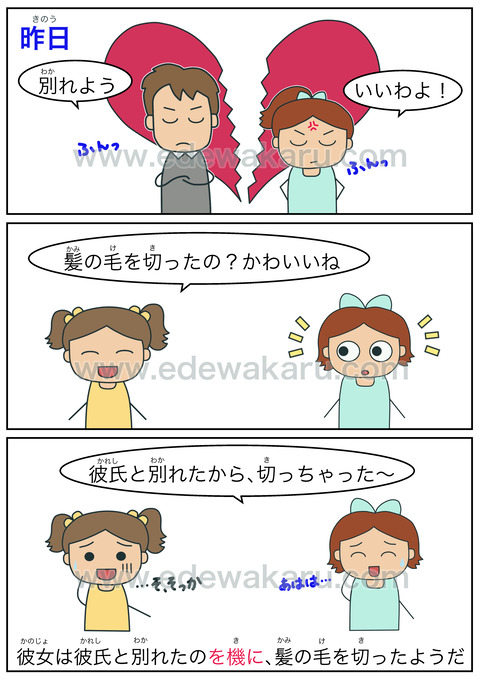
① She seems to have cut her hair after breaking up with her boyfriend.
【Motive/opportunity】Breaking up with her boyfriend
【Something new】Cutting her hair short
→ The heartbreak motivated her to cut her hair.
② He bought a new house on the occasion of getting married.
【Motive/opportunity】Marriage
【Something new】Buying a house
→ Getting married gave him the opportunity to buy a new house.
③ I decided to quit my job after becoming pregnant.
【Motive/opportunity】Pregnancy
【Something new】Quitting her job
→ Her pregnancy became the occasion for deciding to quit her job.
④ He stopped drinking after becoming ill.
【Motive/opportunity】Illness
【Something new】Coming not to drink alcohol
→ His illness prompted him to stop drinking.
⑤ I decided to take English conversation lessons after an overseas trip.
【Motive/opportunity】An overseas trip
【Something new】Starting English conversation lessons
→ The overseas trip prompted me to decide to take English conversation lessons.
Let’s review similar sentence patterns to 「〜を機に」 😉
【Similar patterns】
In context 5 examples
彼女は彼氏と別れたのを機に、髪の毛を切ったらしい
She seems to have cut her hair after breaking up with her boyfriend.
彼は、結婚を機に新しい家を買った
He bought a new house on the occasion of getting married.
妊娠を機に、会社を辞めることにしました
I decided to quit my job after becoming pregnant.
彼は病気を機に、お酒を飲まないようになった
He stopped drinking after becoming ill.
海外旅行(かいがいりょこう)を機に、英会話を習うことに決めた
After an overseas trip, I decided to take English conversation lessons.
Read the original source text
Meaning
〜があったから、〜するようになった
〜を機会に〜になった
How to use it
名詞[辞書形]+を機に
動詞[普通形]+のを機に
Explanation
「Aを機にB」は「Aがあったから、Bするようになった」「Aを機会に、Bになった」という意味の文型です。「Aが動機や機会となって、Bという新しいことをするようになった」と言いたい時に使われます。
[例]
①彼女は彼氏と別れた
のを機に、髪の毛を切ったらしい
【動機・機会】彼氏と別れる
【新しいこと】髪の毛を短くする
→失恋したのが動機になって、髪の毛を切った
②彼は、結婚
を機に
新しい家を買った
【動機・機会】結婚
【新しいこと】家を買う
→結婚が機会になって、新しい家を買った
③妊娠
を機に、会社を辞めることにしました
【動機・機会】妊娠
【新しいこと】会社を辞める
→妊娠が機会にとなって、会社を辞めることにした
④彼は病気
を機に、お酒を飲まないようになった
【動機・機会】病気
【新しいこと】お酒を飲まないようになる
→病気がきっかけになって、お酒を飲まないようになった
⑤海外旅行
を機に、英会話を習うことに決めた
【動機・機会】海外旅行
【新しいこと】英会話を始める
→海外旅行がきっかけになって、英会話を習うことに決めた
「〜を機に」の類似文型(るいじぶんけい)を復習しておきましょう😉
【類似文型】
毎日のんびり日本語教師
How to use it
Noun + を機に
Noun + を契機に
Verb plain form + のを機に
Verb plain form + のを契機に
Explanation
Indicates the starting point at which something new begins. The first part states that starting point, and the latter part describes what happens afterward. It can be rephrased as 「~をきっかけに」, which is often used in spoken language. By contrast, 「~を機に/を契機に」 is somewhat formal.
This pattern cannot be used when the actions in the first and latter parts are of the same kind. It is used when they describe entirely different actions, and the first action serves as an opportunity or motivation for the latter one.
✕
大阪への旅行を機に、京都にも旅行した。
◯
大阪への旅行を皮切りに、京都にも旅行した。
In a case like this, 「~を皮切りに」 can be used.
Notes
Similar grammar: 「[N1 grammar] ~を皮切りに(して)/~を振り出しに(して)」
With 「~をきっかけに」 and 「~を機に/を契機に」, the actions in the first and latter parts must be completely different actions.
With 「~を皮切りに」 and 「~を振り出しに」, the first and latter parts describe actions of the same kind. They also differ in that they indicate those actions continue to be carried out one after another from that point on.
In context 8 examples
失恋を機に髪をばっさり切った。(以失恋为契机剪短了头发。)
After a breakup, I cut my hair short. (I cut my hair short as a result of the breakup.)
出産・育児を機に離職する女性が増えているという。
It is said that more women are leaving their jobs upon giving birth or raising children.
駅のゴミ箱に爆弾が仕掛けられていたらしい。これを機に警備を強化してほしいと思う。
Apparently, a bomb had been planted in the station trash can. I hope they strengthen security in response to this.
パソコンが壊れたが、修理すると逆に高いので、これを機に新しいのを買うつもりだ。
My computer broke, but repairing it would actually cost more, so I plan to use this as an opportunity to buy a new one.
新年度なので、これを機に何か新しいことに挑戦してみようと思う。
It’s the start of a new fiscal year, so I think I’ll take this opportunity to try something new.
女性は結婚を機に家事と育児に追われるようになる。
After getting married, women come to find themselves busy with housework and childcare.
出産を機に10キロほど太った。(以生孩子为契机胖了10公斤左右。)
I gained about 10 kilograms after giving birth. (I gained about 10 kilograms as a result of giving birth.)
父は大病を患ったのを契機に、健康に気を遣うようになった。
After my father suffered a serious illness, he began to take care of his health.
Read the original source text
How to use it
名詞+を機に
名詞+を契機に
動普通形+のを機に
動普通形+のを契機に
Explanation
新しい事柄が始まるその起点を表します。前項にはその起点、後項にはその後の行為を述べます。「~をきっかけに」に言い換えることができますが、こちらは口語でよく用いられる表現です。一方、「~を機に/を契機に」はやや硬めな表現です。
前項と後項が同種の行為の時、この文型は使えません。前項と後項は全く異なる行為を述べ、前項が機会や動機となって後項とするという時に使えます。
✕
大阪への旅行を機に、京都にも旅行した。
◯
大阪への旅行を皮切りに、京都にも旅行した。
このような場合は「~を皮切りに」が使えます。
Notes
似ている文法「【N1文法】~を皮切りに(して)/~を振り出しに(して)」
「~をきっかけに」と「~を機に/を契機に」は、前項と後項の行為が全く別の行為でなければいけません。
「~を皮切りに」と「~を振り出しに」は、前項と後項で同種の行為を述べます。また、それらの行為はそれ以後も次々を行われていく様子を表す点で異なります。