絵でわかる日本語
Meaning
In the way that ~; just as ~.
How to use it
Verb [た-form] + ままを
Explanation
“〜ままを” is a sentence pattern used with a verb in the [た-form] to mean “in the way that ~” or “just as ~.” It is used to say “without changing the content, do it just as it was ~” 😀
It is used with a limited set of words such as 「見る」「聞く」「思う」「感じる」, so memorize them 😉
[Examples]
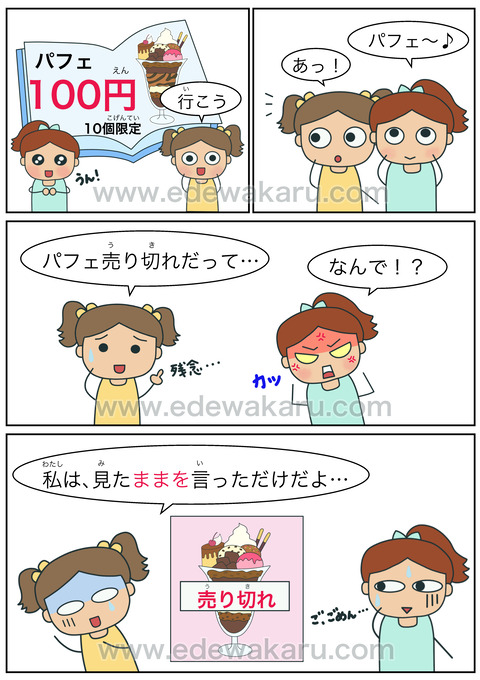
①見たままを言っただけだよ
→I only said what I saw, just as I saw it.
②思ったままを話したまえ
→Tell me what you thought, just as you thought it.
③聞いたままを伝えてください
→Please tell them what you heard without changing the content.
④あの画家は、感じたままを絵で表現するらしい
→Apparently, that painter expresses what they feel in their paintings just as they feel it.
There are several sentence patterns that use “〜まま,” so learn them together 😀
In context 4 examples
見たままを言っただけだよ
I only said what I saw.
思ったままを話したまえ
Tell me what you thought.
聞いたままを伝えてください
Please pass on exactly what you heard.
あの画家は、感じたままを絵で表現するらしい
Apparently, that painter expresses what they feel in paintings just as they feel it.
Read the original source text
Meaning
〜たとおりに
How to use it
動詞[た形]+ままを
Explanation
「〜ままを」は、動詞の[た形]に使って「〜たとおりに」という意味を表す文型です。この文型は「内容を変えないで〜たとおりに、そのまま〜した」と言いたい時に使われます😀
「見る」「聞く」「思う」「感じる」
など、決まったものに使いますので、暗記しておきましょう😉
[例]
①見
た
ままを
言っただけだよ
→見たことを、そのとおりに言ったただけだよ
②思っ
た
ままを
話したまえ
→思ったとおりのことを話したまえ
③聞い
たままを
伝えてください
→聞いたとおりに、内容を変えないで話してください
④あの画家は、感じ
たままを
絵で表現するらしい
→感じたことをそのまま絵で表現するらしい
「〜まま」が使われる文型はいくつかありますので、一緒に覚えておきましょう😀