文法
Meaning
〜らしい / 〜ようだ
An expression of conjecture. Used to say “〜らしい / 〜ようだ” based on evidence.
How to use it
V (plain form) + とみえる
い-adjective (plain form) + とみえる
な-adjective (plain form) + とみえる
N (plain form) + とみえる
In context 5 examples
トムさん、朝からなんだから楽しそうだね。何かいいことがあったとみえる。
Tom, you've seemed happy since this morning. It looks like something good happened.
彼のプレゼンを聞いた感じでは、発表前に相当練習したとみえる。
From listening to his presentation, it seems he practiced a lot before presenting.
庭に大きな水たまりができている。昨晩、寝ている間に雨が降ったとみえる。
There's a big puddle in the garden. It seems it rained while I was asleep last night.
窓ガラスが割れている。留守の間に、誰かが家に入ろうとしたとみえる。
The window glass is broken. It seems someone tried to get into the house while we were away.
ジェームスさんはJLPT N1に受かったとみえて、とても嬉しそうだ。
It seems James passed the JLPT N1; he looks very happy.
Read the original source text
Meaning
〜らしい / 〜ようだ
推量表現。根拠に基づき、「〜らしい/〜ようだ」と言いたいときに使う。
How to use it
V(普通形) + とみえる
イA(普通形)+ とみえる
ナA(普通形)+ とみえる
N(普通形)+ とみえる
Bunpro Grammar Reference
Meaning
It seems that, It can be deduced, One can conclude that
How to use it
Verb + とみえる
[い]Adjective + とみえる
[な]Adjective + (だ) + とみえる
Noun + (だ) + とみえる
Verb + とみえます
[い]Adjective + とみえます
[な]Adjective + (だ) + とみえます
Noun + (だ) + とみえます
Nuance
An expression that makes a conclusion about the way that something appears.
Explanation
とみえる (primarily written only in hiragana) is a phrase that combines the case marking particle と, with the る-Verb見える 'to appear', or 'to be visible'.
This use of the と particle in Japanese is called a result, and marks when (A) is something that has come to a conclusion, or can be concluded. In this way とみえる literally means 'from the way it appears, one can conclude that it's (A)'. However, this translates a bit more smoothly as 'it can be deduced that (A)', or 'it seems that (A)'.
This expression is always used directly after the phrase that it is drawing as a conclusion. However, nouns and な-Adjectives will require だ before とみえる.
家の窓が外から割られていた。泥棒に入られたとみえる。
The windows of the house have been broken from the outside, so I can deduce that a burglar came in.
彼は上着を脱いだ。彼は暑いとみえる。
He took off his jacket, so it seems that he is hot.
彼はサンドイッチを残した。彼はサンドイッチが嫌いだとみえる。
He left the sandwich, so I can conclude that he doesn't like sandwiches.
トムは今日は会社に来なかった。トムは昨日風邪を引いたから今日は休みだとみえる。
Tom didn't come to work today. He caught a cold yesterday, so I can conclude that he is resting today.
While this phrase is conjecture (making a guess about something), it usually implies that the speaker has done some sort of research, or has some reason that led them to 'draw (A) as a conclusion'. Due to this, it appears reasonably confident.
Fun Fact
と always 'sums up' things. As a quotation, it sums up the phrase before it as either something that was said, or thought. As 一緒 'being together', it sums up groups of things that are existing/performing actions mutually. Lastly, as a result, it sums up causes, and then illustrates their effects.
先生が生徒に「廊下で走るな」と言った。
The teacher said 'don't run in the hallway' to the students.
母とレストランに行った。
I went to the restaurant with my mother.
昼寝をすると夜に寝れなくなる。
I can't fall asleep at night if I take a nap during the day.
In context 21 examples
- あの親は優しいとみえる。
Those parents seem nice.
- トムは今日は会社に来なかった。トムは昨日風邪を引いたから今日は休みだとみえる。
Tom didn't come to work today. He caught a cold yesterday, so I can conclude that he is resting today.
- 彼は上着を脱いだ。彼は暑いとみえる。
He took off his jacket, so it seems that he is hot.
- 家の窓が外から割られていた。泥棒に入られたとみえる。
The windows of the house have been broken from the outside, so I can deduce that a burglar came in.
- 彼はサンドイッチを残した。彼はサンドイッチが嫌いだとみえる。
He left the sandwich, so I can conclude that he doesn't like sandwiches.
- 家に行ったけど留守と見えた。
I went to their house, but it seemed that they weren't home.
- 彼はマラソンを走ったと見えてハアハア言っている。
It seems that he ran a marathon, he is breathing heavily.
- テストに落ちたから、勉強してなかったと見える。
Since he failed the test, one can conclude that he did not study.
- 水と見えたが、ラムネでした。
It seemed that it was water, but it was lemon soda. (One can conclude that)
- 彼が今プールから出て来たと見えて、全部が濡れている。
He is completely soaked. It can be deduced that he just got out of a pool.
- 教える必要がなかった。元々知っていたと見える。
There was no need for me to teach it. It seems that they already knew it. (One can conclude that)
- もう準備してあった。誰かから聞いていたと見える。
They had already prepared. One can conclude that they heard about it from someone.
- 誰も理解出来ていないと見えて、皆は難しい顔をしていた。
One can conclude that no one understood from all of the confused faces.
- この城が静かだと見えて、忍者も居ない。
This castle seems so quiet that there aren't even any ninjas. (One can conclude that)
- 外に干した洗濯物はびしょ濡れです。雨が降ったと見える。
The laundry that I hung outside is soaking wet. It can be deduced that it rained.
- 部屋の電気が点いている。彼はまだ忙しいと見える。
The light is still on in his room. It seems that he is still busy. (One can conclude that)
- 幽霊を見たとき、彼女が叫んだ。驚いたと見える。
When she saw a ghost, she screamed. One could conclude that she was surprised.
- 今日の宿題は難しかったと見えて、誰も終わらせてなかった。
One can conclude that today's homework was difficult, because no one completed it.
- 先生が生徒に「廊下で走るな」と言った。
The teacher said 'don't run in the hallway' to the students.
- 母とレストランに行った。
I went to the restaurant with my mother.
- 昼寝をすると夜に寝れなくなる。
I can't fall asleep at night if I take a nap during the day.
絵でわかる日本語
Meaning
...; probably ...
I think it’s probably ... because ...
How to use it
Verb, adjective, or noun [plain form] + とみえる
* With the affirmative present form of な-adjectives and nouns, 〜だとみえる is also acceptable.
([Example] 嫌いとみえる = 嫌いだとみえる; 休みとみえる = 休みだとみえる)
Explanation
“B. Aとみえる” is a pattern meaning “B. Probably A” or “I think it’s A because B.” “B” gives the reason or evidence, and “A” is what is being predicted or inferred. It is used more often as a remark to oneself than in conversation.
[Examples]
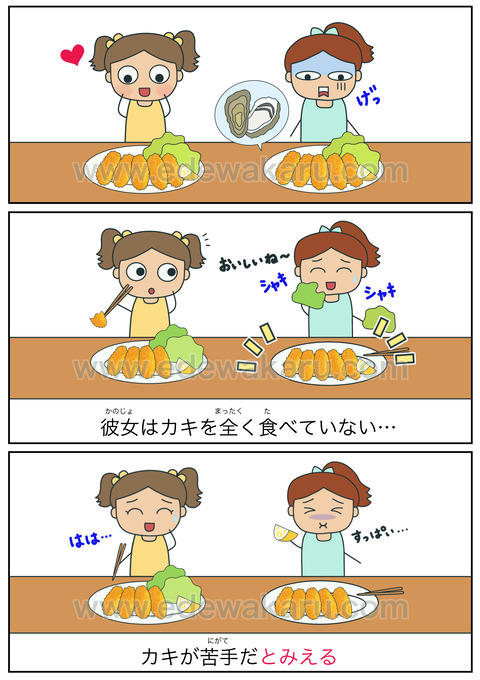
① She hasn’t eaten any oysters at all. She must dislike oysters.
→Seeing that she hasn’t eaten any oysters, infer that she probably dislikes them.
② Judging from how happy she looks, she must have passed N1.
[A] She looks very happy.
[B] She probably passed N1.
→Seeing that she looks happy, infer that she probably passed N1.
③ My daughter came home crying. She must have had another fight with her boyfriend.
[A] She came home crying.
[B] She probably had a fight with her boyfriend.
→Seeing that she came home crying, infer that she probably had a fight with her boyfriend.
④ He is showing everyone pictures of his daughter. He must have been really happy that his child was born.
[A] He is showing everyone pictures of his daughter.
[B] He must be happy that his child was born.
→Seeing him show everyone the pictures, infer that he must be very happy.
⑤ There are lots of police cars and ambulances here. There must have been an incident or an accident.
[A] Police cars and ambulances are here.
[B] There must have been an incident or an accident.
→Seeing the police cars and ambulances, infer that there must have been an incident or an accident.
There is also the form 〜とみえて, so let’s review that too 😊
In context 5 examples
彼女はカキを全く食べていない。カキが苦手だとみえる…
She hasn’t eaten any oysters at all. She must dislike oysters…
すごく嬉しそうなところを見ると、N1に合格したとみえる
Judging from how happy she looks, she must have passed N1.
娘が泣きながら帰ってきた。また彼氏とケンカしたとみえる
My daughter came home crying. She must have had another fight with her boyfriend.
彼はみんなに娘の写真を見せている。子供が生まれたことが本当に嬉しかったとみえる
He is showing everyone pictures of his daughter. He must have been really happy that his child was born.
パトカーと救急車(きゅうきゅうしゃ)がたくさん来ている。事件か事故があったとみえる
There are lots of police cars and ambulances here. There must have been an incident or an accident.
Read the original source text
Meaning
〜だ。たぶん〜なんだろう
〜だから、〜なんだと思う
How to use it
動詞・形容詞・名詞[普通形]+とみえる
*な形容詞・名詞の現在肯定形に使う場合は「〜だとみえる」でもOK
([例]嫌いとみえる=嫌いだとみえる 休みとみえる=休みだとみえる)
Explanation
「Bだ。Aとみえる」は「Bだ。たぶんAなんだろう」「Bだから、Aなんだと思う」という意味の文型です。「B」には理由や根拠が入り、「A」には予想・推量することが入ります。会話で使われるよりも、
独り言として使用されます。
[例]
①彼女はカキを全く食べていない。カキが苦手だ
とみえる
…
→カキを食べていないのを見て、苦手なんだろうと推量
②すごく嬉しそうなところを見ると、N1に合格した
とみえる
【A】すごく嬉しそうだ
【B】N1に合格したんだろう
→嬉しそうなのを見て、N1に合格したんだろうと推量
③娘が泣きながら帰ってきた。また彼氏とケンカした
とみえる
【A】泣きながら帰ってきた
【B】彼氏とケンカしたんだろう
→泣きながら帰ってきたのを見て、彼氏とケンカしたんだろうと推量
④彼はみんなに娘の写真を見せている。子供が生まれたことが本当に嬉しかった
とみえる
【A】みんなに娘の写真を見せている
【B】子供が生まれたことが嬉しいんだろう
→みんなに写真を見せているところを見て、すごく嬉しいんだろうと推量
⑤パトカーと救急車がたくさん来ている。事件か事故があった
とみえる
【A】パトカーと救急車が来ている
【B】事件か事故があったんだろう
→パトカーと救急車を見て、事件か事故があったと推量
「〜とみえて」という形もありますので、復習をしておきましょう😊
日本語NET JLPT文法解説まとめ
Meaning
“〜らしい / 〜ようだ” (“It seems 〜 / Apparently 〜”)
A conjectural expression. Used to say “〜らしい/〜ようだ” based on evidence.
How to use it
V (plain form) + とみえる
い-adjective (plain form) + とみえる
な-adjective (plain form) + とみえる
N (plain form) + とみえる
Explanation
Speculative expression. Used to say '〜らしい/〜ようだ' based on evidence."
In context 5 examples
トムさん、朝からなんだから楽しそうだね。何かいいことがあったとみえる。
Tom, you've seemed happy since this morning. It looks like something good happened.
彼のプレゼンを聞いた感じでは、発表前に相当練習したとみえる。
From listening to his presentation, it seems he practiced a lot before presenting.
庭に大きな水たまりができている。昨晩、寝ている間に雨が降ったとみえる。
There's a big puddle in the garden. It seems it rained while I was asleep last night.
窓ガラスが割れている。留守の間に、誰かが家に入ろうとしたとみえる。
The window glass is broken. It seems someone tried to get into the house while we were away.
ジェームスさんはJLPT N1に受かったとみえて、とても嬉しそうだ。
It seems James passed the JLPT N1; he looks very happy.
Read the original source text
Meaning
"〜らしい / 〜ようだ"
推量表現。根拠に基づき、「〜らしい/〜ようだ」と言いたいときに使う。
How to use it
V(普通形) + とみえる
イA(普通形)+ とみえる
ナA(普通形)+ とみえる
N(普通形)+ とみえる
Explanation
Speculative expression. Used to say '〜らしい/〜ようだ' based on evidence."
NINJAL 日本語文型データベース
Meaning
This expresses the speaker’s inference based on the actual situation.
How to use it
V plain form+とみえる
i-A plain form+とみえる
na-A plain form+とみえる (「na-Aだ」 may also take the forms 「na-A+とみえる・na-Aである+とみえる」)
N plain form+とみえる (「Nだ」 may also take the forms 「N+とみえる・N+であるとみえる」)
Other
Notes
It is generally not used in the past tense.
“~” expresses the speaker’s inference at the present moment. The sentence following “〜とみえて・〜とみえ” explains the situation that provides the basis for the inference.
When used at the end of a sentence, the situation is often explained in a separate sentence.
In context 38 examples
一郎さんはさっきからずっとせきをしています。どうやら風邪をひいているとみえます。
Ichiro has been coughing continuously for a while. Apparently, he has caught a cold.
山田さんは90歳だそうですが、とてもお元気です。健康にとても気をつけていらっしゃるとみえます。
I hear Mr. Yamada is 90, but he is very energetic. It seems he takes great care of his health.
あの人は、よほどお金があるとみえて、車を次々と買い替える。
That person must have a lot of money; they keep replacing their car with a new one.
カフェのテラス席に犬を連れて来ている人を見かけた。犬はよくしつけられているとみえ、おとなしく座っていた。
I saw someone bring a dog to a cafe’s terrace seating. The dog seemed well trained and sat quietly.
田中君はまたスマホでマッチングアプリを見ている。本当に恋人がいないとみえる。
Tanaka is looking at a dating app on his phone again. Apparently, he really doesn’t have a partner.
ご病気がまだ完全に回復していないとみえて、会長は本日の株主総会を欠席された。
Apparently, the chairperson has not yet fully recovered from their illness, so they were absent from today’s shareholders’ meeting.
20キロのマラソンを終えた次郎は、座り込んでしまった。よほど疲れたとみえる。
Jiro sat down after finishing a 20-kilometer marathon. He must have been very tired.
朝方、雨が降ったとみえ、道が濡れている。
It seems to have rained early this morning; the road is wet.
パク君は朝からあくびばかりしている。試験勉強で昨夜は眠れなかったとみえる。
Pak has been yawning all morning. Apparently, he couldn’t sleep last night because he was studying for an exam.
今月も思ったように契約が取れなかったと見えて、一郎は元気がない。
Apparently, Ichiro is feeling down because he didn’t get as many contracts as he had hoped this month either.
この公園の桜のつぼみもほんのりと色づいてまいりました。開花も近いとみえます。
The cherry buds in this park have begun to take on a faint color. It seems they will bloom soon.
この子犬はよほど食べ物が欲しいとみえて、私のそばから離れない。
This puppy must really want food; it won’t leave my side.
雪道で転んだと聞いて心配していたが、加藤さんのあの歩き方からすると、けがはさほどひどくないとみえる。
I was worried when I heard you fell on a snowy road, but judging by the way Mr. Kato is walking, it seems the injury is not very serious.
新しくできたラーメン屋はあまりおいしくないとみえ、いつ見てもすいている。
The new ramen shop must not be very good; whenever I see it, it’s quiet.
あんなにはしゃいでいた雪ちゃんがその場に立ち尽くして泣き出してしまった。私の犬がよほど怖かったとみえる。
Yuki, who had been so excited, stood rooted to the spot and started crying. My dog must have frightened her a lot.
湯が熱かったとみえて、太郎は真っ赤な顔をして風呂から出てきた。
The bathwater must have been hot; Taro came out of the bath with a bright red face.
新しい学校に慣れないのか、あやかには昨日の遠足もあまり楽しくはなかったと見える。
Perhaps she hasn’t gotten used to her new school; it seems yesterday’s field trip was not much fun for Ayaka either.
洋平だけが先生に褒められたのが面白くなかったと見えて、広司は学校からの帰り道、ずっと黙っていた。
Apparently, Hiroshi was unhappy that Yohei alone was praised by the teacher, and he stayed silent all the way home from school.
こんな山道を 5キロも歩いてきたとは、あのおじいさんはかなりの健脚だとみえる。
To have walked five kilometers along a mountain path like this, that old man must be quite strong on his feet.
アニメがよほど好きだとみえて、トム君はアニメのことなら何でも知っている。
Tom must really love anime; he knows everything there is to know about it.
あのお客さんはよほど暇とみえて、毎日、コーヒー1杯でこの店に3時間ぐらいいます。
That customer must have a lot of free time; every day, they spend about three hours in this shop with just one cup of coffee.
佐々木さんは大変几帳面であるとみえ、机の上がいつも完璧に整理整頓されている。
Mr. Sasaki seems to be very meticulous; his desk is always perfectly organized.
欠勤もせず、毎日時間通りに出勤するところを見ると、健は今度の仕事は嫌いではないとみえる。
Seeing that Ken never misses work and arrives on time every day, it seems he doesn’t dislike his new job.
運動はあまり得意ではないとみえて、彼はみんなが参加しているこの工場のサッカーチームには加わっていない。
Apparently, he is not very good at sports, so he has not joined this factory’s soccer team, which everyone else is on.
昨日の試合では、大石選手はよほど不調だったとみえ、何度もサーブを失敗した。
Oishi must have been very out of form in yesterday’s match; he missed his serve many times.
この町にはガラス製品を扱う古くて立派な店が多い。ガラス工芸が昔から盛んであったとみえる。
This town has many old, impressive shops that sell glass products. It seems glasswork has flourished here since long ago.
亡き祖母はずいぶんおしゃれだったと母は言うが、生前の写真を見ると、どこにでもあるような平凡な服を着ているものが多い。母が言うほどおしゃれではなかったとみえる。
My mother says my late grandmother was very stylish, but in her old photos she is mostly wearing ordinary clothes you could see anywhere. Apparently, she was not as stylish as my mother says.
猫は私の膝の上に飛び乗ってきたが、快適ではなかったと見えて、すぐ降りてしまった。
The cat jumped onto my lap, but apparently it wasn’t comfortable, because it got right back down.
6時間たっても終わらないとは、母の手術はよほど難しい手術だとみえる。
If it still hasn’t ended after six hours, my mother’s surgery must be very difficult.
バスは行ってしまったばかりだとみえて、バス停には誰もいない。
It seems the bus has just left; there’s no one at the bus stop.
隣の家は留守とみえて、電気が消えている。
Apparently, the neighbors are out; their lights are off.
駅前に止まっている車は乗り合いタクシーであるとみえ、次から次へといろいろな客が乗り込んでいる。
The car stopped in front of the station seems to be a shared taxi; all kinds of passengers keep getting in one after another.
この猫はきれいな毛並みをしているな。野良猫ではないとみえる。
This cat has such a beautiful coat. It must not be a stray.
今日は祝日だが、隣の家のご主人は休みではないとみえ、朝からスーツ姿で出かけて行った。
Today is a public holiday, but the man next door must not have the day off; he left in a suit this morning.
春香が子どもの頃から持っているといううさぎのぬいぐるみは、かなりぼろぼろだ。よほどのお気に入りだったとみえる。
The stuffed rabbit Haruka has had since childhood is quite worn out. It must have been a great favorite.
道を尋ねたおじさんは地元の人だったとみえて、迷うこともなく、私たちを目当ての居酒屋まで連れて行ってくれた。
The man who gave us directions must have been a local; without getting lost, he led us to the izakaya we were looking for.
提示された契約金は小林選手が希望していたような額ではなかったと見え、小林選手と球団との交渉は決裂した。
Apparently, the contract amount offered was not what Kobayashi had hoped for, and negotiations between him and the team broke down.
あの生徒たちは部活帰りなのだろうか。皆、よろよろと歩いている。よほど空腹なのだと見える。
I wonder if those students are coming back from club activities. They’re all walking unsteadily. They must be very hungry.
Read the original source text
Meaning
実際の状況を根拠とした話し手の推測を表します。
How to use it
V普通形+とみえる
i-A普通形+とみえる
na-A普通形+とみえる(「na-Aだ」→「na-A+とみえる・na-Aである+とみえる」の形になることもある)
N普通形+とみえる(「Nだ」→「N+とみえる・N+であるとみえる」の形になることもある)
その他
Notes
ふつう過去形にはしません。
「~」には話し手の現時点での推測がきます。「〜とみえて・〜とみえ」の後には、推測の根拠である状況を説明する文がきます。
文末に使う場合は、別の文で状況を説明することが多いです。
毎日のんびり日本語教師
How to use it
Noun + (だ)と見える/(か)に見える/かのように見える
Na-adjective stem + (だ)と見える/(か)に見える/かのように見える
Verb plain form + と見える/かに見える/(かの)ように見える
I-adjective + と見える/かに見える/かのように見える
Explanation
This usage expresses the speaker’s inference based on how a person or thing looks.
The inference is a subjective judgment.
Notes
Similar grammar: 「【N3 Grammar】~そうに見える」
In context 8 examples
ドルは下げ止まったかに見えるが、これからどうなるかは未知数だ。
The dollar appears to have stopped falling, but what happens next is still uncertain.
人類はよほど戦争が好きと見える。
It seems humanity must really like war.
あの様子を見ると、今日の試験は合格だったと見える。
Judging by how he looks, it seems he passed today’s exam.
一見すると有能そうに見えたが、コミュニケーションのほうにやや難があるようだ。
At first glance, he seemed capable, but he seems to have some difficulty with communication.
彼は身長が高く大人に見えたが、話してみるとやはりまだ子供っぽさが残っている。
He was tall and looked like an adult, but after talking with him, I could see he still had a childlike side.
秒読みに追われて悪手を指したかに見えたが、AIは最善手という評価を出している。
It looked as if he had made a bad move under time pressure, but the AI rates it as the best move.
直前になっても緊張せずに談笑しているところを見ると、随分余裕があると見える。
Seeing that they’re chatting and laughing without getting nervous even at the last minute, they seem quite at ease.
彼女は天然を装っているだけで、実は腹黒いと見える。
She seems to be pretending to be airheaded, but she’s actually scheming.
Read the original source text
How to use it
名詞+(だ)と見える/(か)に見える/かのように見える
な形容詞語幹+(だ)と見える/(か)に見える/かのように見える
動詞普通形+と見える/かに見える/(かの)ように見える
い形容詞+と見える/かに見える/かのように見える
Explanation
人や物事の外見を見て、それに対する自分の推測を述べる用法です。
その推測は主観的な判断によるものです。
Notes
似ている文法「【N3文法】~そうに見える」