日本語文型辞典
Meaning
Means “so extreme that one might think ….” Used in the form 「Xかと思うほど(の)Y」 to emphasize the high degree of Y. As in the following example, the form 「…かと思うほどだ」 may also be used.
a. V-るかとおもえば
In the form 「V-るかとおもえば/V-るかとおもうと」, used to describe a situation that runs counter to the speaker's expectations. Since it expresses events that repeatedly occur contrary to expectations, or a current situation that goes against expectations, the sentence usually ends with the dictionary form. Also, 「かと思ったら」 is less commonly used with this meaning.
b. V-るかとおもえば…も
Expresses the coexistence or juxtaposition of opposing or contrasting situations. 「V-るかとおもうと」 is also used. Verbs expressing existence, such as 「ある/いる」, are often repeated. In use A, 「V-るかとおもえば」 expresses a discrepancy between expectation and reality, but here it does not particularly have that meaning; it simply presents situations of different kinds side by side.
Follows a clause and means that the following action is taken because of what was stated. The preceding reason usually expresses a purpose that will be fulfilled by the resulting action, and the latter part uses an expression describing an intentional action.
a. V-たとおもったら
⇾とおもう 9
b. 疑問詞…かとおもったら
Expresses the speaker's feeling of finding something strange and paying attention to it. The following part describes an unexpected discovery or an event that prompts surprise.
⇾おもう
Follows a clause and means that although one expected the result described there, a contrary result unexpectedly appeared. As in ③, 「か」 may come immediately before 「と」. This is a somewhat old-fashioned expression used in written language.
⇾おもう
Expresses two things happening successively with no time between them. 「か」 may also come immediately before 「と」. Used in written language. In 「XかとおもうまもなくY」, neither X nor Y can describe an action by the speaker.
a. V-るかとおもうと
⇾とおもう 2a
b. V-たとおもうと
Expresses two contrasting events happening one after another almost simultaneously. The forms 「V-たとおもったら」 and 「V-たとおもえば」 are also used. It often takes the form 「V-たかとおもったら」. The following part often expresses the speaker's surprise or sense that something is unexpected. It cannot describe the speaker's own actions.
⇾ものの 1
Follows a noun referring to a person, purpose, or use, meaning “for that person or purpose.” It is followed by an expression describing an intentional action. The expression 「…にと思い」 is also used.
⇾ものとおもう
⇾おもう 5
How to use it
…かとおもうほど
…かとおもえば
…からとおもって
…とおもったら
…たいとおもう
…とおもいきや
…とおもう
…とおもうまもなく
…とおもうと
10 …とおもったものの
11 N にとおもって
…ものとおもう
…ようとおもう
In context 38 examples
彼は、いつ寝ているのかと思うほどいそがしそうだ。
He looks so busy that I wonder when he ever sleeps.
その家は、ほかに金の使い道を思いつかなかったのだろうかと思うほど、金のかかったつくりだった。
The house was so lavishly built that I wondered if they couldn't think of anything else to spend their money on.
その人のあいさつは、永遠に終わらないのではないかと思うほど長いものだった。
That person's greeting was so long I wondered if it would ever end.
死んでしまうのではないかと思うほどの厳しい修行だった。
It was such grueling training that I thought I might die.
(例) 彼はいそがしい。いつ寝ているのかと思うほどだ。
(Example) He is busy. You'd wonder when he ever sleeps.
勉強しているかと思えば漫画を読んでいる。
One moment she's studying, and the next she's reading manga.
来るかと思うと欠席だし、休むかと思うと出席している。
He'll say he's coming, then be absent; he'll say he'll stay home, then show up.
今年こそ冷夏かと思えば、猛暑で毎日うだるような暑さだ。
I thought this year would finally be a cool summer, but it's been sweltering hot every day.
熱心に授業に出る学生がいるかと思えば、全然出席せずに試験だけ受けるような学生もいる。
Some students attend class diligently, while others never attend at all and only show up for the exam.
一日原稿用紙に向かっていても一枚も書けない日があるかと思うと、一気に数十枚も書ける日もある。
Some days I face my manuscript paper all day and can't write a single page, while on other days I can write dozens of pages at a stretch.
体にいいからと思って、緑の野莱を食べるようにしています。
I try to eat green vegetables, thinking they're good for my health.
せっかくパリまで束たのだからと思って、一流レストランで食事することにした。
Since I'd come all the way to Paris, I decided to eat at a top-class restaurant.
明日の試験に遅れては大変だからと思い、今晩は早寝することにした。
Thinking it would be disastrous to be late for tomorrow's exam, I decided to go to bed early tonight.
何を言うのかと思ったら、そんなくだらないことか。
I wondered what he was going to say, and then it turned out to be something so trivial.
食事もしないで何をやってるのかと思ったら、テレビゲームか。
I wondered what they were doing without even eating, and it turned out they were playing video games.
会議中に席を立ってどこへ行くのかと思ったら、ちょっと空が見たいって言うんだよ。あいつ、最近おかしいよ。
I wondered where he was going after getting up during the meeting, and he says he just wanted to look at the sky. That guy's been acting strange lately.
2才の赤ん坊が夢中で何かやっている。何をやっているのかと思ったら、鏡にむかってにこにこ笑ったり、手をふったりしているのだ。
A two-year-old baby is absorbed in doing something. I wondered what it was, and saw the child smiling and waving at the mirror.
今場所は横綱の優勝間違いなしと思いきや、3日目にケガで休場することになってしまった。
I thought the yokozuna was sure to win this tournament, but then he got injured and had to withdraw on the third day.
今年の夏は猛暑が続くと思いきや、連日の雨で冷害の心配さえでてきた。
I thought this summer would bring an ongoing heat wave, but with rain every day, people are now even worrying about crop damage from cold weather.
これで一件落着かと思いきや、思いがけない反対意見で、この件は次回の会議に持ち越されることになった。
I thought that would settle the matter, but an unexpected opposing opinion means it will be put off until the next meeting.
つめたい雨が降ってきたと思う間もなく、それは雪にかわった。
No sooner had I thought the cold rain had started than it turned to snow.
両目に涙があふれてきたかと思う間もなく、その子は大声で泣き出した。
No sooner had tears welled up in both the child's eyes than they began crying loudly.
帰ってきたなと思う間もなく、息子は「遊びに行ってくるりと叫んで出ていった。
No sooner had I thought, “He's back,” than my son shouted, “I'm going out to play!” and rushed out.
雲を突き抜けたと思う間もなく、翼の下に、街の灯が広がった。
No sooner had we pierced the clouds than the city lights spread out below the wings.
(誤) 私はうちに帰ったかと思う間もなく友達に電話した。
(Incorrect) No sooner had I thought I got home than I called my friend.
(正) 私は家に帰るとすぐ友達に電話した。
(Correct) As soon as I got home, I called my friend.
急に空が暗くなったかと思うと、大粒の雨がふってきた。
Just as the sky suddenly darkened, large raindrops began to fall.
山田さんたら、来たと思ったらすぐ帰っちゃった。
As soon as Mr. Yamada arrived, he left again.
さっきまで泣いていたと思ったらもう笑っている。
She was crying just a moment ago, and now she's laughing.
やっと暖かくなったかと思うと、今朝は突然の春の雪でびっくりした。
Just when I thought it had finally gotten warm, I was surprised by an unexpected spring snowfall this morning.
夫はさっき家に戻ってきたかと思ったら、知らぬ間にまた出掛けていた。
Just when I thought my husband had come home, he had gone out again without my noticing.
今までニコニコしていたかと思えば、突然泣き出したりして、本当に、よく気分の変わる人だ。
One moment she was smiling, and the next she suddenly burst into tears; she really is a person whose mood changes often.
ちょっとうとうとしたかと思うと、突然大きな物音がして目が覚めた。
I had just started to doze off when a sudden loud noise woke me.
(誤) 私は、うちに帰ったと思うとまた出かけた。
(Incorrect) I got home, and then went out again.
(正) 私は、うちに帰って、またすぐに出かけた。
(Correct) I went home and then went out again right away.
おばあちゃんへのお土産にと思って、湯飲み茶碗を買った。
I bought a teacup, thinking it would make a nice present for Grandma.
つまらないものですが、これ、お子さんにと思って…。
It's nothing special, but I thought your child might like this…
健康維持にと思い、水泳を始めた。
I started swimming, thinking it would help me stay healthy.
Read the original source text
Meaning
「そう思うほどはなはだしい」という意味。「Xかと思うほど(の)Y」という形で、Yの程度が高いことを強調するのに使う。次の例のように「…かと思うほどだ」という形が使われることもある。
a. V-るかとおもえば
「V-るかとおもえば/V-るかとおもうと」の形で、現状が話し手の予想に反していることがらを表すのに用いる。予想に反することがらが繰り返し生じたり、現状が予想に反しているということを表す表現なので、文末には辞書形をとるのが普通である。また、この用法では「かと思ったら」は用いられにくい。
b. V-るかとおもえば…も
対立・対比的な事態が共存・並立することを表す。「V-るかとおもうと」も用いられる。「ある/いる」など、存在を表す動詞が繰り返して用いられることが多い。Aの「V-るかとおもえば」は、予想と現実のくいちがいを表しているが、ここでは、そのような意味は特になく、意味的に性質の異なる事態を並べて述べているに過ぎない。
節を受け、そのようなことを理由にして後続の行動をとるという意味を表す。前半の理由の部分は後続動作の結果成立するような意味関係(=行動の目的)を表すのが普通で、後半部分には意志的な動作を表す表現が用いられる。
a. V-たとおもったら
⇾とおもう9
b. 疑問詞…かとおもったら
話し手が不思議に思って注目する様子を表す。後ろには意外な発見や驚きをさそう出来事が表される。
⇾おもう
節を受けて、そこで表されるような結果を予想していたら、意外にもそれに反する結果が現れたということを表す。③のように「と」の直前に「か」を伴う場合もある。やや古めかしい言い方で、書きことばに用いられる。
⇾おもう
丸二つのことが時間をおかずにつづけて起こることを表す。「と」の直前に「か」を伴うこともある。書きことばに用いられる。「XかとおもうまもなくY」で、XにもYにも話し手の行為は使えない。
a. V-るかとおもうと
⇾とおもう2a
b. V-たとおもうと
二つの対比的なことがらがほとんど同時につづいて起こることを表す。「V-たとおもったら」「V-たとおもえば」の形も用いられる。また、「V-たかとおもったら」となることも多い。後ろには話し手の驚きや意外感を表す表現が続くことが多い。話し手自身の行為について述べることはできない。
⇾ものの1
人や、目的・用途を表す名詞を受け、「その人や目的のために」という意味を表す。意志的な動作を表す表現が続く。「…にと思い」という言い方もする。
⇾ものとおもう
⇾おもう5
How to use it
…かとおもうほど
…かとおもえば
…からとおもって
…とおもったら
…たいとおもう
…とおもいきや
…とおもう
…とおもうまもなく
…とおもうと
10 …とおもったものの
11 Nにとおもって
…ものとおもう
…ようとおもう
Bunpro Grammar Reference
Meaning
Think (that)
How to use it
Phrase + 思う
Nuance
A casual Kansai word omission.
Explanation
Similar to standard Japanese, 関西弁 regularly omits particles when they are not needed. A common example of this is 思う being used instead of と思う, to convey that the speaker 'thinks' something.
In the case of nouns and な-Adjectives, which would usually require だ before と思う, や will be used instead.
It should be noted, however, that this omission of と is primarily used when people are speaking quickly.
Notes
Kansai dialect
In context 11 examples
- あの人のことやから、明日雨降っても釣りに行く思うわ。
As for him, I think he will go fishing even if it rains tomorrow.
- あそこのお好み焼き屋が一番美味しい思うで。
I think the okonomiyaki place over there is the best.
- 大阪人は基本的に親切や思う。
I think people from Osaka are generally friendly.
- それはエミコの教科書や思う。
I think that is Emiko's textbook.
- このパンよりそのパンの方が美味しいと思う。
このパンよりそのパンの方が美味しいおもう。I think that bread is more delicious than this bread.
- 綺麗だったと思う。
綺麗やったおもう。I think it's beautiful.
- 犬じゃないと思う。
犬やないおもう。I think it's not a dog.
- 暑いと思う。
暑いおもう。I think it's hot.
- 夜の海は静かだと思う。
夜の海は静かやおもう。I think the ocean at night is quiet.
- あの人は、日本人だと思う。
あの人は、日本人やおもう。I think that person is Japanese.
- 来週アメリカに行こうと思う。
来週アメリカに行こおもう。I am thinking of going to America next week.
Read the original source text
Meaning
Think (that)
How to use it
Phrase + 思う
Nuance
A casual Kansai word omission.
Explanation
Similar to standard Japanese, 関西弁 regularly omits particles when they are not needed. A common example of this is 思う being used instead of と思う, to convey that the speaker 'thinks' something.
In the case of nouns and な-Adjectives, which would usually require だ before と思う, や will be used instead.
It should be noted, however, that this omission of と is primarily used when people are speaking quickly.
Notes
関西弁
Nuance · 日本語
カジュアルな関西弁で用いられる、言葉の省略の仕方。
AIUEO JLPT Grammar
Meaning
「〜と思う」is used to express one’s thoughts, opinions, or feelings, indicating the speaker’s subjective judgment or conjecture. Similar to "I think …” in English.
How to use it
Plain sentence と + 思う
In context 5 examples
この提案は良いと思います。
I think this proposal is good.
来年はもっと良い年になると思います。
I think next year will be better.
この問題が難しいと思う人は手を挙げてください。
Please raise your hand if you think this problem is difficult.
この計画は成功すると思われます。
It is thought that this plan will succeed.
彼は何時に来ると思いますか?
What time do you think he will come?
Read the original source text
Meaning
「〜と思う」is used to express one’s thoughts, opinions, or feelings, indicating the speaker’s subjective judgment or conjecture. Similar to "I think …” in English.
How to use it
普通文と+思う
Explanation · 日本語
「〜と思う」は、自分の意見や考え、感情を述べるときに使われる表現で、話し手の主観的な判断や推測を示します。
文法
Meaning
An expression used to state an opinion or an inference.
How to use it
V (plain form) + と思う
いA (plain form) + と思う
なA (plain form) + と思う
N (plain form) + と思う
In context 13 examples
今日は午後から雨が降ると思います。
I think it will rain this afternoon.
トムさんはあとで来ると思います。
I think Tom will come later.
たぶん、キムさんは納豆が嫌いだと思います。
I think Kim probably dislikes natto.
ジェシカさんには彼氏がいると思います。
I think Jessica has a boyfriend.
来年は海外留学していると思います。
I think I'll be studying abroad next year.
食べ過ぎは体によくないと思います。
I think overeating is bad for your health.
まだ熱いと思うから、気をつけて食べて。
I think it's still hot, so be careful when you eat it.
この人は若いと思いますか。
Do you think this person is young?
このキャラクタ〜は有名だと思っていたんですが、知らないんですか。
I thought this character was famous. You don't know them?
日本のコンビニは私の国のコンビニより便利だと思います。
I think convenience stores in Japan are more convenient than those in my country.
ジェームさんは彼女ができて、幸せだと思います。
I think James is happy because he got a girlfriend.
この人は何歳だと思いますか。
How old do you think this person is?
僕の彼女はどんな人だと思いますか、
What kind of person do you think my girlfriend is?
Read the original source text
Meaning
意見を述べたり、推測したことを述べる表現。
How to use it
V(普通形) + と思う
イA(普通形) + と思う
ナA(普通形) + と思う
N(普通形) + と思う
絵でわかる日本語
Meaning
Expresses the speaker’s opinion, judgment, or conjecture.
How to use it
Verb, adjective, noun [plain form] + と思う
Explanation
“〜と思う” is a sentence pattern that expresses the speaker’s [opinion], [judgment], or [conjecture]. Even when speaking politely to someone senior, such as a teacher or supervisor, it takes the form “plain form + と思います.”
[Examples]
❌I think he’ll be home soon.
❌I think he’ll be home soon.
⭕️I think he’ll be home soon.
“〜と思う” is often used in conversation, so review it 😉
In context 8 examples
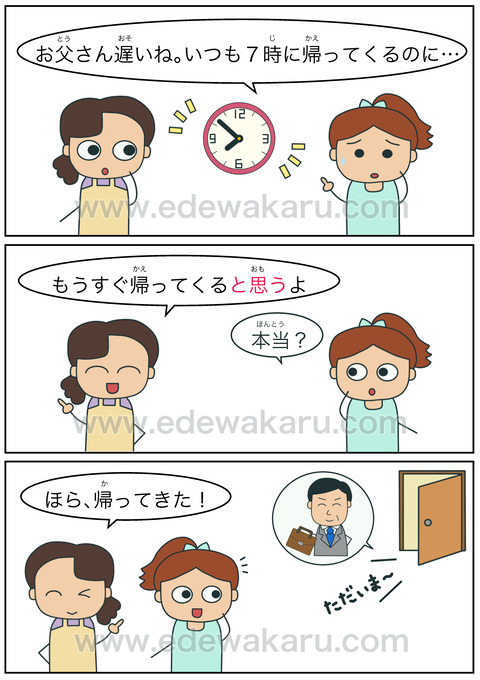
娘:お父さん遅いね…いつもは7時に帰ってくるのに…母:もうすぐ帰ってくると思うよ
→もうすぐ帰ってくるだろう[母の推量]Daughter: Dad’s late… He usually gets home at seven… Mother: I think he’ll be home soon. → He’ll probably be home soon. [Mother’s conjecture]
A:今年はN1にチャレンジしたら?B:N1には、まだ合格できないと思うわ
→N1には、まだ合格できないだろう[Bの推量]A: Why don’t you try taking the N1 this year? B: I don’t think I can pass N1 yet. → I probably can’t pass N1 yet. [B’s conjecture]
お酒の飲みすぎはよくないと思うよ
→飲みすぎはよくない[話し手の意見]I think drinking too much alcohol is bad for you. → Drinking too much is bad for you. [Speaker’s opinion]
A:新しい先生は、すごくこわいね…B:えっ!?私は優しいと思うよ〜
→新しい先生はやさしい[Bの意見]A: The new teacher is really scary… B: Huh!? I think she’s kind~ → The new teacher is kind. [B’s opinion]
A:日本語が全然上手にならないの…B:そんなことないよ!すごく上手になったと思うよ
→日本語がすごく上手になった[Bの意見・判断]A: My Japanese isn’t getting any better… B: That’s not true! I think you’ve gotten a lot better. → Your Japanese has gotten a lot better. [B’s opinion/judgment]
娘:このスカート、どうかなぁ…母:すごくかわいいと思うよ
→このスカートはかわいい[母の意見]Daughter: What do you think of this skirt…? Mother: I think it’s really cute. → This skirt is cute. [Mother’s opinion]
肉だけじゃなく、野菜も食べたほうがいいと思うよ
→野菜も食べたほうがいい[話し手の意見]I think you should eat vegetables too, not just meat. → You should eat vegetables too. [Speaker’s opinion]
A:山田くんってイケメンだよね?B:…私はイケメンじゃないと思う
→山田くんはイケメンじゃない[Bの意見・判断]A: Yamada is handsome, right? B: …I don’t think he’s handsome. → Yamada isn’t handsome. [B’s opinion/judgment]
Read the original source text
Meaning
話し手の意見・判断・推量を表す
How to use it
動詞・形容詞・名詞[普通形]+と思う
Explanation
「〜と思う」は話し手の[意見][判断][推量]を表す文型です。先生や上司など、目上の人に対して丁寧形で話す場合も「普通形+と思います」になります。
[例]
❌彼はもうすぐ
帰ってきます
と思います
❌彼はもうすぐ
帰ってきます
と思う
⭕️彼はもうすぐ
帰ってくる
と思います
「〜と思う」は、会話でもよく使いますので復習しておきましょう😉
日本語NET JLPT文法解説まとめ
Meaning
An expression used to state an opinion or an inference.
How to use it
V (plain form) + と思う
いA (plain form) + と思う
なA (plain form) + と思う
N (plain form) + と思う
Explanation
I think
This is used to express the speaker’s conjecture or used when saying an opinion.
In context 21 examples
今日は午後から雨が降ると思います。
I think it will rain this afternoon.
トムさんはあとで来ると思います。
I think Tom will come later.
たぶん、キムさんは納豆が嫌いだと思います。
I think Kim probably dislikes natto.
ジェシカさんには彼氏がいると思います。
I think Jessica has a boyfriend.
来年は海外留学していると思います。
I think I'll be studying abroad next year.
10年後は結婚して、幸せに暮らしていると思います。
I think I'll be married and living happily ten years from now.
この問題、テストに出ると思いますか。
Do you think this question will be on the test?
先生、それは昨日やったと思います。
Teacher, I think we did that yesterday.
もう先生は帰ったと思います。
I think the teacher has already gone home.
今夜の飲み会には行かないと思います。
I don't think I'll go to the get-together tonight.
食べ過ぎは体によくないと思います。
I think overeating is bad for your health.
まだ熱いと思うから、気をつけて食べて。
I think it's still hot, so be careful when you eat it.
この人は若いと思いますか。
Do you think this person is young?
ひらがなよりカタカナのほうが難しいと思います。
I think katakana is more difficult than hiragana.
AndroidよりiPhoneのほうがいいと思います。
I think iPhone is better than Android.
日本の物価は高いと思いますか。
Do you think prices in Japan are high?
このキャラクターは有名だと思っていたんですが、知らないんですか。
I thought this character was famous. You don't know it?
日本のコンビニは私の国のコンビニより便利だと思います。
I think convenience stores in Japan are more convenient than those in my country.
ジェームさんは彼女ができて、幸せだと思います。
I think James is happy because he got a girlfriend.
この人は何歳だと思いますか。
How old do you think this person is?
僕の彼女はどんな人だと思いますか。
What kind of person do you think my girlfriend is?
Read the original source text
Meaning
意見を述べたり、推測したことを述べる表現。
How to use it
V(普通形) + と思う
イA(普通形) + と思う
ナA(普通形) + と思う
N(普通形) + と思う
Explanation
I think
This is used to express the speaker’s conjecture or used when saying an opinion.
Yokubi — The Common Grammar Guide (https://yoku.bi)
Explanation
The verbs 思う and 考える are both commonly translated as "to think". However, while 考える relates to a more methodical/analytical type of thinking, 思う focuses more on the (sometimes involuntary) feeling of thoughts that kinda float in someone's mind. You can think of 考える as "consider" or "evaluate", although not always as serious.
We already saw the と particle used to quote thoughts in [Lesson 30](../Part3/Lesson30.md). Review that lesson if you forgot it. 考える works in the same way.
Focusing back on と思う, the basic usage is that of a simple thought or feeling. It normally means that the **speaker** thinks something.
This thinking is often natural and unplanned.
A quirk of the verb 思う is that when we talk about **other people**, the verb is usually in ている form instead. In this usage, it can imply there is some reason for us to assume something about someone else's thoughts (maybe they voiced their opinion out loud).
Lastly, when と思う is used with a volitional phrase, it means that the speaker is considering doing something.
In this usage, it is similar to たい, but it is more concrete and focused on actual relatively short-term planned actions rather than a state of desire.
In context 1 examples
食べようと思う
I think I will eat